Thursday in Bird World

It is still super cold on the Canadian Prairies. You don’t even have to look at the temperature on the phone when you hear a super loud crunch when you walk on the snow. It is so dry, the snow, that you cannot even pack it into a snowball or a snowwo/man. The European Starlings were waiting for the first food drop, all lined up on the tips of the Lilac Bush branches. Surprisingly, the Sparrows beat them out. Four sparrows to one Starling. They will all eat but, most of the time, the Sparrows get shut out. The other day Little Woodpecker was here. He just stays away from all of them. Which reminds me – I need to go and fix his suet!

Looking back on the history of the Port Lincoln Osprey Barge, I realize that we probably have another month with the three lads. Last year DEW was last seen on 17:01 25 January. He was never sighted again after that time. Solly departed and flew West on 2 February. We know from her tracker that Solly thrived until that tragic day this fall when, after catching a fish, she landed on a power pole and died. I know that Port Lincoln has lobbied hard to get those poles covered and I understand that the power company is cooperating. For those who wrote letters to the Minister, thank you. Public pressure can help.

Ervie had advanced from flying to the fishing ramps to hanging around the commercial shipping yards over at the Marina!

That is Ervie on his perch. You can see that is crop is full.

Ervie and Falky on the nest hoping to get a fish from Dad.

The nest of White-tail Eagle, Milda, at Durbe has been covered with snow. Still, nest visits have taken place. Just look at the forest and the view. So beautiful. This nest will not become active until spring when I will be reporting daily on the happenings. Looking the White-tail Eagles raising chicks and the return of the Black storks.

Kindness’s nest is all covered in snow up at Glacier Gardens in Juneau, Alaska.

If you are wondering what Kindness might be doing, please have a look at this 2 minute video. It is a bit dated in the sound but the information is correct to the present time. The images of the eagles flying and eating are gorgeous. The video ends abruptly. I would have loved to hear about the two clans but, another time! There are so many Eagles in Alaska. They sometimes take over small trucks delivering fish to the canneries.

The Roe Deer feeder is in Latvia. Yesterday, for the first time, they caught a female deer cow and her calf coming to eat. You can see them arriving on the right to try and get some food. The males are the ones with the antlers and from my reading it can be dangerous. The mother and her baby will wait after being escorted by the leader of the bucks and return.

You can see the little one eating here. There is a hierarchy in all of the groups. This is, of course, why our birds try so hard to be dominant and why Ervie, once he established himself, expected to get the first fish of the morning. E19 and E20 are going through this process currently.

Andy and Lena were both alert and alerting at the Captiva Osprey Nest this morning.

Of course their eyes are so good. All I could hear were people below. I wonder if that is the issue? They sure have a beautiful site for a nest! Hopefully it will be a successful season for this lovely pair who continue to try and continually have the Crows steal their eggs.

You can watch Andy and Lena here:

Harriet and M15 are being kept busy by E19 and 20. You can hear the little ones chirping away to Mum and Dad.
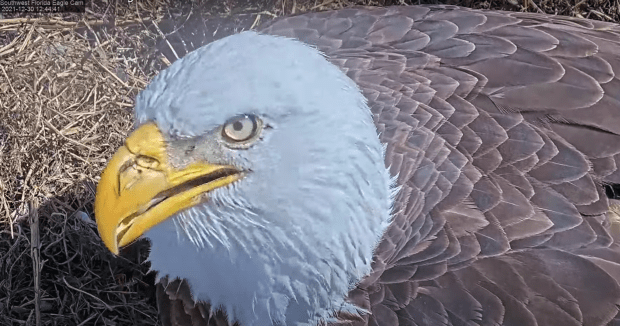
The pair got started on all the beaking as soon as Harriet got up to feed them. Oh, my.

There are over 4000 people watching these two at any one time and a myriad of videos coming up on YouTube. You won’t be able to miss them!

Everything is just fine in Bird World. The eggs at Taiaroa Head have been candled and OGK and YRK’s egg is developing normally. We are a month away from hatch. Gabby and Samson are taking turns up at NEFlorida and you will see me getting pretty excited in a couple of weeks. Thankfully, Daisy has not yet returned to the WBSE nest that I am aware. The latest news was awhile ago on WBSE27 who is currently in rehabilitation. The two chicks at Hilton Head are doing great. My copy of The Season of the Osprey arrived in the post this morning. That is on the agenda for today. It is far too cold to be outside for very long.

Thank you so much for joining me today. Stay warm, stay safe and take care until I see you again.

Thank you to the following for their streaming cams where I took my screen shots: Glacier Gardens, Roe Deer Feeder in Latvia, SWFlorida Eagles and D Pritchett Family, Port Lincoln Osprey, Captiva Osprey Cam, and the Latvian Fund for Nature.

Firsts in Bird World

At 07:47:24 the Dad of the 367 Collins Street Four flew in with a small bird. He begins to pluck it waiting to see if Mum or one of the chicks will come down to the scrape box. Mum did not show up but one of the four eyases did. I could not possibly tell you which one. Dad continues to pluck the little bird as the chick watches. Dad gets closer to the eyas that is standing in the gutter and the chick takes the bird. Dad looks in the gutter and is assured enough that the eyas is self-feeding that he flies away to find more breakfast for his kids. This is a great moment. The chicks are developing so fast!

Here it is in sequence:

This chick is hungry.

Dad gets in the scrape box to feed his baby. That baby looks like it is bigger than Dad! We will know better once that fluffy white down is gone.

Dad feeds the chick a few bites. Look at the eyas standing so strong. The soft fluffy down is falling off revealing the juvenile plumage beneath.

Little Dad walks over to the chick leaning in the gutter with the bird.

Dad leans down and the chick takes the bird. This is wonderful – a first that I have seen. It is 07:50:18.

Little Dad is making sure that the chick has the prey.

The eyas is mantling the prey!

Dad rockets down the side of the building!

Wow.

At the Port Lincoln Osprey Nest, everyone stood up for breakfast. Chatters were shocked! It is, as far as I know, the first time that all three stood up to be fed. We are quickly approaching the self-feeding phase at the PLO Barge.

Mum is feeding Big Bob as Middle Bob (centre) and Little Bob (left of centre) look on.

That is Little Bob getting the bites. Look at its strong legs.

Little Bob gets full and goes to stretch its wings and do a ‘ps’. I love the look – like beautiful white mod style boots. Middle Bob has opted to scrunch down to eat its breakfast while Big Bob in the background is standing. I cannot say enough how civilized this nest is. There is food security. No one is fighting or rushing another to eat or beaking them. When the chick gets full it moves away and let’s someone else eat. This is what happens on the falcon nests. It is great to see it here.

Names and ringing will come soon!

It was a morning of firsts. Self-feeding with the falcons at 367 Collins (or at least one of them) and the chicks now standing to be fed at Port Lincoln.

I have also discovered that if you wish to pre-order the DVD, Season of the Osprey, premiering on PBS tomorrow night, it is $24.99. Go to the PBS shop on line. They are charging 9.99 for shipping within the US only. I telephoned them and they will not ship the DVD out of the country due to copyright issues and laws. The woman suggested I order a copy and have it sent to someone in the US to mail to me. That is precisely what I did. So if you enjoy the programme and want a DVD they are available for pre-order. Shipping is 14 December.

Thank you for stopping in for this quick update on the progress of the falcons and the osplets. Take care!

Thank you to the following for their streaming cam where I took my screen shots: the Port Lincoln Osprey Barge and the 367 Collins Street Falcons by Mirvac.

Bald Eagle Season is approaching

As Bald Eagle season quickly approaches, I am reminded that everyone has a few favourite eagle nests. Some like to cheer Jackie and Shadow at Big Bear while others like Harriet and M15 at the Southwest Florida nest or Samson and Gabby at the Northeast Florida nest. Others love Mr and Mrs North at the Decorah Eagles, the Pittsburg-Hayes or the new couple, Anna and Louis, who had the first eagle fledge from a nest in Kisatchie National Forest since 2013, last year. I could list so many because there are so many streaming cams on Bald Eagle nests in the United States. It is their National Bird and there is a lot of patriotism surrounding some of the nests! Some individuals do not like to watch birds eating birds and mammals but, did you know that the diet of the Alaskan Bald Eagles is almost exclusively salmon? the same will apply to many of the Bald Eagles out in British Columbia. Bald Eagles eat what is in front of them; they are opportunists. So the diet will vary regionally. Sadly, they also eat carrion, dead animals, many of which are on the highways and the eagles get hurt or killed flying down to get the food or the remains left from hunters full of lead shot.

I caught up with a few of the Bald Eagle couples recently. Anna and Louis have returned to the nest they used in the Kisatchie National Forest. Cody and Steve have really worked on the camera situation and there is now sound, too. You have a broken screen showing the landscape and then another view looking directly down into the nest. Cody and Steve are part of the forestry staff. They also ‘man’ the chat. I am terribly grateful for their active involvement in the nest. They have worked hard to make it a fabulous viewing and learning experience for all of us. It was a real joy to watch the first time parents figure out how to parent a growing eaglet last year!

Samson and Gabby have been working on their nest for quite some time. It is comforting to wake up in the mornings and see them roosting on the branch together.

I use that word ‘comforting’ because at any moment something could happen to one or both of the adults. That is certainly the history of Samson’s parents, Romeo and Juliet, who raised their young in this nest. So for both of them to show up every morning and every evening is simply – well, it takes a lot of weight off the mind. Of course, the same applies to all birds on all nests.

Here is a very short slide show that someone posted showing various stages of Legacy’s development last year. Legacy was such a sweetheart. Samson and Gabby did not hold back on the teaching. They had to be parents and siblings, too, so that Legacy would learn how to live in the world beyond the nest.

You may also remember all of the worries over Legacy’s survival when she got Avian Pox. It was a mild case and she not only survived but, also thrived. Legacy became a gorgeous strong fledgling.

Harriet and M15 are getting ready for another season. Harriet has been bringing in monstrous size sticks (someone referred to them as logs) to the nest in Fort Myers. I am so excited.

E17 and E18 were riots last year. I originally thought 17 was going to kill 18. You might recall they were sent to CROW for their eye infection and 17 had ‘time out’. I think the two of them in care for those five days melted everyone’s hearts. Harriet and M15 are old hands at raising chicks and when the pair got into too much bonking, both parents stepped in and fed one or the other. By the time the pair fledged, they were inseparable, best buddies.

Lady Hawk catches one of their first ‘rock’em sock’ems’.

Here they are as fledglings battling over a prey drop. There was not a dry eye in the house when these two finally flew away to find their own territory.

Harriet and M15 have been at the nest since September working on it for another year. What a beautiful couple!

If you have been watching the territorial battles going on at the Captiva Nest on Santibel Island in Florida, word has come that the former male adult, Joe, has reclaimed his nest. I cannot confirm this as none of the eagles have leg bands. That is what someone posted on the Bald Eagle 101 FB page.

I will have lots more Bald Eagle news in the days to come. There are also other birds beginning to get their nests ready for breeding season. Jack and Diane have been at the Captiva Osprey Nest in St Petersburg, Florida and the Royal Albatross are arriving at Taiaroa Head, NZ. There are now 80 adults there. One of the founders of the colony was Grandma and this is a lovely video on the importance of her to the present and future of the colony.

https://www.nzonscreen.com/title/grandma-1990/credits?fbclid=IwAR2AwcNqLyVQ_lqyb2wxAYmfoU0Ohzg3aXVHWLF3AvrHpl2D4TFZJkhxfgA

A quick check on the Australian falcon nests show that all are doing fine. The Collins Street Four run up and down the gutter. As a result their legs are getting really strong. Diamond continues to get Yurruga to stretch for food so that she will strengthen her neck. At the 12:23:40 fish drop on the Port Lincoln Osprey Barge, Little Bob didn’t think he wanted any food at first. Then he changed his mind and went barreling in between Middle and Big so he could get to Mum’s beak. Neither of them blinked. This nest is so civil! Ringing will take place sometime during the first week of November and one or all three will be fitted with a GPS satellite tracker. (I was told all three awhile ago).

For those who want to see the Season of the Osprey, this is a reminder that it is showing in the US tomorrow. Please check your local stations for the correct time in your region.

Take care everyone. Thank you so much for joining me. Have a great day wherever you are.

Thank you to the following for their streaming cams where I took my screen shots: the KNF Bald Eagle Cam, NEFlorida and the AEF, SWFlorida and the Pritchett family, and the Port Lincoln Osprey Project.

Season of the Osprey

One task I take very seriously is alerting readers to the importance of banding and monitoring the birds, reporting sightings, and examining ways to stop human induced injury or death to our lovely feathered creatures. A few days ago I reported the tragic death of Blue 2AA, a Rutland 2015 hatch, who had killed when it landed on a high voltage wire in Spain where he had wintered for the past six years. Here is a well-written article from Rutland that covers many of my concerns with special regard to Duracell, 2AA:

https://www.lrwt.org.uk/blog/abi-mustard/osprey-threats-and-sightings?fbclid=IwAR1orkmPXp58chrj5RANcoqoGuM09ucy8dWhE-NTBmCUsg_Cl2mXtQE-B3A

For those of you waiting word about this fabulous documentary, Season of the Osprey, here is the news for viewers in the US:

This is just two days away!!!!!! Please watch and make sure you check your local stations for any change to the time. I also understand that a DVD will be sold at a later date. That is great for folks like me that don’t have cable television. Thank you PBS!

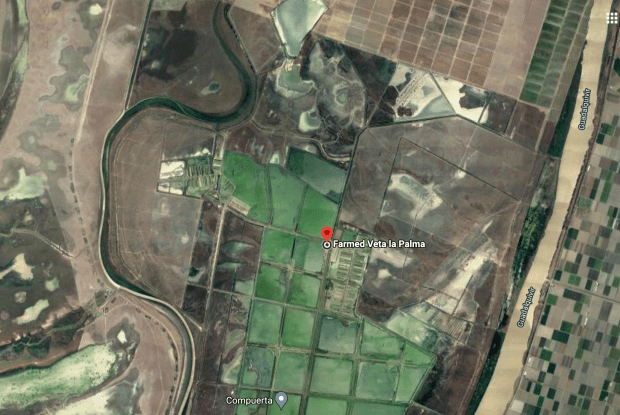
Spotters in Africa and the Iberian Peninsula continue to report Osprey sightings. There are now more than 600 in Senegal alone. I know that each of you will be thrilled to hear that Loch of the Lowes couple Laddie and NC0’s 2021 female fledgling, LR2, has been repeatedly spotted in Spain. She is at the Veta la Palma Espacio Natural Donana, La Puebla del Rio.

This is one of the largest nature reserves in all of Europe. She could not have picked a safer and more appropriate spot for her very first winter. Here are the map images and here is a link to the website so you can see all of the birds and wildlife at this ecological site. I am also posting this in case some of you want to travel at some time to see the birds – all kinds – this time of year – but do not wish to go all the way to Africa.

It is always good news when the first year fledges find a safe place with abundant resources. It is even better when we know about it and can celebrate with them. As you know only about a third of the fledglings succeed so big smiles all around. Laddie and NC0 would be thrilled! Another Rutland bird, Blue 081, a male fledgling of Maya and Blue 33 spent his first year, 2020, and has been seen this year, at Veta la Palma, Cota Donara, Spain. I continue to wait with great hope for news of Blue 463, Tiny Little Bob from the Foulshaw Moss Nest.

It is early morning in Australia. Mirvac has changed the zoom on the camera for the 367 Collins Four but you might find that the eyases are still out of view. I understand that it will not be changed again. You can hear the little ones running around on the metal.

Diamond and Yarruga are awaiting a breakfast delivery.

The trio at Port Lincoln Osprey Barge are still snoozing.

There has been no further word about WBSE 28. WBSE 27 has been seen by several people and photographed near to the Discovery Centre across the river from Lady and Dad’s roost. They will surely know where 27 is and be providing food for it. The eagles first get their flying and landing skills down before fishing and hunting (normally). The parents help them by providing them with food. I sure hope that Lady and Dad also know where 28 is! Ranger Judy reported she has done a walk through the forest adding she did not hear or see anything but that it is a large area.

That is it for today. It is a cool sunny day on the Canadian prairies and it is time to clean up bird seed. The goose flight images were not good last night because of where people had to stand due to pandemic restrictions. I hope to go out to the other nature centre before the end of the month to see if I can catch some of the thousands of Canada Geese making their way south.

Take care everyone. Thank you so much for joining me today.

Thank you to the following for their streaming cams where I took my screen shots: the Port Lincoln Osprey Project, the 367 Collins Street Falcons by Mirvac, and Charles Sturt University at Orange Falcon Cam and Cilla Kinross.

Late Thursday in Bird World

For those of us who only have the Internet and not any television or cable stations, it might be a bit difficult to watch the documentary on the Ospreys, Season of the Osprey on Nature PBS. For those of you with cable television, this is a reminder to check your local station for when Season of the Osprey is showing. For the rest of us, I will be checking for the release of the DVD and, also, to see if the documentary will be streaming on the Internet. Will keep you posted! Do check your local stations. You do not want to miss this if you love ospreys!

I am including the URL for the company that is distributing this special. Why? Because, if you scroll down, you will see that there are a host of podcasts that you might be interested in.

https://www.seasonoftheosprey.com/?fbclid=IwAR1Dvhmb2FiSaIBg0VV-ha87ZiCWeq29iYuF2dRKy5sa2bAZNfi6N8RrHIQ

Oh, what amazing birds. I am already getting excited about our local nests and the birds have only been away for two months! This year I will be checking on several nests and submitting information on arrivals, hatches, juveniles, fledges, and departures. It is an honour to add the Ospreys that consider Manitoba their summer home and breeding territory to the lists of nests from around the world.

Speaking of migration and raptors around the world, Jean-Marie Dupart reports that there were 50 birds this morning on the shores at Casamance, South Senegal. He has counted 432 arrivals so far this season and said he has 10 more locations to check. That is fantastic.

Many of you will be members of one or another of the many groups pressing for businesses and residents to stop using rodenticide. You might also be lobbying various levels of government to ban these designer poisons. It is well known that it is not only cheaper financially but also much more effective to use raptors. Raptors will clean up the critters – just don’t poison the mice and rats because, ultimately, they will also poison cats and birds that eat them. It is a horrific way for a raptor to die.

Today, in the Fall 2021 issue of Bay Nature magazine, the leading article is a vineyard that is employing Red-tail Hawks to keep the rodents out of the fields. They are turning away from using rodenticide. Oh, this could seriously be a start of a movement. Here is that article:

Xavier and Diamond’s only eyas is one week old today. Only Bob can see the world! And Xavier has had some time to spend with his wee one. Here he is brooding Only Bob. How precious.

I have not reported on the White-Bellied Sea Eaglets in their nest in the Sydney Olympic Forest for several days, if not a week. It is really interesting watching the two of them interact together. One will do something and the other will try to outdo the first. Here they are flapping their now very large wings.

I really hope that they do not knock one another off the nest. The more they flapped those wings the more energetic they got and the more air they stirred up. It was like the centre of the nest became a trampoline.

WBSE 27 and 28 will have a wing span of 1.8-2.2 metres or 6 to 7 feet. If I remember correctly, the nest in the old Ironbark Tree is 1.8 metres or 6 feet across to give you some idea of the wing size of the pair today.

WBSE 27 hatched on 29 July 2021 and WBSE 28 hatched on 31 July. This makes the little sea eaglets 78 days old (27) and 76 days old (28). The average fledge period for the nest is 75-85 days. We are now in that window. Ideally, the eaglets will do some branching, will make their first flight, and return safely to the nest where they will strengthen their flying and be furnished prey by the parents. In reality, the Pied Currawongs often chase the newly fledged chicks out of the forest. It is hoped that the parents are providing food off nest or the eaglets find a beach area full of carrion (what most juvenile sea eagles survive on til they hone their fishing skills).

This nest has produced two very healthy Sea Eaglets this season. Just look at them spreading their wings, one looking over the rim of the nest. That first flight could happen at any second. It has been a fantastic nest to watch this year and I do hope that these two strong eagles will survive and have very long lives. Lady and Dad have done an amazing job.

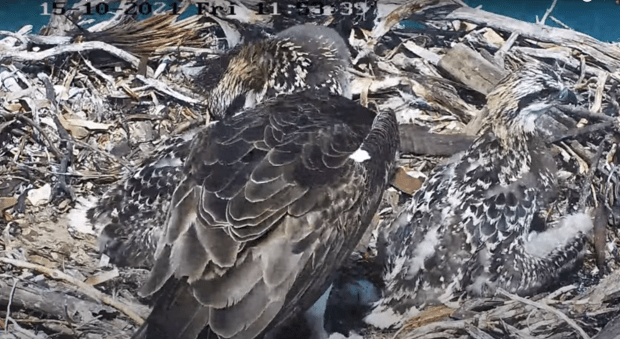
The Osplets at the Port Lincoln Barge nest are not ready to fledge – thank goodness! But they are growing like wild weeds in my garden. The juvenile feathers are now growing in thick and fast. They have had several fish deliveries today. I reported on two and there was a third at 11:28:54 and there will be more during the day.

Mum trying to get the fish off of Dad’s talons.

Little Bob is lined up waiting for some more fish. He is on the right. You can see the more circular mark on the top of his head and the white painted effect under his eye. It coats the lower lid a little like white eyeliner might do. From this angle you can also see some of the white on the cere. Little Bob has a rather large crop. It seems to be sagging from the weight.

Now when I write ‘Little’ Bob it seems a bit silly because he is definitely not little! It will be nice when they get their bands, satellite packs, and names in a few weeks. I wonder what they will name these three?

While we can only see two of the osplets, both of them have big crops. Little Bob is looking out from the nest on the right and another is preening, showing off its big ping pong crop, in the middle.

Look at how those lovely dark grey/black juvenile feathers tipped with white are. They are growing fast. Soon they will cover all of that dark grey wooly down. Much of the fish they are eating is helping them produce these beautiful feathers, feathers essential for their success as raptors. They cannot fledge without them.

Everything is looking good. I cannot wait for their measurements to be taken. Little Bob looks like he could be the biggest or close to it. Little Bob certainly does not take anything off Big Bob.

Thank you so very much for joining me. Take care everyone. Have a terrific Friday.

Thank you to the following for their streaming cams where I took my screen shots: the Port Lincoln Osprey Project, Sea Eagle Cam@Birdlife Australia Discovery Centre, Charles Sturt University at Orange Falcon Cam and Cilla Kinross.

The Miracle Chick

If I mention the name Aran, who is the first to come to mind?

This morning there was a posting about a ‘miracle’ chick – indeed, 2 miracle eggs and one of those being a chick that never should have hatched but did. These stories always interest me because, I immediately think that they are third hatches. This was not the case with these two little bundles of joy.

What a beautiful couple. They have been together now six seasons. You can see Aran’s prominent feather problem.

Mrs G (left) and Aran (right). July 2021.
Mrs G 3 September 2021
Aran in one of his favourite spots before he migrates. September 2021

Aran arrived at the Glaslyn nest, unringed and, as you know if you follow the Ospreys of the UK or Wales, specifically, in 2015. The public wanted the couple named. The female who had raised chicks at the nest previously was to be Mrs G, after Glaslyn. Aran was named after the local mountains, Eryri. The story is lovely and deserves to be read in its entirety. I am enclosing the news from Glaslyn. The story of how Mrs G and Aran came together and how Mrs G’s sixth and seventh eggs – yes – 6 and 7 – came to hatch is remarkable. It makes you feel good. I can add that WO was last seen a couple of years ago in the north of England. So, he really was a survivor! (I intend to check the listings to see if W0 has been spotted this year and the circumstances).

I did get my hair cut and the minute I got home I went to check on the PLO nest. In his book, Soaring with Fidel, David Gessner explains the term ‘Kathleening’. It is when a person claims to have seen the biggest, and the most after someone tells their story. I do not want to sound like I am ‘Kathleening’ but, seriously, Mum was feeding those kids – again. When I left they were eating and when I got home they were eating.

Are those babies getting squirmy? She hardly got them covered and she is feeding them again1

Mom has decided that she wants the fish on the other side.

Yeah for Mom. She pulled that fish over the nest of babies without clobbering one of them.

Mom has decided that it is time for some more fish. The little ones will make their way to the table shortly.

That’s Little Bob on the left with the two older sibs facing in the same direction. Little Bob has his mouth open and he is looking at Mom.

Little Bob has a nice crop. He is the one on the far left. You can still see his egg tooth. It will be gone soon! Big Bob is in the middle. She is the one with the most pin feathers and Middle Bob is on the right.

Mom is looking for another delivery and the three Bobs are waiting at the table with their napkins tucked in and forks at the ready.

It is 12 degrees C with 11 kph winds. What a difference from the days when it was blowing at 34 kph. Dad was able to get some rather large fish those windy days. I wonder if it is the same with the calm water???

I have been notified that the Season of the Osprey, the much awaited documentary put out by Nature and PBS will be shown in the US on 27 October at 00:00:30. Please do check your local stations to make sure this is correct!

That is it for me tonight. There will be at least another 7 or 8 feedings today before Mom gets some time to rest. I will bring you the details tomorrow. Take care everyone! Thank you for joining me.

Thank you to the Port Lincoln Osprey Project’s and Bywyd Gwyllt Glaslyn’s streaming cam where I took my screen shots.