Early Friday in Bird World

The Scottish Wildlife Trust has confirmed that the female, NC0, has left the Loch of the Lowes for her migration after receiving a fish from LM12, Laddie, on Sunday 22 August. This is a late departure. The female fledgling, LM1, migrated on 15 August, a week prior to her mother which is also unusual. The Scottish Wildlife Trust says that is only the second time in the history of the nest that a juvenile has left prior to the female adult. Laddie, LM12 and the male juvenile, LM2, are the only ones left at Loch of the Lowes. Here is the video of that last sighting of NC0:

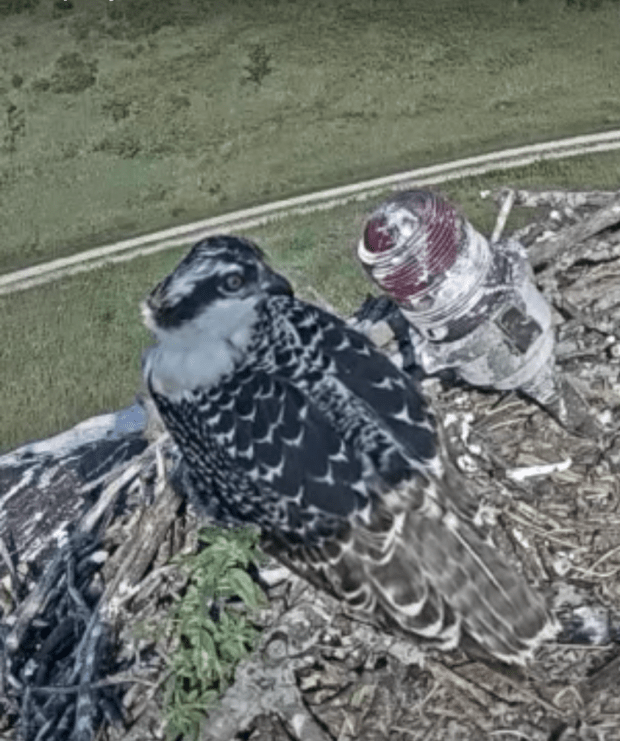
Tiny Little was still on the Foulshaw Moss Nest this morning, 27 August, around 07:00 as confirmed by this image taken by my friend ‘SS’. I have tried to catch her on that nest so many times – even late in the night from the Canadian prairies but those efforts were to no avail. So glad to see this. Is it my imagination or does that crop look full? Maybe she is just hunched down.

Mrs G and Aran were still on the Glaslyn nest. For a bit of time, Mrs G was enjoying a flounder. However, there was other action around. It appears that KA3, Hesgyn, and Z2 Aeron, have been over at the Glaslyn nest.

Here is Aeron, Z2, one of Monty’s boys at the Glaslyn nest caught on camera:

Aran has been dealing with intruders. Are Monty’s lads helping? or are they the intruders Aran is dealing with?

You may recall earlier in the summer before Aran’s wing injury was much better that there was a suggestion that Z2 was the Osprey that Aran battled with over the river. Z2 even spent some time sitting on the Glaslyn Nest as you can see from the image above.

Z2, Aeron, occupies the Pont Cresor nest with 014 nearby. I would not draw the conclusion that Monty’s lad is being a friendly neighbour to Aran – you might be humanizing the situation too much. Perhaps Z2 would like that piece of prime real estate and Mrs G to go with it.

Hopefully Aran and Mrs G will put an end to that nonsense if it is true.

Watching over the territory.

Mrs G and Aran remained on or around the nest for some time. I wonder if Mrs G is waiting for Aran to be fully healed and ready for migration before she leaves? I just love seeing them together!

A quick check on the Black Storks in Latvia and Estonia. At the Jegova County Nest of Jan and Janika, one of their storklings, Julge, was on and off the nest during the day. This image was taken right before 20:00 as you can see from the time stamp.

There is now concern rising for Tasane. This is the most recent message from Urmas: “looking data I suspect problems with 7183, probably killed last evening quite near the nest. I can go there maybe afternoon, but depends how other duties can be solved. It is only warning, yet. … “

Karl II’s daughter, Pikne, is in the Ukraine, on 26 August according to her tracker. This is good news.

On 26 August, Karl II was in a small forest near Hlusk in Belarus. He is headed towards the Black Sea.

I seem to be unable to find data for Udu on the 26th.

There has been no sightings of the storklings at the Latvian nest. People are anxious and hoping that Jan Kuze will go and check around the nests just to make sure. This is such a very difficult time for all. The deaths of Jogeva’s Malbe and Karula’s Tuul have really hit the hearts of so many. The fear that another, Tasane, is lost is just spiking anxiety. Will Julge be the only one to survive? My thoughts go out to all the people who loved these storklings so much. Seeing them perish after thriving and all the efforts to feed them, drains everyone of what energy they have left. And that brings me to the end of this updating, almost.

As I said many times, the circumstances of Malin’s death ‘rattled’ me because they pointed out how governmental agencies like the Department of Natural Resources are more concerned with selling hunting licenses than protecting wildlife. That is the precise reason that Rosalie Edge bought Hawk Mountain – to get rid of the hunters and protect the birds! Malin’s death has showed me that any person can put the title ‘naturalist’ behind their name. It means nothing. Malin’s death has raised so many issues. Sexism has been revealed to be alive and well in Wisconsin! I could go on and on. It feels like Malin was a ‘canary in the mine’ – my canary. As the layers of the onion are peeled away, more is revealed and the more that is exposed the more troubling it is. And so, I have been slightly distracted and there was a misunderstanding that led to my reporting that Diamond laid her egg yesterday. She laid her egg on 27 August last year.

Diamond looks like she is about to pop. She must not feel so good. Today, Xavier brought her an Eastern Rosella for her lunch. Diamond would be delighted!

I hope while I have been writing that she lays that egg. She is starting to make me uncomfortable!

Word has come that WBSE 28 has had some food and remains with us. 28 needs to get large enough but, for now, it is learning to stay clear of 27 until it is so full it doesn’t care and goes into a food coma.

Take care everyone. Keep all the Black storklings in your heart. Indeed, keep all of the birds in your heart especially those that are migrating or beginning their migration.

Thank you to the following persons or the streaming cams where I took my screen shots: To ‘SS’ and the The Cumbrian Wilife Trust and the Foulshaw Moss Osprey Nest for the snap of Tiny Little, ‘S’ and the Falcon Cam on the grounds of Charles Sturt University in Orange, The Latvian Fund for Nature, The Eagle Club of Estonia, and Bywyd Gwyllt Glaslyn.

Send love and positive energy to Latvia and Estonia

I want to begin with the Black Stork nests today. For those just learning about the situation of the Black Storklings in both Latvia and Estonia, here is a very brief summary. The storklings at the nest of Grafs and Grafiene in Latvia and that of Jan and Janika in Estonia are late hatchlings. There was concern from the beginning that both parents might leave for their migration before the storklets fledged. Currently, the mothers have left and the fathers, Jan and Grafs, are the sole providers. Neither male can provide enough food for three storklings to thrive. There is also a question of the supply of the fish. In both Latvia and Estonia, feeder situations have been established with decoy female Black Storks. To date, neither male has found these feeders.

‘S’ in Latvia reports, “The good news is that it seemed that yesterday Grafs had encountered a generous feeding place on the way, not so far away. We were already a bit sad thinking that the storklets will have to spend another day with just one small noon feeding, what a celebrated surprise it was when he came back less than 4 hours later with plenty of food. Many of us bursted into happy tears:) It is good to know that he can still manage to get food elsewhere even if it is not from the feeder. And the most important thing is that he is still here caring for his young.”

aGrafs and Grafiene’s Storklings, Sigulda, Latvia 19 August 2021

At the very beginning, M. Strazds, a Latvian Black Stork specialist, warned that he felt that there was only 0.1% chance that Grafs would find the feeder because birds do not normally search for new feeding spots at the end of the nesting season. Still, as I understand it, the storklings, once they fledge, will find the feeder and it will be very good for them.

In Estonia, Jan has made only one delivery that I am aware of. The storklings have supplemented that with the fish that Urmas delivered last night. I was made aware that the storklings were playing with the fish but, it appears now that they have been eating them as the pile of fish is almost gone as I write this. I am aware that there are controversies about the effect of humans getting close to the nest because of the stress that it causes on the birds. But starving is also a major stressor. I believe that Urmas and his team know what they are doing and I hope they continue to feed these birds.

Jan and Janika’s Storklings, Jegova County, Estonia

There is one other nest with a fledgling, Pikne, the female, still being fed by a parent and that is the nest of Karl and Kaia in the Karula National Forest in Estonia. ‘S’ reports, “The feeder approach has been very successful with Karl’s nest in Karula for the sole reason that he has a transmitter and it is possible to track his usual feeding places.”

Pilkne, the last remaining storkling being fed by Karl II at the nest in the Karula National Forest in Estonia. The other two have fledged.

It has been a very difficult year for those who care for the birds and who watch the streaming cams. Osprey chicks died due to weather related issues and Cooper’s Hawk eyases got so hot on the nests in Canada, they lept off the nests to avoid literally being roasted. Many are dying as they undertake their migrations which are challenging enough without having fires and smoke enroute.

At the same time, there have been some remarkable situations. Around the world, humans have stepped in to save birds of every variety. In the interior of British Columbia, the wildlife rehabbers climbed the Osprey nests and removed the chicks taking them into care because of the extreme heat and fires. At various places around the world, Osprey chicks have been fostered and received a second lease on their life. A Canada Goose named Arnold had his digits fixed so that he could live a full life with his mate, Amelia. A very old Bald Eagle full of lead was given treatments and is now thriving and waiting for A Place for Hope to get its permit so he can be their ‘forever’ bird. Every day I read about a group of people and trying to help fix what many believe is unfixable. I hope that this is just the beginning of a change in intervention and our understanding of what works and what doesn’t. The key is not to give up.

There are, however, three miracles. I am thinking of the three Ospreys that should have died but did not – they have thrived – two of them to become dominant on their nests! Those were Tiny Tot aka Tumbles at the Achieva Osprey Nest in Florida and Tiny Little Bob aka Blue 463 on the Foulshaw Moss Nest in Cumbria. To me these are simply nothing short of a miracle.

Tiny Little Bob aka Blue 463, Foulshaw Moss Nest, 19 August 2021

The third has yet to fledge but has shown remarkable growth. I am aware that many on the chat rooms in Latvia and Estonia are concerned about feather growth. This was also a big concern for Malin on the Collins Marsh Nest in Wisconsin. Malin is our third miracle.

Malin, Collins Marsh Osprey Nest, 19 August 2021

I cannot tell you what happened to make the food deliveries on this nest turn around. All I can say is that they did and there are no more missing feathers, the tail now has 7 dark bands when 3 weeks ago there were 2 with the hint of a 3rd. It has been a remarkable recovery. At one time, there was concern that Malin might survive but not be able to fly. Those concerns have now vanished. Today, Malin has had 3 fish deliveries before 1pm and one of those was a whopper. Malin actually walked away from being fed by mom, Marsha, he was so full.

One of the major concerns for the Collins Marsh Osprey Nest is that the parents would also leave Malin on the nest and begin their migration. So far everything is going smoothly so I will just ‘knock on wood’ that it continues to be that way.

One other good news story is that the fires in Turkey are dying down or are out.

And there is more. Aran, the mate of Mrs G on the Glaslyn Valley Osprey Nest, was injured and was missing a couple of primary wing feathers,. There was a huge concern that he would not be able to fly — and consequently that he would not be able to fish or be able to migrate. Well, look at Aran’s feathers today! Yahoo. He is good to go. Tears. This is an amazing couple who lost their three chicks due to starvation when Aran was injured. The Glaslyn community kept the birds alive with a fish table until Aran was able to fly and fish.

Indeed, I do not want people to think that feeder areas or fish tables do not work. It depends on the circumstance and in the case of Aran and Mrs G as well as the Mlade Buky White Storklings, those fish tables saved the lives of those two families.

Aran at the top sitting on edge of nest! 19 August 2021.

We have a lot to be thankful for – and there is a lot of work to do to figure out how to help our precious birds – all of the wildlife. Humans stepping up to take responsibility and to “try” even if they are met with low odds and negativity should be the norm not the exception.

What can you do today to help the birds and all of the wildlife?

I want to close today with a bit of a giggle. If you watch Ospreys you understand how difficult it is for both the male and female to raise three. Actually that is true of eagles as well. Well, what about five? Now consider the fact that those five are all female. The poor dad would need a set of sound cancelling headphones!!!!!!!!!! You can hear females clear across a lake. Oh, my. The parents of these Westport, MA fledglings will certainly deserve their winter break.

Thank you for joining me on this quick update on what is happening in Latvia and Estonia. Send them all of your positive energy – and take care.

Thank you to the following for their streaming cams where I took my screen shots: Collins Marsh Nature Centre, Cumbrian Wildlife Trust and the Foulshaw Moss Osprey Nest, the Eagle Club of Estonia, the Latvian Fund for Nature, Brywd Gwyllt Glaslyn and the anonymous reader of my blog that sent me the image of these five beautiful female Ospreys. Thank you.