Thursday in Bird World, 2 September

It is pretty quiet at the nests these days – that lull if you like between the Ospreys leaving for their migrations in Europe and the US, the Bald Eagles slowly returning to their breeding areas, and the falcons and Ospreys incubating eggs in Australia. The biggest news in Bird World is that Diamond laid her second egg at 20:55 September 2nd.

Xavier taking a turn incubating and rolling the eggs for a bit this morning. Gosh, those are big eggs!

The Osprey was officially adopted in 1994 as the is the provincial bird of Nova Scotia, one of Canada’s ten provinces. Nova Scotia is a peninsula surrounded by the Atlantic Ocean, the Bay of Fundy, the Northhumberland Strait, and the Gulf of Maine. It is one of Canada’s Atlantic or Maritime Provinces. At its widest, 128 km, it is easy to reach any body of water easily. It is said that Nova Scotia has more Ospreys than the United Kingdom in its entirety. Many live on McNab’s Island at the mouth of Halifax Harbour.

@Wikimedia Commons

The lighthouse was built in 1809. In 1852, Dr. Abraham Gesner was given control of the lighthouse. In December, Gester used a fuel that he had just discovered – kerosene – to operate the light.

“McNabs Island” by KellyMercer is licensed under CC BY 2.0
“Maugher Beach Lighthouse (McNabs Island, Nova Scotia) – (Adventure of the Seas – August 1st, 2018)” by cseeman is licensed under CC BY-NC-SA 2.0
“Wharf at McNabs Island” by wdrwilson is licensed under CC BY-NC-ND 2.0
[[File:Osprey Bird.jpg|Osprey_Bird]]
[[File:Osprey on Sandy Hook (70318).jpg|Osprey_on_Sandy_Hook_(70318)]

Ironically, there were hardly any Ospreys in Nova Scotia two decades ago. The use of DDT had weakened the eggs to the point that the birds were virtually going extinct. Since 1979, the Osprey Management Program, operated jointly between Nova Scotia Power and the environmentalists at the Department of Lands and Forestry to relocate nests that are on top of live utility poles to safer unused poles nearby. Each year they partner with the Museum of Natural History to live stream an osprey nest. The Osprey are in Nova Scotia from April to September. At the end of the summer, when the juveniles are old enough, they leave for their winter grounds in the Caribbean and South America.

The first little video is from 2014. Seven years ago, when streaming cams were not so HD. Here is a typical Osprey family of five in Nova Scotia on top of one of the partnership nests.

Here is another short video of 2020 showing the improvement in cameras. It shows the hatch of the second chick at this nest on 9 June.

Speaking of Osprey, Sharon Leigh Miles took this image today of an Osprey at Mt Sentinel in Missoula, Montana. It is Iris’s favourite tree and it is presumed to be Iris, the grand dame of North American Ospreys. Hopefully she will visit her nest before she leaves. She is the oldest Osprey in the world.

In other news, White YW, the male at the Foulshaw Moss Nest, dad of our one and only Tiny Little, Blue 463, is still in Cumbria. He was photographed there today. White YW hatched at Bassenthwaite in 2008. Gosh, he is a great dad. One of the unsung heroes. Chris Wood has received word that the estuaries that the UK Ospreys travel to for their winter season are filling up with water. Wonderful! Yesterday, I saw Cormorants here in Manitoba and today a couple seem to have taken over Maya and Blue 33’s nest at Rutland (at least for part of the day). The two little sea eagles are getting along fine. Food remains plentiful and they are growing, flapping, and learning to walk. Those clown feet are really growing. Just look, with food, 28’s feet are getting huge. Wow.

I am attaching the progress map of the Ospreys and Black Storks:

Pikne, in orange, is really travelling well. She has gone straight south almost beating Karl II in royal blue. You can follow them, too. Here is the link:

http://birdmap.5dvision.ee/EN

Thank you so much for joining me. Take care. Stay well. Look for egg number 3 on 4 September down in Orange.

Thank you to the following for their streaming cams where I took my screen shots: The Falcon Cam Project at Charles Sturt University in Orange, The Montana Osprey Project FB Page, Sea Eagle Cam @Birdlife Australia Discovery Centre, and BirdMap.

Sadness on Channel Islands Bald Eagle nest and other news from Bird World

There is sad news coming out of the Channel Islands Bald Eagle community. The male eagle, A64, Spirit, devoted mate to Cruz, was found floating in the ocean near Fraser Point on 21 July. The report stated that there appeared to be no traumatic injuries. Spirit’s mate, Cruz, has been seen at their nest. Condolences to all.

Deb Stecyk made a great video of this wonderful couple in 2018. Here it is:

The gusts have really been whipping the Fortis Alberta Exshaw Nest around this afternoon. For awhile it looked like the two chicks might get blown off. Mum was food calling and looking in the sky and you sure had a lot of sympathy for dad trying to fish and feed his family this afternoon. The weather station reports that the winds are blowing at 21 km/h. The gusts appear to be more than that. Hang on everyone!

Of course, you can’t even tell there is a breeze in a still photo!

The chicks are doing well on this nest. There seem to be no worries.

The wind was not blowing at the Fortis Alberta Red Deer Osprey Nest. Just look at how big and pretty Only Bob is getting! It really does help to be an only chick.

As the day heats up, Mum is making sure that this little one is good and shaded from the pounding heat of the sun.

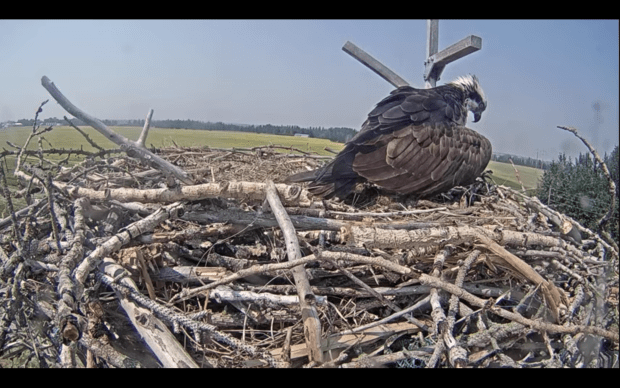
The Only surviving Bob at the Collins Marsh Nest had a nice crop this morning. It is really, really hot on the top of that old wildfire tower. Both Mum and chick are really panting.

It was really nice to see a nice big crop on this little one today especially with the heat.

Tiny Little had breakfast and had an evening meal. Mom flew in to help but looks like Tiny Little did a pretty good job cleaning up. Our little one decided to sleep duckling style on the nest tonight. I like to think that all those lines are golden rays shining down and protecting this wee babe.

Other news coming out of Welsh Osprey nests is from Llyn Clywedog, the nest of Dylan and Seren. Only Bob, Blue 496, today flew from the nest with a good sized fish attached to its talons to eat it elsewhere. It is not clear if this is a first for Only Bob but it sure could be. Well done! Another milestone.

This is so fantastic. Dylan and Seren can be very proud of their 2021 fledgling Blue 396. He is doing so well in all aspects – flying, self-feeding, and now flying with a fish in talon. All good prep for migration.

As you probably know, the mothers leave before the fledglings and dad. They normally take off for Africa (or Spain or Portugal) two weeks before everyone else. Seren has been photographed in The Gambia. Dad will stay behind and feed the fledglings. When they take off and are all on their way it is only then that the male will leave. Everyone knows what a treacherous undertaking migration is. This year only 80% of the Ospreys expected to return did so in the UK (according to Tiger Mozone’s data). That is low. Normally it is 90%. We will begin to look for their return the third week in March. Normally Blue 33 and Maya are one of the first couples to get back to their nests. I can’t wait. There is something adorable about these little fuzzy bobble heads turning into reptiles and then getting their juvenile plumage that warms your soul.

My last report comes from Dr Ericke Green at the Montana Osprey Project. Him and his team have now visited 200 Osprey nests along the Clark Fork River. They note that the water in places is less than half the normal amount. The heat has persisted for more than a month, the water is hot, and the fish are dying. This is bad news for the Ospreys. Green noted that the chicks that they ringed were in good shape, regardless. He said that when they were on the Flathead Indian Reserve north of Missoula they found some nice healthy chicks living in nests lined with Bison hair! The nest is close to the Bison Wildlife Refuge. Wouldn’t that be soft and cosy?

Do any of you know what has happened in the Barlinecka Forest’s Osprey Nest in Poland? I have written to the Polish Committee for the Protection of Eagles that ran the camera. It has gone off line. There were two chicks on the nest – chick 1 hatched on 25 May and chick 4 hatched 31 May. Eggs 2 and 3 did not hatch. That is a massive difference in age! If you know anything about the status of these birds please let me know. I haven’t had a response yet from Poland. I will share it if I hear.

I want to thank all of you for joining me today. It is always a pleasure to have you with me. It was helpful to hear Dr Green say that this year’s osprey chicks in Montana have done well despite the drought that is encompassing so much of that area and ours in Canada. Take care everyone. Tomorrow loads of images of Big Red and the Ks.

Thank you to the following for their streaming cams where I get my screen shots: CarnyX Wild and the Llyn Clywedog Osprey Nest, Cumbrian Wildlife Trust and the Foulshaw Moss Osprey Nest, the Collins Marsh Osprey Nest, Fortis Albert Exshaw Osprey Nest, and the Fortis Alberta Red Deer Osprey Nest. I also want to thank the Montana Ospreys at Hellgate FB Page where I grabbed the image of the Osprey chicks in the nest lined with Bison hair. They hold the copyright.