The Daisy Chronicles Day 9

If you read my earlier blog but not the updated version, then there are a couple of corrections. Daisy left her nest at 01:40:55 after the possum settled down. She landed back on the nest after a break and foraging at 04:59. That was very short! The Ring-tail possum will be an annoyance to Daisy but, unlike the Bushtail Possum, the Ring-tail will not eat the eggs. Last night the Ring-tail and Daisy scared one another leaving Daisy to reveal all of her eggs.

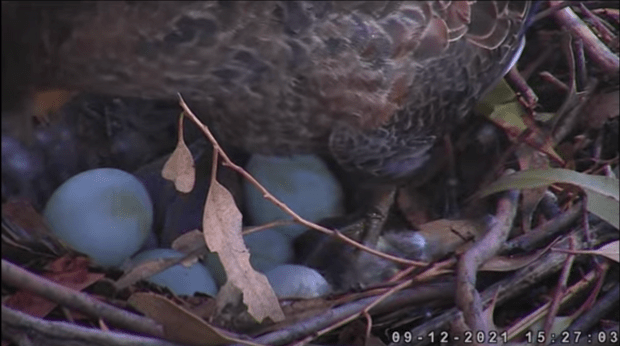
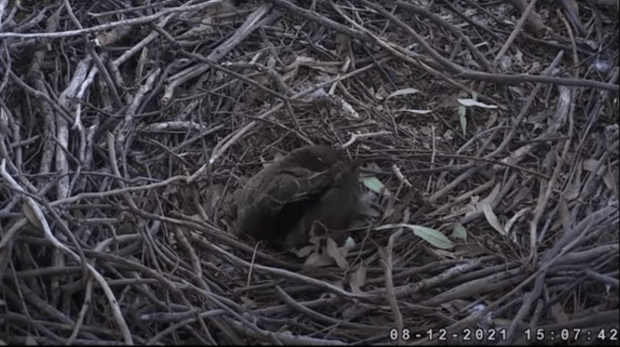
It is now 09:17. Daisy did not lay another egg this morning. So the total of eggs is eight. In the image above you can see that Daisy is getting more down off. It is going between and around the eggs. Daisy is now in ‘hard’ incubation. Normally she would leave the nest often for short bits. Because of the Ravens, she might leave at night to forage. She will probably not be off the eggs for more than 3-4 hours at a time. The eggs will take 26-30 days to hatch. So if we count yesterday as hard incubation day 1, we are looking at 5-9 of January for the ducklings – should the eggs survive to hatch – to arrive. The following day they would leap off the old Ironbark Tree nest to the forest of the floor and follow their brave Mum down to the river where they can begin relative independent lives. They are fully capable of regulating their temperature and feeding themselves, plus walking and swimming when they hatch.

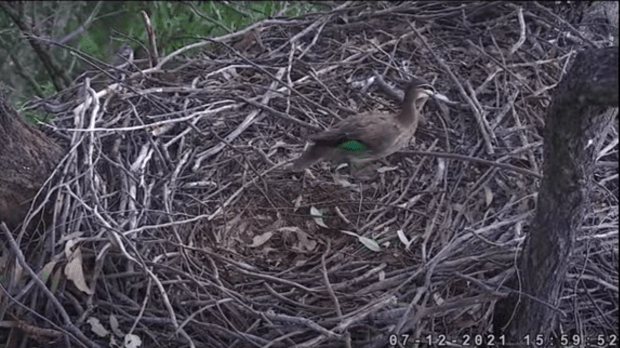
Some images of our favourite brave little duck – the little duck who might, against all odds, hatch some ducklings!

Daisy continues to remove more down, mixing it with the eggs or tucking it in each side.

One of the things I realized today is just how important sound is to Daisy. She has to be able to differentiate the sound of the Ravens from all the other noises including airplanes. She also has to be able to detect when the Ravens – or Sea Eagles – are coming due to the vocalizations in the forest.

Daisy has been on the nest now for almost five hours and no predators. Putting myself in her place – knowing that around where I was trying to keep my children save – were predators that would harm them but I have no idea when they will try to break in the house to take them. I can imagine that this little duck is under a lot of stress. She cannot let her guard down for a second. She is doing her very best!

Daisy has removed more down and some of it has decorated the back of her neck.

At 09:55:17, the pair of Ravens came to the Ironbark Tree. They did not land on the nest but in the upper branches and made a lot of noise and then flew away.

Daisy immediately tucks her head in but she is very vigilant – ready to strike if they get on the nest.

The concept of ‘the sitting duck’ is too appropriate. But, so far, the little duck has held.

It is now 10:15 and the Ravens cannot be heard in the forest. They will return. Just when is a guess but they will be back.

For a comparison of their size, the Pacific Black Duck ranges in length from 54-31 cm with the males being larger. The wingspan is 90 cm and they weight 1000-1100 grams. Australian Raves are 46-53 cm in length and weigh 650 grams. They have a wingspan of 100 cm. Daisy could be a little smaller in terms of length and wingspan but she outweighs the Ravens by at least 350 grams or about 3/4 of a pound.

Daisy is really pulling off the down. More is clinging to the back of her neck. I hope it doesn’t blow off and be wasted. Hopefully when Daisy has to take a break she will be able to cover up the eggs really well with more down to help her. I wonder if that would deter the Ravens?

It is nearing 10:30 in the morning for Daisy. I have the sound turned up so I can hear if the Ravens return and will be monitoring what Daisy is doing from now to dark. All I can hear in the forest right now are a lot of Noisy Miners. I will do a posting at dusk (2am CDT in Canada) of a round up of the rest of the day’s events.

Thank you for coming to check on Daisy, the brave Pacific Black Duck who is on day 2 (?) of her hard incubation. Take care everyone. Stay safe.

Thank you to the Sea Eagles@Birdlife Australia Discovery Centre for their streaming cam where I took my screen shots.

The Daisy Chronicles, Day 9 – updated

It is actually still Day 8 for Daisy as I write this. The clock on the streaming cam says that it is 19:28. It is 02:28 on the Canadian Prairies. Daisy remains on her eggs.

Does she know that the two Ravens are on the branches above the nest? She must. They are right above her. One on one side and one on the other.

Every once in awhile they make a noise. They know that sooner or later Daisy is going to have to leave the nest. When she does, they will take her eggs. I am hoping that Daisy can sleep a bit and conserve all of her energy. She has not left the nest for at least 14.5 hours. Unlike raptors that have true crops to store food, ducks have an enlarged esophagus that is capable of handling large amounts of food before it moves into the a thin-walled area of the stomach called the proventriculus.

The White-Bellied Sea Eagles, Lady and Dad, are not at their River Roost.

Daisy has been very vigilant about the Ravens but she had another intruder. That was the Ring-tailed Possum who has its own nest in that big nest. This possum will not harm Daisy’s eggs. It might scare her – which it did but it is the Bushtail Possum that likes the eggs. That possum wanders around at night. Daisy remained on the nest until the possum quieted down. Poor thing they will wear her out by not letting her eat! I wish there was some type of sci-fi invisible protective dome we could place around Daisy and her eggs.

Daisy flew off the nest at 1:40:55. She waited for the Ravens to leave and then had to wait for the possum. By leaving in the middle of the night she outwitted the Ravens. She will have a few hours to forage before she has to return to her eggs. I hope our little duck got lots to eat. She must be tired fighting off all these intruders who want her eggs!

It is now 03:50 in the Sydney Olympic Park Forest. Daisy should be returning to her eggs within an hour. It appears that the on line camera continues to go on and offline. I cannot access live after 01:59 – so, for now, this is my Daisy report. So many of you have dropped all your other bird watching to cheer Daisy on. Continue to send your good wishes to her. She needs all she can get. Will the little duck outwit all of them? We wait. It appears we have 8 eggs – hopefully no more. Daisy did a bit better covering. Fingers crossed.

Daisy returned to her nest at 04:59 ahead of the Ravens. Our little girl is smart!

Our girl looks good and the down coming around the nest will make it easier for her to cover. Cloudy today but no rain forecasted for Daisy.

Thank you so much for joining me. Take care everyone. Be safe out there.

Thank you to SeaEagles@Birdlife Australia Discovery Centre for their streaming cam where I took my screen shots.

The Daisy Chronicles, Day 8 The Ravens return AGAIN

No more had Daisy relaxed along with the other nectar eating birds in the forest than the Ravens returned.

Daisy is OK. As you can see from the images, she had to reveal the eggs twice trying to thwart off the Ravens. The Ravens were actually moving sticks which made Daisy a bit nervous. I was hoping they would loosen up some leaves.

Our little duck is very brave. But will more than two Ravens return.

Daisy shows everyone just how brave a little duck she is in the following segment.

It is nearing 11:30. Daisy is able to relax. The winds are picking up quite a bit and you can hear some distant thunder. I hope that the poor weather coming on will keep the Ravens home and not out plotting those lovely duck eggs. Rain should start at noon and continue until sunset. If Daisy stays on the nest like she has the past days – leaving about 15 minutes before sunset, the eggs should be safe til she returns. Sunset is at 19:56. I hope.

The winds are picking up.

Still it is not yet noon and Daisy has had two visits from the Ravens. They want those duck eggs. They did manage to get them last season but only when Daisy was away from the nest. Perhaps the timing will work this year?

Daisy has chosen this nest and she must feel that it is safer than being down on the ground by the river.

You can watch Daisy here:

Thank you for joining me again as we watch the brave little Pacific Black Duck who laid her eggs in the big Sea Eagles nest – Daisy.

Thank you to the Sea Eagles@BirdLife Australia Discovery Centre for their streaming cam where I took my screen shots and my video clips.

The Daisy Chronicles, Day 8 The Ravens Return

The Sea Eagles@Birdlife Australia Discovery Centre’s streaming cam was off line. It came back on line at 07:49 on 10 December, Day 8 for Daisy.

Daisy is on the nest and has been removing more down for the nest cup. I am going to have to presume that she arrived as she would any typical day, before sunrise which was at 05:38 today. She would have laid egg 8 and it would have dried. She is now incubating the eggs as she has for the past couple of days.

The wind is starting to pick up. It is 08:49 and the forecast is for an 80% chance of rain beginning at 09:00 changing to 100% chance of rain for the rest of the day. Certainly the rain will not bother Daisy and as long as she is on her eggs they are warm and dry. The rain might help keep the predators away – I am not sure. As you know I have been wondering about the amount of down that Daisy has and I was reminded this morning by a good friend that Daisy is actually laying these eggs one month earlier than the last time she attempted to hatch eggs here the beginning of January 2021.

You can see the big duck eggs in the egg cup. Daisy is removing down.

She tucks it in around the edge of the eggs.

Once Daisy finishes tucking, she rolls around on the eggs.

Except for the visit by the two Ravens and Lady and Dad arriving one evening when Daisy was gone, it has been relatively quiet for our little duck. Last time she played tag with Dad. He was determined to find out who was using his nest. They would only miss one another by seconds. I ‘think’ that might be more difficult this clutch because of the lack of nest material to cover the eggs. It makes it very worrisome. Once Daisy finishes laying all of the eggs – oh, geez, I really hope she is done – she will have another long month of incubation.

Daisy was not more than comfortable and the Ravens came to the nest. Here is a video. You need to hear the distant sound, see Daisy hunker down, and see her protect her eggs.

Oh, Daisy is such a brave and determined little duck! As long as there is only one or two Ravens, she just might be able to hold her own. And as long as she is on those eggs I do not think they can get them – unless, of course, they come with 5 or 6 friends. Whew. That was nerve wrecking. I cannot even imagine how Daisy felt when she heard those Ravens coming and had that one right on the nest. My goodness.

Keep sending your positive wishes to Daisy. As long as everything stays OK on the nest with Daisy, you will not hear from me until tomorrow morning. Fingers crossed.

Thank you so much for joining me. Stay safe.

Thank you to the SeaEagles@BirdLife Australia Discovery Centre for their streaming cam where I took my screen captures and video clips.

Thursday in Bird World

The camera for Daisy’s nest is offline. This is the last image and it was raining at the time. Daisy will come to the nest just as she has done for the first 7 days to lay egg 8 today. It will become increasingly difficult for Daisy to cover the eggs as the number increases unless there is a miracle on the nest and a bunch of leaves fall for her to gather. As I pointed out in an earlier blog, Daisy had much more down last year and this was helpful but – it is not helpful in the rain as it shrinks and is for naught. We can only hope that Daisy’s luck continues but we must be prepared that it is a long slog for our little duck until these eggs hatch. Anything and everything can happen.

I will bring a brief update on Daisy later this evening if the camera starts streaming. Just wish our little duck all the luck you can.

There are wonderful reports coming from Jean-Marie Dupart in Senegal. The Osprey count is more than he would have imagined and he is having to report early. Dupart believes, by the end of the month, that he might have counted 1000 individual Ospreys!

At the Kalissaye Reserve, there were 127 for the entire month of November. Already in December for one week, the count is 160. Saloum Park had 64 birds for all of November and now already there are 90. Dupart is overjoyed.

The Kalissaye Reserve is a small nature centre or reserve near the Casamance River. The Casamance Region is know as ‘The Green Garden of Senegal’.

Wet lands and the Casamance River in the background. This is the area of the Ospreys. Wikimedia Commons.

This is Saloum Park or Delta in Sengegal. These look like perfect places for our Osprey to over winter.

Wikimedia Commons
Wikimedia Commons

The Port Lincoln Lads had plenty of fish yesterday. Ervie had the first two fish at 06:19 and 08:39. Bazza had the next four deliveries! At 14:22, 15:58, 17:33, and 20:40. Falky did steal one of Bazza’s fish so he did get something to eat yesterday. Mum delivered the 14:22 fish to Bazza – she even looked like she might have even fed her big boy! I think Bazza is indeed Mum’s ‘baby’ despite the fact that he was the first hatch.

The Captiva Osprey Pair, Andy and Lena, arrived back at their nest early.

I will give you this link to watch this nest but there is a word of caution. Andy and Lena have had many successful hatchlings but have never fledged any Osprey. The reason is that the Crows come and eat the chicks. That is so sad. Maybe this year Andy and Lena will have good luck like Port Lincoln.

The Kakapo Recovery has announced that 2021 adoptions are closing today – that is the 10th of December in New Zealand. If you are a supporter of the Kakapo Recovery, you might wish to adopt one of the non-flying parrots as a holiday gift to all your family.

There are two eggs at the Captiva Bald Eagle nest with Connie and Clive and two eggs with Anna and Louis at the KNF nest in central Louisiana.

Connie’s new mate, Clive, looks at the two eggs.

You can watch Connie and Clive here:

Louis is just a great dad down at the KNF Bald Eagle nest. Last year he was so excited when Kisatchie hatched that there were 18 fish on the nest for the eaglet and Mum. There was no way they could eat all of them. This year he is really helping to build up a really cosy nest!

This is Anna and Louis’s second breeding attempt. Last year they fledged Kisatchie. They are in a very old nest in the Kisatchie National Forest. It had belonged to another Bald Eagle couple who had fledglings up to 2013. Kisatchie, last spring, was the first eaglet to fledge from the nest in 8 years. It was a wonderful event.

Here is the link to Anna and Louis’s nest. I promise they are a fun couple.

Thank you for joining me today. It is so nice to have you stopping in to check on the birds. Isn’t that a great count of Ospreys in Senegal? Wow. I am hoping that Blue 463 might be spotted — our very own Tiny Little Bob from the Foulshaw Moss nest in Cumbria. Take care everyone.

Thank you to the following for their streaming cams or their FB Pages where I took my screen shots: the Kakapo Recovery, the KNF Bald Eagle Cam, the Captiva Bald Eagle Cam, Port Lincoln Osprey Project, Sea Eagles @Birdlife Australia Discovery Centre, Wikimedia Commons, Captiva Osprey Cam, and Jean-Marie Dupart for his report on the Ospreys in Senegal.

The Daisy Chronicles Day 7-8

I have had some marvellous questions about duck breeding behaviour and questions about the ducklings. I hope that the following information is of good use. I am not an expert. But I have a stack of books on my desk by people who are! The comments are generalizations for all waterfowl and might vary a little with Daisy, our beautiful Pacific Black Duck.

In December of 2020, Daisy and her mate came to inspect the nest of the White-Bellied Sea Eagles. It is the only time – to the best of my knowledge – that he has been seen on the streaming cam. Daisy will have chosen her mate several months before breeding. The pair stay together and, when the time comes for breeding, they will have travelled to the female’s territory. The term for females returning to their home nesting area (as opposed to males) is called philopatric. Daisy will have picked the spot to nest. Daisy has laid one egg a day. When Daisy has laid her last egg, she will incubate the eggs day and night with no help from her mate. After several weeks the ducklings will begin peeping inside the shells and all will hatch at about the same time.

So what do these ducklings do once they hatch? They will remain in the nest with Daisy for approximately 24 hours. Daisy will stand on the rim of the nest and jump down. She will call to the ducklings who will each jump from the nest to the forest floor. They will then follow Daisy to the Parramatta River. They hatch with fluffy down and the ability to feed themselves. This is known as precocial – leaving the nest with the ability to take care of oneself soon after hatching. The ducklings are fully capable of feeding themselves. Daisy will stay with her brood until they are able to fly. At that time, they are on their own. While the ducklings are with her, they will gather around for protection and warmth.

It is now 16:19 in the Sydney Olympic Forest. The wind can be heard on the camera and the nest is moving about noticeably. There is thunder and it is getting closer. The time for the thunderstorm and high winds, according to the local weather in Sydney, is right now – and for the next hour. Yesterday Daisy stayed throughout the storm before leaving the nest at 18:04:04.

So far there are no predators today and several times the cam operator has checked to see if the WBSE were at the River Roost and they weren’t. That does not mean that Dad could not fly in at any moment.

Here are some images from the late afternoon of our beautiful Daisy.

Daisy continues to try and find down to line the nest both to cover the eggs and to make it easier on her body as she rolls and moves around the eggs with her feet.
No sign of the WBSE at the River Roost today.

At 17:37 a single Lorikeet arrives to see Daisy.

There is a forecast for a thunderstorm at 18:00 and rain for at least the next while.

At 18:22 a lone Noisy Miner comes to visit. Goodness.

It is only a few minutes after the Noisy Miner that thunder can be heard along with some big drops hitting the camera. By 19:15, Daisy is very wet as is the nest.

I thought maybe Daisy had laid all of her eggs and was now into hard incubation but she began preparing to leave.

You will see that Daisy is having trouble covering her 7 eggs.

Someone did a short video of Daisy trying to cover her eggs.

Daisy was lucky that the weather has kept the Ravens away. Her eggs are still there in the middle of the night.

We must hope that Daisy is not going to lay many more eggs — or that a large number of leaves are blown off that tree. Once she begins hard incubation she will have to leave to eat and take a break. That is when she had problems with Dad and Lady last time and then the Ravens saw the eggs because of not enough material, once it got wet, to cover them properly. They were close to hatching. An hour at a time. Daisy should be arriving for Day 8 before sunrise. She will get a chance to get on the eggs before any of the predators come around. I will bring an update on Day 8 later today. Send Daisy lots of good energy!

Thank you so much for joining me. It is nice to have you hear. Take care, see you soon.

Thank you to the Sea Eagle@BirdLife Australia Discovery Centre for their streaming cam where I took my screen shots.

The Daisy Chronicles, Day 7

There were thunderstorms and lots of rain for Daisy, the Pacific Black Duck sitting on six eggs yesterday. She managed to cover them as best she could before leaving last evening at 18:04:04.

The camera was off when I went to check on Daisy’s arrival on Day 7. That said there is more rain and thunderstorms forecast for today. Daisy was nicely puffed trying to keep her eggs warm and dry.

At 07:35:47, Daisy laid egg number 7.

Daisy continues to roll all those big eggs under her.

Daisy is really beautiful as a bit of the morning light comes through the branches of the Ironbark Tree.

I am terribly grateful for the winds yesterday and last evening as they blew down some more leaves for Daisy to use to cover her eggs.

Daisy continues to roll her eggs and try to loosen some down from her breast. I will continue to monitor her through the day to see if any predators come to the nest and how long she stays today.

Skipping to a different topic for the moment also -.

Dr Christian Sasse and Georgia have been having a conversation about the loss or decline of 3 Billion Songbirds. “Where are all the song birds we once heard?” It has been very relaxing listening to those bird songs while watching Daisy. These are a few highlights from this on line discussion.

Threats to birds and wildlife:

-pesticides end up ingested by other animals such as birds eating insects

-habitat decline, nesting and over wintering, invasive species including pets and dogs. Keep house pets inside. Don’t have cats outside in the morning when birds sing early. Get a bright collar on the cat to help the birds see them. The Tree Snake in Guam – tiny and looks harmless – but made 12 species of birds on Guam. This is a non-native snake species. Was accidentally on American military aircraft. Rats are very bad for island birds eat the bird eggs and attack birds.

-Window Strike during migration due to lights. Keep lights off at night during migration or blinds shut. ‘Lights Out’ by Audubon Campaign.

-Reflective windows are very bad. They mistake it for open sky.

-Climate change.

-Human population is the biggest threat of wildlife. This is especially true of people who use lots of resources even though the population might be lower. We need to think about how our actions impact the environment.

Raptors and waterfowl are not in decline. Active conservation activities are very effective. Sasse comments that a slow decline is very dangerous in the songbirds because you hardly notice. This was compared to the Passenger Pigeon which vanished before people had any idea it was in trouble. This is precisely why we do counts and band birds, also. To be able to recognize when a decline comes into effect.

In fighting the decline of songbirds, this article shows up in The Guardian today.

Are the songbirds getting shut out of habitat by other birds?

iNaturalist is an app to record seeing any plant or an animal. This is very helpful to scientists to understand the decline and rise. Georgia mentioned a new way to help scientists. It is Record the Earth – hit the record button – another way to submit data. In this case it is a video recording. It also acts you to record your emotions about the sounds you hear.

There was a brief mention that the decline in the Salmon population is declining and has a huge impact on bears and Bald Eagles. Looking forward to having a conversation with Dave Hancock on this. You can subscribe by going to Sasse Photo.

Thank you so much for joining me. I am so glad you are interested in what is happening to our little duck, Daisy. She is extremely alert and we just send her all our love and good wishes. Maybe if we all collectively blow we can get some more leaves to fall down off that tree!

It is to be partly cloudy with another thunderstorm and more rain happening at 16:00 Daisy’s time.

Thank you to Sea Eagles @Birdlife Australia Discovery Center and Sasse Photo for their streaming cams where I took my screen shots.

The Daisy Chronicles, Day 6-7

My news of Daisy the Duck who has taken over the nest of the White-Bellied Sea Eagles in Sydney’s Olympic forest left off at noon on Day 6. Daisy had laid her 6th egg at 06:42:50. As I begin writing it is 15:56. Periodically, Daisy has taken down from her breast, rolled the eggs, pushed the egg cup with her paddles to enlarge it, and pulled tiny twigs and some leaves closer to her.

The weather forecast is not favourable. It says, “Severe Thunderstorm Warning for Large Hail from Wed 15:46-Wed 18:46.” damaging winds, large hailstones, heavy rainfall that could lead to flash flooding was part of the warning. No wonder Daisy did not want her nest by the edge of the Parramatta River. This forecast is not good but it might, again, work in Daisy’s favour. The tree canopy might protect the eggs and Daisy, if she remains. Lady and Dad are not at the River Roost. But, they, too might want the protection of the forest. We will have to wait and see. Several times I thought Daisy was leaving and she hasn’t. Here are some images from the afternoon of Day 6. Oh, this little duck is so vigilant. I continue to say that I want to dump a basket of leaves on that nest. Oh, it might make all the difference in the world. If the down gets wet and inevitably it will, it shrinks. Indeed, it shrinks like dryer lint which is why they do not recommend you leave dryer lint for the birds to line their nests in the spring.

We are now within the weather warning zone. The old Ironbark Tree is swaying a little and the wind is picking up as evidenced by the leaves on the nest blowing a bit. The Ironbark Tree is strong and flexible – like bamboo. No worries there. They have changed the warning to extend to 19:36. It is currently 17:07. Either a large drop of rain or a hailstone has just hit the camera. Daisy is wet. She is still on her eggs. Loud bird noises from the forest.

I have just received a note from a friend that says that there could be duck boxes in or around the Olympic Forest. If so, I wonder why Daisy didn’t use one of them?

I am curious about something, however. Daisy has been vigorously trying to get down from her chest and from the back of her body under her wings. I went back to look at Daisy’s nest from a year ago on Day 6. Here are three images of that nest. Please notice the amount of down.

To me, this nest was a beautiful work of art. Daisy could fold the down and leaves in on themselves when she left and cover with more leaves.

Notice the covering over. This is Day 6 in winter 2021.

Daisy was approximately a year old last January. She has pulled more down off for the nest. Notice it fluffying around here. You can see the down that Lady tossed around the nest. Last year there was more down and more plant material.

So, I will be watching. I am wondering if Daisy did, in fact, prepare a nest elsewhere and laid some eggs. Something happened to that nest and she decided to try the Sea Eagle’s nest even though it wasn’t her first choice. Did she use most of her down on the other nest? and how will this impact the likelihood that these eggs can be hidden? Just questions tossing around my head as I compare the egg cup from last year, day 6 to this year.

There were no intruders for Daisy on Day 6. She covered her eggs as best she could starting at 18:02:34 flying off the nest at 18:04:04.

The rain had been coming down for awhile and everything was wet.

It continued to rain after Daisy left. You can see one egg and you might also see the down which is wet and has shrunk.

No one has disturbed Daisy’s nest since she left. That is a big plus. She is going to have to pull leaves on other part of the nest and twigs if she lays more eggs which seems likely now.

Daisy is due to arrive back at the nest in about 2 hours and 15 minutes. I will post my next report after she has laid her egg on Day 7. You can watch Daisy here:

Thank you so much for joining me. Send all of your best wishes to Daisy, our adorable little duck.

Thank you to the Sea Eagles @Birdlife Australia Discovery Centre for their streaming cam where I took my screen shots.

The Daisy Chronicles, Day 6 continued

The Pacific Black Duck Daisy laid egg 6 at 06:42:50.

Since then she has been very alert. She has rolled her eggs often and pulled down off her breast adding it to the egg cup. It is nearing noon and so far there have been no predators. The cam operator checked the WBSE River Roost and saw no sea eagles there. And, so far, I have only heard the cawing of the Ravens around 08:11. They have not come to the old Ironbark Tree – yet – today. They did not show up yesterday either!

Here are some images from the morning with Daisy.

I will bring updates on the afternoon and evening happenings tomorrow. Daisy may stay until nearly 15:30 like she did yesterday. Today is the first day that she has removed significant down from her breast. Poor thing she has pulled in leaves and twigs as she finds them. I see some behind her. She will need to bring those over, too. Those are huge eggs. She is extremely alert, listening to every sound in the forest – it could save her life and her eggs.

I am hearing the Sulphur-Crested Cockatoos in the distance but no Ravens. Maybe Daisy will have another quiet day. We can only hope and take it one day at a time.

Thank you for joining me. Take care everyone!

Thank you to Sea Eagles @Birdlife Australia Discovery Centre for their streaming cam where I took my screen captures.

The Daisy Chronicles, Day 6

It is 13:32 at Daisy’s nest in the Sydney Olympic Forest on Day 5. The Ravens came and Daisy thwarted them for an entire 13 minutes. At least one Raven returned a couple of hours later and Daisy sent him packing. I also found out that WBSE Dad had come to the nest and stomped around on the egg cup the evening of Day 4 for Daisy. The eggs were not damaged.

Daisy has been rolling the eggs many times. I wonder if this is it – if these are the last 5 eggs and she was frightened from her first nest and rushed here to try and at least save some. It is curious. Sometimes waiting to find out is not easy.

As I am writing this, I do not know if Daisy’s eggs will survive to reach Day 6. Sunset on Day 5 is at 19:56.

Will she stay til it is dark and then go and take a break and forage? Neither the WBSE or the Ravens should come at night and from last year, we know that Daisy can come and go in the dark.

The weather forecast for the Sydney area is not good. There is a thunderstorm for today. You can see below.

The winds were already starting. Daisy became ever so alert. She was plucking at her breast, adding leaves – any she could find – and rolling the eggs for the entire afternoon of Day 5.

Daisy covered her eggs flying off the nest at 15:59. You can hear the rain falling on the leaves.

I hope that our little duck gets lots of food while she is foraging and that the ongoing thunderstorm keeps the predators away.

Besides the predators Daisy has that other problem of a lack of material to cover the eggs. Maybe the winds will blow some leaves off the tree and cover those eggs. We can wish!

DAY 6: It is 03:49:00 and Daisy will be arriving back at the egg cup for Day 6. No one disturbed the eggs during the night, so far.

Daisy laid egg number 6 at 06:42:50.

She stood very still after the sixth egg.

The duck eggs are so big. Daisy seems to be having a bit of a time trying to stand up so the sixth one will harden.

Daisy has settled down comfortably.

I wonder what she will do. Will she stay for the normal two hours, cover the eggs and leave? or will she remain at the nest til around 16:00 and depart? We wait.

There have been two very brave birds on this nest. Today we are looking at one of them – Daisy. She should give us all hope that we might not be big but we can be brave and protect that which is dear to us. She is an inspiration. Of course, the other one was WBSE 26 whose leg was broken early in the nest and who endured pain and suffering to meet all of the milestones so that she could fly. What an amazing bird. They both bring tears to my eyes. They were inspirational to so many who have/had challenges. I will personally never forget Daisy or WBSE 26 – ever. I am certain that many of you feel the same.

WBSE 25 holds and comforts its little sister, 26, after its leg is fractured. WBSE 25 will go on to encourage 26 to meet all the milestones and will help her to reach them.

If I had three wishes –

  • The first would be for the WBSE nest to be near to the shore of the river so that the sea eaglets had a better chance of survival. They would be near to their parents after fledge to be taught how to hunt, to be fed while in training and building their flying skills. Not run out of town by the Pied Currawong and left to their own devices.
  • WBSE 26 to have had a very special veterinary surgeon give it a chance.
  • For someone to have built duck boxes for Daisy and the few other female ducks in the river so that their eggs might survive to have ducklings jumping out. They could do a large Pacific Black Duck display and put in permanent binoculars for interested parties to watch – and capture the video of the ducklings jumping and swimming in the river. It would really add to the study of the nature in the area. (Perhaps they already have this????).

I clearly believe in intervention. Humans have destroyed habitat and have built buildings where duck nests used to be and maybe WBSE nests as well. They have also poisoned the Parramatta River and the waters around Sydney. We owe the wildlife a chance. Just this morning I had this vision in my head of the forest caretaker taking a long pole and dumping a basket of leaves on that nest. Now wouldn’t that be grand? Obviously when she was not on the eggs…yes, I do daydream about the birds like you!

I will continue to monitor Daisy throughout the day. So far she is fine. I have not heard any ‘cawing’ from the Ravens so far. There will be an update later this evening.

Thank you so much for your interest and love for this brave little duck! Keep sending positive energy and warm wishes. We can hope. Take care everyone.

Thank you to the SeaEagles@Birdlife Australia Discovery Centre for their streaming cam where I took my screen captures.