The Birds ‘Down Under’

As people in North America wait for the Bald Eagles to begin preparing their nest and breeding, much of the ‘bird’ action is in Australia. I pulled up a map so that we can locate the nests that are on streaming cams in Australia – fondly known as ‘Down Under’ here in Canada.

I made the map a little larger just so it is easier to see. Or is it just me that is having trouble reading all that small print?!

The White-Bellied Sea Eagle Nest is in Sydney. On the map it is in bold letters on the lower right hand side. The Peregrine Falcon Nest of Xavier and Diamond is in Orange. Orange is just outside of Sydney. Trace your finger to 10 o’clock from Sydney and you should see Orange in grey letters. The 367 Collins Street Falcons are in Melbourne. It is at the very bottom in black letters. The Port Lincoln Osprey Barge is in Port Lincoln. This is a small place. Locate Adelaide which is up the coast from Melbourne on the left. Take your finger and move it over in a straight line to the left from Adelaide to the bottom of the second peninsula. There is Port Lincoln. I am also going to include Solly’s Location so you can see where she is relative to where she hatched and fledged at Port Lincoln. Solly is currently staying the majority of the time at Eba Anchorage. Solly is 311 km from the place she fledged. Prior to Solly, the general understanding was that Eastern Ospreys stayed much closer to their natal nest. The evidence from the satellite tracking is changing the understanding of how far these fledglings might travel upon fledging.

Time flies. It was only a blink and Pippa Atawhai, the 2020 Royal Cam chick, had fledged — BUT, that was a year ago. Now we are waiting for Tiaki to fledge soon. It seemed like the month of August just melted. It was on the 3rd, the 6th, and the 9th that Mum at the Port Lincoln Osprey Barge laid her eggs for the 2021 season. At this very moment, the PLO FB Page is taking guesses on when the eggs will hatch. Yes, we will be moving into hatch watch within a week. Baby Ospreys are coming. Oh, those lovely little reptiles!

Dad continues to bring in materials for the nest. They are all over the place – big strips of bark and moss – even some more rope. He is a bit of a pack rat. Thank goodness he hasn’t been bringing in toys like Richmond and Jack in the US. It would be awfully crowded if that were to happen.

Watching this nest is not for the faint of heart. Siblicide is a regular occurrence.

The dominant hatch of 2021 was Solly. She is 352 days old on 7 August, Australian time. Solly was considered, out of the two surviving chicks, to be the one that would succeed. We have no news of DEW and unlike Solly, DEW was not equipped with a satellite transmitter. Solly has, however, demonstrated that she can survive and today she flew rom her normal home tree in Eba Anchorage to Perlubie to check out the fish. This is the graph from the satellite transmission.

The Port Lincoln Osprey Project is taking guesses as to the date of the first hatch on their FB page. You don’t need to be a member to pick a day – go and have some fun!

The White Bellied Sea Eaglets are doing fine. They are well fed and protected and they are growing so fast. Those beautiful juvenile feathers are coming in changing their appearance almost daily. They had a good fish feast the morning of the 6th and the wee ones slept and then woke up and began picking up sticks and leaves on the nest moving them about with their beak. They are not yet steady on their feet but they are standing more and 27 was attempting to walk today.

Both still had big crops after the fish breakfast. 28 got the majority.

Just look at those beautiful colours coming in. 27 is on the left and 28 is on the right.
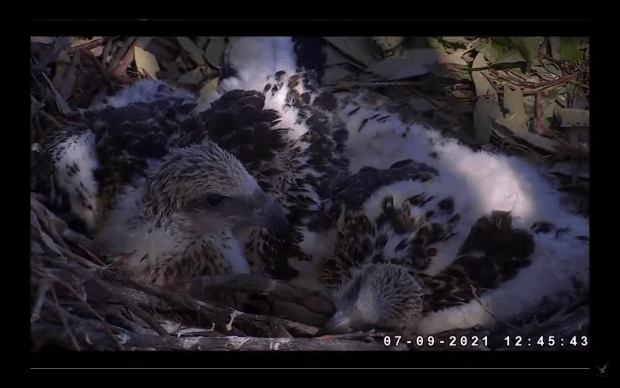
Here 27 is standing watching 28 play with some sticks with its beak and talons. The sea eaglets are developing at a normal pace. It is all good.

The golden glow of morning fills the scrape box of the Peregrine Falcons, Xavier and Diamond, in Orange.

Each parent takes turns incubating the eggs so that the other can have a break. Diamond will do the overnight incubation and Xavier will be the security guard.

Here is a short video of the hand over of incubating duties from Diamond to Xavier:

Remember that the males are about 30% smaller than the females. Xavier works with his feet and wings to get those three large eggs under him so they can all be warm.

It is even harder for the tiny male at the 367 Collins Street nest who has four eggs to warm!

Mom arrives for her turn.

She is working her wings too to get those four eggs under her.

Looked at how poofed out all those feathers are. Wow.

Here is Dad. His feathers are all poofed, too. He is so tiny compared to mom. My goodness – he really does have to work to get all four under him properly.

After wiggling about he gets everything settled. We will be looking for hatch towards the end of September.

Thank you so much for joining me. All of the birds in Australia seem to be doing just fine. We will watch the sea eagles change colour before our eyes and anticipate the arrival of the Ospreys. It’s a few weeks before falcons start hatching. Take care everyone.

Thank you to the following for their streaming cams where I took my screen shots and video clips: The 367 Collins Street Falcons, The Falcon Cam at Charles Sturt University and Cilla Kinross, Sea Eagle Cam @ Birdlife Australia Discovery Centre, and the Port Lincoln Osprey Project and FB Page.

PLEASE NOTE: I am taking my computer in for servicing. I hope to have it returned to me sometimes on Thursday so I will be back with another newsletter Thursday or Friday.

Oh, our lovely fish eating birds

I love Ospreys – bet you can tell! Still, the anxiety rises when there are three eggs on a nest that, historically, simply cannot support that many mouths to feed. Right now the Mum at the Port Lincoln Osprey barge in Australia is incubating three eggs. In 2020, a drop in fish deliveries around day 16 of the youngest life meant that food insecurities hit the two older and much bigger siblings. Tapps was a victim of siblicide. Will 2021 be different?

So far the two adults are working like a super machine. Today Dad came in with a fish delivery for mom. She left and he incubated the eggs for a half hour. Have a look at that smooth exchange:

The 2019 female fledgling of the PLO nest has been seen and photographed at Tulka yesterday. Solly, the 2020 fledgling with the satellite tracker still seems to prefer Eba Anchorage but she has spent some crazy time at Streaky Bay again. Solly is 339 days old on 26 August Australian time.

If it has been awhile since you watched an Osprey catch a fish, have a look at this slow-motion video shot in the Scottish Highlands. Incredible. When you are watching this remember that Ospreys and Owls are the only birds whose outer toe is reversible to help them hold on to their prey. It allows them to grasp with two toes in the front. Great design.

The Ospreys that live in Australia along the coasts and the rivers are Eastern Ospreys, Pandion cristatus. Eastern Ospreys do not migrate. Their status ranges from secure to vulnerable and rare in various states of Australia.

Ospreys have a system of communication between one another that individuals, such as yourself, will recognize if you have been watching Osprey nests. There are 11 physical and visual displays that show they are resting, alarming, soliciting for food, in a defensive posture, nest protecting, under attack, or sky dancing to impress their mate. In addition to the body language Ospreys use they also have 8 sounds that they make alongside the physical signs. Those include alarming, food solicitation ranging from a very low sound to an extremely high pitched sound, a sound for guarding, being excited, screaming, and the sound during copulation. These findings were published in 1993 by Vincent Bretagnoll and Jean-Claude Thibault. The article is “Communicative Behavior in Breeding Ospreys (Pandion haliaetus): Description and Relationship of Signals to Life History.” It was published in The Auk, Volume 110, Issue 4, 1 October 1993, Pages 736–751.

The British Library and the Cornell Bird Lab have an extensive library of bird sounds that you can access. Also, just watch the birds intently on their nests in different situations. You will soon be able to recognize their different visual postures. For those working in situations that deal with Ospreys, it is essential that they learn the communication and behavioural signals of these birds. These skills would definitely have helped those reviewing Malin’s flight off the nest and, in the future, could save a bird’s life.

Blue 33 (11) has delivered Maya a nice fish for breakfast. So Maya is still here. It doesn’t mean she won’t eat and fly! We just need to wait and see.

Either White YW left Tiny Little an early fish or the silvery white object is a leftover piece of fish from last night’s late feed. Is Tiny home to eat it? and will she be in Cumbria all day?

Ooops. Looks like Tiny Little is too late!!!!!!!! Mr Crow has found a nice breakfast. Does this mean Tiny Little has started her first migration?

UPDATE: Tiny Little is still here. I didn’t get the photograph but someone else did. Yippee. Will try and chase her down today.

It is another misty morning. Aran is on his perch almost in the exact same position as he was yesterday morning.

And here is Aran with Mrs G. She remains in the UK still.

At the Dyfi nest, Telyn was last seen on 21 August at 12pm while Ystwyth was last seen on 24 August at 09:26. Dysynni and Idris were both at the nest on 25 August. Idris brought Dysynni a whopper.

Yesterday, Laddie, LM12, delivered a fish to LR2 on the nest. LR2 was 97 days old.

After a pesky crow flew around the nest, LM2 decided it was safer to take that whopper over to his favourite Birch tree to eat it. Wow, Laddie, great fish!

LR1 left for her migration on 15 August. This was only the second time in the history of this nest that a fledgling has left before the female.

Oh, it is lovely to see some of them still home. Thank you, Tiny Little! News in other news is there are now three eggs for the Collins Street Falcons! That last egg arrived at 23:53 last night. Congratulations. And last, if you follow the Loch of the Lowes Nest a wonderful surprise. A 2015 fledgling, FR2, flew over Guardbridge in Fife yesterday. They got a photo. Fantastic. A survivor! There is sad news today. The Black Stork fledglings received their names yesterday. 7181 (no 1) was named Julge meaning Brave. 7181 (no 2) was named Malbe meaning Sedate. 7183 (no 3) was named Tasane meaning Peaceful. You might have recalled some animal sounds being heard at the base of the nest tree. It is now confirmed, so sadly, that Malbe has been killed by an animal. Urmas has taken the body of Malbe to be examined. Word has also come that Tuul, Karl’s fledgling, has also perished. The Black Storks are so rare – it is so sad to hear of these deaths. Our hearts go out to all who loved these beautiful families and to those who so diligently worked to make sure Jan’s nestlings were fed and healthy to fledge. There has been some problems with the tracking and posting of Karl II and his fledglings locations. I will bring this to you as I locate it. Did you follow Milda? You will know that this brave White Tailed Eagle from Durbe lost her mate and sat on her eggs for eight days without food and then a potential mate came. But last year turned to be a sad year for Milda. She is now working on the nest with her new mate, Mr K. So happy for her. There is word that WBSE 28 did, finally, get some food. Send your warm and positive wishes off to all of the birds.

Correction to earlier news letter. Karl II has only had a transmitter for two years. I said ‘many’. Thank you!

Have a wonderful day everyone. Take care. See you soon.

Thank you to the following for their streaming cams where I took my screen shots: The Cumbrian Wildlife Trust and The Foulshaw Moss Osprey Nest, Bywyd Gwyllt Glaslyn, Dyfi Osprey Project, The Scottish Woodland Trust and the Friends of the Loch of the Lowes, LWRT and the Manton Bay Osprey Nest, the Port Lincoln Osprey Project and FB Page.

Checking in on Australia

It is raining in parts of Australia. Orange got 50 mm and there are floods about while there was 37 mm out at the Campus where the scrape box of Peregrine Falcon couple, Xavier and Diamond, have their scrape box.

Diamond has spent time on the ledge and going back to the scrape box looking like she is concentrating on that first egg. What do you think? Maybe today?

Sadly, the poor weather might be impacting Dad’s ability to bring in prey to the two babies in the Ironbark Tree. Until now, there has been little to no demonstrations of dominance but yesterday the prey diminished and WBSE 27 started telling the little one who is boss. It is unclear if WBSE 28 had any of the morning fish. WBSE 27 is 26 days old today and WBSE 28 is 24 days old. Oh, I hope this stops. There is enough for everyone! Most people say that the parents will not step in. And, as you know, if I hear survival of the fittest one more time I might scream loud enough for someone to hear me in Australia! All you have to do is to think about Tiny Tot on the Achieva Nest or Tiny Little — those tortured little ones turned out to be a force to be reckoned with. I wish Tiny Tot had a tag and a satellite transmitter. I sure would like to see what she is doing in a couple of years. If there are two Ospreys that will survive it is those two. And they started out like WBSE 28. Of course, only worse for Tiny Tot.

Mom was looking particularly beautiful over in the Port Lincoln Osprey Nest. The colour of the water contrasted with the nest lining — well, it is gorgeous.

The female at Collins Street in Melbourne certainly looks like she is going to lay her second egg today. She is getting full in the bottom just like Diamond. She is certainly plunked down in that scrape box with that stern look she can give. It must be quite uncomfortable laying eggs!

I don’t do a lot of reporting on the Albatross despite the fact that not only am I fond of them but I really want our oceans to be cleaned up and the fish stocks renewed so that all of the sea birds are promised some kind of a decent life. Sharon Dunne does a great job running the FB group as well as keeping us abreast of everything ‘Tiaki’, the Royal cam chick of the 2021 year.

Ms Pippa Atawhai was just the cutest little albatross chick and her parents were incredible. She was the 2020 Royal Cam Chick. Her nest was close to the visitor’s centre. Tiaki’s nest is down close to other nests. Some are less than 3 metres away. This has led to a lot of ‘drama’ between the chicks! Seriously. I thought it was only the juveniles that caused mischief. Oh, no. These gals can seriously get with the squabbling.

The Cornell Bird Lab caught that on camera today. Have a look:

It reminds me of my garden. Before I seriously started watching birds and their behaviour, it seemed they all got along and lived in some kind of sing song happy land. Oh, geez. There is even a hierarchy in our garden! Incredible. Have you noticed this behaviour at your feeders? Is this why we say ‘Pecking Order’?

This was a quick check in. I am restless – not knowing for sure if Malin is alive or dead or nothing can be determined. But I want to leave you with an uplifting story and a lesson. Yesterday I reported on the Osprey that had been hanging upside down in a tree for two days because of being entangled in fishing line. The beautiful bird had pulled all of its muscles from being upside down. The bird, at 45 feet, was ten feet more than the climber could reach so he used an extension net and a pole saw to cut the line and catch the bird in one swoop. On the ground the bird was detangled from the line. A stainless steel treble hook – for catching 3 fish at once – had gone through the talons of this baby. Today, this young one is healing. The lesson is ——- clean up after you go fishing. Join in groups to clear the shores of rivers and lakes of fishing debris that gets caught in them. Help our water birds!

I took these screen shots from A Place Called Hope’s FB page. They have a wonderful video on their site of this rescue and I urge you to search FB, find their home page, and watch it. It is very moving. What wonderful people these people are – there is not a situation too challenging and if a bird can be saved, A Place Called Hope will give it that chance.

Thank you for joining me today. I am certain that Collins Street will have another egg tomorrow and well, Diamond might have one as well. Take care everyone. Stay safe.

Thank you to the following for their streaming cams: Sea Eagle Cam, Birdlife Australia and the Discovery Centre, 367 Collins Street by Mirvac, Cornell Bird Lab, The Falcon Project with Cilla Kinross and Charles Sturt University, the Port Lincoln Osprey Project, and A Place Called Hope FB page.

Four rare Hen Harrier chicks fledge in Derbyshire

One of the big announcements came today when four extremely rare Hen Harrier Chicks fledged in Derbyshire, England. They were predated by hunters and owners of estates where grouse hunting was popular as well as ‘land management practices’. They are now protected under the 1981 Wildlife and Countryside Act.* In North America, the Hen Harrier is called the Northern Harrier while in France it is the Buzzard of St Martin.

Hen Harriers are a bird of prey like most of the birds that I write about. They are related to kites, hawks, and eagles. Have you ever heard of them? or seen one?

The males are pale grey as in the image below. The primaries are a dark espresso colour. Here the male is flying low over the countryside looking for prey.

“Hen Harrier” by ressaure is licensed under CC BY-NC-SA 2.0

Here is an image of the underside of the male Hen Harrier.

“Hen harrier male, Circus cyaneus” by peter.v.b is marked with CC0 1.0

The females are brown as are the juveniles with a white rump and long barred tail. The females are often called ‘Ringtails’ because of the bars or bands on the tail. Like the Honey Buzzard their heads are rather small in comparison to other raptors. They will measure no more than 42 cm with a wing span of 120 cm. They weight less than a pound at 300-400 grams. Hen Harriers eat small birds and mammals. Besides flying low and finding prey, they also use the cover of bushes in the woodlands to surprise and take their prey on the ground (normally).

“Hen Harrier (Circus cyaneus)” by gilgit2 is licensed under CC BY-SA 2.0

When hen harriers are courting, they do a fabulous sky dance or rolling and tumbling. The Hen Harriers normally lay 4 to 5 eggs in a nest on the ground or in cattails or long dense grass. The male and female both take care of the chicks but the males provide the food. They hunt it and when successful pass the prey to the female by tossing it at them mid-air. They would make great softball players!

Look carefully at the image below. Notice that the facial features of the Hen Harrier look like an owl. Like owls, they have a parabolic facial disk which allows them to hunt by sound (like owls) as well as their incredible ‘hawk’ eyes.

“Hen Harrier (Circus cyaneus – Albanella reale)” by Lorenzo L M. is licensed under CC BY-NC-ND 2.0

*There continues to be the debate between the grouse hunting societies and those that protect birds and want grouse hunting banned. Any number of associations who do not support the killing of animals are active in supporting the reintroduction of the Hen Harrier. You can do a simple search on Goggle for ‘Hen Harrier Myths’. There is even a Hen Harrier Day celebrated in the Highlands of Scotland.

Other Bird World News:

Foulshaw Moss Osprey Cam, Cumbria: After waiting and moving about sticks, Tiny Little (Blue 463) was prey calling and in flew big sibling chasing after Dad or White YW. 464 took the fish and then flew off with it. Poor Tiny Little.

Nasty older sibling!

WBSE in Sydney Olympic Park, Australia: Well, they just can’t stop getting cute!

Collins Marsh Nature Centre, Wisconsin: Malin is looking really good to me. I focused on her wings whenever I checked in. She has been fed and the feathers look grand. I can also see four bands or bars on the tail now so Malin is continuing to grow and develop.

Besides this lovely tail growing and those gorgeous scalloped back feathers – I adore Osprey, can you tell? Malin is no longer dragging one of her wing feathers. It just seems it took almost 7 weeks to get these things sorted. Joy. Real joy. What a beautiful Osprey chick?!!!!!!

Patricia Fisher, the local wildlife rehabber just wrote and agreed that Malin’s feathers are looking much better. They still have to cross but fingers crossed on that one. More Joy. Thanks, Patricia for keeping an eye on this little one with all you have to do.

Port Lincoln Osprey Barge, Australia: Mum is busy rolling two eggs and I believe there remain two, awaiting third. Dad and her have been taking turns incubating.

Dad has returned to see if Mom would like a break. He is annoyed by the blue rope material and Mom seems to be annoyed by him pulling it out from under her! What a pair.

Fortis Red Deer: It is embarassing. I have not mentioned our Canadian Ospreys in Alberta for awhile. When I last checked you could only see Legacy’s little head hardly extended above the sticks. Look at this beauty now. Wow. These chicks have grown. This is what I want to say about Malin’s growth at Collins Marsh in a week!

Fortis Exshaw, Canmore, Alberta: It looks like the ospreys were practicing with their ‘ps’ or there was rain and enough blowing wind to throw mud balls up on that lens!

The good thing is that you can hardly tell which are the two chicks and who is the adult. Incredible.

It has been hot but more than that the smoke pollution has made it difficult to breathe at times on the Canadian Prairies. I am keeping an eye on the White Rock fire in British Columbia. You might all know Dr Christian Sasse and his love of Bald Eagles and Osprey. He often streams live generously showing us these beautiful birds. Well, his cottage where he streams them is in the path of the fire. Send warm wishes his way as well as all the wildlife in the region. The White Rock fire is misbehaving badly, not doing normal things so the firefighters are really having a time of it.

Thank you for joining me today. I had hoped to bring you some local hawk pictures. I am heading out hopefully later. Take care everyone.

Thanks to the following for their streaming cams: the Collins Marsh Nature Centre, the Sea Eagle Birdlife Australia, and Discovery Centre, Cumbrian Wildlife and Foulshaw Moss Osprey Nest, Port Lincoln Osprey Project, Fortis Alberta Red Deer, and Fortis Alberta Exshaw. A Special thanks to Patricia Fisher from Wisconsin who cares about Malin and takes time to answer all our questions. I am so grateful.