Early Thursday in Bird World

4 August 2022

Good Morning Everyone! I was not going to write my newsletter until the end of the day but some of you might wish to know about the banding of the Royal Cam chick. There is a bit of other news as well. Both chicks at the Loch Garten Osprey platform fledged today – so every osprey chick in the UK has now fledged. Fantastic. I am getting notices that the cameras at the SWFlorida Bald Eagle nest of Harriet and M15 and the NEFlorida Bald Eagle nest of Gabby and Samson will go live in two weeks. Wow. Time is speeding by. Those cameras will turn on just about the time we have Osprey and falcon eggs in Australia.

The little fledgling Blue Jay has decided that it is time that I get some more peanuts outside for the three of them! Too funny. These wee ones can be quite loud when they want to be. They are getting their beautiful blue crests. I believe this is the smaller of the three – a little female -. She has that developing crest raised up high because she is excited! They are so cute and so animated.

The NZ DOC rangers will be banding the chicks on Taiaroa Head today. Here is the announcement by Ranger Sharyn Broni posted by Sharon Dunne on the Royal Cam FB page. There is no mention of the time. There will be an archived video of the banding of QT if you miss it!

I know many of you are anxious to also find out about the naming of QT. They may mention how this will be done this year. On line voting took place during the pandemic but this might change now.

Here is the link to the camera:

An Osprey rescue in Scotland that warms our hearts. You might have to keyboard the URL if it doesn’t give you an automatic link. It is the story of the collapse of the Balgavies Osprey nest mentioned a few weeks ago in my blog – this one has pictures!

scottishwildlifetrust.org.uk

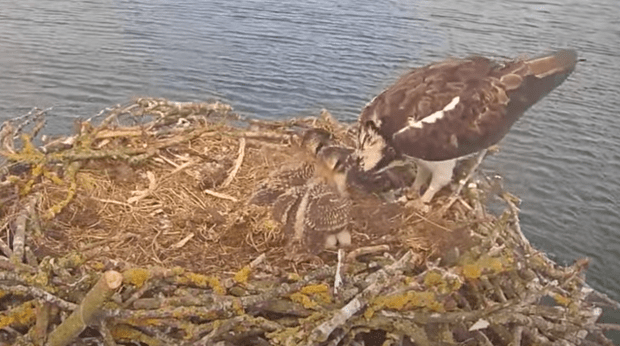
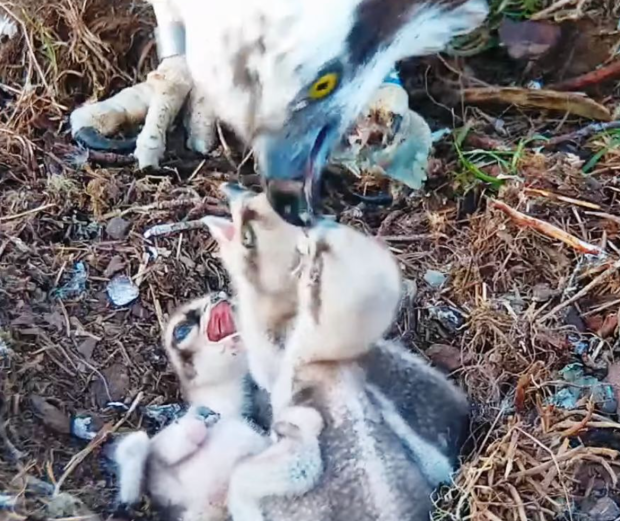
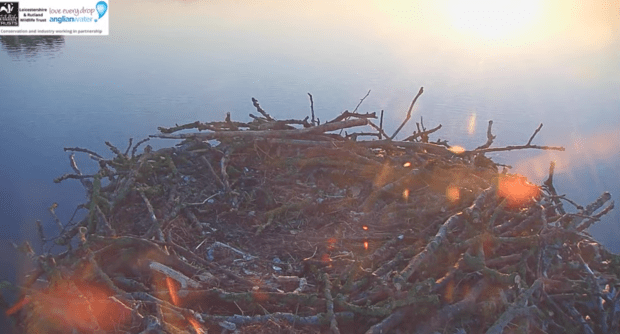
The youngest chick on the Janakkalan Nest has yet to fledge. Titi often remains on the nest now that Boris is flying about for longer periods of time. With intruders and goshawks in the area, it is dangerous for Titi not to be flying.

Boris arrives in the bottom image to protect the nest. Hopefully s/he will take care of its sibling.

This brings me back to the mystery of why a normally wonderful Mum on a Finnish Osprey nest would attack her children. Nuppu on nest #4 attacked her youngest who had not fledged and the eldest who had fledged (much less) last week. Humans wondered how this loving mother could turn on her children. One of my readers ‘L’ suggested that it might have been to get the youngest to fly. Nuppu, knowing that a goshawk was in the area, wanted both of her chicks off the nest and flying free to lessen the threat of predation. I spent some time asking several osprey experts if this could be the case and they said, ‘absolutely’. The youngest did not fly and was predated when the intruder came to the nest. The eldest flew. So, there we are – the mystery of the physical attacks was to get the second chick off the nest and flying. Nuppu wanted to save her chicks, not harm them.

The only surviving fledgling on nest #4.

I do not understand why Titi on the Janakkalan nest has not flown yet. S/he has been doing some exercising of the wings. Hopefully soon!!!!! This is the nest without a female so Boris has taken on the job of security when Dad is not around.

The Sydney Sea Eaglets are doing fantastic. The tips of the wing feathers are beginning to show. You can see them coming in on both chicks – look carefully at the wings.

You will notice that the time between feedings is a little longer. That is because the eaglets can eat much more at a sitting than when they had just hatched and needed a few morsels of fish every 45-60 minutes from dawn to dusk.

SE30 even did a little beaking of 29 yesterday. Nothing major but it was cute when it sat up and gave it a bop.
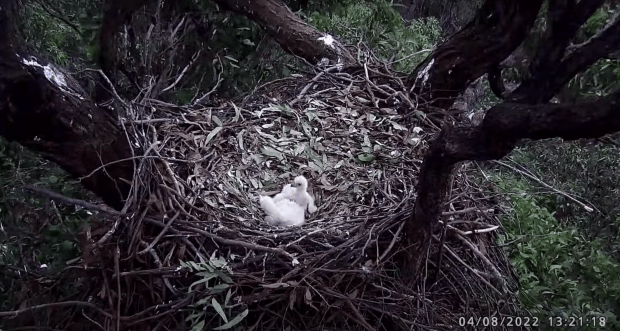
Both had nice crops! Fish will not be stacked on the nest so much now because it could cause predators to become interested in the nest and the eaglets. They are not big enough yet to be out of danger. They need to be 28-30 days old.

It is raining in Orange and Diamond arrives at the scrape box on the water tower soaking wet! But with a full crop. Looking for eggs in a couple of weeks.

The high temperature for the day will be 23 C at the Osoyoos nest. What a change! A nice fish arrived early on the nest and Soo fed both of the chicks. They made it! Olsen and Soo you should receive a reward – you did fantastic in your strategies to protect the two osplets. Just look at them.

Right now the camera is fairly clear at the Fortis Exshaw Osprey nest in Canmore, Alberta. We can get a good look at those three good looking osplets! We are on fledge watch for this nest. At least two are flapping and starting to hover. It will not be long.

Karl II delivered a number of fishes just a few minutes ago to the four Black storklets in the Karula National Forest in Estonia. So far all is well. The storklets are hovering and jumping and practising their perching to prepare for fledge.

A portrait of the three females at the Loch Arkaig nest this year. From left to right: Willow, Sarafina, and Mum Dorcha (unringed). When we talk about the females having beautiful necklaces have a look at these three! Gorgeous.

I am not sure I have ever seen three females with such elaborate necklaces. Dorcha is really influencing the genetics at this nest. Bravo!

A blast from the past. The four Peregrine Falcon eyases being fed at the CBD-367 Collins Street scrape in Melbourne. Time is ticking away. The camera will be up and running in September. Just in case you forgot how incredibly cute little falcons are!!!!

Thank you for joining me this morning. Things look pretty good in Bird World. Take care. See you soon!!!!!!!!!

Thank you to the following for their posts and their streaming cams where I took my screen captures: Friends of Loch Arkaig and the Woodland Trust, Eagle Club of Estonia, Fortis Exshaw, Sea Eagles@Birdlife Australia Discovery Centre Sydney Olympic Park, Osoyoos Ospreys, Charles Sturt Falcon Cam, Finnish Osprey Foundation, CBD-367 Collins Street Falcon Cam, and Royal Cam Albatross NZ.

Friday in Bird World

27 May 2022

I have been away most of the afternoon and have not been able to check on all the nests on my return. It was raining on the two osplets on the UFlorida-Gainesville nest and it looks like they have been at the hair salon, too!

It has been terrible weather at the ND-LEEF Bald Eagle nest. As I understand it the last big feed for ND17, Little Bit was last evening at 21:25. Little Bit was quite full. Eagles do not have to eat every day but 17 would benefit from having more regular food. I saw a discussion about the feathers on Little 17s head. Chicks show stress in their feature development if they have not had regular feedings or as much food as they should be having. In addition, siblings can during beaking pull out feathers. For 17 it could be a combination of both. He will be fine when food comes in later – except that the big siblings will also be hungry. Fingers crossed for lots of fish once the storm passes and the waters clear for fishing.

Sean and Lynn have posted the banding and Q & A session for Cal Falcons. There is some really interesting information in there and if you are interested, please do take the time to listen. Make sure to start it back at the beginning.

Mrs G and Aran now have two chicks as of 20:42 at the Glaslyn nest in Wales! This is the 51st chick for Mrs G and the third egg is cracking!!!!!! These three will be very close together. Fantastic. I continue to worry about the third hatches at both Loch of the Lowes and Llyn Clywedog.

Idris and Telyn have two of the cutest little osplets on the planet at their Dyfi nest, also in Wales.

Idris has two fish on the nest for Telyn and the kids. He is eating some of the second fish before departing for security duty.

There are three chicks on the Llyn Clywedog nest of Dylan and Seren. Yesterday, Dylan had been missing and the weather was terrible. A fish finally came to the nest. Everything seems to have been fine since then. Things have dried out. The third chick is quite small. A nice fish was delivered at 20:51.

The chicks at Manton Bay are so big compared to these wee hatchlings. They no longer fit well to be brooded by Maya.

Blue 33 was acting like there were intruders around. He kept looking around with his snake eyes.

I can hardly believe it. The rain and wind are gone. Dorcha has been able to dry out. We should be on hatch watch by the 31st for her and Louis’s chicks.

I am very concerned about the third hatch at Loch of the Lowes. Blue NC0 has a tendency not to feed them if they are not right in her face and beak. The two oldest at Llyn Clywedog are a bit of a handful, too. This was the early morning feeding at Loch of the Lowes. The wee one did not get any food and I haven’t seen it get fed today – I hope I missed it and please tell me if I did.

So the worries are Llyn Clywedog and Loch of the Lowes. A great nest to watch, if you are looking for one with little drama is going to be Idris and Telyn at the Dyfi. They are as steady as you go, just like Blue 33 and Maya at Rutland. Mrs G and Aran are the favourites of many and I personally like Foulshaw Moss with White YW and Blue 35 but I do not like their camera – no rewind!

Take care everyone. It was great to know that Annie was in the scrape with the two eyases – a daughter and a son – five minutes after the banders left! That is fantastic. Thank you so much for being with me today. See you soon.

Thank you to the following for their streaming cams and/or FB pages: Cal Falcons, Friends of Loch of the Lowes and the Scottish Wildlife Trust, Dyfi Osprey Project, Brywd Gwyllt Glaslyn, Friends of Loch Arkaig and the People’s Post Code Lottery, UFlorida-Gainesville Ospreys, and LRWT.

Sunday in Bird World

13 March 2022

Gracious. Andy is sure hauling in the fish. There have been 9 fish deliveries at the Captiva Osprey nest before 14:30!!!!!! Needless to say everyone has eaten well and all chicks are sporting blood feathers, tail feathers, and contour feathers. It is a good day at Captiva. Lena is even looking much refreshed.

It is busy at the West End Nest of Thunder and Akecheta. The newness of parenthood has not worn off Cheta. He is bringing in fish, brooding babies, and being security guard. The third hatch had its first taste of fish juice, saliva, and fish flake at 11:28. There it is in the image below.

Thunder and Cheta with their three babies on a beautiful California morning. This just puts a smile on my face! Beautiful.

Here is a video of the third chick getting its first meal from Thunder and one of the older siblings doing a great poop shot. Its plumbing is definitely working!

There is now going to be no time to rest. The UK Ospreys are arriving and it looks like the first one at a streaming cam is Laddie, LM12, at the Loch of the Lowes nest! So Laddie is here on 13 March. Last year he arrived on the 21st of March. He is eight days earlier than in 2021. Last year Laddie and NC0 raised two beautiful chicks to fledge. NC0 arrived on 25 March last year.

To see the Osprey you need to go to the lettering at the top. Stop at the ‘c’ in camera and looking down. Laddie is sitting in his favourite spot on the very top of the dead Silver Birch tree.

Here is the link to the Loch of the Lowes Osprey Cam:

I was expecting Blue 33 and Maya to be the first to return! That nest looks very empty. I cannot wait til they get back. They are one of my absolute favourites of the UK nests.

There is a new camera at the Loch Garten nest in Scotland. Here is the link:

Loch Garten holds a very special place in the heart of Osprey lovers in the UK. In the 1950s, a pair of Ospreys settled on the nest and began breeding. It was then the very first nest to have a breeding pair after the ospreys were made extinct in the UK. Indeed, the pair returned to the ancient Caledonian forest, part of Abernethy Forest Wildlife Reserve, near Aviemore, in 1959. It was a perfect place for Ospreys. There were lochs, rivers and estuaries full of fish. There is a little paperback that tells the story of the nest and the return of the Ospreys to the UK. It is Lady of the Loch. The Incredible Story of Britain’s Oldest Osprey by Helen Armitage.

There are high hopes for attracting a new breeding pair to the fine new nest that has been erected for them!

Loch Garten” by Lee Carson is marked with CC BY-NC-ND 2.0.

Talk about hoping to have a new breeding pair. The folks at Poole Harbour cannot wait for CJ7 the resident female who did not have a mate and Blue 022, a male who courted her last year, to return and raise chicks on CJ7’s nest. It this happens it will be the first time in 200 years that an Osprey chick has hatched at the site! Incredible.

Turning back to North America, everyone is on pins and needles waiting for Iris, the oldest osprey in the world, to return to her nest at Hellgate Canyon in Missoula, Montana. No one expects Iris to raise chicks. Her mate, Louis, has another nest that he cares for. I have a soft spot for Iris and feel that at 29 years old it is time she enjoyed her summer holiday. Raising chicks is a lot of work and really diminishes the health of the mother who loses approximately 30% of her weight.

Each of the three chicks at the Dale Hollow nest of River and Obey had a good feed around 11:28ish. Even Little Bit. They all stood in line and were very good as River fed them.

The wee one is doing well. The two older siblings are generally well behaved towards it – such a relief.

You can see that the snow is really melting as we see more and more of the edge of the nest. All of the babies are having a nice sleep in the warm sunshine.

I happened to look over at the Captiva nest. Andy just delivered the 10th fish of the day and it is a nice one. Little Bob is really enjoying this fish. Everyone is being civil and the kids are stuffed to their eyeballs…It is 15:48. Look at Little Bob open his mouth wide for delicious fish. Big is not paying him any mind at all. Food security is back in the mind of Big. Yippeeee. And well it should.

little Bob is still up near the table. Big looks like she has eaten so much she is going to get sick.

Little says there is room for more Mum!!!

What a beautiful image. All three chicks so full that they are passing out in food comas and Lena is getting some nice fish to herself. It just puts tears in your eyes. This nest has had a few really rocky days but today is one for the record books.

Every nest is doing really well. That is just wonderful. We can all rest easy tonight. Here is a sweet moment at the nest of Jackie and Shadow. Keep your eyes on the little one.

Thank you for joining me. Take care everyone. See you soon!

Thank you to the following for their streaming cams and/or FB Pages where I took my screen captures: Captiva Ospreys and Window on Wildlife, Dale Hollow Lake Bald Eagles, Explore.org, Cornell Bird Lab and the Montana Osprey Project, Scottish Wildlife Trust and Loch of the Lowes, Loch Garten, Poole Harbour Ospreys, Rutland Wildlife Trust, and West End Bald Eagles.

Tuesday in Bird World

01.03. 2022

I was in great need of a giggle and a smile and Jackie and Shadow provided it. This couple is incredible. Now that pip watch is upon us, Jackie is less and less prone to letting Shadow do any incubation duties. In the short video below, I captured the moment that Jackie returns from her break and wants Shadow to relinquish the nest.

I have re-figured my math (never a strong subject of mine). The first egg was laid on the 22nd of January with the second on the 25th. If we do not count the day the egg was laid, that means that egg 1 is 36 days old today and egg 2 is 33 days. At an elevation of 2058 metres or 6751.9 feet, Big Bear Lake is within the Bear Mountain Ski Resort area.

Because of the elevation of the area, it takes eagle’s eggs longer to hatch than those in nests at much lower sites. It might be, then, that Jackie and Shadow’s eggs will take the full 40 days to start pipping. Each of us and the more than 3000 fans needs to keep up the positive energy for this much loved eagle couple.

News has come that the second Hilton Head Island Trust eaglet of Harriet and Mitch has died. The bodies of both HH3 and HH4 have been sent for a necroscopy. It is believed that both have died from avian flu but this has to be confirmed. Our thoughts go out to Mitch and Harriet and all the people at Hilton Head Island Trust eagles.

The first fish of the morning came in at 08:44 to the Captiva Osprey nest. Lena fed the chicks for nearly an hour. She finished off the skin at 09:44.

Just look at Andy’s long legs or tarsi. These allow him to reach quickly and deep to get his fish. You will notice that the legs of other raptors are not quite as long.

It looks like a different fish than the Sheepshead Andy normally brings to the nest.

Turn around Little Bob!

Little Bob still sports his fuzzy down which is actually unbranched feathers. Alan Poole describes them as being “almost furlike”. Little Bob is changing though. His head is not as soft looking as it was.

Awww. There you are right, Little Bob, up there with that long neck of yours. Dinosaurs. Tomorrow or Thursday you will all look like dinosaurs!!!!!!

These nestlings still cannot regulate their body temperature. It will be another week or 10 days. Until then it is Lena’s job to protect them from the heat of Florida and the rain.

They are, however, quickly entering the period of their fastest growth – between two weeks and a month when they will gain an average of forty grams or .09 lb a day, according to Poole.

From this angle you can clearly see the change in the plumage between one of the older Bobs on the left and Little Bob with its still fuzzy lighter down on the right.

At the Dale Hollow Lake Nest in Tennessee, the third hatch, DH16, is eating along with its twin siblings, DH14 and 15. They are so cute. Here are the fuzzy bobbles everyone loves. Precious.

The nest can only be seen from the water. In May, there is a large group picnic with opportunities to go out and have a view of Obey and River and their eaglets. Check the Dale Hollow Lake website if you are interested.

The second egg has hatched at Duke Farms. Congratulations everyone!

1 March is the first day of meteorological spring. The followers of UK Osprey nests bring out their UK Arrival Sheets and start keeping track of who arrives where and when. The first official sighting of a returning came today from the hide in the Holkham Fresh Marsh in Norfolk. Of the public nests where there are streaming cams, I am hoping for Blue 33 and Maya to get back to Rutland Manton Bay quickly!

Loch of the Lowes is gorgeous. This nest fledged two last year. It is the home of Laddie LM12 and Blue NC0. I adore Blue NC0. She is a great angler and she is not shy about getting a huge fish up on the nest for her chicks if Laddie isn’t delivering food quick enough!

Everyone is hoping that 2022 will be a fabulous year for Aran and Mrs G at Glaslyn. What a serene pastoral setting. Last year their three chicks perished.

There are, of course, many people who fell in love with Ospreys because of this nest, Loch Arkaig. We continue to hope for a miracle to happen and Aila to return after not being seen since August of 2020. That year her and Louis fledged the JJs – they stole our hearts and I personally cannot wait to see if JJ7 will be seen in Scotland this year.

The JJs, July 2021

Last year Louis bonded with another female at a close nest and fledged two beautiful chicks but not with the one he shared with Aila.

There are many, many more Osprey streaming cams in the UK and as the birds arrive I will be posting those. One of my favourites is the nest of White YW and Blue 35 in Cumbria at Foulshaw Moss. It is the home of Tiny Little, a third hatch so wee compared to the two older siblings, no one thought she would survive but, survive she did thanks to the ingenuity and hard work of the parents and her very own cleverness and determination.

The sun is out and there is a hint of blue in the sky today. Yesterday it was -8 and today it is a little colder at -13 C. I had a lovely walk accompanied by seven Black-capped Chickadees, a White Breasted Nuthatch and a Red Squirrel. They all knew I had seeds in my pocket!

They were so cute and it was a nice warm day for them, too.

There is still no sighting of Annie at The Campanile. It is very sad to say goodbye to her. She gave us and the world 13 beautiful chicks in the five years she was at the scrape as Grinnell’s mate. I hope by some miracle she returns and is only away quietly healing from an altercation. Send her your warmest wishes.

Thank you so much for joining me today. Take care everyone. See you soon.

My sincerest thanks go out to the following for their streaming cams where I took my screen captures and video clip: Glaslyn Bywyd Gwyllt, Friends of Loch of the Lowes and Woodland Trust, Loch Arkaig, People’s Post Code Lottery, Duke Farms, Dale Hollow Eagles, Friends of Big Bear Valley, Captiva Ospreys and Window on Wildlife.

Oh, our lovely fish eating birds

I love Ospreys – bet you can tell! Still, the anxiety rises when there are three eggs on a nest that, historically, simply cannot support that many mouths to feed. Right now the Mum at the Port Lincoln Osprey barge in Australia is incubating three eggs. In 2020, a drop in fish deliveries around day 16 of the youngest life meant that food insecurities hit the two older and much bigger siblings. Tapps was a victim of siblicide. Will 2021 be different?

So far the two adults are working like a super machine. Today Dad came in with a fish delivery for mom. She left and he incubated the eggs for a half hour. Have a look at that smooth exchange:

The 2019 female fledgling of the PLO nest has been seen and photographed at Tulka yesterday. Solly, the 2020 fledgling with the satellite tracker still seems to prefer Eba Anchorage but she has spent some crazy time at Streaky Bay again. Solly is 339 days old on 26 August Australian time.

If it has been awhile since you watched an Osprey catch a fish, have a look at this slow-motion video shot in the Scottish Highlands. Incredible. When you are watching this remember that Ospreys and Owls are the only birds whose outer toe is reversible to help them hold on to their prey. It allows them to grasp with two toes in the front. Great design.

The Ospreys that live in Australia along the coasts and the rivers are Eastern Ospreys, Pandion cristatus. Eastern Ospreys do not migrate. Their status ranges from secure to vulnerable and rare in various states of Australia.

Ospreys have a system of communication between one another that individuals, such as yourself, will recognize if you have been watching Osprey nests. There are 11 physical and visual displays that show they are resting, alarming, soliciting for food, in a defensive posture, nest protecting, under attack, or sky dancing to impress their mate. In addition to the body language Ospreys use they also have 8 sounds that they make alongside the physical signs. Those include alarming, food solicitation ranging from a very low sound to an extremely high pitched sound, a sound for guarding, being excited, screaming, and the sound during copulation. These findings were published in 1993 by Vincent Bretagnoll and Jean-Claude Thibault. The article is “Communicative Behavior in Breeding Ospreys (Pandion haliaetus): Description and Relationship of Signals to Life History.” It was published in The Auk, Volume 110, Issue 4, 1 October 1993, Pages 736–751.

The British Library and the Cornell Bird Lab have an extensive library of bird sounds that you can access. Also, just watch the birds intently on their nests in different situations. You will soon be able to recognize their different visual postures. For those working in situations that deal with Ospreys, it is essential that they learn the communication and behavioural signals of these birds. These skills would definitely have helped those reviewing Malin’s flight off the nest and, in the future, could save a bird’s life.

Blue 33 (11) has delivered Maya a nice fish for breakfast. So Maya is still here. It doesn’t mean she won’t eat and fly! We just need to wait and see.

Either White YW left Tiny Little an early fish or the silvery white object is a leftover piece of fish from last night’s late feed. Is Tiny home to eat it? and will she be in Cumbria all day?

Ooops. Looks like Tiny Little is too late!!!!!!!! Mr Crow has found a nice breakfast. Does this mean Tiny Little has started her first migration?

UPDATE: Tiny Little is still here. I didn’t get the photograph but someone else did. Yippee. Will try and chase her down today.

It is another misty morning. Aran is on his perch almost in the exact same position as he was yesterday morning.

And here is Aran with Mrs G. She remains in the UK still.

At the Dyfi nest, Telyn was last seen on 21 August at 12pm while Ystwyth was last seen on 24 August at 09:26. Dysynni and Idris were both at the nest on 25 August. Idris brought Dysynni a whopper.

Yesterday, Laddie, LM12, delivered a fish to LR2 on the nest. LR2 was 97 days old.

After a pesky crow flew around the nest, LM2 decided it was safer to take that whopper over to his favourite Birch tree to eat it. Wow, Laddie, great fish!

LR1 left for her migration on 15 August. This was only the second time in the history of this nest that a fledgling has left before the female.

Oh, it is lovely to see some of them still home. Thank you, Tiny Little! News in other news is there are now three eggs for the Collins Street Falcons! That last egg arrived at 23:53 last night. Congratulations. And last, if you follow the Loch of the Lowes Nest a wonderful surprise. A 2015 fledgling, FR2, flew over Guardbridge in Fife yesterday. They got a photo. Fantastic. A survivor! There is sad news today. The Black Stork fledglings received their names yesterday. 7181 (no 1) was named Julge meaning Brave. 7181 (no 2) was named Malbe meaning Sedate. 7183 (no 3) was named Tasane meaning Peaceful. You might have recalled some animal sounds being heard at the base of the nest tree. It is now confirmed, so sadly, that Malbe has been killed by an animal. Urmas has taken the body of Malbe to be examined. Word has also come that Tuul, Karl’s fledgling, has also perished. The Black Storks are so rare – it is so sad to hear of these deaths. Our hearts go out to all who loved these beautiful families and to those who so diligently worked to make sure Jan’s nestlings were fed and healthy to fledge. There has been some problems with the tracking and posting of Karl II and his fledglings locations. I will bring this to you as I locate it. Did you follow Milda? You will know that this brave White Tailed Eagle from Durbe lost her mate and sat on her eggs for eight days without food and then a potential mate came. But last year turned to be a sad year for Milda. She is now working on the nest with her new mate, Mr K. So happy for her. There is word that WBSE 28 did, finally, get some food. Send your warm and positive wishes off to all of the birds.

Correction to earlier news letter. Karl II has only had a transmitter for two years. I said ‘many’. Thank you!

Have a wonderful day everyone. Take care. See you soon.

Thank you to the following for their streaming cams where I took my screen shots: The Cumbrian Wildlife Trust and The Foulshaw Moss Osprey Nest, Bywyd Gwyllt Glaslyn, Dyfi Osprey Project, The Scottish Woodland Trust and the Friends of the Loch of the Lowes, LWRT and the Manton Bay Osprey Nest, the Port Lincoln Osprey Project and FB Page.

Late Saturday and early Sunday 17-18 July in Bird World

If you have watched Kindness, the Bald Eagle nestling at Glacier Gardens, then you might have caught her nipping at her mum’s beak. It looks like she is trying to kiss mum. A couple of days ago a video was made showing Kindness interacting with her mum. My goodness, Kindness, you are lucky your mum is so patient! Have a look.

At the Port Lincoln Osprey barge, it looks like the final touches have gone on the nest renovations. The egg cup is now lined with very soft pieces of bark. Mom decides to try it out!

Dad flies in with something else on his mind! No eggs yet but mating is taking place. Season will begin soon!

As we approach fledging at all of the Northern Hemisphere Osprey nests and migration in a month to six weeks, if you fear Osprey withdrawal, here is the link to this nest. Just a warning. This nest has had instances of siblicide in the past.

The Port Lincoln’s eldest chick from the 2020 season, a female named Solly, was fitted with a satellite tracker. Solly is 301 days old and she is still hanging out at Eba Anchorage and Kiffin Island. It sure seems that Solly has found her forever home at Eba Anchorage. For those of you unfamiliar, the movements of Solly changed what everyone understood about Ospreys in Australia. It was believed that ospreys stayed near to where their natal nest was located. Solly travelled over 200 km to Eba Anchorage and Perlubie giving the researchers fresh insights to the behaviour of these ospreys.

To my knowledge there has been no sighting of DEW, her younger brother. He did not receive a tracker but he did get a metal ring and a Darvic colour band.

Suzanne Arnold Horning was on the Cornell Campus again this evening. How lucky she was to get some great images of Big Red with a squirrel down on the ground – and it wasn’t raining. (Send the rain to the Canadian Prairies when you get tired of it, Suzanne!).

It was wonderful to see Big Red with prey that she was going to eat herself. She needs to build up her strength after laying eggs, incubating those eggs, and feeding and caring for the three Ks until fledge. Even now she is doing some prey drops and is busy training the Ks to hunt.

Big Red with Squirrel. @ Suzanne Arnold Horning

The Robins were giving Big Red a lot of grief. Could it be because Arthur has been up at their nest eating their babies? Or the fact that K1 caught a bird today and it was rumoured to be a young Robin?

Robins being rather assertive around Big Red. @ Suzanne Arnold Horning

Big Red and her squirrel also attracted another visitor – a Turkey Vulture!

Would you mind sharing asks the Turkey Vulture. @ Suzanne Arnold Horning

The pair also attracted a human who was said to have tried to interfere with the situation. Both of the birds were fine. Big Red was eating and the Turkey Vulture appeared to be waiting to see if she left anything.

One of the things that I have learned is that hunting is difficult and prey is not abundant always. Raptors can wait for hours, half a day, or even a day to catch prey to eat. It is estimated that only 1 out of 3 juveniles live to the age of two years – mostly due to starvation. Humans should not interfere when a raptor is eating. As a result of the human intrusion, Big Red chose to fly away from the human who was interfering. This also caused her to leave part of her meal. The vulture did eat the rest – so in the end everyone ate- but it was a situation that should never have happened. Remember if you see a hawk hunting or eating, please leave them alone. Finding their meal is not that easy.

Turkey Vulture at Cornell. @Suzanne Arnold Horning

The scientific name for the Turkey Vulture – Carthartes Aura – means ‘cleansing breeze’. They are scavengers, eating mainly carrion. They have dark espresso coloured feathers, red legs and head, with a white beak. Like the condor, there are no feathers on their head. This is a great evolutionary trait so that pieces of the dead do not stick to them causing disease or parasites. The Turkey Vulture’s sense of smell is so great that they can find a fresh killed animal a mile away! The only raptors larger than the Turkey Vultures are the Eagles and the Condors. What I find interesting is that they are the only raptor that cannot kill their own prey. They simply do not have the right talons to do this – their feet are more like that of a chicken. That said they can tear through really tough hides with their beak. In other words, the Turkey Vulture was never a threat to Big Red.

As I prepare to settle in for the night, Tiny Little is waking up. The early morning fog over the marsh is just starting to clear. You can see the parents, or siblings, or both back on the parent tree. Tiny Little is still sleeping like a duckling on the nest. Good Morning Tiny Little! Let’s get that gear box into forward today.

Tiny Little is also checking the nest for any little tidbits of leftover fish. And just like Tiny Tot he has found some lurking under those sticks.

Tiny Little was doing some prey calling and looking up in the sky. The morning fog doesn’t seem to be clearing. What a beautiful colour it is – that sort of golden pink gradually fading into the grey-blue-green. Lovely.

Update: Tiny Little had a huge breakfast. It is now mid-afternoon and Blue 462 is working on a fish that arrived. 464 is standing next to that fish and Tiny Little, 463, is ignoring it right now. She is probably still full enough from the morning not to bother. Unclear if Tiny Little has taken a second flight today. I stayed up waiting! But had to give in to being tired.

This is the image of the afternoon line up for a fish! 462 is eating, 464 is pretending to be Tiny Little and bugging his big sibling. Tiny Little is over at the side duckling style. Tiny Little is full from breakfast and knows that Mum will come to the rescue later if she gets hungry.

There is a beautiful peachy almost coral sky as the morning begins at the Poole Harbour Osprey nest. CJ7 and Blue 022 are roosting elsewhere.

Golden diamonds are falling on the nest of Blue 33 and Maya at Rutland Manton Bay. No one is home. They are all perched elsewhere. Blue 33 does make food drops at the nest for the two Bobs.

A little later, Blue 095 flies into the nest and settles down and then flies out again.

Blue 095

Oh, wow. Just look at that sun coming up over the Dyfi nest of Idris and Telyn in Wales. It is so bright you cannot see the perch!

A very short video of Ystwyth fledging at 7:59 am on 17 July is here:

It is serene up at The Loch of the Lowes. No one is home but it sounds like there is a fledgling on the camera perch.

What you don’t see here is that later, NC0 is on the nest, spots a fish, goes out and gets it, and gives it to LM2.

Early Morning at Loch of the Lowes. 18 July 2021

The only thing you can hear at Glaslyn are either bees or wasps on the microphone! Oh, it is so beautiful and green. It has been hot at this nest, 26-29 degrees C – and the birds are staying cool in the shade of the trees. Even with the heat the landscape looks so lush. What a gorgeous way to begin the day.

Early morning at Glaslyn. 18 July 2021

Thank you so much for joining me today. I so enjoy hearing from all of you. Stay safe! See you soon.

Thank you to the following for their streaming cams where I took my screen shots: Byrwd Gwyllt Glaslyn, Dyfi Osprey Project, Scottish Wildlife Trust and Friends of the Loch of the Lowes, Cumbrian Wildlife Trust and the Foulshaw Moss Osprey Nest, Poole Harbour Osprey Project, LRWT and the Manton Bay Ospreys. I would also like to thank the Port Lincoln Osprey Research Project and the PLO FB page where I took a screen shot of Solly’s recent tracking. And last but never least, I would like to say a huge thank you to Suzanne Arnold Horning for allowing me to use her images on my blog. She holds the copyright on them so please do not use elsewhere. Thank you.