A joyful day

It was just so nice to start the day knowing that the Collins Marsh osprey chick was still with us. It was nothing short of a miracle that the very serious storm cells turned and headed away from the nest – and all the other Osprey nests in the area! Watching the satellite feed and then seeing those cells turn southeast – well, it was hard to believe. After 1am, the lightning strikes began to wane.

The site of the Collins Marsh nest is at the red pinpoint. In this area are also numerous Bald Eagle nests along with countless other Ospreys. The storm turned as it approached Lake Winniebago.

The little one has had several feedings today and, hopefully, this will be the last big drama this baby has to face before fledge.

‘S’ just wrote to tell me that the Dad on the Collins Marsh Nest had brought in a sizeable fish for Mum and babe just after 6pm. Many of the fish have been small. Thank you ‘S’. Much appreciated!

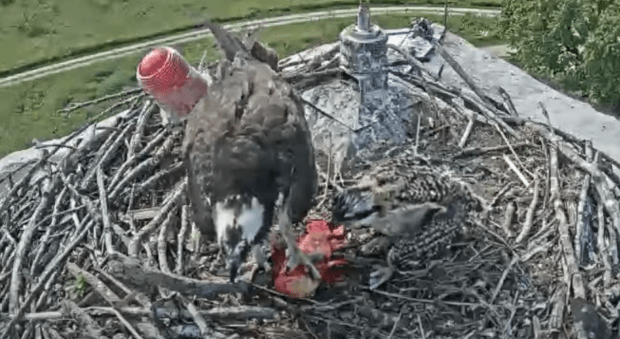
Right before the fish delivery the chick was being fed. Oh, what a lovely image – a little crop growing and mum on the nest feeding this very brave baby.

Here’s dad just about to leave after dropping off a bigger fish for these two. So glad that the waters were not stirred from the rain and storm last night.

Wee Bob had a nice crop. Mum is finishing up that nice fish. Both of them are going to sleep well tonight.

Everyone is celebrating the hatch of WBSE 27 and the pip of 28. Thankfully, they will be hatched close together. The sea eaglet bobbles are known for their sibling rivalry and fights over dominance in the nest. Perhaps this will help. We will see. For now, WBSE 27 is simply a little cutie leaning on ’28’.

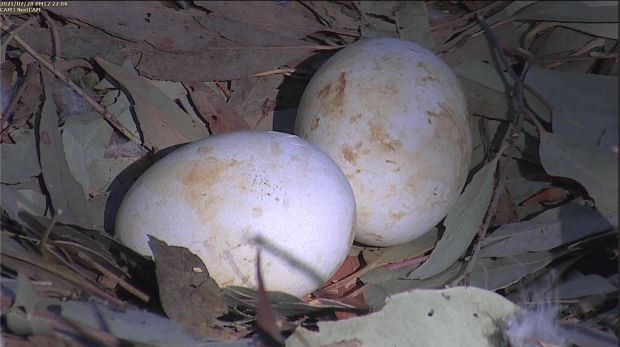
This is not a great image of the chick. Apologies. But you can see the pip starting in the second egg.

Lady sure looks happy with that little fluff ball sticking out in front of her.

Two things to notice. First, that white line down the front of the beak is the egg tooth. It actually sticks up like a little spike. The chick uses it to pound away at the shell. It will eventually disappear as the beak grows. Secondly, if you are used to Bald Eagle babies, you will notice that the natal down on the White-bellied sea eaglet is white, not grey.

This is the first breakfast of fish for this little one.

We are having wildlife fires in Canada just like parts of the United States. On Vancouver Island, the Bald Eagle juveniles have been heavily impacted by the fires, the drought, and the lack of fish in some areas. There are lots of eagles, ospreys, and other species in care.

My daughter sent me an article this morning about how the people on Vancouver Island have joined together to provide fish for the Bald Eagles in care. It is one of those feel good comings together – just like the people of Mlade Buky who fed Father Stork and the little ones or the people of the Glaslyn Valley in Wales who provided fish for Aran and Mrs G when Aran was injured and could not fish for his family.

Here is the link to this wonderful story of a community helping these amazing birds.

https://www.cbc.ca/news/canada/british-columbia/fish-for-hungry-baby-eagles-1.6121415

No one will ever hire me to be a wildlife photographer! I have a large lens that intimidates me at times but, after today, there will be another trip north to one of our provincial parks to take Osprey pictures ‘properly’.

This is the marshy wetland in front of the Osprey nest. There were lots of pelicans who did not want me to take their picture!

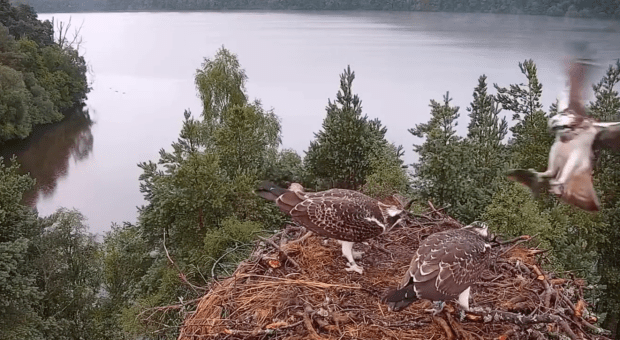
There is a mother and her two chicks in the nest. The mother is leaning down. Before I could get my camera ready the Dad had delivered a fish and left. My goodness. When this mother and the chicks saw the fish delivery getting closer, they were so loud that you could hear them easily 45 metres away.

You can see the profile of the mother better in the image below. The sky is so hazy because of the wildfires and smoke in the area.

This is an area of the park between the West and East entrance gates. This is where the Dad fishes.

Just across the road is this area full of pelicans fishing.

What you are seeing below is an Osprey platform that is unused. It is only about 7 metres from the road leading into and out of the park. The noise of the traffic would be a big deterrent to occupancy – at least to this auntie.

There is going to be camera and lens practice this weekend with a return visit before these juveniles fledge. As it turned out, the images taken with my phone were better than with my small camera. Next week, I will try and be brave when I use that other lens – like the Collins Marsh chick was during the storm.

Tiny Little has evaded me today. Hopefully tomorrow!

Thank you for joining me. It was so nice to get out of the city and get to see and hear the Ospreys that travel here to breed in the summer. It was a gift to see all four of the family today. Take care everyone. Keep sending warm wishes to the Collins Marsh nest. They are certainly working.

Thank you to the following for their streaming cams where I took my screen shots: Sydney Sea Eagle, Birdlife Australia, and the Discovery Centre and the Collins Marsh Nature Reserve.

Hatch is imminent at WBSE nest…red fish, Polish storks, and Tiny Little gets a fish

My virtual friend ‘S’ and I probably never thought we would be pouring over fish ID charts trying to identify partially eaten fish. OK. I can’t fully speak for her but even growing up with a dad who lived to fish, a son that travels the world to fish and feels more at home in a boat than on land, and a grandson that fishes in all his spare time – I never thought for a second I would spend more than a few minutes looking at the type of fish the Ospreys are eating. Surprise. The fish that comes to the Collins Marsh Osprey nest is making some of us very curious as to what it is and where mum is catching it.

The DNR of Wisconsin is great. They have games you can plan, fish ID charts by name or identifying marks. It was not until I found their posters today that I even believed there was hope of figuring out this fish. It looks like my late mother’s Siamese Fighting Fish but for its colour and size.

Thanks ‘S for this great screen capture.

Seriously I thought that the Mum at the Collins Marsh Osprey Nest had found someone’s ornamental fish pond to raids. This is at least the second fish of this species brought to the nest in a 24 hour period.

These are some of the top game fish in Wisconsin but nope. Nothing on this poster resembles that fish.

It isn’t a Roach but it could be a Rudd. But the Rudd hasn’t got red scales! There are suckers that look like a closer match.

This is beginning to drive me a little nuts. And don’t be shy. If you recognize that fish the mum is feeding her chick – tell me. I will be smiling for a week. Tomorrow I am going to ask the Naturalist at Collins Marsh. To be continued.

Dad was only seen on the Collins Marsh nest once today. Mum was busy bringing in these smaller fish for her and the chick. It is a good thing that she isn’t afraid to get wet – because if she were her baby would not be alive.

The chick will eat this species but it is certainly not its favourite and Mom, on the other hand, seems to like it or is so hungry she leaves hardly any scraps.

Speaking of eating, the female at the Bucovina Golden Eagle Nest brought in an Eurasian Hare for Zenit. Zenit wasn’t close to the nest tree when mum arrived and called but he quickly comes in mantling like crazy. When you see this eaglet or any of the fledgling Osprey aggressively going after prey, the term is hyperphagia. Every bird that migrates needs to eat as much as they can – compulsive overeating – in order to store fat for their migratory journey.

Lady Hawk caught all of the action and Zenit’s enormous crop in a video:

Some of the biggest news of the day is that 8:54 am on 28 July a pip was first noticed in one of the two eggs of Lady and Dad, White Bellied Sea Eagles, whose nest is in an Ironbark Tree in the Sydney Olympic Forest.

This was Lady checking, listening, and gently rolling the eggs about forty minutes later.

There is now a hole in that egg. So hatch is close.

I adore the little sea eaglets but this nest really broke my heart last year with WBSE 26 striving to live, to fly, to be a bird and then to have it end with her being euthanized.

I have seen prosthetic legs made for birds, 3D printed beaks for eagles, sophisticated operations on the webbed feet of Canada geese, and more. I have witnessed pain management programmes for animals in care and wildlife rehabbers like those at A Place Called Hope in Connecticut that not the extra mile – they go ten extra miles. All we have to do is remember the state that The Old Warrior was in when he arrived at their clinic. His lead levels were 48, he had multiple fractures in his leg, and his beak was so damaged that he could hardly eat. That old eagle wanted to live and he was treated accordingly. His lead levels are around 10, he is eating well, his feather condition is improving all the time. He is happy! Today he remains with the clinic as they await a permit for him to be their ‘forever Warrior’. I had hoped, like so many others, that something would be done to help 26.

There are several ways to access the cam for the sea eagles. There is even one with a chat room. I will try and locate those other links for you.

Here is cam 4. The definition is good.

I want to thank a follower from Poland who sent me a note suggesting I look at the beautiful stork nest in Ostroleka, Poland. So I did! There were five storks sleeping on this nest in the northeast of Poland.

What a picturesque village. The farmer’s fields are so lovely. Tranquil is the word I want to use as the sun rises on a new day.

I need to find out more about this nest which I will do in the coming days. I am trying to imagine the challenges for the parents to feed five – or is it four chicks and the parent is off the nest? Here is the link to the camera for this nest:

Tiny Little is not sleeping on the Foulshaw Moss Nest tonight. It is not clear to me whether he had a fish drop later last night or not. But after waiting for big sibling to get their fill of a large fish, Tiny Little is now eating for sure. It is 17:01 on the Foulshaw Moss Osprey Nest.

Of course, big older sister is sitting there waiting in line! Poor things. They always get caught up spending so much time around the cheek and mouth, the bony bits. Hopefully Tiny Little will get full before it gets tired.

I love it when the mother’s get out there fishing. We see that in the mom at the Collins Marsh Nest and here comes NC0 at the Loch of the Lowes.

That fledgling just about tore her leg off! I am looking at those strong thin legs of NC0. She has been diving and bringing in fish to this nest for at least a month. Soon she is going to have to begin bulking up for her flight to Africa. It’s that word: hyperphagia.

It has been a pretty exciting day. So nice to see some of the fledglings on the nests! It is comforting to know that they are surviving.

Thank you so much for joining me. I hope that everyone has a great day. Take care. See you soon.

Thank you to the following for their streaming cams where I took my screen shots: Collins Marsh Osprey Nest and the Neustadlter Nature Center, Cumbria Wildlife Trust and the Foulshaw Moss Osprey Nest, Sea Eagles, Birdlife, and Sydney Discovery Center, Ostrolekas White Stork Nest, and Scottish Wildlife Trust and Friends of Loch of the Lowes. I would also like to thank the Wisconsin DNR for the fish poster files and ‘S’ for sending me that great shot of that ‘gold’ fish.

White-Bellied Sea Eagles and the birds that visit their nest

In a 2014 article in The Smithsonian Magazine, Rachel Neuwer asks why there is a Sulphur Crested Cockatoo in a Renaissance image of the Virgin and child, Madonna della Vittoria. Rebecca Mead examines the image by Andrea Mantegna, painted in 1496. You can see the painting of the Madonna and child with saints in the article below (sorry, it has a copyright so I can’t show it). The Sulphur Crested Cockatoo is above the Virgin’s part in her hair a little to the left.

https://www.smithsonianmag.com/smart-news/why-there-australian-cockatoo-italian-renaissance-painting-180950227/

As I drank my morning coffee several days ago, I flipped through the latest New Yorker. In that 5 July edition, there is an article, Invasive Species.

https://www.newyorker.com/magazine/2021/07/05/where-did-that-cockatoo-come-from

Each writer considers how the Sulphur-Crested Cockatoo made its way from AustralAsia all the way to Italy focusing on the initial discovery of the bird in the painting by Heather Dalton, a British historian living in Australia.

The Mantegna is not, however, the first time that a parrot is included in a picture. Parrots show up in the murals of Pompeii, the Italian city buried by ash when Mt Vesuvius erupted in 79 CE. They are also the subject of floor mosaics in the region. Indeed, exotic birds (not just parrots) appear as subjects in many mosaics and frescoes in the Roman domus.

Alexander the Great’s army went as far as parts of India before stopping on their eastern expansion of his empire. Their presence on what is today the Indian subcontinent heavily influenced the art of the Gandharan region. In turn, Alexander acquired a parrot from the Punjab in 327 BCE. If parrots were in Italy 1700 years before the Mantegna, one might begin to ask what is all the fuss? The Barber Institute of Fine Art in Birmingham, England hosted an exhibition solely on parrots in art in 2007. They were exotic, they were status symbols, and it appears that they were present in the art of the Italian Peninsula for some 2400 years to today. Of course, they were not all Sulphur-headed Cockatoos and that could well be the reason for the continuing discussion about the Mantegna. Other species of parrots came from the southeastern coast of Africa and from the region of the Indian subcontinent and Southeast Asia. Sulphur-Crested Cockatoos originate in Australia and the islands of Indonesia and it was surely the trade through the islands of Indonesia that spirited the bird all the way to the port of Venice along with black peppercorns and other spices.

“20121210 Sulphur-crested Cockatoo (Cacatua galerita) – a first-time visitor” by Degilbo on flickr is licensed under CC BY-NC-ND 2.0

Sulphur-Crested Cockatoos are extraordinarily beautiful and are the largest of the white parrots. I have never seen them in the wild. Indeed, it was not until I watched the White-Bellied Sea Eagle streaming cam in the Sydney Olympic Park that I heard them before I saw them. It sounded like someone being murdered in the forest! Seriously. One of the moderators answered the question, “What is that?” Later, these lovelies were seen climbing all over the old Ironbark Tree.

Sulphur-crested cockatoos are nut, root, and fruit eaters and live for up to eighty years. They make their nests in tree hollows where the female lays one to three eggs. Those eggs are incubated for thirty days. The little ones remain in the nest being fed by the parents for a period of approximately sixty-five days after hatch. The breeding season for these parrots is August to January in the Southern Hemisphere.

Why am I talking about these parrots today? It is because of the White-Bellied Sea Eagles (WBSE), Lady and Dad. The two eggs that Lady has been incubating will be hatching in approximately two weeks. There is a live streaming cam that is on day and night, 24/7 year round except for maintenance. If you like birds of Australia, you can often see them coming and going around the Sea Eagles nest. The birds are either curious as to what is going on in the nest or they would like the Sea Eagles to leave! The streaming cam in the Sydney Olympic Park is the only one in the world that observes the second largest eagles in Australia.

It is in the middle of the night. This is the WBSE nest in the Ironbark Tree in the forest of the Sydney Olympic Park.

The Rainbow Lorikeets are curious. They come as a group climbing all over the branches of the tree. They are easy to spot!

“rainbow lorikeets” by cskk is licensed under CC BY-NC-ND 2.0

Every once in awhile the Galahs come to the Ironbark Tree. I think they are adorable. One of the WBSE chatters from Australia said that if anyone visits Australia and someone calls them a ‘Galah’, it is an insult meaning the person is not very smart. I have no idea how the Galah got that reputation except that I have seen several in the talons of Peregrine falcons in Australia.

“Galahs in Love” by David Cook Wildlife Photography is licensed under CC BY-NC 2.0

The Noisy Miners are definitely heard before they are seen. They are a constant in the forest around the WBSE Nest.

“Noisy miner (Manorina melanocephala) (24 – 27 centimetres)” by Geoff Whalan is licensed under CC BY-NC-ND 2.0

The Pied Currawong flits around the WBSE nest all the time. I do not like them! Once the nestlings have fledged the Currawongs gather and try to chase them out of the forest. They did this on the first try with WBSE 25 last year and during the re-fledging of WBSE 26.

“Pied Currawong” by Tatters ✾ is licensed under CC BY-SA 2.0

Then there is the smallest owl in Australia, the BooBook. Isn’t it cute? This owl, like all others, flies silently and it can see very well in the dark. It comes in the night hitting the WBSE has they roost for the night. They fly low over the nestlings trying to hit them and make them leave. One attack injured Lady’s eye last year. Despite their size they are to be taken very seriously. The BooBook often has a nest in the forest the same time as the WBSE so it is very protective and wants the eagles gone for fear they will eat its young.

“Boobook owl” by jeans_Photos is licensed under CC BY 2.0

Here is a compilation video of Lady and Dad after the first egg was laid through the 23rd of June. It shows the actual labour of the second egg and a changing of the incubation shift from Lady to Dad.

Here is the link to watch the WBSE in the Sydney Olympic Park:

https://www.twitch.tv/seaeaglecam

Be sure to check out the time difference. One of the most beautiful moments of the day is when the adults do a duet at sunrise. It is an amazing way to start the day. It wakes up the forest but it is also a continuous bonding method between the birds. The nestlings will join in with their parents when they are older. It will warm your heart. Here3 is a video clip I made after Lady laid the first egg. She leaves the nest and joins Dad on the branch for the singing.

Thank you for joining me today. It is now three days since Tiny Tot was at the nest. We are all having Tiny withdrawal. Take care everyone.

Thank you to the WBSE Streaming Cam, BirdLife Australia, and the Discovery Centre and Twitch TV where I took my screen shots and video clips.