The Sweet and the Bittersweet

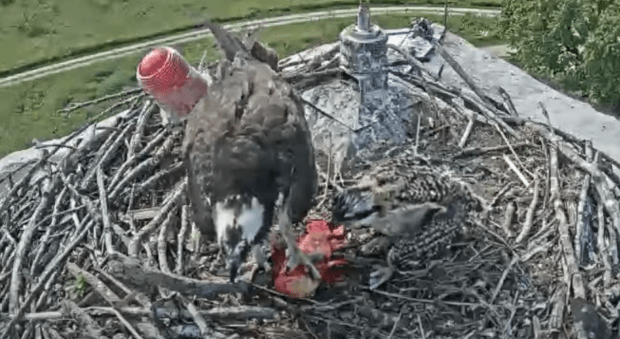
Ah, the sweet and the bittersweet. All of my friends from the Achieva Osprey Club who loved Tiny Tot or Tumbles as so many called her, will remember that she was the last fledgling to leave the nest. She was there for precisely four months – worrying us, causing us to lose sleep, cry, hope, cry again, bite our finger nails to the quick and watch the hurricane warnings with great anxiety. And then, of course, the miracle of it all, Tiny Tot became the most fierce and dominant bird to hatch on that nest this year. She will survive anything. No doubt. Tiny Tot stole my heart because of her ferocious desire to live. She had been starved – not being allowed to eat for several 72 hour long sessions by her two older siblings – and she tried every way to get around and get the food. Of those four months, she had no food for 12 full days, scattered more in the first half than the last. In the end, Tiny Tot ‘didn’t take anything from anyone’. She could handle an intruder as well as an adult – and she did, many times protecting the nest alone. Here she is a few days before she left the nest for good. She was gorgeous and she was the first miracle of 2021.

The second miracle I often talk about, too, is Tiny Little on the Foulshaw Moss Nest of White YW and Blue 35. Like Tiny Tot, Tiny Little is the only fledgling left on the nest in Cumbria. Everyone else but dad, White YW, has migrated. She has benefited, like Tiny Tot, from getting well fed, getting her flight skills in order, and not being in a hurry. She was enjoying a nice fish tonight for dinner (nest time). Will it be the last on the nest? Or will we get the pleasure of seeing her tomorrow? There are still plenty of Ospreys hanging on.

Polly Turner caught Tiny Little with her fish in this very short video!

The view this morning from the Glaslyn nest is Aran overlooking the valley. It reminded me of the paintings of the German Romantic painter, Casper David Friedrich. Aran’s healing from his late May-early June injury is something to smile about as well.

Idris and Dysynni were still at home on the Dyfi Nest. Idris brought in quite the catch for his boy, Blue 490. Telyn has not been seen since around noon on Saturday, 21 August.

That fish is just amazing. Idris you are so strong and just a great provider!

And what a beauty Blue 490 turned out to be. A lovely male.

So proud of his fish!

You can’t see them – sadly the camera at the Llyn Clywedog nest of Seren and Dylan and Only Bob, Blue 496. John Williams reports seeing Seren fishing and Only Bob later in the afternoon today, UK time. So they are still with us.

Maya was still at Rutland yelling as loud as she could for Blue 33 to get that breakfast fish on the nest! Ah, so happy to see you Maya. You deserve the time to get in great shape after the kids have headed off on their adventure.

I mention all of these because I really hope that Tiny Little is in no hurry to get on with her life. Selfish me. I want to enjoy her for a few more days.

In Latvia, everyone is elated. One of the storklings of Grafs has found the feeder!!!!!!!!!!!!! It is a success.

No matter where you live, remember this, please. In the future when our birds are at risk with no food or water – an area can be designed for them with a decoy to lure them to the site.

So happy for our friends in Latvia. It has been a long worrisome year.

Discussed on the Latvian Forum today is also a theory that the male, Grafs, lured the storklings off the nest by flying close and then flying away. This was what was suggested by chatter Liz01, a long time watcher and forum poster, “After the first storklet leave the nest on August 23 and didn’t come back, someone landed on the left. He flew away and the Storklets followed his departure with their eyes .. they turned and looked towards the forest on the right. One of the two, the eldest, took courage and flew behind. I already saw it yesterday, but only the departure and wondered how it could be that he chose this route. Now I have the explanation. It could be it was flying with Grafs!”

That is a very interesting and astute theory. I have seen hawks take a small piece of prey to lure their fledglings from one hunting spot to another or Peregrine Falcons that tease the eyases with prey flying in front of them to get them to leave. It is certainly a very credible idea by Liz01. Here is the link to the page where you will find photographs and a short video of what she noticed.

The wind continues in Sydney, Australia. At this point I am not prepared to report on the White Bellied Sea Eagles nest. The amount of prey has dropped to the point that I fear that WBSE 28 will be killed by 27. I do hope that the situation turns around. I am still working on how best to deal with the situation that occurred with Malin in the hope that people will learn and help wildlife. In a few weeks, someone let me know how WBSE 28 fared. Thanks.

Last a very rare sighting of a White-tailed Eagle has occurred in King’s Lynn, UK. If you are an eagle fan, have a read. This is amazing news.

https://www.edp24.co.uk/news/rare-white-tailed-eagle-spotted-in-kings-lynn-8270552?fbclid=IwAR2wzMu2VsM9qykrr8KSXX86DC3MvUQZqzcCs00iNhJ7kTeIMFzxdBZMUfc

In Manitoba, we are celebrating the work of our great vets, the rehabbers, and the visiting vets at Wildlife Haven. We also have the Manitoba Peregrine Falcon Recovery Project. I will tell you more about that in a couple of days. For now, our grand dame, Princess is 19 years old. She hatched in Minneapolis in 2002 and was translocated to Winnipeg that same year. Two years later she meets up with her first mate. She has had 4! In 15 years, she laid 54 eggs, hatched 46 chicks with 37 fledges. More about her later this week and her rescue. Everyone is happy.

Take care everyone. I am hoping to let you know that Tiny Little is still with us and has not started her migration. Just a few more days, please, Tiny Little. And where are Karl II and family? Updated reports tomorrow. Stay safe. Be kind to one another. Protect our wildlife.

I am grateful to the following for their streaming cams where I took my screen shots: The Cumbrian Wildlife Trust and the Foulshaw Moss Osprey Nest, The Latvian Fund for Nature and the Latvian Fund for Nature Forum, the Dyfi Osprey Project, LRWT and the Manton Bay Osprey Nest, the Achieva Osprey Nest, and the Brywd Gwyllt Glaslyn.

Fishy Dreams and Fish Tails

Today, the Collins Marsh Osprey chick, Malin, had six fish deliveries. SIX! Feel free to correct me but I don’t ever remember this much fish on this Osprey nest. Ever.

In fact, there was so much fish with deliveries coming in on top of one another that Malin simply could not eat all the fish. There is a bullhead left – it is on the left below the light. Malin is sleeping on half of a bigger fish. What a grand pillow for an Osprey. He can have fishy dreams all night! And, Malin can wake up in the morning and not have to wait for a fish delivery.

Fish. It makes all the difference in the health and well-being of our Ospreys and Storks.

In the image below, the setting sun puts a soft glow over our little one. Please note that the big feathers are now beginning to cross. Malin is also standing and walking more and is flapping his wings much more often to get them strong for flying.

A month ago there was concern that Malin would not develop his plumage and would be unable to fly successfully off the nest. Now just look! Food – the right kind of food and the amount of it – makes all the difference in the world in Malin’s development.

Malin is miracle #3 for 2021.

Here on the Foulshaw Moss nest, Blue 463 or Tiny Little Bob, is eating the fish her dad delivered. White YW would have heard her several miles away screaming for fish. Blue 462 had gotten the earlier fish and Tiny Little wasn’t liking it. Dad came to the rescue! Indeed, White YW and Blue 35 should get a round of applause. They pulled off a nest of three fledglings this year. They did not lose a hatch.

The crows are hoping that Tiny Little will leave some bites for them! I don’t know. She is a bit like a nest vacuum when it comes to food falling between the twigs!

Tiny Little is miracle #2 and, of course, miracle #1 is Tiny Tot from the Achieva Osprey nest in St Petersburg, Florida. I am certain that there are others that will come to mind when I publish this newsletter. For now, however, these three were enough to cause lots of anxiety.

I did a Sunday hop-skip-and-jump through some of the UK Osprey Nests to see if anyone was home. This is the Dyfi nest in Wales of Idris and Telyn. On the nest is Ystwyth, their daughter. Telyn is on the nest perch and Idris is on the far perch.

Idris and Telyn together. How beautiful.

Does he need an introduction? The chick on the Llyn Clywedog Osprey Nest, Only Bob? Only Bob was so big when he was ringed that everyone believed him to be a large female. Nope. It is just all that fish that Dylen and Seren fed him. My goodness did Blue 496 grow.

He has spotted Dylan flying in with a fish. We are so lucky to see this. Indeed, to see so many of the UK fledglings on the nests today is fantastic.

That is a gorgeous fish for dinner. Only Bob looks pretty excited.

Watch out for your toes Dylan.

Only Bob learned well despite the fact that he was the only chick on the nest. He is excellent at mantling. But, stop, and take a look at that tail and the size of those wings. I would be ever so grateful if Malin’s was half that size when he fledges.

Oh, let’s just move this beauty over here so I can eat it!

At least one of the chicks on the Loch of the Lowes has a huge crop. It is so big, it looks like it could pop. The other is hoping for a fish delivery. Of course, neither is showing us their pretty blue bands.

NC0 and Laddie have done an amazing job raising these two. NC0 has really moved up to be one of the females that I want to watch. She is becoming super mom. She can fly and haul fish to the nest just like Iris – and she isn’t afraid to do it!

Grafs was able to find enough fish for two deliveries today. The first was a bunch of small fish at 15:29 and the second came at 19:41 with some bigger fish. The storklings are starving. They are already beginning to show the signs of malnutrition.

Grafs makes sure he moves around so that each one gets a little something.

It was mentioned that not only the sunken bodies but also the fact that the bills are turning a bright colour indicates starvation.

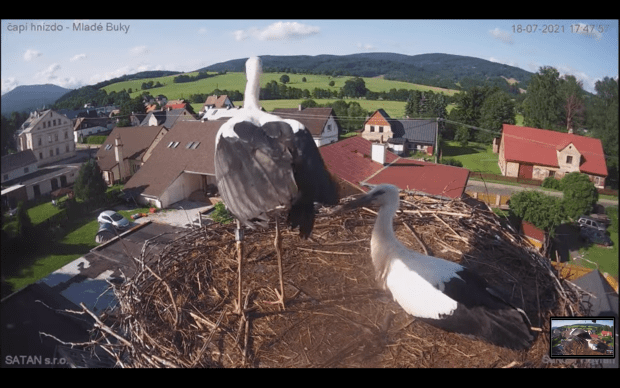
Once the people watching these nests realized what was happening, they became very vocal in their demands that the birds be fed. Everyone knows about the fish table that the two engineers set up for the White Storks in the village of Mlade Buky, Czechoslovakia. The people demanded that their storks be fed and the wildlife staff heard them. After seeing only one feeding by 15:00, Janis Kuze wrote the following on 15 August 2021: “It may be necessary to support the operation of the feeder – to bring live fish there regularly (once a day or two). I will write about it in the coming days.”

Liz01, the moderator of the looduskalender.ee/forum (English forum for the Latvian Fund for Nature and this Black Stork Nest) posted this notice:

“Due to the fact that the female has not been seen in the stork nest for several days, she has probably started migrating, opportunities are being sought to artificially feed this nest. Currently, the only feeder is the male, whose capacity is too small for the young birds to be successfully.
One way of trying to help the inhabitants of this nest is to set up an artificial feeder. There is one ditch near the nest where it can actually be done. Ornithologist Jānis Ķuze is ready to take over the management of this event, but he needs the help of the society. Therefore, we are looking for:
1) people on the Sigulda side who would help to set up a feeder,
2) human or fish feeders on the Sigulda side, which would be willing to donate and / or catch small fish (they must be still alive), with the possibility, to put these fish into the feeder, thus regularly
replenishing fish stocks in the feeder a third person or another link in the chain).
If anyone has the opportunity to help with this event, please send a message to Jānis Ķuze by e-mail: janis.kuze@ldf.lv.
This is currently the only real way you can still try to help the young birds in this nest survive and fly successfully! It is not known whether it will work, but we think it would be better to try not to do anything and just watch.”

Immediately, there were too many offers to help the Black Storklings and Grafs. Tears. People are so generous. All we have to do is ask.

If you wish to follow the discussion about what is happening at this particular nest in English, please go here:

When I have news of what is happening at the Estonian Black Stork nest, I will let you know.

You can watch the Black Stork Nest in the forest near Sigulda, Latvia here:

We all send our prayers and warm wishes to these beautiful birds and the people helping them. We need a miracle like that at Mlade Buky.

Thank you so much for joining me. It is wonderful to bring you such good news. Please send all your positive energy to Latvia and Estonia so that the efforts to save the Black Storklings from starving to death will be successful. It is heart warming to see so many people answer calls for help.

Thank you to the following for their streaming cams: The Latvian Fund for Nature, the Collins Marsh Nature Centre, Dyfi Osprey Project, Cumbrian Trust and the Foulshaw Moss Osprey Nest, Scottish Wildlife Trust and Friends of Loch of the Lowes, Llyn Clywedog Osprey Nest and CarnyX Wild, and Bywyd Gwyllt Glaslyn.

Just a note. My newsletter will be posted late on Monday 16 August. Thank you!

Tiny Little lands 3 fish for the day!

At one time there was fear that Tiny Little Bob, the itsy bitsy third hatch on the Foulshaw Moss Osprey nest would perish.

The top image is from 12 June. You can see how large 462 and 464 are at the time. There is our Tiny Little Bob sitting up looking over them.

This image is from 30 June. Tiny Little Bob has grow but is still shy and waits to eat. At this time, the banders cannot tell if 463 is a male or a female because of the lack of food and growth.

Today is 13 August. It might be hard for some to believe but Tiny Little now controls the nest. She is a big bird – the dominant bird – on the Foulshaw Moss Osprey Nest. Tiny Little has take three fish today. The first one at 6:08 am, the first fish to land on the nest today. Then she gets the fish at 16:16. And then, she snags the fish and is eating at 19:48. This is quite a change in status for a bird that people thought would die because the others were so large and cruel.

Long time readers know of my interest in the third hatch (or a tiny second that battled with a large first when there was no third). This year alone we have seen Tiny Tot (Tumbles) rise from the near dead several times on the Achieva Osprey Nest to grow into an aggressive survivor. Other researchers have sent me stories about other third hatches who came back strong. If you know of any, please do not write to me.

This is the best news of the day. Thanks for joining me for this very short newsletter. The voting closes at Collins Marsh today for the name of their Osprey. A very kind Wisconsin DNR Biologist has sent me their 2020 report on Bald Eagles and Ospreys. I will report on that tomorrow. And there is one other piece of good news. Idris had been missing on the Dyfi Nest since Wednesday the 11th at 13:16. This morning he showed up with a big fish for one of his fledglings. He had an extremely empty crop. Wonder what happened? This is great news as Telyn would have to delay her migration if he did not show up. A few Osprey adults have gone missing for a couple of days. Are they getting caught in something line line or netting?

Take care everyone!

Thanks to the Cumbrian Wildlife Trust and the Foulshaw Moss Osprey Nest and the Dyfi Osprey Project for their streaming cam where I took my screen shots.

Tiny Little, it is good to see you!

Friday morning started off fantastic with Tiny Little on the nest alone food calling. She was later joined by older sibling, 462.

What you need to know is that Tiny Little had an entire fish to herself a little earlier for breakfast! Just look at her enjoying that fish!

7:45 nest time. Nice fish delivered by White YW to his girl.

Tiny Little returned later and was joined by 462. Yes, I said that already! They waited and waited. All that waiting and food calling paid off! Both Tiny Little (or Bobbie to some) and older sibling got a fish – older sib gets the flounder, Tiny Little has something else (?). Dad, you are fantastic. This is the way to keep the kids happy and quiet.

Tiny Little is the fledgling on the right. She is a ‘big’ girl! I am just so delighted to be able to see her. She is growing and growing. Tiny simply doesn’t fit anymore!!!!!!

This is the link to the Osprey Nest at Foulshaw Moss managed by Cumbrian Wildlife Trust:

https://www.cumbriawildlifetrust.org.uk/wildlife/cams/osprey-cam

But there was more happiness. To top it off, the little Osprey nestling at Collins Marsh Nature Centre had two feedings before 9:30 this morning. If this pace keeps up Malin is really going to have a big growth spurt this week. Already the tail and back feathers are remarkably changed from last week.

And another feeding here. So happy to see these parents stepping up the food. Malin is really starting to present as a juvenile Osprey now. I keep looking at those little feet – wonder if we have a little boy here? Male or female it doesn’t matter. Malin is really a gorgeous/handsome.

The link to the Osprey nest at Collins Marsh is here:

https://www.cumbriawildlifetrust.org.uk/wildlife/cams/osprey-cam

One of my readers was asking about the nest for the Black Storks in Latvia. I was able to find some information and a couple of images so that you can see the beautiful forests in the area.

The nest is in a forest in the Sigulda region of Latvia. It is 53 km southeast of the capital, Riga. It is the orange area on the map below.

The area is home to Sigulda New Castle and the remains of a medieval castle built in 1207.

The image below is the New Castle.

“Siguldas jaunā pils (Sigulda Castle)” by twiga_swala is licensed under CC BY-SA 2.0

Through the forest you can see the New Castle.

These are the remains of the medieval castle. It is a major tourist site and because of this, Latvia has stabilized some of the walls so it can be fully appreciated.

The nest in the forest is on a pine branch that extends about 1.8 metres from the trunk of the tree. So, in plain English, the nest is on a branch that is sticking out —- just a big branch! I know. Take a deep breath. It could make you nervous. The nest is 18 metres from the ground. Imagine these storks on such a branch! I kept thinking they could slide off the edge.

The youngest storkling is 53 days old today. It is flapping its wings and gets really excited. The eldest is 56 days old and the middle one is 54 days.

The adults, Grafs and Grafiene, have to be very careful when they come to feed their little ones now so they do not slide off the nest. It is getting a little crowded as the nestlings grow!

One of the moderators for the nest forum created a video of Grafiene coming to feed the storklings about one month ago. It is very short but shows us just how much these nestlings have grown in that time. Just look how tiny they were.

All of the storks meet to begin their migration. ‘S’ tells me that they land on the tops of all the houses, the hydro poles, and the trees. And then they begin clacking and this is the beginning of their long journey as far as South Africa. Everyone is a little sad when they leave.

The link to the Latvian Black Storks is here:

Don’t all babies look sweet when they are sleeping? The little sea eaglets are no exception. You would never know that they are so tired from all the mischief they cause when their parents aren’t watching.

They look like little angels.

Dad is making sure that there is lots of food on the nest.

Here is the link to the White-Bellied Sea Eagle nest in Sydney’s Olympic Park. It is the only WBSE nest in the world that is streaming live. One of the really neat things is just listening to the forest sounds when the streaming cam is on. You will hear many Australian birds. There are lots of YouTube videos of the birds and the sounds they make. Just do a search of ‘Australian Bird Sounds’.

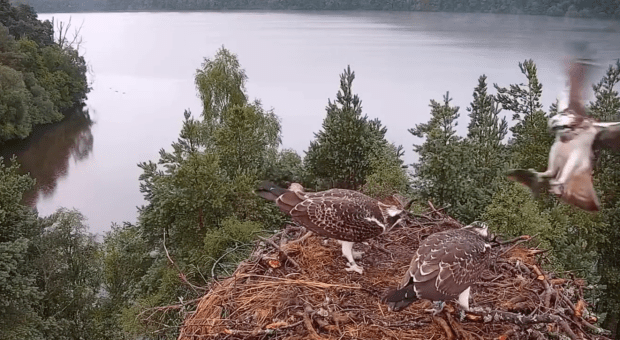
There has been a lot of chatter about when the female ospreys in the UK will be leaving the nests and heading off on their migration. Blue NC0 is still up at the Loch of the Lowes working hard, along with Laddie, to feed LM 1 and LM 2. She is known to catch big fish and this morning she brought in a whopper. The sad part was NC0 worked so hard to get this fish out of the water and on to the nest and one of the kids let it fly off the nest. It happens but we all must appreciate the real effort these parents put into feeding these juveniles especially when they must be eating themselves, fattening up, to make their journeys.

NC0 has turned into one wonderful mom over the season. It has been such a joy to watch her develop from when the little ones hatched and we had no idea if she was going to figure out how to feed them!

The fledglings still associate the nest with food so you might still get in some good action. This has to be one of the most beautiful nest locations in the world. When I went to check, I could see the Ospreys flying around and food calling on the branches at the top left of the image below. So turn up your sound and look there when you check on this nest.

Here is the link to their camera:

I checked to see if the names had been announced for Louis and Dorcha’s chicks on the ‘other’ Lock Arkaig nest. There seems to be no mention or I have missed it. So hold on. Will let you know as soon as I hear anything! I am also waiting for the Collins Street Peregrine Falcon cam to come on live. You are going to be in for a real treat with that falcon nest! I promise.

Thank you for joining me today. I hope everyone is well. Tomorrow I am heading out to find the local hawk. Expect news to come in the late afternoon for all the nests. Enjoy your weekend. Stay safe.

Thank you to the following for their streaming cameras where I took my screen shots: The Latvian Fund for Nature and the Sigulda Black Stork Nest, the Collins Marsh Nature Centre and Osprey Cam, the Sea Eagles, Birdlife Australia, and Discovery Centre, the Scottish Wildlife Trust and the Friends of the Loch of the Lowes.

Hatch is imminent at WBSE nest…red fish, Polish storks, and Tiny Little gets a fish

My virtual friend ‘S’ and I probably never thought we would be pouring over fish ID charts trying to identify partially eaten fish. OK. I can’t fully speak for her but even growing up with a dad who lived to fish, a son that travels the world to fish and feels more at home in a boat than on land, and a grandson that fishes in all his spare time – I never thought for a second I would spend more than a few minutes looking at the type of fish the Ospreys are eating. Surprise. The fish that comes to the Collins Marsh Osprey nest is making some of us very curious as to what it is and where mum is catching it.

The DNR of Wisconsin is great. They have games you can plan, fish ID charts by name or identifying marks. It was not until I found their posters today that I even believed there was hope of figuring out this fish. It looks like my late mother’s Siamese Fighting Fish but for its colour and size.

Thanks ‘S for this great screen capture.

Seriously I thought that the Mum at the Collins Marsh Osprey Nest had found someone’s ornamental fish pond to raids. This is at least the second fish of this species brought to the nest in a 24 hour period.

These are some of the top game fish in Wisconsin but nope. Nothing on this poster resembles that fish.

It isn’t a Roach but it could be a Rudd. But the Rudd hasn’t got red scales! There are suckers that look like a closer match.

This is beginning to drive me a little nuts. And don’t be shy. If you recognize that fish the mum is feeding her chick – tell me. I will be smiling for a week. Tomorrow I am going to ask the Naturalist at Collins Marsh. To be continued.

Dad was only seen on the Collins Marsh nest once today. Mum was busy bringing in these smaller fish for her and the chick. It is a good thing that she isn’t afraid to get wet – because if she were her baby would not be alive.

The chick will eat this species but it is certainly not its favourite and Mom, on the other hand, seems to like it or is so hungry she leaves hardly any scraps.

Speaking of eating, the female at the Bucovina Golden Eagle Nest brought in an Eurasian Hare for Zenit. Zenit wasn’t close to the nest tree when mum arrived and called but he quickly comes in mantling like crazy. When you see this eaglet or any of the fledgling Osprey aggressively going after prey, the term is hyperphagia. Every bird that migrates needs to eat as much as they can – compulsive overeating – in order to store fat for their migratory journey.

Lady Hawk caught all of the action and Zenit’s enormous crop in a video:

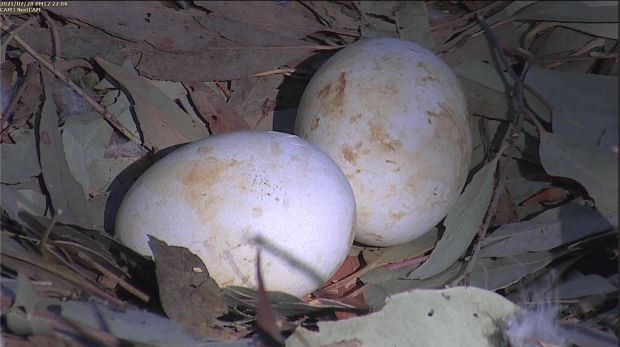
Some of the biggest news of the day is that 8:54 am on 28 July a pip was first noticed in one of the two eggs of Lady and Dad, White Bellied Sea Eagles, whose nest is in an Ironbark Tree in the Sydney Olympic Forest.

This was Lady checking, listening, and gently rolling the eggs about forty minutes later.

There is now a hole in that egg. So hatch is close.

I adore the little sea eaglets but this nest really broke my heart last year with WBSE 26 striving to live, to fly, to be a bird and then to have it end with her being euthanized.

I have seen prosthetic legs made for birds, 3D printed beaks for eagles, sophisticated operations on the webbed feet of Canada geese, and more. I have witnessed pain management programmes for animals in care and wildlife rehabbers like those at A Place Called Hope in Connecticut that not the extra mile – they go ten extra miles. All we have to do is remember the state that The Old Warrior was in when he arrived at their clinic. His lead levels were 48, he had multiple fractures in his leg, and his beak was so damaged that he could hardly eat. That old eagle wanted to live and he was treated accordingly. His lead levels are around 10, he is eating well, his feather condition is improving all the time. He is happy! Today he remains with the clinic as they await a permit for him to be their ‘forever Warrior’. I had hoped, like so many others, that something would be done to help 26.

There are several ways to access the cam for the sea eagles. There is even one with a chat room. I will try and locate those other links for you.

Here is cam 4. The definition is good.

I want to thank a follower from Poland who sent me a note suggesting I look at the beautiful stork nest in Ostroleka, Poland. So I did! There were five storks sleeping on this nest in the northeast of Poland.

What a picturesque village. The farmer’s fields are so lovely. Tranquil is the word I want to use as the sun rises on a new day.

I need to find out more about this nest which I will do in the coming days. I am trying to imagine the challenges for the parents to feed five – or is it four chicks and the parent is off the nest? Here is the link to the camera for this nest:

Tiny Little is not sleeping on the Foulshaw Moss Nest tonight. It is not clear to me whether he had a fish drop later last night or not. But after waiting for big sibling to get their fill of a large fish, Tiny Little is now eating for sure. It is 17:01 on the Foulshaw Moss Osprey Nest.

Of course, big older sister is sitting there waiting in line! Poor things. They always get caught up spending so much time around the cheek and mouth, the bony bits. Hopefully Tiny Little will get full before it gets tired.

I love it when the mother’s get out there fishing. We see that in the mom at the Collins Marsh Nest and here comes NC0 at the Loch of the Lowes.

That fledgling just about tore her leg off! I am looking at those strong thin legs of NC0. She has been diving and bringing in fish to this nest for at least a month. Soon she is going to have to begin bulking up for her flight to Africa. It’s that word: hyperphagia.

It has been a pretty exciting day. So nice to see some of the fledglings on the nests! It is comforting to know that they are surviving.

Thank you so much for joining me. I hope that everyone has a great day. Take care. See you soon.

Thank you to the following for their streaming cams where I took my screen shots: Collins Marsh Osprey Nest and the Neustadlter Nature Center, Cumbria Wildlife Trust and the Foulshaw Moss Osprey Nest, Sea Eagles, Birdlife, and Sydney Discovery Center, Ostrolekas White Stork Nest, and Scottish Wildlife Trust and Friends of Loch of the Lowes. I would also like to thank the Wisconsin DNR for the fish poster files and ‘S’ for sending me that great shot of that ‘gold’ fish.

Late Thursday and early Friday in Bird World 22-23 July 2021

The Royal Albatross ‘Cam Princess’ for 2021, Taiki, was banded on Taiaroa Head, New Zealand on 22 July. Taiki is Maori and means ‘protector of the land and sea’. She now has a permanent metal band with a unique number to her and a white plastic band with the number 60 on it on the other leg. The white designates the chicks that were born this year. All 34 of them will get a white band. When they return to land, after being at sea from 4-6 years, they will receive the adult colour bands. For example, Taiki’s mother is Lime-Green-Lime (LGL). Can you imagine being at sea and only returning to walk on the ground after being away for all that time?

Here is an image of Ranger Sharyn putting on the bands.

And here is the video that the Cornell Labs did of the entire banding session.

It is unclear how many fish came up to the Collins Marsh Osprey Nest today. ‘S’ noted one medium fish. I did check in on the nest and caught the chick standing. That is very good. It is getting its juvenile feathers and it is beginning to get strength in its legs to walk and stand up. Excellent.

One of the most beautiful times of day at the White-Bellied Sea Eagle nest in the Old Ironbark Tree in Sydney is early morning. The forest is waking up. You can hear all the birds singing including the Sulphur-Crested Cockatoo, the Noisy Miners, and the Currawongs. We are just getting a trade off on incubation duty (I believe) when I checked the nest. We should be on hatch alert in a couple of days!

It is so calm and peaceful in the forest. No one is allowed inside this restricted area other than the Rangers and specific staff of the Discovery Centre.

Here is another hand off around 13:30 this afternoon.

The adult plumage is this beautiful slate blue grey with a white head and underbelly. The juveniles are the most gorgeous rusty-espresso.

I want to give you the link to the Sea Eagle camera so that you can start watching. It is very exciting. The little ones are fuzzy white when they hatch. So cute.

It is 4:59 and Tiny Little has already flown off the Foulshaw Moss Osprey Nest.

Just looking at that nest reminds me how grateful everyone was when Tiny Tot stayed around the Achieva Osprey nest for so long. In fact, for four months we got to enjoy seeing that wee one grow up. We saw her change from the beaten, pecked, and starved little one to a ferocious independent fledgling. What a gift we were given! We never know how long we are given with these ‘special survivors’ so we have to savour every minute. Tiny Little will, no doubt, return to the nest when there is a fish drop unless the parents begin to feed the fledglings off nest.

Ah, and before I stopped writing it seemed like a good time just to check on that Foulshaw Moss Nest again and guess what? Tiny Little is there with another sibling waiting for the breakfish drop!

Tiny Little, 463 on the left and 462 on the right.

And they both got their wish!

Some good news was posted today. Seventy eggs of the Black Foot Albatross from Midway Island were transported to Guadalope Island, Mexico. I mentioned this in an earlier blog last week. It has now been confirmed that all 70 of the eggs hatched and all 70 of the chicks have fledged. You can’t get any better than 100%.

One of my friends and readers lives on the Hawaiian Islands. She mentioned the colony of Albatross Hawaii they have. That reminded me to introduce you to a very special person who founded the Kauai Albatross Network.

Her name is Hob Osterlun. In this short clip, she is doing a one person play on her life as a nurse for nurses and doctors and she talks about how the albatross changed her life.

That short video, Kapuna Life, mentions Hob’s book, Holi Moli. I recall the first time I read it. I devoured the pages reading from late in the evening to the wee hours of the morning.

So many of you reading my blog have been moved by ‘the birds’. Whether it was during the pandemic or before, a two legged creature with feathers – that fly or not (we can’t forget about the Kakapo) – touched you in a way that is probably hard to describe. For Hob Osterlund, having that Laysan Albatross touch her foot was extremely powerful.

Here is a beautiful video about Hawaii and the Albatross. It is an hour long. Watch pieces of it or the whole thing when you have time. These are such beautiful birds. Hob never gets tired of talking about them!

It is a scorcher in southern Manitoba and Winnipeg today. Yesterday my daughter and her sons got to see an Osprey dive for its fish at Lake Winnipeg. She saw the nest using binoculars with its two chicks, too. We have a number of Osprey platforms placed by Manitoba Hydro around Victoria Beach, Grand Beach, Grand Marais and on the way to our Iceland city, Gimli. How lucky they were!

Thank you for joining me. Stay safe everyone! Stay cool. Remember to leave water out for the birds.

Thank you to the following whose streaming cams I use to get my screen shots: Cumbrian Wildlife Trust and the Foulshaw Moss Osprey Nest, Collins Marsh Reservoir Osprey Cam, Cornell Bird Lab and NZ DOC, Sydney Sea Eagles, Australian Bird Life, and the Discovery Centre.

Fledge at Mlade Buky and other news in Bird World

We have a fledge at the White Stork nest in Mlade Buky!

Oh, this is just so wonderful. The people of this community can be so proud as these three beautiful birds leave their nest. It was their help that made it possible for these three to be alive today. Bravo.

Here is the video so you can watch it.

The heat wave has taken more tolls on birds in the Pacific Northwest not just the Osprey chicks that literally roasted in the nests. Cooper’s Hawks have been jumping off the edge of the nests so they do not get cooked by the hot sun. This is a real tragedy in the making. Even the number of birds at my feeders is down. They spend the day in the myriad of vines in the shade of the house and the lilac bushes only coming out to drink and return to shade. The outside temperature near the water bowls reads 34 C. That is hotter than it is in the West Indies! So please put out water for the birds! Find old dishes and provide them with something. Thank you!

I hope that you are able to open this. If not you could Google ‘hawks jumping out of nests to avoid heat’. This is just so sad.

The streaming cams for many of the nests are being turned off as the season ends. Glaslyn will turn off the feed to Aran and Mrs G’s nest shortly as will Rutland Water on the Manton Bay Nest of Blue 33 and Maya. We will look forward to another season with them in the future. Blue 33 and Maya are a super Osprey couple – celebrities if you will allow me to call them that. They have been together since 2015 and have fledged 17 chicks. They raised a nest of four in 2019. That is almost unheard of and really takes a strong male to feed that many. I am impressed. I told someone if I came back as an Osprey in another life I wanted Blue 33 for my mate. He is incredible. They will return to the Rutland Manton nest in late March – usually within an hour of one another.

I expect many others will follow as it is costly to run the cameras. If you go to the camera and it is not functioning check the nest’s FB page. They have probably turned off the camera til the next season. But please remember that the breeding season is only beginning in Australia with the Peregrine Falcons, Port Lincoln Ospreys, and the WBSE.

NC0 up at the Loch of the Lowes nest is out fishing for her chicks. She is incredible. She spots the fish from the nest and dives down and gets it. Here is a very rough cut of a video of the two Loch of the Lowes chicks enjoying themselves.

I never thought I would say that a Golden Eagle nestling was cute but Zenit certainly is.

Zenit is really working on his wing flaps and from his crop it appears that he has had a feeding. That is good. I am just thinking how lucky Zenit is to be in a tree nest with shade.

Kindness is one of the cutest Bald Eagle nestlings I have ever seen! Here she is again trying to nibble around mom.

Oh, how beautiful. Kindness sitting next to Mom. Everyone thinks Kindness is a female because her Dad loves to feed her!

You are getting to be a big girl, Kindness. You are 52 days old today! More than halfway to fledge which will be around 89 days – the average for the Glacier Gardens nest. (The average in Alaska is 80 days).

Tiny Little has been in the nest every time I checked on her. A fish came in and 462 ate and ate. Then 464 came and couldn’t get the fish tail down. Tiny Little was playing with it when White YW brought in another fish. Tiny Little ignored it and dad left with the fish! Silly Tiny! Some dads will feed their chicks but White YW doesn’t seem to do this very often preferring that Blue 35 take on those duties almost exclusively. Tiny Little has yet to get confident in opening up a fish with a head.

White YW returned to the nest at 17:39 and Blue 35 flew in to feed Tiny Little. Tiny did not ignore that fish this time!!!!!!!

Oh, she just loves being fed by mum. Tiny Little eats for about forty minutes.

This kiddo should be stuffed.

At 21:00, Tiny Little and big sib 462 were cuddled up duckling style read to sleep.

It is not clear to me if Tiny Little ever did a second flight today. She was flapping those wings really hard and walking around the nest looking down for a long, long time. Often I had to leave only to return to find Tiny on the nest. Maybe someone saw her fly again?

Tiny tried everything but getting over on the middle left side of the nest and just going for it like she did when she fledged was something she did not do. There were a few good hovers. Fingers crossed for tomorrow. Need to get those wings strong and self-feeding down for migration.

The couple who saved the little osprey chick that fell into the river at the Putuxent Osprey Nest 2 were surprised that so many people from around the world watch their birds! I mentioned to them the need for an emergency number on the streaming cam. Fingers crossed! Thank you to everyone that sent them a thank you note. The chick is doing well.

Thank you for joining me for a quick look at a few nests on a Sunday evening. Take care. It is very hot in so many places or there are torrential rains and flooding. So where ever you are be careful.

Thank you to the following for their streaming cams where I took my screen shots: Glacier Gardens Park, Cumbrian Wildlife Trust and the Foulshaw Moss Osprey Nest, Mlade Buky White Stork Cam, Patuxent Park Osprey Cam 2, and Asociatia Wild Bucovino.

Late Friday and early Saturday in Ospreyland

There is news in Ospreyland, some good and some not so good. I am going to start with all of the good news.

Those who follow and read about Ospreys know that there are certain ‘truths’ that are held dear. These ‘truths’ get passed down through books, Websites, and conversations. One of those is that a male fledgling will ‘always’ return to its natal nest area on its first migration ‘home’. The question is how true is that statement? Is it 90% true or 80% or with all of the unringed birds is it even 50% true? There are always exceptions! It was reported today that Rutland’s Maya and Blue 33’s 2015 male chick S2 has been breeding in the Biesborch National Park in The Netherlands for the past two years. In 2020 S2 and his mate fledged three chicks and in 2021 they have two in the nest. Fabulous news.

Male 022 has been courting CJ7 since he first returned as a two year old from his first migration. Initially, this young male wasn’t quite sure of the ‘process’. What he didn’t know he made up for in enthusiasm. Could he hear everyone shouting “Bring her a fish!” Sometimes he would bring a fish but he would not share. Sometimes he shared. Meanwhile they were mating all over Poole Harbour – seriously, they were. 022 has certainly grown into understanding his role. He has been working on the nest with CJ7 and today he brought her a fish and gave it to her to enjoy – a gift. How sweet. He has done a sky dance for her and now we watch and then we will wait for next spring when everyone hopes that these two will be a couple and raise some chicks. 022’s sky dance was the first seen in 200 years in Poole Harbour. Oh, please let this couple have a nest of healthy chicks next year that fledge! Poole Harbour might announce a holiday in their honour.

The eldest chick has fledged at Foulshaw Moss, Blue 464. The others look surprised! Who will be next? That special moment was caught here on a short video:

Tiny Little has been doing a lot of wingersizing. Will he be next? He is doing a great job and I know that he is going to grow up and be as strong and fierce as Z1, Tegin.

And Tiny Little is clever, like Tiny Tot in the Achieva Nest. Today, he sniffed about and found a piece of leftover fish that the other siblings had forgotten. Tiny Little had a nice little self-feed over in that front corner. He is a survivor.

You can see that he is still Tiny but not as tiny as he once was! What a little cutie. In addition, his eyes are fine. There were some early issues, perhaps from one of the older siblings pecking him about but all seems fine now. Tiny Little is in the clown feet stage!

White YW brought in a nice fish for Blue 35 for breakfast. Guess who was first in line? You got that right – Tiny Little! Go Tiny Little, Go!

Everyone ate and had nice crops and Mom even got the fish tail.

At Loch Arkaig, there appears to be a new couple working on bonding. YP and Blue 152 have been bringing in moss and sticks to add to what Louis did in the early spring while he waited for Aila. It will be grand to have a couple in this nest next year although I have to admit that I wish it were Louis and the new Mrs Louis.

After the heat and the storms the two Osprey nests in Albert, Exshaw at Canmore and the nest at Red Deer appear to be doing well.

This is Exshaw this morning. It is a sunny dry day and the chicks are sleeping after a 5:35 am breakfast.

Legacy is doing fine, growing like a bad garden weed, down in Red Deer:

Good news coming in from Loch of the Lowes is that the first fledgling has returned to the nest and taken its second flight with mom, NC0. The first fledgling at Foulshaw Moss, has also returned to the nest. Well done!

Now for some of the sadness. The concern in Canada’s West is the growing number of wild fires active in the province of British Columbia. Last week 330 were added to a growing list of over 780 fires. The impact on wildlife now and in the future is alarming not counting, of course, the human and property cost. The province desperately needs rain and lots of it.

News has come to me from my friend, ‘T’ that goshawks have taken the lives of two banded Osprey chicks in a single Latvian nest and another chick at a nest in Spain. This is so very, very sad. The chicks were big – already ringed – in earshot of fledging.

“Goshawk” by Andy Morffew is licensed under CC BY 2.0

‘L’ has reported that a fledgling Bald Eagle was killed when it landed on a power line in Dayton, Ohio. This is so very sad because we have known for decades the problems with power lines. There could be a silver lining to this story – the community has spoken to the local power company and they seem willing to do something to their poles so that these tragedies will not happen again. Let us hope that they work fast. There are other fledglings in that nest! Indeed, every power line needs to be ‘bird friendly’. This should be standard practice.

Thank you for joining me on a sunny and going to be crispy hot Sunday on the Canadian Prairies. The news in my garden is curious. After the extreme heat wave, the number of birds at the feeders seems to be less. Strange, however, is the now regular appearance of a dozen or more Blue Jays. We always had 3. Mr Crow and family are not happy about the Blue Jays but they won’t enter the yard to try and escort them away. Perhaps the number of Blue Jays has driven the other birds away — except for Mr Woodpecker and baby. The tiny Downy fledgling was here yesterday! They are always so quick and gone by the time I have grabbed my camera.

Take care everyone. I hope to have news of Big Red, Arthur and the Ks this evening. Stay safe, stay cool. See you soon.

Thank you to the following for their streaming cams where I get my screen shots: Fortis Albert Red Deer Osprey Nest, Fortis Albert Exshaw Osprey Nest, Cumbria Wildlife Trust and Foulshaw Moss Osprey Nest, and the Scottish Wildlife Trust and Friends of Loch of the Lowes.