Late Thursday in Bird World

In my excitement about the eaglets this morning at the KNF and the NEFlorida nests, I really did forget to say thank you to the people and the companies or government departments that sponsor and take care of the streaming cams so that we can learn about wildlife. My great hope is that by learning and caring about these amazing creatures and the challenges that they face, the more each of us will do to help out the environment whenever and wherever we can so that the lives of these beautiful raptors and seabirds continues.

Some of you might have seen the posting elsewhere but I want to mention it here in case you did not. A fully grown adult Bald Eagle flew into a plate glass window in a house in PA. It is in care.

https://www.wagmtv.com/2022/01/27/bald-eagle-crashes-into-houses-front-window/

This is nor the first time an Eagle has flown into a window although you are probably more familiar with the smaller birds that hit the windows and either get stunned and are alright or their necks are broken. There are solutions to this problem. The first one is to not clean your windows so that you can see reflections in them! Yes, I am inviting you not to make ever window in your house spotless. What a concept. The second is to install decals to prevent bird strike. Some of these work better than others. The third is to have ultraviolet barriers put on your windows. The last is something ingenious that I saw at our nature centre yesterday. They had 2 x 2 wooden boards cut the width of the window. Holes drilled in the bottom of the boards every 3 inches. Inserted inside were 1/4 inch nylon cords cut to the length of the window. They were glued into the holes. You could easily put the hole all the way through and tie the cord. These were hung outside the windows of the nature centre. The cords blew in the wind and they have never had a window strike despite having so many windows. I will take a photo the next time I am out there. I have so many birds in my garden and they all go flying madly in all directions if Sharpie arrives so, my windows are never spotless clean – never. I also have vines that hang down and the birds sit there and eat the berries or build their nests so – so far, any window strike problem has ceased.

In other Bald Eagle news, R-7, nicknamed Rover by the people of Brooklyn, was in Central Park giving everyone an absolute delight. How many Bald Eagles have you seen in Central Park? Incredible.

If you love urban raptors as much as I do and want to keep up with what is happening in New York City, I highly recommend Bruce Yolton’s blog urbanhawks.com

Everyone knows that I have a huge soft spot for the little eaglet of Anna and Louis. How could you miss it? At 15 days old this little one is a real charmer. What a beautiful image of it looking so lovingly up to its Mum.

The pantry is full of the most amazing things – all freshly provided by Kincaid Lake – Coots, ducks, all manner of fish including a large Bass today, and yes, turtles. With such a varied diet, this little eaglet and its parents are super healthy.

I am getting more than curious. Anna is feeding the eaglet on the KNF nest and there are 50 people watching.

Just look at that little one’s crop. No shortage of food, great parents, beautiful setting, super mods on the chat, super cameras, and great sound! That is what KNF has to offer.

There are 2129 people, as opposed to 50 at the KNF nest, watching the Bald Eagle incubate eggs at Big Bear.

What makes one nest more popular than another? I would love to hear your thoughts on this. Feel free to write me a comment or send me a note at maryannsteggles@icloud.com I seriously do not understand and want to!

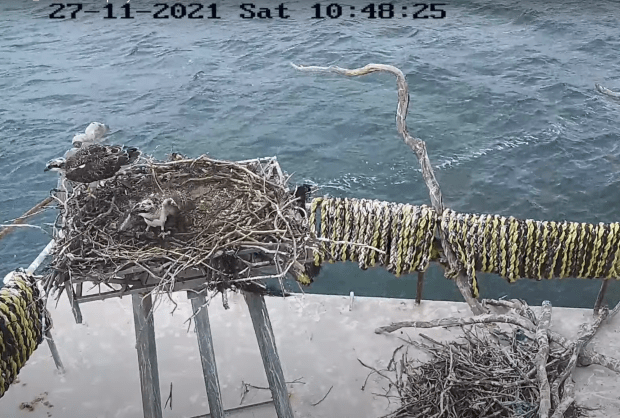
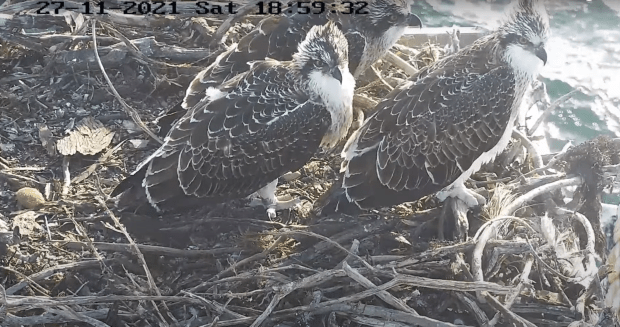
The streaming cam at the Port Lincoln Osprey barge is still on the blink. For a few minutes Ervie was caught on the nest sleeping so all is well there.

For those of you that are fans of Xavier and Diamond, you might be aware that the temperatures in parts of Australia have hit all time highs of 50.7 C or 123.6 F. That heat really impacts the wildlife including the Peregrine Falcons who are being brought to the wildlife rehabbers for care. The one below is doing well!

Speaking of falcons, one of the pair (I could not make out which ones) was on the NE ledge of The Campanile just now at UC-Berkeley.

Diamond was on the ledge of the scrape. It was a bit foggy early in the morning with what looks like some rain. I checked and the temperatures seem to have cooled down considerably.

Well, I said it was civilized but despite an overflowing pantry provided by Samson, NE26 wants to be a bit of a ‘not so nice’ big sib at the most recent feeding. AWWWWWW.

Samson is really in competition with Louis for the most items in the pantry! Gabby is fabulous mother. “26, you need to settle down. Everyone gets fed.”

The eaglet at the Kisatchie National Forest just ate.

Anna filled up its crop. That baby is sound asleep in slumberland.

So if you don’t want to watch 26 bash 27 a bit, tune into the cutest eaglet at KNF. Here is the link:

Jack and Diane at the Achieva Osprey Nest were caught on camera mating on the nest today. Everyone is on egg watch as Diane settles. There is certainly excitement brewing amongst the chatters as Osprey season in Florida quickly approaches! Jack and Diane are the parents of Tiny Tot Tumbles – the third hatch no one though would survive last year but who did and became the dominant bird on the nest.

After watching Port Lincoln this year, we know that the atmosphere on a nest can change from year to year depending on the fish availability, the health of the adults, the temperature, and the gender make up of the chicks as well as the difference in hatch times. We wait to see how it will go.

The link to that camera is:

Thanks so much for joining me today. All other nests are doing well. We wait for Port Lincoln’s camera to get up and working again although there is no guarantee that Ervie will be there very much. Take care. See you soon.

Thank you to the following for their streaming cams or their FB pages where I took my screen captures: NEFlorida Bald Eagle and the AEF, KNF Bald Eagle Cam, Falcon Cam Project at Orange and Cilla Kinross, Achieva Credit Union, and Minton Farms Animal Rescue FB, and Cal Falcons.

Late Friday in Bird World

LOL. It looks like Ervie roosted on the perch last night. The angle of the camera only allowed you to see the nails of the talons if you looked really close. He is back on the nest waiting for his breakfast fish!

They were moving the camera when I caught a glimpse of Ervie on the perch.

No one else appears to be on the barge. Ervie will be hoping that Dad or Mum will hear his calls for breakfast.

Andy and Lena of the Captiva Osprey Nest on Sanibel Island now have three eggs.

Despite the fact that I am always checking on on E19 and E20 at the SWFlorida Bald Eagle Nest, I often don’t comment. That is a shame. These are two of the best behaved Bald Eagles I have seen. It feels like the year for that. The Port Lincoln lads lined up and ate and really didn’t have much rivalry at all until they had fledged. E19 and E20 had a bit but that went away quickly. They are marvellous. I hope that Lena and Andy hatch three well behaved Ospreys, too. We will not know, however, as the owner has decided that once the eggs hatch the camera will go offline until the ospreys are too big for the Crows to take.

Meanwhile E19 and E20 are being ‘filled up’. Look at that crop.

The little one at the KNF nest could be heard chirping loud and clear wanting to be fed. Louis was brooding and, well, Louis is a great fisher but he isn’t such a good feeder – at least not yet. Give him time.

That little eaglet is very strong. It can clamour up the egg cup after food besides being able to sit upright for a bit.

Louis has brought more fish and Anna is brooding the eaglet now. It will get a nice feed. The microphones Cody installed are fantastic. You can hear the eaglet clamouring for a feeding under Anna!

Anna got up right away and gave the baby some nice big bites of Pike.

This little eaglet is so patient and Anna is a splendid Mum.

The baby will have a nice big crop when Anna finishes feeding but they aren’t going to show us. Look at how chubby it is already! This is one of the strongest little bobbleheads I have ever seen. A great family to watch. No worries about sibling rivalry or hunger here! The chat moderator, Tonya, has just confirmed that when Kisatchie, their eaglet last year, was 13 days old, Louis brought in 8 fish and Anna brought in 2 for a total of 10 fish on the nest in case the chick got hungry!!!! (or Mum or Dad). Wow. I recall that big stack of fish in the corner.

Remember to send in your name suggestions to nameknfeagle@gmail.com by 30 Jan. Let’s give this great eaglet a super name! Everyone can join in. They will select some names for a final voting.

Here is the link to this great Eagle family in case you lost it.

If you are looking for something to do on a Friday evening, if you haven’t seen it, I highly suggest the movie about Pale Male, the Red-tail Hawk that lives in New York City’s Central Park. He is 32 years old this year. Him and Octavia still live in the park. It is free. Scroll down for the white rectangle that says ‘Watch It’. It is an inspirational story of how the people of the City came together to save the nest of this amazing hawk.

https://www.thelegendofpalemale.net/

It looks like there could be a pip or a large crack in the second egg at Berry College. Will continue to monitor.

Take care everyone. Thank you so much for joining me. See you soon!

Thanks to the following for their streaming cams where I took my screen captures: Berry College Bald Eagles, SWFlorida Bald Eagles and D Pritchett, KNF Bald Eagles, Captiva Ospreys, and Port Lincoln Osprey Project.

Saturday in Bird World

Are you having Peregrine Falcon withdrawal since the Collins Street kids and Yurruga fledged? Did you know that there are a pair of falcons living in Baltimore, Maryland that do not migrate? Their names are Barb and Boh. Barb will lay her eggs in March (normally) but for now the camera is live every day! The history of the scrape is located on the web cam page.

Urban hawks are very fascinating as are the amount of wildlife that exist in the very large urban parks such as Central Park in NYC. I always recommend this site. There are some good videos on Cedar Waxwings and the Peregrine Falcons as well as the RTH’s. The blog is run by Bruce Yolton who is extremely knowledgable. Check it out if you are interested in how wildlife survives in some major cities like New York.

https://www.urbanhawks.com/

There is also an Osprey streaming cam in Maryland that you should have on your radar. It is the home of Tom and Audrey 2 on the property of The Harrison Family.

This Osprey family, Tom and the original Audrey, were the subject of a book full of wonderful images, Inside An Osprey’s Nest. A Photographic Journey through Nesting Season. The images and text are for year 2015 when Tom and Audrey became adoptive parents – twice! The story is as good as the images showing the arrival of the two chicks to the nest and then, a little later, another chick lands on the nest and wants to be part of the family.

The eggs of Tom and Audrey are determined to be non-viable. The eldest two nestlings are removed from a nest with four chicks. Imagine Audrey’s surprise when she returns to her nest from a break to find not three eggs but two chicks and an egg. It is a very heart-warming story!

One of our readers asked if I would share some information from that big book on Australian birds of prey – and the answer is definitely yes! It is too difficult to find that volume and too expensive to purchase but, oh so wonderful to share! We will work our way through Australian birds of prey!

The latest news on two peregrine falcons that we are watching – Grinnell, the mate of Annie at UC-Berkeley’s Campanile – and Yurruga, the recent fledge at Orange is no news. The last posting from UC Falcons is that the interloper male appeared briefly on the ledge and was greeted by Annie. It was raining in Orange. Diamond and Xavier were about but Yurruga was not seen. He could be in the trees staying quiet out of the weather. Perhaps he will be spotted today.

The boys at the Port Lincoln Osprey Barge are doing fine. Bazza decided to be a little aggressive when he received one of the morning fish deliveries from dad. Afraid that Ervie might steal his late breakfast, Bazza decided to mantle and then thrust himself at Ervie just to make sure Ervie understood.

Bazza was very quick to protect its fish and mantle Ervie. The mantling is not the problem it is that beak. They can do a lot of damage to one another if they decide that is what is necessary.

Bazza finally settles and goes back to eating his fish.

Later. All is forgotten. Simply beautiful fledglings. Falky is on the right, Bazza with his great crest is on the left and Ervie is behind with his sat-pak.

Someone said that Falky had a wing or feather injury but I can see nothing to indicate that in these images. Falky is definitely one beautiful elegant bird. He has really come into himself in terms of flying. I also hear rumours that Ervie is trying his hand at fishing. Wonderful!

Just beautiful. Sometimes I just stare at these three boys. What joy they gave to us this year. I wish each had a sat-pak because we get so attached to them and then – poof. Nothing. What happened? Rather than think things are well, I like to know. If something happens, then we need to deal with it. Like Solly’s electrocution. Put the protectors on the poles. It is simple.

As we prepare for Bald Eagle season, I want to stop and say that there are so many many nests. You have your favourites and I have mentioned mine in the last few days. Some of the first eggs that will hatch belong to M15 and Harriet at the SWFlorida Eagle nest in Fort Myers on the property of the D Pritchett family. Those eggs are set to hatch from the 25-28 of December. They are an experienced family with little trauma – the GHOW being the exception. If you are after an eagle family to watch, SW Florida should be your first go to this season. There are three cameras. You can find the others on YouTube.

Ithaca, New York is the same temperature as the Canadian prairies today, 0. Yes, it warmed up and the sun is out! Ferris Akel’s tour is live at the moment. He is on Wildlife Drive and it is snowing but he did find some beautiful swans.

If you are reading this at the right time you can still join the tour. On Thursday Ferris found Big Red and Arthur on the Cornell Campus. Maybe he will do the same today!

I am also happy to report that so far, knock on wood, Dyson has not found the new feeder for Little Woodpecker! Yippee.

Take care everyone. Thank you for joining me today. I hope you have a marvellous Saturday. See you soon.

Thank you to the following for their streaming cams where I took my screen shots: Port Lincoln Osprey Project and Ferris Akel.

Saturday in Bird World

Sometimes you don’t need any words to go with the images. It was 13:30 Saturday 20 November at Diamond and Xavier’s scrape box in Orange, Australia. Yurruga is 44 days old.

Some of the volunteers at the Lindsay Wildlife Hospital are on the grounds around UC-Berkeley in case there is a falcon that needs to go in care. So far nothing. Annie has been seen soaring with the intruder that injured Grinnell. Despite Grinnell returning to his and Annie’s territory there is no certainty that he will be successful in winning his mate back or keeping his territory. Will bring all news to you when I hear it.

Bazza ‘finally’ got a portion of a fish at 12:36 yesterday. Here is a parent delivering.

The boys and their wings.

You can see Bazza’s red leg band – he has the portion of fish. Good job, Bazza. Look at Dad’s nice crop. My goodness. He has delivered so many fish to this nest I wonder if he had any portions for himself. We know the answer now.

It is so funny. Falkey is mantled like he has a fish too. Ervie is full and doesn’t care. Bazza enjoyed every morsel. Now – everyone has eaten and it is only the middle of the day. Dad has brought in at least three fish in 6 hours. Gold star.

Falkey will go on to get the 17:15 delivery from Dad. Falkey is really getting good at grabbing those fish. He seems to have ditched his nickname ‘Mellow Yellow’.

At 19:13 Bazza is going to steal what is left of Falkey’s fish right from under him. Good work, Bazza. He’s catching on. That is grand.

Bless his heart, Dad brought in yet another fish at 19:50. Bazza and Ervie fought for it. Lost it and then Ervie found it. Dad is really taking care of his boys. Thanks, Dad. If you are wondering, Bazza has hovered but has not done any flying other than the day he had the fight with Ervie and landed on the deck of the boat in Dad’s area.

Other News:

For those of you wondering about the Cornell RTH camera of Big Red and Arthur, there is a power outage at the Alumni Fields that is affecting the camera.

Poole Harbour Osprey Friends will be holding a free on line talk about the importance of bird life. Here is the information:

https://www.birdsofpooleharbourbookings.co.uk/event/osprey-project-talk?fbclid=IwAR0E886G-XBU-n5Q20cVXARlKaUNeaAxSsneJslHavl1Wjuza_EkqjSY1SQ

Bruce Yolton who writes the blog Urban Hawks and takes amazing images of the raptors in New York City, has been looking at the 86th Street Peregrine Falcons. Have a look.

I have been lucky to have stayed in Southeast Asia many times. I am particularly fond of Cambodia and Laos. The rice farmers in Cambodia have started planting a new type of rice to attract the birds back to their fields. It is a good little read.

It has been a great morning. We have not seen the garden rabbit, Hedwig, for some time. We were afraid that the construction of new condos about three blocks away destroyed the rabbit burrows. Perhaps the rabbits have moved. I was delighted to see him. He must have been under the feeders eating seed for some time because I didn’t have time to get my camera before he left.

Thank you so much for joining me. Take care everyone. Enjoy your Saturday. I am going to step back and listen to Ferris Akel’s Tour until it is time to feed all the birds.

Thank you to the following for their streaming cam where I took my screen shots: the Port Lincoln Osprey and Charles Sturt University Falcon Cam and Cilla Kinross.

Urban Birds

There is a superb little video of Dad delivering Mum a pigeon carcass to feed the Melbourne Four. You will notice that the chicks really come to attention when they hear the ee-chupping that signals that a food delivery and meal are eminent.

I wonder how many prey items have been delivered to this nest so far? Awww…cute little dad just melts my heart. He is such a sweetie.

The Port Lincoln Ospreys had 7 feedings yesterday, 7 different fish deliveries. They were getting off to a good start today with a delivery very early in the morning and several quickly following. This nest just amazes me this year. Everyone is doing so well. Just look at those beautiful juvenile feathers growing in and the tails! Those magical tails with their white fringe.

I have been interested in birds since I was a child – enjoying the ones in my family’s garden and feeding them as well as the regular trips to the duck pond. It was not until I was an adult and had an encounter with a female Sharp-shinned hawk that my life catapulted into a different direction. Today I have two very focused ‘bird interests’ – Osprey nests with three hatches and urban raptors.

Today I turned back to thinking about the need for large parks within cities so that there would be a diversity of wildlife. One person who covers the Central Park area of New York City has a great blog with incredible photographs and short videos. His name is Bruce Yolton and he covers all of the birds and sometimes other species that live in the urban parks of New York City. This is the address of his blog, take a look. He has recently written about a beautiful Belted Kingfisher and Great Horned Owl.

https://www.urbanhawks.com/

Indeed, the very first streaming cam I ever watched was a pair of Red-tailed Hawks raising eyases in a nest on the ledge of New York City University’s library. I learned so much about the challenges that urban wildlife faces watching their daily lives unfold, learning the history of the nest, and chatting with many of the other people watching. Then one year, the female died of rodenticide poisoning. The male tried to incubate the eggs but, as we all know, it generally takes two full time adult birds to raise a nest. It was quite sad. Eventually, I discovered Big Red up at Cornell.

Bruce is an expert on the notorious Pale Male whose nest is on Fifth Avenue across from Central Park. You might have seen the full length documentary The Legend of Pale Male and the fight for this raptor to maintain his nest at this prestigious address. Pale Male is, I believe, coming on 32 years of age. He arrived in Central Park in 1991, thirty years ago. Bruce just uploaded a video of Pale Male hunting in Tupelo Meadow for a Brown Rat.

One of the greatest causes of death to urban raptors is rodenticide. Every time I hear or see a bird of prey eating a rat or mouse I worry that they will die from secondary poisoning. As you well know, raptors kill more rodents than any poisons. So why aren’t the designer poisons banned?

It was, however, Bruce’s video of Chimney Swifts, hundreds of them, flying into the chimneys of New York City that intrigued me. I think it will you, too.

All of the birds are doing well. Really well actually. It is reassuring in a world full of anxieties.

Thank you for joining me. I will put the link to the movie about Pale Male in case you haven’t seen it. If that is the case, grab your favourite snacks and enjoy watching the lobbying for a bird to keep its nest. It is quite remarkable. Take care. See you soon!

Thank you to the following for their streaming cams where I took my screen captures: 367 Collins Street Falcons by Mirvac and Port Lincoln Osprey Project.

You can find the Legend of Pale Male here. It is free and well done.

thelegendofpalemale.net

It’s Nearly Mother’s Day and I tip my hat to Big Red, a 17-year-old Red Tail Hawk for “Mother of the Year 2020”

If my mother were alive, I hope that she would understand why I am so adamant that a Raptor Formel should be nominated for Mother of the Year 2020.  It was, after all, my mother who carried the duck my father had given me to my grandmother’s every day on her way to work.  There the duck lived in a specially designed ‘cage’ or stayed in the hen house.  On occasion, the duck would join my grandmother and me for a swing on the porch. I know that my grandmother would approve as she had a fondness for all living creatures, as did my dad.

2020 is a very unusual year.  Since the end of 2019, the international community has been paralysed by COVID-19 that has killed nearly three million people as I type this.  Many are without jobs or health insurance.  Entire countries and cities have been under various levels and length of lockdown.  The funeral homes cannot handle the number of dead.  Hospitals have run out of protective gear for healthcare employees.  And there remains uncertainty from world leaders on how to continue to manage this virus.  Is it safe for people to be outside amongst one another?  or should we be locked down longer? When will a vaccine be available? When will people be able to travel? When will schools open? Will people have jobs? Will there be enough food?  The level of anxiety, coupled with the number of people working from home, has caused people to seek solace in cooking, reading, and learning.  Many have turned to nature with the number of individuals watching bird cams sometimes more than five times the norm.  I am one of those people.  I have a fondness for hawks ever since I first stood about a half metre away from a female Sharp-shinned hawk in our garden three years ago.  That moment had a transformative impact on my fondness for these regal birds of prey.

In early March I began following the exploits of a pair of Redtail hawks with their nest on the ledge outside the office of the President of New York University.  They were Aurora and her new mate, Orion.  Having laid three eggs, the pair took turns incubating them so the other could eat.  On the morning of March 26, Aurora did not return.  She did not return that evening nor the next day.  Everyone was in tears and devastated beyond belief.  That pair of hawks symbolised hope for the people watching who were living in the hardest-hit area of the United States at the time.  The virus was so harmful and so many people were dying that the parks were being turned into field hospitals and temporary burial grounds.  One of the members suggested that we switch our attention to the Bird Cams run by Cornell University.  And that is how I met “Big Red.”

Big Red is specifically a Buteo jamaicensis.  Technically this is the order Accipitriformes, and the family is the Accipitridae.  Leaving the fancy language aside, Big Red belongs to one of the most common hawk families in North America.  There are approximately two million.  The birds, along with their nests, eggs, and feathers are protected by treaties on migratory birds throughout the Americas.

Big Red was born in 2003 and was banded in Brooktondale, New York that fall.  When you look at pictures of her, you will notice that she has a large dark red head, nape, and throat and the most magnificent red tail feathers.  She currently resides on the campus of Cornell University in Ithaca, New York with her mate, Arthur.  Redtail hawks mate for life.  Arthur was born and fledged in 2016, making him a whole thirteen years younger than Big Red!  Arthur and Big Red completed their first breeding season in 2018; this is their third year for successfully raising chicks.  Arthur has a real pale head, chest and nape, not unlike the notorious Pale Male from Central Park in New York City.  For the last two months, this pair of hawks taught me so much and inspired so many others at a time when the world needed something beautiful.

Big Red is the epitome of dogged persistence and dedication to the task of taking care of her nest, incubating her eggs, brooding and feeding her chicks, and being a model for them for their successful life as raptors.  Since the first records at Cornell in 2012, Big Red has successfully raised twenty-one chicks!  There could be almost that many more uncounted – before the cameras – from 2006 (?) through 2011.

Big Red and Arthur are often seen in the late fall inspecting their nest which is eighty feet above the ground on a lighting tower on the campus of Cornell University.  Hawk nests can get very quiet high and wide as the couple continue to refurbish and redecorate annually. Typically, hawks have one nest, but Big Red and Ezra actually have two. For the last couple of years, they have favoured their current nest.

Screen Shot 2020-05-06 at 1.03.57 AM

Sticks and twigs ranging in size between eight inches and fourteen inches are carried from the ground to the site in anticipation of eggs being laid.  Redtail hawks lay between one to four eggs depending on the local food supply.  Typically, Big Red has a clutch of three eggs. Redtail hawks usually incubate their eggs from 28-35 days although in 2012 Big Red sat on her eggs for 35-38 days with the longest being 42 days in 2013.

Observing the weather in Ithaca, New York made me quite happy, actually, to be living in Winnipeg.  There were quite a few days where it was frosty with snow, but on April 17, Big Red found herself encased in ice and snow as she incubated her eggs, ensuring the survival of her chicks.

Below are the three eggs in the clutch. Big Red laid egg number 3 at 1: 23 pm on March 24.  She immediately “told Arthur” and began incubating the clutch.  Both Big Red and Arthur take turns sitting on the eggs until they hatch.

Screen Shot 2020-05-06 at 12.15.35 AM

There are several things to notice in this image.  The first is the nest bowl which is lined with soft materials.  Big Red and Arthur will continually maintain the nest bowl, making sure that it is big enough to hold the checks and that they cannot harm their tiny legs and talons.  Second, notice the pine.  The hawks bring these into the nest in preparation for the hatching of the chicks.  They help keep flies and their larvae away and protect the chicks from disease caused by flies.  And third, the bottom left egg has a pip, and the chick is beginning to use its body to crack the shell.  Pipping is when the chick first breaks through the shell with its “egg tooth”.  Sometimes it takes the chick up to twenty-four hours to completely break out of its shell.

pipping red tail hawk

It takes a lot of energy to hatch, and the newborn chicks are often tired for the first day of their lives.  Before long, however, their feathers will have dried off, and they will be covered with white fluff.

J1 hatching and J2 pipping

At first, the chick’s eyes do not focus well, and they do not quite understand what “food” really is and who is feeding them.  There is an awful lot of pecking and bonking that goes on with the siblings.  This settles down after about four or five days.

The chicks are not given names.  They are assigned letters of the alphabet.  In 2012, when Cornell University first installed its hawk cameras, the chicks were given the letter C after Cornell.  In 2013, the chicks were given D and so on until 2020 when the chicks have been given the letter J.

In the image below, the first hatched chick, J1, is trying to take a bite out of J2’s head!

Two chicks

J1 and J2 tiny fighting over a small piece of meat

3 chicks

It is up to Arthur to bring food for Big Red and the chicks.  Arthur’s territory is abundant.  Until the chicks fledge, he will bring chipmunks, squirrels, pigeons, Starlings, snakes, voles, and rabbits to the pantry.  There is never a shortage and viewers have been surprised – shocked even – at the plentiful supply of animals and at the talents of both Arthur and Big Red at hunting.  She has, in fact, brought some meals back with her when she has gone off the nest for a bit.

Arthur filling up pantry on May 1

These chicks have a lot of food security, thanks to the excellent hunting skills of Arthur and Big Red.  The rails to keep them in the natal nest are made out of their dinner.  Pine is scattered about to keep away the flies, and sometimes you could see the chicks sleeping with their head on a furry pelt.

all the food

Big Red fed and kept her chicks warm during a period of dangerous wind and heavy rain on May 1. I don’t think anyone slept that night and there was certainly a lot of emotion, even tears.

Screen Shot 2020-05-05 at 8.24.35 PM

wet2

And she has patiently made sure that each and every chick, from the first to hatch J1 to the tiny J3, is fed.

Here the three of them are lined up for an afternoon meal.  Little J3 is front and right with J2 front left.  J1 is behind both.  The trio managed to eat an entire chipmunk!  That was just one meal.  Big Red is feeding them a lot.  She still spends the night brooding, keeping those chicks toasty warm.  Soon they will sleep on their own at night.  Eventually, they will jump and flap their wings, preparing to fledge.  By then they will also be eating on their own, and Big Red and Arthur will courier food to the nest throughout the day.

3 lined up for a feeding

By the middle of June, all of the 2020 chicks will have fledged.  They will spend the summer learning how to hunt, and by fall they will be gone to find their own territory.  At the age of two, they will get their distinctive red tail feathers, and by three, they will have families of their own.

In the meantime, Big Red and Arthur will enjoy being empty nesters, and by late fall they will again repair their nest on the Cornell campus in preparation for 2021!

All of us who have gotten to know this hawk family and to learn a little about raptor behaviour have been inspired by the sheer dedication Big Red has maintained during the most horrid of weather.  We have watched J1 grow to be four times the size of “Little J3”. We have worried that the little one might be left out.  This was decidedly not the case!  J3 is right up there, and Big Red makes sure each is fed well, that they are safe and warm.  She is currently teaching them to preen their feathers and by observation, J1 today began flapping its wings.