New Year’s Day in Bird World, late edition

New Year’s Day started off wonderfully with the uniting of Annie and Grinnell. Cal Falcons posted a note that the interloper that had injured Grinnell and sent him into rehabilitation on 29 October has not been seen in the past two weeks. It appears that our little Grinnell watched, got stronger, and got rid of him! That is a good thing. Grinnell is far too experienced a mate and knows how to take good care of the eyases – that is invaluable to Annie. I only wish Daisy had a mate half so invested in the eggs and nestlings!

10,600 people have watched Annie and Grinnell ring in the New Year together! Look closely at the image. Notice just how much bigger Annie is than Grinnell. That is reverse sex-size dimorphism – in raptors, the female is normally 30% larger than the male.

These little falcons like to live on the highest buildings so they can have a great view if anyone larger than them should want to arrive at their scrape box. Thousands of years ago they lived on the highest cliffs (some still do in certain geographical regions) but, like other birds they have adapted as humans take over their space. They have adapted to our skyscrapers like this perfect building on the University of California at Berkeley, The Campanile.

Oh, what a beautiful sight first thing in the morning. So happy. This is just such a relief.

The White-Bellied Sea Eagles were up on the branch together to sing the morning duet. They had a rough night of it. They were chased and harassed by the Pied Currawong first. The Curra are the birds that injured WBSE 27 – gathering in a group to fly and hit its head. The Curra are also the birds that chase the eagle fledglings out of the forest before they have learned from Lady and Dad how to fish and survive. I really do not like them and their numbers have grown in the forest over the past few years. They are more than a nuisance. They can be deadly.

As soon as the Curra were in bed, it was not long until BooBook Owl and its mate started their silent attacks. They spent five full hours harassing the WBSE. They are also dangerous. One injured Lady’s eye last year and she could have been blinded.

Here is a video of the attacks with the eagles falling off the branch.

To my knowledge, the WBSE do not eat the hatchlings of either the Curra or the Owls. These little birds just want the big Apex raptors out of the forest and they will do everything they can to accomplish this.

The pair sang The Duet and promptly left the forest. I wonder if there is another nest location for them? The old nest of Dad’s collapsed but there could be other suitable sites.

I made this video clip a few months ago in mid-September. I love the beauty of Lady and Dad singing their song to wake up the forest. Scroll your mouse or tracker over the left hand corner and then click on the arrow to play.

I have never liked this nest because of the Currawongs and now Boo and his family are older and bolder. It is not good for the eaglets who hatch or for Daisy. My eyes in that area tell me that the Ravens have also been coming to the nest to check for eggs every couple of days. So sad. If Daisy does return, I have no hope for her eggs hatching. I just do not want her to get injured if a large number of Ravens would come at the same time.

This morning on the Port Lincoln Osprey Barge Bazza was on the nest when the fish arrived at 08:09. Falky flew over from his perch hoping to get it but Bazza was the clear winner and kicked Falky off the nest! You will remember that yesterday Bazza flew in and took the fish right when Dad brought it in. Bazza is going to be called Bold Bazza for sure. He is getting street smart for sure – all good survival skills.

Here comes Dad with the fish. Bazza can see him and he is prey calling louder and louder.

Bazza is starting to mantle the fish (on the left side of the nest). Mantling is when a raptor spreads their wings over the food item so that others cannot get to it. It is almost like hiding it. Falky is on the right edge of the nest. Ervie is up on the perch and Mum is on the ropes.

What interested me was not Bazza getting the fish or Falky trying to take it but, Ervie’s behaviour. Ervie did not move off the perch. He did not care. He was not hungry. This tells me that Ervie had already been out fishing for his morning breakfast. He will continue to get more and more independent.

E19 was being a bit of a stinker today. His attacks on E20 were frequent and sometimes brutal.

So what do Harriet and M15 do when this happens? Well, often, they will ‘sit’ on the chicks but, at other times, they will do a tandem feeding. That is precisely what happened today. M15 stepped in to help Harriet with the cantankerous two.

Just lovely. Both eating at once. They will learn, over time, that everyone gets fed. No one goes hungry in Harriet and M15’s house.

Ferris Akel held his tour today. Viewers were treated to the sightings of five Snowy Owls at the Finger Lakes Airport.

Snowy Owls are moving south from their home in the Arctic to find food. They mostly eat rabbits, grouse, mice, weasels and small waterfowl and marine birds. Open fields, golf courses, or small airports like this one are perfect for them to find food.

Not far away were what seemed like a thousand Sandhill Cranes. Some were feeding in the fields, some were in the marsh, and some were flying from the fields to the marsh. There seemed to be Sandhill Cranes everywhere!

The adults have grey bodies with a distinctive crimson red cap. Their long legs and necks immediately tell us that these are ‘wading’ birds. They stand 90-122 cm tall or 36-48 inches. They have long pointed beaks for finding food in the muddy waters of wetlands. They also have a ‘bustle’ or tufted tail. You can see those tufts on the cranes in the image below.

The Sandhill Cranes migrate during the winter leaving their summer feeding grounds in the Arctic and Northern Canada in large groups. They will gather in the thousands in staging areas.

With their long beaks they probe in the waters feeding on plant tubers, roots, seeds, and small invertebrates. In the image below you can see how their long legs and neck really assist them in finding food.

Oh, these cranes are so gorgeous. Sandhill cranes have been the subject of Japanese art for centuries. They are a traditional symbol of immortality because it is believed that the cranes live for a thousand years.

The panel below is called Cranes in a Winter Landscape. This is clearly a good wish for longevity.

The screen below is part of a series of two six-panelled screens done in the 1700s. Typically the backgrounds would have been painted gold. Both the old twisted pine and the crane signal immortality or wishes for a long life. These would have typically folded and divided rooms.

Thank you so much for joining me. Stay warm, stay safe. See you soon.

Thank you to the following for their streaming cams where I took my screen captures and video clips: SWFlorida Bald Eagle cam and D Pritchett, Port Lincoln Osprey Project, UC-Berkeley Falcon Cam, and Ferris Akel.

Grinnell and Annie Unite – and other Bird World News

In North America it is the first day of the New Year. We remain under an Extreme Cold Warning. It is -30. Yesterday, it was reported that there are nearly 200 ducks still in the open waters of our Assiniboine River. When it is warmer I will go and check for all of us! And get a photo.

It is incredible that the waterfowl can tolerate such extreme temperatures. The ducks apparently swim very close to one another. That mass creates a large area of heat which keeps the water melted so they are able to eat. They just have to keep moving. They will swim in one direction in unison and then turn and swim the other direction keeping the water flowing so that it does not freeze. Their down – remember all that down that Daisy removed from her breast for the nest? – keep them warm along with their waterproof feathers. This is impressive in terms of adaptation.

I am so excited. Annie and Grinnell bonded on the ledge of the scrape box together first thing New Year’s Morning. Tears. Grinnell is back. Annie has picked him over the interloper that injured him! Oh, I could hardly believe it. Grinnell arrived calling Annie last night. What wonderful news for everyone. Congratulations UC-Cal Falcons.

Wow. Remember I said that E20 was a pistol? Meaning that this little one is full or surprises. Well, guess you wanted the first bite and climbed out of the nest bowl to get it? E20!!!!!!!

Here is a very short video showing E20 climbing up the nest bowl. At first, 20 did not get any food because the angle was wrong. It is an advantage to not be right under Mum or Dad’s beak. Notice that the adults have to turn their head in order to feed the chicks. That is so the eagle can see the beak of the eaglet. It is often why first time Bald Eagle mothers have difficulties feeding – they do not tilt their head. In the image above you can see the tilt of Harriet’s head in order to feed the babies. And, yes, E20 does get fed. This little eaglet has lots of spunk.

Harriet will make sure that they are both fed. Sometimes she fills up the one that is causing all the mischief so it will go to sleep and then she will feed the other one. Harriet is very experienced. She had this nest with her mate Ozzie before M15. There has never ever been a chick lost on this nest to siblicide or hunger. Ever. It is a really good nest for everyone to watch.

The other streaming Bald Eagle cam with two eaglets is Hilton Head. Deb Steyck put together a video of the Dad, Mitch, feeding the pair. They will, eventually, both get fed. Now sure how much experience Mitch has feeding his babies!! They are such darlings.

Dear Ervie was on the nest at the Port Lincoln Osprey as the sun was setting on New Year’s Day in Australia. Happy New Year PLO!

Yesterday, Mr and Mrs Daisy visited the nest of the White-bellied Sea Eagles. What Daisy doesn’t know is that the crows have been visiting the nest almost daily looking for eggs. If they see her sitting on eggs they will go after them. Then, like clockwork, Lady and Dad returned to the nest to spend the night on thee first night of the New Year. As much as we all love Daisy, I hope that when she comes back the Sea Eagles are there and she will choose a different place for her nest!

First, it was the Currawongs bothering the Sea Eagles.

Then BooBook Owl came calling in the middle of the night.

Maybe this time we should collectively blow Daisy off the nest?! I feel so sorry for her. I wish she had a safe place to raise her ducklings. This nest is not that safe place! And, it is possible the Sea Eagles will have trouble with the Ravens now. I hope not.

I want to wish you and all the birds every happiness and success for the New Year. It is so nice to have you here with us. Take care of yourself. See you soon.

Thank you to the following for their streaming cams where I took my screen shots: Port Lincoln Osprey Project, Sea Eagles@Birdlife Australia Discovery Centre Sydney Olympic Park, UC-Cal Falcons, SWFlorida Eagle Cam and D Pritchett.

Thursday Happenings in Bird World

It has been a very difficult time for all of us since the Ravens destroyed Daisy’s nest. Things had gone so smoothly that most of us began to believe that those eggs would hatch. Sadly, it was not to be. I so wished that the male Pacific Black ducks had the instinct to go to the nest and relieve their mates! Daisy was quite distraught, understandably. A friend that is around the Discovery Centre has offered to take a photo for me of Daisy paddling around the canal after the holidays. There are not that many ducks there so she is confident she will recognize her again this year. Before I move on to other bird news, I am reminded that Daisy rushed to the big WBSE nest to lay an egg. She did not prepare the nest and it is possible that she had a nest elsewhere and something destroyed those eggs and, as a last resort, she came to the WBSE nest. There might well not be a safe place for our Daisy and that could account for so few ducks in the water there. If a duck hatches a normal clutch, it is normally 47 days before the pair mate again and this will only happen twice a year. If the eggs are broken, it can be as few as 10 days, a reliable source tells me. I hope that we do not see Daisy again – as much as I would like to see her and know she is safe! The WBSE are often at the nest in January and it would be wonderful if later Daisy was seen with little ones in the canal. We wait.

I needed ‘something lighter’ and that turned out to be the boys at the Port Lincoln Osprey barge. It seems that Bazza picked off the first two fish deliveries. At some time Ervie got mad at him and kicked him off the nest. Falky continues to perfect his diving skills hoping to catch that elusive fish one day. They are so lucky that they have parents that continue to provide these big strapping lads with food!

Here is Falky diving off the ropes and coming out of the water in sequence:

No fish but, Falky tried! If you look at the time stamps you will see how quick that dive was. This family is just doing great. That is a wonderful thing! Falky is really trying.

Ervie’s satellite tracker indicates that he has been visiting the local boat ramps. The owner of PLO is wondering if Ervie has discovered places where he can get fed! Here is Ervie’s latest tracking:

Port Lincoln Osprey FB Page posted some great shots of Ervie and Falky. They were taken by Bazz Hockaday. I hope they don’t mind my sharing them with you. You can see how stunningly handsome and – well, these are just great Osprey fledges. A success story this year that gives us a lot of hope. I understand that Falky followed Ervie to the beach. Bazza stayed on the nest and cleaned up on all the fish. I am certain that Bazza will never leave home!

Ervie
Falky
Falky
Ervie

Port Lincoln also posted a picture of the barge from the other side. It really helps us visualize where the nest is.

This is dad delivering a fish dinner to the nest. What an amazing shot! Thank you Port Lincoln!

The hatching and fledging of the three males at this beautiful barge with its Osprey nest made history for this mated pair. For years they have had issues relating to siblicide and they have never fledged three. Everyone was cautiously optimistic and it happened. It is one of those great moments of 2021 that no one will forget!

I urge you to check in on this nest and also the Port Lincoln Osprey FB Page. You don’t have to be a member of anything to find out what the lads are doing. And this is such a happy site – we need it, we truly do.

There are lots of mothers incubating eggs. Two of my favourites are Harriet and Gabby.

Harriet and M15 have been taking turns at the SWFlorida Eagle Nest. It has not been easy for the male, M15. He has continual strikes by the Great Horned Owl whose nest is 900 metres away. M15 had an injury the other day. The GHOW also strike Harriet on the nest and will do the same to the hatchlings. Sad.

Samson and Gabby have been taking turns incubating their two eggs in the NE Florida Bald Eagle nest near Jacksonville. They have had a sub-adult intruder but nothing like the issues with the owls that Harriet and M15 have endured. As nests and trees become more precious – with growing numbers of eagles and owls – these fights for territory could come more often and many times the owls usurp the eagles from the nest. I continually remind everyone that they might be cute – the owls – but they are a formidable Apex predator.

Gabby – you can always tell the ‘shag look’.
Samson with his slick backed head.

Hatch watch for Harriet! Bobble heads coming real soon. I can’t wait.

I want to leave each of you with something that is just full of joy! Perhaps you have discovered this wonderful girl that loves squirrels. If you haven’t, then you are in for a real treat. Please enjoy -.

Thank you so much for joining me today. Thank you for all the letters and comments about Daisy. It was a very difficult time for the community of people from all over the world that loved her. I hope that we get a picture soon of her paddling away and that if she should lay more eggs, we don’t see them but they hatch and we get news of Daisy on the canal being a Mum. Take care everyone. See you soon.

Thank you to the following for the streaming cams and their FB pages where I took my screen shots: Port Lincoln Osprey, SW Florida Eagle Cam and D Pritchett Family, and NE Florida Bald Eagle Cam and the AEF. I also want to thank Bazz Hockaday for those amazing images of Ervie and Falky.

The Daisy Chronicles, Day 20

Daisy flew off the nest – very early – at 02:56:25 for her early morning foraging trip. She did not return until 07:05:08. It was an anxious time waiting for her to fly back to the nest. Sunrise was at 05:38. As always, I worry about the Ravens. They are such intelligent birds. They know there are big delicious eggs in that nest and they want them. So far they have flown by or landed on the upper branches of the Ironbark Tree in the Sydney Olympic Forest checking to see if Daisy is there. The Ravens do have a routine – arriving between 08:30 and 10:00 – but, that is not to say they would not come early!

To my mind, Daisy has had an unusually quiet day after returning to the nest. She has moved leaves, shifted back and forth turning the precious eggs over, and she has slept.

The cam operator has checked a couple of times and the Sea Eagles are not at the River Roost – but, we should all remember that anything can change in an instant.

The camera operator has also given us some really nice close ups of our adorable duck!

It is now almost 16:00. All is well. It has been such a quiet day. Sometimes all you could hear was the hum of the camera and the traffic. It almost seemed like all the birds had left the forest! We will take it. Hopefully the remainder of Day 20 will be completely uneventful! She has one more foraging trip. I will report on that tomorrow.

Before I close, Judy Harrington has given an update just minutes ago on WBSE 27: December 22 latest report on SE27 – a Seasonal message. “SE27 is doing as well as can be inspected for the short time she has been in care. She is building up her confidence and her weight and when the weather clears will be moved into the larger flight aviary.” I think she meant ‘expected’ not inspected. It is wonderful to hear 27 is improving. I hope that when 27 leaves it has the confidence that Iniko has!

Thank you so much for joining me today. It is so nice to have so many people sending their love and positive energy to this darling little duck. Take care everyone. See you soon.

Thank you to the Sea Eagles@Birdlife Australia Discovery Centre Sydney Olympic Forest.

The Daisy Chronicles, Day 19 morning

Daisy flew off the nest at 05:07:04. Then the camera went offline. Thankfully Dasha moved the Twitch streaming cam so that we could see Daisy instead of a wide view of the nest tree. It is unclear when Daisy returned precisely but she was on the nest and dry at 07:29.

The cam operator (I think it was Dasha – thank you) gave us some beautiful close ups of our favourite duck. Daisy is just so beautiful.

This first image with the wee bit of sunlight falling really shows off Daisy’s plumage and that amazing down.

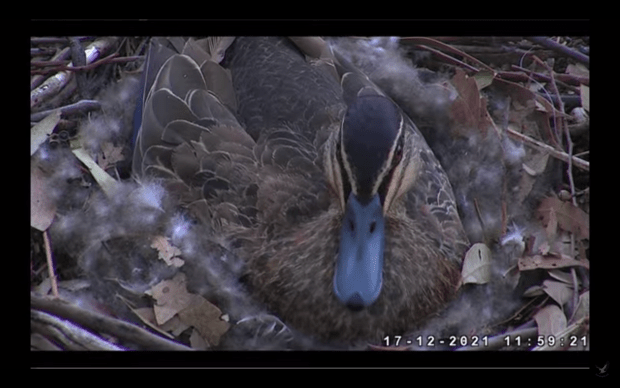
That blue bill really differentiates the Pacific Black Ducks from the ones in North America.

There is that beautiful distinctive creamy tan line from the bill above the eye and then the wider one below.

Oh those bits look like twinkle stars. I never knew Duck down was so beautiful — just warm!

Sometimes you can hardly see Daisy on the nest.

It has been a very quiet morning for Daisy as it nears noon. I can hear the Noisy Miners in the forest but, there appear to be no Sea Eagles over on the River Roost.

What a blessing! I do not believe the Sea Eagles will harm Daisy and I don’t even think that they will mess with the down because Lady doesn’t like it. But Daisy would leave quickly and she would not be able to cover her eggs leaving them in view of predators.

Of course, Daisy being a very intelligent duck would wait in a nearby tree for the WBSE to leave and then she would fly over quickly, right?

Daisy doesn’t often stay in the same position for a long time. She is twisting and moving about, turning the eggs, tucking in down.

You can see the shadows moving over the nest at noon. It will be a hot day for our girl and those eggs. Hopefully she will not leave the nest too early this evening.

Daisy has moved a little. It is noon and all is well.

It is a little after noon. Daisy is rolling eggs and reaching out to find leaves underneath the branches and twigs. I really hope she is not thinking of a break. Oh, please, Daisy. Just stay put for six and a half more hours, please.

I will continue to monitor Daisy til she leaves for her evening foraging and then will check on her periodically. I am hopeful that nothing untoward will happen. Fingers crossed.

In other nest news, OGK has flown in and replaced YRK on the Royal Albatross Cam in New Zealand. Also a 2017 hatch, Royal cam chick, Tumanko, landed on Taiaroa Head. This is amazing. He is four years old and has survived. As a chick he was not always well so this gives us all hope for all the birds. Over at the Port Lincoln Osprey Nest, Falky has been trying his hand at fishing. He made two dives off the barge this morning. The first was at 07:04:41 and the second at 07:20:07. In the image below, you can see the nice form Falky has. It will not be long until he catches his own fish. Mum looks on proudly while Bazza is on the nest waiting for his fish. Is it really Bazza Baby??? Ervie is off flying!

Here are a couple of lovely morning views of Diamond, the Peregrine Falcon female at Orange. She is adorable.

It has been a good day in Bird World. M15’s injury from the GHOW is improving and we wait for Gabby’s second egg — oh, and it is getting close to hatch watch at SWFlorida with M15 and Harriet. Oh, I am in dire need of some bobble head action! And if you are missing the Ospreys, her is a great image of Aran, the male at the Glaslyn Nest who was injured during the storm that hit Wales at the end of May. The community was so generous. They brought out a fish table for him and Mrs G – allowing them to grieve the loss of their three osplets and heal. Oh, Aran is a handsome one – and he is also a good fisher. Three and a half more months – Osprey action in the UK!

Take care everyone. Thank you so much for joining me. See you soon.

Thank you to the following for their streaming cams where I took my screen captures: Port Lincoln Osprey Project, Sea Eagles @ Birdlife Australia Discovery Centre Sydney Olympic Park, and Charles Sturt Falcon Cam and Cilla Kinross.

The Daisy Chronicles, end of Day 18

Daisy had a relatively quiet day on Monday, the 20th, in Australia.

The wind broke a small branch loose that had some leaves on it and it fell right by Daisy’s nest! Seriously, this is one lucky duck.

By mid-morning the sun was making Daisy hot. In the image below she is panting to thermoregulate her temperature.

The camera operator checked to see if the Sea Eagles were at the River Roost. They were not.

Daisy spends some of her time removing more down and tucking it in.

Everything was pretty quiet until 15:55 when Daisy froze. I could hear the Ravens but they went quiet. They had to be sitting on the tree branches out of view of the camera. Daisy stayed in the same position until 16:03:30 when she relaxed.

Daisy kept her head down but she was looking and listening.

Every once in awhile the Ravens would make intimidating sounds.

Daisy relaxed and then she froze again at 16:13:10.

She has relaxed.

Daisy worked on the down, twigs, and leaves and bits and bobs to cover the nest for more than three minutes before she felt certain her precious eggs were covered well enough to leave.

Daisy did not leave as early as she did yesterday. She flew off at 17:34:21. It is still light and you can still hear some birds in the forest. She is counting on the Ravens not returning. It is two and a half hours until sunset at 20:04.

It is nearing 01:00 on the Canadian Prairies and I am going to take a leap of faith that Daisy will get home and her eggs will be in tact and toasty warm under the down, the heat of the nest, and the rays of the sun.

Thank you for joining me. It is wonderful that so many people care for this wee duck who has laid her eggs in this enormous nest in the forest. Take care everyone. See you soon. — Look for my next posting mid-afternoon on the Canadian Prairies tomorrow.

Thank you to the Sea Eagles@Birdlife Australia Discovery Centre Sydney Olympic Park streaming cam where I took my screen shots.

The Daisy Chronicles Day 17, continued

Despite the presence of the Sea Eagles, Lady and Dad, at the River Roost on the Parramatta River, Daisy has been blissful since she returned from her morning foraging trip at 07:11:00

The Sea Eagles have not come to the nest. The wind is beginning to really pick up. I have not seen any predators on the nest. That said, the sound is off on the main camera and the Ravens could have been in the branches above like they have been lately or simply flying by. The strong winds might keep them at home!

It is currently 30 degrees in the forest and the winds are blowing at 19 km/h with gusts up to 39 km/h. It is hot and humid for Daisy with the confirmation of thunderstorms (90% chance) from 15:00-18:00. Hopefully Daisy will wait til the rain and winds have calmed before going out for her evening foraging. I am not concerned about her. She has been through many storms but, rather, for the priceless down covering those eggs.

It is nearing 11:30 on the old Ironbark Nest. The wind is rocking the tree but Daisy does not seem bothered. I have no noted any predators around and it is unclear if the Sea Eagles are still at the River Roost. The sound is still off line.

Other Nest News. A video has been posted of the thunderstorm that hit Orange last evening. Lightning, hail, thunder, and high winds. Diamond is in the scrape. You can see she is frightened. This morning Xavier arrived on the ledge of the scrape box and there was much relief he was alright. You can imagine that was this type of storm that also hit Daisy in Sydney.

Need an Osprey fix? Lena can see Andy in the distance and she is fish crying. Here is that video:

Samson is so happy that him and Gabby have their first egg as of yesterday. Just look at those two!

Over at the Port Lincoln Osprey Barge, Ervie picked up the first delivery of the morning -despite the choppy water and winds – from dad at 06:30:41.

Falky got the 07:39:44 fish.

Last time I checked Bazza was alone on the nest wishing for a fish.

Thank you so much for joining me. There is not much to report about Daisy which is, after all, a good thing. Hopefully the weather will not be as bad for her as it was for the Peregrine falcons, Xavier and Diamond, at Orange. I will monitor her throughout the rest of the day. Take care everyone. Stay safe! Look to the birds for joy!

Thank you to the following for their streaming cams where I took my screen shots: the Port Lincoln Osprey, the NEFlorida Bald Eagle Cam and the AEF, and the Sea Eagles@Birdlife Australia Discovery Centre Sydney Olympic Park.

The Daisy Chronicles Day 15-16

I had a question from a reader. It was a good observation about Daisy and the multi-tasking she has to do such as security, nest cup maintenance, incubation, and feeding herself. You might have noticed that no one relieves Daisy when she needs a break. It would be ‘monumental’ in terms of security if that were the case but, it isn’t. The Pacific Black Ducks are similar to the Mallards in that the males might go with the female to look at nesting sites but it is her choice. If the nest is down in the reeds by the water, they ‘might’ provide some security. Indeed, Daisy is responsible for nesting site choice, nest cup creation and maintenance, incubation, brood rearing, and getting her own food. Dr Mike Brasher in his article, ‘Understanding Waterfowl: Drakes and Ganders’ points out one of the issues when he says, ‘In North America, nearly all duck populations consist of a higher proportion of males than females…This gender imbalance is mostly caused by higher rates of mortality suffered by females while nesting and brood rearing.’ In other words, it is dangerous for Daisy to be left alone and yet the species has not developed behaviours that would see the female protected or assisted. Daisy is most vulnerable when she is incubating her eggs. David Sibley says that in many studies, ‘…up to 30 percent of adult females did not survive the four weeks of incubation.’

Daisy and other ducks spend approximately 23 hours a day incubating eggs for 26-30 days. She relies on her camouflage, be alert, puffing up to enlarge her size, and travelling quietly to avoid predators. I think she also needs a great deal of luck. Sibley says that ‘A nesting attempt has only a 15 percent chance of fledging any young.’ Once fledged, he adds that only about a third of those that fledge survive the first 2 or 3 weeks.

In other words, we are witnessing something rather miraculous if all goes well and those eggs of Daisy’s hatch and fledge. There were some who thought Daisy was ‘crazy’ selecting this nest but with the odds maybe she isn’t. Indeed, maybe Daisy was not ‘a crazy duck’, at all, selecting the WBSE nest. She tried last year and even with the Sea Eagles coming often, they showed no intent to harm the duck. They were curious. Dad seemed to be concerned about who dared to lay eggs in Lady’s nest cup and his nest. Daisy and Dad played ‘nest tag. She would often fly off the second he landed. One day he sat on the camera tree waiting for the bird to show up that owned those eggs. Daisy stayed away. She would have noticed him from a nearby tree and the second he left the forest she flew to her eggs. Dad broke one of the eggs – perhaps by accident. He didn’t like the taste of the egg but he was very curious about the down as was Lady. They didn’t know what it was – they had never experienced it. Neither of them liked it! The down stuck to their beaks and just about drove them crazy trying to get it off. No, it was the Ravens wanting the eggs when they saw them. While there were a few days to go to hatch, Daisy had held out that long. She learned something, I hope. That is not to leave the nest unattended during the normal daylight hours. That is when the Ravens could come and predate the eggs. So far, she has left on average around sunset and before sunrise. The last set of breaks was an exception – there were three in a 14 hour period – shorter in duration than the longer break days. With the cooler weather and what Daisy learned from last year, we can only hope that she does not leave the nest during the prime daylight hours when the Ravens are about.

The cam operator zoomed in and there are some wonderful closeups of our darling Daisy.

It is 16:00 on the nest and all is well. It is 23:00 on the Canadian Prairies. I have a nasty habit of getting up to check on Daisy constantly even though the sound is on quite high to alert me if any Ravens or WBSE come to the nest. Fingers crossed the time from now until Daisy departs the nest for her evening meal will be blissful and free of any incidents.

And all has gone well. Daisy left the nest at 18:11:17 – well before sunset at 20:03. That made me a bit nervous. However, Daisy pulled it off. As luck would have it neither the WBSE or the Ravens came to the nest while she was away that I could see. She returned at 20:25:37.

She has lots of down to cover the eggs. The down is quite visible but maybe the WBSE will leave it alone since they don’t like it on their bills – if they come and then if they notice.

Daisy had that enlarged esophagus or ‘crop’ when she returned. It looks like she had a very good foraging!

It is Day 16. It is now 04:14 on the nest. Daisy seems very content. Sunrise is at 05:40. The weather forecast is for a ‘possible’ scatter thunderstorm in the Sydney Olympic Forest area around 16:00. The temperature will rise to 34. Much hotter than Daisy has seen on the nest. I hope those storms with their rain are scattered. Daisy really is relying on that gorgeous down to protect those eggs.

Thank you so much for joining me. I will have an update in early evening of all the day’s happenings for Daisy. Continue to send your positive energy to this amazing duck that just might defy all the odds. She certainly has a huge support group that love her so much.

Thank you to the Sea Eagles @ Birdlife Australia Discovery Centre at the Sydney Olympic Park for their streaming cam where I took my screen shots.

The Daisy Chronicles Day 15

Oh, my goodness. I missed it. Sharon Dunne posted a video of the Lorikeets visiting yesterday but, in that video is a split second visit of Lady to the nest. She is chased by the Pied Currawong – they simply do not just harass the fledglings – they also harass the adult WBSE. Lady was more interested in the Currawong and did not notice Daisy’s nest. Lady was on the nest for just a blink, nothing more while Daisy was away foraging! ——— Seriously, this is one lucky duck!

I took that screen capture from Sharon’s video that is posted on YouTube. You can watch the entire visit of the Lorikeets and Lady. Thanks, Sharon! Here is the link:

It is Day 15 and is 17 December in Australia. Daisy has already had two breaks today. She appears to now be taking shorter breaks but more of them. She first left for foraging at 01:10 returning at 03:10. This departure is right in the middle of her usual foraging breaks.

She returns and spends time drying off her plumage so that the down will not stick to her wet feathers.

Her second break of Day 15 comes at 05:09:04. She returns at 06:36:15.

There is no indication that either of the White-bellied sea eagles came to the nest this morning while Daisy was away. The Lorikeets did return in mass to say good morning to Daisy.

Some of the Rainbow Lorikeets were climbing in the top of the tree. Maybe they will lossen some of those dry leaves so Daisy has some more material to cover those eggs.

So far, the Lorikeets and the Noisy Miners have been the only birds to visit — so far this morning! The possum has been moving about, too. It is no danger at all to Daisy just maybe to that fluffy down.

The shadows are across the big nest. You can hardly see Daisy but she is there.

Daisy is sleeping in the warm sunshine. Look at all that down. It looks like our smart and brave little duck is sleeping on a cloud of twinkling stars.

Oh, just look at that purple/blue sometimes green (depending on the light0 wing pattern. How beautiful.

Daisy is very content to sleep and do her little wiggle moving the eggs. She takes time to fix the down, move the leaves, and sleep. Did you notice that there are a few more leaves that have fallen down to the nest?

Thank you cam operator for these great close ups!

The Lorikeets are returning to the tree. You can just see one on either side in the middle ground. You can hear more of them in the background.

What amazing colour patterns these beautiful birds have!

I hope that they climb around on the branches above Daisy. They could really help with leaf collection.

They must be so curious about this quiet little duck who has taken on a ‘time lease’ on the WBSE nest. They have been coming to visit more often each day.

The camera operator checked the Parramatta River. One of the WBSE – Lady or Dad – is on the River Roost!

Sometimes Daisy’s eye gives her away. Despite the fact that she has her beak tucked in behind her wing as if she is sleeping, she is very much alert and away. Has she heard something in the forest that concerns her?

I love how the leaves are getting tangled in with the down. Better camouflage to help conceal those eggs.

It is after lunch and so far all has gone well. Our little brave duck has weathered today with two breaks. I hope that she can wait til sunset to go for her last one of the day. Sunset today is 20:03. No showers or rain in the forecast. The temperature is 23 – a far cry from the 40 degrees C last time she had a clutch of eggs. Join me in wishing Daisy an uneventful afternoon incubating eggs!

Thank you so much for joining me today to check on our brave little duck. We might have to start calling her the ‘brave lucky duck’. Please take care. See you soon!

Thank you to the Sea Eagles@BirdLife Australia Discovery Centre Sydney Olympic Park for their streaming cam where I took my screen captures.

The Daisy Chronicles, Day 13-14

It is the middle of the afternoon in Sydney, Australia – Day 13. Daisy, the Pacific Black Duck who is incubating 8 eggs in a ‘borrowed’ nest from the White-Bellied Sea Eagles has had a quiet day.

Daisy still has a substantial amount of food left in that extended esophagus or crop. Just look at it. That is wonderful. She must take care of herself. It will give her the strength to take on the Ravens again if the pair of them should show up on the nest proper.

Daisy has removed a substantial amount of down in the last little while. That nest of hers is amazing. It is so beautiful.

Some down, a little wiggle and some egg rolling, and Daisy is settled in for more incubation and sleep.

I have just checked the weather and there is a 40% chance of rain at the nest at 19:00 and a 100% chance beginning at 20:00. That is the time that Daisy normally goes foraging. The rain is scheduled to continue throughout the night until 13:00 tomorrow afternoon. Why am I mentioning this? Well, it is important. Duck down shrinks or compacts. Daisy has had to rely on the duck down to not only insulate the eggs and make a nice comfy nest but she has also used it to cover the precious eggs. There are sadly not enough leaves on the nest to do that this clutch. Fingers crossed that Daisy is able to manage coming and going so that the down is not that impacted.

Gosh, she is a very special little duck – just beautiful. So sweet. The breeze continues to rock the old Ironbark Tree ever so gently.

That beautiful blue bill really sets Daisy apart from many ducks.

At 15:58 Daisy turned her head and listened. Something caught her attention. She was alert for a few minutes and then…nothing. She settled down and relaxed.

In a surprise move, Daisy flew off the nest at 18:36. Sunset is not until 20:02.

Oh, if the wind would only send some more leaves down right by those eggs!

Did Daisy leave because she needed to so that she could return before the rain begins? Did she need a comfort break after all the foraging before sunrise? Will the Ravens come while she is away?

The camera went offline and it is unclear to me when Daisy returned to her eggs. But at 02:02, her and her eggs are fine. Fantastic.

Daisy, you really are amazing –and we worry so much about you!

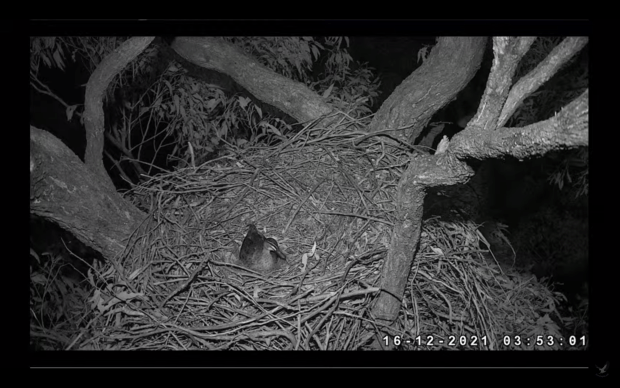
Daisy has been able to leave the nest untended during the evening/night with no worries. The cam operator caught a visitor to the nest that has the potential to cause our Daisy some serious problems, Boo-Book Owl and his mate! This was taken the night prior to this posting so all is well with the eggs.

I have not been able to determine if Boo and his mate actually eat eggs. The Duck eggs are quite large. While they might not, they could definitely wreck havoc by pecking at them or removing down which, at this time, is precious as it really is covering everything. Ah, I wish they had not noticed. These little owls cause such mischief when they fly through hitting Lady on the head or the nestling sea eagles.

The forecast for Day 14, 16 December 2021, is for it to be 22 degrees C and cloudy with a 40% chance of rain around 09:00. I wonder if Daisy is going to go on a break? It is getting close to when she should leave. Sunrise is at 05:39.

Daisy continues to wait to leave for her break. I wonder if those pesky possums are running around on that tree?

Daisy finally left for her break at 04:46:45. You can see her preparing to leave in the image below. She has pulled some more down off her breast and will be covering the eggs with the rest of the down and a few leaves.

There she is plucking off that down.

With the eggs covered as best she could, Daisy leaves to go and get some food.

Daisy returned to the nest at 06:08:22. You can just see her wings fluttering to the right of the rim of the big Sea Eagle nest.

Daisy is all settled and at this moment, everything is alright with the world. Take a deep breath everyone. Send all your good energy.

I will monitor Daisy through the rest of the day providing an update in about six or seven hours. Fingers crossed! We are on Day 14. Daisy has been incubating her eggs now for 7-8 days depending on how you want to count. This means that with the hatch watch from 26-30 days, we continue to look around the 4-6th of January, possibly as early as the 3rd. She is doing so well.

Thank you so much for joining me and for sending all your very best wishes to this little Pacific Black Duck who dared to make her nest in the big Sea Eagle tree nest. Stay safe. Be careful. See you soon.

Thank you to the Sea Eagles @Birdlife Australia Discovery Centre for their streaming cam where I took my screen captures.