Port Lincoln chicks ate well!

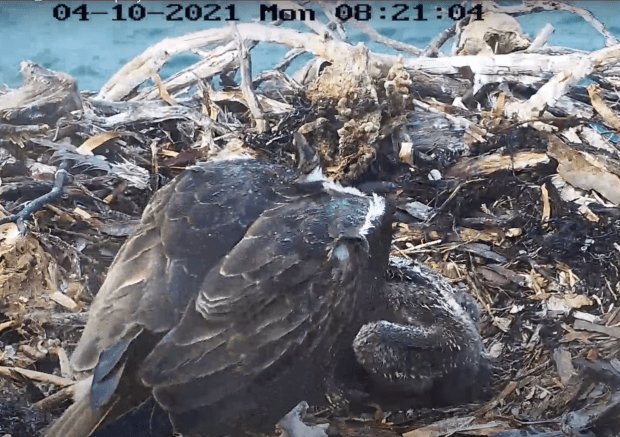
The streaming cam has been down at the Port Lincoln Osprey barge most of the morning. It was also a dreadfully wet and miserable start to the day. Mum tried as she might to snuggle up with her three babies (can we call them babies anymore?). At 10:30 they were wet, cold, and probably hungry.

The first fish arrived at 11:09:12. Even the sun came out for the occasion. Mum was still feeding the trio at noon.

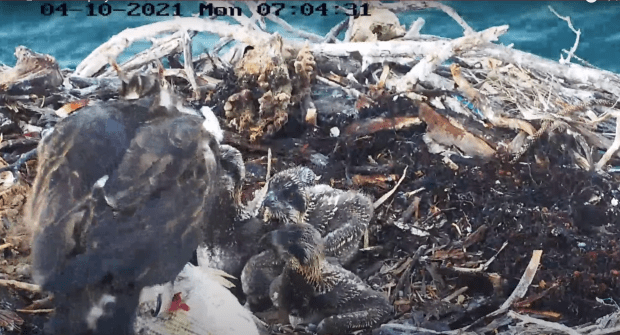
In the image below, Dad is eating his share and making certain the fish is dead before he delivers it to Mum and the chicks.

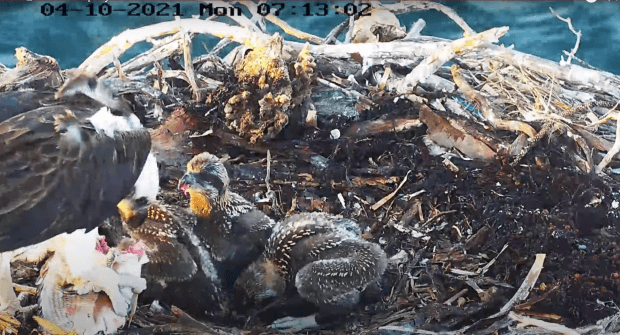
Mum has the fish and she is getting ready to feed the three hungry chicks. It is late for the breakfast fish.

There is Little Bob at the end. What is he looking at so intently?

I wonder if it is Dad flying away. Look at the expression on his little face.

Whatever it is, Little Bob is more interested in what is happening off the nest than eating his first fish of the day. That is pretty incredible. Little Bob is always the one who wants to be fed first!

Oh, two of the chicks are watching instead of eating. Is Dad giving a flying demonstration? These chicks are developing just as they should. They are becoming much more interested in things happening outside of the world of the nest. They are standing more and beginning to flap their wings. Think they are dreaming of flying? Little Bob is 29 days old today. The two older siblings are 31 days.

For those that are worried, Little Bob has stood up to ‘sometimes nasty’ Big Bob. Little has done that twice that I am aware. This nest is really calm and the chicks are so big that we should all expect them to fledge with their satellite packs. I understand they will be ringed, get their sat paks, and get their names in early November. Oh, I cannot wait to find out what the names will be this year.

When the three fledge, this will be a historic moment for this nest. Perhaps with the first fledgling of all three hatches, the curse of this nest will be lifted. These two adults have demonstrated clearly that they are highly capable parents and can easily raise a nest of three chicks from hatch to fledge.

Oh, look at Little Bob and look carefully – there is another chick looking up in awe, too. What an expression!

Now down to the business of breakfish!

After eating for 40 minutes, the chicks are beginning to get nice filled crops.

By noon, the fish is finished. Everyone is full and ready for a bit of a snooze.

The three osplets had no more than settled down when the second fish arrived on the nest at 12:35:28. Little Bob is on the right. He is turning around and probably cannot quite believe what he is seeing – another fish!

The role of the crop is to grind up the food before it enters the stomach. It also serves as a storage tank. The chicks can ‘drop their crop’ when they need nourishment. The reality of a raptors life is that they might eat well one day but not have any food for another two days. They need to eat as much as they can when they have the opportunity.

There they are lined up very politely for Mum again. I do not believe I have ever seen such a civil nest of growing ospreys. They might have their spats but not at the table. They line up and Mum feeds them. She is very fair. I have not noticed her favouring one over another. She does, in fact, often feed them as they appear in the line – one bite each and then back to the beginning. The other thing that is noticeable is the chicks do stop eating when they are full allowing the line to close so the other two are only being fed.

Is this behaviour down to the simple fact that they are so close in age? There is only 51 hours separating Big Bob from the time Little Bob hatched.

Just look at how close they are in size.

One of the chicks has left the table. Little Bob (see the roundish spot on the top of his head?) is still hungry. Of course, he is.

The second fish was done and dusted by 13:02. Little Bob is still looking. Maybe he sees some fish skin? or is there a piece of tail? He has a very nice crop.

In terms of size, I can no longer tell Little Bob from the other two. If the roundish spot disappears I will no longer be able to identify him as easy. He is growing so much. Wonder if Little Bob is a female?

Ah, it is silly to try and guess the genders but we all do it. They will measure the chicks when they are ringed. Of course, the measurements are not foolproof. Only DNA or an egg or mating can confirm.

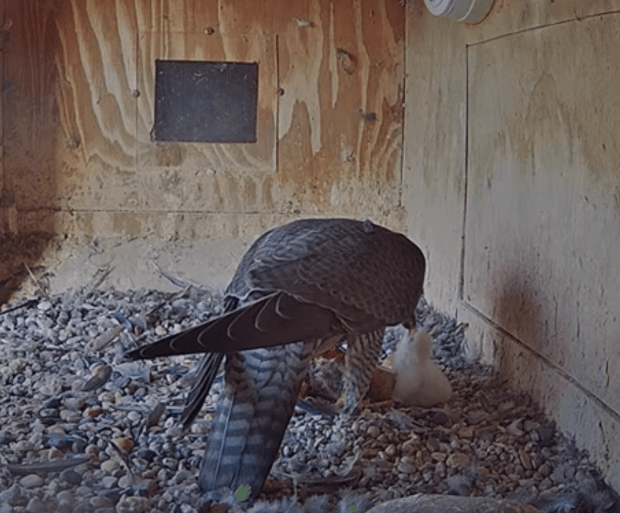
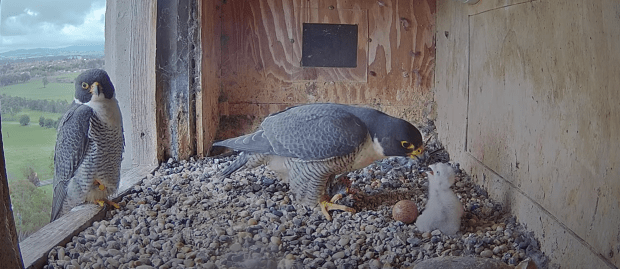
Once the three are fed and all is well, it is much easier for me to sleep. The wee eyas of Xavier and Diamond’s have also had several meals today. You can clearly see that it has more than doubled in size from hatch.

Xavier is on the ledge while Diamond feeds the chick the prey he delivered. Look at the size of the wee one’s wing. Is it looking over to Xavier?

When Xavier turned around, I thought it was last year’s chick, Izzi.

Only Bob is looking directly at the beak and eyes of Diamond. Diamond is so delicate with the tiny little bites she feeds her baby.

The chick’s neck is now so much stronger. It can hold its head still for longer so that Diamond can feed it. The bobbling days are pretty much over. Notice, at times, that the chick instinctively keeps its balances by placing its wing tip on the gravel.
I absolutely love this image of Xavier looking so tenderly at his baby.

All full. The little one has now had four meals. Unlike the Ospreys, Only Bob needs many meals and fewer bites. Her crop is tiny. She is now collapsing into a food coma.

Awww. I wonder if Xavier wishes that Diamond would let him brood the chick? Perhaps she will in a few days but the falcon mothers are extremely protective in the beginning.

The Collins Street Four have been eating, sleeping, growing, and decorating the walls around the scrape. Their world is that of the scrape box. They are not as interested – yet – in what is happening outside of their world. They will become more interested, just like the Osplets at Port Lincoln, in a couple of weeks.

As the days pass, we will begin to notice a difference in size. This is not due to the amount of food the eyases eat individually. It will be because some of them are males and some are females. The females will be approximately 30% larger than the males and they will consume about 25% more food (nothing staggering). When fledge time comes, it is normally the males that fledge first. Their feathers will have covered them quicker because they are smaller! It is that simple.

Last year we did not notice a difference in size in the triplets. That is because they were all females. I do hope Dad gets a break this year and has a couple of males. I cannot even imagine what it would be like to try and feed four large females!

They are beginning to look slightly different in their faces. Notice the one facing the back who looks more ‘hawk’ like.

These eyases are more than full. Look at that shiny big crop. My gracious.

If you missed the live streaming of Iniko 1031 arriving at the pre-release containment area at Big Sur, here is the video of that moment. The condors are so endangered and there is no telling how many more wildfires will rage. Fingers crossed!

It is late on the Canadian Prairies. Our damp is supposed to go away on Saturday. Meanwhile, it is the annual birdseed sale at our nature centre this weekend. It is a great time to get high quality feed for a big discount and help out the centre as well. You might check and see if your local nature centre does this. The savings can be substantial. I will also continually remind people that if you have a local feed and seed store, you might be able to find Millet, corn, Black Oil seed, peanuts in their shells at a substantially lower price point. My neighbours introduced me to this years ago but, sadly, the big feed store moved. The distance makes it no longer viable as a source.

Thank you for joining me. It is always a pleasure to receive your notes and letters. I appreciate the time you take to write to me whether it is an e-mail or a public comment. You take care. See you soon. All of these nests are doing so well that we can all rest easy. Life is good!

Thank you to the Port Lincoln Osprey Project, Charles Sturt University Falcon Cam at Orange and Cilla Kinross, and Collins Street Falcons by Mirvac for their streaming cams where I took my screen shots.

Late Wednesday Bird World check in

The streaming cam is now back on line at the Port Lincoln Osprey Barge. Instead of being late Wednesday it is Thursday. It is a wet miserable day there, too. The osplets are waiting for their breakfast fish to arrive. It is currently 10:30.

The stark contrast between that gorgeous blue of the Port Lincoln waters and the white of the talons makes it almost appear as if Mum and the chicks had gone shopping for those vinyl ‘mod’ boots of the Twiggy era.

Mum is amazing. She tries absolutely everything to try and crowd the chicks under here so they will not get wet. Of course, their feathering will not keep them dry but there is nothing so nice to keep a chill off as being toasty warm under Mum.

The chicks are standing a bit more. Isn’t that one cute? You can really see the development of the tail. Their pantaloons are showing, too. The term has been adopted for decades when talking about the upper leg feathers of the raptors. Originally, the casual name for them was ‘britches’. They are actually the crural feathers and they cover the tibial area of the leg. They continue up to the chest.

Look at those wing and tail feathers! Wow. Growing before our eyes they are.

The skies open again around 9:37 and Mum works hard to crowd in next to the chicks.

Once the rain stops she is off to try and catch a fish for everyone’s breakfast. She has been fishing more and it is certainly keeping the wee babes happy – and full.

It is really beginning to be difficult to tell which chick is which. Each had some type of a mark on their head. Little Bob had a big circle and he had the white webbing pattern on his cere with a huge white swipe with a wide paint brush under his eye. If that him in the middle?

Big ‘sometimes-not-so-nice’ sibling is in the very front. Her eye is much darker with a wider eye stripe. She has always appeared much darker than the other chicks. Did you know that professional ball players adopted adding a black line under their eyes to keep off the glare?

You can really see the very dark wooly down on the chick standing up. You can also see how the crural feathers continue on to the chest area easier, too.

Now look. Is that our Little Bob at the back? I think so. The circle and the white are there as is the white on the cere. Oh, but they could be fooling us. Even their sizes are coming together so that it is difficult to recognize one from the other.

Let us hope that a nice fish for their breakfast arrives soon!

Ah. There is Little Bob turned around facing Mum in case a fish lands right there.

Awwww. Xavier. What a sweetie. He has arrived with the third item of prey for the baby at 10:14 but Diamond is ignoring him. The chick is full having had two feedings already. Maybe Xavier will get a chance to enjoy that Starling himself.

Remember to go and vote on the names for Xavier and Diamond’s baby. Cilla Kinross selected Maori names for weather. You can find the form here:

https://forms.gle/iPQhxDCLtEh19jp38

As the sun sets in central Louisiana, Anna and Louis are still on the nest making adjustments for the upcoming eggs. They have now flown off and are roosting elsewhere.

Wish for a fish! The trio at Port Lincoln will be very hungry when it arrives.

Take care. Thank you so much for joining me this evening.

Thanks to the following for their streaming cams where I took my screen shots: the KNF Bald Eagle Cam, Charles Sturt University Falcon Cam at Orange and Cilla Kinross, and the Port Lincoln Osprey Project.

Bird World Happenings

For those of you hoping for a second hatch at Diamond and Xavier’s scrape box, it is not to be. Either the eggs were not viable or the second chick died trying to hatch. What we have, however, is one really healthy eyas whose eyes will open in the next few days and what a delight that will be. One healthy baby is just fine!

A video was made of one of the chick’s feedings. I cannot wait til it can see its parents! How wonderful.

It is pitching down rain in Port Lincoln. Mum and the three osplets are absolutely soaked to the core.

Mum is the best. She is trying as hard as she can to keep her three babies from catching a chill. Sadly, Melbourne’s weather says it is to have rainy periods through Saturday. I do hope the nest gets a chance to dry out for this incredible Osprey family.

To my knowledge no breakfast has come in yet. Mum is really tired and would appreciate the sleep. She has a smelly wet pillow!

It is an hour later and Mum is beginning to dry out just a little. Hopefully Dad will be in with a fish soon.

The Melbourne Four have already had three meals today – before 8:30! These parents are working overtime. It has to be exhausting. Look how big that little one is and how big its crop is. These four are also healthy and strong. Well done Mum and Dad.

Skipping over to the US, those who fell in love with Anna and Louis during their first year as Bald Eagle parents will be excited to know that the streaming cam is up and running. Here is the link to that nest at Lake Kincaid in the Kisatachie National Forest. Last year, Anna and Louis had one eaglet fledge, Kisatachie. It was wonderful to watch the parents grow into their roles as parents. One time Louis was so eager to provide food early on that he had 18 fish in a pile. I can sure imagine quite a few nests that would have liked some of that! Kisatchie grew big and strong and honoured this old Bald Eagle nest that had not had an eaglet hatch or fledge in 13 years. Incredible.

Cody, Steve and the gang are handling the chat to answer any of your questions.

I have not checked on the Black Storks from Latvia and Estonia for some time. There is some troubling news, perhaps. regarding Julge. This latest report is on Birdmap.

“In the morning September 8, Julge crossed border between Germany and Belgium and from next overnight there was not long distance up to France border, anymore. 20-30 km, depends in what direction Julge continues migration. But perhaps, there is time to improve energy sources? Interesting, if quarry is good place to find food for stork…. Anyway, Julge flew south in September 12. That means France is next country Julge visits. And stayed in a village called Saint-Hilaire-le-Petit. Nor dare not fear the closeness of people. He could be seen picking up insects from the lawn in the parking lot of the nearby Pontfaverger supermarket … But on the afternoon of September 21, Julge flew some 30 km in direction of Paris. On 22 September, Julge reached a stopover between Paris and Reims, where the latest data were received on the morning of 25 September. Next behaviour of Julge is unknown. A local newspaper is also involved in the searches of Julge.”

You can check the migration status of the Ospreys, Black Storks, White-tailed Eagles, Eurasian Cranes, and the Lesser Spotted Eagles here:

http://birdmap.5dvision.ee/EN

I also wanted to check on Karl II and his three children and on their migration status.

First is Udu. This is from the Forum: “It is now becoming unlikely that Udu will find/follow the ‘usual’ eastern migration route, I fear. All other options to cross the Mediterranean Sea are far more complicated, difficult and dangerous. Unless Udu will winter in southern Italy, or in Greece?” Udu is now in Kosovo.

Here is the map showing the three members of the family: Karl II, his daughter, Pikne, and son, Udu . They are making wonderful progress!

You can follow the Black Stork family whose nest was in the Karula National Forest in Estonia here:

This was just a quick check on the developments at the Orange Australian scrape box of Xavier and Diamond. I am certain that chatters and followers would loved to have seen two eyases hatch but, it was not to be. We can, however, wait with wonder to see the little one open its eyes and see its parents for the first time – and grow, thrive, and fledge. Send positive wishes for a fish to arrive at the PLO and for the rain to let up so the nest can dry.

Thank you for joining me. It will get chilly on the Canadian Prairies tonight – down to 4 C. It will certainly feel more seasonal. Take care everyone. See you soon.

Thank you to the following for their streaming cams or Forums where I took my screen shots: the Port Lincoln Osprey Project, 367 Collins Street Falcons by Mirvac, Charles Sturt University at Orange Falcon Cam and Cilla Kinross, the KNF Bald Eagle Cam, the Latvian Fund for Nature, the Estonian Eagle Club, and BirdMap.

Time to Catch up with the Royal Albatross

The 2021-22 breeding season is beginning. One of the first to arrive on Taiaroa Head was OGK (Orange-Green-Black), the mate of YRK (Yellow-Red-Black) and the father of Miss Pippa Atawhai, Royal Cam chick of 2021.

OGK arrived on the headland a few days ago waiting for his mate. The males generally arrive first and select the nesting site. Then the females arrive. Last year, YRK arrived in the middle of the month.

OGK has been making sky calls.

Look carefully. To the far right are two Royal Albatross. One of them was OGK doing his sky call. Is the other YRK? Has she arrived? The couple were first spotted doing sky calls together on 10 October at 16:22:54. Oh, I do hope so!

Wish we could see through grass! According to Ranger Sharyn Broni, there are now 30 toroa back on the peninsula. After the chicks have fledged, the new birds arrive on the headland. (The younger first time to return home since fledge birds arrive in late November and December). The adults have been at sea for 12-13 months. They will build their nests and mate. Often the male will pick a spot for his nest close to the one where he hatched and fledged. Those that breed successfully will remain until their chick fledges next September going out to sea to forage for food for themselves and the little one, returning to the headland and going out again. Because of the stress on their bodies, the Royal Albatross raise a chick every other year – not every year.

Here is a short video of OGK doing some of his amazing sky calls several days ago when he first arrived at Taiaroa Head waiting for YRK.

This year’s Royal cam chick, Tiaki, was fitted with a satellite GPS locator just like her parents. She has really been making good progress and is getting near the Chatham Islands.

Here is the link to follow Tiaki’s progress as she makes her way to the waters off the coast of Chile:

The satellite pack on Tiaki’s mother, LGL (Lime-Green-Lime) stopped working long ago. It was faulty. The one on her father, LGK (Lime-Green-Black) was functioning properly until recently. No data has been uploaded for 8 days. Ranger Sharyn Broni says this could because his feathers have moulted and the tracker is lost or a failure for it to charge properly. It could also have been a malfunction. The last option is that something has happened to LGK. It may be some time before there is any confirmation.

Mel, the manager of the retail store at Taiaroa Head, is adding more products for holiday shopping to their on line store. Check out the soft Albatross plushies and the books or the other unique gifts. You might find something for just the right person – and it will not only make them happy but will help support everything that is done for the welfare of the birds at Taiaroa. If you have questions for Mel, he normally answers quite quickly. His e-mail is: mel@albatross.org.nz

Here is the link:

https://shopalbatross.org.nz/

Here is the link to the streaming cam on Taiaroa Head:

There is lots happening in Bird World! Things will start to get complicated soon.

OTHER BIRD WORLD NEWS: Sad news today. The environmentalist and BBC presenter, Chris Packham, was the victim of an arson attack on his home in The New Forest. The perpetrators burnt his gate and set a car alight in front of CCTV cameras. This is the article on this tragic event in The Guardian. Thankfully, no one was injured but they could have been.

https://www.theguardian.com/uk-news/2021/oct/10/chris-packham-vows-to-continue-activism-after-arson-attack-on-home

The Big Bird Count that took place on the 9th of October had wonderful results. 29,282 participants took part around the world. There were 6885 species and 66,020 checklists submitted. Fantastic! If you want to check out more data surrounding the results and checklists, please go to:

https://ebird.org/octoberbigday

Still waiting for news of a second hatch for Xavier and Diamond at the scrape box on the water tower at Charles Sturt Orange University. Xavier is there with Diamond and is doing is creaky door call to welcome the day. Will check in with them throughout the day.

It is a soggy but welcome rainy day on the Canadian Prairies. Tomorrow Canadians celebrate Thanksgiving – quite different in spirit than that of the Americans south of us. For Canadians, its origin was a time to be thankful for the bounty of the fall harvest. It is a time for families to join together, if they can, and share a meal and is quite low-key compared to the American version. There are so many things and people to be thankful for. The list is long!

Thank you for joining me today. Please take care. See you soon.

Thanks to the following for their streaming cams where I took my screen shots: Cornell Bird Lab and the NZ DOC, Charles Sturt University Falcon Cam Project and Cilla Kinross.

Saturday in Bird World

There is still time for you to put in your count for the October Big Bird e-Bird Count. You have until midnight as far as I know. In one hour we had 37 Dark-eyed Juncos, 3 Blue Jays, 3 Harris’s Sparrows, 1 American Robin, and a host of House Sparrows. There were also 3 grey squirrels and 1 red and then Little Woodpecker came when the new suet cylinder went up. I wonder if they sit and watch? or how good their noses are.

Everyone of them seems to know the minute the feeders are full and once the suet cylinder is finished when a new one is put in place. It is much cooler than it was a few days ago and the sky has been a light grey all day. I wonder how long the Dark-eyed Juncos will be with us?

There is, as far as I know, only one hatch at the Peregrine Falcon scrape box in Orange. The little one has been fed several times already. It gets full with 3 or 4 nice bites of prey.

And then it will pass out quickly in a food coma! It is quite frightening the first time you see this happen, especially with a newly hatched chick.

Yesterday I made a video clip of one of the feedings at the 367 Collins Street Peregrine Falcon Scrape.

The Collins Street Kids are really growing. The two larger ones now jump a bit to get up to Mum’s beak for the prey.

There was a beautiful golden glow on Mum at the Port Lincoln Osprey Barge this morning. Viewers got a treat. The cam operator showed the Calypso Star I taking clients out for shark cage diving. You might know it but it was that business that allowed the Port Lincoln Osprey Barge and streaming cam to come into existence. Thank you Calypso Star!

It is 8:23 just now and the kiddos are still waiting for breakfast. They will certainly not starve! Never. Last night when they went to sleep their crops were bursting.

Once of those funny crop shots when they lean back to preen. Look how big that is. Each of them was the same.

Here’s Little Bob! Look at that crop and then look at his feet!!!!!! I love Clown Feet Time.

I am learning just to keep quiet on bird chats. A couple of days ago, a dear woman, who has been quite ill and is recovering, was more than put down because she suggested that birds have emotions. There is a lot of research on this subject. For the next week or so, I will post some academic/scientific papers on this topic. Some will be shorter and some longer. The one today concerns two particular emotions: fear and frustration. It is titled, “Avian Emotions: Comparative Perspectives on Fear and Frustration.” It was published in Frontiers of Psychology in December 2018.

https://www.ncbi.nlm.nih.gov/pmc/articles/PMC6344452/

I grew up in Oklahoma (home of the Five Civilized Tribes before it became a state) where there are strong beliefs about animals and birds. They serve as messengers of the Spirits of the Indigenous people. Some offer warnings – others are there to help. Here is an interesting article birds as symbols.

We are looking for a hatch for Xavier and Diamond today. It might not happen. If it doesn’t, it is just fine. Those who watched their scrape last year certainly came to love their only hatch, Izzi. He was quite remarkable.

Thank you for stopping in today. Remember to turn in your bird count if you haven’t already. Take care. See you soon!

Thank you to the following for their streaming cams where I took my screen shots and video clips: the Port Lincoln Osprey Project, 367 Collins Street Falcons by Mirvac, and Charles Sturt University at Orange Falcon Cam and Cilla Kinross.

Helping the birds and animals

Oh, be careful for what you wish for! It is 14 degrees, grey, 84% humidity day in the ‘Peg. An overnight rain has made the leaves smell like fall but the cool reminds us of what is to come. Today as I look out the window few of the big old Maples have any leaves left on them and the lilac hedgerow, of sorts, is almost bare. Today, I am missing those 28 degree temperatures of two days ago!

The Superb Fairy Wren won The Guardian’s Australian Bird of 2021. They are such beautiful little birds.

“Superb Fairy Wren” by James Niland is licensed under CC BY 2.0

These gorgeous song birds are rapidly declining in numbers with the loss of territory due to human construction. There are many other birds that are dropping significantly in populations also – everywhere!

Some are dying due to the lack of water. An article in today’s Guardian, ‘The water used to be up to your armpits’: birds starve as Turkey’s lakes dry up provides a stark warning to all of us. This migratory period between 3,000-5,000 flamingos died of starvation in Turkey in July at Lake Tuz because the shore of the lake had receded so far from their nests that they could not reach it. It also caused mass gull deaths and our raptors are getting sick because they are having to change their diet. Many are having to eat rubbish and carrion to survive. Others are killing one another they are so hungry. The deaths have been caused by lack of water and food resources as well as parasites. Unmitigated agricultural practices, large construction projects using the lake water, and pollution are causing all of the wetlands to dry and this is a primary corridor to Africa for migrating birds. This past summer there were also the wild fires. Environmental researchers categorically state that there must be a balance between humans and the natural world if we are to hope of avoiding catastrophic damage/extinction to the planet.

Chris Packham and Megan McCubbin have packed a lot of good information into their book, Back to Nature. How to love life- and save it.

It is a great book and everyone should have a copy. It is choked full of ideas on how we can help our planet. The book is excellent at provoking thoughtful responses to the challenges that the authors put forth. At the same time, they provide easy and sensible solutions and a backdrop of positivity that makes us understand that acting together can produce great benefits to all life. The paperback is $20 in the US and Canada and 8.99 GBP. Well worth it!

I only want to mention two things. Turkey is often called the dumping ground for the EU as plastics are sent there for recycling. According to today’s article in the Guardian about the lakes drying up, much of that plastic is burnt causing pollution or simply left to clog up the earth for millions of years. In one section, Packham and McCubbin write about the Scavenger works. These worms that have existed for 100 million years eat everything from bones to maggots and mealworms to organic matter in our gardens. “Scientists have recently tested the larvae of these superworm species called Zaphobas atratus to determine whether it could successfully consume styrofoam.” The scientists were shocked at the ability of the worms to survive completely on plastic. They are hopeful that the use of these superworms could stop the plastic apocalypse in the world. And that is good news!

Packham and McCubbin also address the issue of the lack of proper ‘avenues’ if you like for birds. Since the studies by Robert MacArthur and Edward Wilson in the 1960s, it has been recognized that large parks and nature reserves are better ecosystems than small parks or nature reserves. They developed the concept of ‘island biogeography’. “Species richness will be higher in larger areas and the species richness will decrease with increasing isolation.” A good example would be Central Park versus the little parks scattered throughout my city that are a city block square. The landscape of almost every country is fragmented. Hedgerows used to be a way for the wildlife to move but much of those are being cut down for development. Packham and McCubbin suggest that it is up to the members of the community to now create these areas of species richness through their own gardens. It can be private gardens, public gardens, or even balcony or patio gardens. They argue that adding up the land areas of the private gardens gives you a huge area but people must work together. Plant trees, native grasses. The idea is to create a series of gardens so that the wildlife and insects can move around freely. One house on one block will not create this. You have to get your neighbours involved by educating them to the importance of greening and wilding. Some cities, such as Portsmouth in the UK, are wilding their streets. People are adding insect hotels, bird boxes, hedgehog highways (holes in fences) and greening their yards not cutting them and fertilizing them to be manicured lawns. It is expected that these wild streets will have a very positive impact on the insects, animals, and birds —- and, ultimately, on us! If you want to find out more, I am including the link to the Hampshire and Isle of Wight Wildlife Trust. They say their goal is: “In the next ten years we must create a much wilder Hampshire and Isle of Wight. We want nature’s recovery to be at the forefront of tackling the climate crisis. We want broken ecosystems to be restored and missing wildlife to return. We want people to benefit from a healthy natural environment.” Maybe you can take a page from them and start your own wilding!

https://www.hiwwt.org.uk/our-strategy

It is true that we can all do something but working together in our communities can have an even bigger impact.

A quick check in on Xavier and Diamond, the adult Peregrine Falcons waiting for their second hatch today, sees Xavier sleeping on the ledge with Diamond brooding the first hatch and incubating the two remaining eggs.

The second feeding of the chick will be coming soon. If there is a crack or a pip, I cannot tell.

Enjoy your day everyone. Take care and pick up a copy of Back to Nature. It is full of ideas and great things happening around the world to save our wildlife, our planet, and us!

Thank you to Charles Sturt University at Orange for their streaming cam where I took my screen shots.

First Feeding at Orange

Diamond brought part of a pigeon into the scrape box at 13:37 to see if the eyas was ready for its first feeding. It was not. The little fluff ball continued to sleep, all tired out. The egg was full of nutrients and the chick does not need a feeding til tomorrow morning. Still, Diamond will continually check and when the chick sits and opens its beak by instinct to be fed, she will know it is ready for food.

Diamond first went to the corner in the image below where she considered leaving the pigeon. Then she went to the other corner.

Eventually she decided to fly out with it.

She returned in ten seconds and immediately went over to brood the chick and incubate the two remaining eggs. The eggs were laid on 31 August at 10:40, 2 September at 20:55, and the last on 4 September 6:28. Diamond started incubation with second egg and then hard incubated with the third.

Last year Diamond and Xavier also had three eggs. One did not hatch. The second hatchling was not strong and died and Izzi, that beautiful character, was their only fledge. Xavier is an amazing hunter and this family can certainly provide for three.

Half an hour later, Diamond decides to try and feed the eyas again. She gathers the prey from the left corner pantry. I have taped a portion of that first feeding for you. This chick is very strong. It is approximately 7 hours old. It fell over and lifted itself back up. I was amazed at how long it held its head relatively still and its beak open. This first hatch definitely had some nice bites of the prey.

Just look at that little one. So happy for Xavier and Diamond.

Over in Port Lincoln, Dad brought a fish in at 10:05:13. All three osplets lined up to eat. I noticed several times that Mum fed them in sitting order. It was quite interesting. Food security remains in the positive. It is simply grand. Little Bob is now 22 days old. The other two are 24 days old.

In the image below, the chick at the back has a nice crop from the earlier feed. You can see it clearly.

It is definitely getting difficult to tell who is who unless you can get a glimpse of their beak. Little Bob has on the left side of the cere a kind of white netting pattern.

Dad brought in another fish at 14:17.

Now looking carefully, see the little osprey’s head in the middle of the image below. That is Little Bob. I want to point him out to you because you can clearly see that whitish netting on his cere. It sometimes looks like someone took a white paint brush and went over the cere and under the eye of this third hatch. You will also notice that Little Bob is being himself – getting to the front of the table where Mum is feeding and never taking his eyes off that fish until he is full.

Little Bob is in a very good position to get a lot of fish.

You might also notice that spot in the feathers between Little Bob’s eyes. That pattern might not stay there but for now, it is also helpful in finding him in the group.

In the image below you can see those two indicators clearly.

Little Bob has quit eating. There you can see him on the far right. Just look at that crop. Talking about ready to pop. I think that Mum fed Little Bob most of the fish in the beginning. He should really sleep well. Dad should be in with another fish in a couple of hours! Oh, these three are so well fed and behaving so nicely.

So far, the feedings at Port Lincoln have been at 07:49, 10:05:13, 11:26, and 14:17. That is four and it is only the middle of the afternoon. Well done, Dad.

It is time to call it a night. So happy for Xavier and Diamond that their first hatch is so strong. It ate so well and so did our little Ospreys at Port Lincoln. As I sign off the day continues to look good in Australia. Oh, and I almost forgot. The Superb Fairy Wren was voted Australia’s Bird of 2021. That is an image of a male Superb Fairy Wren below. That plumage is amazing. During breeding season, the electric blue plumage becomes iridescent. They are common across Southeast Australia and are known to sing to the chicks when they are in the egg – the chicks recognize the parents by their voice when they hatch.

“superb fairy wren male” by Ralph Green is licensed under CC BY-NC 2.0

Over 400,000 votes were cast this year. The Guardian said, “The superb fairywren has been voted bird of the year for 2021, narrowly defeating the tawny frogmouth in a nail-biting finish.” Here is the story:

https://www.theguardian.com/environment/2021/oct/08/superb-fairywren-crowned-2021-australian-bird-of-the-year-winner-in-hotly-contested-vote#:~:text=The%20superb%20fairywren%20has%20been,during%20the%2010%2Dday%20competition.

Take care everyone!

Thank you to the following for their streaming cams where I took my screen shots and video clips: The Port Lincoln Osprey Barge and Charles Sturt University Falcon Cam and Cilla Kinross.

Hatch at 04:56:09 for Diamond and Xavier

The very first peregrine falcon of Diamond and Xavier was fully hatched at 04:56:09. Xavier will be at the scrape box around 05:56 – 06:00 and hopefully Diamond will give him a good look.

There were some loud pips. Congratulations Xavier and Diamond on the first hatch of the 2021 season!

Thank you to the Charles Sturt University at Orange for their streaming cam where I took my screen shots.

Waiting for hatch at Orange

We are all waiting with Xavier and Diamond for the first (or all) of the eyases to hatch in the scrape box at Orange, Australia. There is, perhaps, a pip. Fingers crossed. BTW. The Peregrine Falcons made it to the final vote in the Australian Bird of the Year. We now wait to see who wins.

The chicks on the Port Lincoln Osprey nest certainly did get another big feed at 16:28. A small fish tail was brought on the nest at 19:57 but everyone had a big crop. Mum got off the nest for a bit a little later. Everyone is great. As I continue to say, all three chicks are doing well and I sure haven’t seen any of the rivalry of past years.

The chicks are still eating the whopper of a fish brought in at 14:49. This is going to really fill them up. It is also late in the day.

Some are still eating at 15:23.

Dad is still on the nest after delivering the 16:28 fish. You can see that the chicks still have large crops from the feeding they just finished.

This fish will really top them off.

There was certainly not a lot of fish left on that tail that Dad brought in. It does not matter. I hope that Mum got some of it. The chicks are definitely full and will be fine til tomorrow.

I am always looking for great videos by the people that advertise for the various camera companies. The reason? Their footage is simply the very, very best. So when I spotted Mark Smith’s video about the migration of the mullet off Florida, I knew there would be some great Osprey images. I would also like to think that our very own Tiny Tot, Achieva Osprey’s miracle third hatch survivor in 2021, might be out there during that annual mullet run filling her crop. Here is the link. It is about 8 minutes long and worth all of it.

Enjoy those wonderful shots of Mark’s.

Thank you for joining me this morning. All of the nestlings in Australia are doing great. I have one last image to leave with you. One of the FB members posted this gorgeous screen shot of the 367 Collins Street Falcon faily. I am reposting it here because it is priceless and a lovely way to leave our blog. Take care everyone.

Thank you to the following for their streaming cams where I took my screen shots: the Port Lincoln Osprey Project and the 367 Collins Street FB Page.

Gold Star for PLO Dad – again!

It was a gorgeous day to be outside clearing up after the birds and replenishing their feeders and bowls. The gossip around the City is that the Robins are making their way through and stopping over for a bit before heading farther South. I don’t blame them. The wind is hardly blowing, the leaves are now golden, and the sky is blue. It is 24 degrees F. I would enjoy a vacation here if I didn’t live here, too!

It is nasty down in Port Lincoln, Australia. It is 11 degrees with 37 mph winds. Not as bad at the moment as yesterday but, the waves were fairly high and rough a bit earlier. That said I am just gobsmacked by the Port Lincoln Dad. A really nice fish hit the decks of the nest on the barge at 7:00:33. From some of the flapping going on, it appeared to be still alive. Little Bob doesn’t care! He just wants breakfast. I am certain that he currently has no idea of the effort his Dad went to getting that prize on the table.

There is a wee bit of chaos on the nest when the fish arrives. In front, with those lovely light grey stomach markings, and ‘staring’ at the fish is Little Bob. Oh, he does love his fish.

It really helps to get in the right position for Mum to see you. Little Bob keeps his eye on Mum and that fish. He needs to get himself up to the table and Big Bob is in the way.

Ah, Little Bob moves up. He is in the foreground or on the left of the choir but it is not a good place to be. Mom is feeding from the front of the fish. Little Bob really does like to go first. Will he move or stretch his neck?

They are all lined up nicely.

OK. Little Bob has relocated. He wants Mum to see his wide open mouth and fill it with fish. Do you think this is a better spot?

Bingo. The sun shines down on the ‘Golden Child’. The two older sibs look like they would rather lay down and not have the wind hit their faces. Little Bob prefers to eat.

Both Eyes wide open as well as beak open.

Yes! Little Bob is in the perfect spot. The others don’t seem to care. Indeed, they could well be used to him going first. There is always lots of fish to go around.

I wish you could see the smile on my face. Remember the day that Big Bob wanted to push her weight around and try and be dominant? You will recall that it didn’t work. Some of these third hatches are just brilliant. Little Bob is one of those. He doesn’t want to take ‘no’ for an answer so he figures out a strategy. Moving worked today.

Something happens. Mum starts feeding the big sibling in between Little Bob and the fish! Little Bob opens his mouth wide over and over again to try and get Mum’s attention.

It looks like the same image below, it isn’t. Little Bob tries over and over again. “Hey, Mum. Look, my mouth is open. Right here”.

Will his persistence pay off?

Finally!

Little Bob is getting some good bites. You can see the fish on his beak.

Little Bob is still opening wide. He has dropped the little crop he had and he is wanting more fish. Mum and Dad might have different ideas about that.

Did Dad want fish left for another feeding in case he couldn’t catch another one for awhile? It is unclear. At 7:32:57 Dad comes to retrieve the fish.

Every chick ate. Little Bob wanted some more bites but Mum said it was time to stop.

Surprise! Dad ate some of the fish and brought it back to Mum and the kids at 8:09:50.

It is difficult to see but it looks like everyone is crowded around Mom. The nest looks wet and cold. Hopefully that sun will come out and dry it tomorrow.

Is there someone still eating?

There is no telling who got what or how much. It is really windy and I bet chilly on the nest. Mom has them tucked in tight. The worst thing would be to get a chill in that damp nest.

Despite the cool windy weather, the chicks have had two feedings off that nice fish in the space of an hour and a half. Mom has them tucked in and they will be super toasty. Everything is fine on this nest. Just fine.

Mum and Dad are busy getting groceries for the four little falcons. My goodness they are growing and seem to be getting bigger and stronger by the hour. All you need to do is to take a look at the size of that wing in the image below to see the growth in a couple of days. Wow.

Xavier got a chance to incubate the eggs this morning so he was super eggcited.

WBSE 27 and 28 had an early feeding and they are both perfect – strengthening their legs and wings and getting very interested in the world outside of the nest. This has also been a great family to watch this year, just like the Port Lincoln Osprey family. No big dramatic events in either.

That is it for me today. I hope you had a very good weekend no matter where you are or what time it is. Take care everyone. See you soon!

And a last reminder. Mark you calendars. 9 October is eBird count day.

Thank you to the following for their streaming cams where I took my screen shots: Sea Eagle Cam @ Birdlife Australia Discovery Centre, Port Lincoln Osprey Project, 367 Collins Street Falcons by Mirvac, and Charles Sturt University Falcon Cam at Orange.