Falcon and Red-Tail Hawk Cams

I had a lovely note form ‘M’ asking about other peregrine falcon cams. Thank you for your letter, ‘M’.

Each one of us feels a little ’empty’ when the eyases fledge. Without trackers, we have no idea what happens to them. We just wish them well and I know that everyone is working hard to make their environment better. The only birds on the nest who have fledged and not left permanently are the PLO Lads – Ervie, Bazza, and Falky. It is winter in the Northern Hemisphere and the birds have migrated to warmer climates. I will, however, be checking on nests in Asia to see if there are any for you to watch.

This is not an exhaustive listing but it is a beginning and I will be adding to it for all of you as the camera streams return. We have streaming cams on the falcons in Winnipeg as part of the Manitoba Peregrine Falcon Recovery. I will post those at the beginning of the summer. Most of our birds are in southern Texas or Mexico right now.

So here goes – and if you have a favourite falcon or hawk cam, let me know!

One of my favourites are the Peregrine Falcons in Melbourne. They are known as the CBD or 367 Collins Street Falcons. The cam is currently not live. Will come back on line September 2022

Cornell Red-tail Hawks (Big Red and Arthur), Ithaca, New York. The construction work at Bradfield has caused a power outage on the Athletic Fields. Those building works are winding down and this camera should be live shortly. Big Red and Arthur will be very busy once late February and March roll around. There are only two Red-tail hawk streaming cams in the world and this is the best. Big Red is 19 this year. Arthur is 5 or 6 years old. They are a fantastic couple that normally fledge three eyases a year. There are birders on the ground that keep track of the fledglings so you get to see the parents do team training in hunting, etc. Highly Recommended.

Charles Sturt University Falcon Cam in Orange, Australia. Yurruga has fledged. Look for egg laying in the fall of 2022. This is the scrape box of Diamond and Xavier. They are a well established couple. For the past two years three eggs laid but only one fledgling each year which is fine. It is a nice comparison with the Melbourne falcons who fledge 3 consistently. Orange is more rural and, of course, Melbourne is urban. The camera is left on and the falcons come and go regularly.

The Campanile Falcons on UC-Berkeley. This is the scrape box and cams for the Peregrine Falcon Couple, Annie and Grinnell. Grinnell was injured by a male interloper on 29 October. He was in care, as a result, and has been returned to his territory. The male interloper is still at The Campanile. It is unclear which of the males Annie will choose. Nesting activity late March, 2022. Annie and Grinnell are incredible parents who traditionally fledge three adorable babies.

The following are falcon cams that I have watched ‘on and off’ and that have come highly recommended to me from viewers:

Illkirch, France:

Great Spirit Bluff, Minnesota

Anacapa Island, California. There are current a large number of Pelicans to watch.

I will definitely be posting more including a couple of streaming cams from the UK. All of that action will begin when spring arrives. I also want to post some sites in Asia which I will do over the weekend. There will also be the Northern Hemisphere Ospreys, White-tailed Eagles, Golden Eagles, as well as the returning storks to Latvia and Estonia.

For now, things are really pretty quiet except for the Port Lincoln Ospreys, Diamond and Xavier coming in and out of the scrape box in Orange, and the Bald Eagles laying eggs in the US. There are two nests that you might wish to consider and if you have never watched a Royal Albatross nest then you definitely need to check out the Royal Cam Family in New Zealand who are incubating an egg laid on 9 November. They are very experienced and adorable parents, OGK (Orange Green Black) and YRK (Yellow Red Black). They are already grandparents. I often suggest this site to individuals who have a difficult time watching any nest if there is sibling rivalry. The Albatross lay one egg every two years. Parents rotate all of the duties. Last year the Royal Cam chick, Tiaki, had a sat-pak attached to her. We are currently watching her fish off the coast of Chile.

It is a bit wet in NZ this morning. This is YRK’s 6th day on the nest. OGK will be flying in soon and they will switch. Should something happen, the NZ DOC rangers are there to step in and intervene. No one goes hungry, injuries are taken care of, etc. It is a great site and in the process you will bear witness to a country that really protects its wildlife!

There are way too many Bald Eagle streaming cams to list them all. For now, I am only going to recommend one. These are experienced parents Harriet and M15 at the SWFlorida Bald Eagle nest on the property of the Pritchett Family. Their eggs are due to hatch soon – December 25-28. Once Gabby lays her egg in NE Florida I will post that information. For now, you can have fun watching Harriet and M15 change places. The only un-fun thing is the GHOW that attacks the eagles regularly.

There is no word on Yurruga. Cilla says she will look for a few more days. Just so you know the building that Yurruga was last seen on is a gabled (triangle) pointed roof, a bit steep. It is a single story building with clay tiles. Yurruga is not there – not alive, not dead. He was there on Thursday – seen twice during a big storm. I would expect to hear this fledgling screaming for food. Falcons are loud! Is it at a distance from the tower? is Yurruga injured? is Yurruga somewhere else? There are no answers I am afraid. If I hear anything you will be the first to know. Now, it is time for me to go and take care of all my feeders. The gang will be here soon!

Thank you so much for joining me. Take care everyone. See you soon.

Little Yurruga

As many of you are aware, Yurruga has not been seen since last Thursday. Cilla Kinross saw him on the top of a building in the pitching down rain and later, university workers also saw Yurruga on the same building. Cilla sent me a short note this morning because I had written to her earlier about Yurruga’s 2nd right tail feather still being contained by the quill. The local vet did not think this was a problem but, like Cilla Kinross, was concerned about a lack of feather development on the little falcon. What impact this might have had will never be known. Cilla has looked and looked in all the places Yurruga might be and others but she is concerned and has posted a note that has been placed on the FB Page for the Orange Peregrine Falcons. I was very touched because she referred to Yurruga as a ‘poor little lamb.’ Every day is a test for our birds. Even the strongest have challenges. It is difficult enough for fledglings but compounded with unkind weather for numerous days, well. Yurruga should be flying around screaming at his parents for food and the conclusion is that he is no longer with us.

The parents, Xavier and Diamond, had an extremely long – fifteen minute or more – bonding session in the scrape yesterday morning at 05:15. This is simply not something that would normally happen with a fledgling needing prey and training. Considering the work of Marc Bekoff (Emotional Lives of Animals), Jane Goodall, the observations of Hob Osterlund with the Laysan Albatross, the bonding behaviour of Xavier and Diamond should be considered alongside grief. While we have only a limited view of the falcon’s behaviour, it might be assumed that the couple have now grieved for their wee one and are, with the weight of that loss, reconfirming their love and commitment to one another. We cannot do a brain scan on Diamond’s hippocampus (area of brain in human animals for emotion) to see if it lights up, Barbara J King in her book, How Animals Grieve, would tell you that the investment in the mating, the making of the egg, the care and incubation, the care and feeding after and training, she says that ‘grief comes from love loss.’ There have been roadside funerals of Crows, Ospreys who have mourned the loss of their chicks by predators. Other bird species and drowned themselves after the death of their mate. And, of course, all of you reading my blog, will know about Arnold and Amelia, the two Canada geese. Arnold and Amelia lived at the pond on the grounds of the clinic (fortunate for them!).* Arnold had one of its digits severed by a snapping turtle and required surgery. Amelia went to look for Arnold and watched through the glass, finally sharing a meal and a pen til Arnold was released.

So, today, we grieve with Xavier and Diamond over the loss of little Yurruga.

It was a beautiful morning when little Yurruga flew for the first time.
Diamond and Yurruga bathed in the golden glow of the sun the morning Yurruga flew.
Xavier feeding his baby.
Xavier brings prey for Yurruga.
Diamond and her baby.
Xavier feeding Yurruga. Xavier loved getting a chance early on to feed his little one.

What an adorable little eyas. Fly high little one. Fly high.

I am so sorry to bring this terrible news to you. We join Xavier and Diamond, Cilla Kinross and the team at Orange in their mourning.

Thank you to Charles Sturt University and Cilla Kinross for the streaming cam where we get to share the joys and the sorrows – and where I took my screen shots of this lovely Peregrine Falcon family.

  • I say this because many do not consider the mate when one is taken into care. Arnold and Amelia were extremely lucky.

Updates from Bird World…or, oh, gosh…WBSE released 6 days ago!

Holly Parsons posted an update from Dr Cilla Kinross on the FB page for the Orange Peregrine Falcons. Thank you Holly!

(Nov 23):”I had a look at the eggs. One was clearly unfertilised. The other was, I think fertilised, but there was no chick inside. It exploded (big POP) all over me and it was just yellow liquid. No chick remains. I’ll do updates later. I’ll also try to get some confirmation from the museum where there are candling experts (I am not).”

One great report that was featured by Sunnie Day on FB is this. Just look at those numbers. Now how do we take care of these amazing birds – our Osprey?

Osprey Report for 2021, USA

The entire report on the Ospreys for the 2021 season can be read here:

https://www.ctaudubon.org/wp-content/uploads/2021/11/Osprey-Nation-Report-for-the-2021-Season.pdf?fbclid=IwAR3gLbtstZokgb5Ii6EVTE6gj5_ifSVGCQQGaUiFUUmj61p3SMgUJy-WkUQ

If you want to protect our Ospreys, The Observer focuses on them this week. They say:

“A growing cause of death for ospreys is entanglement:  If adults incorporate monofilament or other discarded non-natural twine into their nests, these can end up wrapped around chicks’ feet, injuring or trapping them.  And, as food specialists, with one main food source, a grave threat to our osprey populations is contamination of their aquatic ecosystems; our Sarasota waterways.  As top predators, they’re exposed to the highest concentrations of toxins (such as mercury) in our environment. 

To protect these beautiful birds, who are key members of our ecosystem, we can keep toxins out of our waterways, and plastic litter, including twine and fishing-line, out of our environment.”

White Bellied Sea Eagles. 28 on the left and 27 on the right.
Is this WBSE 28 and not 27?

And great news coming out of Sydney, Australia. Someone let the cat out of the bag. The juvenile WBSE that was grounded by the Pied Currawongs was released six days ago on 18 November. I am using the term ‘juvenile WBSE’. There is no proof that it is either 27 or 28. It is a juvenile WBSE.

Just like we compared the Peregrine Falcons on the ledge yesterday, I want you to look carefully at the two images above. Someone that I trust very much indicated to me that the juvenile taken into care was not WBSE 27 but, rather, it was WBSE 28.

Dr Christian Sasse is one of my favourite people. He is so dedicated to the wildlife of British Columbia and in particular the Bald Eagles. Have a look at this beauty!

https://fb.watch/9t2vM9rY8t/

It is 14:47 and Harriet and M15 appear to still have one egg in the nest at Fort Myers, Florida on the Pritchett Farm.

Falky scored the 06:37 breakfast fish. At that point, Ervie took off flying behind Dad. Maybe Ervie is gonna go and see if he can get a fish himself.

The Eastern Osprey in Australia do not migrate. Unlike the Northern fish eagles that do shift to warmer climates during the winter and catch their first fish when they migrate, the Eastern Osprey will fish before they leave the parent’s territory.

There goes Ervie off the perch. I sure hope he learns to fish. He can get his own breakfast and eat it somewhere away from the brothers!!!

I have seen no further news coming out of UC-Berkeley on Grinnell and Annie.

It is not late in the day but it feels like it. It will be totally dark in less than an hour and a half. So I am off to clear up things outside.

Thank you for joining me. Take care!

Thank you to the following for their streaming cams where I took my screen captures or for their FB Pages: Port Lincoln Osprey Project, Sea Eagles@ Birdlife Australia Discovery Centre and their FB Page, Sunnie Day and Holly Parsons.

Bird World. 16 November

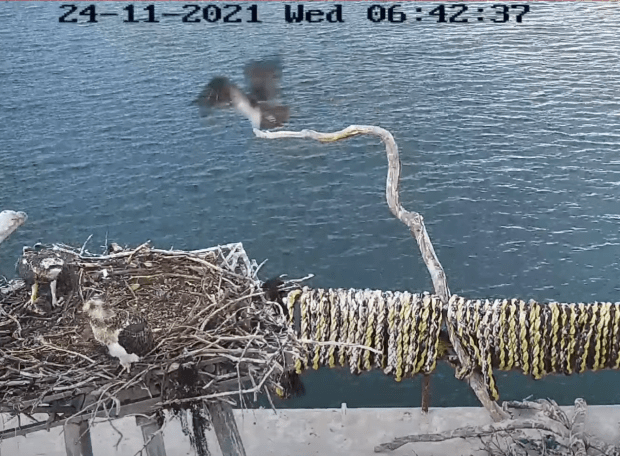
Viewers of the Port Lincoln Osprey Barge are starting to wonder if Bazza isn’t eating so much fish that he can’t get lift off the nest. He sure does love his fish.

At 08:00 Dad flies in with the first fish of the day. Falkey gets that one fighting off Bazza who would just love to have breakfast. At 8:50, Falky is full and he walks away leaving a beautiful fish tail on the nest. Ervie spied it immediately and finished that off quick.

They remain such a civil trio. There is Falkey getting to enjoy his breakfast.

Ervie turns around and probably doesn’t believe his luck – a nice fish tail just in front of him. He was there claiming it in the snap of a finger.

Ervie made quick work of the fish tail. Falky is full and Bazza really doesn’t seem interested.

At 09:36:53, Dad flies in with another fish, quite a large one this time. He puts it right at Bazza’s feet. Talk about luck. Bazza was still eating on that fish an hour and a half later. I don’t think he will be leaving too many scraps.

Just look at the size of that fish!

Bazza is still eating. My goodness. It could be true. Maybe he is too big for take off. Bazza certainly seems to be wider than the other two lads.

Do you follow the falcons at Orange? If so, then you probably know that this is the one year anniversary of last year’s chick, Izzi’s fludge. For those unfamiliar, Izzi was the only hatch of Diamond and Xavier in 2020. He dozed off on the ledge and literally fell out of the scrape box. Cilla had to find him and carry him back up the 170 steps to the box. When he did fledge, the first time, Izzi flew into a window and went into care. Cilla returned him to the scrape to do it properly the third time. Isn’t that what they say? The third time is a charm. It worked. In memory of the fludge, someone has put together a video clip of it and Izzi being returned to the scrape.

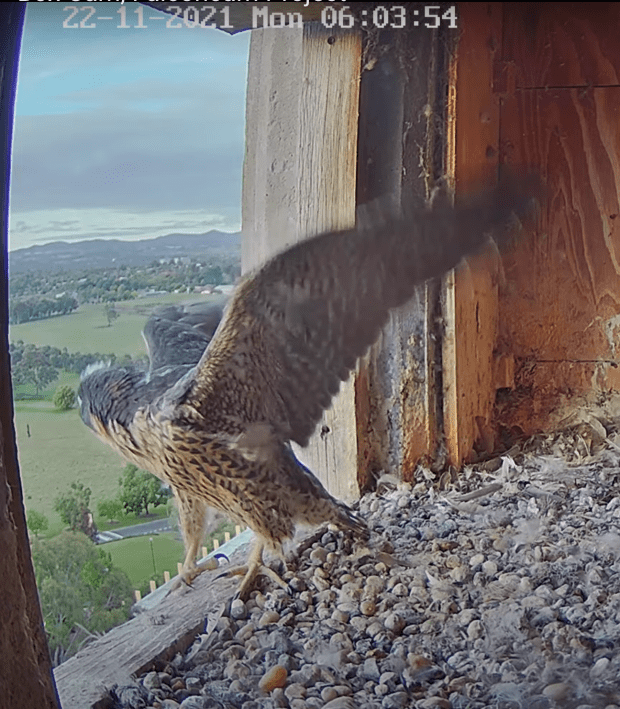
As for ‘Little’ Yurruga, Xavier delivered three prey items for his daughter before 06:45! Diamond will come in later and help Yurruga but she is doing a good job of the self-feeding. I love how she watches Diamond so intently when she is plucking and eating – memorizing / imprinting it all.

Rumours are circling that the WBSE Juvenile will be released from care into an area around the Newington Armoury by the Discovery Centre in the Sydney Olympic Park. The juvenile injured by the Curras is believed to be 27. (There are some that believe it is 28 and with no bands and no DNA who knows.)

There is really not a lot going on in Bird World. Waiting for Bazza to take the leap, waiting for some of the first Bald Eagles to lay their eggs, waiting to find out who is the Royal Cam Albatross family this year. Feels like a lot will happen at once!

Oh, I had to just go and check on the lads one more time to see if it is possible Bazza has flown. Nope. It is an hour later and Bazza is still eating!!!!!!!! Bazza has been eating for two hours. I kid you not. Did someone get Little Bob mixed up with Big Bob?

Flying uses up a lot of calories. Look at the difference in size between Falkey and Bazza. Gracious.

Thank you for joining me. Take care everyone. See you soon.
Thank you to the Port Lincoln Osprey Project and Charles Sturt Falcon Cam and Cilla Kinross for their streaming cams where I took my screen shots.

Snow and Sadness

It is a very good day to stay home where I live. We had our huge snow fall, the side streets are thick with ice like a hockey rink, and snow is beginning to come down again! It is amazing that the garden birds are out but, of course, their lives depend on getting food. I have discovered that the sparrows will also eat the suet cylinders which is a real plus as they do not seem to get ‘mushy’ like the chipped up peanut and sunflower seeds do.

We had so many Osprey deaths that the people literally rose up and demanded that our public utility put up Osprey poles and covers. The Western Ospreys that come to Manitoba and breed during the summer are much loved. Their nests are around ‘cottage’ country on Lake Winnipeg or farther north along the Mossey River. In Latvia, the Government passed a law that all the power poles had to have protective devices for the birds. It is unfortunate that the government there gave them so long, til 2024, to complete the project. Huge numbers of beloved storks have been killed as a result of the delay in implementing the law. There is a reason that I am still talking about this: Solly. Much loved and with so much potential was tragically and unnecessarily killed on a power pole at Streaky Bay on the 11th. My condolences go out to the entire Port Lincoln Osprey community who have to be just gutted with this news.

The Minister for the Environment and Water for South Australia is David Speirs. He has just been at Port Lincoln and Thistle Island for the banding of this year’s osprey nestlings. If you are so inclined, I am urging people to write to him and ask that he take on the initiative of having the power poles made safe for the birds. It does not mean that the poles have to be removed but, rather, there are covers for the places where the birds can land and get killed. He says he loves Ospreys – so let’s check and see if he is a man of action. His e-mail address is: Minister.Speirs@sa.gov.au

Solly’s death was ‘human caused’ and entirely unnecessary.

It looks like the rain is peppering the Osprey nest at Port Lincoln this morning. The wind is blowing at 26 kph with gusts over 40 kph.

If it continues the nestlings will not be fledging voluntarily. Wet feathers and taking a first flight do not go well together. I hope they hunker down like I will be doing today with our blizzard.

The rain at Port Lincoln appears to be easing up but not the wind. Send them warm wishes today. No one wants a premature fledge – a fludge.

Over in Orange (or ‘up’ in Orange), it looks like a rather nice day. Little Yurruga is waiting for her breakfast to arrive.

Xavier did not disappoint! Xavier sure gets out of there quickly. He doesn’t want his talon on the breakfast menu.

Yurruga is really doing well at feeding herself. She has to learn so she can survive.

Yurruga is still working on that Starling. Often Diamond, the Mum, will come in and help the little one when she gets tired. It is so sweet.

If you have been watching the Melbourne Peregrine Falcon Family on Collins Street, I urge you to start watching Little Yurruga. Her name means Sunshine and she will bring joy to your day. Diamond and Xavier are experienced parents and Yurruga is their Only Bob this year. Like Izzi last year. Here is the link to the streaming cam:

Here is a short video, 8 minutes, on the Peregrine Falcon. Yurruga will fly out of the scrape and join the family of the fastest birds in the world!

Here is a ‘too short’ look at falconry. This time we are going to Nijo Castle in Japan. The Castle is a style known as ‘flat land’. It was built in 1603 for the first Japanese Tokugawa Shogun, Ieyasu. This began the period of Japanese history known as Edo era, 1603-1867. The Shogun also had a castle in Edo, modern day Tokyo. Falconry in Japan, as in other countries, was a noble endeavour. Have a look:

There is another ‘bird or avian’ association with Nijo Castle. The floors have special brackets that cause them to chirp like a Nightingale. The chirping gets louder as the person would get closer to the private quarters of the Shogun. It was a type of security system because there were always individuals who wanted to assassinate the Shogun and take their power.

Take care everyone. Thank you so much for joining me and thank you to those who have written to Minister Speirs. Fingers crossed. Stay safe.

Thank you to the following for their streaming cams where I took my screen shots: the Port Lincoln Osprey Project and Charles Sturt Falcon Cam and Cilla Kinross.

Monday in Bird World

On the Canadian Prairies, it is 8 November and it is 11 degrees C. There are some birds still around the southern part of our province including a large number of Great Horned Owls (GHOW) and Barred Owls (BADO). Several hours from where I live there are some hawks and Bald Eagles still making their way south. In celebration of such a gorgeous day with the promise of snow and plummeting temperatures on Wednesday, we decided to make one last check at Oak Hammock Marsh.

It was simply grand. You could see for miles.

The walk was great. It was sooooo quiet, a wonderful change from the noise of the city. If you were intent on counting tonnes of birds and seeing lots of species, then it was a bust! There were about 60 Canada Geese scattered about and a couple of Mallards, a male and a female.

They were all feeding on the tender marsh grasses below the surface.

Even the geese were quiet, no honking, nothing. Just working hard on those plants.

The two Mallards were quite interesting. They were sort of breaking down the grasses as they moved through forcing them under the water with their paddles and then eating them.

Beautiful little female Mallard.

The ducks were not bothered by the geese – everyone seemed intent on eating and enjoying the warm sunshine. The farmers in the area have finished harvesting their crops and the fields are bare. In several hours only six or seven Canada Geese flew into the wetlands.

It might have been quiet in rural Manitoba but there was a lot of things happening elsewhere. First up, for all of you that watch the Royal Albatross, OGK’s mate since 2006 has been YRK. OGK was first in on the peninsula excited to see her and build a nest but…she didn’t arrive. Time passed and she didn’t arrive. Today, 9 November YRK landed on Taiaroa Head. If people could have rung bells they would have. Instead many of us sat and shed tears. The fear is always there. OGK and YRK were the parents of very popular Royal Cam chick, Atawhai (aka Pippa) in 2020. This year will be their 8th breeding attempt.

In other Royal Albatross news, the new couple – Red and BOK (Blue-Orange-Black) have really been entertaining us. They are so sweet. Well, today, Red got some new bling. As one of a mated pair, he is now WYL (Whit-Yellow- Lime).

The image below shows the Ranger giving Red his new bling and identity. BOK is walking off the nest. She will return once everything is over.

Could this new couple with their first attempt at breeding turn out to be the Royal Family of the year? We wait.

The Port Lincoln Osprey Mum decided it was time to go to the spa. She flew off the barge and went over and had a lovely bath in the warm Australian waters of the cove yesterday. It is well deserved. Her and her mate have raised three healthy boys this year.

Isn’t Mum just beautiful?

It is hard to keep up with the 367 Melbourne Peregrine Falcons. I ‘believe’ that there are two (probably female) still on the ledge.

Yes, still there. There is a lot of noise and it could well be the parents trying to lure these two off with prey.

There are theories about gender and fledging times in falcons and hawks. Because the females are substantially larger, it takes longer for their bodies to feather. Therefore, they generally fledge after the males. I do not know how accurate it is but I hear this often.

In Orange, Diamond’s foot is doing much better. At 8:11 Xavier, the male Peregrine Falcon of the scrape on the water tower of Charles Stuart University, delivers a Starling to Yurruga. Xavier does not wait. He drops the breakfast prey and gets out. I don’t blame him. It could definitely save his talons.

Notice how big Yurruga is compared to Xavier. Think Yurruga is a female like her mum, Diamond?

Yurruga is a very good plucker!

Cilla Kinross just posted a video clip of Yurruga. It is really short. Have a peek. I do not think those eggs are going to last much longer.

Everything is as it is expected at Port Lincoln. Dad flew in with a really nice fish but instead of letting the chicks do a grab, Mum got over quickly, mantled the breakfast, and proceeded to take control of the feeding.

It should, by now, not surprise anyone to the identity of the chick right up at Mum’s beak. Now the chick can be identified quite quickly – it’s Ervie! aka Little Bob.

The rule of thumb is that the males return to make their own nests near their natal nest. I hope there are three or four more barges available.

One last nest. NEFlorida with Samson and Gabby. They are both very busy working on that nest. They have been bringing in a lot of big twigs. Here is Gabby moving some of those around.

Cute little Samson looks like he is standing very still in his tight black jeans waiting for orders. What a sweetie.

Samson is a very good listener and Gabby is giving precise instructions. Looks like they are already thinking they need high rails this year.

Thank you so much for joining me today as we check in on some of ‘my’ favourites. Take care everyone.

Thank you to the following for their streaming cam where I took my screen captures: Cornell Bird Lab and NZ DOC, Port Lincoln Osprey Project, NEFlorida Eagle Cam and the AEF, Charles Sturt University Falcon Cam and Cilla Kinross, and 367 Collins Street Falcons by Mirvac.

Excitement in Bird World

It has been quite the day in Bird World. It started out with gorgeous weather on the Canadian Prairies and my hunt for Wood Ducks. Were they still here? Yes, they were! There was only a pair at Kildonan Park but what cuties they were. I almost didn’t see them at first. They were both standing on a log back in a hollow with an overhang. I have so fallen in love with Wood Ducks the last six months.

The last time I visited the duck area of Kildonan Park, there had to be three dozen in the stream near the Witch’s Hut but, not today. I walked up and down the shore, down close to the water, and well, they had to be hidden really well if they were there.

This time it was also easy to count the Mallards. 25 in total. Each of the Mallards were busy either preening or dabbling for food. I thought I would give you a view different perspectives for a couple of the males. Their plumage is simply gorgeous.

In the image below, I love the soft feathers on the chest in contrast with the two white borders of that deep navy. Look at the curls on the tail and the horizontals on the chest. Stunning.

This is a great example of how waterproof their feathers actually are.

There were about 350 Canada Geese at various locations. Some were feeding on the grass, others were in the water. None of them liked the people walking their dogs.

Today was a problem because I wanted to get back and hear the updates and discussion about Grinnell, the injured falcon from UC-Berkeley. Sadly, I did not have as much patience with a little Red Squirrel that seemed to not like my taking photos of the ducks. It chattered away the whole time. Perhaps it wanted its picture taken? I decided that it didn’t because it would not give me one of those cute squirrel poses everyone else seems to capture. This little one was determined to hide behind that branch!

Oh, it screeched at me til I got out of sight! My phone told me that I had a little over an hour. Would it be possible to check on the duck pond closer to where I live? Were there any Wood Ducks there?

I scoured Duck Island at St Vital Park, walked the entire perimeter of the pond, and could only find three Wood Ducks – 2 females and a male in Eclipse plumage (the one in the middle). All of the others were gone.

There were not nearly the number of Mallards or Canada Geese despite the wide open soccer and cricket areas where they can feed.

It seems that the cooler weather a few days ago really did get many to head South. It will be nice when April comes and we can hear them honking overhead. I can’t wait.

I have reported on the update on Grinnell earlier today. You can read about it here and there is a link to the live event in my blog:

https://wordpress.com/post/maryannsteggles.com/27983

At this point it felt like the day was almost over and I had yet to check on the ‘regulars’ – the PLO osplets set to be banded on 8 November, the 367 Collins Street Four, and Yurruga, the Peregrine Falcon nestling at Orange.

The first was little Yurruga. I think I will stop using the adjective ‘little’. Yurruga is growing and changing. She is really beginning to loose that fluffy down revealing her juvenile feathers. Despite the fact that Yurruga has had short bouts of self-feeding, today was a bit of a surprise. I captured it for you in a short video.

Several hours later, Diamond came into the scrape and fed Yurruga the remaining portion of the Starling.

What wonderful training. Yurruga worked and worked on that prey item until she was tired. She did well. Mum knew to give her time and then come in and feed her little one. These are incredible parents. I also want to add that Diamond is walking much better! Her injury is healing.

Wow. Could it get any better? Well, I don’t know if it is better or not but I can say that the three osplets at Port Lincoln are even civil when wing flapping. They take turns! That said, I just about fell out of my chair watching them. Little Bob is flapping first. The trio are to be ringed on Monday, measured, given names, and at least one will have a sat-pak attached to its back. I just hope they are still on the nest! Can you imagine planning for that and they have literally flown the nest? It could happen!

Little Bob really wants to fly.

I am not certain which of the other siblings is featured in this clip testing out its wings. Mum is feeding – it sure doesn’t take long now to consume an entire fish! What a change from six weeks ago. Little Bob is on the right and unknown sibling on the left eating.

They take turns.

All three are getting some air. Oh, my. I was almost afraid to check on the 367 Collins Street Four for fear they had all fledged while I was away or doing other things. Relief. All four were on the ledge a few hours ago.

These are bittersweet moments. Fledge can happen at any time. At least one of them is more than ready. In an interview today, Victor Hurley, the lead researcher of Peregrine Falcons in Victoria, says he believes that there are 2 females and 2 males this year. How lovely!

It has been an exciting day with more to come in the next week. There will be fledges in Melbourne and Port Lincoln for sure.

Thank you for joining me today. Take care everyone.

Thank you to the following for their streaming cams where I took my screen shots and video clips: the Port Lincoln Osprey Project, 367 Collins Street Falcons by Mirvac, Charles Sturt University Falcon Cam and Cilla Kinross.

Friday in Bird World

There is an update on WBSE 27 but, first, some background for those that do not know what happened. White-Bellied Sea Eaglet 27 had a forced fledge. The Pied Currawong were attacking 27 who was alone in the nest after WBSE 28’s fludge. 27 flew to the camera tree and then was, more or less, escorted out of the forest by the Currawong. A few days later, 27 was spotted. It was on some pavement. When it flew up, the Currawong began to attack its head. 27 fell to the ground. Thankfully help was at hand! WBSE 27 was taken into care and checked. Luckily there was nothing broken. The latest news is promising. I do really hope they will keep 27 til it is a very strong flyer. Maybe we will also find out if 27 is a male or a female.

This is the latest update this morning from Judy Harrington: “SE27 is doing well, gaining in strength and is feeding by itself. It has moved to a larger raptor cage to allow it exercise and recover. The treating vets have advised that SE27 will be in care for a few weeks while it recovers and will be released back into the wild as soon as it’s well enough. Healing takes time so please be patient. Updates will follow when possible.”

Oh, it is so good to hear that 27 is improving.

Photo taken by Cathy Cook.

There is a lot of discussion and concern for Grinnell, the mate of Annie, at the Campanile on the grounds of UC-Berkeley in San Francisco. An undergraduate student wrote a great article on the falcon family for The Bay News. I was excited when I read it because it mentions Holly Parsons, who runs the FB group for Xavier and Diamond on the Charles Sturt Campus, and the Manitoba Peregrine Recovery Project in the city where I live and the City’s 19 year old female falcon, Princess. The article is really informative. What a good writer this undergraduate is. Have a read:

I was hoping to have an image of the Spotted Eagle Owlet in Joburg back in the nest but it isn’t there.

In fact, the Mum has just noticed that one of the babies is out of the nest box. You can see its fluffy head under the Mum’s left leg. Poor little thing. It must be scared and hungry. I understood that someone was to place it back in the nest box. Hopefully this will happen soon.

Xavier flew in with a Starling to the Peregrine Falcon scrape on the campus of Charles Sturt University in Orange. Yurruga had been waiting and watching!

Yurruga spends a lot of time looking at the world outside the scrape. She is 28 days old today.

Here comes Xavier with a freshly caught Starling. Yurruga is so excited!

Dad can hardly get the bird into the scrape.

Yurruga is tugging and pulling.

Xavier looks like he really wants Diamond to fly in and feed Yurruga.

Yurruga reaches up and bites Dad’s beak. Look at how big ‘she’ is! Notice also that the down is coming off from around Yurruga’s eyes. She will look like she is wearing goggles tomorrow. Yurruga is right on track in the transitioning from the down to her juvenile feathers.

Xavier cannot prepare the Starling with Yurruga wanting to eat ‘now’.

He opens up the bird and feeds Yurruga some of the nice meat.

Then he flies out of the scrape with the remainder of the bird. He will either put it in storage for later or eat it himself or give it to Diamond. Clearly Yurruga is very healthy and doing quite well. It is nice to see Xavier feeding the little one. Maybe Diamond needs to rest her leg. No doubt Yurruga will have a couple more feedings today. Fingers crossed. She needs all the lunch she can hold.

At the Port Lincoln Osprey barge, Dad brought in a fish tail. Little Bob got it and Big Bob tried to take it. No real tussle and it looked like Little Bob was able to keep it. Just look at the strong mantling (putting wings over prey to protect it from being stolen). These three are going to be a handful to band on Monday!

Despite the mantling, the chicks definitely were remaining civil. This was not a real tussle for food.

Good practice for the future. Dad is so cute. He acts like he isn’t paying attention but he is. These parents are watching everything the three of them do. Everything is about being able to survive in the real world. They have done an amazing job.

Friday has started out pretty good. I hope it continues that way. Diamond is healing but still a bruise on her foot. 27 is improving and so is Grinnell. Yarruga is growing like a bad weed and soon will be bigger than Xavier. There are still four falcons at 367 Collins Street and it is hoped that someone will put the owl back in the box – again.

Thank you for joining me. Take care everyone and have a great day.

Thank you to the following for their streaming cams where I took my screen shots: Port Lincoln Osprey Project, Charles Sturt University Falcon Cam and Cilla Kinross, EcoSolutions JoBurg Owl Cam, and the Sea Eagles FB Page for the image of 27.

Send your warm wishes to Diamond

Diamond, the female at the Charles Stuart University scrape box in Orange, Australia, was away from the scrape for ten hours a few days ago. When she returned her right wing was droopy and she was limping slightly. Xavier, the male, has been doing the hunting and feeding little Yarruga, their three week old plus 2 day chick, its meals. Xavier is getting more proficient with each feeding!

Diamond slept in the scrape box last night with little Yarruga. She was standing on ‘her’ rocks in the corner.

When she went to go to the ledge to fly out for a break, she could not put weight on her right foot and stumbled.

She fell down, got up and stumbled some more.

Just watching her trying to make it to the ledge to fly off made you realize how difficult it is for her to heal. It will be a long process. She doesn’t have the ability to put a lounge chair in a tree or in the scrape box and elevate that leg. Anyone who has sprained an ankle or hurt their foot can have great sympathy with this devoted Mum. Of course, Yarruga had no idea what was going on.

Xavier arrived at 07:03:06 with a very prepared fat pigeon for little Yarruga. He might have been expecting Diamond to be in the scrape and feed their baby. He hesitated.

All Yarruga wanted was breakfast and she began to make her way over to Dad.

At that point, Xavier realizes he is on feeding duty and dragged the carcass into the middle of the scrape, away from the ledge so the baby wouldn’t accidentally fall out.

Yarruga was delighted. Dad is getting very good at this!

Little Yarruga is so cute. She will go into the corner when she is full to the brim. Xavier always has to check to make sure she doesn’t want anymore!

Xavier makes his way over to the ledge. I am hoping that he shares that lovely breakfast with Diamond.

Send Diamond your warmest wishes.

Port Lincoln has confirmed that the trio will be banded Monday, 8 November – Australian time. The bander is arriving from Adelaide. I do not know the time.

Thanks for joining me. I knew that you would want to know how Diamond is doing. We all hope that she is well soon but, in reality, it will take some time. There is no need to panic. Xavier is doing a wonderful job. No worries for little Yarruga. Dad is definitely up to the job.

Take care everyone.

Thank you to Charles Sturt University Falcon Cam and Cilla Kinross and the Port Lincoln Osprey Project streaming cams where I took my screen captures.

The Falcon

We patronize the animals for their incompleteness, for their tragic fate of having taken form so far below ourselves. And therein we err, and greatly err. For the animal shall not be measured by man. In a world older and more complete than ours, they are more finished and complete, gifted with extensions of the senses we have lost or never attained, living by voices we shall never hear.

Henry Beston, The Outermost House, 1928

If you have not read Henry Beston’s book, The Outermost House. A Year of life on the Great Beach of Cape Cod, you might want to check and see if your local library has a copy. Or, like me, you might want to check out the many on line used book shops unless, of course, you happen to live close to one. It is also very reasonably priced new at $17.99

Beston is entranced by his surroundings. His intent was to spend only a fortnight in the cabin on the windblown dunes but, as he became more and more enthralled with the seaside, the migrating birds, the blowing sand and the waves that surrounded him day in and day out, he could not leave. Beston spent a year living on the shore. He listened, observed, and began to understand the natural world. Beston would sit and write, often looking out a west window, observing the Terns and the Hawks. His descriptions of their lives is nothing short of vivid. You can almost reach out and hear the splash of the waves as a storm approaches or feel the warmth of the sun on a summer’s day or hear the birds.

As an art historian (at least in another life), I appreciate Beston spending some time reflecting on how the ancient Egyptians depicted the birds and animals in their art. He said, “The longer I live here and the more I see of birds and animals, the greater my admiration becomes for those artists who worked in Egypt so many long thousand years ago, drawing, painting, carving in the stifling quiet of the royal tombs.” Beston believed that the Egyptians were the only ones who were able to portray their true psyche. “A hawk of stone carved in hardest granite on a temple wall will have the soul of all hawks in his eyes. Moreover, there is nothing human about these Egyptian creatures. They are self-contained and aloof as becomes folk of a first and intenser world.”

Indeed, the Egyptians covered the inner chambers of their burial tombs with images of hawks, carved statues out of stone, painted their portraits on papyrus, and cast small amulets.

“Horus” by swanksalot is licensed under CC BY-NC-SA 2.0
“Horus – Temple of Seti I” by Riley and Amos is licensed under CC BY 2.0
“Sheet gold collar depicting a falcon representing the god Horus found in King Tutankhamun’s tomb New Kingdom 18th Dynasty Egypt 1332-1323 BCE” by mharrsch is licensed under CC BY-NC-SA 2.0

Horus is the son of Osiris and Isis. Osiris is the God of the Dead as well as the God of Resurrection. His partner, the goddess, Isis , helps the dead through the afterlife. Together with their son, Horus, who is depicted with a falcon head wearing a crown with a cobra, they are to Egyptians, the holy family.

The name Horus means ‘the one who is above’ or ‘the one who is distant’. The eye of Horus, the Wedjat, is depicted in many works of art. It is said that the god’s right eye held the sun while his left eye held the moon. They represented power and healing and appear on many works of art and amulets as protective devices.

“The Eye of Horus, the Great Hypostyle Hall, the Temple of Hathor, Dendara, Egypt.” by ER’s Eyes – Our planet is beautiful. is licensed under CC BY-NC-SA 2.0

The Eye of Horus, seen in the centre of the tomb painting above, became a powerful amulet in Old Egypt. The notion that Horus can protect a person continues today. Talismans of all types appear at the stalls in the old markets throughout Cairo and even on running shoes worn by teenagers.

Horus is a falcon. All one has to do is look at the profile of the peregrine falcons to see the similarity between the Egyptian representations of Horus. Peregrine Falcons are Apex Predators. That means that there are very few animals that will harm them – they are at the top of the food chain, so to speak. They are capable of flying at 390 kmh making them the fastest bird or animal on the planet. The falcons would have been known, of course, to the ancient Egyptians. There are written records of the falcons as early as 10,000 BCE in the Middle East.

There are many books on falcons. One that I particularly like was released in 1967. It is The Peregrine by J.A. Baker. There is a recent reprint with an excellent introduction by Robert MacFarlane, British nature writer and critic. If you are into falcons, I highly recommend it.

I have been thinking a lot about falcons. Yesterday when Diamond did not return to the scrape box at Orange for nearly ten hours, Xavier just stepped in and took care of their eyas. Just watching Yarruga or the 367 Collins Street Four in Melbourne gives me pause to contemplate Beston’s quote at the beginning of this blog. I can also ‘hear’ the falconer, Laura Culley, answering someone who asked if Big Red, the Red-tailed Hawk at Cornell, would know that one of her fledglings had died. Laura fired back, “And why wouldn’t she?!” One of the ways that we can move forward to find a balance between humans and the natural world is for us humans to stop thinking that we are superior. Beston is right – we aren’t. For so many people that I know, the birds continue to be the messengers of the gods giving us signals and warnings – if only we could recognize them.

Xavier did a top notch job of taking care of little Yarruga. This morning he brought in a Starling for Diamond to feed the little one. Diamond’s right wing was still a little droopy then.

Diamond gave the chick part of the bird and left with the remainder. A little later Xavier flew into the scrape box with a nice plump pigeon. He stuffed Yarruga til the wee one could hold no more.

Xavier is getting the hang of feeding Yarruga but he gets anxious the more Yarruga begs for food (or screams for it) as he finishes plucking the prey. So today, once again, Xavier fed Yarruga lots of feathers and, also, one of the legs of the pigeon. It had to have been larger than the one the other day. Yarruga struggled for awhile. Then bit the leg into two parts and Xavier then continued to feed her pigeon.

Yarruga’s crop was getting bigger and bigger. Xavier is doing a fantastic job feeding his chick. Do you remember all those days Xavier wanted to feed the newly hatched Yarruga and Diamond wouldn’t let him? Oh, he is making up for that desire to care for his baby now.

At the end, he is still wanting to make sure that Yarruga is no longer hungry. Diamond would be proud.

Diamond rested herself in one of her spots – possibly a nearby tree or on top of the water tower. Her shoulder or wing might just be bruised or sore. However, by the early afternoon, her wing was looking better and was back in place. You can see that in the image below.

The 367 Collins Street Four are losing down and losing down. They now look like Peregrine Falcons instead of fluffy little samurai warriors running up and down the gutter.

Here they were a few days ago:

Here they are today:

They have really changed. Just look at the one in the background standing on the ledge outside the scrape. What beautiful juvenile plumage.

All of the falcons seem to be just fine – including Diamond. She just needed to rest. With only one chick in the scrape and not four, Diamond can let Xavier be more active in both hunting and feeding. Having one is certainly less stress. It is, however, such a relief to have Diamond and her wing back to normal.

The following is an update on WBSE 27:

Thank you so much for joining me. Falcons are wonderful birds. I hope you enjoy them as much as I do. Take care everyone. See you soon.

Thank you to the following for their streaming cam where I took my screen captures: the 367 Collins Street Falcon Cam by Mirvac and Charles Sturt University Falcon Cam at Orange and Cilla Kinross. I would also like to than the Sea Eagle Cam FB Page for the update on WBSE 27 which I have cut and pasted here.

Please note: The blog for Monday, 1 November may not appear until late evening. I hope the weather is not too bad so that I can get out and catch up on the ducks and geese and there is, apparently, an influx of Robins in our City.