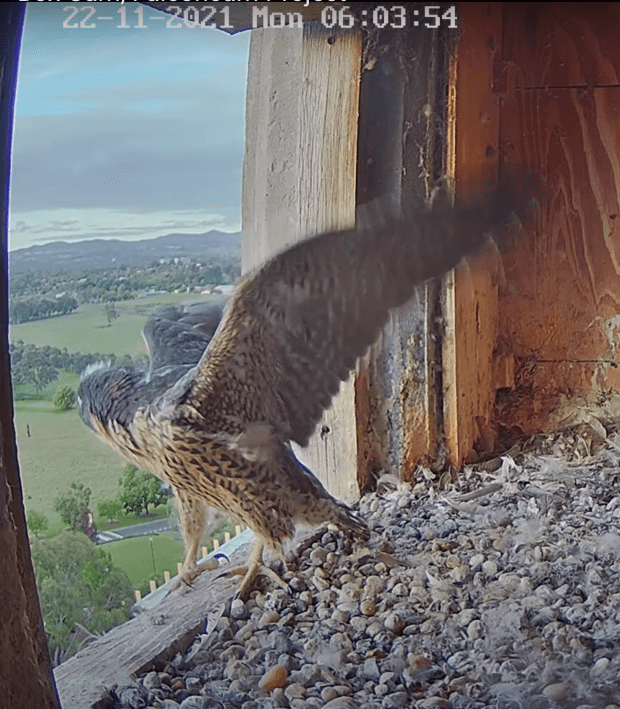
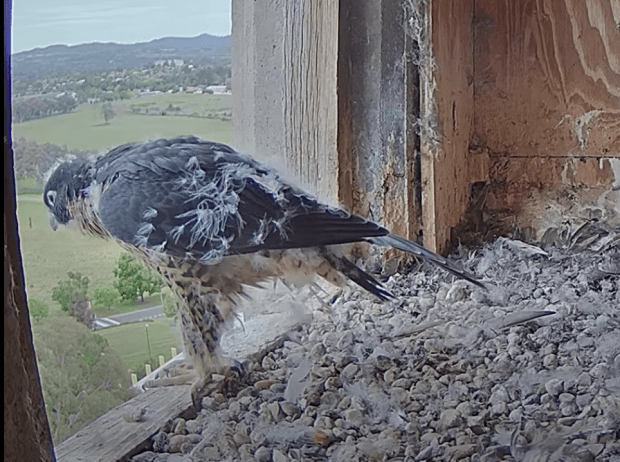
It was a beautiful flight. Xavier was outside taunting Yurruga. Diamond was at her side. Then Diamond flew. Yurruga was watching everything. She took off like a pro with perfect form. It was a beautiful Monday morning in Orange, Australia. 06:03:55.
Diamond and Yurruga are watching Xavier. That beautiful golden glow of the morning sun touches the scrape.
Diamond is off!
Yurruga joins her parents flying around the water tower. It was brilliant. No fludge for this young man or lady.
She has perfect flying form.
Yurruga leans down and out she goes. Magnificent.
This is the view of Yurruga leaping out to chase her destiny from the ledge cam. Look at Yurruga go! Beautiful and strong legs.
Fly safe, Yurruga!
Diamond returns to the scrape box ledge. Her job is mostly over.
Diamond watches from the ledge cam. Xavier and Yurruga are flying by. Xavier will teach Yurruga to fly and hunt along with team teaching with Diamond.
Congratulations to Dr Cilla Kinross, the lead researcher on the Peregrine Falcon Project, to Diamond and Xavier bravo! You did an amazing job. May Yurruga bless you with children, grandchildren, and great-grandchildren!
Thank you to Charles Sturt University and Cilla Kinross for their streaming cam where I took my screen shots.
Sometimes you don’t need any words to go with the images. It was 13:30 Saturday 20 November at Diamond and Xavier’s scrape box in Orange, Australia. Yurruga is 44 days old.
Some of the volunteers at the Lindsay Wildlife Hospital are on the grounds around UC-Berkeley in case there is a falcon that needs to go in care. So far nothing. Annie has been seen soaring with the intruder that injured Grinnell. Despite Grinnell returning to his and Annie’s territory there is no certainty that he will be successful in winning his mate back or keeping his territory. Will bring all news to you when I hear it.
Bazza ‘finally’ got a portion of a fish at 12:36 yesterday. Here is a parent delivering.
The boys and their wings.
You can see Bazza’s red leg band – he has the portion of fish. Good job, Bazza. Look at Dad’s nice crop. My goodness. He has delivered so many fish to this nest I wonder if he had any portions for himself. We know the answer now.
It is so funny. Falkey is mantled like he has a fish too. Ervie is full and doesn’t care. Bazza enjoyed every morsel. Now – everyone has eaten and it is only the middle of the day. Dad has brought in at least three fish in 6 hours. Gold star.
Falkey will go on to get the 17:15 delivery from Dad. Falkey is really getting good at grabbing those fish. He seems to have ditched his nickname ‘Mellow Yellow’.
At 19:13 Bazza is going to steal what is left of Falkey’s fish right from under him. Good work, Bazza. He’s catching on. That is grand.
Bless his heart, Dad brought in yet another fish at 19:50. Bazza and Ervie fought for it. Lost it and then Ervie found it. Dad is really taking care of his boys. Thanks, Dad. If you are wondering, Bazza has hovered but has not done any flying other than the day he had the fight with Ervie and landed on the deck of the boat in Dad’s area.
Other News:
For those of you wondering about the Cornell RTH camera of Big Red and Arthur, there is a power outage at the Alumni Fields that is affecting the camera.
Poole Harbour Osprey Friends will be holding a free on line talk about the importance of bird life. Here is the information:
Bruce Yolton who writes the blog Urban Hawks and takes amazing images of the raptors in New York City, has been looking at the 86th Street Peregrine Falcons. Have a look.
I have been lucky to have stayed in Southeast Asia many times. I am particularly fond of Cambodia and Laos. The rice farmers in Cambodia have started planting a new type of rice to attract the birds back to their fields. It is a good little read.
It has been a great morning. We have not seen the garden rabbit, Hedwig, for some time. We were afraid that the construction of new condos about three blocks away destroyed the rabbit burrows. Perhaps the rabbits have moved. I was delighted to see him. He must have been under the feeders eating seed for some time because I didn’t have time to get my camera before he left.
Thank you so much for joining me. Take care everyone. Enjoy your Saturday. I am going to step back and listen to Ferris Akel’s Tour until it is time to feed all the birds.
Thank you to the following for their streaming cam where I took my screen shots: the Port Lincoln Osprey and Charles Sturt University Falcon Cam and Cilla Kinross.
Yurruga is a Peregrine Falcon whose parents, Xavier and Diamond, have their scrape on the water tower at Charles Sturt University in Orange, Australia. Soon this beautiful fully feathered falcon will take its first flight out to that world that it is becoming increasingly interested in.
There are, according to Helen MacDonald in her book, Falcon, “60-odd species of the falcon family Falconidae…Those species are subdivided into four groups: the largely insectivorous hobbies, the tiny, bird-killing merlins, the kestrels and…the large falcons which are divided into two groups, the peregrines and the desert falcons.” The Falco Pereginus or the peregrines are fast flying hunters in the open air whose physical traits have developed over millions of years.
In the world of falconry, the female peregrine is called a falcon while the male is called a tiercel. In French, tiercel means a third indicating that the male is roughly 1/3 the size of the female.* This is called sexual dimorphism. Many also believe that the third hatch is always a male, a tiercel.
Yurruga has incredible vision. In The Peregrine by JA Baker, he says, “The eyes of a falcon peregrine weigh approximately one ounce each; they are larger and heavier than human eyes. If our eyes were in the same proportion to our bodies as the peregrine’s are to his, a twelve stone man would have eyes three inches across weighing four pounds.” * White goes on to say that the whole retina of a hawk’s eye records objects “twice as acute as that of the human retina…with a resolution eight times as great as ours.” Helen MacDonald states that while humans have one fovea and falcons have two enabling them to have two images of the same object fused in their brain.*** Humans have three receptors – red, green, and blue but falcons have four. We have three-dimensional colour vision, falcons can see four. In other words, these magnificent slate grey birds with their streaked chests, yellow cere and legs are far superior in their vision than we could ever wish to equal.
Southern falcons, such as Yurruga, are said to have significantly larger beaks than northern birds. Historically it was believed that these evolved for killing parrots. Researchers today are not quite sure of the discrepancy in size between the two geographical locations.
Peregrines also have a tomial tooth. This is a razor sharp point shaped like a triangle on the outer edges of the upper mandible that fits into a slot in the lower mandible. They use this tooth to bite into the neck of their prey to cut the vertebrae killing the bird instantly.
Sometimes Yurruga sits on the ledge of the scrape box with her mother, Diamond, looking out on the family’s territory.
Once Yurruga fledges, her parents, Diamond and Xavier, will teach her to hunt and will supply her with prey until she makes her very first kill. Yurruga will normally leave the parent’s territory after 4-6 weeks of training.
In the image below, you can clearly see Yarruga’s tomial tooth and her large eyes. She looks so much like a falcon today as opposed to a nestling. She is a gorgeous bird. Some viewers and chatters have gotten upset when Yurruga is aggressive with either Diamond or Xavier. Cilla Kinross said, “Shrinking violets won’t last long in the real world.” So true. Sadly, the survival rate of falcons in their first year is low. We know that Yurruga’s brother, Izzi, was thriving and we hope that she will, too.
One last observation. Diamond has been broody lately. She has incubated or fiddled with the eggs on numerous occasions. This could just be hormones or the physical eggs being there triggering Diamond. But, I wonder if she understands that ‘her baby’ will only be in the scrape a little while longer and she wants to ‘mother’?
In the middle of the night, Diamond was looking at her beautiful daughter.
As winter sets in, we are all looking for some good reads. There are many field guides that feature falcons but it is difficult cuddly up with a field guide. Looking at my bookshelf, I can see any number of them. If, however, you are looking for a really good read to understand the cultural history of falcons and their mythology, I highly recommend (and have done so many times) Helen MacDonald’s Falcon. MacDonald is an excellent and knowledgable writer that easily draws you into her respect and love for these birds. If you have exhausted the guides and have all three of MacDonald’s books, then there is another one. It is a small book illustrated by Welsh artist, Jackie Morris. She is incredibly talented. It is called Queen of the Sky and tells about the rescue, rehabilitation, and release of a peregrine falcon in Wales. An enjoyable read. Morris has a great website full of her wonderful animal stories and bird images.
There has been a real leap forward against animal cruelty. You may recall that several months ago, the home of Chris Packham in the New Forest had its gate burnt and a car set on fire. Packham has been leading the call for a banning of ‘the hunt’ on the grounds of animal cruelty. Today, trail hunting has been banned on all the land owned by Natural Resources in Wales. The amount of land is 362,456 acres or 146,681 hectares.
Trail hunting is supposed to involve dogs and hounds following scent without actually harming, chasing, injuring, or killing a fox. It has been proven that this is not always the case and Wales said that they did not have the resources to police the land for those who do not follow the law so they are not outlawing the practice altogether. Recently, Packham demonstrated that one of the riders was unusually cruel to her horse – an incident filmed that went viral. In October, the National Trust in England outlawed trail hunting on its properties as well. This is a great move forward in outlawing any cruelty to animals.
Speaking of cruelty to animals, Animal Nation, has called for people to stop using doves and pigeons at memorial ceremonies. The birds are released and die or if they are lucky wind up in a wonderful centre to receive care. They are not bred to live in the wild. Please tell your friends. No wonder it was so easy for Dad to catch that dove and take it to try and feed his #4 chick at 367 Collins Street in Melbourne.
The text was too long so that I had to take two captures. If you know of anyone considering memorial doves or pigeons, please talk to them, respectfully, about the implications to the birds. This is tragic. Thank you.
Whenever it looks a little dark, there is always someone or a group of people doing a really good thing for the birds and animals. A Place Called Hope posted images of the new osprey platform going up in Branford, Connecticut. A pair of Osprey nicknamed the Pretzel Pair had a poor location for a nest and annual failures. The community hopes that this brand new platform on a telephone pole will attract the couple and that there will be fledglings next summer. How thoughtful!
Photos @ Deanna Broderick on A Place for Hope FB Page
Wow. A lot can be done when a few dedicated people get together to help our birds. The platform on the pole will be lifted into place tomorrow. Fingers crossed the osprey couple find this to their liking!
It is raining in Port Lincoln. The three lads are wet. This might calm their adrenalin. Falkey is eating the latest fish delivered after Mum retrieved an earlier fish that Bazza got from Dad and that Ervie managed to take later. (They both ate). It felt like a lesson that Mum was teaching them when she swooped in and grabbed that fish. Sadly, it is time to toughen them up for the real world – which I hope is not so full of ospreys that they do not thrive.
Little Yurruga is very interested in what is going on outside and below the scrape. She has given viewers today more than a little scare. It was only a year yesterday that her big brother, Izzi, fell out of the scrape!
For some time now, Cilla Kinross, the main researcher at this scrape box, believed Yurruga to be a female. Now with the fluffy down falling away, Kinross now believes Yurruga is a male. She showed images of Yurruga next to Diamond and said she would expect Yurruga to be much bigger at 41 days and she isn’t.
Do we really care? I think everyone wants a lively, beautiful, and successful falcon – male or female!
I have seen no news on Grinnell or on the release of the WBSE fledgling in Sydney.
Take care everyone. Enjoy the end of the week. Thank you for stopping by.
Thank you to the Port Lincoln Osprey Project and the Charles Sturt University Falcon Cam and Cilla Kinross for their streaming cams. That is where I took my screen shots. I would also like to thank A Place Called Hope for the posting and images of the new osprey platform at Branford. That is where I took my information and images.
Bazza, the first hatch at the Port Lincoln Osprey Barge, is the last nestling to fledge. OK. He hasn’t fledged yet but you might have been fooled at 06:15 this morning when you saw an empty nest. Bazza was doing amazing hovering. Maybe this will be his day to fly! Wouldn’t that be grand? Bazza could begin to explore the cove with his brothers, Ervie and Falkey.
He really seems to want to be out there enjoying all the fun! But to put all of this into perspective, Ervie fledged early at 60 days. Bazza is 65 days old and Solly fledged last year at 65 days. DEW did not fledge til 73 days. Ervie just got us all excited! And then of course, Falkey followed suit rather quickly, too. But if Bazza does fledge today it will be right in line with Solly.
Yurruga, the nestling Peregrine Falcon in the scrape box of Xavier and Diamond on the grounds of Charles Sturt University in Orange, Australia, is waiting for her breakfast. She is looking a little ‘ragged’ this morning. Almost all of the baby down is off!
Grinnell, the resident male Peregrine Falcon, at the Campanile on UC-Berkley’s campus, was released one hour ago in his territory. He has been in the Lindsay Wildlife Rehabilitation Hospital and in ‘home care’ since he was injured in a territorial take over bid on 29 October. That is the latest news that I have. The cameras are being rotated a bit to try and get a glimpse of what will ultimately happen when Grinnell tries to land on the Campanile and take his place beside Annie. Will he succeed? Will the interloper? Here is a link to one of the cams:
It is nothing short of a blustery winter day on the Canadian prairies. Snow is blowing everywhere, some more flakes are falling, and the temperature is warm enough to be causing ice. It was a bit worrisome when I stopped at the pond and found a few ducks in a small open space of water.
They seemed to be enjoying themselves. No one seemed to have feather or wing issues but that open water is closing in fast.
There they are from a distance. It will give you some perspective on the size of the little pond.
I was surprised to see a few standing on the ice. Ducks – at least here – tend not to like to get their paddles cold.
My garden has been ‘very loud’ all day with about 200 or more House Sparrows all clamouring for food – which is in abundance. This little fellow was all puffed up to stay warm.
There was one lone Black-Capped Chickadee eating something in the Flame Willow. Like the sparrows, the chickadees are year round visitors to the feeders.
The two books from Roy Dennis Wildlife – Mistletoe Winter and Cottongrass Summer – arrived today. I have just finished Chris Packham and Meg McCubbin’s book and Isabella Tree’s on wilding to help restore the environment. It will be interesting to see what Dennis says in his latest book, Mistletoe Winter. Now for a nice cup of hot tea to go with it.
Send out positive wishes to Grinnell and all our feathered friends.
Thank you for joining me today. Take care everyone and be safe.
Thank you to the following for their streaming cams where I took my screen shots: Charles Sturt University Falcon Cam and Cilla Kinross, and Port Lincoln Osprey Project.
Viewers of the Port Lincoln Osprey Barge are starting to wonder if Bazza isn’t eating so much fish that he can’t get lift off the nest. He sure does love his fish.
At 08:00 Dad flies in with the first fish of the day. Falkey gets that one fighting off Bazza who would just love to have breakfast. At 8:50, Falky is full and he walks away leaving a beautiful fish tail on the nest. Ervie spied it immediately and finished that off quick.
They remain such a civil trio. There is Falkey getting to enjoy his breakfast.
Ervie turns around and probably doesn’t believe his luck – a nice fish tail just in front of him. He was there claiming it in the snap of a finger.
Ervie made quick work of the fish tail. Falky is full and Bazza really doesn’t seem interested.
At 09:36:53, Dad flies in with another fish, quite a large one this time. He puts it right at Bazza’s feet. Talk about luck. Bazza was still eating on that fish an hour and a half later. I don’t think he will be leaving too many scraps.
Just look at the size of that fish!
Bazza is still eating. My goodness. It could be true. Maybe he is too big for take off. Bazza certainly seems to be wider than the other two lads.
Do you follow the falcons at Orange? If so, then you probably know that this is the one year anniversary of last year’s chick, Izzi’s fludge. For those unfamiliar, Izzi was the only hatch of Diamond and Xavier in 2020. He dozed off on the ledge and literally fell out of the scrape box. Cilla had to find him and carry him back up the 170 steps to the box. When he did fledge, the first time, Izzi flew into a window and went into care. Cilla returned him to the scrape to do it properly the third time. Isn’t that what they say? The third time is a charm. It worked. In memory of the fludge, someone has put together a video clip of it and Izzi being returned to the scrape.
As for ‘Little’ Yurruga, Xavier delivered three prey items for his daughter before 06:45! Diamond will come in later and help Yurruga but she is doing a good job of the self-feeding. I love how she watches Diamond so intently when she is plucking and eating – memorizing / imprinting it all.
Rumours are circling that the WBSE Juvenile will be released from care into an area around the Newington Armoury by the Discovery Centre in the Sydney Olympic Park. The juvenile injured by the Curras is believed to be 27. (There are some that believe it is 28 and with no bands and no DNA who knows.)
There is really not a lot going on in Bird World. Waiting for Bazza to take the leap, waiting for some of the first Bald Eagles to lay their eggs, waiting to find out who is the Royal Cam Albatross family this year. Feels like a lot will happen at once!
Oh, I had to just go and check on the lads one more time to see if it is possible Bazza has flown. Nope. It is an hour later and Bazza is still eating!!!!!!!! Bazza has been eating for two hours. I kid you not. Did someone get Little Bob mixed up with Big Bob?
Flying uses up a lot of calories. Look at the difference in size between Falkey and Bazza. Gracious.
Thank you for joining me. Take care everyone. See you soon.
Thank you to the Port Lincoln Osprey Project and Charles Sturt Falcon Cam and Cilla Kinross for their streaming cams where I took my screen shots.
Little Yurruga has really been shaking it up – or should I say ‘off’? Those fluffy white down feathers, so soft and so cute when she was younger, must be driving her crazy. Underneath what is left is going to be a lovely bird, just like her Mum, Diamond.
There is no doubt that Yurruga can be loud and she certainly almost claims those eggs as her own in the video above. She can also persuade the parents to go to the ledge or leave entirely. But, Yurruga feels like a much gentler soul than Izzi. Diamond is simply a patient observant Mum and after a bit, Yurruga stops with the prey calling when she sees that nothing is coming. Rather nice.
A few minutes later, Yurruga was running around with a Starling beak. What a character!
There have been several fish deliveries at Port Lincoln. Ervie got the first fish and left a little for the brothers. That came in at 6:50:24. There was another delivery at 12:11 and another at 14:25:11. I could not tell who got the last fish but, Bazza picked up the noon delivery. Maybe Falky got the last one. Ervie didn’t. They are all getting fish to eat and no one is hungry despite the scramble for the latest delivery.
Port Lincoln posted Ervie’s flight path yesterday. He is definitely exploring around the barge.
Falky continues his flying and landing exercises and Port Lincoln adds that Bazza seems to figure if he stays on the nest, he has the best chance of getting a fish! One of the chatters wondered if he was too ‘heavy’ for lift off. Bazza will fly when Bazza is ready. We don’t need to urge him on. I am certain Ervie and Falky are very capable of doing that.
I am continuing to read and enjoy Emry Evans Monty more and more. I am on my second reading of parts of this marvellous book. While it is about the foundational male of Welsh Ospreys it is also about this wonderful species and insights into their behaviour. I was particularly moved by the essay on Monty’s mourning the loss of his daughter, Ceri, and the links drawn to all of the studies that demonstrate that animals not only experience ranges of emotion but also pain and suffering and to Dr Marc Bekoff’s writing as well as to that of Jane Goodall. One of those is The Ten Trusts.
Those trusts, according to Goodall and Bekoff are: 1. Respect all life; 2. Live as part of the Animal Kingdom; 3. Educate our children to respect animals; 4. Treat animals as you would like to be treated; 5. Be a steward; 6. Value the sounds of nature and help preserve them; 7. Do not harm life in order to learn about it; 8. Have the courage of your convictions; 9. Act knowing that your actions make a difference, and 10. Act knowing that you are not alone.
Because of the unnecessary death of Solly, the 2020 hatch at Port Lincoln, on the power line at Streaky Bay, I am particularly interested in #9. Each of us can make a difference and I note that in Wales, all that had to be done to keep the Ospreys off the power lines where they love to eat fish was to place two diagonal rods. How simple is that?! The South Australian Government could do this with all of the power lines near the coasts where the birds fish and eat.
There is an update on Grinnell, the male Peregrine Falcon who was injured in a turf war. Of course, everyone hopes that Grinnell is super fit and able to take on his assailant who is now courting Grinnell’s mate, Annie. This was 19 hours ago:
It is a another grey day with the promise of more snow. Meanwhile everything seems to have a crust of ice on it or, in the case of walkways, several centimetres of ice making it nearly impossible to walk. The birds are very inventive. They have been burrowing tunnels in the snow and then standing in the holes – it is like having one’s on private igloo.
Take care everyone. Thank you so much for joining me. Stay safe!
Thank you to the following for their streaming cams or FB groups where I took my screen captures and video clips: Port Lincoln Osprey Project Cam and FB Page, Charles Sturt University Falcon Cam and Cilla Kinross.
The fish arrived on the nest at Port Lincoln at 6:35:01 and immediately Ervie was mantling it.
Needless to say, Ervie really is the boss of this nest and for good reason. He has fabulous survival instincts.
As you know, my interest is in third hatches and how well they do on nest and off. It will be very informative on how well Ervie does when he leaves the area of the nest seeking out his own fishing spots.
Bazza and Falky might wish that Ervie would fly off and not return.
I only commented once but watchers were calling Falky ‘Mellow Yellow’. It is time that Falky was not so laid back. Yesterday, Bazza took the second fish while Falky had the fish tail from Ervie’s earlier breakfast. If I missed Falky getting a fish, I apologize. It would be good if each had one fish per day. They are all well-feathered and Bazza and Falky will fledge when they are good and ready. e
Oh, wouldn’t it be wonderful to watch Ervie learn how to fish?
At 7:43, Ervie is still eating but his two siblings are hanging close hoping to get some leftovers.
Ah, and Falky got it. Well done, Falky.
If you missed Ervie’s fledge, here it is again. It is quite beautiful on the take off and fly by but the landing was not impressive! Still, I applaud our third hatch lad. Ervie, you are amazing. You are definitely the leader of the pack, so to speak.
If you missed Victor Hurley’s Q & A discussion, it was really really super. I posted that link in my blog, Ervie Flies! early this morning. Very informative and you can start and stop it as you like. If you are interested in falcons or Australian birds of prey – it really is a talk not to miss.
Since the shut down of the 367 Collins Street camera, I hope that many of you are filling that gap with Yurruga in the water tower scrape of Charles Sturt University at Orange. As a former academic, we do not like to comment on others’ research. There were a couple of questions to Victor Hurley about the scrape at Orange and he answered in general terms. Someone asked about the low hatch rate and the eggs. VH said that if the eggs are too large (and he does not know that is the case at Orange) it is hard for the chick to kick them to create a crack all around the egg. He also noted that sometimes eggs get turned when a beak is protruding and the chick cannot right itself if the egg is turned around. Of course, VH said that those are general statements and not specific to Orange. He did comment that Yurruga gets all the food while the four at Collins Street had less bites per chick. He also noted that the Collins Street Four developed quite fast this year and that Yurruga appears to be developing normally. So, she is 8 days younger and the amount of floof she has is normal for this stage.
One of the things that I took away from VH’s discussion was how adaptable Peregrine Falcons are. If there is a drop in numbers of a prey item, they will move to something else. For example, some Alaskan Peregrines have been known to eat trout. The image below was shown as an example.
This year I noted a drop in the amount of pigeon delivered to the scrape at Collins Street. This could, according to VH, be a result of the several lockdowns they have had due to the pandemic. Less people eating their lunch and feeding the pigeons. He did note that the male did bring in Quail and Rail. The falcons normally have a 5 km hunting range but are known to go farther. The are for Collins Street is prey rich. The red dot indicates the site of the nest box.
The falcons do not spend a lot of time on the ledge after the eyases fledge. There is a good reason for this – parasites.
As we learned with Grinnell, the male at the University of California – Berkeley Campanile scrape, birds can become loaded with parasites and they might not be able to protect themselves as well as if they were healthy. Grinnell was taking anti-parasite medication to overcome this. We know he is improving and will be released shortly.
One of the most interesting things to come out of this talk had to do with how the females are attracted to a mate. VH said that there are ‘stunning’ Peregrine males. You and I have seen them. They have an almost orange cere and legs. Dark black, really black, hoods with cream chests and very fine pinstripe chests. Those are the extremely healthy males and the females want healthy. Pale yellow indicates unhealthy. So now when you look at a falcon you can tell healthier vs not so much.
Also falcons divorce. If the female hooks up with a male and he does not share incubation duties or bring in prey, she will move on the next year. The male stays with the nest but it could be in a prey deficit area. At any rate, it was a real good discussion! It is nice to listen to the expert in the area – even talk about rodenticide.
Little Yurruga is doing well. She was working on her breakfast the last I checked.
My daughter went to the Assiniboine River for a walk and discovered about thirty-five ducks still on the river. She sent some photos for us. She noted that there was at least one other group this size down the river.
There are a lot of signs on our park ponds not to feed the ducks and geese or they will not migrate. My daughter ran into a neighbour that says the ducks stay at that part of the river year round and people feed them. They added that parts of the river in that location have been open – not frozen over. I sure hope that is the case this year! There is also an American Bittern hanging around one of the creeks. Maybe they know that this big snow is just to scare us into thinking it is going to be a horrible winter and it will be mild. We wait to see.
The garden birds have found the seed left on the deck and Dyson has, of course, been helping himself. I missed getting him hanging upside down on a suet cylinder. The migrating birds are all gone from this area. Thankfully.
Dyson always knows when the food comes out!!!!!!!!!!!!!!!
The feeders – and there are many different kinds – are all full. It was interesting to me that the sparrows did not mind standing on the snow. According to my daughter, the ducks really like being in the water and not having their paddles on the cold ice.
It is a good day to be inside!
Thank you for joining me today. There could be another fledge at Port Lincoln and we know there will be lots of prey for Yurruga. Take care everyone. See you soon.
Thank you to the following for their streaming cams where I took my screen shots: Port Lincoln Osprey Project and Charles Sturt Falcon Cam and Cilla Kinross. I also want to thank the 367 Collins Street FB group for posting the link for Victor Hurley’s talk and my daughter for those great duck images.
It is difficult to try and describe the weather we have been having to someone who might never have experienced it. Someone took a video of the blowing snow on the highway, a huge buck, and some of the issues people face trying to drive on the road in a storm. When you cannot see the road for the blowing snow, we call it a ‘white out’. This is the time of year we also call ‘the rut’. The bucks dig and spray marking their territory. We are seeing many in the fields around the city and in larger treed forests within the City.
Ah, but I am not here to talk about the horrible winter weather we are having.
My last blog focused on Ervie, the third hatch at the Port Lincoln Osprey barge in South Australia. Ervie managed to get the first fish of the day. He only left the tail for Falky. To show how congenial these three are, Ervie did not even try to get the 10:48:28 delivery from Dad. Instead, Bazza (Big Bob) snatched it.
There he is enjoying his fish.
The camera is zoomed out in case one of the lads decides to fledge. Oh, I do hope they stay a little longer – another week, maybe.
Little Yurruga at the Charles Sturt University falcon scrape had 5 prey items for breakfast today. Yesterday was not a good day for feedings but, Diamond and Xavier have made up for it today. I am thinking that the parents might be teaching Yurruga that there are days with little food and some days with a lot.
Yurruga was really hungry when Xavier came with breakfast! Really hungry.
Yurruga has just finished that breakfast. Another prey item sits on the scrape, a Starling, and Xavier has brought more food. Notice that Yurruga is not running up and tackling Xavier to get the prey. Yurruga is probably wondering why there is so much food today.
Diamond came in to help Yurruga finish up that delivery. The Starling is still where it has been all morning. Diamond really dislikes Starlings!
Yurruga has an enormous crop. It isn’t her crop that interests me, however, but, the change in her plumage. Much of the fluff has disappeared. Peregrine Falcon juveniles have beautiful banded chests. Their bars are vertical. When Yurruga is an adult, the bars will be horizontal. Notice also the beautiful dark head and the tip of the wing. Oh, she is morphing right before our eyes into a very beautiful juvie.
She does not seem to be interested in the Starling that she pulled over to the rocks earlier. Oh, wait…maybe she is!
The feathers are almost off the left side of Yurruga’s head. Notice her beak. We get a chance to see how it has developed in this profile image. Yurruga is becoming very ‘falcon like’. Those chest feathers – that coppery brown – are just lovely. She looks like she has a feather boa around her neck – something she might need where I live today.
Oh, Yurruga means business. She is going to do something with that Starling.
She is showing us how strong she is! There are still some soft pantaloons but the down is coming off with every flap of those wings. Is there anything cuter than a little peregrine falcon at this stage in their development?
She is dragging that old bird back into the centre of the scrape.
There is our Peregrine Falcon with her large beak standing victorious on her prey. This pose really reveals how much Yurruga has grown. All of the feathers necessary for flight are growing in. Amazing.
Awww. Yurruga gave up on that old bird. No one seems to really want it. Wonder if Starlings have ‘Best Before’ dates on them?
WBSE 27 @Chris Bruce
If you missed it, here is the latest update on White Bellied Sea Eagle Fledgling 27, three days ago:
I wanted to bring you an update and some good news. The Port Lincoln Osplets are doing fine and I am certain that Falky will have a fish before the end of the day. Yurruga has already eaten enough to last her well into tomorrow. It also appears that WBSE27 is doing extremely well in care. The last update on Grinnell was on 10 November. He was getting to go into foster care for a few days before being released. All of the Kakapo are alive and the NZ DOC Rangers at Taiaroa Head will not decide which Royal Albatross couple will be on the Royal Cam until all eggs are laid.
Thank you. It is really nice that you are joining me. Take care wherever you are. Stay safe.
Thank you to the following for their streaming cams or FB news where I took my screen captures: the Port Lincoln Osprey Project, Sea Eagle Cam, Charles Sturt University Falcon Cam and Cilla Kinross.
It is a very good day to stay home where I live. We had our huge snow fall, the side streets are thick with ice like a hockey rink, and snow is beginning to come down again! It is amazing that the garden birds are out but, of course, their lives depend on getting food. I have discovered that the sparrows will also eat the suet cylinders which is a real plus as they do not seem to get ‘mushy’ like the chipped up peanut and sunflower seeds do.
We had so many Osprey deaths that the people literally rose up and demanded that our public utility put up Osprey poles and covers. The Western Ospreys that come to Manitoba and breed during the summer are much loved. Their nests are around ‘cottage’ country on Lake Winnipeg or farther north along the Mossey River. In Latvia, the Government passed a law that all the power poles had to have protective devices for the birds. It is unfortunate that the government there gave them so long, til 2024, to complete the project. Huge numbers of beloved storks have been killed as a result of the delay in implementing the law. There is a reason that I am still talking about this: Solly. Much loved and with so much potential was tragically and unnecessarily killed on a power pole at Streaky Bay on the 11th. My condolences go out to the entire Port Lincoln Osprey community who have to be just gutted with this news.
The Minister for the Environment and Water for South Australia is David Speirs. He has just been at Port Lincoln and Thistle Island for the banding of this year’s osprey nestlings. If you are so inclined, I am urging people to write to him and ask that he take on the initiative of having the power poles made safe for the birds. It does not mean that the poles have to be removed but, rather, there are covers for the places where the birds can land and get killed. He says he loves Ospreys – so let’s check and see if he is a man of action. His e-mail address is: Minister.Speirs@sa.gov.au
Solly’s death was ‘human caused’ and entirely unnecessary.
It looks like the rain is peppering the Osprey nest at Port Lincoln this morning. The wind is blowing at 26 kph with gusts over 40 kph.
If it continues the nestlings will not be fledging voluntarily. Wet feathers and taking a first flight do not go well together. I hope they hunker down like I will be doing today with our blizzard.
The rain at Port Lincoln appears to be easing up but not the wind. Send them warm wishes today. No one wants a premature fledge – a fludge.
Over in Orange (or ‘up’ in Orange), it looks like a rather nice day. Little Yurruga is waiting for her breakfast to arrive.
Xavier did not disappoint! Xavier sure gets out of there quickly. He doesn’t want his talon on the breakfast menu.
Yurruga is really doing well at feeding herself. She has to learn so she can survive.
Yurruga is still working on that Starling. Often Diamond, the Mum, will come in and help the little one when she gets tired. It is so sweet.
If you have been watching the Melbourne Peregrine Falcon Family on Collins Street, I urge you to start watching Little Yurruga. Her name means Sunshine and she will bring joy to your day. Diamond and Xavier are experienced parents and Yurruga is their Only Bob this year. Like Izzi last year. Here is the link to the streaming cam:
Here is a short video, 8 minutes, on the Peregrine Falcon. Yurruga will fly out of the scrape and join the family of the fastest birds in the world!
Here is a ‘too short’ look at falconry. This time we are going to Nijo Castle in Japan. The Castle is a style known as ‘flat land’. It was built in 1603 for the first Japanese Tokugawa Shogun, Ieyasu. This began the period of Japanese history known as Edo era, 1603-1867. The Shogun also had a castle in Edo, modern day Tokyo. Falconry in Japan, as in other countries, was a noble endeavour. Have a look:
There is another ‘bird or avian’ association with Nijo Castle. The floors have special brackets that cause them to chirp like a Nightingale. The chirping gets louder as the person would get closer to the private quarters of the Shogun. It was a type of security system because there were always individuals who wanted to assassinate the Shogun and take their power.
Take care everyone. Thank you so much for joining me and thank you to those who have written to Minister Speirs. Fingers crossed. Stay safe.
Thank you to the following for their streaming cams where I took my screenshots: the Port Lincoln Osprey Project and Charles Sturt Falcon Cam and Cilla Kinross.