Egg stealing, eaglets and more…Bird World for Wednesday

11 January 2022

Good Morning Everyone,

The month of January is flying by. My children are back in their classrooms teaching and I am enjoying the benefits of retirement – being here with you and the birds. I must begin with a request. If you have been writing to me at my outlook address (check your e-mail) and I have not responded, my apologies. Lewis finally chewed through the entire cord despite my putting electric tape all over it. He does not like the cord to the Mac Air – thank goodness. I will get a replacement but, I think moving forward please send letters to me at this address now that I have this other machine: maryannsteggles@icloud.com

Doesn’t he just look innocent? I blamed it on teething but I think Lewis is just ‘nuts’ about dangly things. In the image below, he has uncovered a window that was ‘wrapped’ so that he could not get to it. Surprise! The foamy stuff that has dried over the years caused me great anxiety. Of course – he found it! Terrible Mum put him in ‘time out’ until I could remove the window to the basement! You would have thought I was pulling his toe nails out. Poor thing. I wonder what he will think when I do trim those nails this evening?

Missy is a very big girl and she is not even six months old. That is the beautiful blanket that was given to her when she was adopted – I love the pastel granny squares. Perfect for such a sweet girl. The issue is her size! This is my grandmother’s old quarter-cut oak dining table. It is 50 inches in circumference (without the leaves) or 127 cm. Stretched out Missy is 38 inches or 96.52. How do you say Maine Coon? BTW. Yes, they have taken over the dining room table. They like the light on – like a heat lamp!!!!!!!

They are not fighting. Missy sleeps with her head on Lewis’s leg. Seriously. They are almost always inseparable. Never seen anything like it.

In the Mailbox:

Question: ‘A’ wonders if Indigo is capable of catching his own prey.

Answer: The majority of the resources that I read and have checked state that Peregrine Falcon Fledglings in North America can and do catch their own prey after about 4 weeks from leaving the scrape. So Indigo is certainly capable. He has been bringing in beetles which we all presume that he has caught. It reminds me of Izzi with his cicadas and then eating them like popsicles on the ledge of the scrape. If Indigo has not caught a bird yet, he is able to and should be doing so soon. I asked how much an adult peregrine needs to eat in a day and from several centres that do peregrine falcon recovery, the answer is approximately 70 grams of food a day is good for an adult – that is apparently equivalent to two Starlings or Blackbirds.

This video is actually from the 30th of December so it is now 12 days ago. Indigo arrives at the scrape with a large bug. He is so pleased with himself over these bug catches that it leads one to believe that they are his first successful hunting forays. Good protein in those bugs, too, for our young lad.

In the News:

Gemeff sent me this news item the other morning and it was too late to include in my blog for that day. You might think that egg collecting and putting feathers in ladies hats died out in the 19th and early 20th centuries. Turns out Scotland Yard has been working on Operation Easter Egg for 25 years. This is very sad, indeed. I am reminded of the four eggs stolen from Taiaroa Head where the Royal Albatross nest late in 2022. Despicable. You can find the entire story at Raptor Persecution UK.

‘A’ has written to me about the torrential rains and flooding that Melbourne has experienced. Have you ‘A’ or any of our other readers in Melbourne seen these floating platforms? and if so, are they working to help wildlife? I would love to have a personal account. They look brilliant and I am reminded of the floating loon nests that I just wrote about in my blog posted on 10 January.

Most of the people who read my blog know that helping wildlife makes you feel good. Many of us recognise the animals that come regularly to our gardens. An article appearing today in The Guardian carries the following message from the author:

Getting to know animals as individuals with varying personalities and behaviour grants them elevated importance. But be aware that it is likely to push you closer to vegetarianism and inspire you towards conservation. Because once you have a relationship and an attachment to another living creature, they become part of your sphere of compassion. And then there is no choice but to protect both the animal and its environment. 

Kate Ahmad, The Guardian, Befriending a wild animal will make you a better human – here’s why

https://www.theguardian.com/commentisfree/2023/jan/06/befriending-a-wild-animal-will-make-you-a-better-human-heres-why?CMP=share_btn_link

Ever wondered what it would be like to go to a Red Kite feeding station? I have and I would love to see these magnificent raptors. The Bellymack Hill Feeding Station is near Castle Douglas and the Galloway Red Kite Trail. This is a great little 10:04 minute video created by visitors to see the kites being fed. They also got to see other farm animals. At 1400 every day, food is put out for the raptors. They have hides where you can watch. Your admission helps buy the food. So, if you travel to anywhere in the UK, check and see if there is a Red Kite feeding station! Watch them for me! And if I get there first, I will publish lots of photos.

We all have dreams and like seeing Red Kites in the Wild come to feed, I really would like to see Ospreys migrating to their winter homes and then go on a trek to photograph and count them in those winter regions. Jean-Marie duPart goes up and down the Senegalese coast and into the parks and rivers in search of ospreys and he reports back. There seems to be more good news this year for various nests. You can catch his reports on FB by searching for his name: Jean-Marie Depart. He works for Nature et Oiseaux Sénégal .

The Nests We are Watching (some of them):

Connie and Clive’s first eaglet together is a cutie – CE9. So happy for this eagle couple after all they have been through.

Little eaglet is tuckered out. Hatching is hard work!

Some fish for the wee one? That first feeding will just be little bits and bobs and some fish juice and saliva. It is actually unclear whether the eaglet has been fed. Certainly Connie has eaten!!!!! Little one will be strong and hungry tomorrow morning screaming for fish.

Lady Hawk caught the hatch in a video. Dad Clive was on the nest when it hatched. The chick hatched at 11:22 on Tuesday. For whatever reason, Connie has yet to feed it despite fish on the nest.

Louis and Anna’s little eaglet is a chubby little one…so sweet. Anna is already covering up Louis’s fish – hoping that those nasty flies and mosquitoes will stay away. Maybe these nests need Zappers! I think the fact that the beautiful Spirit Bluff peregrine falcon chicks jumped to their death because of black flies has me on edge now when I see lots of insects. And, yes…we need insects. I am not proposing that we don’t have them. We need more actually but, maybe just not on smelly eagle nests when there are babies.

KNF E#-01 and 02 are doing well. Both have had big crops and there is no issue about an eaglet not being fed. Everything is going along fine.

It continues to look like Pearl is self feeding at the Superbeaks nest while Tico is being fed …that said, Muhlady also feeds Pearl but the oldest eaglet is trying. She is just over a month old.

At the Southwest Florida Bald Eagle nest, Harriet got a break around 0742 Tuesday morning. M15 took over the feeding and let Mum hang out having a break. M15 is fantastic. I love it when he feeds the eaglets because each gets to eat. He will also step in and feed the little one, this year little E22, if 21 is getting the majority. I often wonder if he came from a nest where he was the last hatch with a big sister? Things are fine at this nest!

These kids had a bunny breakfast. While eagles bring many things to their nests, some of the prey M15 delivers is road kill – bunnies, cats, etc. Bald Eagles eat almost anything – fish, ducks, Coots that they have caught, other mammals they have hunted, and carrion.

M15 and Harriet have given E22 several little private feedings. Fantastic.

The weather is nasty at the nest of Shadow and Jackie in Big Bear Valley today. Strong howling winds, blowing snow/ice. I really hope our gal doesn’t decide to lay her eggs during this period of bad weather. This storm caused power outages, etc even in San Jose where Sequoia has her scrape (an hour south approximately).

The winds have calmed down slightly.

They have calmed down for Sequoia, also.

It poured on the University of California-Berkeley campus. I hope that Annie is safe. So glad no chicks in the nest for Annie. Weather, wet weather, is difficult when there are new chicks. Many studies show that the decline in Peregrine Falcons in the far northern region is often due to rain – the damp cold and hunting for prey become issues for the adults.

The weather looks pretty good in Iowa. Both eagles were at the nest at Decorah, near the trout hatchery, at dawn. They later worked on the nest.

In Australia, Zoe was at the nest early hoping for a fish on the 11th. Before Dad arrived she turned and I would almost guess she had already had something to eat. Look at her profile. This is at 07:11. I think our girl is catching fish although it is a bit of a mystery. She did leave the nest between dawn and the time the fish was delivered. Was it enough? or did she get a fish drop off camera? I am so curious about this huge crop.

Dad obliged at 0714. Zoe is 116 days old today (115 when this fish was delivered in Australia).

For Achieva Osprey fans, Diane and Jack have both been at the nest today in St Petersburg, Florida. Jack brought Diane a fish and Diane was seen defending the nest. Her leg must be getting better. Such good news! Now if a fairy would repair the hole in the centre of that nest.

Thank you so much for being with me today. It is so exciting having a few more little eaglets to enjoy – and also to have a few nests with eaglets developing at different stages. It is a real way to visually see the changes from week to week at different nests. Somehow I always find I remember these developments easier if I can ‘see’ them rather than read about them. We should be watching for pips at both Captiva and KNF-E1. Pips will be coming up at Barry College in a week or so. Take care all. See you soon!

Thank you to the following for their letters, tweets, announcements, blogs, and streaming cams that make up my screen captures today: ‘A’, Geemeff, Orange CSU Peregrine Falcons, Raptor Persecution UK, #BirdTheFeckAtHome, The Guardian, Red Kite Feeding YouTube Video, Window to Wildlife, Lady Hawk, KNF E1 and KNF E3, Port Lincoln Ospreys, Achieva Credit Union, Superbeaks, SWFL Eagles and D Pritchett, FOBBV, San Jose City Hall Falcons, Cal Falcons, Raptor Resource Project and Explore.org.

Anna and Louis have a hatch, pip for Connie and Clive…Monday in Bird World

9 January 2022

Good Morning Everyone,

I hope that you had a lovely weekend. Maybe some time to watch some birds? or did you stay glued to the screen over the Es at Southwest Florida? It was beautiful here on the Canadian Prairies with a reasonable temperature but, the wind remained such that being outside had you gasping for breath. I am hoping to get out this coming week! Til then I am still working on all my new year’s cleaning! How can two kittens, not big cats yet, leave behind so many furry balls every day? It is like they invite friends over and party all night! Quietly.


I love the Starlings that come to my garden. I would not want them to ever stop coming. They are on the Red List in the UK – they were one of the first birds I posted when I began listing the 20 or so out of the 160 odd that are vulnerable to extinction. Here they are in murmuration.

Have a read. The decline in winter birds that migrate to the UK and their empty nests has many worried. Once there would have been 2 million Starlings murmuring in Somerset at dusk, now there is only 25% of that number. What is the cause?

https://www.theguardian.com/environment/2023/jan/08/uk-wintering-birds-sharp-decline?CMP=share_btn_link

HeidiMc has a lovely video of a day in the life of Ron and Rose..greetings, working on the nest, lots of chortling and a fish delivery. A nice celebration of a new relationship! Thanks H.

And another video by Golden Gate Audubon. Peregrine Falcons have been spending time on Richmond and Rosie’s Whirly Crane Osprey nest in SF Bay. I wondered if they were any of the fledged CalFalcon chicks but they answered this in the description – no. If they find out where the falcon was banded, they will let us know. Until then…he or she is a cutie.

There is news of WBSE27: On the 14th of December, WBSE 27 was at Swan Bay on the Karuah River. You can see Sydney and then the red pin. It is a distance of 188 km.

Isn’t she beautiful? I wish Lady and Dad knew their baby was safe and doing well.

WBSE27 is 17 months old and is going through her first moult. As a result she has shed her tracker which was attached to her tail. WBSE 27 is banded so any future sightings will be from the band and not the tracker. “Now SE27 starts the new year afresh – while we can no longer follow her adventures, we have a wealth of information to analyse and share! We are happy that she has found her way in the world after such a rocky start. She is familiar with a wide expanse of the Hunter Region of NSW, and has established travel corridors, roosting and feeding areas. We hope that in the next few years she’ll be able to find a territory, mate and nesting site, and one day produce chicks of her own to continue the journey.” Tears. After watching these beautiful babies thrive on the nest, it is a tragedy that they are so attacked by the smaller birds to the point of near death or death unless someone finds them and takes them so they can have the care they require. WBSE30 will get a sat pak tracker when she is released and we will be able to watch another baby.

My wish for the new year is that all of the sea eagle fledglings go and sit in front of the Discovery Centre – right away after fledging – and are taken into care so they will be able to thrive in the wild knowing how to hunt prey and fly well like 27. OR that someone comes up with a solution to the Currawongs, Boobook Owls, and Magpies that harass them til they are no longer in their parents territory, are injured, or stave to death.

Suzanne Arnold Horning caught Big Red and Arthur out in the sunshine on Sunday. Big Red first and Arthur the second image. Thanks SAH.

There are birds that instantly will draw me to tears – tears of joy and relief. In Ferris Akel’s tour of 7 January, we saw Big Red and L4 hunting. Cornell has posted a tweet showing L2 on Sunday morning. Also Karel Sedlacek had Arthur on his iPhone presentation on Sunday. So why am I so happy? All of Big Red and Arthur’s kids from 2022 are accounted for: L3 is in care but preparing for release in the spring (we believe). L2 and L4 are hunting in their parent’s territory. Sadly, we lost L1 when she hit a glass corridor at Cornell (shame on them for having no bird proofing on that!). This is the very first year that I can remember fledglings being present in January! There is obviously plenty of food and Mum and Dad are not anxious for them to go anywhere. Tears of joy.

Finally a good look at both of the eaglets on the Superbeaks cam at once and look at those crops. Goodness these eaglets are being well fed and nicely cared for by Pepe and Muhlady. Notice also that a big stick has been placed across that opening to the left! Yes.

Big crops for both E3-01 and E3-02 at 1302 on Sunday! And it looks like there are still about nine fish on that nest. Alex is a great provider.

Alex came in yesterday and diffused a bonking event. E3-01 was 12 days old. Bonking seems to start with the growth of the thermal down (or at the age of about 8 days in Ospreys). It is hard to watch and entirely not understandable with a nest with so much fish but, in fact, food sometimes has nothing to do with it. Just a dominance issue. Thanks, Alex, for stepping in. Not worried about them…the eldest just making sure the little one knows who is boss!

Sunday. Look at the fish on the nest of Alex and Andria. Both babies eating well.

The key is to let the older sibling eat til it is about to pop and then feed the younger. This is only a problem if there is not enough food. On this nest there is tonnes of fish. No shortage here and both parents are willing to feed til they each have a crop as in the image above and below. The eldest can be a stinker.

Anna is listening to the eggs as she has a fish lunch at the E1 nest in the Kisatchie National Forest. There is a pip in one of the eggs.

And there is a hatch!!!!! Welcome to the world, E1-03.

Oh, precious. Louis will start hauling in the fish now. Can’t wait to see what he brings in – last year he was so excited he brought in 11 and Anna brought in 9 for a total of 20 fish on the nest in a single day. These eagles in Louisiana hatched at Kincaid Lake eat well!

MO and FO are still there. Reports are coming in from the SW coast of Florida that a lot of Ospreys are now returning to the area. I hope there are not too many nest fights. Will Lena return? Is Andy still out there?

MO and FO are working on technique.

E21 and 22 are fed well. There is some beaking at times. Still, they are adorable. How many eaglets has Harriet raised? Everyone to fledge as far as I know. I do not worry about these two at all.

Gabby and V3 on alert today.

Both Gabby and V3 were sleeping at the nest tonight. You could see Gabby on cam 1 and V3 on cam 2.

It is nearing 0700 and Zoe is awake wishing for a breakfast fish. Mum and Dad appear to be trying to get their girl to go out and fish for her own breakfast. Yesterday Dad brought a fish and Mum brought a fish but the times for the deliveries were late in the day: 16:42 and 17:50. So our girl went to sleep full to the brim. Today she is 113 days old.

A screaming Indigo!!!!!!!

I wanted to stop and check on Karl II’s family – the Black Storks from the Karula National Forest in Estonia. There has been no transmission from Karl or Kaia since they were in Africa and this is expected. There has been no transmission from Bonus since he was crossing the Eastern Desert in Egypt and I do not know yet what to think about that. Urdu (2021) remains in Turkey near the Aegean Sea although he flew west and not south. Perhaps Udu will stay in Turkey??

Little Waba (2022) seems to have really settled in to staying in Sudan on their side of the Nile. He is actively fishing.

A few bobble heads to watch and keep you yelling at the screen when they are beaking. It does end! It is often not nice to watch. If it drives you crazy, take a few days off. It looks like Diane at Achieva has a problem. She flipped in the nest into that hole in the centre. Last year that ‘hole’ at their eggs. No sense laying them this year if that hole that the squirrels made is not patched!!!! It appears that the eggs at Metro Aviation are not viable. The female is new replacing a long term mate of the male this year. The new female is very restless on the eggs tonight. Maybe a miracle late hatch? It would be nice as that nest has a history of successful fledges.

Last, congratulations to Connie and Clive on the pip of their first egg at Captiva. Last year their eggs were not viable. Wonderful news after the tragedy of Hurricane Ian, too.

Thanks for being with me today. Take care all. See you soon!

Thanks to the following for their notes, posts, videos, announcements, tweets, and photos, and streaming cams that make up my screen captures: The Guardian, Heidi Mc and WRDC, Golden Gate Audubon, Raptor Recovery Australia, Suzanne Arnold Horning, @CornellHawks, Superbeaks, KNF-E3, KNF-E1, Window to Wildlife, SWFlorida Eagle Cam and D Pritchett, NEFL-AEF, PLO, Elain and Charles Sturt Falcon Cam and Cilla Kinross, and Looduskalender.

Bobbleheads, pips…Sunday Morning in Bird World

Good Morning Everyone!

Oh, Saturday looked promising for a nice walk in the forest. No! It was only -12 C but the winds were gusting more than 16 kph which means wind burn. I ‘decided’ reluctantly that it would be a good morning to clean house while listening to Ferris Akel’s tour. At the same time, I was very much aware of the European Starlings – all 40 of them – that had descended on the garden. Out went two new cylinders -a plain butter bark one and a seed cylinder. The images are poor because of the light. The Starlings came not just to eat but to ‘sun’ themselves on the tips of the lilac branches rotating their bodies to get warm. Brilliant.

These Starlings are nothing short of gorgeous. They live in harmony with the many sparrows that show up at the feeders. It is the squirrels that cause most of the havoc claiming the entire 10 metres of lilac bushes as their own.

All four of the squirrels were out and about – Dyson and two summer babies and Little Red. The images of them could not be lightened any more. It is unfortunate as this little summer offspring of Dyson is so cute. My offering is one meagre image. This little male was finding peanuts in the snow and eating them. So sweet.


My top story is a shout out to the wildlife rehabbers and the vets in Prince Edward Island for undertaking only the second spinal cord compression injury and the eagle surviving! When I was a professor, one of the things I valued was curiosity above almost everything else. ‘What if I did this?’ ‘How can we improve that?’ ‘Could something like this work?’ Questions that often result in our wildlife having a second chance at life. I wish more vets and rehabbers were as curious as some who make milestones in our understanding of raptor injuries and the potential with groundbreaking surgeries. Congratulations to everyone.

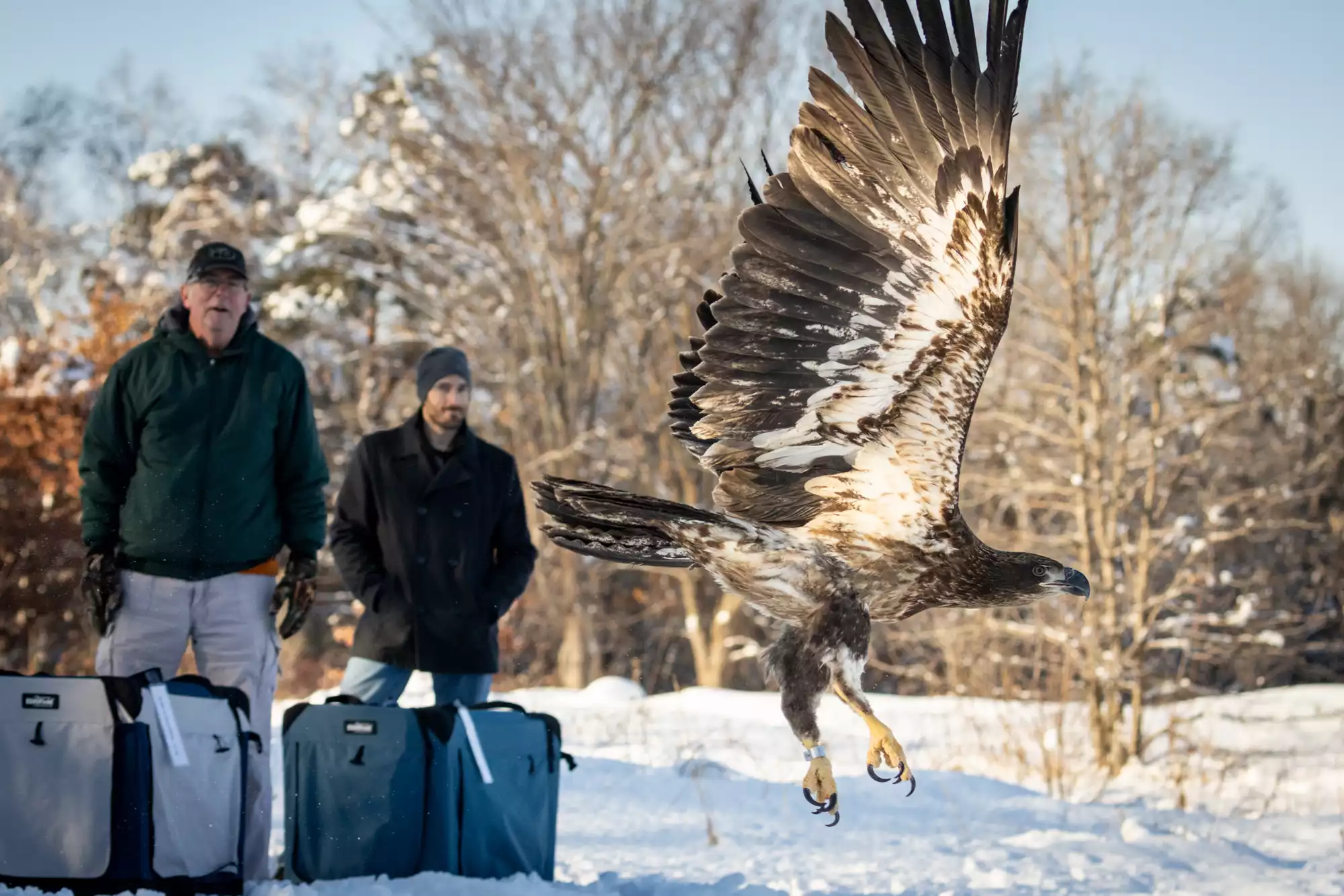
More good news. Another six of the Bald Eagles who suffered in Minnesota from phenobarbital poisoning (and some with high lead levels) were recently released. The staff at the wildlife rehab centre had to physically remove the poisoned/euthanized pets from the stomach of these beautiful birds before they could be treated. There were thirteen in total. One had Avian Flu along with the poisoning and died. Another two died leaving ten that were nursed back to health.

‘A’ has reminded me that pip watch will begin in one week at the Royal Albatross Colony on Taiaroa Head. The Royal Cam parents are GLY and L. What is so fascinating to me is how the NZ DOC recognises the impacts on Climate change and is trying to do something about it! ‘A’ included this quote from Ranger Sharyn Broni when she wrote, “

Virtually all the eggs will be hatched in the incubators as the increasingly hot summers make the risk of fly strike too great. We see the effects of climate change on these large birds quite markedly. During the 1950s for example, this type of work would have been unnecessary. By the 1990s conditions were more frequently hot enough to cause fly strike at some nests some of the time. It was during the 1990s that methods to repel flies and also to keep toroa cooler on the nest began. By 2018 fly strike is almost a certainty if the egg is left at the nest to hatch.

The dummy egg holds the parents on the nest while the egg hatches in the incubator over several days. The nest will be sprayed with AIL (Avian Insect Liquidator) to clear out any flies that may be living in the nest. The newly hatched chick has AIL applied to it prior to it being returned to the nest.

It is a whole lot better cleaning out kitchen cupboards and little ‘kitten’ things all over the house while listening to Ferris Akel’s Saturday Morning Bird tour of the Montezeuma/Ithaca area of the Finger Lakes area of upstate NY. I can stop and look if I hear something of interest or just listen. Ferris is a great advocate for being outside and for birdwatching as a way to let the stress of the world go! I will keep reminding all of us this winter as it is far too easy to stay inside on bad weather days. And sometimes advisable to do so!

There were Snowy Owls, swans of various species, gulls of various types including a Black-backed gull, Canada geese, Red-tail Hawks (a young adult with a red tail and light eyes), Northern Mockingbird, and Bald Eagles on the morning’s tour.

The images were chosen for very specific reasons.

Snowy Owls like ‘snowy, northern climates’. There are always a few around a small airport that Ferris frequents. They are commonly seen in the fields of the province where I live, and one, as you know, is in Southern California this winter!!!!!

A juvenile Tundra Swan with the grey head. Strangely, we have one still living in Winnipeg in an area that has some open water. It should not be here. Will it survive? So far our temperatures have not been constant -32 to -38 C. So, I am hopeful. Our climate is changing so it will be interesting if more stay in the future.

It is Bald Eagle hatch season in the US and while we all get giddy over little pink tootsies, it is good to know how the little eaglets change in their appearance until they become the iconic bird with it sure white head. The image below – look closely, has the yellow smile I spoke about yesterday in the eaglets on the Superbeaks nest. Its eyes are still dark but not as dark as the month olds at Superbeaks. They will continue to lighten. The cere, mandible, and beak are all espresso brown. The head is brown and the body has scattered white and brown striations on the chest. The eagle at the top fits nicely into being a year and a half old according to Avian Reports picture chart on eagle development (below this image). If it were a year old it would have prominent white streaks in its head.

The two eagles below are an adult pair. The beak and the head are definitive means of attributing age. Look at the chart often. It will not take you long to single out the age. But, always remember, eagles can get ‘stains’ on their feathers, especially the tail feathers and sometimes the head. So then look at the beak!

This is a gorgeous Red-tail Hawk. We know that it is at least a year old because it has its red tail. But the eyes remain light so it is not a full adult yet. What a beautiful hawk. My goodness you would think that it was a copy of a young Big Red with its extraordinary apron.

Those eyes are part way between a juvenile (blue/green) and an adult (dark chocolate).

Ferris spotted Big Red when he entered the Cornell Campus. For some reason, the sighting was very emotional. Big Red will be 20 years old this year. What she has gone through to survive that long is beyond imagination. As far as we know, she has only ever had one chick not fledge and that was K2 who had to be taken into care because of a beak/jaw infection/deformity and who had to be euthanised. She is the most famous Red-tail Hawk in the world and rightly so. She will be laying eggs in mid-March.

Ferris caught up with Big Red on one of the light stands as the light was really going late in the day. You can see the wind is really blowing. She is holding on tight to the bars of the stand. Every sighting of her is a joy. It is 1 degree C and the wind is blowing at 14 kph on the ground so it is really windy on the top of the tower. Evan the tower is moving a lot.

Ferris also found L4, the 2022 fledgling of Big Red and Arthur. It was the first year that Big Red had four eggs and had four fledglings. No one believed a 19 year old hawk could do that – Big Red is changing everything we know about Red-tail Hawks in the wild.

In this side view, you can clearly see that the eyes are still light. Not yet a year old.

L4 looking up as some Canada Geese fly overhead.

Little E22 is already such a cutie. Harriet and M15 are a dynamic duo. The DNA running through those two eagles gives us very strong eaglets right out of the broken egg shell. E22 is standing up pretty good…only a few hours after hatching.

Want some fish, E22?

By late afternoon, it was apparent that 21 and 22 had several feedings. There was fish juice all over them. Any bearing came accidentally from 22 whose eyes are not yet focusing. Harriet and M15 must be the most patient feeders!

At 1757, they both had juice and matted feathers everywhere especially 22. The following image gives you a terrific look at that egg tooth and how it extends so much below the mandible. Imagine the eagle on its back hammering away.

Harriet and M15 are great partners. It was only a matter of time before 21 bonked 22. So Harriet, who had been feeding the pair alone, called in M15 to help. Lady Hawk caught the tandem feeding in the following video.

At Anna and Louis’s KNF E-1 nest there have been plenty of opportunities Saturday morning to see the eggs but, no obvious pip. Eggs are 39 days old and 34 days. Average hatch time in Louisiana is 35-39 days so folks are sitting on the edge of their seats to see if this young couple will have a hatch (or two) this year.

Both Anna and Louis have been incubating and rolling the eggs. Louis is a great provider and Anna has proven to be a really good eagle Mum. I was so hopeful they would have two chicks this year as the food resources are there but, it might well be that they, again, have only one. One is fine!

Oh goodness. There is a pip seen after 1300 Saturday. Jumping up and down! Tomorrow there will be a wee one for Anna and Louis. (could be later in the day on Sunday depending on its progress)

At 1652, you can really see the progress that little eaglet is making. Well done!

It is raining in Louisiana this morning. Louis covered the eggs with nesting material not giving us any hint as to how the hatching is going!

At the E3, nest of Alex and Andria, the two eaglets are growing like bad weeds in the garden plot.

Look at the bottom of E3-01!!!!!!! Well fed eaglets, both of them.

Eggs are being rolled at Metro Aviation. It is unclear if there is a pip. I saw a black spot but I think it is nesting material. Will these eggs hatch? The first egg is 42 days old today. The second egg is 39 days. Remember the average is 35-39 for Louisiana Bald Eagle eggs. It is possible that neither egg is viable. But we wait and hope for this couple.

At Berry College, Pa Berry was on the nest. We have some time before pip watch for these two Georgia Bald Eagles. Egg 1 is 26 days old today and egg 2 is 23 days old.

All is well at Superbeaks! Both are on the nest and I haven’t had to scream yet today about the lack of chair rails…but, oh, I wish these eagles would strengthen the sides of this nest.

Rolling eggs at Captiva. Next week is pip watch for Connie and Clive at the Captiva Bald Eagle nest. That is a very clear camera image!!

At the Captiva Osprey nest, Andy and Lena are now replaced by FO and MO. They need to bring more nesting material and everyone would love to see some fish gifts. There is still time! Rumours have it that the pair mated on the nest for the first time on Saturday. I did not see it and I screamed at the rewind on the camera! I can neither confirm nor deny.

Elain continues to keep us up to date with her daily video summaries from Orange. Indigo made only one appearance on the 7th of January! Much more quiet, yes.

Geemeff posted an article on Twitter that is really informative about tracking devices and how they are so useful to our understanding of the movements, behaviour, and challenges our wildlife face. It is a really good read!

So where does a disappearing elusive Australian Painted-Snipe go if no one has hardly ever seen one? Just look at how lovely it is in the image above. I love that white eye line.

https://www.theguardian.com/environment/2023/jan/08/vanishing-bird-the-mystery-of-the-near-mythical-australian-painted-snipe?CMP=share_btn_link

Keeping closer to home and keeping in mind that lovely book, Slow Birding (I think it is the favourite of 2022), I want to remind all of us that we can do things at home now or next year to enrich the lives of the visitors to our own gardens.

  • Provide shelter. No, it doesn’t need to be some elaborate structure. It could mean leaving some of those tall perennials in place to provide a place away from the wind or rain. If like me you have had to cut trees down (yes, sadly), place the limbs and branches around the garden preferably stacking them. Great shelter. In addition, the rotting wood will provide great feasts for birds that feed on insect life. I have several different 60 cm tree trunks that are now about 20 years old. The birds peck away at them in the spring and summer as they are slowing breaking down into a kind of mulch.
  • Looking at the seed and garden catalogues and wishing. Consider – and you must consider your own planting zone – climbers for shelter in the fall and winter but also plants that are bird, bee, and butterfly friendly in your area. I am looking for quick growing berry bushes and a couple of trees with berries right now to plant in the spring. The birds will all thank you.
  • If you have the space, the finances, and the physical ability, why not set up a couple of bird feeders? Feeding the birds really gives them a boost and a better chance at winter survival. Also consider seeds with shells and no shells. All of my garden birds love the Black Oil Sunflower Seeds but the empty shells make a huge mess. You can purchase already hulled seeds. (I rake mind and push them to the back of the mini-forest where they break down and help the soil). If you do put up feeders or bird feeding tables, you have to be able to clean them. Feeding birds is also about responsibility to them so they do not get disease. “The National Wildlife Health Center recommends cleaning bird baths and feeders with a solution of nine parts water to one part bleach. (If there is visible debris, scrub it off before soaking in the bleach solution.) Dry out the feeder before hanging it back up”.
  • Want to give the birds some treats? These ideas I originally found on the RSPB website. You can blend birdseed with unsalted nuts, raisins, and lard and press it into moulds or over pinecones and hang outside. Do you have some old hard cheese that could be grated? (no Blue apparently). Birds love it. My Starlings are loving pieces of apple and pear as well as raisins, sultanas, and currants. It is a good way to use up some bruised fruit. I put chunks into a tray feeder.

It is always my pleasure to bring you some of the recent news about our feathered friends. I did not cover Zoe today but rest assured, the girl is eating! Dad brought her a fish yesterday and it is believed Mum added one to that as well. Most days she has 3 fish delivered by Daddy and Mummy Door Dash. Oh, they must be wishing she would move out of the house?? But, they will dutifully continue to feed their girl. No fear. They are dedicated. It is nearing noon in Australia as I write this and Zoe is 112 days old and she is yelling at Mum who is on the ropes for a fish. Time to become independent dear girl. Or are we set to break other records? She is exploring the area but is she exploring places where she could catch fish? And Ervie! Oh, I wish someone would submit some images of Ervie. Missing that beautiful boy.

Oh, thank you so much for being with me today. It is wonderful to know that there is such a supportive community ‘out there’ for our feathered friends. Please take care! See you soon.

Thank you to the following for their tweets, announcements, articles, posts, videos, and streaming cams where I took my screen captures: ‘A’ and NZ DOC, Ferris Akel Tours, Avian Reports, SWFL Eagle Cam and D Pritchett, Lady Haw, and SWEagle Cam and D Pritchett, KNF 1, KNF 3, Metro Aviation, Berry College Eagle Cam, Superbeaks, Window to Wildlife, Elain and Charles Sturt Falcon Cam and Cilla Kinross, Geemeff, The Guardian, and Port Lincoln Ospreys and Friends of Osprey.

It’s Love…Saturday in Bird World

Good Morning Everyone! It’s Saturday. We hope that each of you had a good week. For those going back to school, it must have been a bit of a shock after the holiday break. Have a good weekend. Get outside if you can – even if it is only for a few minutes. Makes all the difference in the world smelling the fresh air, feeling the sun on your cheeks, and I hope seeing a bird!

The kittens have a new ‘enrichment’ activity toy.

They have had so much fun and have spent so much time figuring out things. Lewis can now use both paws. It is past midnight and Missey is working on her technique. Cute.

My top story is yet another death by lead. As long time readers will recognise, I am a big fan of all the work that the Ventana Wildlife Society and the LA Zoo do for the California Condors. So, today, when I received the link to this Twitter feed from Geemeff, I was once again saddened beyond belief. Lead in hunting and fishing equipment needs to be banned from being manufactured and used. Pull it off the shelves. There are alternatives – copper and stainless steel. Yes, at the moment because their production numbers are not as high as lead, they are a bit more expensive. About $1.50 US a box of cartridges for shooting I was told (not sure the size). So, the use of lead is not necessary. It is also not necessary by the military. Ban lead! Just do it.

First feathered friend for the 2023 Memorial Wall. So sad. It is so unnecessary that I just want to stand in the middle of the street and scream but that won’t help. So today I am going to write my Member of Parliament, the Honourable Web Kinew. He is Indigenous and has a good chance of being our next Premier in Manitoba. He might just care enough to do something when he has the power and the people. Clearly our current government in Manitoba will do nothing. But it needs to be a federal law here, in the US, everywhere-!!!!!!! So make a resolution to write to your Department of Natural Resources and the Department of the Interior in the US, your Congress member, and your Senator. Their e-mail addresses will be published. Then why not write your President.

BTW. The Ventana Wildlife Society is hiring a lead specialist for outreach to ranchers in the area of Big Sur and Pinnacles. Know anyone that fits the description? Please forward.

I always wonder if the DNR puts up a few bird cams to make us feel soft and fuzzy towards them. They derive huge income from selling hunting licenses. The specific amount is published. Check it out and then get mad. But don’t donate to their cameras until they take a stand against lead. A serious one. For those of you living in other parts of the world, check out the use of lead in your country and let me know what you find out. It would be appreciated.

While you are at it, how do you think about selling licenses to drill for oil and natural gas in pristine waters that could easily impact wildlife? aren’t we, as an international society, telling those folks in power that it is time to invest in renewables? not fossil fuels?

Have a look at this 1:39 minute video on the birds and the land in Alaska – and imagine an oil spill. Please help them by writing to your politicians pressing them to stop licensing for oil and natural gas – anywhere.

Hello Everyone! You cannot have my prey!!!!!!!!! Got that, Mum. I am telling everyone so they know – you cannot have it!

Elain’s great video for 6 January shows us the many visits of Indigo and the interactions in the scrape box at Orange on Charles Sturt University’s water tower! And, of course, it begins with Indigo arriving with prey screaming his head off!!!!!!

Well, it’s love. No other pictures of the sweetie pie E21 and Harriet needed. Just look at the love in a mother’s eye to her recently hatched wee one. Precious. Who says eagles do not have feelings?

Meanwhile, it is after 1700 on Friday and E22 is working away with its tooth visible trying to get out of that shell. Soon!

Oh, goodness. If you were watching, Harriet went to roll the egg and E21 got stuck on her talon and went out of the nest cup. The little ones cannot move to get back under Mum and they cannot regulate their temperature. Thankfully Harriet saw what had happened and within 10 minutes had E21 back under her by rolling it with her beak!!!!!!!!! It was a little tense watching it as Harriet had to stop a couple of times but she managed to get the job done. E21 had its first adventure!

Welcome E22! I saw you for the first time at 07:06.

A little later. You are more dried off and E21 is no worse for his adventure.

At 09:36:03, V3 flies in and meets Gabby on the nest. She sees him coming before he lands and begins calling.

The couple begin working on the nest. — I think that it is time to recognise that V3 is the ‘main man’ now. Whether or not this new pairing will produce eggs and eaglets this year is unknown. Will V3 be around next year if they do not have eaglets now? Who knows. For now, it is time to enjoy the two of them together and be happy for Gabby.

The couple get an entire five minutes together before V3 is off protecting the realm. I am thinking about getting him a Superman suit.

Both appeared back together on camera at 13:47. Give V3 a big hand of applause. He is keeping everyone else away from the natal nest. Bravo.

They are both constantly vigilant. Each one watching from different sides for intruders that could attack the nest. It has to be very stressful.

Gabby flew in with a huge crop and V3 flew in after her with a large crop, too. They dined together it seems.

They are a couple. They are together in the morning, during the day, and at night. No doubt about it. And who says they aren’t mating at their ‘special’ spot off camera??? Or maybe they aren’t. Who knows???

Superbeaks. Pearl is 28 days old today and Tico is 27 days. Let us examine the pair more closely through a few images. That is Pearl closest to the rails and little Tico at the back by Mum.

What do you notice about these two eaglets immediately? There could be several things.

Let’s work on some terms and the one I want is not in the image below!!!!!!!! Their rictus or smile is now yellow. This happens during week 4. Their eyes are the best 90% chocolate you can purchase! When they get older their eyes will lighten to that celadon colour that can be white, lightest of watery blue, or very light grey-green. Their cere is still black. Their Maxilla is black. These will change to chrome-yellow as they age. Now look. Dandelions on the top of the head with thick grey down. Those dandelions will begin to look like ‘Mohawks’ very soon. The blood feathers are growing in. This thick down will remain under them to help the eagles regulate their temperature. Now it covers all of their body.

Pearl is getting much more stable on her legs and was seen flapping her wings.

I thought I had a screen capture. One of the eaglets, Pearl, was flapping her wings building up some muscles. They are both developing just fine. There is so much food! Some chatters noticed a bit of bonking by Pearl to Tico and that Pearl had eaten most of one meal but, they are both fine. The last time I checked Tico was being fed.

Now just imagine. In 28 days time, Little E21 is going to look like the eaglet in the image above. Hard to get around that, isn’t it? They grow so fast.

Jackie and Shadow have been on and off their snowy nest all day.

Thunder and Akecheta were perched on Tor together today. Time 16:02.

Anna and Louis are not giving us any hints. For the past two years, this Louisiana Bald Eagle couple whose natal nest is E1 at the Kisatchie National Forest have had only one hatch. Will it be the same this year? Egg 1 is 38 days old today and egg 2 is 34 days old. The average hatch time in Louisiana is 35-39 days. So things are going to happen shortly. Wish them luck! This is their third breeding year together and both are nicely equipped to raise two healthy eaglets. Louis will just pile more fish on the nest. Can you imagine? He was so excited the first year, 18 fish (Anna brought in some to equal 20) on the nest at once!

The wee ones at the E3 nest of Alex and Andria are ‘lanky teenagers’ now. Not round little cuddly eaglets. They are growing their feathers and getting bigger and bigger. E3-01 was out of the nest cup the other day and E3-02 made that leap today.

Oh, precious. Notice. They do not yet have yellow smiles!!!!! But they do have black specks and those black specks indicate grey wooly down and feathers!!!!!!

Both eagles were at Decorah today. When you look at that image, I want to give a shout out to the Raptor Resource Project and Explore. They have done an amazing job – with the quality of the images – and their ability for close ups and pans. Just beautiful.

The juvenile was back at Decorah North.

Good news for Achieva Osprey fans. Barbara Snyder reports on FB that there was a successful mating attempt today. Diane’s leg must be getting better. Cannot think of more joyful news. Thanks Barbara!

Bird sightings in Dulwich. I could hug the author…they even like to see Sparrows. I wish so much that people who dislike sparrows would stop to think that not only do they need to eat but they are in rapid decline in certain locations. I love my sparrows. Each has a different face and some you come to recognise as they reappear daily.

https://www.theguardian.com/environment/2023/jan/06/country-diary-a-flock-of-seagulls-and-a-lesson-in-resolve?CMP=share_btn_link

Everyone reading my blog knows that habitat loss, climate change and the sheer impact of the human population is killing both wildlife and our planet. An article in The New York Times discusses the impact on various species. Save it and read it when you have time. But read it so that you can talk about this with others. Thank you.

My blog is mostly about raptors. But, I love all birds (and other wildlife) and I am absolutely entranced by Loons. As many of you know, I have wanted to get a good look at them and have travelled throughout my province trying to do so. I did finally see ‘two at a great distance’ in 2022. There is a new book out about loons. Stay tuned!!!!!!!! It has received rave reviews. I hope to have it read in a couple of weeks.

Thank you so much for joining me. I expect we will wake up to E22 with all of us holding our breath and hoping that E21 is a ‘darling’ of a big sib. Tomorrow one story I will be following is the loss of wildlife due to outdated farming and farmland practices in the UK. Don’t ever think it is just the UK. All I have to do is drive to the nature centre for my walk to see all the farmland given over to large housing developments. No birds there. Hardly a tree! There is more bad weather with more record breaking rainfall coming to California from the 9-14th. Jackie and Shadow could see lots of snow while our falcons and eagles in the Channel Islands will have rain. If you live in an area that has the potential for flooding and mudslides, please do take extra precautions. Everyone take care. Winter weather can be very hazardous. See you soon!

Thank you to the following for their notes, their Twitter feeds, their announcements, postings, videos, and streaming cams that make up my screen captures: Geemeff, Ventana Wildlife Society, GoGreen, Cornell Bird Lab, Charles Sturt Falcon Cam and Cilla Kinross, Elain and Charles Sturt Falcon Cam and Cilla Kinross, SWFlorida Eagles and D Pritchett, Birdie Cam, NEFL-AEF, Superbeaks, FOBBV, IWS and Explore.org, KNF-E1, KNF-E3, Raptor Resource Project and Explore.org, Barbara Snyder and Achieva, Achieva Credit Union Osprey Cam, The Guardian and Amazon.ca