Hovering, Nest building…Saturday in Bird World

19 November 2022

Good Morning Everyone!

I hope that you are well. So nice to have you with us this morning. It is a blue sky cold day, -14 C, on the Canadian Prairies. The kittens are up carrying toys and watching the Crows come for their morning feeding. The Grackles have already been to the suet feeder and the little Sparrows are all puffed up keeping warm in the lilac bushes.

It is a type of soft suet that the Starlings like. They can stand back and poke at it with their long sharp beaks.

The Blue Jays that fledged from the nest across the lane are still here. One was eating peanuts while these two were in the lilacs sunning themselves.

Nest News:

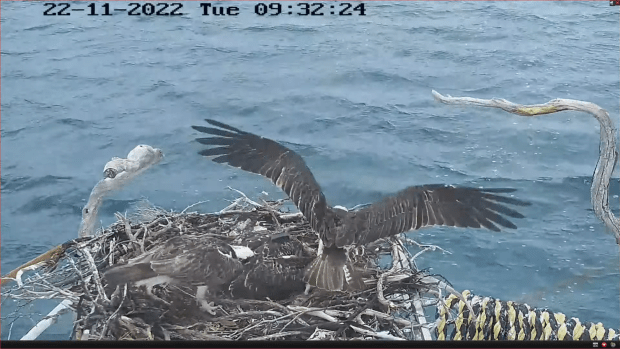
Yesterday Zoe got some really good height in her hovers. Thankfully she remained on the nest and did not fledge into those strong winds as that storm did roll in.

If you missed it, here are those beautiful early morning hovers.

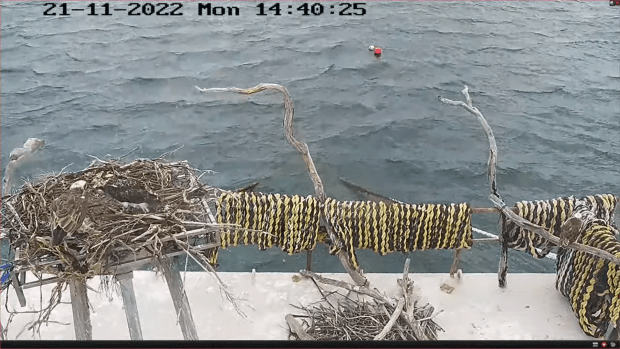
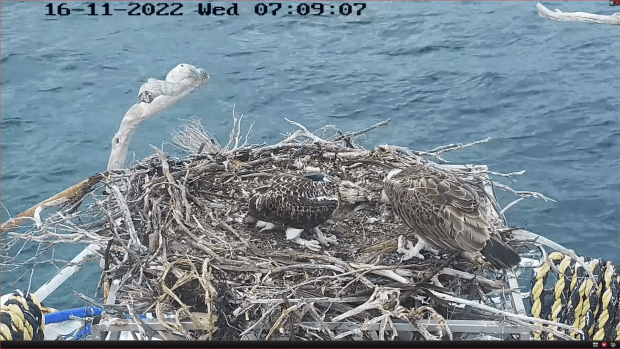
Later, Mum is down in the nest with Zoe taking care of her only ‘baby’. Dad was not out fishing. If you remember, Zoe ate really well on Friday so did Mum. On Saturday morning, Mum took Dad’s fish and returned with the tail portion for Zoe. That has been the only meal so far and if the weather stays, it could be it for the day. Zoe will be fine. She is not going to starve.

Indigo continues to fly out of the scrape and return. This is excellent. Most of you watch the Bald Eagle nests as well as the Ospreys and it is ‘normal’ for fledglings to return to the nest for food, to fly and strengthen their wings being fed by the parents for a period of 4-6 weeks.

Rubus continues to do his wingers and the pair enthusiastically eat all that is brought into the scrape. There are still a few dandelions on Rubus but not many.

The brothers 9 days ago.

Just look at them all covered in down with Indigo revealing some lovely back and tail feathers.

Oh, little Rubus had to get to the front and jump in the beginning to get some prey. Hard to imagine now when both of them are screaming and running all over the scrape. Diamond and Xavier have raised two healthy feisty chicks.

‘A’ reports that it was raining so hard in Melbourne yesterday that the wipers had to be on full speed. Of course, all we can think of are the fledglings from 367 Collins Street. Positive wishes out to them to be safe and fed.

As the season in Australia winds down, everyone is on egg watch at the nest of Harriet and M15 in Fort Myers, Florida. The pair have been working diligently to rebuild their nest after Hurricane Ian. Sadly, that GHOW continues to plague our beloved eagle couple. Oh, I wish their nests were further apart!!!!

Harriet and M15 continue to work on their nest together. They are amazing.

Samson and Gabby have been at their nest, too, working away. They have had a three year old Eagle visiting the nest and I began to wonder if it could be Jules or Romey.

Mum and Dad have been rebuilding the nest in St Patrick’s Park in South Bend, Indiana. You will remember that this is the home nest of Little Bit ND17. They are making good progress and now, some snow has arrived. I sure wonder where Little Bit is! Gosh, we long for them to fledge and then we grieve to see them again hoping they survived that almost insurmountable first year.

Humane Wildlife Indiana sent out a clever fundraiser. They are asking for donations for the strays in their care to have a full fledged Christmas dinner. You can purchase one for one animal or more. I wonder why more animal sanctuaries do not do this? You might mention this to your local care group. It is a marvelous idea.

Making News:

Sadly, for the wrong reasons the adorable Melbourne Four make the news.

https://www.theage.com.au/national/victoria/collins-street-falcon-chick-dies-days-after-taking-wing-20221115-p5byi1.html?fbclid=IwAR22J_pnOqqPaRA8JqL7WcplN8ddPreG3bIpfCVw8kNgpVudjgCKWoSHXgI

Oh, our beloved Canada Geese are making news in the UK.

https://www.theguardian.com/environment/2022/nov/18/country-diary-canada-geese-are-on-the-move-with-a-melancholic-honk-but-why?CMP=share_btn_link

No 9 The Red List: The Nightingale

It is the song of the Nightingale that has attracted writers for thousands of years. Pliny the Elder described its song more than 2000 years ago when animals were denied artistic abilities. He wrote: “the sound is given out with modulations, and now is drawn out into a long note with one continuous breath, now made staccato . . .” Ellen Finkelpearl continues in her short article on Pliny and the Nightingale that he did believe, strongly, that the natural world including our feathered friends can be artistic!

https://classicalstudies.org/plinys-cultured-nightingale

If you are a lover of Shakespeare, you will know that the Nightingale shows up in more of the plays, not just when Juliet educates Romeo on the wonderful song of the Nightingale.

Wilt thou be gone? It is not yet near day.
It was the nightingale, and not the lark,
That pierced the fearful hollow of thine ear.
Nightly she sings on yon pomegranate tree.
Believe me, love, it was the nightingale.

Here is a fantastic blog that captures the portrayal of the Nightingale in all of Shakespeare’s works.

https://blogs.bl.uk/sound-and-vision/2016/04/shakespeare-and-the-nightingale.html#:~:text=The%20morning%20after%20their%20secret,is%20not%20yet%20near%20day.

In his entry in Red Sixty Seven, writer Luke Massey says, “…We should be ashamed that in our quest to clean our landscape, in our acrimonious divorce from nature, we have forgotten this songster and let it suffer. Despite its song we have ignored it ; we have let it fall silent in our copses, our scrub and our hedgerows. We have failed it and with that we have failed nature. Will we really let this be the last song of the Nightingale?”

Its very last space in the UK is under threat.

https://www.nationalgeographic.co.uk/animals/2018/04/last-stronghold-of-nightingale-under-threat

There are problems with the Nightingale’s wings getting shorter due to climate change. That is mentioned in this great report for The Guardian.

https://www.theguardian.com/environment/2020/apr/01/nightingales-at-risk-due-to-shorter-wings-caused-by-climate-crisis

Changes in farming practices, the destruction of hedgerow and copses for more modern farming are all adding to end the life of this most beloved bird who nests are on the ground. There are fewer and fewer sites for this beloved bird to raise their young safely.

As I read more and more of what we have done to halt the lives of so many birds, it is readily apparent that the world needs to return to some of the ‘old ways’ and continue policies or re-wilding if we are to save our precious wildlife.

In the Mailbox:

‘EJ’ was wondering how these transmitters work – like the one put on Zoe at Port Lincoln. She found a great article and you might be wondering how these transmitters work, too. Thank you, ‘EJ’. Here is the link. You should be able just to click on it.

Technology (ospreytrax.com)

Thank you so much for being with me today. Take care everyone. As I look at the weather report there is a severe weather alert for wind in both Orange and Port Lincoln. Maybe Zoe and Rubus – as well as Indigo – will take care today. Send best wishes to them!

Thank you to the following for their posts and their streaming cams that make up my screen captures: RSPB, The Guardian, Osprey Research, Port Lincoln Ospreys, Charles Sturt Falcon Cam and Cilla Kinross, The Age, Lady Hawk and SWFlorida Eagles and D Pritchett, NEFL-AEF, and Notre Dame Eagle Cam.

Hovering with Zoe!

18 November 2022

The eyes are all on Port Lincoln where it is the morning of the 19th of November. Zoe is all wound up just like Indigo was before she fledged. Oh, she wants to fly and she is getting some really good wind under those wings. We are so close to that first flight – the fledge!

I took a video clip for you to enjoy.

The problem is the weather. I am seeing overcast skies, chopping water, wind, and 100% chance of rain starting in less than six hours. Not a good day for a fledge unless Zoe is going to fly and return to the nest. We have come this far. I would hate for anything to happen to this super osplet.

Take care everyone. See you tomorrow!

Thanks Port Lincoln for your streaming cam where I took my video clip.

Indigo fed on top of tower…and other Early Friday news in Bird World

18 November 2022

Good Morning Everyone,

I hope this newsletter finds all of you well. It is the end of the week. In a fortnight I will be on the island of Grenada in the West Indies visiting my son and looking for birds. He doesn’t know it but I have plotted the spots on the island and I am hoping that we can see at least 25% of the birds on the island – that would be about 40 new species. There are Ospreys right by his office and I am told hummingbirds and hawks in his garden. Can’t wait. With the pandemic, it has been far too long since I have seen him. There are many birds that I do not know or some that have similar names such as the Coot but the one in the Caribbean has a white shield on its head along with its white beak. There are any number of shore birds. So excited. I have a copy of the small book, Birds of the Eastern Caribbean on my desk to help me get acquainted.

In the Mailbox:

An absolutely timely and great question from ‘H’: “Funny you mentioned about the three Stepdads for Peregrine families. I was just thinking about that yesterday. I had wondered if you had ever known any other species where that had occurred. Have you known of any cases where another male had taken over responsibilities of hunting/incubating/parenting duties at the nests of Ospreys or Eagles, for example? (Not including where a chick had intentionally been placed on a different nest) Is this just a Peregrine Falcon thing?”

A bit of background for those not familiar. It is hard to imagine Diamond without Xavier. I recounted in my last blog how Xavier came and helped Diamond with her eyases when Bula disappeared. He was named Xavier because he was a saviour to our dear Diamond and her clutch. The eyases would not have survived having just hatched without Xavier bringing food to Diamond. We all know that Alden stepped in for Grinnell at the University of California at Berkeley scrape belonging to Annie. And we have recently witnessed Male2022 help raise Male2017’s eyases at the ledge scrape of 367 Collins Street in Melbourne. There are a number of instances coming out of the UK where a step dad or extended family members have helped raise clutches including fledglings. But, to get back to the question at hand.

Ospreys go absolutely crazy at the thought the eggs that are in the nest might belong to another male. I posted a couple of video examples a few months back of an osprey kicking the eggs out of the nest that he believed belonged to another male. I have never seen a male Osprey raise another male’s osplets. I have also never seen an eagle of any species take over the role of the male and raise another’s eaglets.

There are, as you seem to have indicated, many instances whereby the fostering of eggs and/or chicks has been successful but that is an entirely different situation to what you are asking. I have tried to find literature on the topic to more fully answer your question and if there is anyone reading this that knows of examples other than Peregrine Falcons becoming active step-dads, please do bring that to my attention.

After reading about ‘J’s’ budgie, Wolpe, Raj writes that they had a very similar incident with their pet birds. ” My pet budgie Daisy was best friends with Blue. Both inseparable. Loving each other always side by side. One day Daisy died. I held Daisy in my palm. Blue was so distressed and loudly screeched when Daisy died. Blue was very quiet not eating or playing.” When a new budget, Sky, came to the family, Blue was not interested. He was only in love with Daisy.” Thank you, Raj. This another beautiful example of the emotions that our feathered friends feel and express.

In the News:

Humans must steer clear of Yew trees as they are very poisonous to us but, not to our charming Nuthatches!

https://www.theguardian.com/environment/2022/nov/16/country-diary-the-nuthatch-takes-a-toxin-that-can-paralyse-our-hearts

Australian Nests:

Zoe is a big girl. We knew that when they weighed and banded her but today, Mum purposefully left a nice fish (sans head) for Zoe to see what she would do. Well, Zoe took the fish and ate every last bite including the tail as watchers cheered her on. The fish tail was horked at 11:11.

Zoe takes pulls the fish over so she can eat it as Mum looks on. This is crucial – Mum is full and knows that Zoe needs to self feed and will be fledging soon.

“Nice talons you have, Zoe.” “All the better to scratch you with!”

At Orange, panic might have set in if you looked at the scrape and did not see any eyases in there. Indigo flew out and was on top of the tower. Look carefully and you will see Rubus sleeping in the corner – bottom left reveals his tail.

A really nice and informative interview with Cilla Kinross about the history of the scrape and the Peregrine Falcons at Orange.

Indigo left the scrape at 101439 and he returned at 121012. Diamond had been in the scrape with prey and flew out with it right when Indigo came back. Rubus was really wondering what was going on and gave some of his very loud prey cries.

After a busy morning with 4 prey deliveries in 5 hours – and one being removed – the two lads, Indigo and Rubus, settled down to a nice sleep on the ledge.

I don’t know about anyone else but, I am really pleased that Indigo is returning to the scrape box, flying off for short periods to strengthen him flying techniques, and then returning again for prey and rest. Surely this will help him to be much more successful!

‘A’ sent a link to a video of Indigo being fed on top of the water tower. Thanks, ‘A’! Great clip.

The Red List. No 8. White-tailed Eagle

White – tailed eagle” by gcalsa is licensed under CC BY-ND 2.0.

At one time there were thought to be at least 1400 pairs of breeding White-tailed Eagles in the United Kingdom. By the beginning of the 20th century, the White-tailed Eagle was almost extinct. Before their recent re-introduction, the birds last bred in England and Wales in the 1830s, in Ireland in 1898 and in Scotland in 1916.   The RSPB reports that the last UK birds was shot in Shetland in 1918.

White-tailed eagle” by Ignacio Ferre is licensed under CC BY-NC-ND 2.0.

Reintroduction efforts began in 1959 and 1968 in Scotland. They were not successful. Then in 1975, juvenile eagles brought to the UK from Norway were released on the Isle of Rum in the Hebrides. The first pair bred successfully a decade later and now there are 130 pairs of White-tail breeding Eagles across the west and north of Scotland.

White-tail Eagles have added much to the economy and at the Isle of Munn where there are so many, the boost to the local coffers from bird tourism was 5 million GBP. Still, humans kill these beautiful birds.

The reintroduction efforts were the hard work of Roy Dennis and the Roy Dennis Wildlife Foundation. Continuing efforts are now overseen by the Sea Eagle Project Team – a joint effort of the RSPB and Scottish Natural Heritage. The biggest threats are predation by illegal killing particularly around the grouse hunting estates and secondary poisoning.  

Thank you so much for being with me today. Please take care of yourselves. See you soon.

Thank you to the following for their posts, videos, and streaming cams that make up my screen captures: ‘A’, OpenVerse, The Guardian, Port Lincoln Ospreys, Charles Sturt Falcon Cam and Cilla Kinross, and OmarGlobal.

Indigo flies out and in…plus more news in Bird World for Thursday Nov 17

17 November 2022

Oh, good morning to all of you. Thank you so very much for being with me today. I am so very, very happy to be with you! Thank you for all of the wonderful stories that you have sent. I will be working my way through them slowly. Much appreciated. We woke up to more snow. Everything is beautiful and white!

The kidlets, Missy and Lewis, had their first vet visit. I am a glowing proud parent. They were soooooo well behaved. They are not litter mates and the adoption person told us that they might not get along with one another. I have not had more than one kitten since I was a child and did not know what to expect.

I remember one stray that someone left at our gate. when I was a child. Oh, I loved that cat. To me the drab brown tabby was the most beautiful cat in the world. My grandmother was very diplomatic and said, ‘He sure is sweet’. I begged to keep this one particular cat. My dad agreed since it was a ‘boy’. Well, he apparently didn’t check very good…a few weeks later we had a pack of kittens. That tabby lived for more than 10 years. She was incredibly sweet. It is very different, having kittens outside with their mother and kittens in the house – in a conservatory, with very large plant pots and tall vines with flowers, or trees…yes, trees.

But, back to the topic at hand. Lewis and Missy are the best of mates. They do everything together including eating out of the same dish at the same time, drinking out of the same dish at the same time, having to have their paws touch when they are sleeping or sleeping in the same tent. Always together. So off they went in the same pet carrier, not separate, together. Not a single peep. At the vet they were so content. Proud Mum here!

I got a tip from the technician at the vet. One of the biggest culprits for cats will be their teeth. I hope if you have cats and dogs are brushing their teeth or giving them things to facilitate good gum health and clean teeth. If you have tried brushing their teeth and it didn’t work, get a nice flavoured tooth paste. Lewis and Missy like the chicken. Take clean nylon stockings or panty hose. Cut a square. Wrap it around your finger, put a dab of the toothpaste on it and away you go. Be sure to do the back ones and those sharp canines in the front. You can get them used to what you are going to do by rubbing on the outside of their cheek for a couple of days. Small toothbrushes or those prickly things you put on your finger did not – at least not for these two. Panty hose do! And I swore I would never wear the darn things again after I retired. So glad there is some use for them!

Missy is the ‘alpha’ You might recall she had Lewis well aware that she is the boss immediately. The vet saw it too! Indeed, the vet smiled and said, “Always the female!” Anyone watching a raptor on a streaming cam knows this. I said nothing. The odd thing is Lewis is so solid and looks ‘so tough’ and Missey appears to be ‘so fragile’. So funny. Missy is half Maine Coon – but both, at the end of the day, are literally ‘alley cats’. Found new borns taken to the shelter from different parts of my city. We are so lucky to have in our lives.

Missey likes to get inside plant pots – with or without soil. This is the tiny artificial tree that has been put up. The soft felted birds have had to be removed. LOL.

Looking so innocent! “We didn’t do it!”

Today’s action was still at the scrape box of Diamond and Xavier. Those parents are really making sure that both Rubus and Indigo are well fed. What a fantastic couple they are. The moderator put some history in the chat today and for those of you that do not know – we now have at least three male peregrine falcons that we know of that have started out as step-fathers.

The last sighting of Diamond’s mate, Bull, was on 30 September 2016. Their erases hatched on the 4th and 5th of October. The first sighting of Xavier in the scrape box at Orange was on the 7th of October. He brought prey to Diamond and the babies on the 8th of October. The rest is history as it is with Alden at UC-Berkeley and M2022 at 367 Collins Street.

Aren’t they adorable? Every day Rubus looses more and more dandelions.

Everyone has been wanting to know when Indigo would fly again. He certainly has been eating well and enjoying being back home. Today, right before 14:38 Indigo got a little frantic, running around the scrape just like he did the day before he fledged. At 143802, Indigo flew out of the scrape box. He returned 35 seconds later! I caught it on video for you.

​RECAP of feedings at Orange: 05:29:41 X/quail; 05 32 39 X/St.Quail Indigo Grabs; 06:05 38 X/juv star; 8 39 04 D/prey 8 47 58 D takes leftover quail; 15 41 31 D/pigeon; 18 32 52 X/red-browed Finch; 19 06 55 D/Live Star

‘H’ sent this link to me. It is a split screen video that Cilla Kinross made of a feeding. Disregard the word ‘kestrels’. It is definitely Rubus and Indigo. Thanks, ‘H’. Delightful.

Indigo and Rubus both in the scrape as the IR lights are turning off.

The wind was really blowing and there were lots of white caps at Port Lincoln. It made everyone wonder whether or not there would be any fish today but – alas, it turned out good.

At Port Lincoln, Zoe can surely scream for the fish! I have jokingly said that I hope she lives a long and healthy life with many osplets screaming their heads off to her…their poor Dad. Just imagine.

There have been at least 2 fish deliveries today. Mum was on the ropes eating a fish around 1400. Zoe took absolutely no notice. She was not hungry. Isn’t that grand? No one on this nest hungry. The fish are ever so unstable. But – we will take it. Today is a good day. Mum ate her bit and flew to the nest at 141408 and fed her large daughter.

Zoe doesn’t even seem to know or care if Mum is over on the ropes eating a fish. Normally she would be screaming her head off. Not today. It is a good fish day.

When the feeding was over, Zoe had an enormous crop.

All of the family together. Mum has a very nice crop from the earlier feedings.

Lots of food at Port Lincoln. These are the late time stamps from Gtr Kitarr:  19:16 headless fish by Dad, Mum off w the fish, back at 19:29 to feed Zoe. 20:24 Zoe wing flapping & 20:24:14 standing on one leg. 21:10 headless fish by Dad, Mum feeds Zoe in the dark.

Making News:

The investigation of the theft of four precious Albatross eggs continues.

https://www.stuff.co.nz/national/crime/130488815/was-a-boat-used-to-steal-four-rare-albatross-eggs-in-daring-heist

How many of us love Iris? The oldest Osprey in the world whose nest is on the lot of Riverside Health Care Center in Missoula, Montana. A request has come in from lovers of Iris. Here it is:

Here is a very short report on the current status of Sea Eaglets 29 and 30. I also want to mention that my contact tells me that the sea eaglets are at different clinics. The specific names are not being mentioned as is the case with other popular birds to keep the phone lines open for injured wildlife.

The Red List 8. The Yellow Wagtail

Yellow wagtail” by hedera.baltica is licensed under CC BY-SA 2.0.

There are many birds that I do not know. This bird is one of the first to be spotted when it returns from its winter migration in Africa to the fields in the UK. In Africa, they feed on the insects that the elephants kick up from under their feet so if you ever get to go to Africa on a safari and see a herd of elephants look for these dramatic sulphur yellow birds with their grey heads. In the UK, they follow the farm tractors kicking up the soil to reveal their next meal. They need a good supply of insects and spiders to survive. Besides fields, manure heaps and wet lands are good places for them to forage.

Yellow Wagtails raise two clutches a year if there is suitable nesting spaces and food. Their nests are low on the ground adjacent to wet lands, salt marshes, hay meadows, and some fields of vegetable crops.

Yellow wagtail” by hedera.baltica is licensed under CC BY-SA 2.0.

Changes to agriculture and crops grown put the Yellow Wagtail under threat. The RSPB has made some recommendations to farmers in the UK which would help stabilise and grow the numbers of these beautiful birds. This includes returning to having some manure heaps for them to forage through. They are beautiful songbirds. Let us hope that those who can do something to encourage their population growth will keep this in mind when they are planning their crops and how they do their farming in the upcoming years before it is too late.

We are waiting for both Zoe and Rubus to fledge. Rubus is not quite ready but is getting more and more interested as Zoe spends time in the scrape and now, that she has flown in and out again. Zoe is doing a lot of wingers. I am a bit old fashioned. The longer they stay on the nest or at the scrape and the stronger they are when they fledge, the more chance they will have of success. Weak tired birds do not do well in the field.

Thank you so very much for being with me today. Send your best wishes to our beautiful sea eaglets as they recover. Take care of yourselves, too. Looking forward to seeing you soon.

Thank you to the following for their posts, their videos, and their streaming cams which make up my screen captures: OpenVerse, Port Lincoln Ospreys, Sea Eagles FB, Montana Ospreys at Hellgate, Charles Sturt Falcon Cam and Cilla Kinross, Royal Albatross FB.

Prey fights between siblings and more…it’s Wednesday in Bird World

16 November 2022

Oh, good morning to everyone! I hope that you are all well. If you have not been watching the scrape of Diamond and Xavier you are really missing something. First, there is the adorable Indigo and Rubus. They are ‘not sweet’ when it comes to prey items as the following two videos will demonstrate! But, they will be ‘out there’ defending their own prey and these little dust ups help them prepare for that. In the first video Rubus really does a good job at snatching that small prey item. He doesn’t prevail in the end but watch closely what he does. Quite the character.

Rest assured that at the end of the day, both eyases had quite enough to eat and at times were even sharing prey items.

So this is the first prey delivery, a small piece.

The second is a much more substantial bird, a Galah (pink and grey). There was more than enough for both eyases.

The fish deliveries continue to be rather scarce at Port Lincoln. It is difficult to determine if there has been an actual drop in the prey delivered or a slow down due to the imminent fledgling of Zoe and not three rapidly growing osplets. There are too many factors – the weight of the fish delivery, the portions that each family member ate, etc. It appears that at the current delivery rate, Mum, Dad, and Zoe are each getting the equivalent to one small fish per day. Is this enough?

Hoping for another fish but nothing has arrived. Mum appears to be reluctant to get too far away from the nest. Did the intrusion of the humans to band and put the sat pak on Zoe cause her stress? Is she afraid to leave Zoe? Quite possibly. Perhaps she will go fishing tomorrow but, for now it seems that she is relying on Dad.

The ospreys are not moving about much, not exerting much energy. Today, however, Zoe is doing a lot of wingersizing. Her wings are gorgeous. Just look at how big they are! It will be those big wings that will pull Zoe up out of the water when she catches her fish.

This shows what those strong wings will be doing. Just imagine. Zoe will have to catch her own fish until such time as she has a mate and has eggs in the nest.

AND THEN…a whopper of a fish arrived. Mum ate her fill and then took the fish to Zoe. Everyone will go to bed with a full crop at Port Lincoln. Relief.

Mum did not part with the fish when Dad arrived more than an hour later to see if there was any left. This whopper should take care of the hunger that she was experiencing – and Zoe. (I do hope that Dad had a fish, too).

Making News:

Even in Manitoba we are experiencing some birds that are late to migrate or who have decided to check it out and see what it is like in the winter for food. Some of those are Cardinals. This is an osprey in Idaho though! They need water and fish as we all know. Why so late?

Project Eagle will be the new home of the American Eagle Foundation The facility is located in Kodak, Tennessee and is set on 57 acres. Challenger the Eagle will be in residence there.

https://www.wate.com/news/positively-tennessee/project-eagle-in-the-home-stretch-of-building-new-facility/?fbclid=IwAR2P8t-e9ZiNLkwKCky0dQZJZokdILCmXE1HOdfooe2hb1hYt2wlr4QuYzs

In the Mailbox:

‘M’ introduced me to an Australian photographer, Georgina Steeler. All of this relates again to how we perceive our wonderful feathered friends and other wildlife. We have been having this discussion about anthropomorphising birds. We need people to care, to help all of us, to add to the numbers so that we build a huge network. At the same time, we need to recognise and educate ourselves about the emotions that wildlife have so we can try and have an intelligent conversation with the non-believers.

I urge you to Goggle Georgina Steytler and go and see her website, read her blog, look at her photographs, and ponder all the ways that you can make a difference. Oh, I like this woman and the way she thinks!

Here is one of the quotes on her site today from one of my heroines, Jane Goodall who knows that wildlife have and show emotion, pain, anger, fear, grief, and joy.

‘D’ sent me the link to this story to share with all of you. After reading about Wolke, this is another story of how much our feathered friends enrich our lives as told through budgies:

https://www.theglobeandmail.com/life/first-person/article-feathered-friends-are-the-best-friends-of-all/

When I wrote about the Red Listed Bird, The European Starling, I had no idea Starlings were so intelligent and could mimic anything including Mozart’s concerto. Birds and their intelligence fascinate me more and more. ‘F and M’ sent me a note telling me about an incident at the Taronga Zoo in Sydney. They wrote, “A week or so ago Tooronga Zoo in Sydney Australia had a breakout from the lion’s enclosure causing an alarm and the instruction “EVACUATE NOW” to sound. The lyrebird is now mimicking this alarm and instruction. It is causing quite a problem at the zoo. !!” Enjoy!

https://www.adelaidenow.com.au/news/victoria/a-lyrebird-mimicking-the-evacuate-now-alarm-at-taronga-zoo/video/47d9e5b56f9139880f0dfc5b302eaaed

No 7 The Red List: The Dotterel

The top image is of the male Dotterel. Notice that beautiful white eye line and belly with the grey brown and espresso feathers mingled with white on the head, wings and back.

Northern NZ dotterel.” by Bernard Spragg is marked with CC0 1.0.

This is the female. In this instance the female Dotterel has the brighter plumage than the male. The female has the same grey-brown plumage on the back of the head, wings, and back but look at that magnificent chestnut apron! With the espresso necklace and line between the eyes forming a brown and the espresso line running from the beak under the eye. What a beauty.

Banded dotterel” by Andrej Chudy is licensed under CC BY-NC-SA 2.0.

The Dotterel is a medium sized member of the Plover family measuring approximately 20-22 cm in length. The birds are unusual in that it is the female that has the brighter plumage rather than the male. They live on insects and worms. Their eggs take 28-32 days to incubate and during this entire time the female does not leave the nest to feed. She is fed by her mate.

Dotterel face a number of threats from predators that have been introduced into their environment particularly during the nesting and breeding season. These include dogs, hedgehogs, cats, rats, stoats as well as other larger birds, and humans.

Thank you so very much for being with me today. Do stop in and watch Indigo and Rubus. You will not be disappointed! Take care. See you soon.

Thank you to the following for their postings and streaming cams where I took my screen shots: Port Lincoln Ospreys, Openverse, Charles Sturt Falcon Cam and Cilla Kinross, American Eagle Foundation, Montana Ospreys at Hellgate, Georgina Steytler. I would also like to thank those that sent in news items today: ‘M, D, F and M’. Much appreciated! It is always lovely to get mail to share with everyone.