22 September 2025
Good Morning Everyone,
It is the autumn equinox and here is everything you should know.
The Autumnal Solstice, or equinox, marks the first day of astronomical autumn in the Northern Hemisphere and occurs on September 22, 2025. At this precise moment, the sun is directly above Earth’s equator, resulting in days and nights of roughly equal length, though atmospheric effects make them not perfectly equal. This seasonal milestone also brings winter to the Southern Hemisphere and concludes summer in the Northern Hemisphere.
What is the Autumnal Equinox?
- A Moment of Balance: The term “equinox” comes from Latin, meaning “equal night”. While day and night are close to equal in length, the Earth’s atmosphere bends sunlight, making days appear slightly longer than nights.
- Orbital Position: The equinox occurs when Earth’s axis is tilted neither toward nor away from the sun, and the sun is positioned directly over the equator.
When is it?
- Date: The autumnal equinox falls on September 22 each year.
- Time: In 2025, it will occur on Monday, September 22, at 2:19 p.m. EDT.
What it means for the Hemispheres:
- Northern Hemisphere: The autumnal equinox ushers in the start of fall and signals the end of summer.
- Southern Hemisphere: For those in the Southern Hemisphere, this day marks the start of spring and the end of winter.
Additional Facts
- Harvest Moon: The full moon closest to the autumnal equinox is known as the Harvest Moon, which historically allowed farmers to harvest crops for longer into the evening due to its earlier moonrise.
- Cultural Significance: The autumnal equinox is a significant date in various cultures, such as the Mid-Autumn Festival in East Asia, which is often celebrated around this time.
Late updates:
Dyfi Osprey Project:


Little Buckaroo or Eeny at Dunrovin appears to have started its migration. Last seen eating breakfast on Thursday, the 18th of September.
Charlie is still at Charlo, Montana on the 21 September (Sunday). Gail Woodstock posted some lovely screen captures of this dedicated male.

At the Boulder County Fairgrounds, it appears the male is still present, too! Thank you for the screen capture and post – Barb and Bob Larsen. The ospreys are staying later. Does this mean a late and milder winter? I wonder. We still have ospreys in Canada, too.

SK Hideaways latest videos!
Two Harbors Eagles Cholyn and Chase (2025 Sep 19)
Chase brought a late lunch, having to dodge ravens during his meal. He managed to quickly finish his fish and then departed. Cholyn arrived later with a whopper fish, which she took her time to eat. She lingered into the late afternoon, chatting remotely with Chase, who we could hear off camera. It was a special treat to see them both.
Video: https://youtu.be/vvXeaSus5M0
Courtesy Institute for Wildlife Studies, explore.org
Eagle Cam: https://www.youtube.com/watch?v=E5T2eHM8tcI
Overlook Cam: https://www.youtube.com/watch?v=2yx7RKxpyzQ
367 Collins St. Falcons Dad M24 Boycotts Changeovers Till Mum F24 Sets Him Straight (2025 Sep 20)
After a typical morning of clockwork-like changeovers, Dad decided he wasn’t going to relinquish his egg time when Mum returned. She waited patiently for nearly 10 minutes before gently persuading him it was time to give up his boycott. He left without incident.
Video: https://youtu.be/xeJOumxQUDE
Courtesy 367 Collins St. Falcon Cam
South Facing: https://www.youtube.com/watch?v=oibsohQ14cY
North Facing: https://www.youtube.com/watch?v=dNKk0ivuWe4
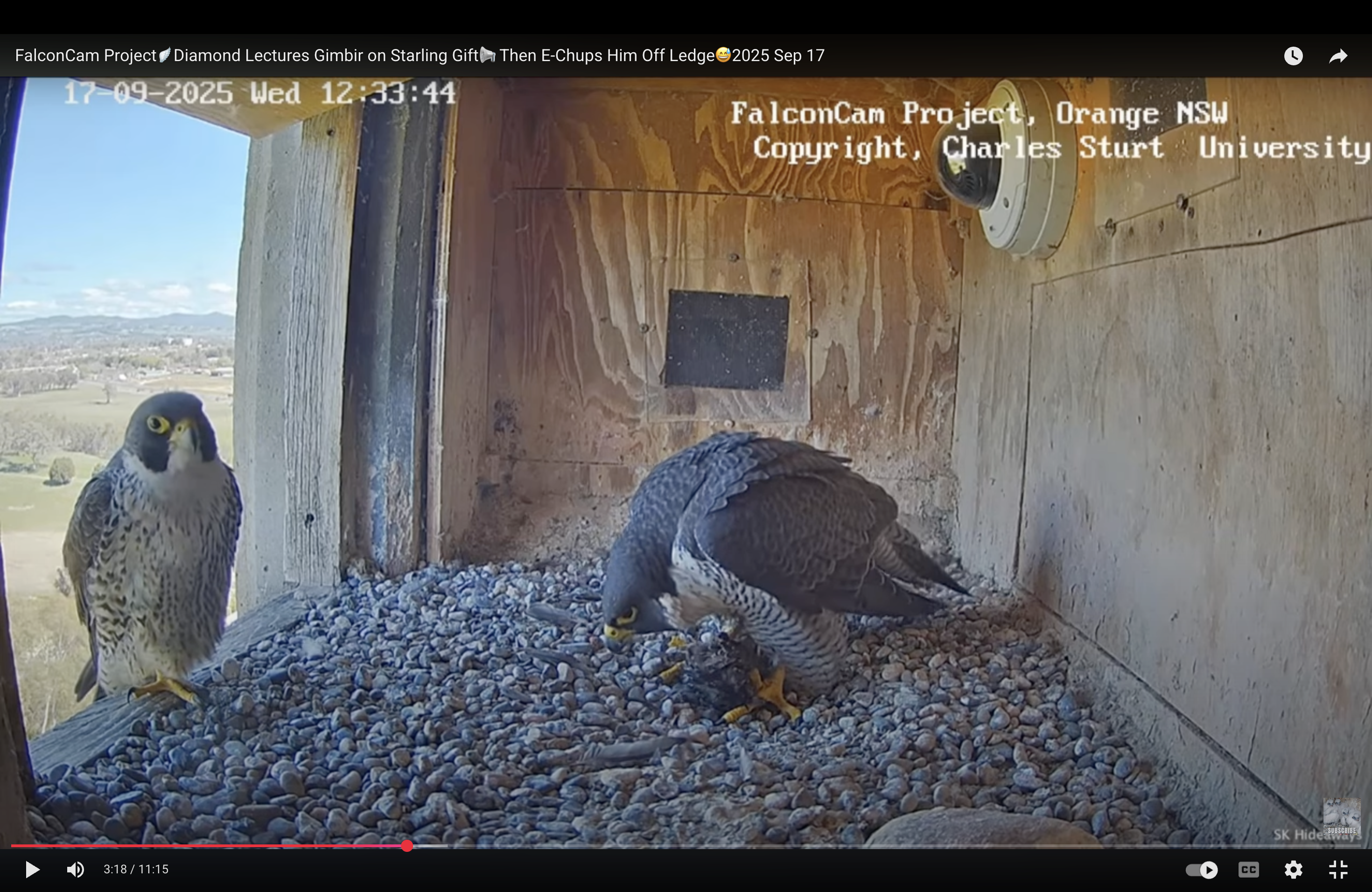
FalconCam Project, NSW Australia ~ home of Diamond and Gimbir (2025 Sep 17)
Gimbir was proud of his starling gift ~ the first time he’s brought one to Diamond, who historically has refused starling gifts except to feed growing chicks. She gave him quite an earful, about which he seemed somewhat confused. In the end she e-chupped him completely out of the nest box and proceeded to eat some of the starling. Maybe Di’s taste’s have changed.
Video: https://youtu.be/7Fibnk3qEt4
Courtesy FalconCam Project, Charles Sturt University NSW (http://www.csu.edu.au/special/falconcam/)
Box Cam: https://www.youtube.com/watch?v=yv2RtoIMNzA
Ledge Cam: https://www.youtube.com/watch?v=adCIawe2WWI
Nest Cam: https://www.youtube.com/watch?v=Xj1Y6ydRl1c
Tower Cam: https://www.youtube.com/watch?v=X4332mBQdnc
Sydney White-Bellied Sea Eagles Lady, Dad, SE35 & SE36 (2025 Sept 22)
After Lady and Dad woke the neighbourhood with a duet, SE35 and SE36 entertained themselves till breakfast arrived. Between beaky kisses, wingers, twig swapping, and napping, they were well occupied for the few hours till Lady returned with a nice, big breakfast.
Video: https://youtu.be/j5_brVPp7XE
What’s happening? SE35 Steps Aside as SE36 Eats a HUGE Breakfast! (22 Sep 2025, 9:47-10:29 a.m.)
When Lady arrived with a whopper fish for breakfast, SE36 stepped right up to receive the first bites. SE35, typically, the dominant eaglet sat back and watched SE36 eat…and eat…and eat. The meal lasted for more than 40 minutes with SE36 getting most of that big fish. There was no aggression between the eaglets, which was a welcome sight to see.
Video: https://youtu.be/tzy323L7v2g
Courtesy Sea-EagleCAM@BirdLife Australia Discovery Centre, Sydney Olympic Park (https://www.sea-eaglecam.org/video.html)
Nest cam also at https://www.youtube.com/@SeaEagleCAM4/streams
Ventana Wildlife will be releasing condors! You can go to their website and sign up for this live event. No costs. I always watch these events. You learn so much and it is so exciting to see the youngsters go out into the world.
“`Carefully transferred from the Los Angeles Zoo to our San Simeon Release Site, seven (1.5-year-old) condors are preparing for their highly anticipated release into the wild in late October.
Condor Release – Saturday, October 25, 9AM-12PM (PT).
– Six female condors: 1265, 1289, 1300, 1302, 1307, 1312
– One male condor:1290
Here is all the information:
I want to thank each of you for taking the time out of your busy lives to check on how our feathered friends in Bird World are doing. I would also like to welcome the more than 5,500 readers from China who have joined us recently. It is so lovely to have you with us in Bird World! Welcome.
To celebrate, here is a lovely article in 10,000 Birds on the Raptors of Nanhui, Shanghai, with some beautiful images. Please check it out and see how many of our feathered friends you knew were in China. I am particularly fond of the Chinese Sparrowhawk.
Tuesday -Great news. The Royal Cam chick fledged on the 17th of September!

Cornell Bird Lab has this maiden flight on video! https://youtu.be/zYqzddsT6pA?
Elain also has a video of that initial flight! https://youtu.be/1JhCsH0JTO4?
Albatrosses forage at sea for an extended period after fledging, typically remaining at sea for 3 to 7 years or more before returning to their natal colony to find a mate and eventually breed. During this time, young albatrosses, known as juveniles, learn to forage and socialise in groups called gams to develop their courtship rituals.
Post-Fledging Journey
- Years at Sea: After leaving the nest, young albatrosses will spend several years at sea, some for as long as 5 to 8 years, continuously foraging and only returning to land for breeding.
- Socialization: Young albatrosses gather in groups of potential mates, known as gams, to learn complex courtship dances and develop their unique “language” for finding each other later in life.
- Maturation: This period allows them to mature, molt their juvenile plumage, and gain the energy and experience needed for their first breeding attempt.
Return to Breed
- Colony Return: Eventually, the adolescent birds return to their natal colonies.
- Finding a Mate: They then begin the lengthy process of finding a mate and developing a pair bond before their first breeding attempt.
- Breeding Frequency: After a successful breeding attempt, many albatross species take a year or more off from breeding to regain their energy and condition before their next breeding season
All the information that you could ever want to know about Albatross by New Zealand’s Department of Conservation:
The latest post from Ranger Sharyn Broni posted by Sharon Dunne.


Holly Parsons has posted some additional information:


‘A’ now has the latest: “Since our baby girl fledged on 16 Sepember, she has been steadily making her way towards South America. The tracker tells us that she is about 200 kms from the headland, heading north. She has stopped off in an area where she probably found food and is progressing well. She is a strong girl. She’ll need to be – her journey is 9000 km long. Safe travels beautiful albie. “
Many of you have been fascinated by the great prey gifts that Gimbir has been bringing Diamond. None of them were Starlings – we know that Diamond does not like Starling. Well, our poor little lad made the mistake of presenting a Starling gift to Diamond and she rebuffed him. SK Hideaways has it on video: https://youtu.be/7Fibnk3qEt4?
Gosh, is there anything cuter in the adult raptor world than a male peregrine falcon? Gimbir has certainly been winning hearts and minds with his generosity and excellent hunting skills. Will there be any eggs? Maybe not this year, but we will wait.

Tuesday afternoon was also magical on the Canadian Prairies. I sat in my friend’s garden, surrounded by the yellow leaves from the trees falling gently around us. Fall is truly here. It is one of the most loved seasons, yet each of us knows what follows. Winter should be a time of relaxation, sitting by the fire, reading a book, sipping hot chocolate or the best leaf teas wrapped with a soft blanket.
We are looking forward to spending several hours in the nature centre on Wednesday, checking out the geese and ducks while Toby is being groomed. There are places where dogs cannot go (understandably), and this is one of them. We have not been there for several months, so I am really looking forward to spending time on those very familiar paths.
The geese are still fattening on the golf courses and at the nature centres. They were in an area of our City that had been abandoned when one of the military bases closed. Now it is a building site. Where will those geese, who have returned to this same place each year, go now? What are humans leaving our wildlife?
We are taking away habitat minute by minute. The City I live in is no exception. For over a hundred years, the population remained stable at approximately 600,000. Now our City is a construction site with the population soon set to reach one million. It sprawls, and many city planners have, for decades, criticised this practice as it is now taking away good agricultural land, along with woods that are perfect for wildlife and birds. It makes me quite angry – the City should be safe, built up, not out, with good public transport. As it stands, things are so spread out that cars are almost a necessity, and every morning, the traffic jams reveal automobiles with a single person in them! I’d best not get started on my soapbox, or we could be here all day.
Humans to push further into wildlife habitats across more than 50% of land by 2070 – studyhttps://www.theguardian.com/environment/article/2024/aug/21/humans-to-push-further-into-wildlife-habitats-across-more-than-50-of-land-by-2070-study-aoe?CMP=share_btn_url
Researchers at Cornell, along with colleagues worldwide, are searching for missing birds. Here is one of the webinars that was posted, so we can join in their discoveries as well. https://youtu.be/sri3ciYgCS4?

It was an extremely sad year for the Black Stork nests in Latvia as reported by Maria Marika. As we know, we must mourn but also celebrate the success. As we take over habitat, the planet and oceans warm, there will be fewer successes unless we radically change our human behaviour.

Border Ospreys latest newsletter:
‘A’ reflects on the Australian nests:
“It was another windy day at WBSE and the chicks were left alone on the nest for most of the day. They are really developing their juvenile plumage now, especially SE35, whose feather development is well ahead of its sibling’s. One reason for this is probably the lack of food SE36 gets in comparison to SE35. I saw only one food delivery today, a gull, and SE36 was fed four or five bites of this (beause it happened to be in the right place at the right time) before SE35 intimdated it into a cowering defensive position, which it maintained until the food was gone. There were no late food deliveries as there have been on previous evenings and little SE36 went to bed with an empty crop. SE35 did relatively well, although would have preferred another two feedings. It is fortunate indeed that both eaglets were well fed on the previous two days. Here are the three reports, from today, yesterday and Sunday:
September 14: another fine day. Last night Lady slept on the rim of the nest, or just by them – disturbed at one stage by the possum passing. Early duets and she was off, returning after 6am and trying to settle in the bowl with the nestlings – but off again a after a short time. When Dad brought in a gull carcass at 7:50 she grabbed it and fed them both –for an hour. Dad came in and took off some of the scraps, with Lady very protective. He fed 36 a couple of bites, then Lady came in again and fed them a little more – protecting the food from him. Then Dad returned and fed them a little himself – and more when Lady took over and fed 35, then 36 – a massive feeding session. As the nest warmed up, chicks were panting – full crops too. They rested, sprawled out in the nest at times, moving into the shade when they could. Dad came in a couple of times and took off a scrap of bone. Late afternoon, Dad came with a whiting, claimed and fed by Lady, to SE35 first. Both ate – full and peaceful at end of day.
September 15: Lady spent most of the night on the nest rim, coming in very early to the bowl, then away. She returned as Dad brought in a Red Rock Cod at 6:15am, claimed by Lady and fed it to both chicks. Both chicks are calling now as the food comes in. A very warm day then, with both of the eaglets moving into the shade when they could. The parents were in and out a few times, with leaves – or nearby – but the chicks were mainly left alone on the nest. Lady came in at last light, but there was no more prey until just after 6pm, when Dad brought a fish. Lady then fed both nestlings before settling for the night.
September 16: Lady slept on the rim last night. She was off very early, then duets, with the nestlings joining in. Dad came and started feeding SE35 a fish scrap early, offered a bit to Lady, then she took over – though there was not much left. The eaglets then waited all morning until Dad brought a gull chick just after 2pm, on a windy afternoon. Lady claimed it and fed both, with SE35 getting most. SE36 has been venturing right to the nest rim, then returning safely to the nest bowl. Both chicks are calling on the nest now – begging for food or parental attention. They were waiting for more food all afternoon. Lady came to the nest just before 6pm, but with no food, then left again, flying to the perch branch. She returned to the nest bowl, settling on the nest next to the chicks. Will there be a late prey delivery again? (Spoiler alert: No, there wasn’t, and poor SE36 went to bed with an empty crop and a hungry tummy.)

At Collins Street, the three eggs are being carefully tended by both falcons, though mum is doing most of the shifts.
At Taiaroa Head, we are told, Miss SS Trig is further down the hill. However, I am not convinced she has not already fledged today because there is an albatross sleeping on her nest and according to Ranger Sharyn Broni, that albatross is her father, who is waiting to feed his girl. (I wondered why, if it is him, he has not called for her at all, though he has looked around and he is sleeping on her nest – also I believe Ranger Sharyn has actually confirmed his identity on her recent travels.So we will have to take her word for the fact that Miss SS Trig has not yet fledged and that there is a goodbye breakfast with dad awaiting her if she decides to head up the hill early tomorrow morning (17 September). The wind will determine her schedule, in all likelihood, but we are hoping she will stay at least another week, until her tummy mohawk (it really is most distinctive) has been shed.
I thank you so much for reminding me that the birds in our own gardens are the interface between ourselves and the natural world. We don’t need to filter these experiences through streaming cams from the other side of the world, although the chance to share the experiences of birds like the red-tailed hawks is something extra special (and a bird like Angel is something too precious for words).
Meanwhile, all appears well at Port Lincoln, where the night herons are doing well with the fish light it seems. They caught two fish in rapid succession the other evening. With three healthy-looking eggs, I do have some fears about the upcoming season – there is an aggressive quality to ospreys.”
“Wednesday: The littles were up and stretching at 6am and the breakfast fish arrived at around 06:08 courtesy of ever-reliable Dad. Lady was quickly in to take control of the feeding, with SE36 finding itself in prime position at the table. It was too intimidated though by its older sibling and went into submission pose, allowing SE35 to push past and take the front spot and the first of the food. But SE36 was still closest to the fish, and had the courage to turn its head and take occasional bites when Lady offered them. It was a good-sized fish and eventually, both nestlings ate a large breakfast.
When I checked back at lunchtime, SE35 was in a food coma and SE36, despite sporting the most gigantic of crops, was still eating like a small feathered machine as Lady fed him still more fish. Oh my goodness those eaglets were full. After yesterday’s lean pickings, I’m sure they both enjoyed the food overload they got today. They have become very vocal in recent days, chittering away to each other on the nest and vocalising to their parents whenever food approacheth. Oh they are the cutest small people. SE35 is starting to show caramel colours on its breast and head feathers and will soon begin to resemble a juvenile sea eagle. SE36 is still a huge ball of fluff with some feathertips on its wings – at least two or perhaps three days behind its older sibling.
At Collins Street, dad brought in such a large pigeon (I think) at 15:24:20, he could hardly get it up onto the ledge. It was as big as he was. Mum was less than impressed, after all his hard work, and stayed on the eggs, so he dived off the ledge again with his prey, at which mum looked rather surprised but still didn’t move. I presume he ate it himself, or stashed it on a floor above the nest (he glanced up there before diving off the ledge). At least there appear to be enough workers back in the Melbourne CBD to feed a good crop of pigeons for the falcons to feed their chicks once those eggs hatch. Dad is obviously a good hunter – that really was a very large catch.
Dad returned with empty talons soon after 16:28, and the pair had an animated conversation before mum dived off the ledge and presumably headed off to the pantry for the pigeon remains. Finally! Egg time for dad. He is such a cutie. A very neat little falcon. And his sweet little voice is adorable. Mum is back at 17:27:30. Another changeover at 18:02:30. “
The cam operator gave us some great closeups of the little sea eaglets and their gorgeous juvenile plumage coming in.

“Here is yesterday;s ranger report:
The eaglets both ate a large breakfast at around 10am this morning, with SE36 doing particularly well at this feeding. Both chicks finished the meal with huge crops, and spent the rest of the afternoon resting in the sunlit nest. The weather has improved, with the winds dying down and no rain today, so things are drying out and the fishing is easier.
September 21: A lovely sunny day. Last evening, Dad brought in a last prey offering, another young gull, and Lady fed them, though SE35 ate most. SE36 found a last scrap itself. Lady spent most of the night beside them on the nest rim. A quiet morning until Lady herself brought in a young gull. SE36 did quite well at this feeding. Both are picking at things in the nest. Then, in the late afternoon, Dad brought part of a fish, having already eaten himself. He fed them a little first, then Lady took over until all was gone. As the eagles called, the youngsters joined in too at the end of the day. Both adults settled nearby.
And today (22 September), the eaglets both ate a large breakfast at around 10am, with SE36 doing particularly well at this feeding. Both chicks finished the meal with huge crops, and spent the rest of the afternoon resting in the sunlit nest. The weather has improved, with the winds dying down and no rain today, so things are drying out and the fishing is easier.
These two are starting to look so grown up (especially SE35). It is scary to think that they are nearing the time when their privileged life on the nest will be exchanged for their annual losing battle with the currawongs.It seems so futile – all the hard work the parents have put in and yet it is destined to be fruitless, with the fledglings unlikely to survive without human intervention (and even with that assistance, their futures are very uncertain).
At Collins Street, the incubation continues, with the three eggs looking good and being well looked after by both parents. Mum headed off at 06:14 this morning to get herself some breakfast, and little Dad quickly arrived to take over, making his tiny chirping noises. The way he talks to the eggs is so adorable. He loves these chicks before they’ve even hatched.
At Port Lincoln, mum is still waiting for food – nothing has been brought in so far today. There are usually two fish (or one huge fish) brought in per day, but I am not confident that this is going to increase sufficiently to feed a family of five when these eggs hatch. I do hope the Fish Fairy is ready for action because I fear she is going to be needed on this nest this season. I do wish they would stick to two eggs.
Mum is doing the vast majority of the incubating at Port Lincoln – some days, dad spends less than an hour in total on the eggs, with mum taking care of the rest. She is doing a great job, but as I said, I’m hoping the fish supply will step up when the eggs hatch – as things stand, mum isn’t getting enough for her own needs. “
Pat Burke got the cutest screen capture of the little sea eaglets, who are a month old now.

TE3 is still hanging around the natal nest in Tempeauleau Wisconsin. This gorgeous juvenile was raised by her Mum basically single-handedly. Many thought the eaglet would not survive, but she did and what an amazing eagle she is going to be. Thank you Bud Whillock for these great images that you shared on FB.

The American Bird Conservancy announces a huge win:
| ABC is celebrating a much-needed win for seabirds with the announcement that the U.S. Department of the Air Force (DAF) has suspended its proposal to use Johnston Atoll National Wildlife Refuge as a site for commercial rocket landing pads. ABC was among the first organizations to raise concerns about the plan and request further study on the potential impacts on the more than one million seabirds that nest on the tiny Pacific Ocean atoll each year. The DAF’s pause on their plans gives seabirds like the Brown Noddy and Red-tailed Tropicbird breathing room and keeps this important site a safe refuge for birds, for now. |
As our population grows, the impact on wildlife is enormous.
The ospreys are almost all gone on their journeys to their winter quarters. Iris is no longer at Hellgate Canyon, and Charlie is no longer at Charlo, Montana. A few linger in Nova Scotia, and one of CJ7 and Blue 022’s fledglings was photographed in Poole Harbour.
It appears that the male at the Boulder County Fair Grounds osprey nest is still at home, too.

Swoop continues to deliver to the fourth hatch, known fondly as Eenie or Little Buckaroo, at Dunrovin Ranch. Lin Lawson did a physique comparison between the father and the juvenile.

Connie Dennis reminds us that this is the number of days we have until they return in Nova Scotia:

Each of us will be sitting on pins and needles waiting for Iris to return to Montana next spring! Lovely montage Lucille Powell, thank you.

There are still some ospreys in Manitoba! Marlene Mitchell caught this one where we go to see the Pelicans.

At the Golden Gate Audubon nest site – lamp and crane – one fledgling and the parents that remain are Beacon, Rosie, and Richmond. “At 128 days old, Beacon has now lingered the longest of any of Rosie and Richmond’s offspring. And apparently her calls for more fish are working, as she received two separate deliveries today, after visiting the Whirley Crane several times. Rosie also visited the crane. http://www.sfbayospreys.org”. https://youtu.be/sT1WdpdP4-Q?

Rosie is still there on Thursday. Thanks, Lucille Powell.

Cumbria Wildlife Trust gives us the remarkable story of White YW and Blue 35 at Foulshaw Moss, who raised three chicks, with White YW now 17 years old and Blue 35 fourteen years old. And then, White YW feeds and cares for another’s fledgling. A good read. White YW and Blue 35 are two of my favourite osprey couples in the UK, often overlooked.
It is that time of season when there are summaries and highlights. Cornell Bird Lab takes us through the life of the Barred Owls. “Relive five unforgettable moments from our 2025 Barred Owl Cam, sponsored by Wild Birds Unlimited! This season was full of fun and heartwarming memories as this feathered family raised their two adorable owlets, Moss and Maple, in a nest box nestled in the backyard of WBU Founder and CEO Jim Carpenter. Here is the link: https://youtu.be/HfW9vYw2HSY?

It is also cam maintenance time for both the ospreys and the eagles.

Gabby and Beau continue to work hard on their nest in NE Florida, with Gabby even trying out the egg bowl. Will we have eggs early this year? We wait to see.


Duke Farms nest is waiting for its eagles.

There was an eagle at the ND-LEEF in South Bend, Indiana, on Tuesday.

Hawk Mountain’s Migration chart for this week:

Robert Fuller‘s six kestrel chicks have fledged! https://youtu.be/Fqc19QvkE-k?

Reports from Raptor Persecution UK.
Welsh government is in trouble as Avian Flu spreads.
While the news from Wales is worrisome, there is some good news. Hen Harriers will not be introduced into the south of England. I am delighted.
The American Bird Conservancy Bird of the Week is the Belle’s Vireo. Don’t know this bird? Have a read.
The Maori, along with North American Native Tribes, along with many other cultural groups, believe that birds carry messages, especially when someone dies. A lovely short read from The Guardian:
In the days after my mum died, a blackbird lingered like a messenger of solace | Mark Saunokonokohttps://www.theguardian.com/environment/commentisfree/2025/sep/18/in-the-days-after-my-mum-died-a-blackbird-lingered-like-a-messenger-of-solace?CMP=share_btn_url
Toby wants to know how many people remember Murphy the Bald Eagle who incubated the rock and then got to raise an eaglet? Thanks National Geographic!


Thank you so much for being with us today! Take care of yourself. We look forward to having you with us again next Monday.
I want to thank our notable contributor, ‘SK Hideaways’ for their videos highlighting the nests we are following as well as the owners of the streaming cams listed in bold, other individuals and institutions who create videos and the authors of posts such as Jeff Kear at UK Osprey Information, and all others, often too many to name but whom I have tried to cite in bold. I am very grateful to you and to the newspapers and journals that still cover environmental issues as they relate to our precious feathered friends. A special thank you to Raptor Persecution UK for keeping us well informed about what is happening to the raptors in the UK. My blog would not be what it is without your input into the world of birding.
Calico wants me to add an essay, “The Thin White Line,” from Emergence Magazine. She thinks it is thought-provoking.
Thank you so much for being with us today! Take care. See you next Monday.
I want to thank our notable contributor, ‘SK Hideaways’ for their videos highlighting the nests we are following, ‘A’ for their Australian commentary, the owners of the streaming cams listed in bold, the individuals who take the time to create videos and the authors of posts such as Jeff Kear at UK Osprey Information, and all others, often too many to name but whom I have tried to cite in bold. I am very grateful to you and to the newspapers and journals that still cover environmental issues as they relate to our precious feathered friends. My blog would not be what it is without your input into the world of birding.


 . Good morning.