It’s hot. We were out early with Toby and now we are inside, drapes drawn and AC on. Cavaliers are susceptible to many ailments (I don’t care, I will take good care of Toby forever) so that Toby cannot be out in the heat of the day. He has a ‘chill’ coat that is soaked in cold water and a chill mat and I have made ice lollies for him with bone broth. Interestingly, Don has a medicine that restricts him from being out in the heat, too. So I guess summer is going to be interesting!
The first hatch has happened in the Glaslyn Valley and it is at the Pont Cresor nest of Z2 Aeron and Blue 014.
There are still two at the nest of CJ7 and Blue 022 at Poole Harbour although I almost caught myself thinking there were three.
There are three osplets at the Moraine Preservation Fund Osprey Platform. Little is so tiny! I hope they get lots of fish and this baby survives.
Clark PUD in Washington State has three babies and no shade!
Newport Bay Conservany has two osplets that are getting their juvenile feathers.
Three babies at Smallwood…
Beautiful babies with Mum at Brevard in Florida.
Incubation continues in the Usk Valley in Wales.
Two little scrappers at Port of Ridgefield in Washington.
Please send the Dewey Beach every ounce of energy you can. One little osplet. Please, please let them have enough fish to keep this baby to fledge. Two small fish have come to the nest. Dad is trying but the adults have to be so hungry. This whole lack of fish ‘thing’ that is human caused is simply driving me to the brink.
Incubation continues at Loch of the Lowes in Scotland.
First fish from Jack at the Achieva nest came at 0832. The family was waiting. Mum got it and fed everyone.
Chick 2 has hatched for Idris and Telyn at Dyfi.
There are still three chicks at Rutland’s Manton Bay nest of Blue 33 and Maya.
Three eggs being incubated at Lyn Brenig in Wales.
One beautiful baby so far for White YW and Blue 35 at Foulshaw Moss.
Frankie and Angel and their two darling osplets at Loch Doon.
Dylan loves delivering Brown Trout to his family at Lyn Clywedog in Wales.
Life in the osprey world appears to be going well at these nests. There are, of course, many others, and we must check in on Iris. Tomorrow is the first day to vote on the name for NewGuy2. Please take part.
These two are hilarious.
Rosie Shields brings us the latest news from Border Ospreys.
I am excited that Aran and his new mate will have chicks in a few days. He was the mate to Mrs G, then Elen (who is now with Teifi), and it is just great that there was a platform and a female for this dedicated dad.
Mary Kerr posted a YouTube video of Teifi and his brother Tywi in 2020. Teifi will be a dad in a few days when his and Elen’s eggs begin to hatch. Teifi is the son of Idris and Telyn. https://youtu.be/x1ewvCXqql8?
It appears that Richmond and Wendy’s first egg is not viable at 41 days.
Kielder Forest news – and there is a hatch at nest 1A.
The livestream has been turned off of the Falconshire Bald Eagle nest where Scout eats crumbs and picks at his injured wing. Will he survive? We will never know what happened because they chose to intervene to band the chicks but not to keep Scout in rehab. Banding is, in my mind, a good thing but it is an intervention on the nest. Why not help Scout? Instead of hiding what is happening just because they are overwhelmed by people who care? Caring people should motivate for good!!!!!!
The last screen:
Good night from Missey.
First egg of the 2026 Loon Preservation Society has been laid!
Bird flu has been detected in a pair of goshawks in the UK.
The heat on the Canadian Prairies has kept us inside. Don sleeps more as his disease progresses. Sometimes Toby ‘allows’ me to check on the bird nests. Toby is a bit like a toddler when their mother is on the telephone and they want attention!!!!!!! And how can I refuse?
If you are living in the UK, I know it is HOT, with temperatures of 35°C. Geemeff told me. Unbelievable. Mark Avery, head of RSPB for 25 years, has included paragraphs on a hotter Britain. I have included those thoughts in their entirety. “A hotter UK: a report published a couple of days ago – click here – by the Climate Change Committee contained the slightly chilling phrase ‘The UK was built for a climate that no longer exists today and will be increasingly distant in years to come.‘. That focuses our minds on what we need to do to adapt to the climate-mediated changes that are heading down the road anyway, such as increasing summer temperatures and increasing length of periods of what are currently abnormally high summer temperatures.
It won’t be me who is living in my current late-Victorian semi-detached brick-built, no cavity wall house in 25 years’ time but whoever does will need to do a bit more than know which curtains to shut, which doors to shut (and when to leave them wide open) to cope with high temperatures. Our house has quite a lot of roof that faces south (which is why solar panels work pretty well) but only one small window that faces south so the sun doesn’t beat down into rooms in the middle of the day. And the front door, and largest windows face west (whence the wind often comes) and the back door faces east, so it is possible to flush hot air from the house when temperatures drop in the evening. Even so, sitting quietly, reading a book, with one’s feet in a bowl of cold water is still an option applied even in these times.
There is much food for thought on flooding, the viability of farming, wildlife and infrastructure in this report. Read it and please never, ever, consider voting for Reform or the Conservatives whilst they have their current policies of scrapping net-zero measures. “
It is not just Britain that is hot. And the water that holds the fish for our beloved ospreys will be warming. Life will be difficult. How can we help? Remember: Put a bowl of water outside. There will be someone who needs it, and you might not know. It could be Mama Raccoon, the Sparrow, the homeless cat or dog, that comes in the middle of the night. Water is life.
It isn’t about raptors but if you happen to be near Mumbai, head over to see the art show and listen to a talk by my friend Pherozah Godrej.
Beautiful Big Red and her babies. The oldest is just becoming steady standing.
Ruth and Oren’s two hawklets are older at Syracuse University. Look at their juvenile feathers coming in and how good they are at standing.
Geemeff’s The calm routine of the previous days changed today when Louis was kept busy keeping intruders away from the nest – while Dorcha protected the eggs, Louis chased away first a crow and later in the day an intruder Osprey. Neither got close enough to be a threat and Louis still had plenty of time to deliver two fish, taking the nest tally to eighty six. No intruders troubled the occupants of Nest One, and Garry LV0’s tally rises to eighty one after he delivered two fish to Aurora 536. The Inver Mallie forecast for the nest area is dry overnight with light cloud and light winds and a low of 9°C, continuing tomorrow with sunny intervals and a high of 20°C. Today’s videos:
The Amersfoort Tower that has falcons in The Netherlands has another little one, Little Prince. He is doing so much better than Smallie that we worried so much about years ago!
Minnesota Landscape Arboretum – new couple? two eggs? three? hard to see. I did not see any fish brought on to the nest for the female. I hope I just missed the delivery. Looks like intruders about, too.
Remember. Names for NewGuy2 posted tomorrow!
Thank you for being with us. I expect many more osprey babies to enter the world over the next couple of days. It is marvellous. I don’t believe I have ever worried about fish coming on a nest, save for the year that Aran was injured. What a contrast to the concerns in the NE US. Send wishes to all those nests, please – if the eggs hatch we need fish!
I have just learned that California has passed a law that would protect endangered species. I will find out more and report in a day or two. If this is true, it is wonderful – a real change from what is happening in Florida.
Take care. Stay cool. Remember to drink lots of water! Stay hydrated. See you soon.
Thank you to all of today’s contributors, whether it be videos, FB announcements, newsletters, or invites. We are grateful for all the camera owners who allow us to watch the lives of the birds, and we would be very grateful to know what has happened to Scout.
It could be a very busy day at the UK nests and in the western part of the US as favourable winds are blowing in the ospreys.
It has been confirmed that our dear Iris is, indeed, the osprey that landed early this morning on the Hellgate Canyon nest. I hope everyone had a good cry – a joyful one. Now let’s get that young male osprey back that was courting her last season!
Louis and Starr are already back. Starr was the first to arrive in Missoula. Their nest is at the Baseball Park – and despite all we think, Louis is a good mate to Starr and they raise 2 or 3 chicks to fledge every year.
Gosh, Iris looks good.
Blue 35 has returned to Foulshaw Moss Nature Reserve in Cumbria and is reclaiming her nest after Blue 717 got a little friendly with White YW.
We are waiting the arrival of Louis at Loch Arkaig Nest 2 in Scotland. His mate Dorcha will be delighted to see him land with a nice big trout.
Busy day at the Glaslyn nests:
Lots of action at Loch of the Lowes.
Thanks, Alison Copland. BoPH have created a genealogy chart. The Carey nest is the one for CJ7 and Blue 022, and it has a streaming cam.
One of my favourite males, Tegid Z1, Monty’s son, who breeds on a private nest, has returned safely.
So the males are starting to show up in Wales, too. Come on Louis!!!!!!!!!
The feeding is going very well at the Achieva Osprey platform. My goodness, if I didn’t know better, I would think this was a new male. (Maybe it is – I am not trying to start rumours here, just pondering the fish deliveries. I was never that pleased with Jack’s deliveries for Diane and the kids. Has anyone truly identified head markings?)
Bella and Scout’s two eaglets are doing just fine although there was a choking concern for the baby earlier on Monday.
Nature chat’s banner:
Interloping Common Buzzard laid 2nd egg today at Lesser Spotted Eagle Cam, as usual LSE pair hasn’t arrived for the season yet.
Peanut has branched at the Winter Park, Florida Bald Eagle nest. Best be watching this energetic second hatch. She is going to take off fast!
News about California Condors:
Stop over and see the two little cuties that Jackie and Shadow are feeding and brooding. They are two little round teddy bears! So very happy for our darling couple.
Take care everyone. Iris’s arrival has made this day much brighter! We are all delighted. If Louis returns, I will be posting again. Otherwise, I will see you later in the week.
Thank you to ‘PB’ for her messages, to the owners of the streaming cams for my screen captures and for allowing us to witness the life of these incredible birds. I am grateful to everyone who posts on FB with information. Without your eyes, we might miss something!
I did not intend to post a blog today. The warm weather has energied all of us. We did a 4.3 km walk and then came home and dismantled the conservatory, scrubbed the floors, and rearranged the furniture. I wish Toby could do heavy lifting. He gets bored when Hugo Yugo wants to sleep and not play and now Toby is into tearing leaves off the tropical plants! What a mess they make.
We have our first egg at Duke Farms.
It is the time of year when some institutions offer honorary adoptions to support the essential work they do for our raptors. One of those is Ventana Wildlife, which manages the California Condors at Big Sur and Pinnacles. You could adopt – Redwood Queen, mother of Iniko (1031), who survived the Dolan Fire. Redwood Queen was the mate of Kingpin, who died, but she is now the lead condor in the flock.
Eagles at Decorah North.
Milda, the White-tail Eagle, was on her nest in Durbe County, Latvia on Monday.
I do love the eaglets – they are the cutest little things but my heart throbs at the sight of a tiny osprey or eyas.
I really ‘need’ Jackie and Shadow and Jak and Audacity to have at least one healthy eaglet this year. It would make 2026 so much better. Both couples are working on their nests.
Jean-marie Dupart counts ospreys in Western African along the coast of Senegal. We are so grateful for his diligence, dedication, and the sightings of banded birds. Thank you for your report. Gosh KA9 sounds like a familiar osplet…let me see if I can find out where it is from.
Of course, KA9 is a male that hatched at Llyn Brenig in 2022. Ringed 4 July 2022. Parents are LJ2 and LM6.
Screenshot
We did lots of walking and cleaned up the conservatory, moving furniture, etc. Then we made SK Hideaways’ scone recipe #2. Delicious.
Oh, I wish I were a little younger. I would open a facility for people with dementia where they had free access to gardens, animals, baking -. Most talk about the time for some things, but it doesn’t seem to happen in the free way that it should. Keeping minds and bodies busy is paramount.
I will share one of these with each of you virtually!
Thank you so much for being with us for this very brief blog. I cannot promise that there will be another til the end of the week or next Monday. In the meantime, please do take care of yourself.
Thank you to everyone who posted information on FB. We appreciate your generous sharing of information and videos. Thank you to the owners of the streaming cams that allow us to watch our beloved raptor families.
We are so happy that you could be with us today! Everyone in the family – from the tiniest red squirrel to energetic Toby and the ‘sleepy’ Girls – hopes that you had a terrific week. If you are struggling, we will send you a virtual hug. The holiday season can be terribly difficult, especially for those alone.
We want to remind you that if you are planning to donate to your local wildlife rehab clinic or another organisation that helps our raptors, consider donating on Giving Tuesday, 2 December. All of the wildlife groups are struggling with limited funds, with donations, in many cases, being down due to the rise in the cost of living. Their costs are up, too. Thankfully, some individuals pledge to match any donations on Giving Tuesday (up to specific amounts). So, if you are thinking of giving, why not donate when the organisation can have double?
Or you might consider adopting (symbolically) a condor!
Before we begin, the greatest news of the week is that Wisdom’s young mate has returned safely to the Midway Atoll.
Our week sped by. Thursday was haircut morning, and during that time, Ellen arrived to take Toby for one of his two weekly walks. It was a bit chaotic for about five minutes as Toby really loves Miyoung, who comes to cut our hair. Honestly, I do not know where the time goes. On Saturday, Toby went to the pet store to get his photo with Santa. When the digital images hit our inbox, I will be happy to share that adventure with you. Pet photographers must have iron-clad patience – and humour!!! We also took advantage of the Black Friday sales to stock up on pet and bird food. It felt good to save 30% as prices have steadily increased here since the spring, with dry cat food prices tripling. Everyone is now set for several months into the new year. The ‘third’ annual visit with Don’s doctor was mid-week. Every year, he checks to see how Don is doing, and while we have had a little cognitive and physical decline, it is not nearly what should be expected as we head into either the fourth or fifth year of Lewy Body Dementia. Dr Classen attributes this to Don exploring ‘new’ things, going on adventures, walking anywhere from 1.2 to 3.6 km a day, eating well, and, last but not least, Toby. I am grateful for every moment we have together. I cannot tell you how it breaks my heart for this kind and ever-so-gentle man to have this disease. We are doing everything we can to make his and our lives as rich and full as we can as we navigate the unknown.
Snow began to dance through the skies late Friday and by today we had about 12 cm on the deck which Toby and I quickly cleared. We have found a product that will melt the ice but not harm the animals. It is a bit pricey but I cannot imagine Toby or any other dog or outside animal licking it and getting ill.
Winter is, indeed, officially here—no more sandals or lightweight jackets.
There have been some worries in Bird World. I did not send them out because it is often the case that we need to just take a deep breath and settle down to wait and see how things evolve.
Akecheta was not seen for three days. My heart sank as each day went by, but he showed up!
Akecheta spent some time on the far tor on Sunday.
The other issue was Gimbir’s lack of prey deliveries to the scrape for three days!
‘A’ fills us in with what has been happening- I am very grateful and I do not edit their ‘voice’:
The first paragraph is from today and the other comments come from various days observing the Australian birds.
“Girri did not get fed all day today. After a couple of good breakfast feedings, there was no prey brought to the scrape until 19:00, when Gimbir arrived with a beautifully prepared piece of prey, very closely followed by Diamond.
But neither was counting on a starving Girri, who immediately grabbed the prey from Gimbir and ran off with it, Diamond in hot pursuit. Eventually, she retrieved the food and began feeding Girri.. You have NEVER heard a feeding like this one. It took all of Diamond’s experience to negotiate the feeding process without losing her beak. The entire prey item (it was hard to recognise because Gimbir had already removed its head, wings and most feathers so that it most resembled a small lean beef roast) was demolished within about three minutes, with Diamond getting perhaps one bite while Girri was busy dealing with a particularly large beakful.
At 19:03, when Diamond actually dared eat a bite herself, Girri was not impressed. Making absolutely sure of the subsequent bite, she (this is a female – I agree with Cilla) leaned in, grabbed the prey from mum and tried to wrestle it away! Diamond was stronger and retained control but karma’s a bitch, and coincidentally, the next bite for Girri was a leg bone! That challenged her for a moment. She even checked mum’s talons to ensure she had eaten every last morsel
I think the lesson to be learned from this story is Girri needs food. Lots. Often. She didn’t become the gigantic fluffball we see before us without lots and lots of food. She INHALED that bird. And did I mention how beautifully prepared the prey was? Well done, Gimbir!”
From earlier:
“The cable has been repaired and the cameras are back up at WBSE but there has been no sighting or even any audio indication that SE35 is around. It has not returned to the nest tree over the past two days, despite prey being brought to the nest by the parents. This is worrying me greatly.
November 27: Camera streaming has been restored and we have been able to look back at some of the recorded action. Last evening at 19:19, gull prey was brought in, though SE35 was not seen at the nest. One adult spent last night by the nest. Early, both adults were seen on River Roost and lovely flowers were seen that were left in memory of SE36. Then at 7:24, fish prey was brought to the nest, though SE35 was not seen to eat any. We feel SE35 is still in the area though.
November 28: Lady brought a gull chick prey in to the nest at 6:22. The eaglet did not return, so Lady ate it herself nearby. Shortly after, neither parent was seen at the river, until just after 9am, when one was seen on Mangrove Island. A ground search in the morning showed no sign of SE35 in the area. A quiet day, then at 16.30, one adult was seen at River Roost being swooped by a currawong. Then a currawong escorted Dad in with a catfish at 5:40pm, followed by Lady. SE35 was still not seen and Lady again ate the prey herself – the parents then joined in a duet. In the evening, both parents were nearby, but we haven’t seen our SE35 today. We wonder how long the parents will stay around now?
November 29: Both parents were near the nest last night and flew in to the nest early – checking things and moving a few sticks. During the morning, lorikeets visited, with the usual lorikeet fuss and noise. Cockatoos were close as well. The wind picked up and was quite strong during this hot day. At 11am, both parents were seen on Mangrove Island. Then a quiet afternoon with no sightings – keeping their heads down in the wind somewhere sheltered. By late evening, no eagles had returned to the nest. Then, just after dark, at 8pm, both parents came in. A duet and moving a few sticks, then settled close by.
At 10.30pm (29 November), both parents are perched side by side, tucked and sleeping. We can only hope for the best, but the fact that there has been no sign of SE35 for three days now is depressingly familiar news. When they came in, one parent (Lady, I think) checked the nest and moved a stick, but primarily, she appeared to be studying the look and smell of the nest, as if seeking signs that SE35 had been there at some point during the day. After a couple of moments, Dad joined her for five minutes or so, and he did much the same, before returning to the perch branch. Lady stayed on the nest another five minutes or so, seemingly unsure, before joining Dad. They are both settled for the night.
Yes, I’m anthropomorphising, but rewind the footage and watch for yourself (time stamp from 20:04:15) and then tell me what you think she’s doing. She is looking for her eaglet. She is trying to ascertain with whatever senses she can bring to bear on the question whether SE35 has been on the nest since she checked it last. I’m not just looking at the footage, I’m emotionally immersing myself in it. I think you might be a person who understands what I mean by that.
But in any case, I really don’t want to speculate at this point. I would actually be surprised to lose SE35. I honestly would. Independence really should be at least as good a possibility as disaster in explaining its absence, but somehow that sinking feeling overwhelms me. SE35 was such a confident and competent eaglet, with a strong will to survive, and was obviously smart enough to return to the nest to be fed. I felt it had the drive and the skills to learn quickly. It would be possible that it is being fed nearer to the river, but it would then surprise me that the BOTG are finding no sign of it. These birds DO have very recognisable (and often very loud) vocalisations. I am so disheartened.
I think it’s easy to forget how urban their immediate environment really is. Far more like what the Collins Street fledglings face than we realise. This area of parkland is in the centre of a large city – a bit like New York’s Central Park in some ways, though it does have more ‘wilderness’ features, with a walking trail of 1000 steps, which tells you something about its size.
At Orange, Gimbir has not brought prey to the box for three days, with Diamond doing all of the hunting. That is an interesting development. Girri is GIGANTIC with all that fluff, and appears much larger than Gimbir. She brought in a banded rail this afternoon. The scrape is filled with feathers, some of which are Girri. Girri loves all four corners of the scrape and is usually napping in one of them. When Gimbir arrived earlier, he saw the empty scrape and there was a momentary look of alarm before he scanned all the corners and spotted Girri in the front right corner. He went over to check his chick, touching it with his beak. Too cute.
Girri’s feathers are starting to come through. Our little one will look very different by next week. But please don’t be in too much of a hurry to fledge – we will miss you! I wonder where Gimbir came from. Where was his natal nest? Is there any possibility that he is the offspring of one of Diamond and Xavier’s surviving chicks or have no recent fledglings survived? I am curious about where he came from, though, given that the males tend not to disperse nearly as far from their natal nest as the females. That would suggest that he was born within a 50-km radius of this scrape, perhaps even closer. I would love to know.
On the 30th:
The sea eagles were awake early this morning, by 5am. By 5.05, it was starting to get light and they had both come down to the nest – first Dad and then, a moment or so later, Lady. They spent about 15 minutes nosing about the nest, doing some aerating and moving the odd stick. Then one parent (I think it was Lady) moved high up the perch branch, then flew off at 05:23. Around 05:30, the other also moved high up along the perch branch, where he waited a moment or two, before flying off at 05:37. Around 07:13 some rainbow lorikeets visited the tree, their raucous vocals seemingly a mismatch for their gorgeous brightly coloured plumage (bright red beak, orange and yellow chest, blue head and green wings and back and tail – look them up because they are absolutely gorgeous and we see them here in Melbourne all the time). See the close-ups around 07:20 and especially 07:34. By lunchtime, the wind was starting to get gusty, and intermittently, the branches of the nest tree were really rocking. That nest is VERY secure. But no signs of any sea eagles, juvenile or adult. Or any vocals. Around 2.29pm, the whole tree was tossing, and I thought I heard a sea eagle in the background. But no sign of SE35. The wind has continued to gust, and by 3pm, the rocking of the nest tree branches was really quite violent. (Melbourne’s day is very similar today, with gusty winds, but we have some decent rain as well.)
At Taiaroa Head, mum BOK (Blue, Orange, Black), currently on incubation duties) has been fitted with a new GPS tracking device on her back feathers. Dad WYL (White, Yellow, Lime) will get his tracker when he returns from foraging to take his next turn at incubating. Their offspring will be known as ‘Plateau Chick’ until given a proper name. Their egg, laid on 6 November, has been candled and is fertile. Incubation will take 77 to 79 days, so it is due to hatch between 22 and 24 January. The rangers report that 47 eggs have been laid this year, only one of which is non-viable. I think that refers to the one egg that was broken. They are ‘holding’ that couple (GO and WO) with a dummy egg in case they are needed as foster parents. Our 2025 Royal Cam chick Kaewa (meaning traveller or adventurer, and she is certainly that!) has travelled over 10,000 km since fledging on 17 September and is now fishing the Humboldt Current off the west coast of Chile. Wow. Safe travels Kaewa. Hope to see you in 2030.”
Thank you so much!
I found the latest posting by the Sea Eagle Cam FB group for you:
An early update November 30: Parents were by the nest last night and came to nest very early, fiddled with a few sticks – then away soon after. During the morning both eagles were seen on Mangrove Island. We searched in the forest and nest area though no sign of SE35, & no alarm calls from currawongs. We found a currawong nest – with 2 Channel-billed Cuckoo chicks – probably a currawong we have heard calling at the nest. Late afternoon, we have not seen or heard any reports of SE35.
SK Hideaways has sent us her week’s videos – thank you so much!
SK Hideaways video for week of 23 November 2025
Redding Bald Eagles: Liberty & Guardian Attend to Some Branch Management(2025 Nov 27)
With a few challenging and wonky branches to place, Liberty and Guardian worked together (mostly) to resolve all their construction challenges. A crisp autumn day in Redding cast a golden glow on this beautiful couple.
Cholyn Tries Egg Cup ~ Fans Try to Relax (2025 Nov 25) During their evening nest check, Cholyn and Chase aerated the nesting material ~ all part of preparing the nest for eggs. But then Cholyn laid down to test out the nest cup for comfort. While we know that she has never laid before 15 February, this action still gave fans pause. She was clearly teasing us. A collective deep breath was taken. Video: https://youtu.be/hNt_gEbzjKA
Cholyn & Chase Spend Day Together ~ 23rd Anniversary Approaches (2025 Nov 24)
Cholyn and Chase met at the overlook nest before settling in on their couch for most of the day. Next year marks their 23rd year together, which we think deserves a big party. Video: https://youtu.be/wRZeXKpPz8c
FalconCam Project
Courtesy FalconCam Project, Charles Sturt University
Girri Gives Gimbir Feeding Lesson (2025 Nov 30)
Girri was already in a food coma from the huge breakfast Diamond had fed her. But like a good child, she rushed up to Gimbir when he arrived with more food. It took Gimbir a few minutes to remember why he had brought food, as he munched on it himself. But then he remembered and Girri obliged by taking the bites her dad offered. It was a heartwarming scene between this young dad and his big girl.
It is Bald Eagle season. It will not be long til eggs will start hatching while others are still working on their nests.
That incredible female at the White Rock Bald Eagle nest that raised her chicks alone is back at the nest.
It is exciting times.
Just a last check in on some nests before signing off.
Diamond stuffed Girri, and then Gimbir came in with prey, and the poor chick is going into a long food coma at the Charles Sturt University falcon scrape!
Beau and Gabby exchange incubation duties at NE Florida.
Incubation at SW Florida with M15 and F23 continues.
Liberty and Guardian have been restoring their nest at Redding.
Clive and Connie are enjoying the sunshine while incubating their two eggs at Captiva.
Mr North and Mrs DNF are undaunted by the snow that hit the Midwest.
Busy at John Bunker Sands!
Jackie and Shadow have been discussing stick placement at their nest in Big Bear Valley.
One of the short, 350 word pieces, in The Guardian, does reveal that patience and determination can change things. It put a smile on my face. Maybe it will yours, too.
Lastly, one of our readers who ‘reads’ extensively has spotted a trend in books being published. The titles are misleading. There is one way to spot these volumes quickly and easily, our astute fellow bird lover has discovered. They say ‘Pet Owner’s Manual’ – there is one for Kakapo!!!!!!! Indeed, the kakapo was the book that set off our friend to searching through some other titles. Can you imagine a Kakapo as a pet?!!!!!!! They say purchase at your own peril.
I have not read or purchased any of these books but just from what I have been told and read I would certainly say, ‘beware’.
Version 1.0.0
Thank you again for being with us. We hope that you have a lovely week and we look forward to having you again with us next Monday!
Thank you so much to SK Hideaways and ‘A’ for their brilliant contributions. I am grateful to the owners of the streaming cams and the authors of the FB posts that add so much to my blog, as well as to The Guardian for continuing to follow critically essential topics on the environment and wildlife. Thanks, ‘J’, for the book report.
I am too excited and couldn’t wait til tomorrow to share the fantastic news. Gabby and Beau have their first egg at the NE Florida American Eagle Foundation nest! That egg arrived around 18:33. What a way to start the week!
I hope you had a remarkable weekend and spent some time outside, enjoying the crisp air of late autumn/early winter and getting those legs moving! Don went with Anne to the nature centre for a walk in the golden sunlight and to see if there are any geese on Friday. Toby and I have come in from our walk, and all the Girls, including Calico, are napping. Calico is doing well. Thank you for your kind notes. She is a very special girl to me, and I was so afraid we would lose her!
It has been quite warm. 8 or 9 degrees C on Sunday! We had such a lovely walk. The children were outside playing with only light jackets. We could tell which houses had birdfeeders by the song from their gardens, and many were taking the opportunity to put up fairy lights on a day when their fingers wouldn’t freeze. The time is speeding by. It was a blink, and a week disappeared.
Toby is getting his photo taken with Santa on the 29th. I will post it for you. I can’t imagine taking The Girls to the pet store to get their photo taken although it would be so cute and it is an excellent fundraising idea.
As I mentioned in earlier blogs, the raptors are still in Manitoba, along with hundreds of Canada Geese. It is hard to believe. What else is hard to believe is that for the past couple of weeks, we have seen Christmas trees decorated inside the homes as we go for our evening walk. The lights are gorgeous – I do appreciate them – but when did we start getting ready for the holidays (no matter which one/s you celebrate) right after Halloween?
Look what arrived in the post! (Our postal workers are on rotating strikes, and to receive any mail is rather remarkable.) I am so delighted. The Dyfi calendar is full of beautiful images and historical facts and those beanies will come in handy when winter does arrive.
I want to wish all of our readers who will be celebrating Thanksgiving this week a very special day to enjoy good food and the companionship of friends and family.
SK Hideaways Videos, week of 16 November 2025
Channel Island Bald Eagles Sauces Bald Eagles, Santa Cruz Island, CA: Jak & Audacity’s Stunning Habitat plus Roosting On the Night Perch (2025 Nov 21) Cam ops treated us to spectacular views of Santa Cruz Island before panning to the night perch, where Jak and Audacity roosted for the night. Video: https://youtu.be/G4Wa_vOuuYQ Courtesy Institute for Wildlife Studies, explore.org Nest Cam: https://www.youtube.com/watch?v=rnTsOesC6hE
West End Eagles: Haku Scarfs Lunch ~ Meets Akecheta on Tor + Night Perch Rendezvous(2025 Nov 18) After cam ops gave us a glorious tour of the area from the HD camera, they caught Haku devouring a nice, big vermilion rockfish on the nest before setting off to Wray’s Rock and then the far tor, where Akecheta met her. As evening approached, they rendezvoused on the night perch, much to the delight of fans. They don’t tend to spend the night on this perch and this night was no exception. But they did seem to spend much of the day together, and most likely roosted together out of prying camera eyes. Videohttps://youtu.be/dLIlDCq_DO0
West End Eagles: Akecheta on Sentry & Haku on Fish + Island Fox ~ HD Cam New Position (2025 Nov 16) The IWS re-positioned the West End low cam for better visibility of the nest (no more secret hideout), but it also provides excellent views of the tors. Here we see both Akecheta and Haku from the re-positioned vantage point. As a bonus, an island fox makes a cameo appearance. Seeing Haku devour a fish on the nest gave us the view we needed to get our bearings of the re-positioned camera. The cherry on top was seeing Akecheta and Haku meet up on the far tor, this time on the original West End camera (not HD, but a wonderful scene nonetheless). (2025 Nov 16; 7:12-15:02) Video: https://youtu.be/ILrE2CbmkoI Courtesy Institute for Wildlife Studies | explore.org Nest Low Cam: https://www.youtube.com/watch?v=wfuqjSNXZ14 Other Nest Cam: https://www.youtube.com/watch?v=RmmAzrAkKqI Overlook Cam: https://www.youtube.com/watch?v=kad6O4nF6bg
Girri Burrows into Diamond for Cute Cuddles (2025 Nov 18) Girri got the cuddles they were craving from super mum Diamond. A mother-child connection at its sweetest. Video: https://youtu.be/aHzjeTDcHcY Girri Tries to Teach Gimbir to Brood ~ Detente is Achieved (2025 Nov 17) 12-day old Girri still likes to be under a parent, where it’s nice and warm. Gimbir, however, hasn’t yet learned how to brood. Despite Girri’s efforts to wedge under Gimbir, it is not to be. A side-by-side arrangement has, however, been achieved. Not to Girri’s full satisfaction, but it’s working. Video: https://youtu.be/vWzj5tnUWOs
FOBBV Eagles, Big Bear Valley, CA Jackie & Shadow Herald the Start of Stick Season ~ with Raven Cameo(2025 Nov 20) It was a 9 stick day in what might have been the beginning of stick season. Jackie and Shadow came and went from the nest throughout the morning with Jackie making a final visit just before dusk. It was all about delivery, but little placement. There’s plenty of time. During the day, Jackie and Shadow rested on Split Pine, a raven visited the nest, and there was a sprinkling of snow at day’s end. Video: https://youtu.be/GNMyJtB-Zbc Courtesy FOBBVCAM | Friends of Big Bear Valley Nest Cam: https://www.youtube.com/watch?v=B4-L2nfGcuE Wide View Cam (Cam 2): https://youtube.com/live/LCGYWfbyBWc LIVE Recap & Observations https://bit.ly/3Md8TSz
Redding Bald Eagles Liberty & Guardian Have Some Branch Management Issues (2025 Nov 19) Liberty and Guardian performed some serious nestorations, some of which involved tricky branch placement. They each had a troublesome branch that we think will require ongoing tweaking before they’re content. Their new nest is coming along beautifully and will be ready for breeding time whenever they are. Video: https://youtu.be/5cl-uDFTq0I Courtesy of Friends of the Redding Eagles, Redding, California Livestream page: https://www.youtube.com/@FriendsoftheReddingEagles/streams
SE35 Attacks Camera Parts ~ Tired of Paparazzi (2025 Nov 22) SE35 has had an ongoing rivalry with the nest camera that we fans cling to, day in and day out. With SE36 out exploring, SE35 has been the sole star of the show. On this day, SE35 put their talon down and went after the camera equipment, tired of being in the spotlight. They succeeded in pausing its operation for about 10 minutes, but when operation resumed, we were right there watching. SE35 has since realized that being the object of so many fans’ affections is really not so bad after all. Video: https://youtu.be/_U_eFdYLgec
SE35’s Quandary ~ Self-Feeding or Being Fed ~ Tricky Fish Skin/Bones (2025 Nov 21) When Dad delivered a fish, SE35 was somewhat conflicted between independence and the comfort of being nurtured. It was a pretty gnarly fish from a skin and bones perspective. Lady knew just what to do. She let SE35 stand on part of the fish while feeding the other part. Then she stood back and watched as SE35 practiced self-feeding before helping again. It was a very long meal with lessons learned along the way. Video: https://youtu.be/h0y6JphCKDY
The Tweed Valley Osprey Project has reason to celebrate and so should we. Blue 722.
The Raptor Resource Project wonders which eagles you are watching at Decorah?
Beautiful condors in heraldic pose captured by Tim Huntington.
Speaking of condors, did you catch the Condor chat with Kelly Sorenson and his team at the Ventana Wildlife Society? If you missed it, here is the link and as always, you will learn so much! https://www.youtube.com/live/XBZIu2i9l5s?
Here is the population update and, of course, it is only one page in the presentation. Please do check this presentation out!
‘A’ sends us her commentary on the Australian nests with a nod to Beau and Gabby:
“Just WONDERFUL news about Wisdom. You know my soft spot for albies – I’ve been watching the returnees at Taiaroa Head finding each other and laying eggs. The announcement of the Royal Cam family for this season is coming any minute now – literally. I will let you know when I hear. The educated money is on LGK and LGL, who are experienced parents and previous Royal Cam parents with a fertile egg this year.
Meanwhile, the WBSE story continues to be a happy one, with the eaglets doing fabulously well. They continue to sleep in or near the nest, with their parents nearby, and they continue to return to the nest to wait for food deliveries or follow their parents in to the nest when they see them returning from a successful hunting trip. Each day, they are bigger and stronger and more confident. We can only hope they are following their parents down to the Parramatta River – they have been spotted near River Roost – and learning to fish for themselves. But at least they are getting that chance this year. What was it, I wonder, that so convinced me that this would be the year? As you will recall, I have been saying this since they were far too young for it to be even an educated guess. This was just a ‘feeling’, a premonition if you like. But I did feel it, and you are my proof! I am SO happy to be right about this. There are no words. There has been so much hope with such beautiful eaglets in previous seasons, only for them to come to a tragic end or disappear altogether. But this is so special and so beautiful to watch. They are operating as a family group, and this is the secret to the success of this year’s fledglings.
Meanwhile, I have no news to report on the Collins Street fledglings, and this is good news. My sister tells me that there have been no fledglings brought into care so far – if there are, her husband will know because he will be the person they are likely to be brought to. So the absence of any word is wonderful. I spoke with her this afternoon, just to check, and so far, so good. I am annoyed that Mirvac turned off the cameras on 16 November, so we have no idea whether the chicks are returning to the ledge for food. I am hopeful that they may be, based on what we saw before the cameras went off. The parents both visited the ledge on that final day of footage – I told you about the behaviour in the scrapes – but we also know that all three did return to the ledge on the day of or the day after fledging, and the returnees foraged for leftovers and self-fed in the gutter. So I remain hopeful that they may be continuing to do so.
At Orange, Gimbir is really taking to the role of dad enthusiastically, but it is also true that the little one adores its dad. Watching it trying to get Gimbir to brood made me laugh so much, because of course despite the best efforts of father and chick, nothing was going to make Gimbir large enough to cover the fluffball. Still, both tried hard. Girri was SO determined. The wee one has also followed dad to the ledge more than once – heart in the mouth stuff – and on one occasion, nipped at his tail and wing feathers (playfully or perhaps thoughtfully might be a better description). But it really does seem like dad is a bit of a favourite with Girri.
As you might remember, I was a huge fan of Beau when he was V3 (I believe there were a total of 13 suitors for Gabby when Samson disappeared), and where all the others were pushy, V3 was quiet and loyal and took his time to respect Gabby’s grieving process and the time she needed to bond to a new male. I was always fond of the way he did his courting (yes, anthropomorphising to the max here but he really was the quiet devoted type when all his rivals were the exact opposite). It felt like Gabby needed to take whatever time it took her to process the loss of a long-term partner, and V3 was the only visiting male to recognise that. But whether or not that was the case, Beau certainly had staying power, and he is certainly doing his job with gusto this season. Just take a look at this: https://www.youtube.com/watch?v=ITiCBZwVQys&list=TLPQMjExMTIwMjVp9OEdcQ6I4Q&index=11. What a man!
Update from WBSE:
November 21: Early to wake and away from the nest before 6am. Dad brought a good-sized fish at 8:35, with SE35 in quickly to claim it. Lady followed soon after with the remains of a gull. SE35 was quick to grab that, a little tussle, Lady fed a little, then SE35 self-fed well, Dad calling in for the tail. Then, it was fairly quiet until mid-afternoon, when one eaglet was close by, with currawong swoopers close too, swooping enthusiastically. Late in the afternoon, the parents were seen down on the river. Then at 7pm, just one was there and one eaglet came in to the nest, hoping, and finding a little scrap. At 7:30pm, Lady and one eaglet were above the nest. The other adult joined them shortly after. The second eaglet was not to be seen. A late duet then. Now all settled?
November 22: Early duets and SE35 came to the nest. At 5:30am, Dad flew in apparently with a small fish which SE35 ate on the nest. Both adults were seen on River Roost. Meanwhile our other eaglet was heard and then seen closer to the river, but in the Armory area. Swoopers were chasing it, ravens and currawongs. SE36 was flying strongly and seen in a tree. Has it been fed during the past day or two when not seen? At 11:20am, SE36 was seen again being chased across parklands – both adults were on River Roost. SE35 was seen below the camera at 13:40, still near home.
So one of our eaglets, SE36, is being chased and harrassed but is apparently flying strongly and could, we know, return to the nest if it wanted to do so. Perhaps it is exploring the Armory area and the Parramatta River, watching its parents fish. It is healthy and strong, so we continue to hope both are doing well even if we don’t see both every day – the BOTG at this nest provide wonderful information for us all. As I type, SE35 is playing with the twine holding the microphone above the nest, having finished eating the fish that Lady brought in.
More when there is news at Taiaroa Head.
Much love to you (and a special chin scratch for Calico)”
And more from ‘A’ on Sunday: “There are some concerns about SE36. Last night, SE35 slept in the nest tree, but I saw no sign of SE36. This morning, SE35 was where it had slept, in the branches of the nest tree, and waiting for breakfast. Around 06:28, a parent flew in to the nest with a piece of leftover fish, and SE35 hurried down the branch, squeeing with excitement, to self-feed. Happy eaglet noises! The juvenile seemed to be begging to be fed but Lady (I think it was mum) was having none of that. You’re a grown-up eaglet now! Feed yourself! Eventually, SE35 settled down to eat very proficiently, gripping the chunk of fish tightly in its left talon. The currawongs were swooping but SE35 seemed unconcerned. The parent remained on a branch above the nest while SE35 ate breakfast. The rain was falling and the wind gusted up and Lady flew higher in the nest tree. SE35 responded by doing a bit of flapping of its own, whether to get the water off its wings or whether a burst of energy suddenly overcame the fledgling, I have no idea. But there was jumping and flapping in the rain. At one stage, SE35 took the chunk of fish halfway up the perch branch, where it ate the remainder of its breakfast, still gripping its fish tightly in its left talon. Very well done SE35. But there was no sign of SE36.
It is noteworthy that only one parent slept in the nest tree last night from what I could see. So the other parent could be with SE36. And it is worth remembering that the BOTG have heard SE36 and spotted it in the Armory area. I think it has also been seen and heard around River Roost. The question is whether SE36 is being fed. When it has been spotted, it has been flying strongly.but it has also been pursued by currawongs. So it is not being harrassed to the point that previous fledglings from this nest have been. However, it is critical that SE36 gets fed, wherever it is at the moment, and I have to wonder why it was not sleeping in the nest tree lasts night, if only because the nest and the nest tree have proved to be a reliable family-run restaurant for both juveniles since fledging. So it follows that if SE36 is healthy and hungry, it should be at or near the nest tree. The only reasons for this not being the case would be that it is injured or exhausted or that it is being fed elsewhere. We have to believe that the BOTG will report some sighting or audio of SE36 today (it is a Sunday in Australia so there should be people out there looking for these two today – and yesterday) and remember that when last spotted, SE36 was in good shape.
We know little or nothing about the dispersal of fledgling sea eagles in this area because there really hasn’t been any recorded, thanks to the damned currawongs. And we have no idea of the genders of these two. So we don’t know whether one or both of the fledglings will instinctively move to establish a territory away from the nest area, though I would be surprised if either has learned to hunt independently as yet. So there remains a concern that if SE36 is not returning to the nest tree, things are not proceeding as smoothly as they have been. I will of course get today’s ranger report to you asap. It should be posted in the next couple of hours, but with daylight savings, it could be as late as 8pm (it’s 5.22pm now and I would expect it by 6.30).
After breakfast, SE35 hung around in the nest tree, drying out its wings once the rain stopped, and occasionally vocalising when a currawong came too close. It was obvious that a number of them were above SE35 in the nest tree, but SE35 seemed confident that it was the boss. SE35 is the most exquisite creature, looking absolutely beautiful with its wings outstretched and the glint of the early morning sunlight on its plumage. After foraging around in the nest for any scraps, SE35 flew off the nest at 08:27.
Shortly after 3:05pm, an eaglet landed on the nest. I am not sure which one but I think it may have been SE36. They’re very hard to tell apart when they’re not together, and I could easily be wrong because the pics of SE35 from this morning were in quite heavy rain and its plumage was therefore looking different. This afternoon visitor was getting dive-bombed by currawongs, swooping low over the nest, and it stood in the centre of the nest, looking up at the currawongs and vocalising as they swooped past. It was definitely an aggressive response, not one of fear and intimidation. But the currawongs are certainly as relentless as they have been in every previous season. Certainly, this prolonged dive-bombing did not occur this morning when SE35 was on the nest, so I wonder whether that also suggests that this afternoon eaglet is SE36. If so, the currawongs are attacking it far more fiercely than they did SE35 this morning, which is concerning, but SE36 (if it is 36) is giving back as much as it can muster and is refusing to be cowed. No parent arrived with food, though the eaglet continued to hang around in the nest tree.
So SE36 has not been seen at the nest for the past two days, so we are starting to worry. SE35 is doing wonderfully well but I am concerned about SE36. “
“There was no ranger’s report for WBSE yesterday, which is why I didn’t send it to you, but I was hoping it would go up later. Not so. I fear they may have decided the season is over and ceased doing daily reports, which is frustrating because now is when we really need them. There has been no sign of SE36 at or near the nest for two days and two nights now, which is very worrying because it represents a sudden change from the routine the fledglings had established since leaving the nest. I can only hope for the best, and rely on the parents to do their job. At least SE35 is doing well and standing its ground against the currawongs. But I am very worried for SE36.
News from Taiaroa Head is that the RoyalCam couple for this year is BOK and WYL, who raised a chick in 2024 at Top Flat Track. These are experienced parents and are incubating a fertile egg.”
Thanks, ‘A’ – so glad there is no news to report on the Collins Street kids. It is as they say: No news is good news!
We are all concerned about what is happening to the osprey and other species due to industrial fishing in the Chesapeake Bay region – I say region because Omega goes out from the Bay since they have taken all of its Menhaden. Heidi found a really informative article from The Washington Post for us on this very subject. Please lobby to protect the ospreys!
Red Kites are one of the most magnificent raptors. The RSPB describes them thus: “This magnificently graceful bird of prey is unmistakable with its reddish-brown body, angled wings and deeply forked tail. It was saved from national extinction by one of the world’s longest-running protection programmes. It has now been successfully re-introduced to England and Scotland. Red Kites are listed under Schedule 1 of The Wildlife and Countryside Act.” In terms of their conservation status, the RSPB states: “Back in Shakespeare’s day, Red Kites were really common, even in cities, where they acted as clean-up crews, catching rodents and scavenging on the scraps of meat that littered the streets. But attitudes changed and Red Kites became the victims of intense persecution. By the end of the 19th century, they were extinct in Scotland, England and Ireland, and just a few pairs were clinging on in Wales.
Thanks to reintroduction projects led by the RSPB and other organisations, Red Kites have made an astonishing comeback in the UK, with numbers increasing by 2,464% between 1995 and 2023. The UK is now home to about 17% of the world’s population.”
The study intended to shed light on the release of non-native gamebirds in the Cairngorms National Park in Scotland, which is proving problematic. Thank you, Raptor Persecution UK.
What a stunning image by one of our Manitoba photographers of a Northern Harrier.
Mark Avery brings us up to date in his 21 November blog on Bird Flu in the UK:
“Bird flu: Defra’s most recent update seems to cover the period up to 16 November and has a lot of positive records, especially of wildfowl, with Black Swan, four new duck species and Woodpigeon added to the 2025 list of affected species bringing the total to 52: Mute Swan, Whooper Swan, Bewick’s Swan, Black Swan, Greylag Goose, Canada Goose, Pink-footed Goose, Barnacle Goose, Shelduck, Mallard, Gadwall, Wigeon, Pintail, Tufted Duck, Eider, White-tailed Eagle, Red Kite, Buzzard, Goshawk, Sparrowhawk, Peregrine, Kestrel, Curlew, Herring Gull, Lesser Black-backed Gull, Black-headed Gull, Mediterranean Gull, Yellow-legged Gull, Great Black-backed Gull, Common Gull, Kittiwake, Little Gull, Sandwich Tern, Arctic Tern, Common Tern, Roseate Tern, Gannet, Fulmar, Manx Shearwater, Cormorant, Razorbill, Guillemot, Puffin, Black Guillemot, Barn Owl, Long-eared Owl, Tawny Owl, Grey Heron, Pheasant,Woodpigeon, Greenfinch and Starling. The flaws in the ‘surveillance’ scheme mean that it is difficult to know what this species list means in terms of species affected – click here.
Notice, Woodpigeon is on the list. Maybe it would be helpful to know a bit more about those Woodpigeon movements at this time of year.
In Germany (1000+ birds) and France (maybe 10,000 birds) very large numbers of migrating European Cranes have died of bird flu. “
It’s not a bird or a plane, but just a bit of fun with fashionable dogs and a cat in Country Life! (I do think Toby fits the Spaniel – his ability to track the cats that come to the garden is undeniable!)
Toby has more winter outfits than I do! He loves his red turtleneck.
Adorable friends.
Dear Calico.
Toby and Hugo Yugo caught horsing around.
Thank you so much for being with us today! We hope that you have a marvellous week with lots of birdsong and fresh air – please do get outside if you can! It really does raise your spirits. We look forward to having you with us again next week.
I want to thank SK Hideaways and ‘A’ for their generous contributions to my blog. SK Hideaways’s videos are first-rate and I am so grateful that they create them out of love for the birds and not for subscription numbers. That said, please give them a like and share them with friends and family. I also want to thank ‘A’ for their lively commentary and observations of the Australian raptor families. To the owners of the streaming cams, the blogs and the FB groups that are indicated in bold throughout my blog, my post would not be the same without you, too. I am grateful to all of you!
Late Breaking News: A couple of hours ago, the oldest of Mum and Dad’s sea eaglets attempted to fly up to the branch to be with Lady and did not make it. The sea eaglet is on the floor of the Olympic forest and is being monitored by WIRES. Deborah Victoriana gives us the news in her FB post:
We had our first really hard frost during the wee hours of Wednesday, the 22nd of October and another the following night. Not wanting to pound the point too hard about how much our climate has changed, but when I moved to Canada, we often anticipated that the first frost in August would kill the garden flowers. Even so, you might get sick of me saying how much I am dreading winter this year. Is it because I am a year older? Or is it because there is a growing puppy that is now—gosh, time does melt—getting on to nine months old and needs to be outside walking several times a day? I used to love bundling up and trudging through the nature centre in the dead of winter. Now all I want to do is bundle up with the log burning, warming the snug, reading a good book with Toby cuddled up next to me.
The garden is busier than ever in the morning. It is comforting to sip tea after breakfast while counting the squirrels, the Crows, and the Blue Jays, realising that everyone is present and accounted for. The Starlings come around 3:30 to eat dog and cat kibble, and dear Brock shows up at least twice, if not three times, during the day, all the while trying to keep out of Toby’s sight. Life is good despite my grumbling…it is, as many of you would say, all first-world problems. I have a comfortable home; it is warm, there is food, and I can go to the doctor whenever needed without fear of a bill showing up in the post! I am lucky to be able to afford to feed all the animals in the garden, along with Toby and The Girls. Many just dream of being able to afford a pet, while some have had to give theirs up due to rising costs. Grateful is the word. The joy in life is not about money or buying ‘stuff’ (oh, to have finally almost decluttered everything) but in the small, simple joys of everyday life.
I read a very interesting blog post on the growing interest in hobbies and it reminded me of the ‘Back to the Land Movement’ (in part) of my generation. You might enjoy reading about the resurgence of hobbies like knitting and embroidery and the move to get away from social media. I found it fascinating. Perhaps you will, too.
Before we check in on the nests, the Bald Eagles continue to gather in one of my favourite spots, Hecla Island. Oh, I wish I were up there to see them hanging around the Marina.
So, let’s check in on our favourite raptors!
Most of the chatter is about the Bald Eagle nests coming on line or the raptor couples working away for their future getting those nests just perfect for little ones.
There has been concern about one of Jackie’s eyes and the folks in Big Bear Valley have been keeping good track of her and any issues. The latest post gives much clarity and relief as it appears that her eye might be improving according to Big Bear Lake Bald Eagles FB.
Our dear Shadow! Then and now.
In the mailbox was this from ‘B’. I knew that you would be as excited to check out that video – which I had seen years ago but not recently – of a young, a very young, Akecheta!
‘B’ writes: “In the West End chat today there was mention of a video of the banding of Akecheta in 2016. The video shows Dr. Sharpe fetching Akecheta from the Los Pinos nest and attaching his band and wing tags. Not all that exciting, but I just had to watch to see our handsome Akecheta in his youth. You might be interested in taking a peek if you haven’t seen it. I had to watch the whole thing (!!!), but just seeing the opening retrieval and glancing at him being held for banding and then returned to the nest would be more than enough for most people!
Elsewhere, I found a Facebook discussion from 2018 by watchers who were saddened by the disappearance of Superman from West End and the appearance of this young upstart Akecheta wooing Thunder. Not that different from us, sad that Thunder is missing, and yet somewhat reluctantly pleased that someone (Haku) is there in her place for Akecheta. The cycle of nest life goes on. https://youtu.be/VJctnVtsq-4?
Trempealeau is online, and everyone would love for TE3 to fly into camera view. The Raptor Resource Project tells us all about what is happening in that area of Wisconsin.
The latest migration statistics from Hawk Mountain in PA, USA are in. Could you take a look at the Broad Wing Hawks? Goodness.
Beautiful Big Red. So grateful to Suzanne Arnold Horning for her ‘hawk eye’ in catching up with our favourite Red-tail Hawk.
In the mailbox – oh, I do so love the questions that show up once in a while. Heidi wonders if Mum caused the eggs to be unviable by stopping incubation, or if the eggs were already non-viable, which is why she stopped incubation. What a great question.
The analysis done at Adelaide indicated that the eggs were fertile but that the osplets had stopped developing.
So we are still back to this: It appears to be one of those six of one and half a dozen of another events. Heidi confirms that Dad has brought in the same number of fish pre-hatch as he did in 2024. That means one or two a day. Females incubating do not use much energy, and that is sufficient. Many raptors continue to incubate even when the eggs are not viable. Shadow insisted on staying on the eggs for sixty days a year. We have seen this behaviour in various raptor nests. Mum should have been hearing the chicks because hatch was approaching. So my question is this: Did Mum hear them, then didn’t, and then stopped incubation? And if this was the case, and it wasn’t her stopping incubation that caused this, then what did?
The late Laura Culley would tell you that Mum knew precisely what she was doing and that her babies, which she is devoted to, were not alive when she stopped incubation. I hope that Port Lincoln will discover what happened. It could be a while.
What are you thinking?
Giliath and a fantastic fish, demonstrating that he is doing very well after hatching from Mum and Dad’s nest on the barge in Port Lincoln in 2023, along with Bradley.
The Currawongs in the Olympic Park are very brave in their attacks on the little sea eaglets. Nesting Bird Life and More has that attack on video. https://youtu.be/X_z3cZk1v6w?
SK Hideaways has the most recent video on the Melbourne 367 Collins Street Falcon scrape: https://youtu.be/vDS7DxjwH8A?
Incubation continues at Orange. Are you getting anxious for hatch and to see how Gimbir will do as a first-time dad?! So am I.
California Condors are or have been released. I am looking forward to Ventana Wildlife Society’s release on Saturday the 25th but here is some information on other releases by the Yurok Tribe. You might find this interesting if you love these very endangered birds as much as I do!
Some of the most beautiful birds can be found in Asia. Thank you, BaoWan, for posting this beautiful image of White-naped Cranes.
I am a huge fan of our local wildlife rehabilitation centre, Wildlife Haven. Most of our donations support the fantastic work they do, persevering under sometimes dire conditions to ensure wildlife returns to the world they love. Everyone has been eagerly awaiting news of the rare lynx that came into care, and I am delighted to report that, although it will not be released back into the wild, it will be a permanent resident at our Assiniboine Park Zoo, where it will have a spacious and suitable home. Read all about that and more in the centre’s latest newsletter. These are inspiring, dedicated individuals! They give me hope, as do so many other centres.
Book Alert: For those just joining our community, every evening after Toby’s walk, it is story time. This began when I was trying to coax Calico into trusting me and then, later, when she came into the house. Calico is interesting. She loves story time, but lately the books have not been exciting enough for her to stick around! So today, I have one for you. It is titled Life Changing: Cley and Salthouse Marshes by David North. It is one of many recent publications that are journals examining life on the marshy coast of north Norfolk through a single year. This one weaves the months of the marshes into a beautiful narrative illustrated by nearly thirty excellent artists. The woodblock prints and water colours are worth the price! Of course, I was first drawn to it because of the many entries about geese, but there are frogs, bitterns, all manner of geese and ducks, Avocets, and others, including owls, drawn to the site. It is a place I hope to travel to —near where I lived in Lincolnshire —but you don’t need to live in the UK to appreciate the excellent writing and those gorgeous images!
A lovely little 350 word opinion piece in The Guardian’s Country Diary on Canada Geese! How grand.
Thank you so much for being with us and being part of our Bird World community. Please take care. Enjoy the outdoors if the weather permits (and bundle up and get out anyway, even if it doesn’t!). We have to keep these legs moving! Will see you on Monday with a short posting and update on SE35.
I want to extend special thanks to SK Hideaways for their videos. Thank you to ‘B’ for that link to the fabulous video of Akecheta being ringed. Thank you to the individuals and owners of streaming cams, as well as those posting for various FB groups listed in Bold. The Guardian continues to publish informed articles on wildlife and the environment as do many of the authors such as David North. In our chaotic world, it is refreshing to be amongst people who love nature and want to protect its inhabitants.
The big news at the moment is that Diamond has laid her first egg with new mate, Gimbir, at the Charles Sturt Falcon Cam scrape in Orange, Australia. Are you teared up? I sure am! Many questioned Gimbir’s youth and his ability. Well, they can stop wondering now!
09:02:16 was the time.
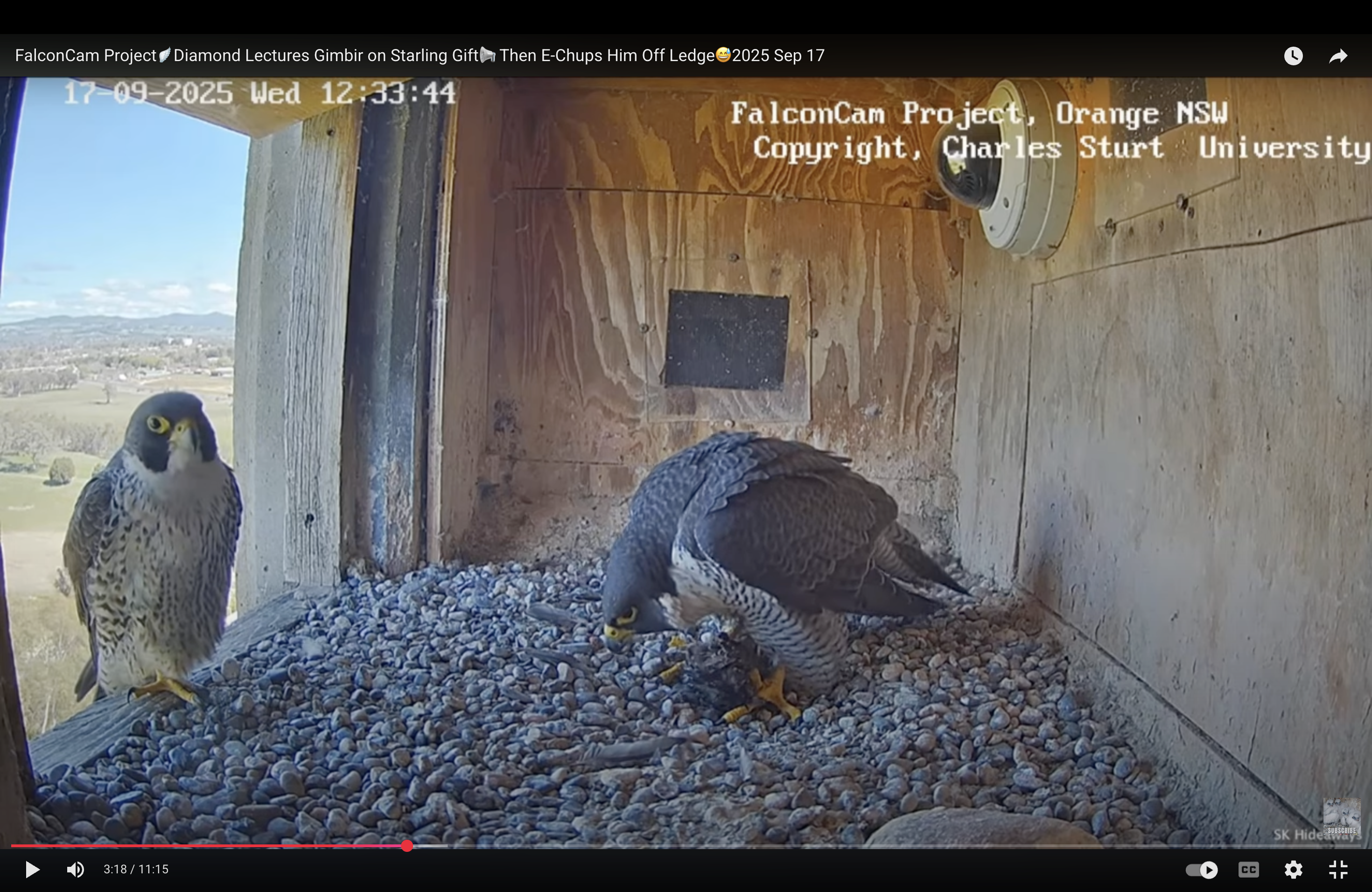
The most recent videos from SK Hideaways including Diamond and her precious egg!!!!!!
DIAMOND LAYS FIRST EGG OF 2025 After Early A.M. Mating x3 (2025 Sep 29)
After dear Xavier’s disappearance on 27 August and Gimbir’s arrival soon thereafter, the breeding season was in question. No one knew if Diamond would remain fertile or whether the mating occurrences between she and Gimbir would be successful. Today’s egg laying answered some questions.
Much gratitude to Cilla Kinross, director of the FalconCam Project, and Charles Sturt University NSW
CHANNEL ISLAND EAGLES
Two Harbors Eagles, Catalina Island California ~ Cholyn & Chase (21 Sep 2025)
Cholyn and Chase enjoyed each other’s company on their cactus perch, chatting, stretching, and peacefully watching the world go by. I celebrate these 27-year-olds and their 22 years of mated bliss every time I’m lucky enough to see them
Courtesy Institute for Wildlife Studies, explore.org
West End ~ Catalina Island, CA
May be too soon to say for sure, but it seems that Akecheta’s return may have been a one-day event.
**********************************************
FALCONCAM PROJECT ~ ORANGE NSW AUSTRALIA
A Morning Filled with Bonding and Mating (23 Sep 2025)
Diamond and Gimbir pair-bonded twice and mated thrice all before 11 a.m. Only time will tell if the activities of this new couple have the desired effect, but it’s evident that young Gimbir’s reproductive instinct is fully functional.
Gimbir incorporated the leftovers of a silver gull into a long bonding session with Diamond. It seemed a little rude until Diamond ultimately joined in the nibbling. A strange and entertaining episode!
Jackie & Shadow Chortle Night Away on Favorite Perches ~ Habitat Critters Photo Bomb (2025 Sep 26)
Glorious sounds of Jackie & Shadow filled Big Bear Valley as they chortled throughout the night. They settled on their Roost Tree overnight and convened at the Lookout Snag at dawn. All through the night, habitat critters, Fiona, the Bernardino flying squirrel, and her friend, a wee tiny mouse, visited the nest looking for snacks. A lovely Cooper’s Hawk graced the Cactus Snag to close the morning’s activities.
Shadow returned to the nest after a record-setting 82 days. He and Jackie must really be enjoying their summer vacation. Shadow took in the mess of sticks left by Sunny, Gizmo, and all the visitors to the nest since the family departed, vowing to return with Jackie after vacation to tidy the place up. The ravens greeted him with an aerobatic display, much to his chagrin. He conveyed the whole story to Jackie when they met up on their roost tree for the night.
Jackie & Shadow Return to Nest ~ Reminisce About Sunny & Gizmo (2025 Sep 26)
After 3 months, Jackie and Shadow returned to the nest, taking in their habitat for over 2 hours. I like to think they were reminiscing about the special spring they shared raising Sunny and Gizmo. I’ve interwoven lots of those memories here.
On Monday, the 22nd of September, our family said goodbye to our oldest grandson, Zak, who died in a tragic accident on the 15th. He was soon to be twenty-nine years old. His father was our son who was killed in a car accident twenty-six years ago. Zak was enormously funny and very kind; we are so grateful that we got to see him a year ago. A new tree has been added to the garden.
Needless to say, this has not been the most productive time, although distractions were welcome, and the return of Akecheta gave me hope for all manner of things.
We spent Sunday restoring our spirits in the woods of the Birds Hill Park. Toby was so good. We were shocked that he did not even bark when the chickadees came to take their Black oil seed.
Oh, lots of news in Bird World.
We saw him injured and cried. He was photographed several months later near Ojai, California on the mainland and now Akecheta has returned to the West End where he raised eaglets with Thunder. Thunder suddenly left her eggs (Makaio’s) and I still wonder if she didn’t see Akecheta and follow him. We wait to see if she shows up and if they are in camera range.
Akecheta has not been seen since the 25th at the West End. That was Thursday.
On May 18, Akecheta was photographed near Lake Casitas, California on the mainland.
Here is the chronology of the drama from Jann Gallivan around the nest of Thunder and Akecheta:
Cornell Bird Lab has posted the results of the necroscopy on Big Red and Arthur’s O1. She died of West Nile Virus.
The progress of the Royal Cam chick on her race to get to the waters off of Chile and Peru. Thanks, Holly Parsons.
Heavy rain is hitting Gabby and Beau’s nest south of Jacksonville, Florida.
On Tuesday, Charlie was still at Charlo Montana while Dad was last seen at the Boulder County Fair Grounds Saturday morning the 20th. It appears that both have started migration now.
Rosie appears to have started her migration late this week from the SF Golden Gate Audubon Osprey nest.
What happens when glaciers recede? The Guardian tells us.
Fall is a wonderful time of year to see many wildlife species as the leaves give way and the birds and animals linger feeding before winter. USFWS got some great images of the migrants.
I dream of seeing this number of Pink-footed Geese! Just look at those at the Montrose Basin Wildlife Reserve in Scotland. Oh, I am dreaming.
Sightings of youngsters is always welcome. Those at Threave Ospreys are excited.
Newmann has a visitor at Great Spirit Bluff and Ashley Wilson caught 33/U!
Did this Norwegian osprey go off course, winding up in the UK? Thanks, Mary Cheadle.
It is simply beautiful fall weather on the Canadian prairies, and we have managed to squeeze in some time to go to the nature centre for a much-needed walk during the week. I particularly wanted to see some geese, and was not disappointed.
I am very concerned about the hurricanes in the Atlantic and their impact on the Bald Eagle nests in the NE of Florida like that of Gabby and Beau. Extreme Weather Chaser posted these images.
Keep an eye on the nests as these systems move through. For those of you living in the region of the storms, please stay safe!
Please let your voice be heard on the use of rodenticides in the UK! We know that they do not just kill rodents, and we also know that eagles, owls, hawks, harriers, and all manner of our feathered friends catch the rodents that have consumed these horrible toxins and die. Let the raptors eat the rodents! Raptor Persecution UK gives the details.
‘A’ comments from Australia – (I can’t wait to see what they will say about Diamond’s egg):
“Yes, the spring equinox has ushered in some gorgeous weather – sunny and not at all hot (15C today but it’s been up to 22C in recent days). The trees are blossoming, the bulbs are flowering and everything is energised. The birds are flirting and nest-building. Melobourne is not yet subtropical.
Mr and Mrs Crow are huge birds with huge appetites.They like to grab chicken carcasses and fly it to a flat rooftop over my back fence (a three-storey block of units), where they eat at their leisure. There must be a lot of regurgitated bones and the like on that rooftop!
Mr and Mrs Magpie definitely have a nest but do they have eggs yet? I suspect they might, as I have been seeing them both but not together. And Mr Magpie has been removing food from the garden, which is unusual. I suspect he is taking it to Mrs Magpie on their nest. It’s nearly the end of September, and the falcons have had three eggs for a couple of weeks now, so I’d be surprised if that were not the situation with the magpies. Interestingly, by summertime, the magpies are sometimes accompanied by a fledgling from the previous year as well as the one from the current year. I have no idea whether the gender of the fledgling has any impact on whether this occurs but it’s interesting to see the family group – mum, dad, and a couple of kids. (I usually see only one fledgling per season – I really should do some reading on magpie breeding because I don’t even know why there’s only one fledgling per season (siblicide/food shortage or only one fertile egg).
Those sea eaglets in Sydney are so gorgeous as their juvenile plumage comes in. I hate watching them nearing fledge however, based on previous years. I wish I could think of ways to give them a better chance of surviving after fledge – the annual rescue with mixed success and the loss of contact with no way of knowing whether they even survive. It’s an awful end to a season of watching them daily and counting their bites and growing to know and love each one of them. I think it’s the seeming inevitability that makes it so hard.
At Collins Street, the parents are so patient, sitting on those eggs day and night, rain or shine. Dad has this endearing habit of chatting to the eggs in a tiny, squeaky little voice. It’s adorable. And you are SO right about male falcons. They are the cutest things. Gimbir has learned to deliver the fruits of his hunts (he is a very good hunter) to Diamond – now, all he has to work out are her preferences, though she has very kindly accepted and actually partaken3 of a starling gift, no doubt trying to encourage him. Such an odd couple, with Gimbir so young and tiny and Diamond a matriarch old enough to be his great-grandmother and at least twice his size. But if we had to lose Xavier (and he is dreadfully missed) I am glad that Diamond has found a new mate.
At Port Lincoln, the incubation continues, with mum doing most of the egg sitting and dad getting in egg time whenever he can (and sometimes being tardy about leaving again – mum has had to apply the foot more than once). Three eggs laid over the course of a week does concern me. I’m sorry to repeat myself but I do wish they had stuck to two. I suppose three eggs at Port Lincoln has far too many memories of Zoe for my liking. Still, the Fish Fairy has arrived since (and perhaps because of) the Zoe season. I keep wondering what that taught us about spoiled first hatches and their survival skills. Zoe certainly seemed to lack them!
The information about the breeding habits of the albatross was interesting. The updates on some of the birds from previous years were fabulous. I am glad YRK has a new mate, although we always grieve for those who are missing. We must advocate for an end to the eating of tuna!
Of course we check everything for safety before offering it to the birds because they will eat all sorts of leftovers, raw and cooked, so obviously, I don’t want to do anything dangerous through ignorance. In that manner, I discovered that avocado is deadly for birds – it damages their liver. The magpies in particular love a walnut as a special treat – that’s safe for them.
It is so good to see Gabby and Beau together. And the return of Akecheta is wonderful news. Do we think he has perhaps been recovering from an injury? What else would have kept him away, I wonder. “
The Ventana Wildlife Society has a monthly chat. If you missed the one in September, the link is here. There are other links to the different cameras for watching the condors.
We still have ospreys in Nova Scotia, Canada. At other sites, winter occupants have arrived,including Colin the Cormorant at the Rutland Manton Bay nest of Blue 33 and Maya and Fred the Heron, captured on the nest by Barb and Bob Larsen at Boulder County.
Thank you so much for being with us today. We look forward to having you with us next Monday, when we will be sharing several book suggestions! In the meantime, please take care. Put your devices away and go outside to restore your spirit.
I want to thank our notable contributor, ‘SK Hideaways’ for their videos highlighting the nests we are following, ‘A’ for their Australian commentary, the owners of the streaming cams listed in bold, the individuals who take the time to create videos and the authors of posts such as Jeff Kear at UK Osprey Information, and all others, often too many to name but whom I have tried to cite in bold. I am very grateful to you and to the newspapers and journals that still cover environmental issues as they relate to our precious feathered friends. My blog would not be what it is without your input into the world of birding.
It is the autumn equinox and here is everything you should know.
The Autumnal Solstice, or equinox, marks the first day of astronomical autumn in the Northern Hemisphere and occurs on September 22, 2025. At this precise moment, the sun is directly above Earth’s equator, resulting in days and nights of roughly equal length, though atmospheric effects make them not perfectly equal. This seasonal milestone also brings winter to the Southern Hemisphere and concludes summer in the Northern Hemisphere.
What is the Autumnal Equinox?
A Moment of Balance: The term “equinox” comes from Latin, meaning “equal night”. While day and night are close to equal in length, the Earth’s atmosphere bends sunlight, making days appear slightly longer than nights.
Orbital Position: The equinox occurs when Earth’s axis is tilted neither toward nor away from the sun, and the sun is positioned directly over the equator.
When is it?
Date: The autumnal equinox falls on September 22 each year.
Time: In 2025, it will occur on Monday, September 22, at 2:19 p.m. EDT.
What it means for the Hemispheres:
Northern Hemisphere: The autumnal equinox ushers in the start of fall and signals the end of summer.
Southern Hemisphere: For those in the Southern Hemisphere, this day marks the start of spring and the end of winter.
Additional Facts
Harvest Moon: The full moon closest to the autumnal equinox is known as the Harvest Moon, which historically allowed farmers to harvest crops for longer into the evening due to its earlier moonrise.
Cultural Significance: The autumnal equinox is a significant date in various cultures, such as the Mid-Autumn Festival in East Asia, which is often celebrated around this time.
Late updates:
Dyfi Osprey Project:
Little Buckaroo or Eeny at Dunrovin appears to have started its migration. Last seen eating breakfast on Thursday, the 18th of September.
Charlie is still at Charlo, Montana on the 21 September (Sunday). Gail Woodstock posted some lovely screen captures of this dedicated male.
At the Boulder County Fairgrounds, it appears the male is still present, too! Thank you for the screen capture and post – Barb and Bob Larsen. The ospreys are staying later. Does this mean a late and milder winter? I wonder. We still have ospreys in Canada, too.
SK Hideaways latest videos!
Two Harbors Eagles Cholyn and Chase (2025 Sep 19)
Chase brought a late lunch, having to dodge ravens during his meal. He managed to quickly finish his fish and then departed. Cholyn arrived later with a whopper fish, which she took her time to eat. She lingered into the late afternoon, chatting remotely with Chase, who we could hear off camera. It was a special treat to see them both.
367 Collins St. Falcons Dad M24 Boycotts Changeovers Till Mum F24 Sets Him Straight (2025 Sep 20)
After a typical morning of clockwork-like changeovers, Dad decided he wasn’t going to relinquish his egg time when Mum returned. She waited patiently for nearly 10 minutes before gently persuading him it was time to give up his boycott. He left without incident.
FalconCam Project, NSW Australia ~ home of Diamond and Gimbir (2025 Sep 17)
Gimbir was proud of his starling gift ~ the first time he’s brought one to Diamond, who historically has refused starling gifts except to feed growing chicks. She gave him quite an earful, about which he seemed somewhat confused. In the end she e-chupped him completely out of the nest box and proceeded to eat some of the starling. Maybe Di’s taste’s have changed.
After Lady and Dad woke the neighbourhood with a duet, SE35 and SE36 entertained themselves till breakfast arrived. Between beaky kisses, wingers, twig swapping, and napping, they were well occupied for the few hours till Lady returned with a nice, big breakfast.
What’s happening? SE35 Steps Aside as SE36 Eats a HUGE Breakfast! (22 Sep 2025, 9:47-10:29 a.m.)
When Lady arrived with a whopper fish for breakfast, SE36 stepped right up to receive the first bites. SE35, typically, the dominant eaglet sat back and watched SE36 eat…and eat…and eat. The meal lasted for more than 40 minutes with SE36 getting most of that big fish. There was no aggression between the eaglets, which was a welcome sight to see.
Ventana Wildlife will be releasing condors! You can go to their website and sign up for this live event. No costs. I always watch these events. You learn so much and it is so exciting to see the youngsters go out into the world.
I want to thank each of you for taking the time out of your busy lives to check on how our feathered friends in Bird World are doing. I would also like to welcome the more than 5,500 readers from China who have joined us recently. It is so lovely to have you with us in Bird World! Welcome.
To celebrate, here is a lovely article in 10,000 Birds on the Raptors of Nanhui, Shanghai, with some beautiful images. Please check it out and see how many of our feathered friends you knew were in China. I am particularly fond of the Chinese Sparrowhawk.
Albatrosses forage at sea for an extended period after fledging, typically remaining at sea for 3 to 7 years or more before returning to their natal colony to find a mate and eventually breed. During this time, young albatrosses, known as juveniles, learn to forage and socialise in groups called gams to develop their courtship rituals.
Post-Fledging Journey
Years at Sea: After leaving the nest, young albatrosses will spend several years at sea, some for as long as 5 to 8 years, continuously foraging and only returning to land for breeding.
Socialization: Young albatrosses gather in groups of potential mates, known as gams, to learn complex courtship dances and develop their unique “language” for finding each other later in life.
Maturation: This period allows them to mature, molt their juvenile plumage, and gain the energy and experience needed for their first breeding attempt.
Return to Breed
Colony Return: Eventually, the adolescent birds return to their natal colonies.
Finding a Mate: They then begin the lengthy process of finding a mate and developing a pair bond before their first breeding attempt.
Breeding Frequency: After a successful breeding attempt, many albatross species take a year or more off from breeding to regain their energy and condition before their next breeding season
All the information that you could ever want to know about Albatross by New Zealand’s Department of Conservation:
The latest post from Ranger Sharyn Broni posted by Sharon Dunne.
Holly Parsons has posted some additional information:
‘A’ now has the latest: “Since our baby girl fledged on 16 Sepember, she has been steadily making her way towards South America. The tracker tells us that she is about 200 kms from the headland, heading north. She has stopped off in an area where she probably found food and is progressing well. She is a strong girl. She’ll need to be – her journey is 9000 km long. Safe travels beautiful albie. “
Many of you have been fascinated by the great prey gifts that Gimbir has been bringing Diamond. None of them were Starlings – we know that Diamond does not like Starling. Well, our poor little lad made the mistake of presenting a Starling gift to Diamond and she rebuffed him. SK Hideaways has it on video: https://youtu.be/7Fibnk3qEt4?
Gosh, is there anything cuter in the adult raptor world than a male peregrine falcon? Gimbir has certainly been winning hearts and minds with his generosity and excellent hunting skills. Will there be any eggs? Maybe not this year, but we will wait.
Tuesday afternoon was also magical on the Canadian Prairies. I sat in my friend’s garden, surrounded by the yellow leaves from the trees falling gently around us. Fall is truly here. It is one of the most loved seasons, yet each of us knows what follows. Winter should be a time of relaxation, sitting by the fire, reading a book, sipping hot chocolate or the best leaf teas wrapped with a soft blanket.
We are looking forward to spending several hours in the nature centre on Wednesday, checking out the geese and ducks while Toby is being groomed. There are places where dogs cannot go (understandably), and this is one of them. We have not been there for several months, so I am really looking forward to spending time on those very familiar paths.
The geese are still fattening on the golf courses and at the nature centres. They were in an area of our City that had been abandoned when one of the military bases closed. Now it is a building site. Where will those geese, who have returned to this same place each year, go now? What are humans leaving our wildlife?
We are taking away habitat minute by minute. The City I live in is no exception. For over a hundred years, the population remained stable at approximately 600,000. Now our City is a construction site with the population soon set to reach one million. It sprawls, and many city planners have, for decades, criticised this practice as it is now taking away good agricultural land, along with woods that are perfect for wildlife and birds. It makes me quite angry – the City should be safe, built up, not out, with good public transport. As it stands, things are so spread out that cars are almost a necessity, and every morning, the traffic jams reveal automobiles with a single person in them! I’d best not get started on my soapbox, or we could be here all day.
Researchers at Cornell, along with colleagues worldwide, are searching for missing birds. Here is one of the webinars that was posted, so we can join in their discoveries as well. https://youtu.be/sri3ciYgCS4?
It was an extremely sad year for the Black Stork nests in Latvia as reported by Maria Marika. As we know, we must mourn but also celebrate the success. As we take over habitat, the planet and oceans warm, there will be fewer successes unless we radically change our human behaviour.
“It was another windy day at WBSE and the chicks were left alone on the nest for most of the day. They are really developing their juvenile plumage now, especially SE35, whose feather development is well ahead of its sibling’s. One reason for this is probably the lack of food SE36 gets in comparison to SE35. I saw only one food delivery today, a gull, and SE36 was fed four or five bites of this (beause it happened to be in the right place at the right time) before SE35 intimdated it into a cowering defensive position, which it maintained until the food was gone. There were no late food deliveries as there have been on previous evenings and little SE36 went to bed with an empty crop. SE35 did relatively well, although would have preferred another two feedings. It is fortunate indeed that both eaglets were well fed on the previous two days. Here are the three reports, from today, yesterday and Sunday:
September 14: another fine day. Last night Lady slept on the rim of the nest, or just by them – disturbed at one stage by the possum passing. Early duets and she was off, returning after 6am and trying to settle in the bowl with the nestlings – but off again a after a short time. When Dad brought in a gull carcass at 7:50 she grabbed it and fed them both –for an hour. Dad came in and took off some of the scraps, with Lady very protective. He fed 36 a couple of bites, then Lady came in again and fed them a little more – protecting the food from him. Then Dad returned and fed them a little himself – and more when Lady took over and fed 35, then 36 – a massive feeding session. As the nest warmed up, chicks were panting – full crops too. They rested, sprawled out in the nest at times, moving into the shade when they could. Dad came in a couple of times and took off a scrap of bone. Late afternoon, Dad came with a whiting, claimed and fed by Lady, to SE35 first. Both ate – full and peaceful at end of day.
September 15: Lady spent most of the night on the nest rim, coming in very early to the bowl, then away. She returned as Dad brought in a Red Rock Cod at 6:15am, claimed by Lady and fed it to both chicks. Both chicks are calling now as the food comes in. A very warm day then, with both of the eaglets moving into the shade when they could. The parents were in and out a few times, with leaves – or nearby – but the chicks were mainly left alone on the nest. Lady came in at last light, but there was no more prey until just after 6pm, when Dad brought a fish. Lady then fed both nestlings before settling for the night.
September 16: Lady slept on the rim last night. She was off very early, then duets, with the nestlings joining in. Dad came and started feeding SE35 a fish scrap early, offered a bit to Lady, then she took over – though there was not much left. The eaglets then waited all morning until Dad brought a gull chick just after 2pm, on a windy afternoon. Lady claimed it and fed both, with SE35 getting most. SE36 has been venturing right to the nest rim, then returning safely to the nest bowl. Both chicks are calling on the nest now – begging for food or parental attention. They were waiting for more food all afternoon. Lady came to the nest just before 6pm, but with no food, then left again, flying to the perch branch. She returned to the nest bowl, settling on the nest next to the chicks. Will there be a late prey delivery again? (Spoiler alert: No, there wasn’t, and poor SE36 went to bed with an empty crop and a hungry tummy.)
At Collins Street, the three eggs are being carefully tended by both falcons, though mum is doing most of the shifts.
At Taiaroa Head, we are told, Miss SS Trig is further down the hill. However, I am not convinced she has not already fledged today because there is an albatross sleeping on her nest and according to Ranger Sharyn Broni, that albatross is her father, who is waiting to feed his girl. (I wondered why, if it is him, he has not called for her at all, though he has looked around and he is sleeping on her nest – also I believe Ranger Sharyn has actually confirmed his identity on her recent travels.So we will have to take her word for the fact that Miss SS Trig has not yet fledged and that there is a goodbye breakfast with dad awaiting her if she decides to head up the hill early tomorrow morning (17 September). The wind will determine her schedule, in all likelihood, but we are hoping she will stay at least another week, until her tummy mohawk (it really is most distinctive) has been shed.
I thank you so much for reminding me that the birds in our own gardens are the interface between ourselves and the natural world. We don’t need to filter these experiences through streaming cams from the other side of the world, although the chance to share the experiences of birds like the red-tailed hawks is something extra special (and a bird like Angel is something too precious for words).
Meanwhile, all appears well at Port Lincoln, where the night herons are doing well with the fish light it seems. They caught two fish in rapid succession the other evening. With three healthy-looking eggs, I do have some fears about the upcoming season – there is an aggressive quality to ospreys.”
“Wednesday: The littles were up and stretching at 6am and the breakfast fish arrived at around 06:08 courtesy of ever-reliable Dad. Lady was quickly in to take control of the feeding, with SE36 finding itself in prime position at the table. It was too intimidated though by its older sibling and went into submission pose, allowing SE35 to push past and take the front spot and the first of the food. But SE36 was still closest to the fish, and had the courage to turn its head and take occasional bites when Lady offered them. It was a good-sized fish and eventually, both nestlings ate a large breakfast.
When I checked back at lunchtime, SE35 was in a food coma and SE36, despite sporting the most gigantic of crops, was still eating like a small feathered machine as Lady fed him still more fish. Oh my goodness those eaglets were full. After yesterday’s lean pickings, I’m sure they both enjoyed the food overload they got today. They have become very vocal in recent days, chittering away to each other on the nest and vocalising to their parents whenever food approacheth. Oh they are the cutest small people. SE35 is starting to show caramel colours on its breast and head feathers and will soon begin to resemble a juvenile sea eagle. SE36 is still a huge ball of fluff with some feathertips on its wings – at least two or perhaps three days behind its older sibling.
At Collins Street, dad brought in such a large pigeon (I think) at 15:24:20, he could hardly get it up onto the ledge. It was as big as he was. Mum was less than impressed, after all his hard work, and stayed on the eggs, so he dived off the ledge again with his prey, at which mum looked rather surprised but still didn’t move. I presume he ate it himself, or stashed it on a floor above the nest (he glanced up there before diving off the ledge). At least there appear to be enough workers back in the Melbourne CBD to feed a good crop of pigeons for the falcons to feed their chicks once those eggs hatch. Dad is obviously a good hunter – that really was a very large catch.
Dad returned with empty talons soon after 16:28, and the pair had an animated conversation before mum dived off the ledge and presumably headed off to the pantry for the pigeon remains. Finally! Egg time for dad. He is such a cutie. A very neat little falcon. And his sweet little voice is adorable. Mum is back at 17:27:30. Another changeover at 18:02:30. “
The cam operator gave us some great closeups of the little sea eaglets and their gorgeous juvenile plumage coming in.
“Here is yesterday;s ranger report:
The eaglets both ate a large breakfast at around 10am this morning, with SE36 doing particularly well at this feeding. Both chicks finished the meal with huge crops, and spent the rest of the afternoon resting in the sunlit nest. The weather has improved, with the winds dying down and no rain today, so things are drying out and the fishing is easier.
September 21: A lovely sunny day. Last evening, Dad brought in a last prey offering, another young gull, and Lady fed them, though SE35 ate most. SE36 found a last scrap itself. Lady spent most of the night beside them on the nest rim. A quiet morning until Lady herself brought in a young gull. SE36 did quite well at this feeding. Both are picking at things in the nest. Then, in the late afternoon, Dad brought part of a fish, having already eaten himself. He fed them a little first, then Lady took over until all was gone. As the eagles called, the youngsters joined in too at the end of the day. Both adults settled nearby.
And today (22 September), the eaglets both ate a large breakfast at around 10am, with SE36 doing particularly well at this feeding. Both chicks finished the meal with huge crops, and spent the rest of the afternoon resting in the sunlit nest. The weather has improved, with the winds dying down and no rain today, so things are drying out and the fishing is easier.
These two are starting to look so grown up (especially SE35). It is scary to think that they are nearing the time when their privileged life on the nest will be exchanged for their annual losing battle with the currawongs.It seems so futile – all the hard work the parents have put in and yet it is destined to be fruitless, with the fledglings unlikely to survive without human intervention (and even with that assistance, their futures are very uncertain).
At Collins Street, the incubation continues, with the three eggs looking good and being well looked after by both parents. Mum headed off at 06:14 this morning to get herself some breakfast, and little Dad quickly arrived to take over, making his tiny chirping noises. The way he talks to the eggs is so adorable. He loves these chicks before they’ve even hatched.
At Port Lincoln, mum is still waiting for food – nothing has been brought in so far today. There are usually two fish (or one huge fish) brought in per day, but I am not confident that this is going to increase sufficiently to feed a family of five when these eggs hatch. I do hope the Fish Fairy is ready for action because I fear she is going to be needed on this nest this season. I do wish they would stick to two eggs.
Mum is doing the vast majority of the incubating at Port Lincoln – some days, dad spends less than an hour in total on the eggs, with mum taking care of the rest. She is doing a great job, but as I said, I’m hoping the fish supply will step up when the eggs hatch – as things stand, mum isn’t getting enough for her own needs. “
Pat Burke got the cutest screen capture of the little sea eaglets, who are a month old now.
TE3 is still hanging around the natal nest in Tempeauleau Wisconsin. This gorgeous juvenile was raised by her Mum basically single-handedly. Many thought the eaglet would not survive, but she did and what an amazing eagle she is going to be. Thank you Bud Whillock for these great images that you shared on FB.
The American Bird Conservancy announces a huge win:
ABC is celebrating a much-needed win for seabirds with the announcement that the U.S. Department of the Air Force (DAF) has suspended its proposal to use Johnston Atoll National Wildlife Refuge as a site for commercial rocket landing pads. ABC was among the first organizations to raise concerns about the plan and request further study on the potential impacts on the more than one million seabirds that nest on the tiny Pacific Ocean atoll each year. The DAF’s pause on their plans gives seabirds like the Brown Noddy and Red-tailed Tropicbird breathing room and keeps this important site a safe refuge for birds, for now.
As our population grows, the impact on wildlife is enormous.
The ospreys are almost all gone on their journeys to their winter quarters. Iris is no longer at Hellgate Canyon, and Charlie is no longer at Charlo, Montana. A few linger in Nova Scotia, and one of CJ7 and Blue 022’s fledglings was photographed in Poole Harbour.
It appears that the male at the Boulder County Fair Grounds osprey nest is still at home, too.
Swoop continues to deliver to the fourth hatch, known fondly as Eenie or Little Buckaroo, at Dunrovin Ranch. Lin Lawson did a physique comparison between the father and the juvenile.
Connie Dennis reminds us that this is the number of days we have until they return in Nova Scotia:
Each of us will be sitting on pins and needles waiting for Iris to return to Montana next spring! Lovely montage Lucille Powell, thank you.
There are still some ospreys in Manitoba! Marlene Mitchell caught this one where we go to see the Pelicans.
At the Golden Gate Audubon nest site – lamp and crane – one fledgling and the parents that remain are Beacon, Rosie, and Richmond. “At 128 days old, Beacon has now lingered the longest of any of Rosie and Richmond’s offspring. And apparently her calls for more fish are working, as she received two separate deliveries today, after visiting the Whirley Crane several times. Rosie also visited the crane. http://www.sfbayospreys.org”. https://youtu.be/sT1WdpdP4-Q?
Rosie is still there on Thursday. Thanks, Lucille Powell.
Cumbria Wildlife Trust gives us the remarkable story of White YW and Blue 35 at Foulshaw Moss, who raised three chicks, with White YW now 17 years old and Blue 35 fourteen years old. And then, White YW feeds and cares for another’s fledgling. A good read. White YW and Blue 35 are two of my favourite osprey couples in the UK, often overlooked.
It is that time of season when there are summaries and highlights. Cornell Bird Lab takes us through the life of the Barred Owls. “Relive five unforgettable moments from our 2025 Barred Owl Cam, sponsored by Wild Birds Unlimited! This season was full of fun and heartwarming memories as this feathered family raised their two adorable owlets, Moss and Maple, in a nest box nestled in the backyard of WBU Founder and CEO Jim Carpenter. Here is the link: https://youtu.be/HfW9vYw2HSY?
It is also cam maintenance time for both the ospreys and the eagles.
Gabby and Beau continue to work hard on their nest in NE Florida, with Gabby even trying out the egg bowl. Will we have eggs early this year? We wait to see.
Duke Farms nest is waiting for its eagles.
There was an eagle at the ND-LEEF in South Bend, Indiana, on Tuesday.
The Maori, along with North American Native Tribes, along with many other cultural groups, believe that birds carry messages, especially when someone dies. A lovely short read from The Guardian:
Toby wants to know how many people remember Murphy the Bald Eagle who incubated the rock and then got to raise an eaglet? Thanks National Geographic!
Thank you so much for being with us today! Take care of yourself. We look forward to having you with us again next Monday.
I want to thank our notable contributor, ‘SK Hideaways’ for their videos highlighting the nests we are following as well as the owners of the streaming cams listed in bold, other individuals and institutions who create videos and the authors of posts such as Jeff Kear at UK Osprey Information, and all others, often too many to name but whom I have tried to cite in bold. I am very grateful to you and to the newspapers and journals that still cover environmental issues as they relate to our precious feathered friends. A special thank you to Raptor Persecution UK for keeping us well informed about what is happening to the raptors in the UK. My blog would not be what it is without your input into the world of birding.
Calico wants me to add an essay, “The Thin White Line,” from Emergence Magazine. She thinks it is thought-provoking.
Thank you so much for being with us today! Take care. See you next Monday.
I want to thank our notable contributor, ‘SK Hideaways’ for their videos highlighting the nests we are following, ‘A’ for their Australian commentary, the owners of the streaming cams listed in bold, the individuals who take the time to create videos and the authors of posts such as Jeff Kear at UK Osprey Information, and all others, often too many to name but whom I have tried to cite in bold. I am very grateful to you and to the newspapers and journals that still cover environmental issues as they relate to our precious feathered friends. My blog would not be what it is without your input into the world of birding.
It has been rainy and grey for most of Wednesday and all day Thursday. I am so tired of rain. Please let the sun and warm weather return for a bit!
Toby spent the afternoon with his friend Nellie while I took Don to a doctor’s appointment. Toby and Nellie are besties.
Don has Hemachromatosis, and we have been working hard to get those Iron levels in his body down, along with ‘phlebotomies’—such a funny name. Well, we went from the high 160s to 13 Iron. He doesn’t even have to have any blood taken out until 2026. We are pleased, and his doctor is a ‘sweetie’. She lives in our neighbourhood and also feeds all the wildlife, including four baby raccoons. She kissed Toby’s picture on my phone, and she has eight rescue cats while driving a Mojito Lime coloured Jeep. I adore her!
The overwhelming response to Gabby’s arrival filled my inbox – it lit up with over 300 emails. Has it been such a sad year for the ospreys that the safe arrival of this iconic Bald Eagle has given us hope? She is gorgeous, looks fit, and Beau was undoubtedly happy to see her!!!!!!!
I will keep you informed as this has always been one of my favourite nests.
SK Hideaways video offerings on some of our favourite nests!
While Jackie & Shadow are Away, the Critters Do Play ~ 24-Hours in Their Habitat (2-3 Sept 2025)
It’s a veritable menagerie in Jackie and Shadow’s paradise habitat. Over a 24-hour period here are just a few of the critters we saw:
Diamond’s new suitor, Gimbir, has been very keen to impress and getting very familiar with the nest box over the past 3 days. This morning, they bonded three times before 6:00 a.m. and even shared a beaky kiss. They then met on the tower for one decent mating attempt and one miss. It’s fascinating to watch this new relationship unfold, while we humans still struggle with the loss of Xavier. We do believe that falcons have emotions, but they are certainly nothing like the human variety, which bodes well for their survivability.
Courtesy FalconCam Project, Charles Sturt University NSW
Revolving Changeovers with Dad’s Lullaby and Mum’s Melbourne Shuffle (2 Sep 2025, 5:15-9:16 a.m.)
Dad arrived early for the first changeover. The next four came in relatively quick succession. Dad sang his chirping lullabies and Mum did her magnificent Melbourne Shuffle atop the eggs. These chicks will know who’s who when they hatch.
Geemeff’s Woodland Trust daily summary for Loch Arkaig Thursday 4th September 2025 Not much activity today, a few songbirds visited and an RAF Atlas transporter was seen on both nest cams but the most interesting event today is a post from George with some season wrap up statistics. The Osprey cam page is the most visited of the entire Woodland Trust website – of course! – with over 100,000 visitors clocking up 1,000,000 web sessions, and along with the Friends of Loch Arkaig and Morag Hughes’ big swim, has generated £25,000 in donations. Let’s give ourselves a pat on the back, and big thanks to George for moderating this forum which along with the nest cams is the best entertainment around. Thanks to Postcode Lottery for sponsoring the cams. Link to George’s post:
‘A’ brings us the latest commentary on the Australian nests- and I do love this personal take on nests in the country where she lives:
“Breakfast was early at WBSE this morning, with Lady feeding some leftover fish to the littles before 6am. Little SE36 woke up in the prime position so was offered the first couple of bites and was brave enough to take them, despite the looming of SE35 from behind. It decided not to push things, however, and allowed its larger sibling to eat then, until it had taken the edge off its early morning appetite. Both are getting enough to eat and are looking good. Preening is the order of the day today, with both obviously feeling very itchy as they learn about feathers. They are just too adorable for words. And so sweet.
Meanwhile, in the course of comparing last season to this, I notice that this year’s chicks are being called by the same numbers as last year’s (SE35 and SE36). Is this an oversight? I am confused (though it is worth noting that this is an almost constant state and it is particularly easy to confuse me, so that’s not exactly a measure of anything whatsoever). Why are this year’s chicks not SE37 and SE38? Surely they should be.
We will probably not see SSTrig chick fledge and her absence from the hilltop will be our only hint that she is no longer on the headland. The rangers do a daily sweep of the area and the nests in an attempt to pinpoint the departures, but they cannot be sure whether an individual chick has left the building or whether it is just exploring potential take-off points (as SSTrig has been doing of late). They do a regular head count and estimates are based on that (and of course on the rescue of birds who ditch in the bay and have to be given a second attempt at fledging). What a wonderful thing it is to know that these rangers devote their lives to helping these exquisite birds and that they are being given every bit of help they can possibly need. Supplementary feedings, hydration, sprinkler systems in the heat of January and February, weekly weighings to monitor their weight gain and vet checks where needed, not to mention the incubators that allow these eggs to hatch in a perfect environment, untouched by flies or other pests. It truly is a beautiful thing, and the closest thing to a worry-free live stream you’re ever likely to find. The fact that these birds are the stuff of seafaring legends and can live (and breed) into the seventies (thinking of Wisdom of course, although she is a Laysan albatross rather than a royal northern albatross, but the distinction is largely irrelevant from the perspective of adoring the albatross) is just awe-inspiring before you even consider their amazing endurance and their incredible inbuilt GPS allowing them to negotiate journeys covering thousands of kms with such precision that they return to within 50 metres of their natal nest. Just beyond belief. No wonder they are perhaps the most fascinating of birds. Certainly they are one of the most loveable, with their gentle nature, their grace and their beauty. Their dedication to raising their one chick per season is awe-inspiring, sitting for days and days, even weeks, as they await the return of a mate to take over incubation. But there is no need to go on. You know exactly why I adore the albatross so much. Such a very special bird.
SSTrig chick is either becoming better acquainted with the camera or attempting to eat it. Whatever she is doing, she is making a racket and is in such exxtreme close-up that it is difficult to tell which bit of her we are seeing. She really has been a very adventurous albie, building herself a new nest and constructing several play nests during her months on the headland. Obviously, curiosity is a big feature of this chick – she has been fascinating to watch as she has explored her surroundings. She has even reconoitred some of the take-offs her parents use when they leave after feedings, as if she is planning her departure and plotting her path to the skies. Seriously. Why else would she be exploring those particular pathways down the headland? Whether it’s intelligence or some inner GPS, these birds circumnavigate the globe, and the fact that they return to within 50 metres of the nest in which they hatched after a journey of several thousand kms is absolutely mind-blowing. This little one’s big day is rapidly approaching. In fact, she could leave pretty much at any point now. September has arrived and with it two important things: football finals and the first flight of the Taiaroa Head albatross chicks. Both are events filled with equal parts joy and fear. Anticipation and trepidation. Godspeed, gorgeous birds. Return safely.
Just an update on Taiaroa Head. The beginning of the end has arrived, with the most recent sweep of the nests revealing that when the winds came up on Monday (1 September), we saw the departure of the first of this year’s chicks. She was 223 days old. Usefully, she happens to be one of the chicks to be given GPS tags this season, so we can track her progress as she heads towards South America. It appears obvious that SS Trig’s parents are aware that their offspring is on the verge of her own great journey, coming in very frequently over the past week or so to feed her. She has had two feedings today (4 September) and was also fed twice yesterday I believe. There are obviously a couple of other chicks on the headland who are readying themselves for departure, with rangers finding three boluses so far, two of which contained plastic. SS Trig chick has been practising her hovering and getting some good air under her wings, but she has been lighter than average pretty much throughout her life so far, and I hope she is strong enough for her big adventure. It seems strange that they empty their stomachs before leaving when their next meal will also have to be their first catch. Yes, I know they are trying to remove any excess weight, but if they are using wind currents rather than wing flapping for most of their flight, then surely having the caloric buffer would be the wiser choice. It just goes to show how little we humans know, eh?
And a reminder that it was on 3 September 2022 that Royal Cam chick Lillibet fledged, the first of that season’s chicks to do so. I cried and cried that day. I still believe it was a fludge – the winds associated with that storm were so strong, and she had been practising her hovering and slipped on the ultra-slippery headland and up she went. And headed off into the storm. I was watching it live at the time, and could hardly believe my eyes. She lost her footing, ended up in the air and decided to keep going. At least that’s what I saw. Little Lillibet. Named after the Queen, a great lady who will be tremendously missed.
As I type, the open tab from Orange is suddenly a burst of e-chups as a bonding session begins between Gimbir and Diamond. Gimbir is becoming more confident around her, though making sure his exit from the box is secured at all times. This is a lengthy bonding session. Both birds have gigantic crops – Gimbir’s is particularly huge. He certainly is a good hunter but so far has not been observed sharing his bounty. Certainly, they are very interested in each other, and their bonding sessions are frequent (at least a dozen a day). This one is continuing, having lasted several minutes already. I am so glad Diamond is not alone. ”
And more from A: “I’m sure you’re aware that we have the first egg at Port Lincoln. Dad is proving a good provider and brought in a niced celebratory fish for mum. He also took over incubating while she ate her fish.
He’s also brought in some nesting material, which she approved of and has incorporated into the nest structure. These two seem to chat a lot and appear to have a very convivial relationship. I’m never certain that the birds we are seeing are the same two as last year – I can never tell, despite the fact that the pattern on their heads is apparently as distinctive as a fingerprint so some of the viewers have surely done a computer comparison of photos from last year’s stream with those from this year. But certainly, the behaviours of the birds (both individually and in their interactions with each other) appear different year to year, and certainly this year’s pair seem much more relaxed and much more closely bonded than last year’s. So make of that what you will.
At WBSE, little SE36 (or is it SE38 and if not, why not) is so much smaller than its sibling. It simply has to be a male with a big sister, surely, given their identical sizes 24 hours after the second hatch. And again, I wonder what research has been done on the relationship between gender and hatch order, because it certainly seems as though the first hatches are more often female and the second hatches male. There could be many very good reasons for this in terms of species survival, and I could definitely speculate along those lines. But it could be purely illusory – we are more aware of those nests because we become attached to the smaller male eaglet and therefore we tend to remember the female first hatches with little brothers. I would like to know though. I’m sure work has been done on it.
Spring has sprung here in Melbourne – the sun is out and the trees are beginning to blossom, while the birds are flirting and nest building – a lovely time of the year and my personal favourite.”
Do you live near St. Louis? Why not travel to the World Bird Sanctuary for International Vulture Awareness Day this weekend?
There is an army of women in India protecting the General Adjutant. They are known as the Hargila Army. The Hargila Army is an all-women grassroots conservation movement in Assam, India, founded by Dr. Purnima Devi Barman to save the threatened Greater Adjutant Stork (Hargila). This group of thousands of women educates their communities, installs protective nets for nests, and plants trees to restore the storks’ habitat. Through weaving stork designs into traditional clothing and other cultural activities, they have successfully changed the negative perception of the bird, increased local pride, empowered women, and even helped move the stork from endangered to “near threatened” status.
Community Engagement:The army, named after the stork, consists of thousands of women who go village to village to raise awareness and educate others about the storks.
Habitat Protection:They plant trees to create better nesting sites and install nets to protect chicks from falling from their nests.
Rescue Efforts:Members also care for injured chicks at wildlife centers and work to free rescued birds back into their natural habitats.
Cultural Integration:The women weave the Greater Adjutant into their traditional clothing and create folk songs and celebrations featuring the bird, transforming it from a disliked bird to a symbol of pride and a source of income.
Pioneering Conservation:Dr. Purnima Devi Barman’s community-led approach, which incorporates traditional practices and empowers local women, has been crucial to the program’s success.
Impact of the Hargila Army
Population Growth:Thanks to the efforts of the Hargila Army, the population of Greater Adjutant Storks in Assam has significantly increased.
Status Improvement:The bird’s population growth has led to its reassessment by the IUCN from “endangered” to “near threatened”.
Women’s Empowerment:The movement has provided thousands of women with a new identity, a sense of pride, and an opportunity for economic empowerment through weaving and garment sales.
Global Recognition:The conservation model has been shared and is being replicated in other regions, including Cambodia.
Protection for the General Adjutant (Greater Adjutant) involves community-led conservation efforts, including nesting site support, raising awareness, and cultural integration, especially in areas like Assam, India, where local groups like the Hargila Army have significantly increased nest numbers.The species is listed as Near Threatened by the IUCN Red List with a recovery trend but remains dependent on continued efforts to prevent population decline.
Key Conservation Measures
Community Engagement:Local communities, particularly women in Assam, have become active participants in conservation through initiatives like the Hargila Army, which involves cultural programming, educational programs, and local pride in the birds.
Nest Protection:Conservationists have implemented strategies to protect young birds, including placing nets below nests to prevent injuries from falls and raising fallen chicks for several months before their release.
Habitat Improvement:Conservation efforts focus on protecting the nesting trees and surrounding habitat, a key factor in the species’ recovery.
Cultural Integration:The importance of the Greater Adjutant has been integrated into local culture through songs, art, and even prayers, shifting public perception from seeing the birds as pests to valued residents.
Challenges and Current Status
IUCN Status:The Greater Adjutant’s conservation status has improved from Endangered to Near Threatened due to dedicated conservation work, though it remains a species dependent on ongoing support.
Population Size:The global population of mature Greater Adjutants is still moderately small (around 1,360-1,510 individuals), making it vulnerable to declines if conservation efforts weaken.
Examples of Success
In Kamrup district, Assam, the number of Greater Adjutant nests has grown from 27 to over 210 in just thirteen years, a significant increase attributed to the community’s involvement.
A scholarship program for children whose families host nests has been established, and a Hargila Learning Centre and museum have been created, further empowering local communities to protect the birds.
My friend Michael St. John cannot stop seeing birds in the wrong place. Today, he was off to try and spot some raptors, including the elusive Blue KW0, a UK osprey that wound up in Barbados two years ago. Michael saw him first and caused an international discussion! Today, he spotted a Eurasian Spoonbill casually standing in the water. Michael is very humble. His e-bird list is long and he has only been watching birds for a few years. I think he is inspirational to all of us to get out and look! Congratulations, Michael, on this and the Hen Harrier sighting a few weeks ago! You deserve a medal. And now confirmed, it is the first sighting of a Hen Harrier in the Americas! Michael got this note confirming:
Not just for Barbados, but for the Americas! This is amazing news. I know Richard Porter very well and I have met Mark Avery. I wouldn’t argue with any of the raptor experts, especially Richard and Dick Fosman. I think you should amend your eBird record.
I’ll amend my seasonal report to NAB immediately. Are you able to send me your best photos? It might even knock the Pallid Harrier off the front page. About time you had a Northern Harrier to complete the set!
Best wishes
Andrew
‘The Girls’ are doing very well! Toby loves them and has learned to play gently with Missey. Hugo Yugo and Toby are real circus performers leaping, running, tumbling, and playing hide and seek. Hope sits and watches. Calico can be pretty cranky and she will push Toby back. I was told Calicos are different. These two are but I adore them. As of today, Baby Hope has been with us for two years. It was two years ago that she came to the feral feeder and we were able to trap her almost immediately. If you have forgotten the story of Calico and Hope or are new to my blog, here is their story:
In an effort to make more ‘higher’ spaces for The Girls, instead of rushing off to buy another cat tree, we moved this old Asian dresser to the garden window when we moved the large cat tree for Hope to the sitting room. Each of the cats has decided it is pretty nice on that quilt. This time it was Hugo Yugo’s turn.
Missey wanted to be on that soft quilt but Hugo Yugo wasn’t prepared to move. She has just jumped on the island and is in a bit of a snit.
Baby Hope is feeling so much better.
Calico took over the top of the little cat tree and isn’t moving either. Calico is very sweet. I cannot imagine not having her and her only surviving baby in our lives. It has been just over two years since Calico decided to step into that cat carrier and join our menagerie.
The deer near my friend on the way to drop off Toby.
I am enclosing this posting from Wildlife Haven today, not for your to donate, but for you to see one of the rare animals they are caring for – a baby lynx. This is my local rescue and they do amazing work – remember the turtle with the soft shell and the invention of the device by Dr Tess to raise the shell off the back and get it hard again. That turtle was released after a year of care. If you live in Manitoba, Wildlife Haven has its Open House on September 20 and 21 this year. Go to their website to purchase tickets. You will have the opportunity to meet all the ambassadors and see the surgeries, the new flight wing, and more. It will be $10 well spent as it goes directly to the care of the wildlife they rescue.
Just some notes. Idris is still feeding Brianne at the Dyfi Osprey Platform breaking all manner of records.
At Rutland, 8, Maya, and Blue 33 are still home. 9K5 is still on the Gilestone nest in the Usk Valley in Wales along with dad. Ron is back at the Dade County nest and has been for a few days. Nova Scotia Ospreys are still home. O2 was spotted on the Cornell Campus along with Big Red. – Will catch up with all of them on Monday.
We can make a difference. Wild Justice is happy to announce that an adventure playground is illegal in Wales.
Thank you so much for being with us today. We will check on our favourite raptors again on Monday! Take care. Enjoy the weekend – get out and look for birds migrating through your area and remember to ask people to turn off their lights and if you can pursuade the powers in your community who control lighting, tell them why it is important for migrating birds to have the skies dark. Plus it saves money with high energy costs. We will look forward to having you with us!
I want to thank our notable contributors, ‘A, Geemeff, and SK Hideaways’, Michael St John for sharing his birding adventures, the owners of the streaming cams whose information and images we used, the individuals who take the time to create videos ande post them on YouTube, and the administrators of FB groups such as Jeff Kear at UK Osprey Information, and all others, often too many to name. I am very grateful to you and to the newspapers that still cover environmental issues as well as the rescues such as Wildlife Haven who give our friends a second chance. My blog would not be what it is without your input into the world of birding.
Two updates that have been sending this out late Wednesday.
We now have our first osprey egg for Mum and Dad at Port Lincoln! Oh, how excited am I. Now before I get too crazy, let us all just hope that the Fish Fairies are preparing to help out. We know that their assistance ensures that all of the osplets survive!
Dad was on hand to lend his support!
Gabby is home at the American Eagle Foundation’s NE Florida Nest!
Wednesday turned out to be just the perfect day. 14 C with a bit of a breeze, cloudy but some sun and clear blue skies. We took Toby for a walk in the crisp air at our local park. I don’t know why I always seem to forget about it – well, the bigger one. We also seem to have the most ‘small’ parks of any area of the city. Toby loved it! Then we took him for his blood work – Toby becomes a eunuch on Tuesday. He came home and was zonked.
Everyone is curled up somewhere today. After the heat and the humidity, I find it energising. The perfect fall day – tea and a fresh apple crisp.
I missed it! Do we think change can come to Virginia? SK Hideaways caught it and sent it to me. Thank you!
I keep trying to imagine a business where you destroy the entire supply chain and still hope to stay in business. How dumb is that!?
Gerald Doutre caught an osprey fishing in Bedford, Nova Scotia! Amazing little video on the Ospreys of Nova Scotia FB page.
Migration data from Hawk Mountain for this week:
History was made at the Dyfi Osprey Project on Wednesday. Brianne is still here. Idris beats Monty’s record and Brianne is the longest staying fledgling ever.
She’s still there while her two brothers are probably in West Africa by now.
Records are getting set to be made at Rutland Water’s Manton Bay nest. Blue 33 and Maya could become the first to arrive and the last to leave. They are still feeding 8. Blue 33’s record stay, according to the chat, was on September 8, 2016. Keep your eyes on that nest!
8 is beating records too. He is 110 days old on Thursday and has surpassed the record of S3, according to Bart M on the chat.
Llyn Brenig had a second clutch and the family is still around!
Harry is ‘still’ feeding Forest at Alyth SS.
Wow. More sightings of Breac. Be sure to read Geemeff’s summary and check out the link. Gosh, I am so happy to hear this. Louis and Dorcha’s lad is doing well.
Geemeff’s Woodland Trust daily summary for Loch Arkaig Wednesday 3rd September 2025 Today we had the wonderful news of another sighting of Breac 7P7! Juan Luis Menéndez reported Breac was seen yesterday flying over a river in the next valley from where he photographed him on Saturday. He’s honing his skills and loading up on fish before he crosses to Africa and tackles the Sahara desert, unless he chooses to over-winter on the Iberian Peninsula which some Ospreys are doing.
Speaking of fish, Steve Quinn has updated the interesting fish stats such as earliest, latest, fastest, which gives a flavour of how Louis’ season has gone. Conclusion – very well indeed! Link in the bonus section. Night cam switches on (day cam): Nest One 21.03.26 (05.26.28); Nest Two 21.06.43 (05.46.00) Today’s videos: none Bonus fun fish facts – thanks Steve:
In New Zealand, the Royal Cam chick is perfecting hovering and when the right wind comes, they will be off and it will not be long. Please skip over and watch this video by Cornell Bird Lab and then head over to the streaming cam to watch the excitement! https://youtu.be/I0W_mw8ENrg?
Here is the link to the Royal Cam streaming cam:
Waiting for breakfast and a break, Mum at 365 Collins Street in Melbourne.
See if you can access this live view with this link!
At the Charles Sturt Falcon Scrape in Orange, Australia, Diamond had a massive crop Thursday morning!
The little sea eaglets at the Olympic ForestEagle Cam are too big to fit under Lady. Aren’t they adorable?
The Ventana Wildlife Society rushed to vaccinate the California Condors so that the small numbers did not succomb to Bird Flu. Can they save the Kakapo from Bird Flu?
It is a strange idea but keeping humans out of a landscape can help wildlife. Do we need to put landmines everywhere? Look what is happening at the DMZ in Korea, a remnant of the 1950s war that marks the boundaries of North and South Korea.
“Standing on top of a small mountain, Kim Seung-ho gazes out over an expanse of paddy fields glowing in their autumn gold, the ripening grains swaying gently in the wind. In the distance, North Koreastretches beyond the horizon.
“It’s so peaceful,” says the director of the DMZ Ecology Research Institute. “Over there, it used to be an artillery range, but since they stopped firing, the nature has become so beautiful.”
The land before him is the demilitarised zone, or DMZ, a strip of land that runs across the Korean peninsula, dividing North and South Korea roughly along the 38th parallel north.”
Smile. Iris was still home on Wednesday at Hellgate Canyon.
Thank you so much for being with us today. Take care. Have a wonderful weekend. We will see you again on Monday!
I want to thank our notable contributors, ‘Geemeff and SK Hideaways’, the owners of the streaming cams listed in bold, the individuals who take the time to create videos ande post them on YouTube, and the administrators of FB groups such as Jeff Kear at UK Osprey Information, and all others, often too many to name. I am very grateful to you and to the newspapers like The Guardian that still cover environmental issues seriously. My blog would not be what it is without your input into the world of birding.