Pipping at SW Florida? Sad news coming out of Sydney… Monday in Bird World

2 January 2022

Good Morning Everyone!

I hope that the first day of the new year started off in the right direction for everyone. At my house, it meant eating black-eyed peas for luck that I learned as a child growing up in Oklahoma. Today was also a day spent with my daughter and her family – a real treat with everyone together but the son and daughter in law who live in the Caribbean. That said, we did connect with them through the wonderful world of technology so, we were all in ‘the glass room’ together. Laughing. Smiling. Everyone is so busy that it was splendid just to stop, share a meal, and catch up on all the news.


In the mailbox: Geemeff sends us news from Yorkshire in the UK.There are some places that are taking bold moves and are forward thinking that have cancelled New Year’s Eve fireworks. If you know of other Councils or Cities, let me know! This is a good way to start the new year.

https://www.bbc.co.uk/news/uk-england-york-north-yorkshire-64139048.amp

And ‘C’ writes that they have named their squirrel visitor Dyson, too! I think this is marvellous. It is a perfect name for these smart squirrels all around the world who can outwit any bird feeder manufacturer!!!!!!!! (at least the ones in my garden, anyway)


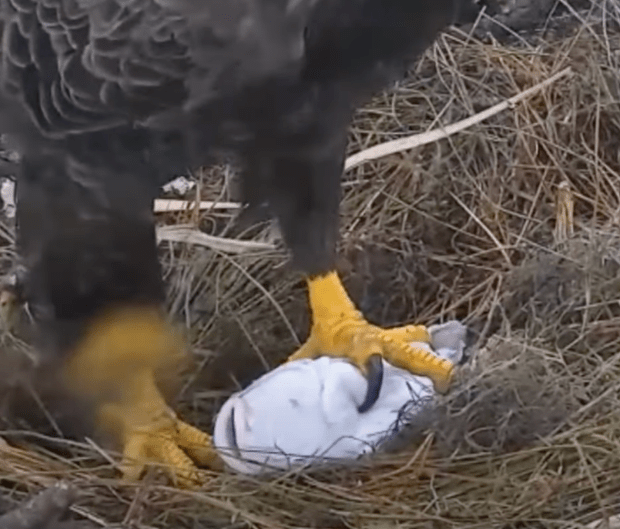
Top story for this morning. At 1027 when Harriet got up, it appeared that there could be a beak pecking its way through the shell of the narrow end of one of the eggs. But, it is now unclear about that mark. It appears to have been some nesting material that caused all the excitement. Harriet is restless. But only a tiny little peck visible in one egg.

There is disturbing weather news coming for the US for the next couple of days and it could have a huge impact on the birds. In San Francisco on Sunday, they received 5.65 inches of rain. That is the most rain ever recorded since 1849 when records began. So what happens to the falcons when it rains like this? Do their prey hide? That area needs water. The reserves are filling but, in some places, there are floods that are going to be problematic and the rain is set to continue with another system moving in.

https://www.theguardian.com/environment/2023/jan/02/weather-tracker-san-francisco-hit-by-second-rainiest-day-on-record?CMP=share_btn_link

The system that brought all the rain to California is going to move into the central US where it will meet up with warm area from the Gulf region. It is going to bring snow and ice to the nests in Iowa. Tornadoes for the area around Alexandria, Louisiana could happen today hitting the nests of Anna and Louis and Andria and Alex and Andria are going to be right in the middle of it, according to one of the current forecasts. I do not watch the weather that much but, I do check on anything that will impact our raptors!

That pink is ice and I am thinking about all of the eagles and other wildlife and birds in that region including Decorah (the system will move through Iowa).

This is a band of tornadoes potentially and Alexandria, Louisiana is right in the middle of it along with our Kistachie National Forest eagle families. You send out all the positive wishes you can to those little eaglets and their parents in E3.

Gabby and V3 were at the nest making restorations today together. I think that it is safe to say that V3 is the ‘chosen’ one to become Gabby’s mate. While we might have had another favourite out of the many suitors that came to the nest, only Gabby knows ‘the why’ of choosing V3 over anyone else. Seeing them together, working on their future, was certainly a wonderful way to spend part of the first day of the new year.

I like his eyes, he brought food, and he seemingly keeps the rest of the intruders away – a real good security guard for the nest and for Gabby. May their lives be long, healthy, and productive – as in cute little eaglets! They sure are a striking couple. But, V3 needs a name. Wonder what it will be?

He is a good provider. Just look at the crop on V3!!!!!! Sadly, Gabby isn’t always there to receive the food gifts.

Another raptor family, Big Red and Arthur, were spotted today on the Cornell Campus by Suzanne Arnold Horning. It is always a gift to see them when it is not nesting time and it is thanks to the BOGS that we are assured of their well-being. Thank you Suzanne!

Arthur sitting on top of a post looking for a vole to move in the grass. If you think about it, raptors hunt so differently. The Red-tail Hawks sit, sometimes for 45 minutes to an hour, elevated – waiting and watching and then they swoop down. Hen Harriers on the other hand fly low over the landscape once they have identified where their dinner might be. Ospreys hover focusing when they find a fish and then making that dramatic dive. They are as different in their behaviours as they are in their plumage. And Red-tail Hawks are gorgeous. My friend Toni died this year. Her and I used to banter back and forth over the most beautiful plumage. I can say that she certainly got me to appreciating that of the White-bellied sea eagle juveniles. In the end, though, they are all gorgeous in their unique ways.

Big Red. She is looking really good for a 20 year old Red-tail Hawk!

Cornell posted other images of Big Red from the 31st on their Twitter feed today.

It was raining at Orange and Elain caught some good images of one wet falcon in her daily summary of life with Diamond, Xavier, and Indigo.

There was lots of action on New Year’s Day and Deb Steyck caught Bella and Smitty arriving at the NCTC Bald Eagle nest. It is good to see them together. Last year Bella was injured in a territorial battle. She did not return to the nest for some three weeks while Smitty took up with another female. Bella kicked her off the nest and out of the area and, well, it is good to see the two together this year. Hopefully there will be little eaglets this year to make up for last!

So let’s have a conversation about one legged eagles. But before I begin, there are deer in my community that live a normal life in our urban forests and have only three legs. When I grew up, my parents had a three legged dog. They were able to adapt. While one might want to argue that an eagle with just a single leg could not possibly fish or feed itself and would starve to death, please read further down. And if you know of an eagle in the wild living with a handicap, send me a note.

There has been a bit of discussion about Clay, the one legged eagle that was in rehab at Wild Heart Ranch near Tulsa was euthanised. I have not followed this case closely but, it was a second trip for the bird who went back to the first place where it was rescued. Clay arrived with a badly infected foot that was later determined to be dead along other injuries. It is not clear to me how he was injured. It is, however, my understanding that the regulations of the USFWS do not allow wildlife rehabbers to keep one-legged Bald Eagles. Please correct me if I am wrong. I also came to understand today that it was that policy that drove the euthanasia. Again, please correct me if I am wrong. No one wants an eagle to suffer, let us be clear. This decision has prompted some to ask about the policy in light of animals living in the wild with less that the normal number of legs.

Today, an individual who has spent years around the Mississippi taking images of the Love Trio, Dennis Brecht, posted a photo he took of a Bald Eagle with one leg flying around the Mississippi at the location in the posting. Just saying. That eagle looks pretty healthy. — I have seen Dennis’s images for several years now and do not believe him to be a person who would deliberately manipulate an image.

So this brings me to another eaglet, WBSE 29 – who we all grew to love at the White-Bellied Sea Eagle nest in the Sydney Olympic Park has been euthanised. I just received a note from a very trusted individual who taught me much about eagles and kept my focus straight and not off in fantasy land. Tonight there are plenty of people whose emotions range from disappointment to fury. Here is the announcement:

As you know SE29 was rescued in early October, after some sort of severe trauma (we are not sure if he flew into a window or was hit by a car).

When he arrived he was bleeding from inside the beak indicating a bleed in the lung following the trauma. He also suffered a particularly nasty fracture just above the foot, which you can see in the radiograph attached to this post. The challenge about this fracture is firstly, that it is quite oblique, and secondly, that it is very far down in the bone, making the orthopaedic repair required quite difficult.

While stabilising and after consultation with many other raptor veterinarians around the world, we initially tried to stabilise the foot in a special cast. But it became apparent quite soon that due to the oblique nature of the fracture the fragments just could not be immobilised properly and there was still some sliding.

Normally these fractures in birds are repaired with an external fixation device. This involves crossbars through the bone which are connected and held in position by external rods. The goal is to have two crossbars in each fragment of the bone. We knew that trying to repair this fracture would be a push, because of the little room left for us in the fragment closer to the foot.

But SE29 was a young bird (this helps with healing) and he was dealing well with the process of being in care, having a generally gentle demeanour, so repair was attempted) and we placed a type 2 external fixation device. You can see on the picture what this structure looks like.

We then had to wait for the bone to mend until we could remove the pins. During this whole process SE29 has been a gentle, strong bird and has allowed us to take him through the rehabilitation process.

However, we have promised ourselves, we would only persevere with his rehabilitation if there was a reasonable chance for SE29 to return into the wild. This is where he came from, and the life of freedom is what he should have if we could make it so.

Two months into the rehabilitation process, the external fixation device was removed and it became clear that some of the tendons making the digits move did not work normally any more, and possibly there was some joint damage at the tarsometatarsal – phalanx 1 joint.

The foot is a structure a raptor just cannot live without, and we had to accept that our attempts had not worked out as we hoped. We knew it was a push from the start (again, this was a very unfavourable fracture), but SE29 had just been doing so well until then and he made us hope even more it would work out in the end. Unfortunately at this point it became clear, SE29 would not be able to be released and he was euthanased for the reasons described above.

Much like all of you, who fell in love with this little bird from since he was an egg, working with him and getting to know him also allowed him to take a very special place in our hearts and sharing these news fills us with sadness. But we are glad that we did give this bird a chance, because otherwise we would have never known.

Raptor Recovery Australia FB

WBSE29 was a beautiful vibrant bird.

There are tears flowing in so many places.

The sad truth about all of this is that the situation in the Sydney Olympic Forest is untenable. The population of Pied Currawongs, Magpies, BooBook Owls, and Ravens has grown unchecked. The sea eagles do not eat them. The energy it would take to catch them would not warrant the amount of meat on their carcass. The small birds, however, attack the sea eaglets and the adults at the nest relentlessly and chase the eaglets out of the forest the minute they fledge. That means that the parents are not able to feed them, to teach them to hunt and the fledglings cannot improve their flying in peace like we see at so many other nests. Then smaller birds attack the sea eaglets when they are grounded. They were even attacking 29 when it was wrapped in a blanket being rescued! The only way that the eaglets that we grow to love so much can survive is if they are picked up the minute they are grounded and taken into a facility that will go the extra mile to ensure that they are given every opportunity to live and be released. One very good thing is that the folks on the ground- and there is a growing number of caring individuals – are dedicated to watching out for the eaglets. They make sure that care is sought the minute they see them in danger – it is the only way that they will have a chance of survival.

Maybe that nest tree should be cut down, too! Believe me I never advocate cutting down trees but, what will it take for the menacing small birds to leave the WBSE in peace?

There is some really welcome good news coming out of New Zealand today. Dr Andrew Rigby has tweeted the following announcement about the flightless green parrots that we love so much – the Kakapo.

Spend a little time with Alex and Andria – Alex working on the chair rails and those cute little eagles, 01 and 02.

Gosh, it is going to get really busy soon. Those eagle nests that are not on pip watch right now or taking care of eaglets, are really getting restorations. Nancy and her new mate arrived early at the MN-DNR nest to work on their nest.

Zoe is 107 days old today. Yesterday Dad brought in one fish for Zoe and Mum brought in two! The times were late in the day: 1606, 1759, and 1816. I wonder if they are waiting to see if their girl will go out on her own before bringing in fish for her????? Is Zoe fishing yet?

Zoe and her parents are Eastern Ospreys. Unlike the Ospreys in Europe and North America and Canada, they do not migrate. In trying to search for recent research on post-fledge independence, I came across a study about Western nests that clearly indicate that the birds become independent a month to six weeks (some stay for ten weeks) after fledgling. The timing, of course, is related to their need to be ready for migration. But what about the Eastern Ospreys at Port Lincoln? Ervie was being fed much longer last year. We attributed it to his missing talon but, what is the average age for Eastern ospreys to become independent, fully independent of their parents? According to information from Susan Close, MP, Minister for the Environment and Water in South Australia, “Young were found to fledge at 9-10 weeks of age in a study on Kangaroo Island (Dennis 2007a), and are sometimes provided with fish for a further 5-6 weeks by the male.”

If we take the extreme dates, the number of days for the non-migratory Eastern Osprey to become fully independent of their parents, is 112 days. Zoe is now 107 so she is well within that range. Interesting to note is that Mum is also providing fish for her daughter. It is normally the male – in all of the Osprey species. Is Mum providing more food for Zoe because, as we fear, there is ‘something wrong’ with Dad. He had two seizures on camera and was seen at times not to fish to his usual standard. That could have been for many reasons but, is he unwell? We do not know the answer to this and might not find out for some time but, clearly, let’s watch those fish deliveries and also, let us watch how long Zoe stays on the nest getting food.

Here is the report by the Minister of the Environment and Water on the status of the White-Bellied Sea Eagles and the Ospreys and the government’s plan for them as they are endangered. It is a worthwhile report to read – to help us understand how the South Australian government sees the recovery of these magnificent raptors. It is recent – July 2022.

Thank you so very much for being with me today. Take care of yourselves. See you soon.

Thank you to the following for their videos, letters, posts, announcements, and streaming cams where I took my screen captures: Geemeff, ‘C’, The Weather Guy, SWFlorida Eagles and D Pritchett, NEFL-AEF, Suzanne Arnold Horning, @CornellHawks, Elain and Charles Sturt Falcon Cam and Cilla Kinross, Deb Stick and the NTCT, Wild Heart Rescue FB, Dennis Brecht, Raptor Recovery Australia, @takapo, KNF-E3, MN-DNR, Port Lincoln Ospreys, and the South Australia Government.

Is V9 the winner? and other news for Thursday in Bird World

22 December 2022

Good Morning Everyone,

It is still freezing. The last time I checked it was -26 degrees C. The furnace is working over time. But I am out of the parking pad and someone is coming to clear all of the snow so I won’t get stuck in there next time there is a blizzard. Tomorrow is the day to make sure that the birdseed and the cat food are topped up so that there is plenty to take all of the garden friends along with Missy and Lewis into the new year. I do not know about you but, I dislike crowds immensely, hate malls even more, and hope to get out and home before many wake up in the morning. Fingers crossed.

It is the day after the Winter solstice. A long time friend sent this to me and I want to share it with you – even if it is a day late.

A Winter Solstice Blessing

May you find peace in the promise of the solstice night, that each day forward is blessed with more light, that the cycle of nature, unbroken and true, brings faith to your soul and well-being to you. Rejoice in the darkness, in the silence find rest and may the days that follow be abundantly blessed. (Source unknown)


Bird World has gotten very quiet for the past few days. The only action that is happening is at the nests of Gabby and Ron where there remains some question as to which of the visitors each of them might choose. SuperBeaks is just steady as you go. This nest will go on my must watch list of eagle nests for next year.

Now at Northeast Florida. Too many visitors to follow. Too many discussions over who is who or if one is old enough to mate, etc. There is plenty of evidence for 4 year olds fathering healthy chicks including Harry at the MN-DNR nest in 2021 and again in 2022 before he disappeared. Is it possible Gabby might not have a mate this year? Of course it is. We should sit back and relax. It is a learning opportunity.

The camera has been down. There is another camera that the AEF have access to while the cameras we use to see the nest are down. Well done Gabby and V9. I gather they are friendly and working on the nest. Great news. Now if he can prove that he can keep intruders away, bring fish, and be truly a grand mate for Gabby — well, there could be little eaglets popping their heads up at this nest in the new year. Hopeful.

There is news of Rita requiring a little more removal of the wing. It is not clear if this is the tip that was removed several days ago or a new surgery. I am trying to clarify. It is certain that she will not fly again and they are looking for a permanent home for her. And this brings me to a problem that we all must consider every time we want a bird to be an ambassador or an educational bird —— they must have a place to go. That place has to have funds to feed and care for the wildlife they have. Many places are just over run with raptors and other birds. So when you consider making donations, please do keep this in mind. The costs involved are high and almost without exception these facilities work on a shoe string through the generosity of volunteers and donations.

Meanwhile Ron seems not to have settled on a new mate yet and appears to not like at least one of the females coming around.

In San Jose at the City Hall, Sequoia, the son of Grinnell and Annie, is calling his mate! This is just so wonderful. While it never makes up for losing birds, it is sure nice to see ones that we have watched from hatch to fledge begin their own families.

For those of you that love Peregrine Falcons and want to know more, here is a hefty book that has come out. Mark Avery wrote a good review in his recent monthly blog and this is part of his report, “This is a monumental book about what is regarded as the fastest animal on the planet (or flying over it). At over 500 pages, and amply and attractively illustrated, this is a tribute to and reference source about a marvellous bird. The brilliance of this bird is well captured in many of the photographs but the text is full of information about Peregrines from everywhere in the world where they occur. Chapters cover falcons in general, an introduction to this species, flight, diet, breeding behaviours and characteristics, movements, friends and foes and population numbers and trends. It feels like an encyclopedic coverage and the book is packed with information, but information delivered in a very palatable form.”

Speaking of falcons, Indigo is still being fed, still hiding food in the scrape and having Mum, Diamond, take it! Indigo has also started something unusual. Bringing grass into the scrape box! Goodness.

The SuperBeaks nest is wonderful. I am so glad that several readers asked me about them. I have had several giggles. While we have been frustrated not being able to see the eaglets, ‘S’ admits that we are getting a reprieve from worrying about them, too. We aren’t sitting and counting the bites this one or that one gets. We just sit and watch PePe bring in large fish and Muhlady feed the bobbleheads. We cannot even seen any beaking! It is actually quite nice. By the time we can see them clearly all of that will have passed!

There is a wee little head showing in the top image.

Both Pepe and Muhlady are on the nest vocalising.

Have not seen Jackie or Shadow at the Big Bear nest today but, there were a couple of Crows (or are they Ravens – difficult to tell) visiting trying to find any leftover bits of fish. Jackie and Shadow were there on Tuesday working away.

Here is a very short compilation for the winter solstice with recent images of the eagles at Big Bear – our adorable Jackie and Shadow.

The GHOs have been after M15 at the SWFlorida nest again – and, of course, since their nest is on the same property, we can expect an increase in this behaviour. Do the Eagles bothered the owls? Probably not. Maybe they should!

Cornell has put out its season highlights from the Royal Cam nest at Tiaroa Head. It opens with OGK doing a sky call – so get the tissue box. What a grand mate and dad he was. Last seen in mid-May (19 May I am told). We will forever miss him as will his long time mate, YRK, who will, perhaps, find another mate and raise more chicks. We will have to wait and see. And it could be a very long wait.

I know that many of you have wondered what happened to Mahlala, the Red tail hawk raised by the eagles on Gabriola Island. Their eaglet Junior, you will remember, was electrocuted on a power pole. I found this announcement today re their FB presence: “UPDATE: 12 20 22 GROWLS Eagle Nest Cam (Gabriola Rescue Of Wildlife Society). This FB Group is temporarily paused for 168 days. An admin paused this group on July 30, 2022. Group activity will resume on January 15, 2023 at 3:00 AM“.

No one knows why the FB was abruptly paused.

As for Mahlala, there are a large number of Red-tail Hawks in the general area. She was not banded so it would be difficult to tell her apart from any other unless you had clear identifying features which we don’t because the camera images were not clear. Did she return to the nest? Maybe GROWLS will tell us when they come back to life!

I posted an image of L4 that was taken during the Ferris Akel Tour last Saturday. Here are other images from this morning’s Cornell Hawks Twitter feed. It is nice to see the juvenile still doing so very well. That is a nice crop – and still in Mum and Dad’s territory without problem.

No. 21 The Red List. The Woodcock

Oh, look at that image. The eyes set way back on their head allow them to see predators when they have their long beak thrust into the ground hunting for food. They have short legs and are rather ’round’ compared to other birds.

Males perform a remarkable ‘sky dance’ on spring and summer nights, in a high, twisting flight, with chippering, twittering, bubbling sounds. These sky dances attract the females who will mate with one of the males. The males – like Daisy the Duck’s mate – take no part in the care of the eggs or the hatchlings!

Audubon Society says, “Downy young leave nest a few hours after hatching. Female tends young and feeds them. After a few days, young may begin probing in soil, learning to search for food. Young can make short flights at age 2 weeks, fly fairly well at 3 weeks, independent at about 5 weeks.” So not like ducklings or goslings that are precocial – able to care for themselves after 24 hours of hatching.

Woodcock vintage drawing” by Free Public Domain Illustrations by rawpixel is licensed under CC BY 2.0.

There are Woodcocks that are resident in the UK and there are others, several hundreds of thousands, that fly from Finland and Russia – a distance of some 3000 km, to over winter in the UK. They arrive during the first week in November. They like damp woodland where they nest in a feathered scrape on the ground. There are stories of the Woodcock carrying their chicks between their legs and body in their feet if danger should arrive. There are also stories of them carrying a stick in their mouth when they fly over the ocean to the UK so if they tire during their flight they have some wood to land on in the ocean.

Many feed at night thrusting their long beak probing around in the soil – their heads go up and down so often they have been compared to ‘sewing machines’. They fine worms and Beatles and suck them up like spaghetti. Can you imagine? I would love to see one.

British writers such as Drayton, Shakespeare, and Milton used them as a metaphor for ‘foolish love’.

Woodcock Scolopax rusticola” by Peregrine’s Bird Photography is marked with Public Domain Mark 1.0.

The threats for the Woodcock vary from geographical location. In the US, fires are burning up habitat, climate change is drying up the wetlands, spring heat waves are driving the chicks from the nest, and heavy rains are endangering the eggs and the nests altogether. In all areas, habitat loss is driving a decline in populations. In the UK, those threats also exist along with the legal hunting of the Woodcock which begins on 1 November despite their being on The Red List. Wild Justice has asked the government to change the date to 1 December to try and help protect during the breeding season!

Two recent short articles from The Guardian are quite good.

https://www.theguardian.com/environment/2008/jun/08/birds.woodcock?CMP=share_btn_link

https://www.theguardian.com/environment/2015/jan/06/country-diary-claxton-norfolk-birds-woodcock-snipe-wigeon?CMP=share_btn_link

Thank you so very much for being with me today. Please take care of yourselves. See you soon!

Thank you to the following for their streaming cams, their notes, their posts, and videos that make up my screen captures: Cornell Hawks Twitter page, Superbeaks Bald Eagle Cam, Charles Sturt Falcon Cam and Cilla Kinross, Mark Avery Book Reviews, San Jose City Hall, Openverse, NZ DOC and Cornell Bird Lab, FOBBV, San Jose City Hall, WRDC, and the NEFL-AEF.

Wednesday in Bird World

14 December 2022

Good Morning Everyone,

It is relative quiet in Bird World as things begin to settle down between Gabby and V3 and Annie and the new guy at Berkeley. The first Bald Eagle nest to have hatches that is on a streaming cam is at Superbeaks in Central Florida. There are eggs now at SWFlorida (2), Berry College (1), Kistachie National Forest at both nests E1 and E3, Captiva (2), and Metro Aviation in Northwest Louisiana (2).

Tonya Irwin has created a great chart:

We continue to keep an eye on Port Lincoln and the scrape of Diamond and Xavier at Orange while, at the same time, watching for any news coming out of Sydney Sea Eagles. I am also hoping that the streaming cam at the new Osprey platform for Lena and Andy at Captiva will be on line soon.

There is a big storm brewing that is destined to bring about a foot of snow to areas just south of me. It is unclear if it will impact Winnipeg. However, the birds and squirrels were really crowding the feeders late this afternoon. They are often very good indicators of any bad weather that is heading our way.

Dyson was not prepared to give up her spot on the seed cylinder. These are fabulous. There is no mess and if you are going to be away for a few days and worried about your visiting birds in the winter, they will also give you peace of mind. We feed hundreds of birds a day and if Dyson didn’t love them so much, I think one would last about a week.

Dyson has her thick fur coat on. Isn’t she gorgeous? I like to think that the food we provide helps her endure the cold of our ‘Winterpeg winters’.

The Sparrows and the Starlings prefer the softer cornmeal and peanut butter cylinder that has a substantial amount of suet in it.

Junior is looking for peanuts! All of Dyson’s kidless have taken them. Junior is not happy.

Sharpie of course would not mind having one of those House Sparrows for his lunch. I think he is out of luck today.

Making News:

A major investigation as to how 13 Bald Eagles were poisoned at the Inver Grove Heights landfill is underway. Three of the eagles have died and the other 10 are recovering at The Raptor Centre at the University of Minnesota. What terrible unnecessary suffering and death.

https://www.facebook.com/TheRaptorCenter/?mibextid=ZbWKw

The last episode with Sasha Dench and The Flight of the Osprey on BBC 4 Radio is here. The programme is about 13 minutes long. I urge you to have a listen. Thank you, Geemeff, for recording the programme and sending us the link. Very thoughtful as so many do not live in the UK.

The announcement that an enormous number of budgies are being taken into care and need homes in the Baltimore area came on my Cornell Hawk Cam Chatters FB. If you or someone you know might be interested in providing a home, please read the posting carefully and make that call.

News has come in from the Kakapo Recovery that all of the transmitters have now been changed on Anchor Island. The last bird was Alison and she was found to be in good health. Wonderful news. It has to be difficult trying to find these pesky little non-flying parrots to treat them and change the batteries in their transmitters so they can be found!


It’s the first egg of the season for Pa Berry and Missy at Berry College in Georgia. Happened at 0950 13 December. Congratulations!

Pa Berry flying in with more nesting material and seeing their first egg for the first time.

The soap opera at the NEFlorida Bald Eagle nest continues. Will Gabby choose the bachelor behind door 3, V3?

He flew in with a nice catfish. It was obviously for Gabby but she was not home. Later they worked on the nest together.

‘H’ sends news that V3 is now playing ‘hard to get’. Order some more popcorn!

Harriet and M15 have an alternative nest on the property of the Pritchett family. A GHOW has taken up residence there and this owl could be the one that attacks Harriet and M15. Two days ago, that owl was attacked by a trio of Crows. Thanks EJ for sending us this link!

Jackie and Shadow have been pair bonding/mating at Big Bear.

Checking in on our Australian birds:

Diamond was not happy to have the scrape box cleaned by Cilla!

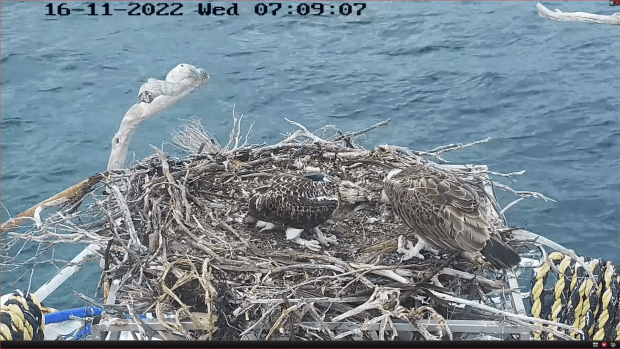
At Port Lincoln, Zoe is 87 days old today. Yesterday, Dad brought his girl 3 fish. Well done, Dad! At one time 06:55 Zoe was on the ropes with what looked like a fish. Did she catch it? No one knows.

I just love this image from yesterday with that crest. Today Zoe has been on and off the nest.


In California, Annie and ‘the new guy’ have been pair bonding in the scrape. He is cute. So tiny. I wonder if he will be the one? He is sure a good scraper! But will he be a good provider for Annie and the eases?

Migration News: Waba continues to feed at the Nile River. There has been no transmission from Bonus since he was flying through the Eastern Desert of Egypt. It is likely we will not hear from him until spring. Send your good thoughts your way.

It is that time of year when people are thinking about suet and putting out tasty treats for the birds. Here is some advice from the RSPB in the UK.

In our garden, Mr Crow and the Blue Jays will be having some special foods during the holiday season. They both like to eat off the deck directly or at a table feeder. I will be putting out Meal Worms, Fresh Cranberries, Hard boiled Eggs, and cubes of streaky bacon along with peanuts in the shell.

Thank you so very much for joining me today. I hope to get back to the list of vulnerable birds in the UK, The Red List, tomorrow. Take care everyone. Stay safe. See you soon.

Thank you to the following for their posts, videos, and streaming cams where I took my screen captures: Geemeff for sending me the link to the BBC 4 Radio series, ‘H’ for the video of V3 playing hard to get, ‘EJ’ for the link to the Crows attacking the GHOW, Geemeff and The Flight of the Osprey, BBC Radio 4, Tonya Irwin, The Raptor Centre, Cornell Hawk Cam Chatters, The Kakapo Recovery, Berry College Eagle Cam, NEFL-AEF, FOBBV, Elain and Charles Sturt Falcon Cam, Port Lincoln Ospreys, Cal Falcons, Looduskalender Forum, and the RSPB.

Indigo, Ospreys reunite, Gabby and the suitor

5 December 2022

Good Morning from the West Indies!

Today was ‘outing day’. I did not take my camera with me thinking I would not see any birds. Now, how silly was that? Thankfully the phone did catch a few. The images are really cropped and blown up so not in sharp focus but, I want to share them with you anyway.

People on the islands begin celebrating and preparing for Christmas the first weekend in December. So many blow up Santas! This evening they are having a big party (islanders love an excuse for a party) with carols, turning on the Christmas lights and walking through an area of them, and bands and singers. One highlight I heard about is that Martha Stewart is flying in with Snoop Dog to promote their wine. If you purchase a bottle of their very expensive vintages, you get to have your photo taken with a celebrity. Ah…it didn’t appeal to me. An Osprey maybe!!!!!!! An Osprey with a Santa Hat.

The entrance to the Le Phase Bleu Marina. It is a fascinating place with cottages you can rent or buy and services for people who come in on their boats – like a restaurant, a laundry mat, a clothing store, and a delicatessen amongst others.

This is a Green-throated Carib. It is there below the big flower almost in the middle. These are smaller than some of the other species of hummingbirds in the Caribbean. They are green all over except for a patch of violet-blue on their breast and a violet-black tail which you can see if you squint! You will find them in gardens and in dry woodlands. They nest between March and June laying two white eggs in a down lined nest with grasses and lichens.

Of course, the Great Egret was just standing there in the pond on the opposite side of the walkway from the hummingbird. You might, by now, recognise how sad I was feeling at leaving my big camera at home!

Such a gorgeous bird. I don’t know if you can tell but, my son and I stood and looked in the little pond and you could see fish everywhere. This Egret is very smart! I wonder if the person who owns the Marina stocks the pond for the egrets?? I must find out!

So this is my idea for Mum and Dad at Port Lincoln. A shallow pond – Ospreys can only go down about a metre. Stocked at Port Lincoln. A little bigger perhaps but, it doesn’t have to be too big. The Ospreys that winter in Columbia are always stealing fish out of the tanks where they are fish farming. But would those pesky gulls take all the fish? Oh, maybe.

Later in the day, I ‘heard’ the birds but, could not see them. Merlin Song ID helped with the sound identification of a Lesson’s Motmot, a Gray Kingbird, House Wren, House Sparrow, Bananaquit along with more Tropical Mockingbirds.

These are not my photographs but, these are the birds I ‘heard’ that I really hope to see. Aren’t they incredibly beautiful?

This is the Lesson’s MotMot that was in the mangrove. What colourful plumage. He fits right in with the fantastic colours of the islands.

Lesson’s (formerly Blue-crowned) Motmot” by Howard Patterson is licensed under CC BY-NC-SA 2.0.

This is the Gray Kingbird. This bird is the largest of the Tyrant kingfisher family in the Eastern Caribbean. It is a lovely soft grey on top and all white underneath. If you look, that grey in the image below is kissed by a wee bit of brown with a white outline on the tips of the wing feathers. There is a black eye line that goes from the cere to the ear coverts. The bill is thick and pointed and black. They build a twig nest high in the trees where they lay 2-4 heavily splotched red eggs between March and July.

Gray Kingbird” by ahisgett is licensed under CC BY 2.0.

The Bananaquit is one of the most common birds across the Caribbean. They are called ‘Honeycreepers’. They have a short slim slightly curved bill. They have a distinguished plumage: The top half is black. They have a yellow-green underbody and rump. There is a distinctive white eye line that go from the cere to the nape in the adult birds. It is yellow in the juveniles.

They live on nectar and the juice of fruit such as mango and banana, seeds from herbaceous plants, and a variety of small insects. Breeding is from March to August. Their nest is a small mass of leaves and grasses with a small hole in the side in which they lay 2-3 heavily spotted white eggs.

Bananaquit” by Alberto_VO5 is licensed under CC BY-NC 2.0.

This is an adult bird but notice that the yellow underpart is limited to the rump with the back and wings a more dark grey or sooty black with white tipped wings. In fact, the plumage of this common bird does vary slightly over the region.

bananaquit” by qmnonic is licensed under CC BY 2.0.

Here is a Bananaquit gathering cotton for its nest.

Bananaquit getting cotton for nest” by Mike’s Birds is licensed under CC BY-SA 2.0.

Eating the juice of a mango.

Reinita común [Bananaquit] (Coereba flaveola luteola)” by barloventomagico is licensed under CC BY-NC-ND 2.0.


When I returned from my adventure today, there was news from ‘H’ on Rita from the WRDC. This is really, really good news.

“Update from moments ago: Rita is recuperating. She ate a fish. She’s still attacking anyone who reaches into her enclosure (this is good). The flesh part of her wound has some healing (also good).”

“Still a very long way to go. She picked a bit at the wrap and pin, which surprisingly was also considered good news, but not enough to need a cone. Sorry I don’t have a pic but if I get one I’ll post.”

I continue to try and point out different incidents to help educate all of us. Rita had a trauma and almost died. She was so lucky she was rescued. Those rescuers had no problem getting Rita to care. She did not fight them BUT she is today and she is still in critical condition. It sounds like I am beating a dead horse but if you are ever in a situation where you can pick up a raptor with a blanket, then that bird needs immediate attention. You should have the name of your local wildlife rehabilitation clinic 24/7 phone number. Call them. Tell them the situation. Ask if they can help or if they can give you the name of a centre who can. Get the bird to care. It should be standard protocol everywhere for this to happen and those connected with streaming cams need to be sensitive and have their entire teams and anyone around the nest versed in what the protocol is. Emergency contact numbers should be posted around a nest but they should also be placed under the streaming cam clearly so people can find them. ‘S’ and I urged this to happen after incidents in 2020 at two nesting sites, Collins Marsh and Patuxent.

Indigo is doing exceptionally well. Diamond was looking out from the ledge of the scrape box at Orange when Indigo flew in with a small bird she had received from Xavier. The time was 09:49.

Diamond is looking out over her territory on the Charles Sturt University.

Diamond sees Indigo coming and she wants out of the way!

Indigo has the small bird but she is still mantling and telling everyone that it is his.

What a handsome fledgling. Strong and healthy.

Indigo is very good at plucking!

It is delightful to see this falcon family doing so well with Indigo proving himself to be a very strong flyer. Very reassuring. ‘A’ writes that the only thing Indigo hasn’t figured out is that Mum steals stashed prey. She sure does! Watch out Indigo!!!!!

The camera at Port Lincoln may or may not have been off part of today. There is news that Zoe has had at least one fish if not two during the time I am writing. Ah, ‘A’ has written this morning that there were 2 fish for Zoe yesterday.

The Port Lincoln Osprey group continues to add information below the observation board including fish counts and hatch and fledge days from 2015 to the present. They have also included images of the barge. All of this is very interesting stuff.

This is the barge with the nest. Isn’t it amazing?

To view all of the documents uploaded to Google Documents by PLO, you go to the streaming cam and then go below the image and click on the link. Here is the link to that streaming cam in Australia.

In New Zealand. L has returned to the nest to join her Royal cam mate much to the relief of all. Sharon Dunne aka Lady Hawk posted a video of their happy reunion. Don’t you just love skycaps?

I continue to wish for a reunion for Samson and Gabby but, it appears that Gabby may be giving up hope as she warms up a little bit to one of her suitors. Both returned to the nest with big crops – you can clearly see Gabby’s – and Gabby allowed V2 (Visitor 2) to move a few sticks in the nest.

In California, at The Campanile, Annie is still being courted. It is not breeding season so we will wait to see how she does with the male visitors. Oh, Alden, where are you?

Thank you so very much for being with me today. I am having a great holiday – what a wonderful battery boost. It is sadly cold and wintery in Canada where I live. They had a big storm yesterday and it is to get very cold. I am so glad I am here for a few days longer! Take care everyone. See you soon!

Thank you to ‘H’ for the news about Rita and to ‘A’ for the news of PLO and Indigo and the following for their postings, videos, and streaming cams that make up my screen captures: Port Lincoln Ospreys, Charles Sturt Falcon Cam and Cilla Kinross, NEFL-AEF, Sharon Dunne and the Royal Albatross Cam and the NZ DOC, Cal Falcons, and OpenVerse.

Egrets, Herons, Mangroves and more in Bird World

4 December 2022

Good Morning Everyone,

I hope that this finds you well wherever you are.

The plan was for today, Saturday in Grenada, to be a full day of birding. Up at 0400 and off for the drive north getting there right before sunrise at 0600. If it rained, we would not go. So packed and ready to go — and the rain starts! We look at one another and decide to take a chance that the rain would stop and, it did! It was a glorious day. Cloudy initially which helped to see some birds and then hot and clear blue skies later. The best real estate on the island are those properties that have not only a beautiful view but also, lots of windows to open and wind to go with them!

The stairs down to the boardwalk at Levere National Park were slippery with the sticky clay. Some of the places between the wooden stairs had washed away. By the time we got to the bottom, the boardwalk was flooded. Those gum boots really came in handy. However, the water was higher than they were tall!!!!!! Still we made it to the little dock and the look out tower for birds.

Imagine silence. Not a human sound at all save for us. Just birds.

Mangroves. To me, these are very special places that I only see in the tropical areas where I have visited or lived. The trees – there are 80 varieties -that grow there only need low-oxygen soil and slow moving water. The soil will accumulate around their tangled roots. In fact, these enormous tangled roots make the trees look like they are being pushed out of the water. These wild looking trees stabilise the land and are home to fish, birds, and other aquatic life.  

This is an aerial photo of Laverne National Forest where I spent the morning. The pond and surrounding mangrove area is ‘landlocked’. This is the very north of Grenada looking out to the Atlantic Ocean as opposed to the Caribbean Sea which is in the South.

St George’s is at the very tip of the island close to True Blue and The Lime. Because Grenada is an island created by a volcano, there is hardly a flat spot anywhere. The roads are narrow, windy, often with a straight drop into the sea and lots of pot holes. It takes about an hour, depending on traffic, to go from the southern tip to the most northern.

I am not an expert on bird vocalisations but, I am getting better with the help of Merlin ID. The ‘Sound ID’ function works much better than the ‘Photo ID’ and it helped me to pin point the first sounds at Leverne National Park. It was a Green Heron. The Green Herons actually flew back and forth in front of me, too close and too quick and unannounced to capture their image. But, what a marvellous quiet place – the only sound was birds!!!!!! Just think about it. Noise cancelling headphones with only sounds from a mangrove would take you to this place.

It has rained a lot. The images below are looking back to a small wooden boardwalk. The top photo is when it was dry last spring. The bottom one, covered with leaves, is from yesterday. In the distance the boardwalk was under water — the reason that I brought my gum boots. It was deeper than the boots were high. That was rather interesting. Have you ever been in a mangrove? They smell – lots of decomposition and sulphur.

The lake and mangrove are absolutely still. Not a ripple in the water except for when the Tarpons come up for air. I sat and watched the Green Herons fly into this area. The foliage is so thick you cannot see them once they are perched.

I missed the opportunity to record the vocalisations of the birds from the mangrove when we first arrived. A huge mistake because they became mostly silent as the hours progressed. You would catch glimpses of them flitting about. There is one flying across the grove.

This is a Great Blue Heron. There were several of them flying across the water. In the spring they made their nests about 1 metre or 36 inches above the water in the mangrove thickets. They lay from 4-6 very light blue-green eggs from March to July. Despite it being a well known area, my son tells me that the herons hatched their eggs near to the boardwalk without any problem – no human interference with their nests and their habitat is protected. It is a lovely safe spot for them.

Great Blue Herons are the largest of the ‘dark’ heron family in Grenada. They are approximately 106-132 cm or 42-52 inches in length

They have such beautiful form and are absolutely silent when they are flying.

There were Great Egrets, Green Herons, Great Blue Herons, Little Blue Herons, a Black crowned Night Heron, an American Woodcock, and a Smooth Billed Ani.

About 10 minutes away, there was a small pond at Mt Hartman. It has not been levelled and the area is so beautiful. The Chinese own the land and are saying they are turning it into a luxury resort, I hope it takes a zillion years. There is something so wonderful about places just being left!

Cows was tethered along the road. There is where you see the Cattle Egret. They get their name because they hang around the cows waiting for the insects and grasshoppers to be kicked up.

Notice how small these egrets are.

Did you know that until the 1930s Cattle Egrets were only seen on the continent of Africa?

They have a very stout yellow beak with beautiful white plumage, and yellow-green eggs.

There were a pair of Common Moorhens or Gallinules swimming in the pond near to the Cattle Egrets.

A Great Egret flew in and landed on the other side of the pond.

This is a Great Egret. We know this because of its size but, more clearly, its distinctive yellow bill and black legs. And the pure white plumage.

Talk about graceful.

The Great Egrets are large, measuring 85-107 cm or 34 to 42 inches. The Cattle Egret is only 48-64 cm or 19-25 inches. You can see the size difference in the image below.

On the off chance there were some shore birds around, we headed to the most northern tip of the island. No birds but fascinating flowers growing up out of the sandy soil.

The sea is very rough and it is not safe to swim here like it is in the South in the Caribbean Sea.

At the end of the day, a Broad Shouldered Hawk circled my son’s property. A perfect ending to a perfect day!

Tomorrow is a break – a wee one – from the birds. To kick off the Christmas Season, there is a huge event featuring carolling, a walk through light show, food and drinks. One of the things that I like best is that in December there is sorrel and you can make your own sorrel juice. In addition, following the idea of ‘no waste’, the simmer flowers of the plant are then used in Christmas cakes. They are delicious. I hope there are some tomorrow to take home!

A Quick Check at a ‘few’ of the nests we are watching.

Elain made a lovely compilation video of events of 3 December 2022 at the Orange scrape of Diamond and Xavier. Some bonding, some family time. Quite enjoyable. Thanks Elain!

These are the Day 3 highlights from the nest of Royal Albatross GLY. The rangers are keeping a close eye on all the albatross, especially GLY as he is waiting for L to re-appear and let him go and feed. Did I say that the albatross are easy to watch? Not when their mate does not return like it did to the Royal Cam family last year, YRK and OGK. OGK went missing in May after hatch. The Rangers will help – and that is what you need to know. They supplemental feed every chick and parent if necessary. How kind, how forward thinking. I really support their efforts!

This is the most recent announcement on Rita that I could find. Continue to send your positive wishes. Rita did so well with the surgery. Now let’s see if a miracle will happen and she will get some circulation in that wing.

Samson and Alden have not returned. I am starting to accept that Samson may not be with us. It is sad but, it is a reality that we might have to accept.

‘J’ sent me the most recent posting from the AEF on Gabby at he nest she shares with Samson who has now been missing 9 cays. Thank you ‘J’.

“Today at 12:19 AM
AEF~NEFL Nest Cam~Gabby was perched on Sunset and V2 came to the nest, Gabby went to the nest to join.  I didn’t edit much as I wanted to show the entire interaction between Gabby and V2. At first she seemed very tolerant.  But after about 3 mins Gabby seemed less tolerant and there was a short tussle.  V2 didn’t push it with Gabby.  Gabby seemed to have enough and went off to roost. V2 stayed in the nest  awhile and went to LOP where V2 is perched (not in video). I suspect they will both spend the night.”

V2 has extremely light eyes and a tint to his white head.

Meanwhile, Harriet and M15 are tending to their two previous eggs while continuing to work on their nest on the Pritchett Property in Fort Myers, Florida.

Jackie and Shadow were back in their nest at Big Bear Lake in California today. They are really getting those side rails nice and strong and high!

Jackie is gorgeous. And formidable. I would not want to be a person trying to get too close to her nest with an eaglet in it. No, not ever.

Anna and Louis have their second egg at the E-1 Bald Eagle nest in the Kisatchie National Park. Congratulations to everyone at KNF! This is fantastic news. For the past two years, Anna and Louis have fledged one eaglet each year. In 2020, it was the first time that a Bald Eagle family had used this nest and raised a fantastic eaglet – Kisatchie!

Our beautiful feathered friends, no matter what species, understand, care deeply, and grieve. The latest on a Moli Mum who has been ever so faithful to her chick that died in 2020. Hob Osterlund writes that she has chosen for a second time to lay her egg on top of that of her dead little one. Oh, how I hope that this year she is successful in raising a family.

Zoe had fish yesterday – Dad brought in 3 and Mum 1. thanks, ‘A’. You can check on Zoe’s day under the streaming cam. Click on the observation board. She has been flying about exploring her territory.

Both of the Australian fledglings, Indigo and Zoe, are doing well. We can relax!

Thank you so much for joining me today. It is always a pleasure to have you hear and to receive your comments and letters via e-mail. Always. I am a little late in responding but, please, do not hesitate to write. Take care of yourselves. See you soon!

Thank you to the following for their streaming cam, videos, and postings which make up my screen captures: Hob Osterlund, Tonya Irwin and KNF Bald Eagle Nest, FOBBV, NEFL-AEF, Ron and Rita’s Nest Watchers, NZ-DOC and Cornell Bird Lab, and Charles Sturt Falcon Cam and Cilla Kinross, Elain. Thank you to ‘J’ who reached out to me with the latest announcement on Rita! And to ‘A’ who sent me all the time stamps and a review of what was happening. Much appreciated.

Zoe flies more, rare Albatross incubate their egg…and more news in Bird World

24 November 2022

Good morning to everyone and the best of Thanksgiving to those celebrating in the US today.

It has been wonderfully warm on the Canadian Prairies. I do not know if it is atypical for this time of year but, it certainly feels like it. The birds in the garden had some of their feeders rearranged and thanks to a lovely friend I swopped out some old feeders for some she gave me yesterday. One of the visitors today was a beautiful Starling. It’s an immature non-breeder. Note all of the white spots on his breast and it has yet to get its oily black head. The males and the female Starlings look alike. Did you know that? One difference is that the beaks of the males are a deep blue while those of the female are a pink colour. This then looks like an immature non-breeding male.

Look closely and you can see their rose coloured legs. It is also a pair of non-breeding adults. They are really loving this soft suet.

The Starlings will not perch on the metal. I do not know why. They want to lean down from the branches to get to the suet. You can see this behaviour in the image above also. So the feeder below was moved so they could more easily reach it! Who says I am a softie?

Junior was grateful for a bowl of corn today.

One of many varieties of the Sparrow family that visit the garden. They are particularly enjoying the Butter Bark Balls on these damp days.

The kittens have had great fun watching the birds and the squirrels. They continue to find places in the house to get into mischief. And they do not always come when they are called setting in a panic that they have miraculously gotten outside in the cold. Of course, they are somewhere laughing (do cats laugh?) while I panic!

Missy has discovered a Rodney Mott sculpture that is just perfect for hiding in. Lewis is in the overturned basket not even showing a whisker.

At the Australian nests, Zoe took off for her first flight of the day at 0901. It was an absolutely perfect take off and her landing at 0907 was spot on, too. She is a very strong osplet. I do hope she gets some nice fish. It has been 24 hours since she last had some food.

While the camera was down for a couple of yours, Dad brought in fish. We are only seeing the tail of the fish but I hope that Dad had some nice fish – the entire head – and that it was big enough for Mum and Zoe to also have a good feed. This family would really enjoy a day with several deliveries but, I am grateful to know that there was a delivery mid-afternoon.

Zoe had a nice crop.

At the scrape in Orange, things were decidedly low key. Xavier and Diamond in and out of the scrape box and Diamond enjoying sleeping in the box all by herself at night. They have busy days chasing after Indigo and Rubus. Little Rubus is, apparently, doing more flying and getting much better.

This was the news from Orange: “Rubus and Indigo both seen within the last hour. Rubus is exploring the campus, going from building roofs to trees etc. He fledged on 20th November. Indigo is way ahead getting flight training from parents, visiting the box etc. He fledged on 11th November at 41 days.”

If you haven’t checked out the FalconCam site in a few days, I urge you to do so. Someone is really adding historical data and you can go back to 2007 to see earlier chicks and read about the big events at the scrape. Here is that link if you lost it.

https://science-health.csu.edu.au/falconcam/home

Oh, it is stormy up near Jacksonville. Samson and Gabby have been on the nest today working despite the wind and the bad weather that looks like it is moving in.

I put this image in not so you could peer at the fluffy bottom of a big Bald Eagle but, rather, for you to see the colour of the legs and feet of Gabby. Then look at their beaks. This is a bright chrome-yellow. This is a very healthy bird.

Harriet and M15 are sleeping at the nest and so far no eggs, just like at NEFL.

At the E-3 nest in the Kistachie National Forest, they have their second egg today. Congratulations Andria and Alex.

There is also news coming out of the Midway Atoll about a very rare pair of Albatross.

As we give thanks for all the birds that bring our lives joy, remember that we are the cause of much of their suffering. Please spread the word to anyone you know – or where you work – that there are solutions other than using rodenticide to get rid of mice and rats. Also teach them about secondary poisoning. It could be their dog or cat but, it is often one of our beautiful raptors.

At small islands in New Zealand, Dr Digby and his team care for the rare non-flying parrot, the Kakapo. In 2016, they hand-raised more than a dozen of these precious little birds. Today they continue to do that work when it is required. The work that Digby and his team do to restore the health of these birds and to keep them safe and try and increase their numbers is remarkable. So thankful.

No 13. The Red List. The Marsh Tit

At first I thought these were out Black capped Chickadees. The Marsh Tit is small, it is mainly shades of a soft grey-brown or taupe with a shiny black cast, a black bib, and a pale ivory underbelly. The bill, eye, and legs are black. They are not plain by any means, look closely at the plumage patterns. Simply lovely.

The woodlands of the United Kingdom – and elsewhere – are changing and that it causing a huge decline in the number of this very small song bird, the Marsh Tit. The woods are more fragmented now, separated by grazing pastures, a growing number of introduced deer. Marsh Tits, according to Mike Toms, “favour woodlands with a complex understory and require surprisingly large patches of suitable habitat in order to breed successfully.” And they’re like their woodlands to be “wet”. Climate change has meant that they are now laying their eggs at least ten days earlier than they were 50 years ago. This change has had a decided impact on available or peak food supplies for the chicks which is also contributing to a decline in population numbers. The Marsh Tit is also known to visit older gardens, copses, and parks, and has sometimes been seen on feeders.

Marsh Tit” by Vine House Farm is marked with Public Domain Mark 1.0.

They feed mostly on insects, seeds and berries, and often cache food over winter if they find a good supply. They nest in existing tree holes, rather than excavating their own, and produce seven to nine eggs.

Their song sounds like a sneeze “pitchoot”.

Here is their range.

Thank you so much for being with me today. I hope that each of you had a wonderful day no matter where you are — or will have a great day if you are just waking up reading this. Take care. See you soon!

Thank you to the following for their posts and streaming cams where I took my screen captures: Port Lincoln Ospreys, Charles Sturt Falcon Cam and Cilla Kinross, NEFL-AEF, SWFL Eagles and D Pritchett, KNF, Friends of Midway Atoll National Wildlife Refuge, A Place Called Hope, Kakapo Recovery and Dr Digby Twitter, Openverse, and RSPB.

Indigo flies out and in…plus more news in Bird World for Thursday Nov 17

17 November 2022

Oh, good morning to all of you. Thank you so very much for being with me today. I am so very, very happy to be with you! Thank you for all of the wonderful stories that you have sent. I will be working my way through them slowly. Much appreciated. We woke up to more snow. Everything is beautiful and white!

The kidlets, Missy and Lewis, had their first vet visit. I am a glowing proud parent. They were soooooo well behaved. They are not litter mates and the adoption person told us that they might not get along with one another. I have not had more than one kitten since I was a child and did not know what to expect.

I remember one stray that someone left at our gate. when I was a child. Oh, I loved that cat. To me the drab brown tabby was the most beautiful cat in the world. My grandmother was very diplomatic and said, ‘He sure is sweet’. I begged to keep this one particular cat. My dad agreed since it was a ‘boy’. Well, he apparently didn’t check very good…a few weeks later we had a pack of kittens. That tabby lived for more than 10 years. She was incredibly sweet. It is very different, having kittens outside with their mother and kittens in the house – in a conservatory, with very large plant pots and tall vines with flowers, or trees…yes, trees.

But, back to the topic at hand. Lewis and Missy are the best of mates. They do everything together including eating out of the same dish at the same time, drinking out of the same dish at the same time, having to have their paws touch when they are sleeping or sleeping in the same tent. Always together. So off they went in the same pet carrier, not separate, together. Not a single peep. At the vet they were so content. Proud Mum here!

I got a tip from the technician at the vet. One of the biggest culprits for cats will be their teeth. I hope if you have cats and dogs are brushing their teeth or giving them things to facilitate good gum health and clean teeth. If you have tried brushing their teeth and it didn’t work, get a nice flavoured tooth paste. Lewis and Missy like the chicken. Take clean nylon stockings or panty hose. Cut a square. Wrap it around your finger, put a dab of the toothpaste on it and away you go. Be sure to do the back ones and those sharp canines in the front. You can get them used to what you are going to do by rubbing on the outside of their cheek for a couple of days. Small toothbrushes or those prickly things you put on your finger did not – at least not for these two. Panty hose do! And I swore I would never wear the darn things again after I retired. So glad there is some use for them!

Missy is the ‘alpha’ You might recall she had Lewis well aware that she is the boss immediately. The vet saw it too! Indeed, the vet smiled and said, “Always the female!” Anyone watching a raptor on a streaming cam knows this. I said nothing. The odd thing is Lewis is so solid and looks ‘so tough’ and Missey appears to be ‘so fragile’. So funny. Missy is half Maine Coon – but both, at the end of the day, are literally ‘alley cats’. Found new borns taken to the shelter from different parts of my city. We are so lucky to have in our lives.

Missey likes to get inside plant pots – with or without soil. This is the tiny artificial tree that has been put up. The soft felted birds have had to be removed. LOL.

Looking so innocent! “We didn’t do it!”

Today’s action was still at the scrape box of Diamond and Xavier. Those parents are really making sure that both Rubus and Indigo are well fed. What a fantastic couple they are. The moderator put some history in the chat today and for those of you that do not know – we now have at least three male peregrine falcons that we know of that have started out as step-fathers.

The last sighting of Diamond’s mate, Bull, was on 30 September 2016. Their erases hatched on the 4th and 5th of October. The first sighting of Xavier in the scrape box at Orange was on the 7th of October. He brought prey to Diamond and the babies on the 8th of October. The rest is history as it is with Alden at UC-Berkeley and M2022 at 367 Collins Street.

Aren’t they adorable? Every day Rubus looses more and more dandelions.

Everyone has been wanting to know when Indigo would fly again. He certainly has been eating well and enjoying being back home. Today, right before 14:38 Indigo got a little frantic, running around the scrape just like he did the day before he fledged. At 143802, Indigo flew out of the scrape box. He returned 35 seconds later! I caught it on video for you.

​RECAP of feedings at Orange: 05:29:41 X/quail; 05 32 39 X/St.Quail Indigo Grabs; 06:05 38 X/juv star; 8 39 04 D/prey 8 47 58 D takes leftover quail; 15 41 31 D/pigeon; 18 32 52 X/red-browed Finch; 19 06 55 D/Live Star

‘H’ sent this link to me. It is a split screen video that Cilla Kinross made of a feeding. Disregard the word ‘kestrels’. It is definitely Rubus and Indigo. Thanks, ‘H’. Delightful.

Indigo and Rubus both in the scrape as the IR lights are turning off.

The wind was really blowing and there were lots of white caps at Port Lincoln. It made everyone wonder whether or not there would be any fish today but – alas, it turned out good.

At Port Lincoln, Zoe can surely scream for the fish! I have jokingly said that I hope she lives a long and healthy life with many osplets screaming their heads off to her…their poor Dad. Just imagine.

There have been at least 2 fish deliveries today. Mum was on the ropes eating a fish around 1400. Zoe took absolutely no notice. She was not hungry. Isn’t that grand? No one on this nest hungry. The fish are ever so unstable. But – we will take it. Today is a good day. Mum ate her bit and flew to the nest at 141408 and fed her large daughter.

Zoe doesn’t even seem to know or care if Mum is over on the ropes eating a fish. Normally she would be screaming her head off. Not today. It is a good fish day.

When the feeding was over, Zoe had an enormous crop.

All of the family together. Mum has a very nice crop from the earlier feedings.

Lots of food at Port Lincoln. These are the late time stamps from Gtr Kitarr:  19:16 headless fish by Dad, Mum off w the fish, back at 19:29 to feed Zoe. 20:24 Zoe wing flapping & 20:24:14 standing on one leg. 21:10 headless fish by Dad, Mum feeds Zoe in the dark.

Making News:

The investigation of the theft of four precious Albatross eggs continues.

https://www.stuff.co.nz/national/crime/130488815/was-a-boat-used-to-steal-four-rare-albatross-eggs-in-daring-heist

How many of us love Iris? The oldest Osprey in the world whose nest is on the lot of Riverside Health Care Center in Missoula, Montana. A request has come in from lovers of Iris. Here it is:

Here is a very short report on the current status of Sea Eaglets 29 and 30. I also want to mention that my contact tells me that the sea eaglets are at different clinics. The specific names are not being mentioned as is the case with other popular birds to keep the phone lines open for injured wildlife.

The Red List 8. The Yellow Wagtail

Yellow wagtail” by hedera.baltica is licensed under CC BY-SA 2.0.

There are many birds that I do not know. This bird is one of the first to be spotted when it returns from its winter migration in Africa to the fields in the UK. In Africa, they feed on the insects that the elephants kick up from under their feet so if you ever get to go to Africa on a safari and see a herd of elephants look for these dramatic sulphur yellow birds with their grey heads. In the UK, they follow the farm tractors kicking up the soil to reveal their next meal. They need a good supply of insects and spiders to survive. Besides fields, manure heaps and wet lands are good places for them to forage.

Yellow Wagtails raise two clutches a year if there is suitable nesting spaces and food. Their nests are low on the ground adjacent to wet lands, salt marshes, hay meadows, and some fields of vegetable crops.

Yellow wagtail” by hedera.baltica is licensed under CC BY-SA 2.0.

Changes to agriculture and crops grown put the Yellow Wagtail under threat. The RSPB has made some recommendations to farmers in the UK which would help stabilise and grow the numbers of these beautiful birds. This includes returning to having some manure heaps for them to forage through. They are beautiful songbirds. Let us hope that those who can do something to encourage their population growth will keep this in mind when they are planning their crops and how they do their farming in the upcoming years before it is too late.

We are waiting for both Zoe and Rubus to fledge. Rubus is not quite ready but is getting more and more interested as Zoe spends time in the scrape and now, that she has flown in and out again. Zoe is doing a lot of wingers. I am a bit old fashioned. The longer they stay on the nest or at the scrape and the stronger they are when they fledge, the more chance they will have of success. Weak tired birds do not do well in the field.

Thank you so very much for being with me today. Send your best wishes to our beautiful sea eaglets as they recover. Take care of yourselves, too. Looking forward to seeing you soon.

Thank you to the following for their posts, their videos, and their streaming cams which make up my screen captures: OpenVerse, Port Lincoln Ospreys, Sea Eagles FB, Montana Ospreys at Hellgate, Charles Sturt Falcon Cam and Cilla Kinross, Royal Albatross FB.

Prey fights between siblings and more…it’s Wednesday in Bird World

16 November 2022

Oh, good morning to everyone! I hope that you are all well. If you have not been watching the scrape of Diamond and Xavier you are really missing something. First, there is the adorable Indigo and Rubus. They are ‘not sweet’ when it comes to prey items as the following two videos will demonstrate! But, they will be ‘out there’ defending their own prey and these little dust ups help them prepare for that. In the first video Rubus really does a good job at snatching that small prey item. He doesn’t prevail in the end but watch closely what he does. Quite the character.

Rest assured that at the end of the day, both eyases had quite enough to eat and at times were even sharing prey items.

So this is the first prey delivery, a small piece.

The second is a much more substantial bird, a Galah (pink and grey). There was more than enough for both eyases.

The fish deliveries continue to be rather scarce at Port Lincoln. It is difficult to determine if there has been an actual drop in the prey delivered or a slow down due to the imminent fledgling of Zoe and not three rapidly growing osplets. There are too many factors – the weight of the fish delivery, the portions that each family member ate, etc. It appears that at the current delivery rate, Mum, Dad, and Zoe are each getting the equivalent to one small fish per day. Is this enough?

Hoping for another fish but nothing has arrived. Mum appears to be reluctant to get too far away from the nest. Did the intrusion of the humans to band and put the sat pak on Zoe cause her stress? Is she afraid to leave Zoe? Quite possibly. Perhaps she will go fishing tomorrow but, for now it seems that she is relying on Dad.

The ospreys are not moving about much, not exerting much energy. Today, however, Zoe is doing a lot of wingersizing. Her wings are gorgeous. Just look at how big they are! It will be those big wings that will pull Zoe up out of the water when she catches her fish.

This shows what those strong wings will be doing. Just imagine. Zoe will have to catch her own fish until such time as she has a mate and has eggs in the nest.

AND THEN…a whopper of a fish arrived. Mum ate her fill and then took the fish to Zoe. Everyone will go to bed with a full crop at Port Lincoln. Relief.

Mum did not part with the fish when Dad arrived more than an hour later to see if there was any left. This whopper should take care of the hunger that she was experiencing – and Zoe. (I do hope that Dad had a fish, too).

Making News:

Even in Manitoba we are experiencing some birds that are late to migrate or who have decided to check it out and see what it is like in the winter for food. Some of those are Cardinals. This is an osprey in Idaho though! They need water and fish as we all know. Why so late?

Project Eagle will be the new home of the American Eagle Foundation The facility is located in Kodak, Tennessee and is set on 57 acres. Challenger the Eagle will be in residence there.

https://www.wate.com/news/positively-tennessee/project-eagle-in-the-home-stretch-of-building-new-facility/?fbclid=IwAR2P8t-e9ZiNLkwKCky0dQZJZokdILCmXE1HOdfooe2hb1hYt2wlr4QuYzs

In the Mailbox:

‘M’ introduced me to an Australian photographer, Georgina Steeler. All of this relates again to how we perceive our wonderful feathered friends and other wildlife. We have been having this discussion about anthropomorphising birds. We need people to care, to help all of us, to add to the numbers so that we build a huge network. At the same time, we need to recognise and educate ourselves about the emotions that wildlife have so we can try and have an intelligent conversation with the non-believers.

I urge you to Goggle Georgina Steytler and go and see her website, read her blog, look at her photographs, and ponder all the ways that you can make a difference. Oh, I like this woman and the way she thinks!

Here is one of the quotes on her site today from one of my heroines, Jane Goodall who knows that wildlife have and show emotion, pain, anger, fear, grief, and joy.

‘D’ sent me the link to this story to share with all of you. After reading about Wolke, this is another story of how much our feathered friends enrich our lives as told through budgies:

https://www.theglobeandmail.com/life/first-person/article-feathered-friends-are-the-best-friends-of-all/

When I wrote about the Red Listed Bird, The European Starling, I had no idea Starlings were so intelligent and could mimic anything including Mozart’s concerto. Birds and their intelligence fascinate me more and more. ‘F and M’ sent me a note telling me about an incident at the Taronga Zoo in Sydney. They wrote, “A week or so ago Tooronga Zoo in Sydney Australia had a breakout from the lion’s enclosure causing an alarm and the instruction “EVACUATE NOW” to sound. The lyrebird is now mimicking this alarm and instruction. It is causing quite a problem at the zoo. !!” Enjoy!

https://www.adelaidenow.com.au/news/victoria/a-lyrebird-mimicking-the-evacuate-now-alarm-at-taronga-zoo/video/47d9e5b56f9139880f0dfc5b302eaaed

No 7 The Red List: The Dotterel

The top image is of the male Dotterel. Notice that beautiful white eye line and belly with the grey brown and espresso feathers mingled with white on the head, wings and back.

Northern NZ dotterel.” by Bernard Spragg is marked with CC0 1.0.

This is the female. In this instance the female Dotterel has the brighter plumage than the male. The female has the same grey-brown plumage on the back of the head, wings, and back but look at that magnificent chestnut apron! With the espresso necklace and line between the eyes forming a brown and the espresso line running from the beak under the eye. What a beauty.

Banded dotterel” by Andrej Chudy is licensed under CC BY-NC-SA 2.0.

The Dotterel is a medium sized member of the Plover family measuring approximately 20-22 cm in length. The birds are unusual in that it is the female that has the brighter plumage rather than the male. They live on insects and worms. Their eggs take 28-32 days to incubate and during this entire time the female does not leave the nest to feed. She is fed by her mate.

Dotterel face a number of threats from predators that have been introduced into their environment particularly during the nesting and breeding season. These include dogs, hedgehogs, cats, rats, stoats as well as other larger birds, and humans.

Thank you so very much for being with me today. Do stop in and watch Indigo and Rubus. You will not be disappointed! Take care. See you soon.

Thank you to the following for their postings and streaming cams where I took my screen shots: Port Lincoln Ospreys, Openverse, Charles Sturt Falcon Cam and Cilla Kinross, American Eagle Foundation, Montana Ospreys at Hellgate, Georgina Steytler. I would also like to thank those that sent in news items today: ‘M, D, F and M’. Much appreciated! It is always lovely to get mail to share with everyone.

Sunday Morning in Bird World

6 November 2022

Good Morning All!

Thank you so much for joining me this morning. It is lovely to have you here. I want to say, right off the top, how inspiring each of you are to me. Osprey season, for me, begins in Australia and it has been a particularly devastating start after the great breeding year of 2021 that produced Bazza, Falky, and Ervie. Fortunately, I did not share that sadness alone and I thank you again for being such an empathetic and caring community.

As migratory season winds up in Manitoba, the wetlands and estuaries that were teeming with ducks, geese, swans are silent. There are no skeins of geese flying over my conservatory and already, I am missing their loud honks. Soon our time will ‘fall back’ and it will be dark by 1615. It appears, however, that the Blue Jays and Crows are staying on. Today, one of the Crows was able to tap hard enough on the bird bath to get some water. I must now find the water heater for them. It is very important to have water when you are giving seeds. Here, during the winter, the birds and squirrels will eat the snow but, they do not get the quantity needed so a heated source is very helpful.

It is 5 degrees. There are European Starlings in the trees in the back. Last year they came and ate and filled up before moving South. This year I wonder if they are intimidated by the Blue Jays. The weather report is for snow to arrive in three hours. It has been falling north of the City for hours.

Lewis and Missy are never apart. You would think they were litter mates. I just looked down and each was eating out of their hard food dish with Lewis straddling the water bowl so they could be parallel with one another. I have not seen kittens behave like this. It is literally like they are joined at the hip.

In the Mailbox:

‘C’ sent me a very long discussion with lots of good links from the Looduskalender English Forum about siblicide or cainism. I have skimmed some of the contents and have several parts thoroughly. The information provides good definitions and also alerts you to species that practice ‘obligatory’ siblicide. It is extremely stressful to watch a nest with two healthy chicks that have hatched knowing that the eldest will kill the youngest. If this troubles you, then please avoid those species or wait to start watching.

It is, perhaps, too early to read about this particular type of avian behaviour having lost Middle but, put the link aside and educate yourself.

Making News:

This late summer, we were blessed with a Great White Egret in our City – indeed, eight or nine of them on a single tree at dusk. Here is a lovely story coming from the UK about walking in the marshes and discovering this amazing bird.

https://www.theguardian.com/lifeandstyle/2022/nov/02/a-walk-on-the-wild-side-explore-the-avalon-marshes-somerset

It is unclear if was fireworks that frightened F22 at the 367 Collins Street scrape last week but, something loud that sounded like fireworks echoing between the tall buildings of the CBD in Melbourne, scared this first time Mum off her perch.

Today, The Guardian is carrying an article demonstrating how fireworks causes geese to become stressed.

https://www.theguardian.com/environment/2022/nov/03/bonfire-night-fireworks-cause-major-distress-to-wild-geese-study-finds

Many are choosing to use drones to light up the sky but, has anyone looked into the direct damage hundreds and hundreds of drones might have on birds? If you see anything, please let me know.

Sharon Dunne has posted some information about the new season at Taiaroa Head. It is getting off to a great start!

Pentobarbital Poisoning. There is at least one Bald Eagle in the US struggling for its life because it found a euthanized prey. It laid unresponsive but not dead and was taken to a rehabber who is posting information and working hard. How did this eagle get in contact with the euthanized animal?

https://www.knowledgefun.com/pdf/secondary_pentobarbital_poisoning_of_wildlife.pdf?fbclid=IwAR3xBTkh1FlmePDXANfrSQAljI8f08LCDAwxsq-_qj83gPgjq0px38JXzVA

Here is an article about Bald Eagles surviving eating euthanized cats. Are the vets not responsible for properly disposing of the animals?

https://archive.jsonline.com/news/wisconsin/bald-eagles-recover-from-eating-euthanized-cats-ns5ah7v-150542725.html/?fbclid=IwAR1vtNBYxADyL7PhOOTOGELhRLvPIISvcthjOSQnpbqmCqA2myfsk9137PY

Australian Nest News:

So far, it has been a relative quiet day in Bird World. Every nest had prey deliveries in Australia and the last time I checked there were still four eyases on the Collins Street ledge.

At the Orange scrape of Xavier and Diamond, it appears that Cilla Kinross has changed her mind and believes Indigo to be a male. Is this size? legs? lack of aggression? I have not seen her statement and only noticed this latest information when one of the chat moderators included it today.

An unplucked Starling was dropped off inside the scrape box. Indigo began plucking it. It appears that Indigo’s very active plucking frightened little Rubus for a few seconds. Rubus ran and stood on the Cilla stones and then, watching and well, Rubus is always hungry, s/he begins to think about helping.

Rubus decides s/he will go and help.

The chicks made a good effort. Indigo was very good at plucking and little Rubus helped her by holding down a part of the Starling with the talons. But they did eventually give up despite their early morning hunger.

Rubus was really working on that Starling’s head.

Rubus twisted and turned and pulled getting some bites.

Looks like Diamond came and saved the day! Both chicks reasonably aggressive but, squealing Rubus slightly more so.

When I finished watching 367 Collins Street today, there were still four eyases on the ledge.

Oh, this one wants to fly so much!

They have been watching the adults fly. It is to lure them off that ledge. ‘Hey, look, you are a bird. Flap those wings and fly’ – Mum and Dad are telling them. ‘You can do it!’

It is 12:21 and all of the Melbourne Four are accounted for – there is one that is blending in well with the scrape box and one in the gutter looking like a piece of prey!

Sometimes Mum – who is now slim and trim – can look like one of the eyases. To tell the difference between an adult and a juvenile Peregrine Falcon, look at the bars on the chest. If they are vertical, the bird is a juvenile. If they are horizontal, they are an adult.

All present and accounted for at 1417. Just look at how much the youngest one has changed. You can easily see which one or ones are hungry. See the sunken crop of the one on the ledge and the full crop of the one in the gutter. Falcons do not need to eat every day and…of course, all of us want them to have banquets but, a day will not harm them. These four have learned how to pluck and are preparing for what they are meant to do – fly! So proud of these first time parents. They overcame so much to be able to fledge these four healthy eyases – and that fledging will be soon. I hope they all wait and fly off together.

Here is a very short video of a pigeon delivery to the Melbourne Four. They are sooooo loud. Once you know that sound you will never mistake it for anything else! Poor parent. Besieged.

Mum and Big have been eating. All of the nests have had food – at least one prey drop or more.

Big is big.

Big had a monster sized crop.

Big is very aware of her surroundings and around 1322 pancaked in the nest. A few minutes later she was looking around as if there was ‘something’ or ‘someone’ about.

Mum got a chance to eat some fish on her own — in the middle of the night while Big slept. Thank goodness. Big will eat everything unless the fish is huge. We are now within 5-7 days of banding.

Brief Eagle News:

If you are a Decorah North fan, Mr North and DNF were working on their nest this morning! There is hardly a Bald Eagle nest in the US that is not now going through nestorations.

Muhlady laid her second egg. Pepe was there at the Superbeaks nest in Central Florida giving support. Muhlady was the first Bald Eagle to lay an egg this breeding season. She will have the clutch finished before most even consider an egg!

Migration News:

Waba is still in the Sudan feeding at the Nile River while Bonus remains in Turkey. There will most likely not be any transmissions from Kaia or Karl II as they were already at their wintering grounds. This is typical. In past years there has been no transmission from Karl II until he began his return journey to Estonia. This is the first year that Kaia has a transmitter.

Thank you for joining us today. I hope that your weekend has been good. Please take care. See you soon!

Thank you to the following for their posts, videos, articles, and streaming cams that make up my screen captures today: Raptor Education, Royal Albatross Cam and Sharon Dunne, The Guardian, Looduskalender Forum, Port Lincoln Ospreys, 367 Collins Street by Mirvac, Charles Sturt Falcon Cam, Decorah North, and Superbeaks.

Kittens, Ospreys, falcons… and more…

5 November 2022

Good Morning Everyone,

I hope that each and everyone of you has had a wonderful start to this first weekend in November. Here on the Canadian Prairies we are really saying goodbye to autumn as the days get colder and colder. It is now time to put away any light to medium weight jackets and pull out the scarves, toques, boots, gloves and all other paraphernalia such as snow scrapers and shovels. The forecast is for a 70% chance of snow on Sunday!!!!!!!!!!!! Then a further possibility next Wednesday and Thursday. Of course, it is going to rain in between which means icy roads. I dislike winter until we are right in the middle of it and life has settled down to something resembling a hibernating bear with a mug of hot chocolate.

Are there days in your calendar where events coincide? The 5th of November is one of those for me. It is Guy Fawkes Day in the UK. Fawkes was part of a Catholic group that tried to burn down Parliament in 1605. It is now better known as Bonfire Night when effigies of Fawkes are burned on bonfires along with the traditional eating of the ‘jacket’ potato. There are many fond memories of the smell of the leaves, the smoke and the fires, the potatoes with all their fillings, and just the camaraderie of friends gathering on a fall evening. 5 November is also the birthday of my late mother-in-law Vi (she was a real sweetheart), the birthday of my late friend Joanne (who died in a fire), and very much the birthday of my BFF here in Winnipeg who is celebrating her birthday today in Dublin. Happy Birthday, ‘S’.

There are many good things in life – ‘good’ friends, ‘close and loving family’, sunshine warming our face, a soaking forest walk, watching birds, warm cookies from the oven, warm bread from the oven, a smile from a stranger, our wonderful feathered friends with their large beaks and huge talons, and our pets, if we are able to share our lives. Many can’t. Of course, that is not an all inclusive list and everyone will have their own and I can add each of you to that list also. A community of empathetic, caring, concerned individuals. I am so lucky.

My Dad loved all animals. He hand fed the Cardinals and Blue Jays in our garden, took in and found homes for all the stray dogs and cats that mysteriously wound up in our yard and tended a gorgeous rose garden…I am so very grateful to him for opening up the beauty of the natural world to me before I could walk. That is where I turn – the birds, the trees, the animals – when life is at what seems its bleakest.

Lewis and Missy really helped me ‘adjust’ (I never get over) the death of Middle. They could not have come into my life at a better time.

Forget factory made toys, roll up a piece of aluminum foil! Everyone will want to play with it.

Missy likes the in floor heating.

It is not always the little brother that starts all the dust ups.

Lewis just loves toys —————- and food! I don’t know where he puts it.

In the News:

Want to understand more about climate change and its impact on the seabirds of the UK, here is an excellent article from the British Trust for Ornithology. The implications could be applied to other areas as well. It is a good read and it will help us to better understand the challenges that seabirds have and will continue to have only multiplied.

https://www.bto.org/our-science/case-studies/understanding-impacts-climate-change-seabirds

It seems that we need to be careful with our toques (knit caps) in Canada. An owl might just swoop down and take it right off your head! I wonder if it had a pom-pom? or what colour the toque was? do owls prefer cool or warm colours?

Owl swoops runner three times and steals hat in Vancouver’s Stanley Park

This article talks about the prowess of Crows getting carrion off the highway. Want to help them? It wasn’t mentioned but, seriously consider stopping and putting the dead animal off to the side of the road – as far as you are able – to keep the Crows, Eagles, Vultures, etc – birds of prey- from getting killed trying to get food.

https://www.theguardian.com/environment/2022/nov/04/country-diary-a-peckish-crow-appears-to-observe-the-green-cross-code

At Port Lincoln, the camera will sometimes find Mum along the opposite shore having a bath but I have never seen one close up. Here is a wonderful opportunity to see an Osprey enjoying a bath close up!

There are so many places to adopt birds. Our local wildlife rehabilitation centre will announce their holiday fundraiser shortly – you can adopt one raptor or the whole lot of them. Many of the nature centres connected with Osprey streaming cams in the UK also have fundraising programmes including adoptions. Many rely on calendar sales for 2023 – lovely images of the raptor families from this year to brighten your day and remind you of their bigger than life personalities. If you are looking for a gift that will have a huge impact and not wind up in a landfill, think about these fundraisers.

I have mentioned the Kakapo Recovery last week and I promise this is the last time…but, they do such a fantastic job monitoring, finding, assessing, and caring for this rare flightless parrot. They have limited adoptions available. Every cent goes to the welfare of the birds! (And I promise I do not get a single cent for mentioning them!)

Here is the announcement from the Kakapo Recovery: In case you missed our announcement last week, adoptions are once again open! If you’re ordering for delivery outside of New Zealand by Christmas you have until Monday the 7th to get these in. Kiwis, you have until the end of the month. Please note that if you log in to PayPal to make the purchase it automatically takes the shipping address from your PayPal account details – if your order is a gift then select ‘pay with card’ in order to be able to enter different shipping details!

https://www.doc.govt.nz/…/get-involved/adopt-a-kakapo/

If you live in the UK, the British Trust for Ornithology has a programme for youth to stimulate learning about birds. They provide binoculars and guidebooks to youth. It is part of their Equipment Donation Scheme. If you live in the UK and have a pair of binoculars to donate, please get in touch with the BTO. You can check out the programme at http://www.bto.org/equipment

If you live elsewhere and are wondering how to help youth get involved with nature and learn to appreciate our feathered friends, why not get in touch with your local wildlife rehabilitation centre or birding groups to see if they would like to start an equipment donation programme for youth. It is a win-win.

Nest News:

Jackie and Shadow, one of the most popular American Bald Eagle couples flew into their nest in Big Bear Valley this morning to find snow. The pair are used to it. Indeed, they could be lucky. Raptors do better in cooler weather! They are working on their nest. You might remember that they fledged Spirit last year – she stole our heart! And theirs. A successful hatch following several years of no chicks. Let us wish them the best of luck again this breeding season.

It is so good to see you, Jackie and Shadow!

Dad came in with a big fish for Mum and Big at Port Lincoln this morning. There wasn’t much time to sit on the nest and get hungry! Look at that time stamp.

I miss Middle. He was like a gentle soul on that nest. But, now, I need to live in the present with the birds, not wishing what could have been. We need to see Big grow and get ready to fledge. Banding and the name giving will take place between the 12th and 14th of November. That is one week away.

It took about 24 minutes for that large fish to be consumed. Wow. I sure hope Mum got enough. She was very careful in the delivery to make sure that she had control of the delivery, not Big. Good for Mum. Once Big starts taking the prey and self- feeding Mum will need fish, too. Wonder if she will just fly out and get them?

Big and Mum saw Dad come in with the fish. He was eating it on the ropes. Everyone had dinner before it was light’s out.

It was a bit of a change this morning at the scrape on the grounds of the Charles Sturt University. It seems that Indigo got a lot of the prey delivery. Goodness. Rubus was a little pouty. Still, they both had plenty. Diamond and Xavier will not let either eyas go hungry.

Rubus decides that if he isn’t going to be fed, he will just eat the prey himself! Remember Rubus has already successfully plucked and eaten a Starling’s head.

Thanks to ‘C’ who sent me this great screen capture of Xavier and Diamond putting on flying demonstrations yesterday. This will be to lure Indigo into joining the fastest raptor on the planet club. There is still fluff and Indigo is about a week behind Collins Street – and the older eyases could fledge there any time! They have their plumage – it is fully developed.

At 131730 Indigo has decided to pull Rubus across the scrape by its toe. Poor thing. You could hear Rubus crying.

A meal came in and all was well. No damage done! It was one of the most pleasant feedings I have seen in a long time at this scrape…equal shares.

When I last checked there were still four eyases living – running, flapping, eating – on the ledge at 367 Collins Street in Melbourne. Just beautiful beautiful eyases. I wonder when we will have our first fledge? It will be soon!

I had to watch and wait for all four heads.

Sometimes we get a tip of a wing showing and we know someone is still home.

There was some confusion surrounding a falcon that flew off the ledge at 0956. It was Mum, not one of the eyases fledging.

There goes Mum. There are 2 eyases in the scrape, one in the gutter, and another on the ledge. It will not be long but it did not happen at 0956. And it is an easy thing to assume until you begin to count bodies. We are all on pins and needles waiting for the first fledge – and it could happen while I sleep tonight!

All four were still present at 1730. Mum and Dad have done a fantastic job raising four healthy – very healthy eyases – for the first time. Just look at the place – what a mess.

Migration News:

There has been no news from either Kaia or Karl II for some time. They had each arrived in Africa and it is assumed that they are in their winter grounds without satellite service. This happens every year. We lose contact until the spring. As always, extremely grateful to the wonderful folks at Looduskalender that report on the transmissions and create the maps and landscape views. It is terrific.

Waba is now in Sudan. He is still feeding along the Nile River – just in Sudan now and not in Egypt.

Bonus is near Baskaraoren in the Turkish Province of Konya. He seems to have found good feeding spots.

Thank you so very much for being with me. It is always a pleasure to have you here. Please take care of yourselves. See you soon!

Thank you to the following for their posts, videos, and streaming cams where I took my screen captures: British Trust for Ornithology, The Guardian, Sprotborough Flash, Kakapo Recovery, FOBBV, Port Lincoln Ospreys, Charles Sturt Falcon Cam and Cilla Kinross, 367 Collins Street by Mirvac, and Looduskalender Forum.