
6 November 2022
Good Morning All!
Thank you so much for joining me this morning. It is lovely to have you here. I want to say, right off the top, how inspiring each of you are to me. Osprey season, for me, begins in Australia and it has been a particularly devastating start after the great breeding year of 2021 that produced Bazza, Falky, and Ervie. Fortunately, I did not share that sadness alone and I thank you again for being such an empathetic and caring community.
As migratory season winds up in Manitoba, the wetlands and estuaries that were teeming with ducks, geese, swans are silent. There are no skeins of geese flying over my conservatory and already, I am missing their loud honks. Soon our time will ‘fall back’ and it will be dark by 1615. It appears, however, that the Blue Jays and Crows are staying on. Today, one of the Crows was able to tap hard enough on the bird bath to get some water. I must now find the water heater for them. It is very important to have water when you are giving seeds. Here, during the winter, the birds and squirrels will eat the snow but, they do not get the quantity needed so a heated source is very helpful.
It is 5 degrees. There are European Starlings in the trees in the back. Last year they came and ate and filled up before moving South. This year I wonder if they are intimidated by the Blue Jays. The weather report is for snow to arrive in three hours. It has been falling north of the City for hours.
Lewis and Missy are never apart. You would think they were litter mates. I just looked down and each was eating out of their hard food dish with Lewis straddling the water bowl so they could be parallel with one another. I have not seen kittens behave like this. It is literally like they are joined at the hip.

In the Mailbox:
‘C’ sent me a very long discussion with lots of good links from the Looduskalender English Forum about siblicide or cainism. I have skimmed some of the contents and have several parts thoroughly. The information provides good definitions and also alerts you to species that practice ‘obligatory’ siblicide. It is extremely stressful to watch a nest with two healthy chicks that have hatched knowing that the eldest will kill the youngest. If this troubles you, then please avoid those species or wait to start watching.
It is, perhaps, too early to read about this particular type of avian behaviour having lost Middle but, put the link aside and educate yourself.
Making News:
This late summer, we were blessed with a Great White Egret in our City – indeed, eight or nine of them on a single tree at dusk. Here is a lovely story coming from the UK about walking in the marshes and discovering this amazing bird.

It is unclear if was fireworks that frightened F22 at the 367 Collins Street scrape last week but, something loud that sounded like fireworks echoing between the tall buildings of the CBD in Melbourne, scared this first time Mum off her perch.
Today, The Guardian is carrying an article demonstrating how fireworks causes geese to become stressed.

Many are choosing to use drones to light up the sky but, has anyone looked into the direct damage hundreds and hundreds of drones might have on birds? If you see anything, please let me know.
Sharon Dunne has posted some information about the new season at Taiaroa Head. It is getting off to a great start!


Pentobarbital Poisoning. There is at least one Bald Eagle in the US struggling for its life because it found a euthanized prey. It laid unresponsive but not dead and was taken to a rehabber who is posting information and working hard. How did this eagle get in contact with the euthanized animal?

Here is an article about Bald Eagles surviving eating euthanized cats. Are the vets not responsible for properly disposing of the animals?
Australian Nest News:
So far, it has been a relative quiet day in Bird World. Every nest had prey deliveries in Australia and the last time I checked there were still four eyases on the Collins Street ledge.
At the Orange scrape of Xavier and Diamond, it appears that Cilla Kinross has changed her mind and believes Indigo to be a male. Is this size? legs? lack of aggression? I have not seen her statement and only noticed this latest information when one of the chat moderators included it today.
An unplucked Starling was dropped off inside the scrape box. Indigo began plucking it. It appears that Indigo’s very active plucking frightened little Rubus for a few seconds. Rubus ran and stood on the Cilla stones and then, watching and well, Rubus is always hungry, s/he begins to think about helping.


Rubus decides s/he will go and help.

The chicks made a good effort. Indigo was very good at plucking and little Rubus helped her by holding down a part of the Starling with the talons. But they did eventually give up despite their early morning hunger.
Rubus was really working on that Starling’s head.

Rubus twisted and turned and pulled getting some bites.

Looks like Diamond came and saved the day! Both chicks reasonably aggressive but, squealing Rubus slightly more so.


When I finished watching 367 Collins Street today, there were still four eyases on the ledge.
Oh, this one wants to fly so much!

They have been watching the adults fly. It is to lure them off that ledge. ‘Hey, look, you are a bird. Flap those wings and fly’ – Mum and Dad are telling them. ‘You can do it!’
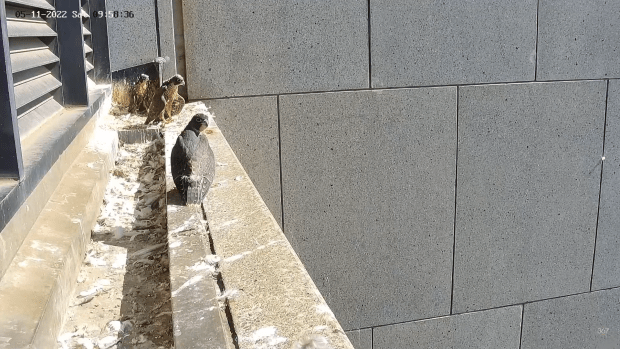
It is 12:21 and all of the Melbourne Four are accounted for – there is one that is blending in well with the scrape box and one in the gutter looking like a piece of prey!

Sometimes Mum – who is now slim and trim – can look like one of the eyases. To tell the difference between an adult and a juvenile Peregrine Falcon, look at the bars on the chest. If they are vertical, the bird is a juvenile. If they are horizontal, they are an adult.

All present and accounted for at 1417. Just look at how much the youngest one has changed. You can easily see which one or ones are hungry. See the sunken crop of the one on the ledge and the full crop of the one in the gutter. Falcons do not need to eat every day and…of course, all of us want them to have banquets but, a day will not harm them. These four have learned how to pluck and are preparing for what they are meant to do – fly! So proud of these first time parents. They overcame so much to be able to fledge these four healthy eyases – and that fledging will be soon. I hope they all wait and fly off together.

Here is a very short video of a pigeon delivery to the Melbourne Four. They are sooooo loud. Once you know that sound you will never mistake it for anything else! Poor parent. Besieged.
Mum and Big have been eating. All of the nests have had food – at least one prey drop or more.

Big is big.

Big had a monster sized crop.

Big is very aware of her surroundings and around 1322 pancaked in the nest. A few minutes later she was looking around as if there was ‘something’ or ‘someone’ about.


Mum got a chance to eat some fish on her own — in the middle of the night while Big slept. Thank goodness. Big will eat everything unless the fish is huge. We are now within 5-7 days of banding.

Brief Eagle News:
If you are a Decorah North fan, Mr North and DNF were working on their nest this morning! There is hardly a Bald Eagle nest in the US that is not now going through nestorations.

Muhlady laid her second egg. Pepe was there at the Superbeaks nest in Central Florida giving support. Muhlady was the first Bald Eagle to lay an egg this breeding season. She will have the clutch finished before most even consider an egg!
Migration News:
Waba is still in the Sudan feeding at the Nile River while Bonus remains in Turkey. There will most likely not be any transmissions from Kaia or Karl II as they were already at their wintering grounds. This is typical. In past years there has been no transmission from Karl II until he began his return journey to Estonia. This is the first year that Kaia has a transmitter.
Thank you for joining us today. I hope that your weekend has been good. Please take care. See you soon!
Thank you to the following for their posts, videos, articles, and streaming cams that make up my screen captures today: Raptor Education, Royal Albatross Cam and Sharon Dunne, The Guardian, Looduskalender Forum, Port Lincoln Ospreys, 367 Collins Street by Mirvac, Charles Sturt Falcon Cam, Decorah North, and Superbeaks.


