Death by micro plastics, M2 is here…Monday in Bird World

8 May 2023

Good Morning Everyone,

Sunday was an overcast day with the feeling that rain could start anytime. It didn’t. The garden feeders were busy! Unfortunately, the squirrels have figured out two different ways to get on the table feeder, causing issues with the birds. Still, they waited and watched. Mr Crow is also afraid of the feral cat that visits and, as a result, has not been quick enough to feed well today. Silly boy. Today they also marked the first day for the White-throated Sparrows to be in the garden this season. In a few days, there could be fifty or sixty of them. If all goes to plan after they arrive, the Orioles will eat oranges and Grape Jelly and pay no mind to Dyson and her gang.

So proud of itself!

Mr Blue Jay watched and waited til he could get a turn at the feeding table.

Your smile for the day…

So far it has been a good Sunday at the nest of Angel and the Baby. This was the posting of the prey delivery and feeding. It is windy and the weather could turn stormy. As I am writing this there has been a feeding at 12:53 with a partial piece of rabbit that Tom delivered. A second feeding began at 2:07:40. ‘A’ has sent me the entire time stamps for the action at the nest. Here they are: “Time stamps for today (7 May) at Angel’s nest. Spoiler alert: Tom brought in some food around lunchtime, which was enough to feed the hawklet three times. Okay, time stamps: 07 02 45 Angel up, wing stretch,head scratch,BJS buzzing her. 08 32 31 Angel up and spots something. And the BJs spot her. 08 39 44 She leaves. 08 41 01 She returns. 10 05 59 After a big wing stretch Angel leaves.10 15 42 PTZ camera Angel flies by on her way back to the nest. 11 46 25 Angel aerating the nest and some preening. 12 52 15 Tom in with part rabbit?. 12 53 30 PTZ feed starts. Some leftovers for later. 2:06:50 RTH5 falls over, gets up after a struggle. 2 07 40 PTZ Second feed starts. 12 51 Angel up.big wing and leg stretch and preening. RTH5 Preening itself. 3 22 00 PTZ Start of third feed. 3 41 44 Angel swallows a lump of fur/skin. 6 06 55 One For the PS fans. This chick is the most adorable little thing ever. The way Angel looks down at it with sheer unadulterated adoration is just precious. I love this chick way too much!”

Thank goodness for small miracles. Angel sure can use them. Let us hope that the storms and potential winds and tornadoes do not hit this nest. This couple needs to find prey and keep it coming so that the baby can develop properly. It sure looks like a hardy little one.

There is something magical about the way that Red-tail Hawks look at their chicks. Big Red is the same. You simply melt at the love in those eyes.

Arlene Beech caught the prey delivery for us.

The weather turned with heavy rain and thunderstorms. Angel is keeping her baby snug and dry.

The situation is also good at Achieva where Jack brought in two fish almost at once. Big Bob ate its own fish while Mum fed Middle. Smiling. Both osplets are safe and find and it is probably that the Bald Eagle wanted the fish and not the osplet! If it had been younger, yes.

Barbara Snyder reports on FB that Mum brought in one of her big catfish and Dad brought in another fish – so another double delivery – Sunday evening that is keeping this nest happy. This is wonderful news for Achieva. These two have their juvenile feathers and well, we don’t want to lose either one of them!

Sadly, the first delivery at Lake Murray did not come until late in the afternoon. Kathryn observed that Mum went out to possibly find fish several times but returned empty handed. Little Peanut did not get any food and this osplet does not look well to me. As Kathryn notes it is also not being clever. I think we should brace ourselves for a sad ending for this very tiny third hatch.

No food for Peanut this morning. It is so very slow and sad to see a sweet baby die of starvation. Only a miracle will help this wee one.

I will add a few articles, once in a while, or postings that discuss siblicide so that we educate ourselves. In 2012, Dr Erick Greene, the Professor at the University of Montana associated with the Osprey Research Project and Iris’s Nest, wrote this post for Montana Ospreys FB Group. It focuses on the amount of food brought to the nest. Other research studies suggest that the oldest or most dominant (usually the same) are getting the majority of food, so siblicide makes no sense. Hopefully, you will enjoy and learn from the articles coming up, and they will provide much to think about as you watch the nests that are getting ready for osprey hatches.

Siblicide – part IV

Siblicide occurs in MANY species of birds and other animals, including all hawks and owls, egrets and herons, kingfishers, pelicans, boobies, cranes and some others. Although it may seem cruel, it is an adaptation that allows the parents to raise the maximum number of healthy and vigorous young under fluctuating and unpredictable food supplies. When there is enough food to go around, all the chicks thrive; when food is limited, only the number of chicks that can be supported survive. So siblicide is a self-adjusting mechanism that matches the number of chicks with the available food.

This is what siblicide is and why it occurs. It is a completely natural part of Osprey biology (and the biology of many other species). However, this does not mean it is easy to watch – it is quite disturbing to watch a chick kill its sibling. Last year fishing was so tough that about 95% of the Osprey chicks starved to death around Missoula. While we were saddened and disturbed to watch the two chicks in the Hellgate nest die last year, we rejoiced that Iris and her old mate were able to raise one very robust and healthy chick in such difficult circumstances. This is something not many Osprey pairs were able to do. If there was not siblicide, all three chicks would have starved to death last year. Nature can be “red in tooth and claw,” even within a family. Even though siblicide may seem cruel to you, there is some sort of comfort in a system that allows the Osprey parents to raise healthy chicks even when times are tough. This is part of the reason we still have thriving Osprey populations.

Some of you may wonder why we don’t take the smallest chick from this nest and put it in the Dunrovin nest. We are not allowed to interfere with this natural part of the Osprey cycle. Our research permits and animal care permits (that are very strictly regulated) would not allow us to do this.

We are giving you this information to let you know about a natural and expected part of Osprey biology, and prepare you in case the smallest chick does not make it. So what can we expect at the Hellgate nest this year? The third chick is definitely running from the back of the pack, but the new male is a fantastic provider! I just watched carefully and saw the smallest chick get absolutely stuffed with part of the large trout the male brought in (Tuesday, 26 June 2012 about 1115). This is a good sign, and if the male continues to be such a good provider all three chicks may make it! Think pure thoughts.

Erick Greene of Project Osprey

That was 2012 and much has been learned since then. I hope to enlighten us more in the coming weeks.

Oh, I wish I could wiggle my nose and transport Peanut to the Moorings Park Osprey platform after Abby and Victor fledge…those two are helicoptering. Fledge (their first flight) could happen at any time!

Moorings Park has gone all out with good cameras and a split screen so we can see all the action.

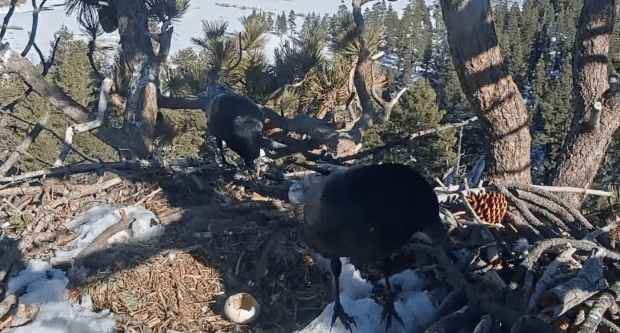
Jackie and Shadow were bringing in sticks and working on their nest in Big Bear Valley on Sunday.

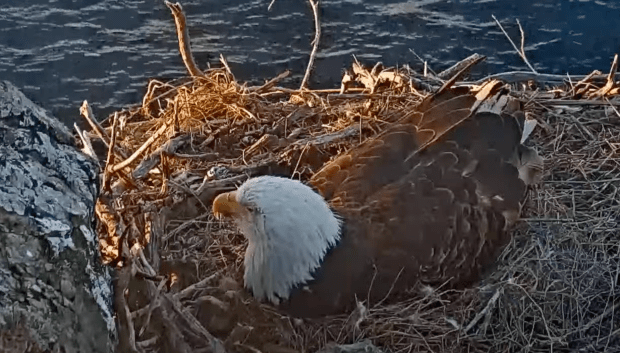
A little windy up at the Glacier Gardens Bald Eagle nest where eggs are being incubated. Looks like some branches have been trimmed so that the camera view of the new nest (as of 2022) is much better. Thanks, Glacier Gardens.

Adults with nice crops keeping a watchful eye over the energetic Cal falcons. That big female sure likes to be out of the scrape. I do not envy Lou and Annie when these three start running around!

Annie has been chasing them about to feed them. SK Hideaways caught it for us.

The Decorah eaglet was really hot today, using panting to help stay cool. Little sweetheart. Doesn’t look like they have had any of those bad storms (yet). Hopefully not.

Whenever you see a nest with three equally healthy raptors on it, just smile. As you are all aware it is not easy. The three at Denton Homes are thriving.

The three at Dulles-Greenway are equally doing well. It is difficult to see if the river is flooding and hard for Martin to get fish but there does not appear to be a shortage of prey. There is also not a shortage of plastic bags! The one black one on the side fooled me one day…at first glance I thought it was one of the eaglets hanging on for dear life!

We have a reminder from Liz Bracken. You will recall that Blue NC0 and Laddie LM12 laid the first egg with Blue 33 and Maya quick on their talons. Well, we will be on hatch watch for both of those nests starting on the 11th…yes, that is 3 days a way.

Blue 33 keeping Maya’s he3ad dry in the drizzle.

It is my favourite nest and it always will be. Steady and reliable. Big Red and Arthur, the Red-tail Hawks calling the Cornell campus in Ithaca, New York their territory.

M2 working its way out of that shell.

If Big Red and Arthur’s kids go hungry there is something very wrong in the world.

Big Red tucking M1 in and we can see M2’s egg tooth working away.

Cuteness!

It started raining at the nest of Big Red and Arthur Sunday evening. Big Red seems to always know and she gets her chick/s fed to the brim and then plunks down on them so they are dry and warm.

M2 is here and already being fed! It is sitting in its shell!

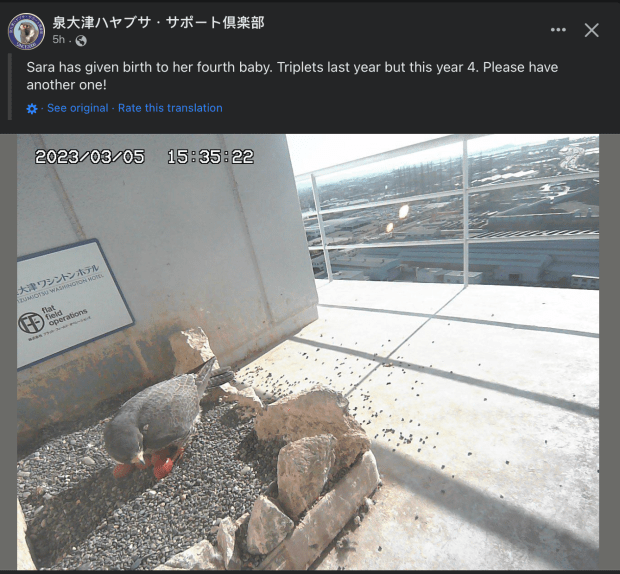
Lots of baby falcons about these days….tis the season!

It is just a gorgeous landscape at the Charlo Montana Osprey platform of Charlie and Charlotte. One egg as of yesterday. Thanks, Loretta!

‘H’ reports sad news coming from Hob Osterlund in Kauai. Not large pieces of plastic, tiny micro plastic that will impact all the seabirds including the Royal Albatross, too…what a shame we cannot get a handle on this nasty stuff that is everywhere.

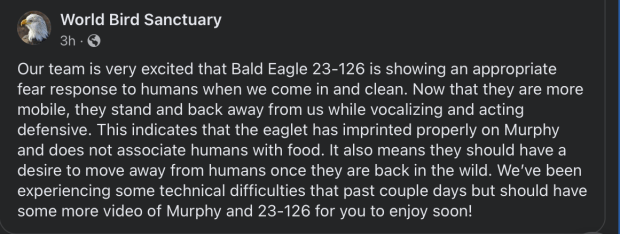
Murphy’s baby is continuing to do very, very well.
Chase and Cholyn’s eaglet at Two Harbours was so full today from eating half a considerable fish that it could hardly walk on the nest. Check out the last image of the three; Mum had a huge crop, too! It was a fish fest day!

‘H’ reports that there is a second egg at Kent Island Ospreys this morning. ‘H’ and I are keeping our eyes on the ospreys at Osoyoos in the hope of identifying them to see if it is Soo and/or Olsen or a new pair.

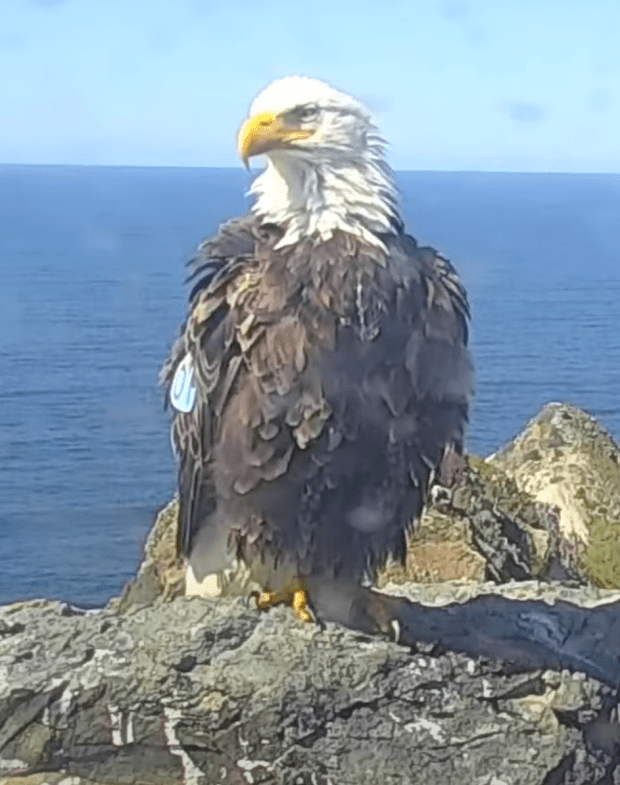
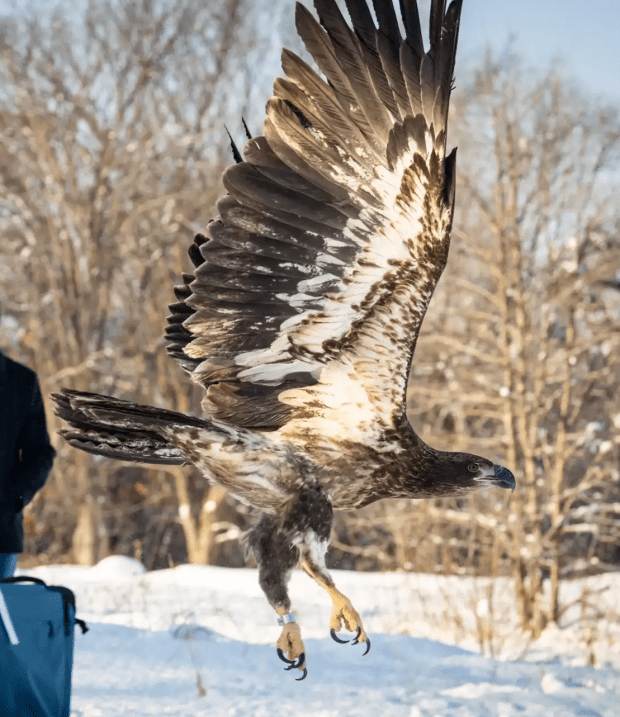
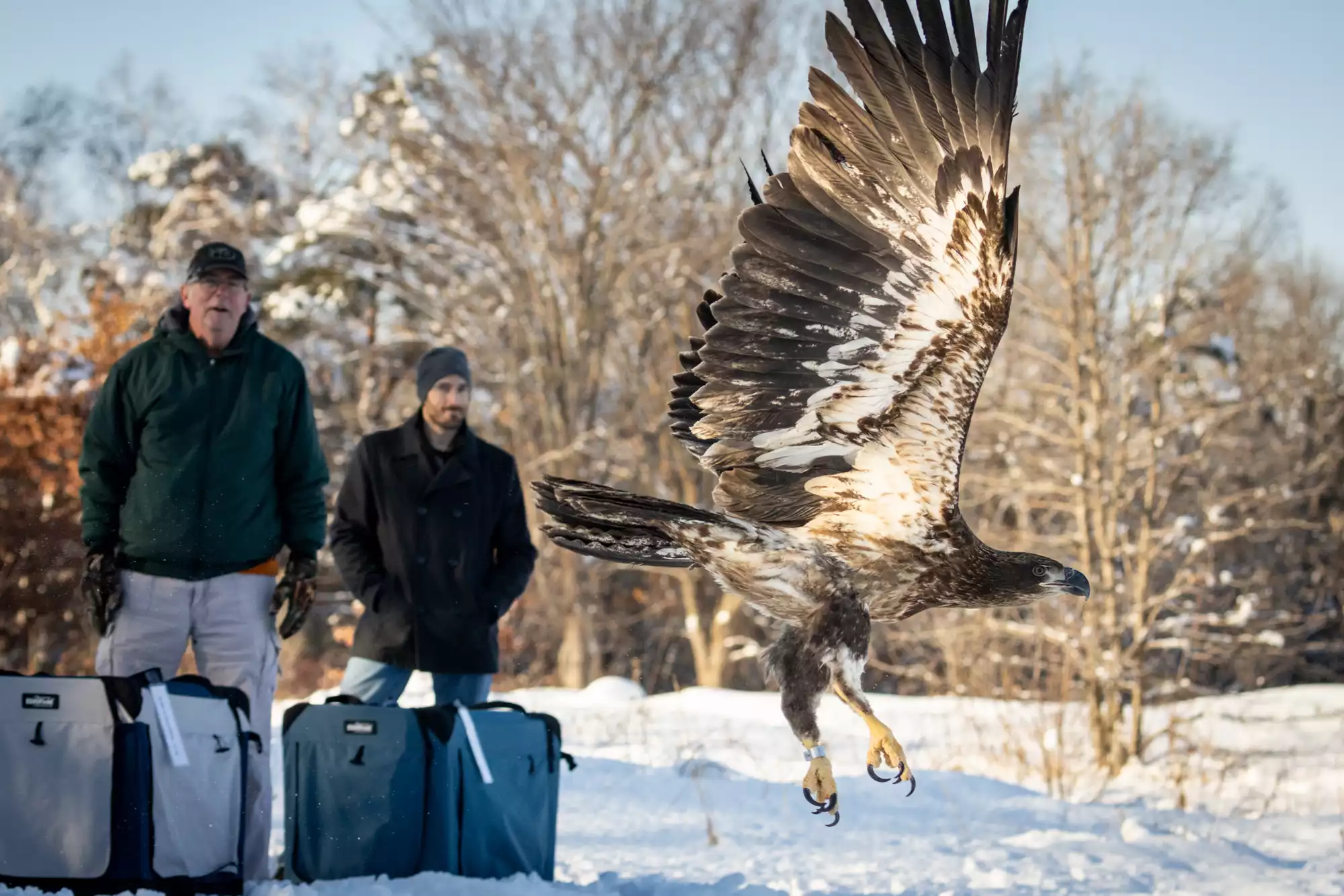
This sub-adult eagle got a second chance at life because of a rehabber!

For everyone who reached out to help on the Dale Eagle chat and felt shunned and ‘well, abused’, there are some changes coming.

Thank you so much for being with me this morning. Take care. See you soon.

Thank you to the following for their notes, posts, tweets, videos, and streaming cams that helped to make my blog today: ‘A’, ‘H’, Loretta, Kathryn, Terry Tempest Williams, Window to Wildlife, Arlene Beech and Window to Wildlife, Achieva Credit Union, Lake Murray Ospreys, Moorings Park Ospreys, FOBBV, Glacier Gardens Eagle Cam, Cal Falcons, SK Hideaways and Cal Falcons, Raptor Resource Project and Explore.org, Denton Homes, Dulles-Greenway, Liz Bracken and Friends of Loch Arkaig FB, LRWT, Cornell RTH, Manchester NH Falcon Fans, Charlo Montana, Hob Osterlund, World Bird Sanctuary, IWS and Explore.org, and Terry Carman and Live Nests and News.

Big Red and Arthur nest building, 3D legs for geese, Ravens eat Shadow and Jackie’s eggs…Wednesday in Bird World

8 March 2023

Good Morning Everyone,

I hope that your week is going well! We have been sent back into the deep freeze. This morning it was -21 C. It is -12 C now, with the promise of much warmer weather at the weekend. Yippeee. When it is really cold, I keep the door to the conservatory closed. Missy and Lewis do not like it these days! They stand and stare but quickly settle into the other living area with nice windows looking out to the birds. Lewis has taken a keen interest in them as of late. It is nice to see both kittens enjoying the out-of-doors safely indoors!

We are going to start with Jackie and Shadow. It is terrific that Ravens ate the two eggs of our beloved couple. I have never said that before! The Ravens arrived at the Big Bear nest at 15:01. They were cautious, looking out for the eagle pair and then getting busy consuming the eggs. Jackie and Shadow can move forward. I have used, and so have many others, the term ‘second clutch’ about the Big Bear nest, but that is the wrong term. The appropriate wording is ‘replacement clutch’ about when the first clutch of eggs is non-viable or lost to predators. At least when they return to the nest, the eggs will be gone. Jackie and Shadow will have closure. Thanks, ‘B’ for letting me know about this!

Jackie and Shadow are going to be on television. Here is the information if you get CBS.

There are currently 2 eggs at the Two Harbours nest of Chase & Cholyn, 1 egg at Sauces with Jak and Audacity (please keep sending best wishes to them), and three eggs at Bald Canyon. I have had no news or seen anything about the Fraser Point nest of Andor & Cruz (they are showing highlights). For those anxious to discover what is happening with Thunder and Akecheta’s nest, Dr Sharpe is travelling to the area at the weekend and will send out a report confirming if there are eggs.

This has just been posted from the IWS Tuesday late.

Akecheta shows up at the old West End nest site where three eaglets fledged last year. Time is 11:31 on the 7th of March.

He was still there at 12:11 enjoying the sun and the view.

Bald Canyon Eggs. Three always make me nervous. Two eaglets are a handful. It is difficult to image the resources and feedings required for three in comparison.

Cholyn at Two Harbours incubating her two eggs. I believe she is 25 years old this year.

Some of the best news is that Jak and Audacity’s seventh egg is still in tact. Today is day 9.

The Channel Islands Bald Eagles are part of a reintroduction project by the Institute for Wildlife Studies. Most of us know Dr Sharpe and his team from the intervention efforts at three of the nests during the 2022 breeding season: eaglet rescue at West End, eaglet rescue at Two Harbours, and Victor removed to rehab from the Fraser Point nest.

You might not know the history of DDT on the Channel Islands. Here is an introductory excerpt from the IWS website:

Bald eagles were present on the Channel Islands until the mid-1950s or early 1960s, but no successful nesting activity was known. The reasons for the decline and eventual disappearance of bald eagles on the Channel Islands are not completely understood. Possible causes include shooting, egg collecting, nest destruction, poisoning, removal of young from nests, and nest disturbance (Kiff 1980). The most likely cause of population declines, however, was the production and use of the industrial pesticide DDT (dichloro-diphenyl-trichloro ethane). Between 1947 and 1961 an estimated 37 to 53 million liters of DDT-contaminated acid sludge, containing 348-696 metric tons of DDT, were disposed of in an ocean dump site 16 km northwest of Catalina Island. In addition, it was estimated that another 1800 metric tons of DDT were discharged from the Joint Water Pollution Control Plant outfall, 3.3 km offshore of Palos Verdes Peninsula (Chartrand et al. 1985). The introduction of DDT into the Santa Monica Basin marine ecosystem was implicated in the decline of two other piscivorous bird populations on the Channel Islands, the brown pelican (Pelecanus occidentalis) and the double-crested cormorant (Phalacrocorax auritus) (Risebrough et al. 1971, Gress et al. 1973). These declines coincided with the decline of bald eagles as a breeding species on the Channel Islands.

I have mentioned it before, but DDT was also sprayed on Big Bear Lake. The toll this believed to be harmless insecticide wrought on all wildlife is unbelievable and ongoing.

Here are the links to all of the Channel Islands cameras including the falcons.

We are three days away from pip watch at the WRDC nest of Ron and Rose in Miami. It is hot at the nest! 86 degrees F. Oh, goodness. We will get to see how eaglets do in the heat. You have observed them when it is cold and snowy.

Pepe and Muhlady have had a wonderful year. Tico and Pearl were on the nest Tuesday at 15:10, having some fish. They are observed flying around the area. Excellent.

On Tuesday, M15 had to contend with an intruder who even entered the nest. Still, he brought in 3 fish, and two prey items – an odd bit of something and a road kill possum. M15 is a constant observer – either in the nest or on the branch – of how the eaglets are doing with their self-feeding. Each of us must be smiling from ear to ear. We all have favourites every year, and 22 has certainly won over the hearts and minds of so many. No longer submissive and cowering but strong and surviving.

Mid-afternoon, Dad brings in a fish and feeds the other eaglet the rest of the road kill.

At 1646, Dad is in the nest cleaning up some of the tidbits that would attract predators and feeding the eaglets their final meal for the day (presumably). E22 is right up there snatching and grabbing that old possum!

Good Night SW Florida. Where is R23-3? Am I missing something?

The two eaglets at Duke Farms each ate well on Tuesday. They are sure growing! Fuzzy little ones with big crops.

In Louisiana, KNF-E1-03, Trey, was almost hit by a falling perch branch!

At the nest of Big Red and Arthur, Arthur flew into the nest early (0626) with more greenery. He checked out the nest bowl and off he went!

Big Red was in later inspecting everything that Arthur did just to make sure it is perfect.

The snow is starting to fall on the nest of our adorable Red-tail Hawks Tuesday evening. It is -1 C with 25 kph winds. Very windy!

The osplets at Mooring Park in Naples, Florida appear to be doing quite well.

Mum Sally needed a quick early morning break.

After the osplets hatch, the Mom stays in the nest most of the time. That said, she does take breaks, and, at this nest, Dad can be seen relieving her so she can have a stretch and a relaxation break. Still, his primary role is food delivery – ‘Daddy Door Dash’ and security. Alan Poole reminds us that the number of fish deliveries doubles and triples in the first 20 days after hatch. This is a rapid growth period.

Ospreys are semi-precocial. This means that they are not as developed as ducks or chickens who, after 24 hours, can walk, are covered with feathers, and feed themselves. Ducks and chickens are precocial. On the other hand, Songbirds are born altricial –naked and require complete care. Osplets are in between. They need their parents to feed them. They cannot regulate their temperature until they are 2 to 3 weeks old.

In terms of growth, osplets should “triple their body weight in the first eight days after hatch and then double that again in the next four days”, according to Poole. By the time they are a month old, they will be 70-80% of their adult size if all has gone well.

The GHOs in Corona, California are growing. That nest is getting tight. All four are doing well. The fourth hatch – about a 1/4 of the size of the oldest – has had some personal feedings.

We all knew it…just from the size, but it has now been confirmed. Sweet Pea or South Plateau Royal Cam chick is a male! A little boy. So nice for a change.

Making News:

We have seen 3-D printers make beaks for eagles and bits and bobs for humans, but, we have been waiting for legs. Now, when will we see these on an eagle? Surely they can use their mind to clinch the toes and talons, right?

Each of us wants to know what happens when one of the birds fledges. This is especially true when they have had a tragedy, such as ND17, when it fell from the collapsing nest. In the UK, at Balgavies Lach, Blue 640, known as The Bairn, did just that – fell out of a collapsing tree, too. That juvenile was spotted in Senegal! It survived its first migration. This is the reason for a huge celebration.

Now this is exciting!

Do you live near enough to the Audubon Centre of Prey in Maitland, Florida, to go for a celebration of baby owls? Oh, it looks like fun! What a great way to get items needed for the rehabilitation of our raptors.

The Cal Falcons t-shirt and hoodie fundraiser has begun for 2023. This design is fantastic, and on Wednesday, 8 March, if Annie is on time, she will lay her 3rd egg around 1600 scrape time.

To look at the options in colour and style, head off to: https://www.customink.com/fundraising/campanile-falcons23 The proceeds go to Cal Falcons not into a generic fundraising at Berkeley.

The Institute of Wildlife Studies (Dr Sharpe) is having their annual fundraiser, also.

Wisdom, the oldest living banded albatross in the world (early 70s) is a grandmother again!

Thank you so very much for being with me today. Keep an eye on Annie and Lou’s scrape and, of course, the WRDC nest of Ron and Rose as pip watch approaches. Take care all. See you soon.

Thank you so much to the following for their notes, posts, tweets, videos, and streaming cams that make up my blog today: ‘B’, ‘H’, FOBBV, Jana Maria Johnson Jamar and FOBBV, IWS, IWS and Explore.org, Jann Gallivan and CIEL, WRDC, Superbeaks, SW Florida Eagle Cam and D Pritchett, Duke Farms, Tonya and KNF-E1, Cornell RTH, Moorings Park Ospreys, Corona California Owl Cam, Sharon Dunne and the Royal Cam Albatross Group NZ, David Attenborough Fans, Ospreys, The Telegraph, Audubon Centre for Birds of Prey, Cal Falsons, Agreement on the Conservation of Albatross and Petrels.

Annie and Lou have the 2nd egg…Monday in Bird World

Good Morning Everyone,

In the Mailbox:

‘J’ asks: “I was just wondering if you could talk about R23-3’s damaged talon. Do they heal? Will the actual nail fall off? Will it grow back?”

These are great questions; they have been on everyone’s mind since we first saw R23-3’s injured feet. First, let’s get to some facts in case some do not know. Those talons (and beaks) carry the eagle’s prey and nesting materials to the nest. They are also used to fight their enemies. Talons are essential for the eagle’s survival. Each foot has four talons, three in the front and one in the back, the hallux. The talons are made out of keratin. It is a protein. Human hair and nails are also made out of keratin.

So have a good look at the image below. Do you remember where the main injuries were on R23-3’s feet and talons? She appeared to have multiple marks and gouges, with one main injury on DIGIT IV, the Outer Talon. We saw it early as black, and I even called her ‘black taloned’. I feared that the injury was necrotic and would eventually kill her. There was no soft tissue swelling, just a deep gouge with a dark, dry scab. That scab eventually came off. The female adult appears to be eating and in good health. She enjoys her baths with M15 and socialising with him in the pond and on the branch. In other words, she is not lethargic.

That hallux is important because it digs into the prey items and allows the raptors to carry their food to where they will eat it or feed their young. The talons are grey in colour when the eaglets are in the nest and turn a shiny black as they age and fledge. They will remain that shiny black throughout their lives..

Now back to the question. The injuries on the female R23-3 appear to be healing. She has yet to lose her talon. If the entire talon were to be pulled out, growing a new one would be a very slow process. You might recall that Ervie, the third hatch Osprey at Port Lincoln in 2022, lost a talon. It was believed to be pulled out when he was fishing, but we do not know. It took nearly 8 months to see any growth in that talon.

We know that the female can bring carrion to the nest tree. We have seen her. She is also eating, arriving with a crop when she has yet to take a fish from the nest. We have yet to see the female actively hunting and carrying a large, heavy prey item to the nest tree. We, therefore, cannot make any observations on her ability or lack of ability to transport prey with that right foot.

If the foot continues to heal as it appears to, this female will be fine. Some eagles are flying and living with only one leg, as we have witnessed this year or managing with a leg with an old injury that did not heal properly, as Ma Berry did for years at Berry College. Feet get damaged regularly. V3’s feet are rough at the NEFl nest (with Gabby). Let us wait and watch to see how she does!

Hard to see the full extent of the injuries in the image below. We can, however, determine which is the most injured toe on the right foot.

We can also see some damage on the left foot.

It must be noted that Peregrine Falcons have been observed with talons with broken ends, which do not appear to grow back. In other words, the entire black talon needs to be pulled out and it is possible that it will regrow slowly.


In the News:

How might climate change impact the Northern Hemisphere’s sea birds? This is a great article coming out of Birdlife International on this topic. Have a read!

https://www.birdlife.org/news/2023/03/02/what-climate-change-looks-like-for-north-east-atlantic-seabirds/


Nest News:

Have you been missing Indigo? wondering if he was still around the scrape on the campus of Charles Sturt University in Orange, Australia? thinking that Diamond and Xavier might be having some peace and quiet? No. Indigo is still there! Elain caught him on video!

Jackie and Shadow are so loved. They get more visitors to their streaming cam in the Big Bear Valley east of Los Angeles than any other eagle family in the US. We are saddened by the non-viability of their first clutch of eggs in 2023. It is not clear whether or not they will lay more eggs. The couple has left these two and the wind and ice are pelting down. Love you, Jackie and Shadow! Today, they made the USToday News. Thanks, ‘B’, for letting me know!

https://www.usatoday.com/story/life/animalkind/2023/03/05/big-bear-bald-eagle-live-nest-cam/11377425002/

M15 is on top of his game. On Sunday, the single parent delivered 3 fish to the nest of E21 and 22 before noon! Way to go, Dad! There were a total of five for the entire day.

Gosh, these eaglets are gorgeous.

The tails indicate the difference. E22 on the left and E21 on the right. Otherwise it is really difficult to tell them apart.

Such beautiful and precious babies. E21 below panting to keep cool.

The end of the day posting from SW Florida Eagles:

I mentioned that Duke Farms’s male will be 23 this year. That hatch date is 11 March. He was taken in as a foster eaglet at Duke Farms when he was a fortnight old. His two recently hatched eaglets are growing and are ever so strong! Just fluffy little snow people…adorable.

The osplets at Moorings Park in Naples, Florida are doing great. No worries at this nest so far.

Monday morning there was some frustration on the osprey nest by the osplets. Sally was hungry and there was a lot of fish. Harry finally gave her a break so that she could eat. The little osplets sure wanted some fish! They were up and waiting as Mum ate. There is nothing to worry about. At this stage of their development, they will eat a little fish many times a day not a lot of fish a few times.

At the Achieva Osprey nest, Jack and Diane have been doing incubation rotations. There are still some days til pip watch for these two.

Big Red and Arthur continue to work on the nest and mate on the light stands. Eggs soon, please!

Big Red and Arthur’s 2022 hatch, L4, remains on the Cornell Campus. Bravo! They are paying her no mind and she is going on about her business hunting in a very prey rich territory.

Happy Hatch Day!

There are now four eggs at the Peregrine Falcon nest in Japan. Will there be a 5th?

Watching for the second egg to be laid at Cal Falcons. Annie has been in the scrape box most of the day.

At 14:51 there was still just one egg. Soon!

At 15:09, Lou is on incubation duties.

‘H’ sent me news that the second egg arrived around 0430 Monday 6 March. Thanks, ‘H’.

Lou is getting the hang of ‘enfluffeling’!

Connie and Clive’s only eaglet, Connick, is looking for roles in more superhero movies. Looks at those legs!!!!! Wow. This eaglet is big and strong.

Connick is a huge, beautiful, well-nourished eaglet! Sometimes there is no place to go when the sun is hot on the nest. Connick can regulate his temperature now.

Gabby and V3 are both at the nest tree today. V3 provided for Gabby the security she needed with so many intruders and hopeful suitors. This nest is pleasantly peaceful now. Have you noticed that it is the same at SW Florida except for the GHOs?

Thanks, ‘T’ for the head’s up. The West End streaming cam was panning around, and guess who the camera caught? Akecheta!!!!!! Oh, it would be grand if they could figure out how to get this camera to focus on the new nest of Thunder and Akecheta. The time is 13:13 Sunday, 5 March. Nice to see you, Dad.

We may not be able to get everyone to stop using rodenticide but each of us can start by remembering that ‘Raptors are the Solution.’ If you know of someone with rodent problems, discuss with them why you do not use these highly designed poisons. If they have domestic pets, it might help save their lives, too. My cat Duncan would still be alive if a neighbour had not used this terrible poison and if Duncan had not caught the mouse that ate it. We will simply not be able to convince everyone but it is worth a try.

I want to thank Dave Hancock and all the folks in British Columbia who work tirelessly to support the well-being of Bald Eagles. There are more Bald Eagles in British Columbia than anywhere in the world. Due to climate change and rising temperatures during breeding and nesting season, Dave Hancock has also been working on eagle nest shades. He is an amazing man who has spent his entire life trying to improve their lives. Some of you will be familiar with the nest cams in British Columbia. They also have a web site with lots of information on eagles.

At the Corona, California GHO nest, the four owlets appear to be very healthy. The fourth is tiny, but size does not mean it is not well. Owlvira seems to be able to manage to feed all of them quite well. Potential names have been posted on chat, and now those are being put into a list for voting.

You can see the size difference in the image below as all are snuggled upright to stay warm.

Thanks so much for being with me today. Take care of yourselves! See you soon.

Thank you to the following for their notes, their posts, tweets, videos, and streaming cams that help make up my blog today: ‘B’, ‘H’, ‘A’, ‘J’, Superbeaks, Lady Deeagle55 and Superbeaks, Avianreport.com, SWFlorida Eagle Cam and D Pritchett, Birdlife.org, Elain and Charles Sturt Falcon Cam and Cilla Kinross, SWEagleCam.com, Duke Farms, Moorings Park Ospreys, HeidiMc and Achieva Credit Union, Cornell RTH, @Cornellhawks, Kakapo Recovery, JPFalcon Cam, Cal Falcons, SKHideaways and Cal Falcons, Window to Wildlife, NEFL-AEF, IWS and Explore.org, Raptors are the Solution, Hancock Wildlife Foundation, and California Corona Owls.

Troubles in Bird World

16 February 2022

Oh, good morning everyone!

Before we begin today, I want you to watch a really short and sweet video of Nugget and Valentine at the KNF-E3 nest by Rhonda. As you might recall, Nugget had an injured leg. Thankfully that is all better. Have a look – you will need this before you read the rest of the news, I promise. It is also a reminder that legs can heal, that good things can happen!

Also on the plus side – Diamond has returned to the scrape after the fearful fireworks set up near the tower several days ago. That was around 08:42 on the 16th in Orange. All three of the Orange falcons are now accounted for and all three have now been in the scrape. Diamond was the last. Welcome back, Diamond. sorry you had to go through that extreme stressful ordeal. Fireworks should be banned! Maybe, Diamond, they could use your beautiful face as the poster for why all loud sounding celebratory items need to be banned, not manufactured, not sold, banned…Every other raptor, wildlife, dog or cat will thank everyone.

Oh, goodness. Soap operas do not hold a candle to ‘As the Nest Turns’ and right now that saying goes for Redding Eagles Liberty and Guardian, Big Bear Valley Samson and Jackie, Captiva Ospreys Mabel and Angus, and, of course, SWFlorida with M15 and E21 and E22. Add the Frequent Female Visitor with the injured talon/s who is so hungry well, Wednesday was quite the day. There would be awards if this was afternoon television! Every nest would be signing contracts…just kidding, of course, but…what the heck?

There were quite a number of feedings at the SWFlorida nest today. I won’t go into them in detail but the one around 1300 caught one attention. M15 is really trying his best to get food to 22. We have all watched him move the fish around, side step, pause with a piece of fish hoping that 22 will grab it. Sometimes 22 is just too scared. Sometimes the fear of what has happened is cause to stop 22 from eating. So at this feeding, ‘A’ wrote this. It is lovely.

Towards the end of that lunchtime feeding, E22 eventually made a frantic grab while M15 was working on a piece, and got the tail of the fish, with some flesh attached. When he turned away with it, mantling, he couldn’t swallow it and M15 came over and picked up the piece. Just when I thought M15 was going to swallow it himself, he instead started feeding it to E22, who managed at least half a dozen decent mouthfuls plus the tail, which he was able to swallow once M15 had pulled off those half-dozen mouthfuls for him. 

No matter what happens on this nest…M15 is trying even going without himself to ensure that these two eaglets survive to fledge. He is exhausted. You can see that when he finishes feeding them for the evening and gets on the nest and his head just falls. He is ravenous if you look at how fast he ate some fish today, too. He really is Dad of the Year and he is certainly making me tearful just thinking at how hard he is trying to make this work.

7771 people watched M15 feeding the eaglets when the hungry female flies down landing on the nest and scuffling with the eaglets. She flew down, began eating the fish, and nipped at 21. It was 16:12-13:18ish.

She started eating the fish so quickly. She is – I am sorry to keep saying this – but, she is starving because she cannot hunt for herself with the condition her talon is in. (I cannot confirm it but there are rumours that there are more than one female around the nest with 2 of the females having injured talons).

She is ravenous and is eating. The eaglets give her a wide berth.

Then M15 is back at the nest and he sees what is going on. At 16:14:28, M15 flies down to the nest and gets rid of the female.

He moves the fish so that he can continue feeding E22 but he is also very hungry and eats ravenously, too.

21 already had a crop and is ready for a nap…good timing for 22.

E22 did get food – that was all I cared about and so did M15. He ate like he hadn’t seen fish for a month which made me – at first glance – think it was the female but there were those dark streaks on top of the head! M15 looks exhausted.

E22 got the fish tail and at 16:24:59 he tried to hork it without success.

There’s the part of the fish tail!

M15 is still feeding 22 at 16:37. E22 leans over and does a reasonable PS at 16:38:40.

Oh, it wouldn’t splatter to the pond but it was a ps and that is good – 22 is not dehydrated. 22 actually was doing a pretty good job eating that fish when the commotion began again. So glad he had some bites.

And, yes, M15 must have forgiven her – or he knows she is extremely hungry and is sick, hopefully healing from talon injuries. He also knows that she has helped defend the territory. Still, he will not give her food before he feeds 21 and 22 and himself. So…hunger is a driver for bizarre behaviour. I have seen osplets attack their older siblings which are 8 times their size. And let us all be honest…M15 is worn out and tense. He is ferociously hungry. The eaglets are hungry. And the female is ravenous like 22.

The female returned and ate all the scrapes. She is with M15 on the branch tonight. She is awake and he is getting some much needed sleep. M15 you are our hero…you are working so hard and it is taking its toll on you – a single dad with all these intruders to contend with!

The struggle for survival at the SWFlorida Bald Eagle nest is a good example for all of us – it is helping us to understand the challenges that our eagle families face each and every day of their lives.

The latest news:

At the Captiva Osprey nest, there are now ongoing battles that have lasted for at least six hours for control of the nest. This could get rather gruesome. Hormones are raging during breeding season and we all know that many of the trees that are good for osprey nests and – some established nests on Captiva and Sanibel – even on the mainland – were destroyed by Hurricane Ian. Everyone is looking for a nest. ‘H’ recorded more than 40 separate events in 8 hours..frightening.

Then the excitement came to the Redding Eagle nest when Liberty laid her first egg of the 2023 season last night.

And then, it waned. Liberty flew off the nest and left the egg. The Magpies came and pecked on it. Finally Guardian was there …According to ‘B’, there are boots on the ground looking for Liberty. These two are dedicated parents like Jackie and Shadow, M15 and Harriet…there is something wrong. Do they have intruders as well?

Relief. Liberty flew in…was she gone since morning. An avid Redding eagle lover, ‘B’ commented that she arrived at the nest in full alert mode vocalising. Oh, I hope that there is no trouble at this nest with intruders. It is simply too close to what might have happened to Harriet.

The problem with the success of the osprey and Bald Eagle breeding in the US – their big comeback after DDT – is that their habitat is being lost, their food supplies are diminishing and everyone wants and needs a nest, food, and security!  They will fight to the death to get it, too.

Then there is the lingering question of why Jackie and Shadow continue to be on and off again with the eggs? and Mating? Right now – it is early evening on the Canadian Prairies on Wednesday the 15th and the eggs at Big Bear were left for the last time at 16:28. No Eagles on them at 15:41. While eggs can survive for different periods of time and hatch, I am beginning to wonder if the eggs are non-viable to begin with…and when after a period of time, no sound or movement was detected – or they heard the eaglets and then it stopped – something has caused Jackie and Shadow to behave differently. Like everything at these nests, there is nothing for us to do but wait and watch. Or take a break and return in a day or two.

Last year we all wept when the fourth hatch – that energetic little scrambler – at PA County Farm died of hypothermia. It is congratulations to Lisa and Oliver on their third egg of the season. Oh, that nest bowl is deep this year…I wonder if they will have a fourth egg?

There is no news of Zoe. An osprey was on the power pole at Streaky Bay. Not identified as Zoe. So long and no news…surely with the way she flew before there would be some place she would ping cell service by now. Patience required.

Making News:

Audubon reports that there are several victories in Alaska at the start of the year that will have us all cheering. The Bristol Bay Project is one of those and the most recent is the Tongass Forest rulings. The Bristol Bay mining project had the potential of harming the waters and the fish and therefore, the birds that depend on those fish such as the Bald Eagles. The Tongass will not have roadless entry protections for species. Have a read.

https://www.audubon.org/news/victories-alaskas-bristol-bay-and-tongass-forest

Sometimes it just feels like a roller coaster. There is great environmental news and then, we turn, and there are 350 dead waterfowl in a Victoria nature reserve in Australia. Why?

Authorities believe it is a case of Avian Botulism which occurs when there is a lot of water and then that water dries up. “Avian botulism is a serious neuromuscular illness, causing problems with muscle paralysis which can result in death. Botulism outbreaks are common during drought when wetlands evaporate rapidly, causing more birds to be concentrated in smaller areas of warmer, shallow water, and resulting in a concentration of bird faeces”. So sad.

https://www.theguardian.com/environment/2023/feb/15/birds-found-dead-parks-victoria-nature-reserve-bells-swamp?CMP=share_btn_link

Let us all wish our nests a little calmer day today! There was a small piece of fish (or small fish) brought on to the SWFlorida nest at 0928. 21 ate. 22 got a scrap….

The camera at the nest of Big Red and Arthur has been offline for a long time. It is now back on just in time for nest building!

https://www.youtube.com/live/ouQL2Gg-rXI?feature=share

Thank you so much for being with me. Please take care. See you soon.

Thank you to the following for their notes, videos, articles, and streaming cams that form my blog: ‘J’, ‘A’, ‘H’, Rhonda A and the KNF-E3, Charles Sturt Falcon Cam and Cilla Kinross, SWFlorida Eagles and D Pritchett, Nancy Babineau and SWFL Eagles, FORE, M and FORE, FOBBV, PA Fair Country, Audubon.org, The Guardian and Cornell Bird Lab.

Bobbleheads, pips…Sunday Morning in Bird World

Good Morning Everyone!

Oh, Saturday looked promising for a nice walk in the forest. No! It was only -12 C but the winds were gusting more than 16 kph which means wind burn. I ‘decided’ reluctantly that it would be a good morning to clean house while listening to Ferris Akel’s tour. At the same time, I was very much aware of the European Starlings – all 40 of them – that had descended on the garden. Out went two new cylinders -a plain butter bark one and a seed cylinder. The images are poor because of the light. The Starlings came not just to eat but to ‘sun’ themselves on the tips of the lilac branches rotating their bodies to get warm. Brilliant.

These Starlings are nothing short of gorgeous. They live in harmony with the many sparrows that show up at the feeders. It is the squirrels that cause most of the havoc claiming the entire 10 metres of lilac bushes as their own.

All four of the squirrels were out and about – Dyson and two summer babies and Little Red. The images of them could not be lightened any more. It is unfortunate as this little summer offspring of Dyson is so cute. My offering is one meagre image. This little male was finding peanuts in the snow and eating them. So sweet.


My top story is a shout out to the wildlife rehabbers and the vets in Prince Edward Island for undertaking only the second spinal cord compression injury and the eagle surviving! When I was a professor, one of the things I valued was curiosity above almost everything else. ‘What if I did this?’ ‘How can we improve that?’ ‘Could something like this work?’ Questions that often result in our wildlife having a second chance at life. I wish more vets and rehabbers were as curious as some who make milestones in our understanding of raptor injuries and the potential with groundbreaking surgeries. Congratulations to everyone.

More good news. Another six of the Bald Eagles who suffered in Minnesota from phenobarbital poisoning (and some with high lead levels) were recently released. The staff at the wildlife rehab centre had to physically remove the poisoned/euthanized pets from the stomach of these beautiful birds before they could be treated. There were thirteen in total. One had Avian Flu along with the poisoning and died. Another two died leaving ten that were nursed back to health.

‘A’ has reminded me that pip watch will begin in one week at the Royal Albatross Colony on Taiaroa Head. The Royal Cam parents are GLY and L. What is so fascinating to me is how the NZ DOC recognises the impacts on Climate change and is trying to do something about it! ‘A’ included this quote from Ranger Sharyn Broni when she wrote, “

Virtually all the eggs will be hatched in the incubators as the increasingly hot summers make the risk of fly strike too great. We see the effects of climate change on these large birds quite markedly. During the 1950s for example, this type of work would have been unnecessary. By the 1990s conditions were more frequently hot enough to cause fly strike at some nests some of the time. It was during the 1990s that methods to repel flies and also to keep toroa cooler on the nest began. By 2018 fly strike is almost a certainty if the egg is left at the nest to hatch.

The dummy egg holds the parents on the nest while the egg hatches in the incubator over several days. The nest will be sprayed with AIL (Avian Insect Liquidator) to clear out any flies that may be living in the nest. The newly hatched chick has AIL applied to it prior to it being returned to the nest.

It is a whole lot better cleaning out kitchen cupboards and little ‘kitten’ things all over the house while listening to Ferris Akel’s Saturday Morning Bird tour of the Montezeuma/Ithaca area of the Finger Lakes area of upstate NY. I can stop and look if I hear something of interest or just listen. Ferris is a great advocate for being outside and for birdwatching as a way to let the stress of the world go! I will keep reminding all of us this winter as it is far too easy to stay inside on bad weather days. And sometimes advisable to do so!

There were Snowy Owls, swans of various species, gulls of various types including a Black-backed gull, Canada geese, Red-tail Hawks (a young adult with a red tail and light eyes), Northern Mockingbird, and Bald Eagles on the morning’s tour.

The images were chosen for very specific reasons.

Snowy Owls like ‘snowy, northern climates’. There are always a few around a small airport that Ferris frequents. They are commonly seen in the fields of the province where I live, and one, as you know, is in Southern California this winter!!!!!

A juvenile Tundra Swan with the grey head. Strangely, we have one still living in Winnipeg in an area that has some open water. It should not be here. Will it survive? So far our temperatures have not been constant -32 to -38 C. So, I am hopeful. Our climate is changing so it will be interesting if more stay in the future.

It is Bald Eagle hatch season in the US and while we all get giddy over little pink tootsies, it is good to know how the little eaglets change in their appearance until they become the iconic bird with it sure white head. The image below – look closely, has the yellow smile I spoke about yesterday in the eaglets on the Superbeaks nest. Its eyes are still dark but not as dark as the month olds at Superbeaks. They will continue to lighten. The cere, mandible, and beak are all espresso brown. The head is brown and the body has scattered white and brown striations on the chest. The eagle at the top fits nicely into being a year and a half old according to Avian Reports picture chart on eagle development (below this image). If it were a year old it would have prominent white streaks in its head.

The two eagles below are an adult pair. The beak and the head are definitive means of attributing age. Look at the chart often. It will not take you long to single out the age. But, always remember, eagles can get ‘stains’ on their feathers, especially the tail feathers and sometimes the head. So then look at the beak!

This is a gorgeous Red-tail Hawk. We know that it is at least a year old because it has its red tail. But the eyes remain light so it is not a full adult yet. What a beautiful hawk. My goodness you would think that it was a copy of a young Big Red with its extraordinary apron.

Those eyes are part way between a juvenile (blue/green) and an adult (dark chocolate).

Ferris spotted Big Red when he entered the Cornell Campus. For some reason, the sighting was very emotional. Big Red will be 20 years old this year. What she has gone through to survive that long is beyond imagination. As far as we know, she has only ever had one chick not fledge and that was K2 who had to be taken into care because of a beak/jaw infection/deformity and who had to be euthanised. She is the most famous Red-tail Hawk in the world and rightly so. She will be laying eggs in mid-March.

Ferris caught up with Big Red on one of the light stands as the light was really going late in the day. You can see the wind is really blowing. She is holding on tight to the bars of the stand. Every sighting of her is a joy. It is 1 degree C and the wind is blowing at 14 kph on the ground so it is really windy on the top of the tower. Evan the tower is moving a lot.

Ferris also found L4, the 2022 fledgling of Big Red and Arthur. It was the first year that Big Red had four eggs and had four fledglings. No one believed a 19 year old hawk could do that – Big Red is changing everything we know about Red-tail Hawks in the wild.

In this side view, you can clearly see that the eyes are still light. Not yet a year old.

L4 looking up as some Canada Geese fly overhead.

Little E22 is already such a cutie. Harriet and M15 are a dynamic duo. The DNA running through those two eagles gives us very strong eaglets right out of the broken egg shell. E22 is standing up pretty good…only a few hours after hatching.

Want some fish, E22?

By late afternoon, it was apparent that 21 and 22 had several feedings. There was fish juice all over them. Any bearing came accidentally from 22 whose eyes are not yet focusing. Harriet and M15 must be the most patient feeders!

At 1757, they both had juice and matted feathers everywhere especially 22. The following image gives you a terrific look at that egg tooth and how it extends so much below the mandible. Imagine the eagle on its back hammering away.

Harriet and M15 are great partners. It was only a matter of time before 21 bonked 22. So Harriet, who had been feeding the pair alone, called in M15 to help. Lady Hawk caught the tandem feeding in the following video.

At Anna and Louis’s KNF E-1 nest there have been plenty of opportunities Saturday morning to see the eggs but, no obvious pip. Eggs are 39 days old and 34 days. Average hatch time in Louisiana is 35-39 days so folks are sitting on the edge of their seats to see if this young couple will have a hatch (or two) this year.

Both Anna and Louis have been incubating and rolling the eggs. Louis is a great provider and Anna has proven to be a really good eagle Mum. I was so hopeful they would have two chicks this year as the food resources are there but, it might well be that they, again, have only one. One is fine!

Oh goodness. There is a pip seen after 1300 Saturday. Jumping up and down! Tomorrow there will be a wee one for Anna and Louis. (could be later in the day on Sunday depending on its progress)

At 1652, you can really see the progress that little eaglet is making. Well done!

It is raining in Louisiana this morning. Louis covered the eggs with nesting material not giving us any hint as to how the hatching is going!

At the E3, nest of Alex and Andria, the two eaglets are growing like bad weeds in the garden plot.

Look at the bottom of E3-01!!!!!!! Well fed eaglets, both of them.

Eggs are being rolled at Metro Aviation. It is unclear if there is a pip. I saw a black spot but I think it is nesting material. Will these eggs hatch? The first egg is 42 days old today. The second egg is 39 days. Remember the average is 35-39 for Louisiana Bald Eagle eggs. It is possible that neither egg is viable. But we wait and hope for this couple.

At Berry College, Pa Berry was on the nest. We have some time before pip watch for these two Georgia Bald Eagles. Egg 1 is 26 days old today and egg 2 is 23 days old.

All is well at Superbeaks! Both are on the nest and I haven’t had to scream yet today about the lack of chair rails…but, oh, I wish these eagles would strengthen the sides of this nest.

Rolling eggs at Captiva. Next week is pip watch for Connie and Clive at the Captiva Bald Eagle nest. That is a very clear camera image!!

At the Captiva Osprey nest, Andy and Lena are now replaced by FO and MO. They need to bring more nesting material and everyone would love to see some fish gifts. There is still time! Rumours have it that the pair mated on the nest for the first time on Saturday. I did not see it and I screamed at the rewind on the camera! I can neither confirm nor deny.

Elain continues to keep us up to date with her daily video summaries from Orange. Indigo made only one appearance on the 7th of January! Much more quiet, yes.

Geemeff posted an article on Twitter that is really informative about tracking devices and how they are so useful to our understanding of the movements, behaviour, and challenges our wildlife face. It is a really good read!

So where does a disappearing elusive Australian Painted-Snipe go if no one has hardly ever seen one? Just look at how lovely it is in the image above. I love that white eye line.

https://www.theguardian.com/environment/2023/jan/08/vanishing-bird-the-mystery-of-the-near-mythical-australian-painted-snipe?CMP=share_btn_link

Keeping closer to home and keeping in mind that lovely book, Slow Birding (I think it is the favourite of 2022), I want to remind all of us that we can do things at home now or next year to enrich the lives of the visitors to our own gardens.

  • Provide shelter. No, it doesn’t need to be some elaborate structure. It could mean leaving some of those tall perennials in place to provide a place away from the wind or rain. If like me you have had to cut trees down (yes, sadly), place the limbs and branches around the garden preferably stacking them. Great shelter. In addition, the rotting wood will provide great feasts for birds that feed on insect life. I have several different 60 cm tree trunks that are now about 20 years old. The birds peck away at them in the spring and summer as they are slowing breaking down into a kind of mulch.
  • Looking at the seed and garden catalogues and wishing. Consider – and you must consider your own planting zone – climbers for shelter in the fall and winter but also plants that are bird, bee, and butterfly friendly in your area. I am looking for quick growing berry bushes and a couple of trees with berries right now to plant in the spring. The birds will all thank you.
  • If you have the space, the finances, and the physical ability, why not set up a couple of bird feeders? Feeding the birds really gives them a boost and a better chance at winter survival. Also consider seeds with shells and no shells. All of my garden birds love the Black Oil Sunflower Seeds but the empty shells make a huge mess. You can purchase already hulled seeds. (I rake mind and push them to the back of the mini-forest where they break down and help the soil). If you do put up feeders or bird feeding tables, you have to be able to clean them. Feeding birds is also about responsibility to them so they do not get disease. “The National Wildlife Health Center recommends cleaning bird baths and feeders with a solution of nine parts water to one part bleach. (If there is visible debris, scrub it off before soaking in the bleach solution.) Dry out the feeder before hanging it back up”.
  • Want to give the birds some treats? These ideas I originally found on the RSPB website. You can blend birdseed with unsalted nuts, raisins, and lard and press it into moulds or over pinecones and hang outside. Do you have some old hard cheese that could be grated? (no Blue apparently). Birds love it. My Starlings are loving pieces of apple and pear as well as raisins, sultanas, and currants. It is a good way to use up some bruised fruit. I put chunks into a tray feeder.

It is always my pleasure to bring you some of the recent news about our feathered friends. I did not cover Zoe today but rest assured, the girl is eating! Dad brought her a fish yesterday and it is believed Mum added one to that as well. Most days she has 3 fish delivered by Daddy and Mummy Door Dash. Oh, they must be wishing she would move out of the house?? But, they will dutifully continue to feed their girl. No fear. They are dedicated. It is nearing noon in Australia as I write this and Zoe is 112 days old and she is yelling at Mum who is on the ropes for a fish. Time to become independent dear girl. Or are we set to break other records? She is exploring the area but is she exploring places where she could catch fish? And Ervie! Oh, I wish someone would submit some images of Ervie. Missing that beautiful boy.

Oh, thank you so much for being with me today. It is wonderful to know that there is such a supportive community ‘out there’ for our feathered friends. Please take care! See you soon.

Thank you to the following for their tweets, announcements, articles, posts, videos, and streaming cams where I took my screen captures: ‘A’ and NZ DOC, Ferris Akel Tours, Avian Reports, SWFL Eagle Cam and D Pritchett, Lady Haw, and SWEagle Cam and D Pritchett, KNF 1, KNF 3, Metro Aviation, Berry College Eagle Cam, Superbeaks, Window to Wildlife, Elain and Charles Sturt Falcon Cam and Cilla Kinross, Geemeff, The Guardian, and Port Lincoln Ospreys and Friends of Osprey.