Sharpie returns, Gabby’s suitors, Hesgyn’s autopsy and more in Bird World

11 December 2022

Oh, gosh, it is grey and dreary here in Manitoba. The sun did not break through at all today. There were moments when I wish we could ‘wiggle’ our noses and be transported elsewhere. I wanted to feel the warmth of the sun, see the green grass, and sit and just listen to the Tropical Mockingbird and Bananaquit.

At the same time, had I not been sitting where I was, I would have missed Sharpie’s visit! I know that he has been about or the larger female Cooper’s Hawk, but I had just not caught him landing. Today, he did!

It is so nice to see you, Sharpie. You are looking quite healthy with those chrome yellow legs.

At the same time, he caused the 31 European Starlings that were feeding to gather and form a murmuration. It was the first time I had seen these birds clustering and flying together to confuse a predator. It was not like anything I have seen when there are thousands of Starlings together forming intricate patterns. These 31 were a loose knit group but, they did manage to keep the hawk at bay with their flying formations.

Sunday morning and Sharpie is back trying to get a songbird feeding in the lilacs. The three Crows are all upset causing the songbirds to flit and fly away. I figure Sharpie is hungry. He is not giving up easily.

I suspect, like Diamond, Sharpie prefers something other than a Starling – perhaps, his usual House Sparrow. He is too small to go after a Crow but, the Crows get excited when anyone enters their territory. I never resent him taking one of the Sparrows. Everyone has to eat to survive. Sharpie just takes what he needs, eats it all but the feathers and even some of those, some days. He doesn’t waste – like humans do.

While I was away, one of our readers, ‘L’ sent me a photo of a hawk wondering what it was. I knew but I decided to ask Merlin and sure enough, Merlin photo ID said Cooper’s Hawk as opposed to the image above which Merlin IDed as a Sharp-shinned.

Which brings me to a point I want to make. At one time I was not happy with Merlin Bird ID. It drove me nuts. While I was on holiday, there were so many songbirds singing at the same time that I could not separate them. Additionally, they were tropical birds that are completely unknown to me. The Merlin Song ID was incredible. The only bird that it did not identify was the Carib Grackle which surprised me.

The other positive besides knowing all of the birds that are around you is that by using the app, you can learn the song of species that were originally unknown to you. By the end of the week, I was able to tell 8 Caribbean birds by their song. That is pretty good for someone who is tone deaf! Just imagine what you could do. It is free. I really do urge you to put it on your phones. Go out, take a friend, or a young person and teach them to hear the songs and identify the birds. Make an outing of it. It is really fun and it helps Cornell understand where birds are located even when they don’t think they should be! Like Sharpie. Once I sent them the image with all its meta-data, they quit telling me that there could not be a Sharp-shinned Hawk in Winnipeg at this time of year.

The final report has come in on Hesgyn, the last chick that Monty raised with Telyn, found dead this summer in Wales after living through his migration and returning to find a mate. The report is cumulative – meaning that that the most recent finding and autopsy report is at the bottom. It would appear that Hesgyn’s return coincided with the tremendous heat that Wales had during that singular week. The impact on the ability of this magnificent osprey to fish – after returning from Africa – could have been the natural cause of his death. No human cause.

https://www.dyfiospreyproject.com/blog/emyr-mwt/hesgyn-has-died

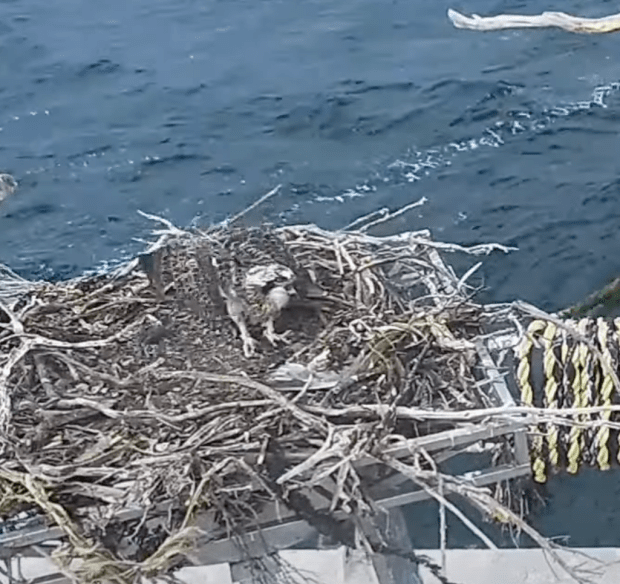
It was nice to see Zoe with a great big fish delivery from Dad. At 0701:14, Zoe sees Dad arriving.

At 0701:20, Dad lands on the nest. Mum begins to fly over from the ropes to the nest.

It was a big fish, not a teaser. Mum seemed to hope there would be some left but, Zoe does love her fish! And has a history of being unable to share.

By 0735, Zoe has finished the entire fish!

At 0801, Zoe sits with Dad over on the ropes. He doesn’t seem to have budged a centimetre from the earlier image above.

At the scrape box of Xavier and Diamond on the campus of Charles Sturt University, Diamond was having a nice siesta in the afternoon sun. She is so beautiful. Her and Xavier must be very happy with Indigo’s progress.
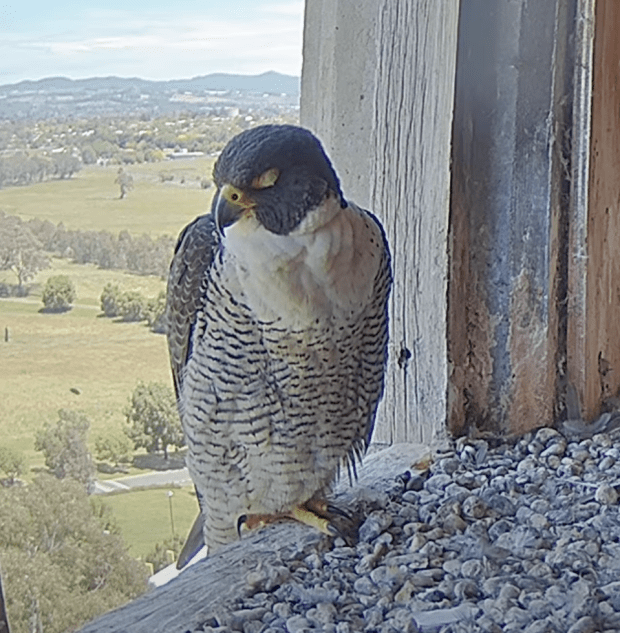
Indigo arrives and thinks the ledge is a good place for an afternoon nap, too.

Elain has another great highlights of the Day for our Orange Falcon family.

The biggest news in Bird World continues to be the competition for Gabby’s heart and nest.

In order to try and keep the identification of the suitors separate and apart from one another and Samson, the AEF have gone to identifying the birds using their tail feathers.

Tail Comparison: Top Row L to R: Samson, V1. Bottom Row L to R: V2, V3

I have not seen V2 at the nest today. There is now the third male, V3, who has been working on the nest and Gabby has not chased him away. Gabby even got into the nest with V3 for a bit.

V3 has slept on the nest and is very alert.

There is very little known about Gabby including her age. She became Samson’s mate at this nest in 2018. She was an adult so she is at least 9 years old now. She has a nest in a good location and there are many suitors. To date, I do not believe we have noticed a brood patch on Gabby. A brood patch is the spot where the feathers do not exist – they fall out when it is time to incubate eggs. The skin of the adult touches the eggs and helps to keep them warm. If the feathers would there, the warmth of the parental body would not exist – so this brood patch has developed over eons to assist the eagles with incubation.

Wonder who Gabby will choose? There seems to be plenty of time so as the AEF suggests, get some popcorn and sit back and watch. It truly is a soap opera. Meanwhile, Harriet is only letting M15 have a little incubation time while Anna down at the KNF nest in Louisiana loves to give Louis plenty of time with their eggs.

M15 brought Harriet a tasty treat today, right off the Road Kill menu – rabbit. Harriet wanted it plain, not in a cassoulet.

Meanwhile at the Kistachie National Forest nest, Louis is getting another chance to incubate the eggs overnight. Wow! These young eagle mums are really sharing the whole experience with their mates. It looks there is some rain and a little lighting near the nest in Alexandria, Louisiana.

Congratulations to Superbeaks – the Central Florida Bald Eagle nest – on their second hatch as announced by Paul Kolnik on Bald Eagles 101.

‘A’ reminded me that Wisdom is not only the oldest Laysan Albatross in the world but she is also the oldest banded bird in the world. Incredible. There is a new announcement from the Midway Atoll. It seems that Wisdom has returned and was seen on the 24th of November but, her mate has sadly not. Will she get another mate? We wait to see. What an amazing seabird Wisdom is…incredible.

Remember that Ferris Akel has his live tour on Saturdays starting at noon Eastern on YouTube. Today, he didn’t catch big Red on the Cornell Campus, our queen of the Red-tail Hawks. Ferris did find her mate, Arthur – and it is always good to see either of them and extremely special when it is both.

Some thoughts from David Suzuki.

Thank you so much for joining me this morning. Take care everyone. See you soon! One last one to put a smile on your face – the ever loving Jackie and Shadow kissing in the nest yesterday while they did renovations.

Thank you to the following for their posts, videos, and streaming cams that make up my screen captures: David Suzuki Foundation, Bald Eagles 101, Ferris Akel Tours, US Fish and Wildlife Services and ‘A’, Tonya Irwin and KNF Bald Eagles FB, Lady Hawk, SWFL Eagles and D Pritchett, NEFL-AEF, the AEF FB, Elain and Charles Sturt Falcon Cam, Charles Sturt Falcon Cam and Cilla Kinross, Port Lincoln Ospreys, Cornell Bird Lab, and FOBBV.

Early Saturday in Bird World

10 December 2022

Good Morning Everyone from a snowy, icy landscape – the Canadian Prairies. As many of you suggested, it was a huge culture shock going from bright sun and warm seas to frozen. It is always good to be away but, it is equally nice to get ‘home’. Thank you for all your wonderful letters and best wishes. I had an epic time!

The big news is still coming out of Samson and Gabby’s nest in The Hamlet near Jacksonville. Will there be a nest take over? will Gabby get a new mate? where is V2 this morning as I write this? did Samson appear? Wow. Everything else pales in comparison.

This is a short catch up on some news that we are following this morning.

I want to start with a disgusting arrogant display that has gone viral. It was posted by Geemeff, one of our readers.

What a disgusting individual.

Was it Samson visiting the NE Florida nest? We would have to see his toe – one is flattened. But, gosh, it sure looks like him.

Maybe the word is out and all of them know that Gabby is now single (sadly) and they are lining up for her to choose? They should try bringing her fish!

There was a musical nest. V2 was there and gone, then Gabby left and V2 returned, and then he saw Gabby and escorted her back to the nest.

Postings of a third visitor.

But where was V2 last night. It looks like Gabby spent the night alone – again!

Gosh, I love these daily videos that Elain posts of the highlights at the Orange scrape in Australia of Diamond and Xavier. That little Indigo reminds me so much of Izzi – chasing the parents out of the scrape in the morning, pair bonding, and snacking.

Why do I like them? Elain edits the entire day into a short video and includes the main highlights.

Now for a few smiles.

Falcons in the Middle East fly in their own 747s. Challenger the famous US Eagle in the care of the American Eagle Association likes to fly SW Airlines.

Have you been following the World Cup of Birds? Let’s see who is left standing! Pick your favourite bird out of those left and follow what happens. Morocco stunned everyone when they beat Brazil putting the Rufous Bellied Thrush out of action. So will Moussier’s Redstart take home the cup? England is playing France today – the Robin vs the Gallic Rooster! Stay tuned.

For all Osprey fans, there is an Osprey still in Londonderry today – at the Bann Estuary. Does this bird know something we do not know? I mean seriously shouldn’t he be sunning himself in Spain right now or Africa? or does he need to get out of town quick?

Zoe is flying over shallow water and getting those wings to work. Dad brought Zoe 3 fish yesterday and Mum brought her 1. They are taking good care of their daughter! Here is her most recent tracking release.

We haven’t done a check on Karl II’s family recently so let’s have a look and see where Waba and Bonus are today.

Waba is still loving Sudan and fishing at the Nile River.

Bonus started flying over the Eastern Desert. There has been no transmission since the 4th of December. We wait. Please send Bonus your best wishes.

Thank you for being with me for this quick look at what is the main story in Bird World – Gabby and her nest. Send out your warmest wishes to Rita who is healing nicely in Miami and to dear Alden and Samson – we wish you would still appear! Take care everyone. See you soon.

Thank you to the following for their streaming cams, videos, and posts which make up my blog this morning: NEFL-AEF, Bald Eagles Live Nest Cams and News, Charles Sturt Falcon Cam Project and Cilla Kinross and Elain, American Eagle Live Nest Cams, Southwest Airlines, Raptors of the World, Port Lincoln Ospreys FB, Looduskalender, and Geemeff.

Gabby’s new man, wind farms in Tasmania and more…in Bird World

8 December 2022

Good Morning Everyone!

Thank you for all your comments and mail. I am very behind in responding and I apologise but, I will before the middle of next week! Keep them coming!

Oh, it is another beautiful day in the Caribbean. Hot. There was little wind and the water was as smooth as glass. It is hard to imagine huge traffic jams and security guards everywhere, that was what happened here today. The Cuban Diplomatic delegation is here to discuss all manner of things with the new Prime Minister of Grenada. There is also a medical conference with a lot of Cuban doctors. So, we spent the day away from the main area of St George’s at the ‘family friendly marina’, Le Share Bleau. The couple that run the restaurant are excellent chefs and they are from Manitoba! The young man grew up in the area of the city where I live.

At the same time I got to check on that Great Egret that has his own private pond!

Everything is cared for here and is beautiful to the eye as well as to the soul.

Christmas decorations began going up last weekend.

There is no reason for this Great Egret to ever leave. It has an entire pond with fish to itself!

An incredibly beautiful bird.

A Coconut Tree. One of the best ice creams on the island is Coconut. The second really good one is Nutmeg.

The Tropic Mockingbirds love to eat the fruit of the palm tree.

This Tropical Mockingbird sat still long enough for me to get a good photo!

It is a gorgeous island that is trying to be good stewards. Plastic bags were outlawed awhile ago but you can still see them. Plastic drinks bottles are a problem – what do you do in an area where the water is not always good to drink and there is a growing number of tourists? Do you put up water stations and everyone has their own recyclable bottle included in their ticket price? Plastic imports carry a higher import duty than other materials that can be recycled. The upmarket shops have lovely jute bags for their customers. Many groups work on shore clean ups. They are trying – there remains a lot to do like there is everywhere.

One of the biggest pollutants does not occur in Grenada but in Brazil where the fertilisers used in the fields runs off the land and into the ocean where it mixes with the seaweed. That seaweed finds its way to the Grenadian coast and then rots giving off noxious gases.

Coming out of the COP 15 Biodiversity Conference in Montreal is the statement: “Humans are instruments of mass extinction”. There has been nearly a 70% decrease in wildlife since 1970. What will be the next Dodo bird? And why aren’t we ready to tackle this and start b being good stewards?

Here is that story:

https://www.theguardian.com/environment/2022/dec/06/canada-leads-calls-to-reverse-nature-loss-as-cop15-opens-in-montreal?CMP=share_btn_link

And another one on two birds that are now thought to be added to the extinct list – the Rook and the Swift. The number of birds added to the Red List – which I was including in all my blogs before the holiday – has doubled. This is just so sad. As a world population we need to stop what we are doing and have a reckoning with ourselves on what is really important to us – what is essential. Not a want but a need.

https://www.theguardian.com/environment/2022/dec/07/rook-and-swift-added-to-threatened-bird-species-list-in-wales?CMP=share_btn_link

One of the good things that the hotels in Grenada do for the birds is maintaining beautiful gardens. The fruit from the trees and the nectar from the flowers feeds multitudes of birds. The ponds – if stocked – attract the herons. Off the beach this morning were a pair of Frigatebirds. The tourists like the birds and the flowers. While I was taking photos of the hummingbirds last evening, a big crowd stopped. They had not see the little one flitting around. Everyone had a smile. Now to spread this love elsewhere!

So tomorrow is my last day here. I will not be back in the cold of the Canadian Prairies until Friday afternoon. Oh, the cold. I am not looking forward to that but, having a week away was a gift.

So, let us see what is happening in Bird World.


Just look at that face. How incredibly cute! Just know that the only time you could cuddle with this little one is when it is not feeling well or is under anaesthesia. After you look at the eyes, move down to that killer beak and well, we can’t see the talons but Victor Hurley calls falls ‘all blood beaks and bloody talons’. The fastest flying predators in the world.

Oh, if they could only market a plush toy as cute as this guy. Hi sweetie.

First up is a question from ‘O’: ‘What is happening at the Melbourne Scrape?’

Well, nothing. The Melbourne Four all fledged. One was lost early in a flying accident and had to be euthanised. The little male was recently taken into care and released with a comment that he was really healthy. The parents lay the eggs and raise the eases to fledge at the scrape box on the ledge of 367 Collins Street. They will teach them to fly and hunt prey around the CBD area. The camera is normally turned off until the following breeding year. Whether or not the parents return with the chicks to the scrape is unknown because of this.

Here is the announcement from Wildlife Victoria:

Annie and Grinnell’s 2020 fledgling, Sequoia, is making news with his meetings with a female at San Jose City Hall, BA24. There is a streaming cam and all are hoping that the pair will form a bond and raise eases. But, will they?

News on Glen, the last surviving Osprey fledgling from Tweed Valley made the news:

Sharon Dunne aka Lady Hawk gives a look at Harriet and M15’s eggs for this year and some of the daily activity at their nest in Fort Myers, Florida.

‘D’ sent me this screen capture making the rounds. This is V2, the visiting male at the NEFlorida nest, who has mated with Gabby. Yes, he does have the most gorgeous soft blue eyes. ‘Celadon eyes’. Celadon was a 9th and 10th century glaze perfected in China for use on porcelain. Celadon glazes ranged in colour but one was like water…that is like the eyes of this eagle.

Some are wondering if there is any possibility that he could be another offspring of Romeo and Juliet and thus, Samson’s full brother. Samson hatched in 2013. The tragedy at the nest occurred in 2018. So, is there a possibility? Perhaps. Like males do, Samson returned to his natal nest so, could this be a 2017 fledgling?

V2 got introduced to the problems with owls.

Jackie and Shadow are working on their nest. They were there today. The California Big Bear Valley could do not normally lay their eggs until January and as late as March.

There have been many times that Indigo has not been able to finish his prey so, like a good little falcon, Indigo stashed it in the corner as he had seen his parent’s do. Well, Diamond has been snatching that prey! So Indigo has been staying in the scrape much longer keeping an eye on his lunch.

Zoe has been diving and flying. Dad delivered his beautiful girl a nice little fish this morning.

At last some intelligence about wind farms and how they impact birds — and a compromise in Tasmania.

For all the eagle lovers, ‘N’ sent me this image…it is perfect for all of us. Smile!

Thank you so much for being with me. My next blog will come out Saturday morning so there is a break on Friday. Please take care. See you soon!

Thank you to the following for their letters, questions, photos, videos, postings, and streaming cams included in my screen captures: Friends of Big Bear Valley, Port Lincoln Ospreys, Elain and the Charles Sturt Falcon Cam and Cilla Kinross, NEFL-AEF, Sharon Dunne/Lady Hawk and SWFL-Bald Eagles and D Pritchett, San Jose City Hall, STV News, Wildlife Victoria, ABC News, The Guardian, and ‘N’, D’ and ‘O’.

Gabby and V2, Melbourne male fledgling in and out of care…and more in Bird World

Good Morning Everyone,

I hope that this blog finds you well. I know that all my neighbours on the Canadian Prairies are living through snow and blowing snow along with particularly low temperatures for this time of year. There is some promise of warmer weather arriving at the weekend.

In Grenada, it is 27 degrees C with a wonderful breeze. The time is passing by way too quickly. I want to soak up all the sights and sounds of nature – of flowers and green leaves – so that I remember them on the cold grey days that are coming.

More and more cruise ships stop at Grenada as Covid fears and restrictions have eased.

Sweet little Zenaida Dove looking for insects.

Another Zenaida Dove. Such gorgeous gentle birds.

This hummingbird comes to this plant at 1630 every day.

It is an Antillean Crested Hummingbird.

Lots of Tropical Mockingbirds enjoy the trees and flowers of the gardens. A large group came in around 1630.


Jackie and Shadow (who had been missing for a number of days when camera came back on) have been working on their nest. Yesterday, Jackie flew into the nest with an American Coot. A juvenile had chased her but, it appears that the juvenile actually took that coot. Thanks to ‘J’ we have a video of that very daring move!

A Juvenile steals Jackie’s Coot!

Cal Falcons is making the news. Oh, I had so hoped that the year would begin to stabilise. Thanks, ‘H’ for this article.

Update on Cal Falcons

Rita is also making the news. Many of us expected that Rita would not ever fly again when the initial note that there was no circulation in her one wing. But, we hoped. ‘H’ just sent me the latest announcement and it is not good.

Wildlife Rescue of Dade County (Mod):  “The bad news nobody wanted to hear. It is 99.99% certain that Rita will never fly again. I know previous messages have left everybody hoping for a miracle.”

“The chances for that miracle have diminished greatly. She is still alive and very angry. I will continue to try to make her fly.”

“Ron is on his own now and hopefully will meet up with another lady eagle.” 

Jeanne_ FL  (Mod):  ” I share in everyone’s sadness that this is not the outcome we hoped for, but I’m thankful that WRDC is going to continue to work with Rita to give her the best life possible.”

WRDC

Ron waiting for Rita to return to their nest.

At the Northeast Florida Bald Eagle nest, Samson has not returned. He was last seen on the 25th of November. That was 13 days ago. As the days pass, my hope for Samson’s returns grows dimmer and dimmer. Coinciding with this, is the fact that Gabby is getting a little more friendly with the male that welcomed her with sweet chortles today.

Gabby and V2 have ow been seen mating on camera. I am happy for Gabby that she has a mate and will carry on raising eaglets on the nest where Samson hatched on the 13th of December 2013.

So far everything is fine at the Redding nest of Liberty and Guardian who have been working on restorations.

Elain’s highlights of 6 December at the scrape box of Xavier and Diamond in Orange, Australia — the antics of Indigo!

Zoe surprised everyone watching at 10:58:04 by focusing and then diving into the water from the perch on the barge. She is obviously watching for fish and if she has not yet been seen catching a fish on camera, she has that potential to do so any time. She also flew to the other side of the lagoon and had a bath – just like Mum.

There she goes!

Albatross are so amazing. I am quite fond of all the different species. It is always nice when Hog Osterlund posts images of the beautiful Laysan Albatross that live on Kauai.

‘H’ sent me a news report that one of the Melbourne Four (then three after the death of the one) had been taken into care. The story came from Victoria Wildlife FB page.

Oh, gosh, isn’t this little male falcon just a cutie pie? Look at those eyes. He is so healthy other than his little bump and what a lucky fellow he is. And gosh, they followed a protocol!!!!!!!!

There was a follow up by Victor Hurley:

“A juvenile male Peregrine Falcon was found concussed on a building in Collins Street, Melbourne on Friday 2nd December, 2022. It was taken to Melbourne Zoo and quickly recovered from its injuries and was released in parklands close to Melbourne a few days later. It was last seen flying towards Melbourne’s CBD. Beyond the concussion and temporary inability to fly it was in good physical condition (weight 685gm, wing length 285mm). The measurements confirm it was a male and most likely the one male fledgling from 367 Collins this year. A lucky find and good outcome for this individual. I thought people in this group might be interested to know. See you all next August.”

Speaking of protocol, I had a chat with my son who teaches for the medical faculty but who also runs the Conservation Biology department. He said for all of us to remember: “If you can pick up a bird, something is wrong!”

If you are waiting for news for Glen from Tweed Valley, here is the latest that I can find.

Thank you so much for being with me today with this bag of mixed nests. I hope that you are well and I will look forward to seeing you again soon!

Thank you to the following for their notes, postings, videos, and streaming cams where I took my screen captures: ‘H’ for keeping me up to date on the CDB story and VW and Gabby, ‘J’ for sending me the link for the Big Bear snatch, Hob Osterlund, Port Lincoln Ospreys, Elaine and Charles Sturt Falcon Cam and Cilla Kinross, Friends of the Redding Raptors FB, WRDC, AEF-NEFL, Big Bear Eagles, and Loch Garten and Other Ospreys.

Indigo, Ospreys reunite, Gabby and the suitor

5 December 2022

Good Morning from the West Indies!

Today was ‘outing day’. I did not take my camera with me thinking I would not see any birds. Now, how silly was that? Thankfully the phone did catch a few. The images are really cropped and blown up so not in sharp focus but, I want to share them with you anyway.

People on the islands begin celebrating and preparing for Christmas the first weekend in December. So many blow up Santas! This evening they are having a big party (islanders love an excuse for a party) with carols, turning on the Christmas lights and walking through an area of them, and bands and singers. One highlight I heard about is that Martha Stewart is flying in with Snoop Dog to promote their wine. If you purchase a bottle of their very expensive vintages, you get to have your photo taken with a celebrity. Ah…it didn’t appeal to me. An Osprey maybe!!!!!!! An Osprey with a Santa Hat.

The entrance to the Le Phase Bleu Marina. It is a fascinating place with cottages you can rent or buy and services for people who come in on their boats – like a restaurant, a laundry mat, a clothing store, and a delicatessen amongst others.

This is a Green-throated Carib. It is there below the big flower almost in the middle. These are smaller than some of the other species of hummingbirds in the Caribbean. They are green all over except for a patch of violet-blue on their breast and a violet-black tail which you can see if you squint! You will find them in gardens and in dry woodlands. They nest between March and June laying two white eggs in a down lined nest with grasses and lichens.

Of course, the Great Egret was just standing there in the pond on the opposite side of the walkway from the hummingbird. You might, by now, recognise how sad I was feeling at leaving my big camera at home!

Such a gorgeous bird. I don’t know if you can tell but, my son and I stood and looked in the little pond and you could see fish everywhere. This Egret is very smart! I wonder if the person who owns the Marina stocks the pond for the egrets?? I must find out!

So this is my idea for Mum and Dad at Port Lincoln. A shallow pond – Ospreys can only go down about a metre. Stocked at Port Lincoln. A little bigger perhaps but, it doesn’t have to be too big. The Ospreys that winter in Columbia are always stealing fish out of the tanks where they are fish farming. But would those pesky gulls take all the fish? Oh, maybe.

Later in the day, I ‘heard’ the birds but, could not see them. Merlin Song ID helped with the sound identification of a Lesson’s Motmot, a Gray Kingbird, House Wren, House Sparrow, Bananaquit along with more Tropical Mockingbirds.

These are not my photographs but, these are the birds I ‘heard’ that I really hope to see. Aren’t they incredibly beautiful?

This is the Lesson’s MotMot that was in the mangrove. What colourful plumage. He fits right in with the fantastic colours of the islands.

Lesson’s (formerly Blue-crowned) Motmot” by Howard Patterson is licensed under CC BY-NC-SA 2.0.

This is the Gray Kingbird. This bird is the largest of the Tyrant kingfisher family in the Eastern Caribbean. It is a lovely soft grey on top and all white underneath. If you look, that grey in the image below is kissed by a wee bit of brown with a white outline on the tips of the wing feathers. There is a black eye line that goes from the cere to the ear coverts. The bill is thick and pointed and black. They build a twig nest high in the trees where they lay 2-4 heavily splotched red eggs between March and July.

Gray Kingbird” by ahisgett is licensed under CC BY 2.0.

The Bananaquit is one of the most common birds across the Caribbean. They are called ‘Honeycreepers’. They have a short slim slightly curved bill. They have a distinguished plumage: The top half is black. They have a yellow-green underbody and rump. There is a distinctive white eye line that go from the cere to the nape in the adult birds. It is yellow in the juveniles.

They live on nectar and the juice of fruit such as mango and banana, seeds from herbaceous plants, and a variety of small insects. Breeding is from March to August. Their nest is a small mass of leaves and grasses with a small hole in the side in which they lay 2-3 heavily spotted white eggs.

Bananaquit” by Alberto_VO5 is licensed under CC BY-NC 2.0.

This is an adult bird but notice that the yellow underpart is limited to the rump with the back and wings a more dark grey or sooty black with white tipped wings. In fact, the plumage of this common bird does vary slightly over the region.

bananaquit” by qmnonic is licensed under CC BY 2.0.

Here is a Bananaquit gathering cotton for its nest.

Bananaquit getting cotton for nest” by Mike’s Birds is licensed under CC BY-SA 2.0.

Eating the juice of a mango.

Reinita común [Bananaquit] (Coereba flaveola luteola)” by barloventomagico is licensed under CC BY-NC-ND 2.0.


When I returned from my adventure today, there was news from ‘H’ on Rita from the WRDC. This is really, really good news.

“Update from moments ago: Rita is recuperating. She ate a fish. She’s still attacking anyone who reaches into her enclosure (this is good). The flesh part of her wound has some healing (also good).”

“Still a very long way to go. She picked a bit at the wrap and pin, which surprisingly was also considered good news, but not enough to need a cone. Sorry I don’t have a pic but if I get one I’ll post.”

I continue to try and point out different incidents to help educate all of us. Rita had a trauma and almost died. She was so lucky she was rescued. Those rescuers had no problem getting Rita to care. She did not fight them BUT she is today and she is still in critical condition. It sounds like I am beating a dead horse but if you are ever in a situation where you can pick up a raptor with a blanket, then that bird needs immediate attention. You should have the name of your local wildlife rehabilitation clinic 24/7 phone number. Call them. Tell them the situation. Ask if they can help or if they can give you the name of a centre who can. Get the bird to care. It should be standard protocol everywhere for this to happen and those connected with streaming cams need to be sensitive and have their entire teams and anyone around the nest versed in what the protocol is. Emergency contact numbers should be posted around a nest but they should also be placed under the streaming cam clearly so people can find them. ‘S’ and I urged this to happen after incidents in 2020 at two nesting sites, Collins Marsh and Patuxent.

Indigo is doing exceptionally well. Diamond was looking out from the ledge of the scrape box at Orange when Indigo flew in with a small bird she had received from Xavier. The time was 09:49.

Diamond is looking out over her territory on the Charles Sturt University.

Diamond sees Indigo coming and she wants out of the way!

Indigo has the small bird but she is still mantling and telling everyone that it is his.

What a handsome fledgling. Strong and healthy.

Indigo is very good at plucking!

It is delightful to see this falcon family doing so well with Indigo proving himself to be a very strong flyer. Very reassuring. ‘A’ writes that the only thing Indigo hasn’t figured out is that Mum steals stashed prey. She sure does! Watch out Indigo!!!!!

The camera at Port Lincoln may or may not have been off part of today. There is news that Zoe has had at least one fish if not two during the time I am writing. Ah, ‘A’ has written this morning that there were 2 fish for Zoe yesterday.

The Port Lincoln Osprey group continues to add information below the observation board including fish counts and hatch and fledge days from 2015 to the present. They have also included images of the barge. All of this is very interesting stuff.

This is the barge with the nest. Isn’t it amazing?

To view all of the documents uploaded to Google Documents by PLO, you go to the streaming cam and then go below the image and click on the link. Here is the link to that streaming cam in Australia.

In New Zealand. L has returned to the nest to join her Royal cam mate much to the relief of all. Sharon Dunne aka Lady Hawk posted a video of their happy reunion. Don’t you just love skycaps?

I continue to wish for a reunion for Samson and Gabby but, it appears that Gabby may be giving up hope as she warms up a little bit to one of her suitors. Both returned to the nest with big crops – you can clearly see Gabby’s – and Gabby allowed V2 (Visitor 2) to move a few sticks in the nest.

In California, at The Campanile, Annie is still being courted. It is not breeding season so we will wait to see how she does with the male visitors. Oh, Alden, where are you?

Thank you so very much for being with me today. I am having a great holiday – what a wonderful battery boost. It is sadly cold and wintery in Canada where I live. They had a big storm yesterday and it is to get very cold. I am so glad I am here for a few days longer! Take care everyone. See you soon!

Thank you to ‘H’ for the news about Rita and to ‘A’ for the news of PLO and Indigo and the following for their postings, videos, and streaming cams that make up my screen captures: Port Lincoln Ospreys, Charles Sturt Falcon Cam and Cilla Kinross, NEFL-AEF, Sharon Dunne and the Royal Albatross Cam and the NZ DOC, Cal Falcons, and OpenVerse.

Egrets, Herons, Mangroves and more in Bird World

4 December 2022

Good Morning Everyone,

I hope that this finds you well wherever you are.

The plan was for today, Saturday in Grenada, to be a full day of birding. Up at 0400 and off for the drive north getting there right before sunrise at 0600. If it rained, we would not go. So packed and ready to go — and the rain starts! We look at one another and decide to take a chance that the rain would stop and, it did! It was a glorious day. Cloudy initially which helped to see some birds and then hot and clear blue skies later. The best real estate on the island are those properties that have not only a beautiful view but also, lots of windows to open and wind to go with them!

The stairs down to the boardwalk at Levere National Park were slippery with the sticky clay. Some of the places between the wooden stairs had washed away. By the time we got to the bottom, the boardwalk was flooded. Those gum boots really came in handy. However, the water was higher than they were tall!!!!!! Still we made it to the little dock and the look out tower for birds.

Imagine silence. Not a human sound at all save for us. Just birds.

Mangroves. To me, these are very special places that I only see in the tropical areas where I have visited or lived. The trees – there are 80 varieties -that grow there only need low-oxygen soil and slow moving water. The soil will accumulate around their tangled roots. In fact, these enormous tangled roots make the trees look like they are being pushed out of the water. These wild looking trees stabilise the land and are home to fish, birds, and other aquatic life.  

This is an aerial photo of Laverne National Forest where I spent the morning. The pond and surrounding mangrove area is ‘landlocked’. This is the very north of Grenada looking out to the Atlantic Ocean as opposed to the Caribbean Sea which is in the South.

St George’s is at the very tip of the island close to True Blue and The Lime. Because Grenada is an island created by a volcano, there is hardly a flat spot anywhere. The roads are narrow, windy, often with a straight drop into the sea and lots of pot holes. It takes about an hour, depending on traffic, to go from the southern tip to the most northern.

I am not an expert on bird vocalisations but, I am getting better with the help of Merlin ID. The ‘Sound ID’ function works much better than the ‘Photo ID’ and it helped me to pin point the first sounds at Leverne National Park. It was a Green Heron. The Green Herons actually flew back and forth in front of me, too close and too quick and unannounced to capture their image. But, what a marvellous quiet place – the only sound was birds!!!!!! Just think about it. Noise cancelling headphones with only sounds from a mangrove would take you to this place.

It has rained a lot. The images below are looking back to a small wooden boardwalk. The top photo is when it was dry last spring. The bottom one, covered with leaves, is from yesterday. In the distance the boardwalk was under water — the reason that I brought my gum boots. It was deeper than the boots were high. That was rather interesting. Have you ever been in a mangrove? They smell – lots of decomposition and sulphur.

The lake and mangrove are absolutely still. Not a ripple in the water except for when the Tarpons come up for air. I sat and watched the Green Herons fly into this area. The foliage is so thick you cannot see them once they are perched.

I missed the opportunity to record the vocalisations of the birds from the mangrove when we first arrived. A huge mistake because they became mostly silent as the hours progressed. You would catch glimpses of them flitting about. There is one flying across the grove.

This is a Great Blue Heron. There were several of them flying across the water. In the spring they made their nests about 1 metre or 36 inches above the water in the mangrove thickets. They lay from 4-6 very light blue-green eggs from March to July. Despite it being a well known area, my son tells me that the herons hatched their eggs near to the boardwalk without any problem – no human interference with their nests and their habitat is protected. It is a lovely safe spot for them.

Great Blue Herons are the largest of the ‘dark’ heron family in Grenada. They are approximately 106-132 cm or 42-52 inches in length

They have such beautiful form and are absolutely silent when they are flying.

There were Great Egrets, Green Herons, Great Blue Herons, Little Blue Herons, a Black crowned Night Heron, an American Woodcock, and a Smooth Billed Ani.

About 10 minutes away, there was a small pond at Mt Hartman. It has not been levelled and the area is so beautiful. The Chinese own the land and are saying they are turning it into a luxury resort, I hope it takes a zillion years. There is something so wonderful about places just being left!

Cows was tethered along the road. There is where you see the Cattle Egret. They get their name because they hang around the cows waiting for the insects and grasshoppers to be kicked up.

Notice how small these egrets are.

Did you know that until the 1930s Cattle Egrets were only seen on the continent of Africa?

They have a very stout yellow beak with beautiful white plumage, and yellow-green eggs.

There were a pair of Common Moorhens or Gallinules swimming in the pond near to the Cattle Egrets.

A Great Egret flew in and landed on the other side of the pond.

This is a Great Egret. We know this because of its size but, more clearly, its distinctive yellow bill and black legs. And the pure white plumage.

Talk about graceful.

The Great Egrets are large, measuring 85-107 cm or 34 to 42 inches. The Cattle Egret is only 48-64 cm or 19-25 inches. You can see the size difference in the image below.

On the off chance there were some shore birds around, we headed to the most northern tip of the island. No birds but fascinating flowers growing up out of the sandy soil.

The sea is very rough and it is not safe to swim here like it is in the South in the Caribbean Sea.

At the end of the day, a Broad Shouldered Hawk circled my son’s property. A perfect ending to a perfect day!

Tomorrow is a break – a wee one – from the birds. To kick off the Christmas Season, there is a huge event featuring carolling, a walk through light show, food and drinks. One of the things that I like best is that in December there is sorrel and you can make your own sorrel juice. In addition, following the idea of ‘no waste’, the simmer flowers of the plant are then used in Christmas cakes. They are delicious. I hope there are some tomorrow to take home!

A Quick Check at a ‘few’ of the nests we are watching.

Elain made a lovely compilation video of events of 3 December 2022 at the Orange scrape of Diamond and Xavier. Some bonding, some family time. Quite enjoyable. Thanks Elain!

These are the Day 3 highlights from the nest of Royal Albatross GLY. The rangers are keeping a close eye on all the albatross, especially GLY as he is waiting for L to re-appear and let him go and feed. Did I say that the albatross are easy to watch? Not when their mate does not return like it did to the Royal Cam family last year, YRK and OGK. OGK went missing in May after hatch. The Rangers will help – and that is what you need to know. They supplemental feed every chick and parent if necessary. How kind, how forward thinking. I really support their efforts!

This is the most recent announcement on Rita that I could find. Continue to send your positive wishes. Rita did so well with the surgery. Now let’s see if a miracle will happen and she will get some circulation in that wing.

Samson and Alden have not returned. I am starting to accept that Samson may not be with us. It is sad but, it is a reality that we might have to accept.

‘J’ sent me the most recent posting from the AEF on Gabby at he nest she shares with Samson who has now been missing 9 cays. Thank you ‘J’.

“Today at 12:19 AM
AEF~NEFL Nest Cam~Gabby was perched on Sunset and V2 came to the nest, Gabby went to the nest to join.  I didn’t edit much as I wanted to show the entire interaction between Gabby and V2. At first she seemed very tolerant.  But after about 3 mins Gabby seemed less tolerant and there was a short tussle.  V2 didn’t push it with Gabby.  Gabby seemed to have enough and went off to roost. V2 stayed in the nest  awhile and went to LOP where V2 is perched (not in video). I suspect they will both spend the night.”

V2 has extremely light eyes and a tint to his white head.

Meanwhile, Harriet and M15 are tending to their two previous eggs while continuing to work on their nest on the Pritchett Property in Fort Myers, Florida.

Jackie and Shadow were back in their nest at Big Bear Lake in California today. They are really getting those side rails nice and strong and high!

Jackie is gorgeous. And formidable. I would not want to be a person trying to get too close to her nest with an eaglet in it. No, not ever.

Anna and Louis have their second egg at the E-1 Bald Eagle nest in the Kisatchie National Park. Congratulations to everyone at KNF! This is fantastic news. For the past two years, Anna and Louis have fledged one eaglet each year. In 2020, it was the first time that a Bald Eagle family had used this nest and raised a fantastic eaglet – Kisatchie!

Our beautiful feathered friends, no matter what species, understand, care deeply, and grieve. The latest on a Moli Mum who has been ever so faithful to her chick that died in 2020. Hob Osterlund writes that she has chosen for a second time to lay her egg on top of that of her dead little one. Oh, how I hope that this year she is successful in raising a family.

Zoe had fish yesterday – Dad brought in 3 and Mum 1. thanks, ‘A’. You can check on Zoe’s day under the streaming cam. Click on the observation board. She has been flying about exploring her territory.

Both of the Australian fledglings, Indigo and Zoe, are doing well. We can relax!

Thank you so much for joining me today. It is always a pleasure to have you hear and to receive your comments and letters via e-mail. Always. I am a little late in responding but, please, do not hesitate to write. Take care of yourselves. See you soon!

Thank you to the following for their streaming cam, videos, and postings which make up my screen captures: Hob Osterlund, Tonya Irwin and KNF Bald Eagle Nest, FOBBV, NEFL-AEF, Ron and Rita’s Nest Watchers, NZ-DOC and Cornell Bird Lab, and Charles Sturt Falcon Cam and Cilla Kinross, Elain. Thank you to ‘J’ who reached out to me with the latest announcement on Rita! And to ‘A’ who sent me all the time stamps and a review of what was happening. Much appreciated.

Harriet and M15 have second egg, Tropical Birds and more…

3 December 2022

Oh, I continue to marvel at the flowers, the beautiful sky and the green grass — and the birds on this small island!

There are Hibiscus of every colour.

It is a gorgeous view. This is a far cry from the wind chills of -30 in Manitoba!

The Tropic Mockingbird was eating fruit off of one of the trees.

In Grenada no one likes the Carib Grackles. They are always around when people are eating, taking their food. Is it because they are hungry? Well, my breakfast companion was a Carib Grackle. You see, I don’t really eat a big breakfast but it is the same amount for coffee and fruit than for everything piled up 3x over. So, — sorry. You will never take me out to breakfast with you! I turned my camera so that the women working at the breakfast buffet could not see. Then I fed the Grackle. It felt good.

In return, that same Carib Grackle, I assume, brought me a gift – feather. He left it right in front of me on the table. How sweet. I have heard of Crows leaving trinkets for people who feed them but, not a Grackle. The colour is washed in this image from my phone. It is small – about 10 cm or 4 inches long – and black. Probably from a Grackle!

After breakfast, we went to the mangroves near Mt Hartman to check on the egrets and herons. Nothing there but some cattle and goats along with a huge termite nest. Will check again early in the morning on Tuesday.

I am really surprised with all the mud around the edges of the ponds that there are not more Shorebirds, like the Greater Yellowlegs out and about. Maybe they come earlier – or later – in the day. Maybe tomorrow.

There were no Ospreys today at St George’s University but, there were some Cattle Egrets in the distance on an island, some more Grackles and Mockingbirds, and then….the fisher cleaning his fish threw the heads into the water. Well, some big birds began to fly in. Apparently the fishers do this everyday – clean the fish and give the birds the parts they do not want. Can you imagine Mum and Dad at Port Lincoln if this were to happen? or Ervie?!!!!!!!

The sea birds after the fish parts were Magnificent Frigatebirds. The image below is the female. She has a beautiful white collar.

The Magnificent Frigatebirds are from 95-110 cm or 37-43 cm inches in length. The male is all black and the female, as mentioned earlier, is all black with a white collar. They soar and swoop on the surface of the water getting fish using a wing span of 2.5 metres or 98 inches. They make their nests in trees and shrubs and laying their eggs from October through December. Unlike Ospreys and other sea birds, the Magnficent Frigatebirds never land on the water as they would not be able to pull themselves out like eagles or ospreys.

This is a juvenile. Its white head and chest will turn black as it reaches adulthood. It is off finding fish with Mum. Being trained like Indigo is.

Their tail reminds me of a scissor tail flycatcher. Notice the beak. It is like an albatross.

You can just see the Cattle Egret flying by the island. They are the smallest of the ‘white’ egrets on the island. The other two are the Greater or Common Egret and the Snowy Egret.

The sweet little Zenaida Dove was around with the Tropic Mockingbirds over on the SGU Campus where the Frigatebirds were.

Look closely at the photo below. See the white eye ring and look above the beak and around the eye at the pink-violet colouring. Just beautiful.

Zenaida Doves grow to be approximately 30 cm or 12 inches in length. It is a grey-brown bird with cinnamon or pink areas appearing around the neck and breast. There are two eye lines, lighter towards the black beak and getting darker towards the nape of the neck. There is a tinge of violet kissing the area around the eye with a blue-grey ‘cap’ on the head. It has white tipped outer feathers. The inner wing feathers have two black spots, while there are also blue-grey feathers going ombre into beige-grey. It feeds mainly on seeds and fruit. The Zenaida Doves lay their clutch of two eggs between February and August in a flimsy nest – sometimes on a palm leaf!!!!!!

This dove is not injured. Their legs and feet are red. Also it closely resembles the Eared-Dove but that bird does not have white around the wing tips.

I thought it was a good day because included in the sightings was a Grenada Dove. I have no photo. They are very quick and live in the back trees – some thorny trees that remind me of the Mimosa growing in my parent’s garden when I was a child. But I did see one! Yippeeee.


Seriously, we all know that the members of the Corvid family are brilliant but here is a new study that just emphasises that even more!

And a new study on the level of self-awareness in crows.

Gabby has not given in to the uninvited guests at the NEFL Bald Eagle Nest that she shares with Samson. Our beautiful Gabby is waiting and we are waiting with her – and hoping just like she is.

That head is not pure white yet or he has had it stuck in suet somewhere. I don’t think he could attract our girl.

Just to remind everyone, Bella had quite the time early last season. She was injured and bleeding and was absent for 21 days while she healed so that she could come and boot any female intruders away from Smitty! This year Smitty and Bella are working on their nest together. Hope for Samson and Alden.

Highlights today from the scrape at Orange. Indigo is quite the character! Diamond and Xavier have very vivacious offspring!

Also in Australia, the Rare Honeyeater is still learning its breeding song even if there are so few they might never find a mate and breed. If I am not mistaken, one of the adults at Orange brought in a Honeyeater this year. If I am wrong, please let me know!

In Port Lincoln, at 11:20:37 Dad brought in a fish. Mum was once again too late. Zoe got it! She spots him flying in and starts doing that famous talon dance.

I think Dad needs fish. It looks like Mum has a good crop.

Zoe is doing well and so is Indigo. This is good news. I do not keep up with their feedings now…Zoe might soon start to do her own fishing. We wait.

Last but not least, Harriet and M15 have their second egg of the season which means that hard incubation will begin. Congratulations to Harriet and M15 (remember Harriet is 28 years old), the Pritchett Family, and all who love SWFlorida Eagles.

This is not a long newsletter today but I hope that you found something of interest and also learned something new. That is the most important thing. Tomorrow I am getting up at 0400 to head north to Levera National Park and Lake Antoine. I cannot find a decent map to show you so, fingers and toes crossed there are some nice birds for Sunday morning!

Thank you for being with me today. Take care everyone. Send best wishes to Samson, Alden, and Rita. See you soon.

Thank you to the following for their posts, videos, and streaming cams that make up my screen captures: My Modern Met, Port Lincoln Ospreys, SWFlorida Bald Eagles and D Pritchett Family, abc.net.au, D Steyck and the NCTC Bald Eagle Cam, Falcon Cam Project and Elaine, Big Think.com and Manitoba Birding and Wildlife Photography, NEFL and SWFL Eagle Cam and Watchers Group – and to my son, Cris, who chased birds all over for me today. It was great fun.

Rita is standing up! Zoe screams for fish, Anna laid an egg…and other news in Bird World

1 December 2022

I can see the lights from the Toronto airport. It was snowing and blowing in Winnipeg and now raining here. Strange to see everything ‘brown’ instead of ‘white’. It is quite ‘strange’ being in an airport! One word of advice: if you can travel with a small carry on, do so. It is a nightmare at the larger airports with the new self-baggage check in. Huge line ups and the same for security. But, I feel privileged to be able to have a short holiday in a wonderfully warm and beautiful place with birds and see my son and daughter in law. It has been far too long!

Speaking of ‘white’, before I go any further, have you ever seen a white eagle? Well, the folks in Oklahoma, where I grew up, are certainly checking their eye sight!

I want to thank everyone that sent me notes so I had them when I landed. First up was ‘H’ and ‘S’ with the good news that Rita has had her surgery and she is standing up!!!!!!!! Now seriously. Standing up. What a strong eagle she is! I am sure we can all shed a few little tears or break out into a huge smile. By, gosh, we need some good news in Bird World. She is still in guarded condition but the surgery itself went well.

The Orthopaedic surgeon said the surgery could not have gone any better. Tears. This is fantastic news at a time when we sure need it!

Tonya Irwin has been keeping a log and it seems that Louisiana is still ahead of Florida in terms of Bald Eagle eggs laid. Today, Anna added to that list with the first of the season’s eggs at the E-1 nest in the Kisatchie national Forest near Alexandria. Congratulations!

At the time of writing this blog, this is the latest news on Samson from the AEF.

There has been no sighting of Alden either but, there is other good news. Annie and Grinnell’s daughter, Sequoia, has a mate at the San Jose City Hall and guess what? They have a streaming cam. Is it possible that we will get to see Annie and Grinnell’s ‘grandeyases’ hatch and fledge? Wouldn’t that just be amazing? When everything seems so dark, there is always light trying to get through.

There is a lot of news coming in but, before I go any further, there has been a question from a very worried watcher of the SWFlorida nest of Harriet and M15. ‘R’ would like to know why Harriet is not incubating her egg? That is such a great question. What Harriet is doing is called delayed incubation. She will lay her second egg in 3 days from the first. If she started ‘hard’ incubation immediately when the first egg was laid, the first hatch would have an enormous advantage over the second hatch. By waiting to start hard incubation until the second egg is laid, the eaglets will hatch much closer together in time – sometimes within an hour or two of one another -and while they will bop one another, it is not usually deadly. They hatch and are closer in size.

In addition, Harriet and M15 do not have to worry about the egg freezing in the Florida sunshine and they have a stocked pond for prey and it appears that there has not been a time of food scarcity at this nest (please correct me if I am wrong).

There are advantages to starting incubation immediately. David Hancock of Hancock Wildlife in British Columbia, Canada has consistently given two reasons why immediate incubation might be practiced. They are: 1) to protect eggs from predators such as Crows, Ravens, Raccoons, etc.; and 2) the eagles want to ensure that at least there is a chance of one surviving during a time of food scarcity. The idea Hancock says is that it is much better for the eagles to have one chick survive than no eaglets at all.

Do not worry. Harriet and M15 know precisely what they are doing. As I said, their eaglets will cause us great grief during the ‘rock ’em, sock ’em’ days but, in the end, the pair normally develop into best buddies. In fact, most of us will grieve for their going off to find their own way in the world probably to never see one another again.

That amazing fledgling Osprey from the Tweed Valley, Glen, is just getting more and more news coverage. If you are trying to figure out where you have heard his name, well, let me remind you that Glen also landed on two different cargo ships and took rides, he flew through a large area of hydro lines and landed on a the roof of a fruit factory in Portugal where he was believed to be dead. But, nope. Not Glen. He flew out over the Atlantic Ocean for 36 hours solid flapping his wings until he found a small island to land on. He is now in Morocco. Glen deserves all the news coverage he can get. What an adventurous life this young man has had and he isn’t even near a year old!

If you do not know about Glen’s adventures on the two fishing trawlers, please start your reading here. You will be delighted you did!

https://www.bbc.com/news/uk-scotland-south-scotland-62967646

So grateful for all the coverage of this amazing young Osprey. Sacha Dench is going to have to add more segments to her programme, Flight of the Osprey, for the BBC. This chap might even deserve his own show! I honestly don’t think I have gotten so excited about the migration of a male Osprey since Ervie didn’t migrate!

At the Port Lincoln Osprey nest, Dad brought Zoe a nice little fish at 10:00:13. ‘A’ says that she can always tell when Dad is coming because Mum ‘does her talon dance’. I watched for that – she does, back and forth on the talons, wings flapping, moving out of the way so Dad can land. Well, Zoe is perfecting or has already perfected that talon dance along with her fish prey screaming. My goodness she is loud. I bet Fran Solly can hear her across the lagoon without having the sound on the streaming cam. Zoe start about a minute and a half before Dad lands with the fish.

We will continue to grieve for little one, Rubus. At the same time, we must also celebrate the falcon fledgling that Xavier and Diamond are working so hard to train so it can have a full and productive life like Sequoia.

Indigo certainly as a ‘voice’! He flew in and chased Xavier out of the scrape a few minutes before returning with his breakfast. Here is a short video clip of Indigo coming into the scrape with prey at 0700.

This is the latest update from Cilla re Rubus. So very sad but, reassuring that the little fella did not suffer.

Thank you so very much for being with me. Send all your good wishes out to Rita as she recovers, to Ron who may or may not know what is going on, to Gabby who waits for Samson and to Annie who might not yet know Alden is missing. So much is happening — and here I thought there might be a lull until eaglets start to hatch at the end of the month. Bird World is always full of surprises. Take care everyone. See you soon!

Thank you to the following for their messages, posts, videos, and streaming cams where I took my screen captures and video clip: ‘S’, ‘H’, ‘G’, Port Lincoln Osprey, Charles Sturt Falcon Cam and Cilla Kinross, Conservation without Borders, BBC, Raptors without Borders, Sharon Pollock and SWFlorida Bald Eagles and D Pritchett, Tonya Irwin and Kistachie National Forest Eagle Cam Fans, Gretchen-AEF, Salsa Bird and Bald Eagles Live Nest Cams and Birds, Holly Parsons and Orange Australia Falcons, and Oklahoma Department of Wildlife Conservation.

Alden missing, Samson missing, Rita injured…Monday in Bird World

28 November 2022

Good Morning Everyone,

I am earlier than I thought I would be today because there is more breaking news. We will start off with the kittens because they, so far, are a good thing to wake up to – no injuries, just boundless energy and cuddles.

Missy and Lewis hope that everyone has had a good day so far. They have discovered something! The in-floor heating comes up through the tiles, through the basket, and into their blanket. Talk about cosy.

These two will not be separated. Missy is the leader, the alpha cat and Lewis follows along dutifully. Same basket. Same food dish. Same water dish. Same tent for sleeping. Together. In all my years with cats – and that is a lot!-I have never seen or enjoyed anything so much.

We are still waiting word on Samson at the NEFlorida Bald Eagle nest. As I noted it is not unusual for eagles to take a couple of days off before the incubation period starts or even during. However, at the NE Florida Bald Eagle nest, if memory holds, it is always Gabby who is away and Samson dealing with incubating eggs or eaglets. Oh, let us all hope he is just a bit out of sorts and gets home soon.

For those of you that do not know him, Samson is the eaglet of Romeo and Juliet. The NEFlorida nest that Samson now shares with Gabby was Samson’s natal nest. Samson hatched on 23 December 2013. That means that he is 9 years old. Simon left the area on the 22nd of April 2014 and returned in 2018. Him and Gabby have had 3 seasons of eaglets. In 2019, they fledged Jules and Romey, named after Samson’s parents. In 2020, it was the ever cute Legacy and in 2021, Jasper and Rocket fledged. Samson is an absolutely devoted mate to Gabby and a super dad to his kids.

Samson with Legacy. 2020

Samson remains missing this morning.

The intruder has literally jumped into the nest at NEFL. Gabby was there and was keeping him at a distance.

At the WRDC Bald Eagle nest in the Miami Zoo, the home of Ron and Rita, I have received word from ‘H’ that Rita has been found injured. An announcement just released states that the injury is not as bad as they thought at first. Rita has a broken wing. She is in surgery. Updates will be issued as more is known.

One would think it would be enough with Samson missing and feared that he will not return, Rita’s broken wing and the fact that she could likely miss the 2022 season but, Alden has not been seen for 5 days (not since 23 November) and a male intruder has been at Cal Falcons. Annie has not chased him away. Does this mean we have lost Alden in a territorial dispute, too?

Darling Alden who gave us the loaf, moth chasing, and who saved the 2021 season after Grinnell was killed. Are you really gone?

Cal Falcons has not, it seems, issued any official word other than releasing the videos and the statement of Alden missing for 5 days.


The observation board at Port Lincoln has Mum delivering 2 fish and Dad none but Dad did deliver a fish tail – literally the tail – to Zoe at 18:26. I am not sure she was impressed.

The anticipation of another fish got Zoe quite excited.

It was nice to see Dad with a crop and when the fish tail landed, Zoe has still had a crop from the earlier fish provided by Mum. Zoe is not suffering from a lack of food!

I checked for updates on SE30 and SE29 and could not find any. The last was a couple of weeks ago. I will let you know if there is any news at all.

Need a new Osprey cam to watch? Cottesloe has long wanted one and now it is a reality. Cottesloe is in Western Australia. It will be fantastic to have another cam to go along with Port Lincoln next year.

In New Zealand, the Royal Cam couple for the year has been decided and the camera at Taiaroa Head has been moved. Thanks Ranger Sharyn!

I will be monitoring the situations to see if there is any change with Alden, Samson, or Rita, I will let you know. Please send out your warmest and most positive wishes to Samson and Gabby, Annie and to Alden, and Rita and Ron.

Thank you for joining me this morning. I wish that the news I was bringing was much better. Take care all. See you soon.

Thank you to ‘H’ for alerting me to the situation at Orange and Dade County and for their streaming cams and videos that make up my screen captures: Cal Falcons, NEFL-AEF, WRDC, Cottesloe Streaming Cam, Port Lincoln Ospreys, and NZ DOC.

Did Rubus fly to the tower? an osprey eating a fish in Central Park? and other news in Bird World

27 November 2022

Good Morning Everyone,

Well, we have all worried about Rubus and it seems that there might be some good news coming. I sure hope so! There is, currently, a lot of confusion about whether or not Rubus was flying around the tower with Xavier and Diamond yesterday. We wait for positive confirmation with high hopes.

It has been warm on the Canadian Prairies but it appears that we will now be sliding from +5 C to -10 C. It can be a bit of a roller coaster here sometimes but, a blue sky and sunshine are always welcome and that is what it is like this morning.

Little Red has mastered balancing himself on the feeder and eating so he is well and appears to be in good health as the winter begins to set in.

I love the Sparrows. While they generally eat the Black Oil Seed and Millet, they also seem to be liking the Butter Bark. It will certainly give them a lot of energy. You can make your own. There are recipes on the Internet using primarily peanut butter and cornmeal. If you have a good one, send it to me! Please.

I think Sparrows are beautiful. Just look at the range of colours out of a very simple paint box for them.

In the Mailbox:

Do you a follow the Tweed Valley fledgling, Glen, Blue 708? Well you might have gotten a real lump in your throat when everyone was worried that he was grounded on top of a building in Portugal. But great news has been posted and sent to me by ‘G’. This is fantastic news. Here are those two tweets:

We have seen those sat pads going haywire in areas where there are a lot of hydro or cell towers or both. But it is possible, looking at the map above, that Glen took off over the Atlantic where there would be no transmissions and then – wow – he lands in Morocco and the signal returns. ‘G’ reports that after flying over the Atlantic for 36 hours, Glen then rested for 12 hours in Khnifiss Bio-reserve and is now fishing in the same area. Thank you ‘G’ and what a relief this is to have everything fully confirmed. Glen is a strong bird, my goodness. Wishing a long and productive life for this fledgling!

Oh I get the most marvellous mail and today, ‘M’ sent me a link to something very special. Imagine an Osprey catching a fish in the pond in Central Park in the middle of New York City. Yes, you read that correctly! It is a rare sight indeed!!!!!!


There is more news from Bernard in Brittany!

I am certain that everyone was so excited to hear the news about Willow being spotted in Brittany in mid-September. That news comes on the heels of another Scottish bird being spotted in the same region which Bernard reported. Here is the information on it that Brian Etheridge sent to Bernard. Some of you might be quite interested in this osprey sighting. Osprey, blue/white 527 at Anse of Combrit, Brittany 29 on 3 September 2022. “This bird was ringed on 25 June 2022 as a chick in a nest of three young near Errogie, Scottish Highlands, 57. 46’12″N, 004.23’19″W by myself, Adam Ritchie and Ian Perks. The British Trust for Ornithology metal ring number is 1489674. This is the first sighting of this bird since fledging in July.”

Well, 527 has been spotted again! Mary Cheadle’s tells me that Blue/White 527 was one of many Ospreys photographed and counted by Jean-marie Depart in Senegal on 16 November. Now that should put a smile on our faces! I am very hopeful that Willow LW5 will be sighted if she is in Jean-marie’s territory!!!!!!

527 as photographed by JMD on 16 September 2022, above.


Atlantic puffins” by U. S. Fish and Wildlife Service – Northeast Region is marked with Public Domain Mark 1.0.

‘N’ sent me a lovely announcement from Audubon. The focus is on Puffins. I had no idea that warming seas could cause the fish to grow larger causing starvation in the Puffins, did you? Here is a brief extract from that mailing by Audubon:

We monitor nesting on remote islands in the Gulf of Maine and this year they have great news! Despite a steep decline in 2021, seabirds like Atlantic Puffins finished this past summer on a remarkably higher note with twice as many chicks surviving and fledging compared to last year. Thanks to generous support from you and your fellow bird lovers, Audubon is able to closely monitor delicate habitats like this one and carefully tend to the birds that very much depend on us to survive.
 
The puffins’ precarious journey for survival is just one of countless examples in which the climate crisis harms and threatens our beloved birds. Last year, warming waters gave rise to increased butterfish counts, a food source too large for small Atlantic Puffin chicks to swallow, tragically leading to starvation. The climate crisis is also making storms more frequent, much stronger, and increasingly unpredictable. 

Australian Nests:

This was posted under the streaming cam by Cilla Kinross. Please keep reading as the news gets better throughout the afternoon.

“Our small search party scoured the campus today for Rubus without luck. The only place that adults gave warning calls was in Girinyalanha (when Indigo was in the box), so there is still a chance that he is there, but just hard to find. I’ll send another call out to staff to keep an eye out for him. However, at this stage, I’m not that hopeful. I have received a lot of criticism about why Rubus was not put back in the box (including hate mail, which I could do without, thank you). On reflection, Rubus probably should have come into care when he was found on the ground, not put in a tree (and certainly not put back in the box). But I was reassured by Victor Hurley’s assessment that it was unlikely that he had trichomoniasis (canker) and we often have birds still with a bit of fluff, that fly poorly for a couple of days before they come good. He was flying and his parents were feeding him, so I was not too worried. I take responsibility for that decision, even though I was not able to be present at the time (for personal reasons). If found, he will taken into care for veterinary assessment and rehabilation if necessary. I will let you know if and when that happens.”

Later there was some more positive news: “NEWS 27th November 2022 1300 h While our small search party was looking in the woods below the tower, a falcon flew out towards the tower. As I couldn’t see Indigo in the box any more, I assumed the bird we saw flying was Indigo BUT Indigo was in the box (at the back), so it was a different falcon. On tower cam, at that time, this same bird was seen to harrass Xavier into leaving the microwave, so I believe it was Rubus. This is typical juvenile behaviour, not something Diamond would do. She would land on the roof. Hopefully, we will soon see all four falcons on the roof together, so we can be sure.

This would be grand. I am so hoping that the mystery falcon is Rubus and all is well.

Breakfast came in the form of a Quail for Indigo who carried it to the scrape box and ate it, leaving leftovers in the corner just like she has been taught by Diamond and Xavier. Approximately 0613.

Diamond came and raided the pantry! There will be a lesson in this for Indigo!

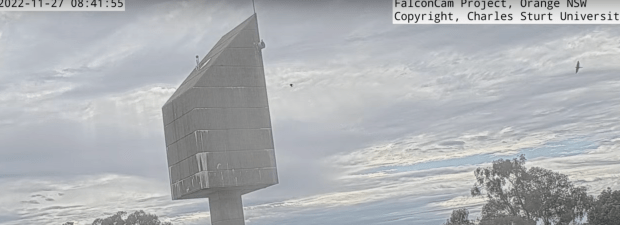
Now let us go back to where this mystery of Rubus begins. At 084155, the tower cam shows two falcons flying. Indigo was in the scrape box at the time. Is there a third flacon sitting on that appendage sticking out on the right near the top? I hope so!

Diamond had been in the scrape and flew out – top image. Then Indigo came into the scrape – bottom image.

It is a tad confusing and perhaps misleading. If there had been three clear falcon profiles around the tower while Indigo was in the scrape box, then yes, we would know. On one occasion a flying bird thought to be a falcon was, indeed, a Swallow. Cilla has said that she will go out and investigate before she heads home. What she needs is to see 4 falcons on top of the tower. Proof. Fingers crossed — and toes.

Cilla has posted a video of the event at the tower. She says she is not wanting to get our hopes up but here is the footage.

There is some indication that the juvenile that was in the scrape box for so long on the 26th in Australia was Rubus but nothing is confirmed.


Breakfast came to Port Lincoln about 090609. Mum was on the nest with the fish and Zoe was elsewhere. Zoe flew in and took that fish and had her fill.

Here comes Zoe wanting that fish!

In Port Lincoln, it looks like Mum has landed another big flat fish at 1309. There she is eating it on the ropes while Dad sits stoically and Zoe is in the nest screaming for fish. I hope that Mum eats her fill. She will always share with her daughter, always, unless she is absolutely starving and sometimes, as we have seen this season, even then.

Well, it is hard to tell what happened with that fish. The camera was fixed in a particular location and if there was a fish transfer to Zoe, we could not see it. In the background you could hear Zoe fish calling so maybe Mum didn’t land on the nest?? Zoe is definitely not going to starve. This fledgling eats more fish than I could imagine. And still wants more!

Dad delivered his second fish of the day at 2043. Zoe in the nest and took it but Mum flew over. I wonder if she still wants to feed her daughter and have a bedtime snack?


No 16. Red List Bird. Pochard

The Pochards are a stunning duck that arrives in the United Kingdom from Scandinavia to over winter in the slower moving rivers and estuaries. There is now, also, a small group of Pochards that stay in the United Kingdom year round. They populate the newly created reservoirs and gravel pits. the Pochard feeds on seeds, roots and other plant material as well as small invertebrates by diving and also tabling.

There are declines in Northern Europe and this will decidedly impact the number coming to the United Kingdom in the fall. One of the major threats to the Pochard are the predatory mink that have invaded their breeding areas. The draining of lowland marshes and fish ponds for agriculture is causing a massive decline in the numbers. The major cause is climate change and there is also a growing number of mink – predators – in their breeding grounds in the north. That could account for a great loss of these gorgeous waterfowl. Other threats include egg collecting, fishing, disease such as Avian Flu, human disturbance, and illegal hunting!

Red-crested Pochard” by Andrej Chudy is licensed under CC BY-NC-SA 2.0.

Let us have a look at this duck more closely in his breeding plumage. He has intense red eyes with a fiery rusty-copper head, a distinctive black breast, a dark taupe on the wings and back, a black rump and grey at the tip of the tail. The under area is white. In this image the bill appears to be red. You would recognise them immediately. The legs and feet are a blue grey for both genders.

Now just look at the female. How beautiful she is with her two little goslings. The eye is the deepest brown-black – not red -with a softer auburn head. The body is white mingled with the same soft auburn from the head.

mare i fill 06, xibecs – madre e hijo, patos colorados – mom and son, red-crested pochard” by ferran pestaña is licensed under CC BY-SA 2.0.

In his text for Red Sixty Seven, Mike Dilger states, ” I will concede that of all our threatened bird species, the more glamorous and charismatic species, such as the Puffin and Cuckoo, will undoubtedly grab the headlines. But, I’d argue, a winter without spotting a Pochard would be even worse than Christmas without a turkey.” (12)


Thank you so much for joining me today. Take care all. See you soon!

Thank you to the following for their videos, posts and streaming cams which make up my streaming cams: ‘G’ and Conservation without Borders, ‘M’, Quoteny, MC, Bernard, and Jean-marie Dupard, OpenVerse, Charles Sturt Falcon Cam and Cilla Kinross, and Port Lincoln Osprey.