11 September 2024
Good Morning Everyone,
Gosh, it is the middle of the week! The days are getting shorter. I noticed this evening when, after celebrating the grandson’s 16th birthday, I started home just after 1930. It was already getting ‘dark’. By the time I was half way home, it was. What happened to those beautiful evenings when we still had light at 2200? And have you had an ice cream cake? I must be the only person in the world that hadn’t until last night. It was so delicious, but the best thing is spending time with almost the whole family. Treasured moments. Everyone is so busy. Some of you will remember Elysha, the granddaughter who came with her environmental checklist more than two decades ago and changed my world. She is heading off to Paris on a European tour in a couple of weeks. I am so proud and happy for her and all of them. The birthday kiddo is in all the school choirs – they are outstanding. I am looking forward to some beautiful concerts this year.
Tuesdays and Thursdays are the afternoons when I have ‘respite’ care come to my house. As a consequence, you might find that the posts are Wednesday and Friday are somewhat shorter. A big shout out to ‘A’ who covers the Australian birds for us!!!!! She is in Melbourne and has a particular interest in those CBD falcons. Today she is thinking about the available prey for them. So even thought it is shorter today, I hope that there is a smile and some valuable information in there somewhere!
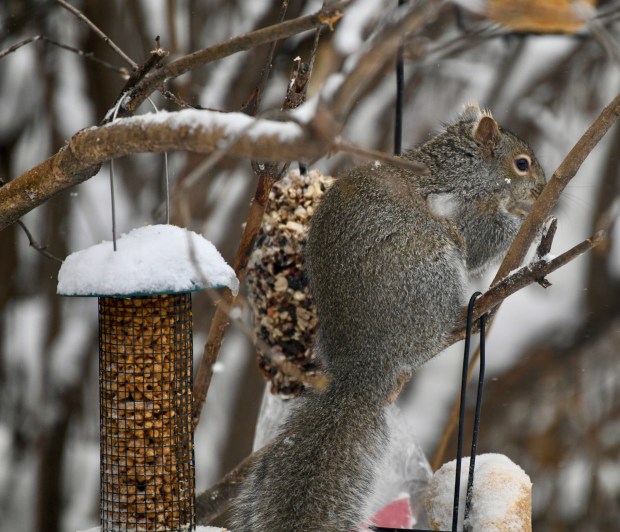
At the feeder was Mrs Downy today. No photo, sorry. I am so glad I saw her along with the Blue Jays, Crows, and other songbirds. Fall migration is in full gear, and we will be heading north to the Icelandic River up near Arborg, Manitoba, to see the fall migration of waterfowl. We have several reservations for goose flights and will be helping out with the cleanup of the shore near Delta Marsh. It looks like the next three weeks are going to be quite busy – delightfully so.
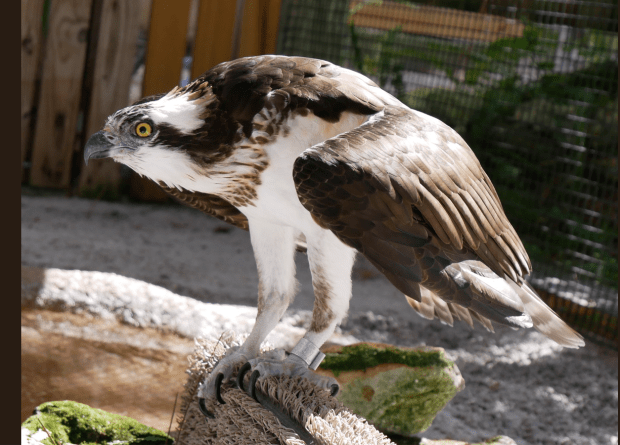
Have you ever wondered about the cost of keeping animals in rehab? Each of you has seen the request for donations when a bird comes into care. Please have a look at what Raptors in Rehab posted in 2022. I would love to see an up-to-date cost breakdown as we all know – everything has increased by at least 25% since then.


The biggest question on most of your minds is: ‘Is Iris still in Hellgate Canyon or has she left on migration?’ Let’s check in and see what is happening there. Here is the latest posting from Dr Green who is keeping a close eye on our family at Missoula:

There is a second posting by Dr Greene that might get you really excited. As you read further down you will see mention of the ‘Iris’ pens. I have had mine for several years since the last time Sharon Leigh’s husband made them. It is wonderful. Could that have been 2020? 2021?
What we have to realise is that Iris is like Dr Greene’s daughter. I think Finnegan has moved into son space – he is so excited about the family this year that a new camera is going up in hopes we have a re-run next season.


Antali had fish deliveries at 0856 and 1013. He was on the nest crying for fish and expecting a delivery at 1413, but nothing came. Both deliveries were from Finnegan. And then Finnegan could not let his lad go to bed hungry, he brought another fish at 1936.

The Owl Cam is showing Antali at the nest or sitting on the nest perch.


The last delivery of the day. Can you just hear Antali fish calling – probably as far as the train tracks. That delivery was at 1936.


If you missed it, you really need to check out the most amazing colours in the sea eagles plumage! https://youtu.be/LRiIuOhlu9g?
From FOBBV, an update on Jackie and Shadow and the Line Fire that is raging through San Bernadino County, California. https://youtu.be/j-lRBiHko6M?s
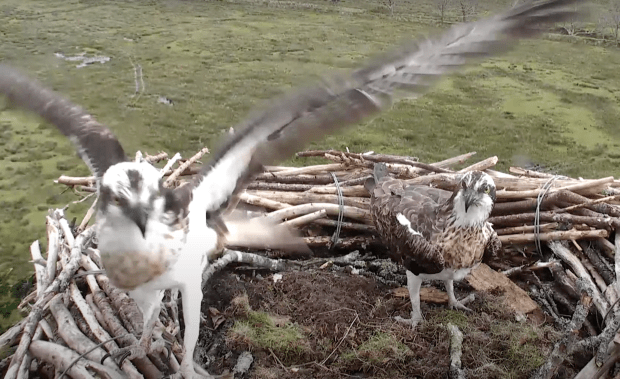
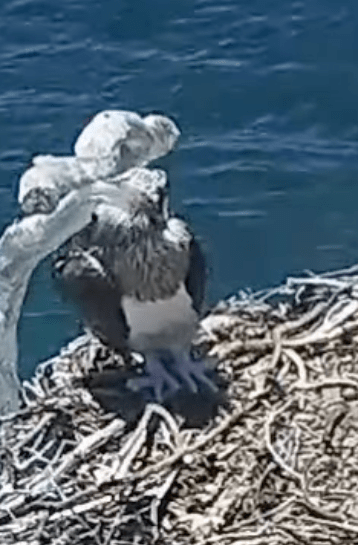
C16 had a really nice fish delivery from Charlie! Looks like the day got hotter as C16 is panting. The temperature in the area was 27 C or 81 F. The hydration in that fish is essential as ospreys do not ‘drink’ water.

Gosh C16 is one beautiful juvenile.

Xavier and Diamond are the favourites of so many of you. Their antics can keep us laughing our heads off. Diamond doesn’t like Starling, and Xavier always wants more ‘eggie’ time. We all know that Diamond is the ‘boss’, but we always shout and cheer for that tiny little male falcon. For those of you who don’t know, Xavier is exceptional. His name means ‘Saviour’, and he saved Diamond and her chicks when her old mate did not return. Xavier brought food for Diamond and the hatchlings, ensuring they were well-fed and protected. That was eight years ago. The pair have been together ever since.

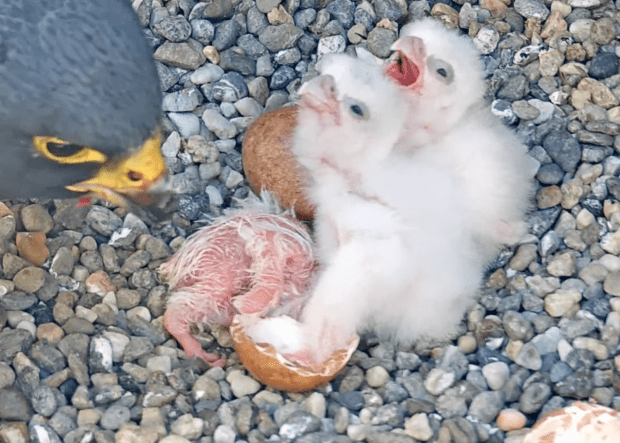
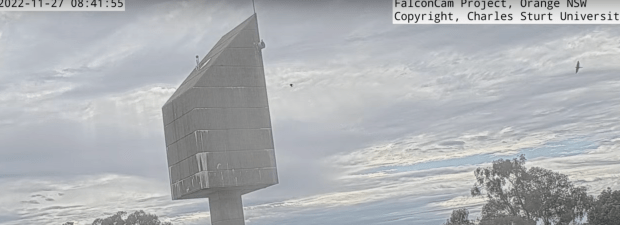
Diamond trying to get Xavier up off the eggs. Meanwhile, Xavier appears to be asking for extra time.


‘A’ remakes: “At Orange, Xavier has been sitting on the ledge, keeping the incubating Diamond company, for about 90 minutes now. (He came into the scrape at about 09:02.) As I have mentioned in previous emails, he really has been doing this quite regularly this year. It is so sweet, and he is the sweetest little male falcon of them all (okay, I may be biased, and some of Annie’s partners have been adorable, but Xavier has been there since about 2016, so he is a long-term resident of our hearts here in Australia, especially considering the circumstances in which he came into Diamond’s life, supporting her and her chicks after mate Bulla disappeared. (I was unaware until recently that Diamond was only in her second season here when that occurred, so she has been with Xavier for all but one of the many seasons she has lived at this scrape.)
Diamond and Xavier are very deeply bonded, and companionable behaviour like this is becoming more frequent each season, based on my observations. I honestly think these two get closer and closer – yes, they work well as a team when it comes to raising chicks, but it is more than that. Xavier simply keeping Diamond company is so very ‘human’, but what else could he be doing? Waiting for egg time? He knows that bringing in a nice pigeon or a plump duckling would give him far more chance of some incubation time than simply sitting there, so that surely cannot be the aim of this exercise. It seems to me that companionship is the only rational explanation for the behaviour. Thoughts? Am I anthropomorphising yet again? But oh how we love little Xavier. “
‘A’ brings up a very good point about the availability of prey in areas abandoned during the pandemic including the CBD in Melbourne: “Speaking of cute little male falcons, the way M22 sings to his eggs at Collins Street just makes me smile every time. He is such a sweetie, but again, as with all new couples, I would prefer that only two of those eggs hatch. Three is a big ask for a new couple, given how rapaciously hungry little falcon eyases are. Let’s hope this pair is up to the task of providing for three chicks. The same of course applies at Orange, where chatters are all hoping for two while you and I are deeply concerned about the welfare of a third hatch at this scrape. Diamond has been very lazy with her second hatches over the past couple of seasons and I cannot even imagine what she would be like with three. Xavier might be allowed to step up and doing some feedings, of course, but wow, he would be working pretty hard. Diamond has a huge appetite (the size of her crop yesterday after her lunch, probably of pigeon, had to be seen to be believed – it was so gigantic, it simply HAD to be uncomfortable, surely) and having to provide for her plus three chicks would really put Xavier to the test.
The Melbourne CBD has not recovered from COVID. Too many office workers got a taste of working from home, and the overseas students who lived in one-room apartments in the CBD (the only real resident community there – it’s otherwise offices and department stores) are only just starting to return in large numbers. My sister lives one suburb away from the CBD, in Fitzroy, and she said that since COVID, they (and other suburbs next to the CBD, such as Richmond) have had a major rat problem. Rats moved out of the CBD because without office workers and shoppers and residents providing rubbish for them to eat, they moved rather than starve. Now they are comfortably settled in Fitzroy and Richmond, of course, no-one has emailed them to tell them that people are back in the city and they can move back to their city digs so they have stayed where they are.
I presume a new generation of rats is growing up in the city, but my point is that the pigeons would also have depended for food on those visitors and residents, so they too would have moved into the parks and suburbs around the city, and would see no reason to move back now. (although they would be way more mobile than the rats and may be aware that the food supply has started to return to the CBD).
The COVID-related changes,though, are presumably going to radically affect the food supply for falcons in the CBD this year. I am very worried that it may be difficult to provision a scrape containing three eyases right now. Time will tell, but I haven’t seen/heard any prey deliveries to the ledge over recent days. It seems mum (whom they are finally correctly referring to as F24 – at least on the videos I have seen) is finding her own food, flying off for a break and being relieved on incubation duty by M22. He does love his eggs, and we love listening to him talking to them. His enfluffling technique is a good one, and three eggs is about perfect for him. Four would be a stretch. “

The University of Toledo says this about the amount of food a falcon requires per day: “How much does a peregrine falcon eat in a day? An adult peregrine will eat about 70 grams (2 1/2 ounces) of food per day. This is equal to about two blackbirds.”
And the Young People’s Trust for the Environment says – if you didn’t know: “Birds are the peregrine’s favourite prey, ranging from small meadow pipits to larger birds such as red grouse and pigeons, although birds as big as a Brent goose may be tackled. In winter, estuary birds are often preyed on, such as ducks, gulls and waders. The falcon may also hunt rabbits and bats. Most victims are caught in the air; the peregrine circles high in the air, keeping a sharp eye out for prey. It can spot prey on the ground from a height of 300 metres. When a victim is spotted, the hunter suddenly snaps back its wings and plunges down in a dramatic ‘stoop’. It can reach speeds of up to 180mph (290 km/h). If the attack is successful, a blow from the peregrine’s sharp talons breaks the neck or back of the flying prey.
Birds on the ground and in hedges may be flushed out as the falcon flies over vegetation, and then they are pounced on. The catch is immediately taken to a plucking post such as a tree branch or rocky crag, and the feathers are pulled out. The whole carcass is eaten and any indigestible material is regurgitated in the form of pellets, usually near the peregrine’s nest. A peregrine eats about 100g of food per day. “
That gives you some idea of what the birds eat in an ideal environment. Falcons like catching the birds in the air so I am not worried about the rats – leave those to the owls and the hawks!
‘A’s final report for the day, “Finally, an update on our albatross chicks. There is good news on the contents of TF’s bolus, expelled I believe on 6 September. It contained three small pieces of plastic, a bottle top, and nothing else but squid beaks and more squid beaks, plus a few extra squid beaks. I was SO happy to see that. Yes, three pieces of plastic and a bottle top, but they made up a tiny percentage of the total (it weighed 75 – about 2.5 ounces in imperial measurements I think). There is a photo of it on the site. https://www.doc.govt.nz/nature/native-animals/birds/birds-a-z/albatrosses/royal-albatross-toroa/royal-cam/royal-cam-discussion/
We are on fledge watch, I think. It will be a matter of when the winds are favourable and the mood takes them. Lilibet’s fledge was a bit of a shock, and I fear it may have been a fludge – she was one of the younger chicks in the colony but fledged very early, into a storm. I worried about her so much. But the look of intense joy on her face in those final seconds before she launched into the winds of that storm, I will never forget. This was a creature about to embark on the epic journey that was her destiny. It was a highly emotional moment, and yes, I sobbed like a baby. I hope this year, they wait until they are physically stronger than Lilibet, as Manaaki did last year. But we could have fledges any day now.
One of the reasons we are not getting weekly weigh-ins now is that the rangers are doing daily head counts so they know whether any chicks have left – the chicks will often move away from their natal nests to find a suitable launching place (based on the winds, obviously) for their fledge. Rangers keep a close eye out so that any chicks who don’t make it (ending up on a beach or ditching in the bay itself) can be rescued for a second attempt at fledging. “

I am posting it again if you did not see Geemeff’s season highlights video from Loch Arkaig. This year was sadly bittersweet with the death of Little Bob due to siblicide/starvation when food deliveries dropped and weather was bad. https://youtu.be/DO7XJOA6OEs?

This reminds me. If I am missing any bird from our streaming cams that died, let me know. Thanks so very much.
‘PB’ has been contacting Niagara Bee to no avail. They were to check the video feed and determine what killed one of the fledglings in the nest.
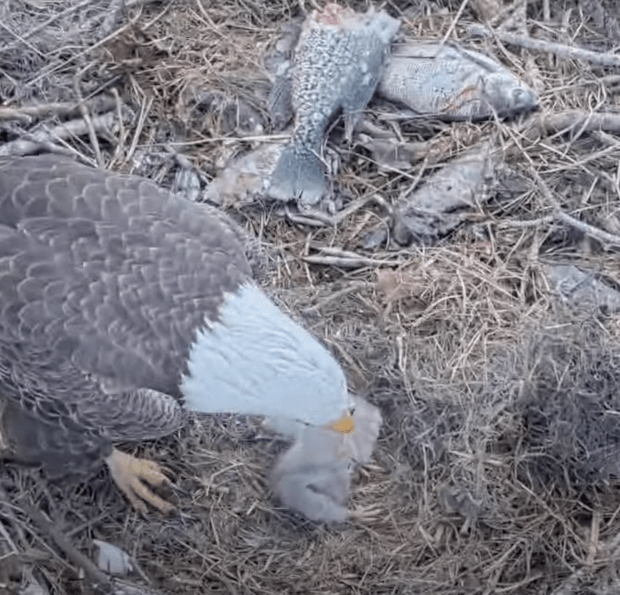
J’ sends news about the Duke Farms Bald Eagle nest:

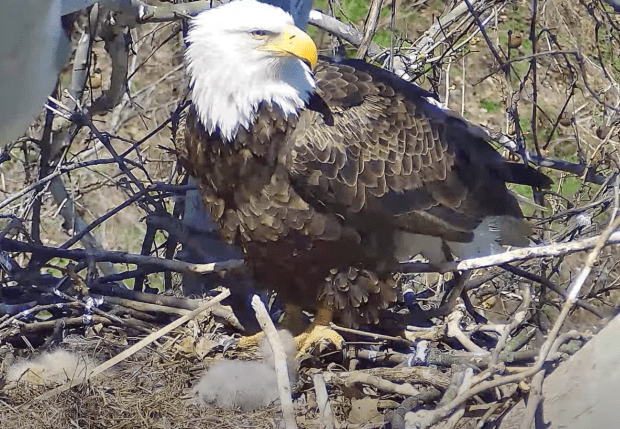
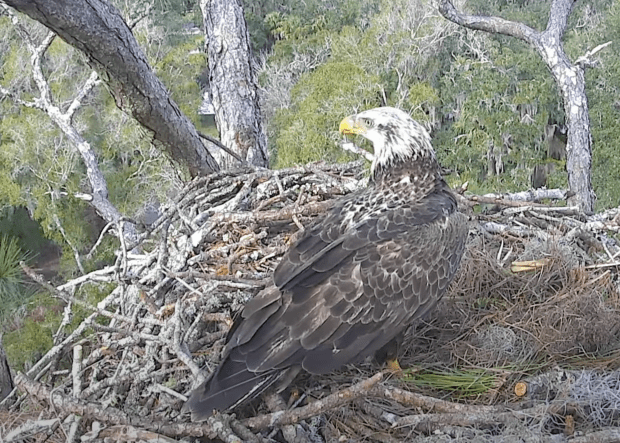
The Bald Eagle nest that everyone is watching is NE Florida. The necrotic toe male was at the nest early Tuesday, cuddled up with Gabby on the branch. Beau was there later and appears to be keeping any other ‘intruders’ away.


The Osprey translocation project in Italy is doing well.

There must be a lot of exasperated people in the UK when it comes to the mysterious deaths of raptors. Laws do not seem to stop the shooters. The penalties when they go to court are laughable. What a sad situation and now eight more dead or missing – beautiful Hen Harriers.
These owl faced small raptors are one of my favourites. They live in the heather on the moorlands in Scotland and make their nests on the ground. They are one of the most endangered raptors in the UK. They feed on grouse and other small birds which puts them in peril near the grouse moor hunting estates. It is there they are shot or their innocent chicks trampled to death in the nest.

“Hen Harrier (Circus cyaneus)” by gilgit2 is licensed under CC BY-SA 2.0.
Last, but never least, checking in with Skylor in Nova Scotia’s Russell Lake area. If you haven’t seen this FB group, do. What a laugh. Connie and Don Dennis have managed to get everyone in Nova Scotia watching and reporting on their local nests. It is incredible. More than 30 of them! I bet camera and binoculars – oh, gosh, scope sales soared, too, like the ospreys.

Calico’s Tip for the Day: Leave the Leaves. Don’t Bag them. That could injure the insects. If you must, rake them carefully into a corner. Put away that noisy leaf blower. It is annoying to everyone that has sensitive ears. Just constrain yourselves. Leave the leaves alone. Take that time to read a good book or go for a walk OR pet a cat!

Thank you so much for being with us today. Take care. See you soon!
Thank you to the following for their notes, posts, comments, articles, images, videos, and streaming cams that helped me to write my post today: ‘A, Geemeff, J, PB’, Raptors in Rehab, Montana Osprey Cams, Montana Osprey Project, SK Hideaways, FOBBV, Owl Research Project, Charles Sturt Falcon Cam, 367 Collins Street by Mirvac, University of Toledo, YPET, NZ DOC, Geemeff and the Woodland Trust, Conserve Wildlife of NJ, NEFL-AEF, Gregorious Joris Toonen, Raptor Persecution UK, Open Verse, Ospreys of Nova Scotia, and Detroit River International Wildlife Refuge.