Bobbleheads, pips…Sunday Morning in Bird World

Good Morning Everyone!

Oh, Saturday looked promising for a nice walk in the forest. No! It was only -12 C but the winds were gusting more than 16 kph which means wind burn. I ‘decided’ reluctantly that it would be a good morning to clean house while listening to Ferris Akel’s tour. At the same time, I was very much aware of the European Starlings – all 40 of them – that had descended on the garden. Out went two new cylinders -a plain butter bark one and a seed cylinder. The images are poor because of the light. The Starlings came not just to eat but to ‘sun’ themselves on the tips of the lilac branches rotating their bodies to get warm. Brilliant.

These Starlings are nothing short of gorgeous. They live in harmony with the many sparrows that show up at the feeders. It is the squirrels that cause most of the havoc claiming the entire 10 metres of lilac bushes as their own.

All four of the squirrels were out and about – Dyson and two summer babies and Little Red. The images of them could not be lightened any more. It is unfortunate as this little summer offspring of Dyson is so cute. My offering is one meagre image. This little male was finding peanuts in the snow and eating them. So sweet.


My top story is a shout out to the wildlife rehabbers and the vets in Prince Edward Island for undertaking only the second spinal cord compression injury and the eagle surviving! When I was a professor, one of the things I valued was curiosity above almost everything else. ‘What if I did this?’ ‘How can we improve that?’ ‘Could something like this work?’ Questions that often result in our wildlife having a second chance at life. I wish more vets and rehabbers were as curious as some who make milestones in our understanding of raptor injuries and the potential with groundbreaking surgeries. Congratulations to everyone.

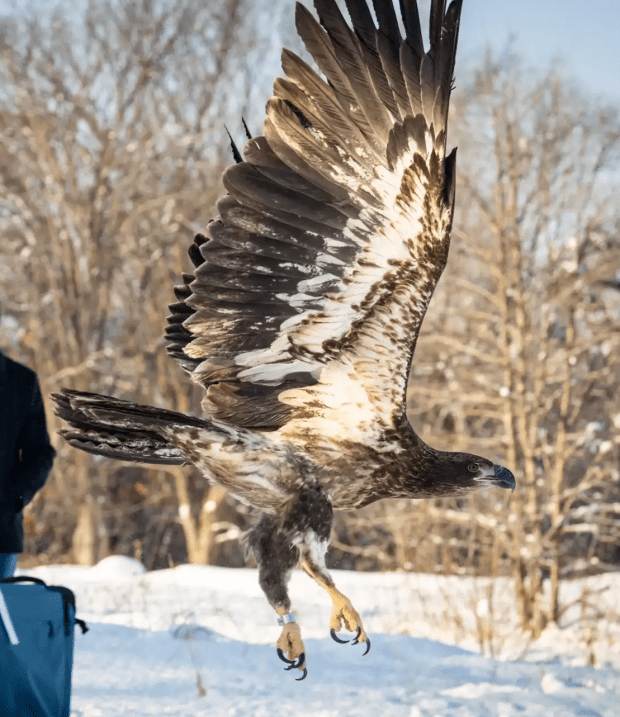
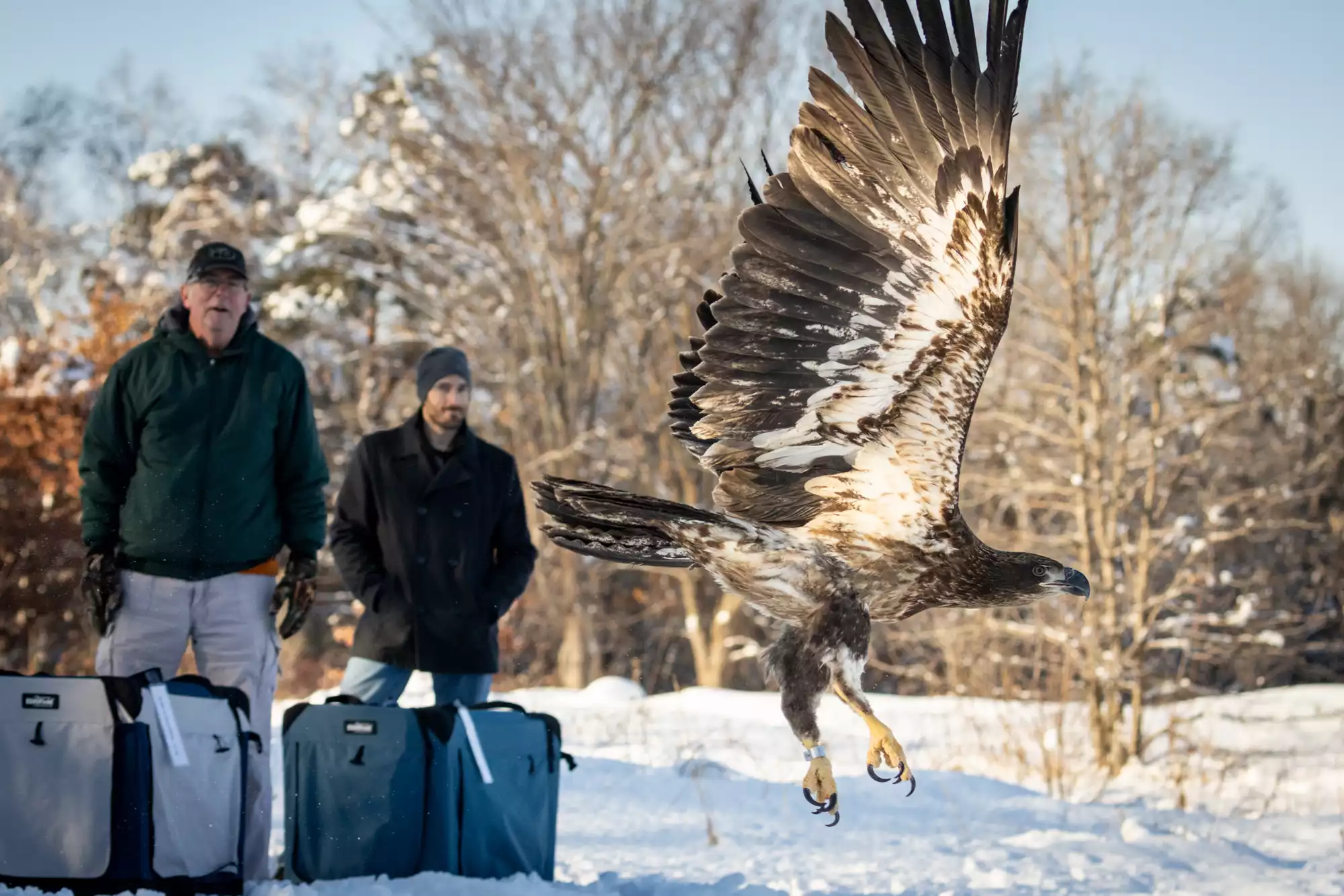
More good news. Another six of the Bald Eagles who suffered in Minnesota from phenobarbital poisoning (and some with high lead levels) were recently released. The staff at the wildlife rehab centre had to physically remove the poisoned/euthanized pets from the stomach of these beautiful birds before they could be treated. There were thirteen in total. One had Avian Flu along with the poisoning and died. Another two died leaving ten that were nursed back to health.

‘A’ has reminded me that pip watch will begin in one week at the Royal Albatross Colony on Taiaroa Head. The Royal Cam parents are GLY and L. What is so fascinating to me is how the NZ DOC recognises the impacts on Climate change and is trying to do something about it! ‘A’ included this quote from Ranger Sharyn Broni when she wrote, “

Virtually all the eggs will be hatched in the incubators as the increasingly hot summers make the risk of fly strike too great. We see the effects of climate change on these large birds quite markedly. During the 1950s for example, this type of work would have been unnecessary. By the 1990s conditions were more frequently hot enough to cause fly strike at some nests some of the time. It was during the 1990s that methods to repel flies and also to keep toroa cooler on the nest began. By 2018 fly strike is almost a certainty if the egg is left at the nest to hatch.

The dummy egg holds the parents on the nest while the egg hatches in the incubator over several days. The nest will be sprayed with AIL (Avian Insect Liquidator) to clear out any flies that may be living in the nest. The newly hatched chick has AIL applied to it prior to it being returned to the nest.

It is a whole lot better cleaning out kitchen cupboards and little ‘kitten’ things all over the house while listening to Ferris Akel’s Saturday Morning Bird tour of the Montezeuma/Ithaca area of the Finger Lakes area of upstate NY. I can stop and look if I hear something of interest or just listen. Ferris is a great advocate for being outside and for birdwatching as a way to let the stress of the world go! I will keep reminding all of us this winter as it is far too easy to stay inside on bad weather days. And sometimes advisable to do so!

There were Snowy Owls, swans of various species, gulls of various types including a Black-backed gull, Canada geese, Red-tail Hawks (a young adult with a red tail and light eyes), Northern Mockingbird, and Bald Eagles on the morning’s tour.

The images were chosen for very specific reasons.

Snowy Owls like ‘snowy, northern climates’. There are always a few around a small airport that Ferris frequents. They are commonly seen in the fields of the province where I live, and one, as you know, is in Southern California this winter!!!!!

A juvenile Tundra Swan with the grey head. Strangely, we have one still living in Winnipeg in an area that has some open water. It should not be here. Will it survive? So far our temperatures have not been constant -32 to -38 C. So, I am hopeful. Our climate is changing so it will be interesting if more stay in the future.

It is Bald Eagle hatch season in the US and while we all get giddy over little pink tootsies, it is good to know how the little eaglets change in their appearance until they become the iconic bird with it sure white head. The image below – look closely, has the yellow smile I spoke about yesterday in the eaglets on the Superbeaks nest. Its eyes are still dark but not as dark as the month olds at Superbeaks. They will continue to lighten. The cere, mandible, and beak are all espresso brown. The head is brown and the body has scattered white and brown striations on the chest. The eagle at the top fits nicely into being a year and a half old according to Avian Reports picture chart on eagle development (below this image). If it were a year old it would have prominent white streaks in its head.

The two eagles below are an adult pair. The beak and the head are definitive means of attributing age. Look at the chart often. It will not take you long to single out the age. But, always remember, eagles can get ‘stains’ on their feathers, especially the tail feathers and sometimes the head. So then look at the beak!

This is a gorgeous Red-tail Hawk. We know that it is at least a year old because it has its red tail. But the eyes remain light so it is not a full adult yet. What a beautiful hawk. My goodness you would think that it was a copy of a young Big Red with its extraordinary apron.

Those eyes are part way between a juvenile (blue/green) and an adult (dark chocolate).

Ferris spotted Big Red when he entered the Cornell Campus. For some reason, the sighting was very emotional. Big Red will be 20 years old this year. What she has gone through to survive that long is beyond imagination. As far as we know, she has only ever had one chick not fledge and that was K2 who had to be taken into care because of a beak/jaw infection/deformity and who had to be euthanised. She is the most famous Red-tail Hawk in the world and rightly so. She will be laying eggs in mid-March.

Ferris caught up with Big Red on one of the light stands as the light was really going late in the day. You can see the wind is really blowing. She is holding on tight to the bars of the stand. Every sighting of her is a joy. It is 1 degree C and the wind is blowing at 14 kph on the ground so it is really windy on the top of the tower. Evan the tower is moving a lot.

Ferris also found L4, the 2022 fledgling of Big Red and Arthur. It was the first year that Big Red had four eggs and had four fledglings. No one believed a 19 year old hawk could do that – Big Red is changing everything we know about Red-tail Hawks in the wild.

In this side view, you can clearly see that the eyes are still light. Not yet a year old.

L4 looking up as some Canada Geese fly overhead.

Little E22 is already such a cutie. Harriet and M15 are a dynamic duo. The DNA running through those two eagles gives us very strong eaglets right out of the broken egg shell. E22 is standing up pretty good…only a few hours after hatching.

Want some fish, E22?

By late afternoon, it was apparent that 21 and 22 had several feedings. There was fish juice all over them. Any bearing came accidentally from 22 whose eyes are not yet focusing. Harriet and M15 must be the most patient feeders!

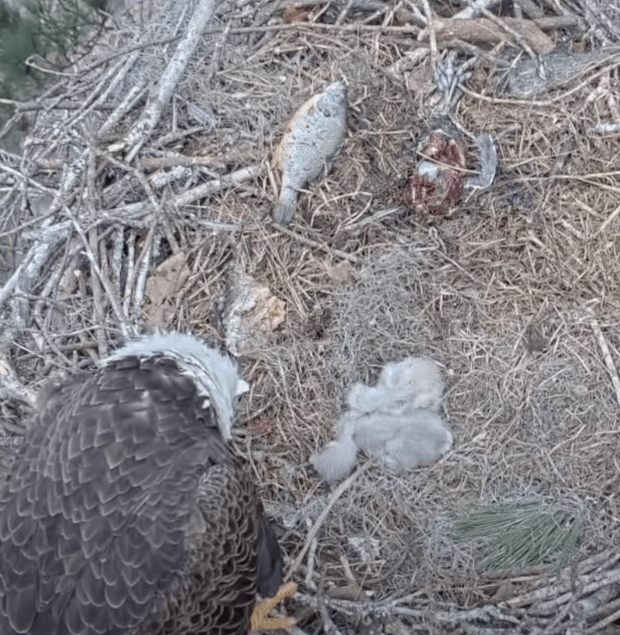
At 1757, they both had juice and matted feathers everywhere especially 22. The following image gives you a terrific look at that egg tooth and how it extends so much below the mandible. Imagine the eagle on its back hammering away.

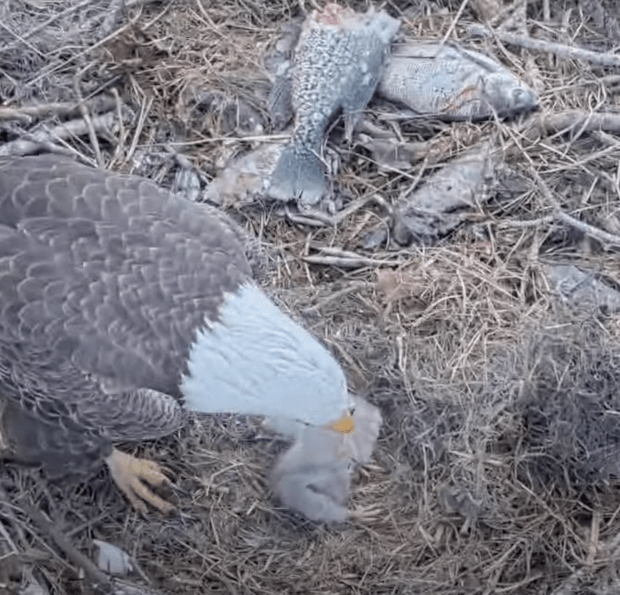
Harriet and M15 are great partners. It was only a matter of time before 21 bonked 22. So Harriet, who had been feeding the pair alone, called in M15 to help. Lady Hawk caught the tandem feeding in the following video.

At Anna and Louis’s KNF E-1 nest there have been plenty of opportunities Saturday morning to see the eggs but, no obvious pip. Eggs are 39 days old and 34 days. Average hatch time in Louisiana is 35-39 days so folks are sitting on the edge of their seats to see if this young couple will have a hatch (or two) this year.

Both Anna and Louis have been incubating and rolling the eggs. Louis is a great provider and Anna has proven to be a really good eagle Mum. I was so hopeful they would have two chicks this year as the food resources are there but, it might well be that they, again, have only one. One is fine!

Oh goodness. There is a pip seen after 1300 Saturday. Jumping up and down! Tomorrow there will be a wee one for Anna and Louis. (could be later in the day on Sunday depending on its progress)

At 1652, you can really see the progress that little eaglet is making. Well done!

It is raining in Louisiana this morning. Louis covered the eggs with nesting material not giving us any hint as to how the hatching is going!

At the E3, nest of Alex and Andria, the two eaglets are growing like bad weeds in the garden plot.

Look at the bottom of E3-01!!!!!!! Well fed eaglets, both of them.

Eggs are being rolled at Metro Aviation. It is unclear if there is a pip. I saw a black spot but I think it is nesting material. Will these eggs hatch? The first egg is 42 days old today. The second egg is 39 days. Remember the average is 35-39 for Louisiana Bald Eagle eggs. It is possible that neither egg is viable. But we wait and hope for this couple.

At Berry College, Pa Berry was on the nest. We have some time before pip watch for these two Georgia Bald Eagles. Egg 1 is 26 days old today and egg 2 is 23 days old.

All is well at Superbeaks! Both are on the nest and I haven’t had to scream yet today about the lack of chair rails…but, oh, I wish these eagles would strengthen the sides of this nest.

Rolling eggs at Captiva. Next week is pip watch for Connie and Clive at the Captiva Bald Eagle nest. That is a very clear camera image!!

At the Captiva Osprey nest, Andy and Lena are now replaced by FO and MO. They need to bring more nesting material and everyone would love to see some fish gifts. There is still time! Rumours have it that the pair mated on the nest for the first time on Saturday. I did not see it and I screamed at the rewind on the camera! I can neither confirm nor deny.

Elain continues to keep us up to date with her daily video summaries from Orange. Indigo made only one appearance on the 7th of January! Much more quiet, yes.

Geemeff posted an article on Twitter that is really informative about tracking devices and how they are so useful to our understanding of the movements, behaviour, and challenges our wildlife face. It is a really good read!

So where does a disappearing elusive Australian Painted-Snipe go if no one has hardly ever seen one? Just look at how lovely it is in the image above. I love that white eye line.

https://www.theguardian.com/environment/2023/jan/08/vanishing-bird-the-mystery-of-the-near-mythical-australian-painted-snipe?CMP=share_btn_link

Keeping closer to home and keeping in mind that lovely book, Slow Birding (I think it is the favourite of 2022), I want to remind all of us that we can do things at home now or next year to enrich the lives of the visitors to our own gardens.

  • Provide shelter. No, it doesn’t need to be some elaborate structure. It could mean leaving some of those tall perennials in place to provide a place away from the wind or rain. If like me you have had to cut trees down (yes, sadly), place the limbs and branches around the garden preferably stacking them. Great shelter. In addition, the rotting wood will provide great feasts for birds that feed on insect life. I have several different 60 cm tree trunks that are now about 20 years old. The birds peck away at them in the spring and summer as they are slowing breaking down into a kind of mulch.
  • Looking at the seed and garden catalogues and wishing. Consider – and you must consider your own planting zone – climbers for shelter in the fall and winter but also plants that are bird, bee, and butterfly friendly in your area. I am looking for quick growing berry bushes and a couple of trees with berries right now to plant in the spring. The birds will all thank you.
  • If you have the space, the finances, and the physical ability, why not set up a couple of bird feeders? Feeding the birds really gives them a boost and a better chance at winter survival. Also consider seeds with shells and no shells. All of my garden birds love the Black Oil Sunflower Seeds but the empty shells make a huge mess. You can purchase already hulled seeds. (I rake mind and push them to the back of the mini-forest where they break down and help the soil). If you do put up feeders or bird feeding tables, you have to be able to clean them. Feeding birds is also about responsibility to them so they do not get disease. “The National Wildlife Health Center recommends cleaning bird baths and feeders with a solution of nine parts water to one part bleach. (If there is visible debris, scrub it off before soaking in the bleach solution.) Dry out the feeder before hanging it back up”.
  • Want to give the birds some treats? These ideas I originally found on the RSPB website. You can blend birdseed with unsalted nuts, raisins, and lard and press it into moulds or over pinecones and hang outside. Do you have some old hard cheese that could be grated? (no Blue apparently). Birds love it. My Starlings are loving pieces of apple and pear as well as raisins, sultanas, and currants. It is a good way to use up some bruised fruit. I put chunks into a tray feeder.
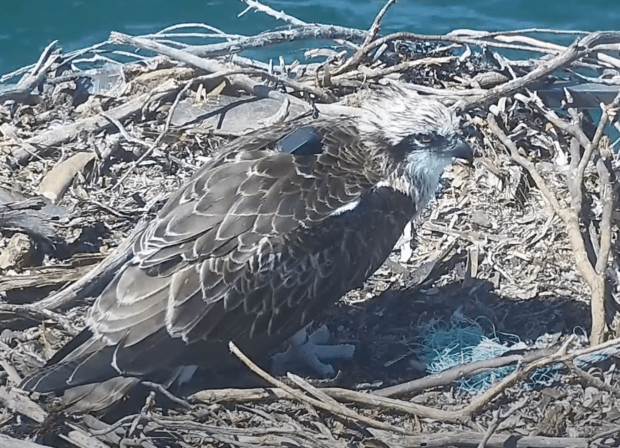
It is always my pleasure to bring you some of the recent news about our feathered friends. I did not cover Zoe today but rest assured, the girl is eating! Dad brought her a fish yesterday and it is believed Mum added one to that as well. Most days she has 3 fish delivered by Daddy and Mummy Door Dash. Oh, they must be wishing she would move out of the house?? But, they will dutifully continue to feed their girl. No fear. They are dedicated. It is nearing noon in Australia as I write this and Zoe is 112 days old and she is yelling at Mum who is on the ropes for a fish. Time to become independent dear girl. Or are we set to break other records? She is exploring the area but is she exploring places where she could catch fish? And Ervie! Oh, I wish someone would submit some images of Ervie. Missing that beautiful boy.

Oh, thank you so much for being with me today. It is wonderful to know that there is such a supportive community ‘out there’ for our feathered friends. Please take care! See you soon.

Thank you to the following for their tweets, announcements, articles, posts, videos, and streaming cams where I took my screen captures: ‘A’ and NZ DOC, Ferris Akel Tours, Avian Reports, SWFL Eagle Cam and D Pritchett, Lady Haw, and SWEagle Cam and D Pritchett, KNF 1, KNF 3, Metro Aviation, Berry College Eagle Cam, Superbeaks, Window to Wildlife, Elain and Charles Sturt Falcon Cam and Cilla Kinross, Geemeff, The Guardian, and Port Lincoln Ospreys and Friends of Osprey.

Waiting for E22, wildlife protection laws in Northern Ireland and more…Friday in Bird World

6 January 2022

Good Morning Everyone!

It was -12 degrees C with no wind Thursday. The sky was a bright blue and there was hoar frost on the trees and shrubs. My photographs do not do the frost justice – it is like a fairy wonderland out there.

Today was my first walk at the nature centre this year. The lake is frozen and it is gorgeous. Simply gorgeous.

According to the Woodland Trust, “Hoar frost is a type of feathery frost that forms as a result of specific climatic conditions. The word ‘hoar’ comes from old English and refers to the old age appearance of the frost: the way the ice crystals form makes it look like white hair or a beard. It forms when the water vapour in the air comes into contact with solid surfaces that are already below freezing point. Ice crystals form immediately, and the ice continues to grow as more water vapour is frozen. On a still night, it can grow well on tree branches, where the surface temperature is unlikely to rise above zero for several hours.”

It was a bit of a fairy tale day. I had not expected to see any birds but, right off, there was a pair of Downy Woodpeckers – a male and a female – as I entered the forest. It felt like a really nice greeting.

When I went to submit the three Downy Woodpeckers to eBird, Cornell thought that was absolutely too many for this date. Thankfully I had images of the three of them. (The third was at a feeder).

There were only two Red Squirrels that I could see. One was eating out of this feeder and the other one was finding seed on the ground.

The Chickadees are so sweet. They will follow you through the forest.

There had been five deer feeding I was told but, this was the only one left when I got to the hide. It was about 3 metres away from me.

It was a good day to get outside for other reasons, too. E21 hatched! E22 is on its way and will be here by tomorrow morning. E21 is so cute and adorable and in a few days everyone will be yelling at that eaglet to stop beaking its sibling. It just happens. So, today was a good day just to be somewhere else.

And it starts. Those lovely soft feathers are going to be just coated and matted together with fish juice and pieces of prey! M15 had the honours of dropping this big piece of prey on E21’s little beak.

Oh, I hope E21 isn’t a little stinker. Looks like an eaglet with attitude.

Harriet is a pro of an Eagle Mother. How old is she now? 26? 28? The fact that the second egg is already pipping is a testament to her experience. The closer they are in hatch times, the better for them – more evenly matched in their dust ups.

Harriet was feeding E21 when the camera zoomed in and caught the precise moment that E22 broke through the membrane and the shell. Lady Hawk has it on video:

The progress at 0736 Florida time Friday morning for E22.

I am so glad that I did not get to see inside the Superbeaks nest. If you think the age and size difference is a lot at KNF-E3 with Alex and Andria, it has to be even a little more at Superbeaks. That first hatch is monster size compared to the little second one. We are now at the stage where they both have thermal down, there is plenty of food, and both are being fed well. My only worry – that will cause some minutes of loss of sleep – is that one area of the nest without a rail. One of the eaglets was hanging its head over that end today! By the way, jump for joy. The rain cleared off the camera (mostly).

Pepe is an amazing fisher and Muhlady has managed to raise two very different aged eaglets. Remarkable. Now I wish they would get their carpentry skills out and get with adding some chair rails before I have a heart attack!

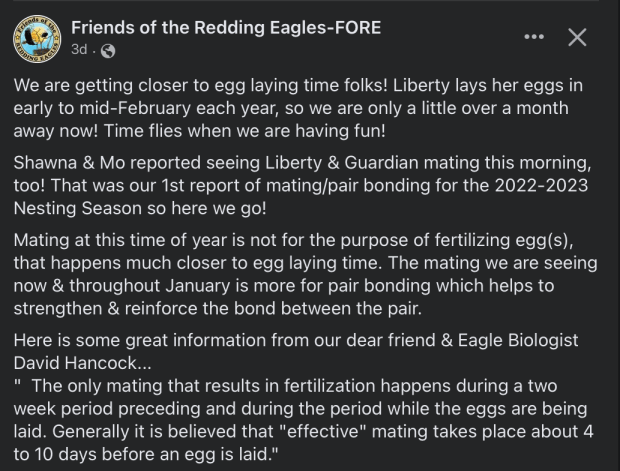
Our very own Dave Hancock answers some questions that have come up about Bald Eagles and mating.

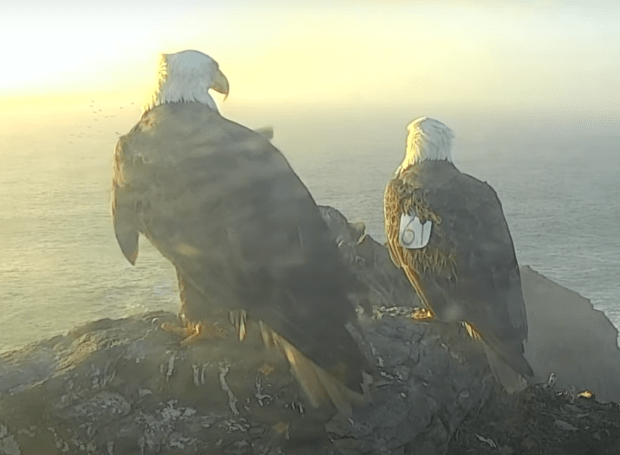
There they are. The beautiful Liberty and Guardian.

Thunder and Akecheta were at their West End nest in the Channel Islands. There has been rain and storms in the area but, it sure is beautiful around 1630 when the pair were spotted on the streaming cam.

The other Channel Islands nests – Fraser Point and Two Harbours – continue to show highlights from last season.

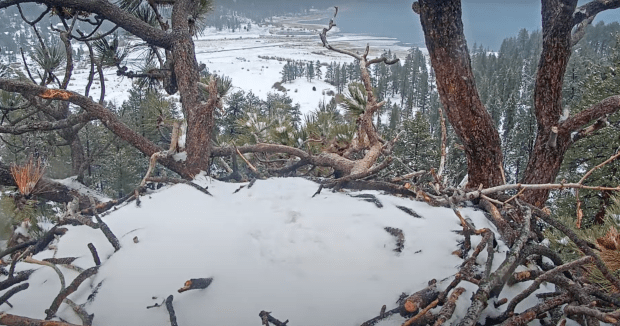
There was rain and pelting hail and show today at Big Bear. It did not stop Jackie from coming to the nest to eat her late lunch at 1344!

Nancy came to the MN-DNR to do a nest check today after the snowy weather yesterday.

The two eaglets at the KNF-E3 nest are doing fantastic. Prey items are continually brought to the nest and if the angle is right you can see the feathers coming in on the wing tips of 01.

They are both getting longer and more slender looking as they move towards losing that natal down and getting their wooly coat.

They still seem to have fat little bottoms with tails coming in.

Gosh, Andria is huge. She sure loves her fish!

The continuing saga of Gabby and V3! Thanks ‘J’. I didn’t see this but saw them sitting together. These two seem to have communication problems over prey deliveries and now Gabby’s signals to want to mate. Goodness.

Lots of eyes trying to get a glimpse of the eggs at the KNF-E1 nest of Louis and Anna. Is there a pip? It is not clear.

My memory – of the first eaglets to die in 2022 of Avian Flu – was the Hilton Head Eagle nest. At the time it was unclear if the parents had gotten sick or died from eating the virus laden prey. This announcement was posted in December. We will wait to see if the eagles return to the nest? Perhaps, sadly, they also passed away later. The GHOWs are still at the nest today, 5 January.

It appears that Diane – of Jack and Diane – at the Achieva Osprey Cam in St Petersburg, Florida is doing better today with her injured leg. That is excellent news!

I am continually surprised at how adaptable wildlife her to the challenges thrown at them. At the same time, I wonder why we do not give them that change to prove themselves? Why not a one legged eagle? Dennis Brecht has photographed one. Just asking. Check out this fox! Only 2 legs.

One reason that I continually peck at this issue is that when I was born, my dad had a three-legged dog that guarded my basket and enjoyed life like any other four-legged animal. I do not recall her having issues but, I do know that she lived to be more than 20 years old.

Before I went to the nature centre, I had a couple of things to pick up. Without naming the store, I noticed a woman fumbling around with a lot of things in aisle 6 – this aisle was fully of products to get rid of ants, mice, etc. I decided to ‘be nosey’. The woman told me she had mice and she had successfully used the traps with the cubes of rodenticide poisoning and also just to be sure, she puts glue traps on the floor around the traps.

I am so aware of the harmful effects of secondary rodenticide poisoning because of Missy and Lewis and losing a cat years ago to these designer toxins. Of course, we read about secondary poisoning for our eagles and other raptors every day. Every day. So I asked the woman some questions. How do you dispose of the glue pads once you have caught your mouse who has died a horrifically painful death? Did she imagine that the garbage bag could get ripped open by wildlife at the landfill and then it would also ‘trap’ them? Did she know that the mice eating the solid blocks of poison go outside, get sludgy and a local cat or hawk can eat them and die? I recounted the horrible death of Duncan – nothing the vets could do. This woman had no idea. She also had no idea that our City outlawed the use and sale of both products. So why are they still on the store’s shelf? My rant had zero impact as I saw her loading the items in her cart. She is more troubled by having the mice around and doesn’t care what happens to the pets of others or the wildlife. Sad.

All of this brings me to a very sad story. Remember the eagle floating on the ice? the one who was saved? and went into rehab?

More eagles in a different state – this time Montana – poisoned from euthanised pets being dumped. It sounds like this practice is more wide spread than anyone would have thought. Isn’t it time for someone to investigate and get in touch with every Vet society there is to stop this inhumane dumping practice that is causing widespread suffering in the Eagles. Cremation is the only way. Just do it.

Keeping in the thread of rodenticide and all manner of illegal killing of raptors – their persecution, we know that there are people working very hard to change laws in every country. Once on the books to try and get those laws enforced and then strengthen them when need be. It is not easy as you have seen by the postings from Raptor Persecution UK. I want to be hopeful that ‘finally’ people at all levels – including the highest in governments – will notice that there is a sea change and the population wants our wildlife, our water, and our land protected. We know the importance of this – help spread the word. Finally for today and certainly not least, Northern Ireland passed its own laws similar to those in the UK. Well done, Wild Justice. You can follow their progress and that in the UK by following Wild Justice and Raptor Persecution UK. Here is the announcement. Thanks, Geemeff for reminding me to post this important information!

Northern Ireland: new general licences which permit killing of a variety of birds are now published (link 1 below) The new licences are much improved: fewer species are listed and the lists make a lot more biological sense. For a bit more detail see our blog (link 2 below) 

These licences are now much closer in line with those in England (where we have taken successful legal challenges), Wales (where we took the former licences to court and although we lost the case, the changes that followed were what we had asked for) and Scotland (where changes have happened in response to those elsewhere in the UK and without us having to intervene, as yet). In particular, the slimmed down version of the ‘conservation’ licence, TPG3, only applies during the breeding season and only includes a couple of corvid species.  In addition, the licences are much better and more tightly worded than before.  

It has taken a long time, and quite a lot of effort, and quite a lot of money spent on legal fees, to get these changes but they wouldn’t have happened without Wild Justice. And by Wild Justice we mean you, our supporters too because many of you responded to the consultations (one aborted and one completed) that the Northern Ireland authorities launched.  And, of course, you funded all the legal challenges across the UK. You helped get this change – thank you.

Thank you so much for joining me today. Please take care of yourself as we await the hatch of E22. See you soon.

Thank you to the following for their notes, announcements, postings, Twitter feeds, videos, and streaming cams that make up my screen captures: SWFL Eagles and D Pritchett, Lady Hawk and SWFL Eagles and D Pritchett, Superbeaks, FORE, IWS and Explore.org, FOBBV, MN-DNR, KNF-E3, NEFL-AEF , NEFL-AEF and Lady Hawk, KNF-E1, Hilton Head Island Trust, Achieva Ospreys, The Telegraph, Terry Carman and Bald Eagle Live Nest Cams, Geemeff and Wild Justice, and Wild Skies Raptor Centre.

Pip for Anna and Louis, hatching at SWFlorida…Wednesday in Bird World

4 January 2022

Good Morning Everyone!

The excitement has been growing with more than 2528 persons watching Harriet and M15 at the SWFlorida Nest as their first hatch of the 2022-23 season is trying to make its way into the world. It is now 1000 Wednesday morning. The little one has been working away for 26 hours and there could be much time to go. It is hard trying to get through those hard shells and often the wee babes are exhausted when they have finished hammering away with their egg tooth. It can take from 24-72 hours. Jackie is not giving away any peeks. There is a pip for Anna and Louis in Louisiana also. Things are beginning to happen….and they will begin to happen fast it seems.

On Everyone’s Mind:

At just after 0800 on Tuesday 3 January, SWFlorida announced that the pip on one of Harriet and M15’s eggs was official.

From pip to hatch can be 24-72 hours.

By mid-afternoon, the little beak could be seen moving inside the small hole. There are now cracks appearing that will radiate out from the pip hole.

Gracie Shepherd caught that little beak working on that shell.

No announcement of a hatch yet this morning.

Making News:

There is a pip for Anna and Louis at the Kistanchie National Forest E-1 nest this morning.

What does politics, friendships, old school ties, and hush ups have to do with the persecution of raptors and the use of illegal poisons in the UK to kill Corvids and other birds and wildlife? It would appear a lot! Despicable.

Check out the latest blog at raptor persecution.uk.org

To counter these horrific deaths in the UK, there is good news coming out of Minnesota. Remember the 10 eagles that survived (3 died) that had eaten euthanised pets at a landfill? Well, they are well enough to be released back into the wild. Well done Raptor Centre! What a great story for the new year.

Another good news story of a sub-adult eagle being rescued and then found to be suffering from some rodenticide poisoning. Thank goodness for the wildlife rehabbers that spotted the thinness and took blood tests and treated this beautiful boy.

No news on any charges being laid for those that dumped the dead euthanised pets.

The raptors have such a difficult time because of humans. Two of the leading causes of their misery can be eliminated easily: ban the use and use of rodenticides with heavy prosecution for any found using these designer poisons and ban the sale and use of lead ammunition and fishing equipment. Every wildlife rehabber in the world will be grateful.

Loving the Kakapo? and thrilled that there more living than ever before they were almost made extinct? The new ones are going to get names! Congratulations everyone. It has been a good year – a real indication of the efforts being made to keep the islands disease and pest free.

Let’s educate ourselves. The Audubon Society has put out a really informative article about feeding birds. It is not just about the food but how our actions can actually harm our feathered friends. Many of you wrote to tell me that you had Scrub Jays in your area but, have never seen a Blue Jay like Junior and Mr Blue Jay. Scrub Jays are a species under threat; they are on the IUCN Red List for endangered birds. How do you help?

Bird lovers quickly realized that Florida Scrub-Jays will come readily to the hand for peanuts. Unfortunately, studies have shown that jays fed by humans reproduce earlier in the year than those that are not. As a result, their fledglings hatch before the caterpillars they rely on for nutrition are available, leading to malnourishment and starvation. People also feed jays near roads, and collision with vehicles is a major cause of their death. Thus, it’s now illegal to feed Florida Scrub-Jays unless you have a permit from the U.S. Fish and Wildlife Service.  

The Audubon Society, ‘When It’s Okay (or Not) to Feed Birds

Here is the entire article. It isn’t long but it is packed with good information.

https://www.audubon.org/news/when-its-okay-or-not-feed-birds

Nest News:

It was soggy in Louisiana as that weather system moved through the area. Andria was wet. The winds are quiet but there is a 95% chance of continued rain the area. It is 77 degrees F.

Andria took advantage of a dry moment to feed the two eaglets.

The eagles at Kincaid Lake are so lucky – a huge stocked area for them to get their prey. The eagles at Decorah, Iowa are lucky, too. A trout farm right across the road!

Images of Gabby at NEFlorida’s Bald Eagle nest at The Hamlet on 3 January. She is beautiful. Where is V3? At 1745 V3 is on the branch, he jumps into the nest alerting and flies off to the right alerting.

V3 is a very good defender of the realm. Some think he has new battle scars on his talons. Probably. He is wet but has a big crop. Been fishing?

V3 does have some cuts on his talons but the blood could also be from the prey that he ate. It does not have to be a battle wound with blood.

Before he takes off, we get a really good look at his crop. This eagle is a good hunter. He is quick to protect the territory keeping all intruders away. Just what Gabby needs.

Those darn mosquitoes and other bugs are not bothering Gabby and V3 as much tonight and both are on the nest. Probably guarding it, too.

Rose and Ron were working on their nest today. Gee, I wonder if we will have eggs there this year?? Apparently Ron and Rose had a visitor to the nest – V1, the first female to try and win Ron’s affections. And who says Eagles do not hold grudges and do silly things in revenge??? Apparently V1 did a ‘ps’ right in the nest bowl where Ron rests today!

Ron and Rose are a beautiful couple. They posed for the camera after the restorations.

Things are still going well at the Superbeaks Eagle nest in Central Florida. It is frustrating trying to get to see the eagles. Without a time stamp I cannot tell you when to rewind but, if you do rewind, you can catch glimpses as the sunlight on the camera lens changes throughout the day. A worrisome hole or a nest collapse where the rim meets the branch on the left has appeared. I hope PePe or Muhlady will bring in sticks to close it up!

It is wet in Louisiana and snow fell on the MN-DNR nest of Nancy and her new mate but, it is unclear how the weather forecasts for ice and snow played out (or will) in the US.

It is snowing and the wind is blowing hard at the nest of Jackie and Samson in Big Bear.

Guess who shows up even with the snow? Time 0644 for Jackie!

Baiba did a winter wonderland video of the visit of the Big Bear eagles today.

The camera operator found Thunder looking out over the water from her perch near her West End nest in the Channel Islands. Time 1518.

It’s raining in Pittsburg. At the US Steel nest, one of the eagles is perched watching the traffic below.

One of the hardest nests to watch in 2020 was the Achieva Osprey nest. The third hatch, called Tumbles by the chatters, was much loved and so very, very tiny. That little one had a will to live like no other osplet I have ever seen – before or after. Everyone counted the bites it got, sat up thinking tonight was the night Tumbles would die (at least 3 times). Adding up all the time in 6 weeks that Tumbles did not get any food equalled 12 days. 72 hours in one stretch was the most.

Well, Mum started catching her famous catfish and she realised that that this third hatch wanted to live and she fed it – sometimes in the dark after the others were full. Tiny Tot Tumbles began to thrive. Tiny Tot became dominant and stayed on the nest after fledge defending it against even adult ospreys. Sadly, today, Tiny Tot’s Mum is injured. It is possible that her leg is fractured. She still comes to the nest. Dad tried to mate but she cannot carry his weight. What will happen to her? Can she be retrieved (the nest is in St Petersburgh, Florida)? and taken into rehab? In the image below, she is calling when she sees Dad arriving with fish for her. He is taking care of her. Anyone reading this know a wildlife rehab in the area that can be asked what might be done? or should be?

The average for Bald Eagles is 35 days. Harriet and M15 are right on the dot. Is the first egg at Metro Aviation not viable? 39 days today. We know that eggs in the southern states where it is warmer generally hatch earlier than those laid in the north.

Everything you wanted to know about Bald Eagles and their eggs is in this simple one page read by AvianReport:

Elain provides a great video of Indigo bringing his prey into the scrape. Always turn the sound up to get the full effect of this darling falcon!

This image came up on a feed. It is such an incredible photograph that it caught my eye. I want to send it out to all our friends in Japan who know there are osprey there but, might not have seen any. Isn’t this a gorgeous image? To get a shot like this you would be in a hide level with the water. There are actually sites that will sell you time to try and get your perfect image!

We are going to close today with an article in The Guardian on the dangers of fireworks to animals. Those reading my blog know this – but, now you have information that you can use to try and get others to cancel any loud fireworks displays.

https://www.theguardian.com/lifeandstyle/2022/dec/30/do-fireworks-harm-animals-we-ask-an-expert?CMP=share_btn_link

Thank you so much for being with me today. We could have a couple of hatchings the next time we meet! Take care. See you soon.

Thank you to the following for their posts, videos, and streaming cams where I took my screen captures: Gracie Shepard and SWFLorida Eagle Cam, SWFL and the D Pritchett Family, KNF-E1, Raptor Persecution UK, Lolo Williams Twitter Feed, The Raptor Centre, Terry Carman and Bald Eagles live Nest and Cams, Kakapo Recovery, KNF-E3, Raptor Resource Project and Explore.org, NEFL-AEF, WRDC, Superbeaks, MN-DNR, FOBBV, IWS and Explore.org, US Steel Eagle Cam, Achieva ospreys, Metro Aviation, Avian Report, Elain and Charles Sturt Falcon Cam and Cilla Kinross, Birds of Prey, and The Guardian.

Blue 497 in Senegal, adult osprey released after 53 days in care…it is Tuesday in Bird World

3 January 2022

Good Morning Everyone,

I hope everyone is well and that the start of the week got off to a good beginning for 2023. It is a warmer day here, -8, and there are lots of sparrows along with Dyson and her gang and the European Starlings at the feeders. It is always good to see them and my heart skipped a little when my granddaughter said she could hear the birds singing as she approached the house on New Year’s Day. Just lovely. What would the world be without our feathered friends singing?

I want to start my blog today with two ‘good news’ osprey stories because, Ospreys are really the raptors that I know best, they make my heart beat just that much faster. The first one is a remarkable sighting because we all know that the majority of the first year fledglings simply do not ‘make it’. The second one is dear to my heart and it is about an adult male osprey taken into care by CROW and released 53 days after being admitted! Remember: Too many people sing the mantra of ‘Ospreys do not do well in care’. This simply does not seem to be borne out by the evidence.

I am super excited. Two Glaslyn Ospreys have been spotted in Senegal. KC4 has been seen previously but it is the youngster, 497, a 2022 fledgling that has me jumping up and down. 497 made the cover of the Glaslyn calendar this year! 497 hatched on May 26 and was last seen at Glaslyn on 13 September 2022. Many of you watched these chicks at Glaslyn grow from egg to fledge. Now Blue 497 is successfully in Senegal. Fantastic. Tears of joy.

What a handsome osprey! The best of Aran and Mrs G in one fish eating bird of prey. Oh, my goodness what a beautiful bird – with great DNA. Can you tell how excited I am?

KC4 is a 2020 fledgling seen in this image before fledging with the entire family. She has been sighted in Senegal various times since she fledged. As I said about 497 – these chicks of Mrs G and Aran have really great DNA. Good DNA and luck – the two things that help the young fledglings. That and experience later. Their Mum, Mrs G, is the oldest Osprey in the UK.

Many of you will recognise the name CROW. They are the wildlife rehabbers located on Captiva Island. Their facilities were hit by Hurricane Ian but many were standing. They have a good news story about an adult male Osprey. Remember this when anyone tells you that Ospreys do not do well in care. We now have a growing file of evidence from chicks to adults that they do well in care – if the wildlife rehabbers know what they are doing and care!

That is simply incredible news.

To the shock of everyone, there is a new little osplet in a nest on the NW coast of Kangaroo Island. Kangaroo Island lies off the coast of South Australia and is Australia’s third largest island.

Xavier and Diamond get to bond without an interruption by Indigo! Can you believe it? Me, neither!

It is so difficult seeing the two eaglets – Pearl and Tito -at Superbeaks. It seems there is more ps on the camera lens. It didn’t stop us getting sight of the largest of the two (I presume) standing up and walking a couple of steps. Can you believe it?

Standing tall!

Then a feeding and both were there. Oh, they are sweet. Looks like a big sister and a little brother to me…but who knows. Or does this camera really distort the size difference? Whatever. Both look great as the sun begins to set on the nest.

Ron and Rose were at their nest today. Rose is a young sweetie. Next year the brown will be gone in her white head. Look closely. Find anything distinguishing. Ron has been working on that nest probably hoping for eggs this year. Will there be any? Perhaps not but who knows. That is the reason that it will be good to try and identify any special features of Rose for next year.

Ron has really made a very nice nest.

The lovely couple.

‘HeidiMc’ did a fantastic clip of Ron and Rose yesterday – a fish delivery, footsie, and bonding! Thanks, ‘H’.

Some people have been very disappointed that there will be a black out of news about Rita and her whereabouts. There is a very good reason for this. WRDC was rehabbing another eagle and people attempted to steal that eagle. That is why the precise locations of nests and now Rita’s future home will not be disclosed. It makes perfect sense. This is precisely the reason that the location of many nests is not published for the safety of the birds. Can you imagine someone trying to steal Gabby?

I did not see a lot of activity at the NEFlorida nest of Gabby and V3. Gabby was prominent on one of the branches around 0948 but after there it appears little presence by either eagle.

Jerinelle Wray posted a video on FB of all the bugs that made V3 move to another branch last night. I took a capture from her video to show you. As she says, “this could be the reason that the eagles are not sleeping on the nest tonight”. You may recall that some cams are now turning off the light at night that attracts insects to the nests and scrapes. It just reminds me that while some will dismiss the bother of the insects, we know that three peregrine falcon eyases at Spirit Bluff jumped to their death because of so many black flies.

The two little eaglets at the KNF-E3 nest are just fine. The oldest one will eat more food because its crop is larger and can hold more. Today, seemed relatively peaceful in the nest to me. Andria has been feeding them American Coot and then switched to one of the two Sunfish on the nest.

02 had a crop and both are sleeping sound in a food coma.

Both Alex and Andria have been doing tandem feedings – a good way to get both chicks full without any beaking. It is a great help and I have always cheered those males that step in – including many of the male UK Ospreys who help out like Louis did with Dorcha when they had JJ5, JJ6, and JJ7 in 2020. Still, Tonya Irwin, the moderator and FB admin for the Kistachie Eagle Cams has placed an announcement on FB today:

I really wondered if Mum and Dad at the ND-LEEF nest would rebuild in the same tree but, like the other eagles who rebuilt after Hurricane Ian (if the tree was still standing), the pair remained faithful to their old home. This is the Bald Eagle nest in St Patrick’s Park in South Bend, Indiana – home of Little Bit ND17. Mum and Dad have done it and the chair rails are going up nicely.

Gosh, I wish that Humane Indiana had gotten Little Bit banded. Wouldn’t you love to know where our ‘survivor’ is?

Andor and Cruz were at the Fraser Point Bald Eagle nest working a bit. — If you go to that cam, be careful. It seems that all of the Channel Islands streaming cams are putting in Highlights now and again. It is easy to be fooled into thinking that what you are seeing is current.

The eagles look to be in very good condition nothing their chrome yellow beaks and feet along with what appears to be good plumage .

Chase and Cholyn visited the Two Harbours nest, too, but I did not see either Thunder or Akecheta at the West End nest today.

Jackie was at the Big Bear Valley nest despite the snow.

There are still some pip watches ongoing or coming up: SWFlorida, Captiva, Berry College, and Metro Aviation to name four. Here is one of the pip watch announcements.

In California, people are flocking to see a rare sight – a Snowy Owl. Here in Manitoba, the Owls literally love our snow. But what is one doing in the heat of the western US?

I have mentioned Cockatoos several times in relation to calls for assistance by one US sanctuary. The real issue is that Cockatoos should not be exported for pets to anywhere. If you have heard them at the White-bellied Sea Eagle nest, their cry sounds like someone being murdered. It is not that nice. They are also pesky toddlers as my friend ‘J’ continues to tell me. Remember the one throwing pots from a second story balcony. Now, seriously why would you want one for a pet? There is an article in The Guardian today showing just how clever these birds are, too.

https://www.theguardian.com/environment/2021/jul/23/cockatoos-in-sydney-learning-from-each-other-to-bin-dive-for-food-study-finds?CMP=share_btn_link

Let’s end with a good news story just the way we began. There are a lot of kind people who are looking out at the ice patches floating on rivers around the world. This morning there are several stories of Bald Eagles being rescued who are found sitting on tiny pieces of ice. Most are juveniles.

https://www.fox32chicago.com/…/bald-eagle-rescued…

Thank you so very much for being with me today. I hope that you have a wonderful Tuesday. Tomorrow a look at the anger around illegal poisons killing Ravens in the UK and investigations into raptor deaths that seem to be going no where. Stay safe. See you soon!

Thank you to the following for their posts, videos, announcements, and streaming cams that make up my screen captures: Brewed Gwyllt Glaslyn, CROW, RAD KI, Charles Sturt Falcon Cam and Cilla Kinross, Elain and Charles Sturt Falcon Cam and Cilla Kinross, Superbeaks, WRDC, NEFL-AEF, Jerinelle Wray and the NEFL and SWFL Eagle Cam Watchers Club FB, HeidiMc, KNF-E3, Tonya Irwin and the Kistachie National Forest Eagle Cam Fans, IWS and Explore.org, FOBBV, CBS, Sharon Dunne and the NEFL and SWFL Eagle Cam Watchers Club FB, FOX32Chicago, and The Guardian.

Pipping at SW Florida? Sad news coming out of Sydney… Monday in Bird World

2 January 2022

Good Morning Everyone!

I hope that the first day of the new year started off in the right direction for everyone. At my house, it meant eating black-eyed peas for luck that I learned as a child growing up in Oklahoma. Today was also a day spent with my daughter and her family – a real treat with everyone together but the son and daughter in law who live in the Caribbean. That said, we did connect with them through the wonderful world of technology so, we were all in ‘the glass room’ together. Laughing. Smiling. Everyone is so busy that it was splendid just to stop, share a meal, and catch up on all the news.


In the mailbox: Geemeff sends us news from Yorkshire in the UK.There are some places that are taking bold moves and are forward thinking that have cancelled New Year’s Eve fireworks. If you know of other Councils or Cities, let me know! This is a good way to start the new year.

https://www.bbc.co.uk/news/uk-england-york-north-yorkshire-64139048.amp

And ‘C’ writes that they have named their squirrel visitor Dyson, too! I think this is marvellous. It is a perfect name for these smart squirrels all around the world who can outwit any bird feeder manufacturer!!!!!!!! (at least the ones in my garden, anyway)


Top story for this morning. At 1027 when Harriet got up, it appeared that there could be a beak pecking its way through the shell of the narrow end of one of the eggs. But, it is now unclear about that mark. It appears to have been some nesting material that caused all the excitement. Harriet is restless. But only a tiny little peck visible in one egg.

There is disturbing weather news coming for the US for the next couple of days and it could have a huge impact on the birds. In San Francisco on Sunday, they received 5.65 inches of rain. That is the most rain ever recorded since 1849 when records began. So what happens to the falcons when it rains like this? Do their prey hide? That area needs water. The reserves are filling but, in some places, there are floods that are going to be problematic and the rain is set to continue with another system moving in.

https://www.theguardian.com/environment/2023/jan/02/weather-tracker-san-francisco-hit-by-second-rainiest-day-on-record?CMP=share_btn_link

The system that brought all the rain to California is going to move into the central US where it will meet up with warm area from the Gulf region. It is going to bring snow and ice to the nests in Iowa. Tornadoes for the area around Alexandria, Louisiana could happen today hitting the nests of Anna and Louis and Andria and Alex and Andria are going to be right in the middle of it, according to one of the current forecasts. I do not watch the weather that much but, I do check on anything that will impact our raptors!

That pink is ice and I am thinking about all of the eagles and other wildlife and birds in that region including Decorah (the system will move through Iowa).

This is a band of tornadoes potentially and Alexandria, Louisiana is right in the middle of it along with our Kistachie National Forest eagle families. You send out all the positive wishes you can to those little eaglets and their parents in E3.

Gabby and V3 were at the nest making restorations today together. I think that it is safe to say that V3 is the ‘chosen’ one to become Gabby’s mate. While we might have had another favourite out of the many suitors that came to the nest, only Gabby knows ‘the why’ of choosing V3 over anyone else. Seeing them together, working on their future, was certainly a wonderful way to spend part of the first day of the new year.

I like his eyes, he brought food, and he seemingly keeps the rest of the intruders away – a real good security guard for the nest and for Gabby. May their lives be long, healthy, and productive – as in cute little eaglets! They sure are a striking couple. But, V3 needs a name. Wonder what it will be?

He is a good provider. Just look at the crop on V3!!!!!! Sadly, Gabby isn’t always there to receive the food gifts.

Another raptor family, Big Red and Arthur, were spotted today on the Cornell Campus by Suzanne Arnold Horning. It is always a gift to see them when it is not nesting time and it is thanks to the BOGS that we are assured of their well-being. Thank you Suzanne!

Arthur sitting on top of a post looking for a vole to move in the grass. If you think about it, raptors hunt so differently. The Red-tail Hawks sit, sometimes for 45 minutes to an hour, elevated – waiting and watching and then they swoop down. Hen Harriers on the other hand fly low over the landscape once they have identified where their dinner might be. Ospreys hover focusing when they find a fish and then making that dramatic dive. They are as different in their behaviours as they are in their plumage. And Red-tail Hawks are gorgeous. My friend Toni died this year. Her and I used to banter back and forth over the most beautiful plumage. I can say that she certainly got me to appreciating that of the White-bellied sea eagle juveniles. In the end, though, they are all gorgeous in their unique ways.

Big Red. She is looking really good for a 20 year old Red-tail Hawk!

Cornell posted other images of Big Red from the 31st on their Twitter feed today.

It was raining at Orange and Elain caught some good images of one wet falcon in her daily summary of life with Diamond, Xavier, and Indigo.

There was lots of action on New Year’s Day and Deb Steyck caught Bella and Smitty arriving at the NCTC Bald Eagle nest. It is good to see them together. Last year Bella was injured in a territorial battle. She did not return to the nest for some three weeks while Smitty took up with another female. Bella kicked her off the nest and out of the area and, well, it is good to see the two together this year. Hopefully there will be little eaglets this year to make up for last!

So let’s have a conversation about one legged eagles. But before I begin, there are deer in my community that live a normal life in our urban forests and have only three legs. When I grew up, my parents had a three legged dog. They were able to adapt. While one might want to argue that an eagle with just a single leg could not possibly fish or feed itself and would starve to death, please read further down. And if you know of an eagle in the wild living with a handicap, send me a note.

There has been a bit of discussion about Clay, the one legged eagle that was in rehab at Wild Heart Ranch near Tulsa was euthanised. I have not followed this case closely but, it was a second trip for the bird who went back to the first place where it was rescued. Clay arrived with a badly infected foot that was later determined to be dead along other injuries. It is not clear to me how he was injured. It is, however, my understanding that the regulations of the USFWS do not allow wildlife rehabbers to keep one-legged Bald Eagles. Please correct me if I am wrong. I also came to understand today that it was that policy that drove the euthanasia. Again, please correct me if I am wrong. No one wants an eagle to suffer, let us be clear. This decision has prompted some to ask about the policy in light of animals living in the wild with less that the normal number of legs.

Today, an individual who has spent years around the Mississippi taking images of the Love Trio, Dennis Brecht, posted a photo he took of a Bald Eagle with one leg flying around the Mississippi at the location in the posting. Just saying. That eagle looks pretty healthy. — I have seen Dennis’s images for several years now and do not believe him to be a person who would deliberately manipulate an image.

So this brings me to another eaglet, WBSE 29 – who we all grew to love at the White-Bellied Sea Eagle nest in the Sydney Olympic Park has been euthanised. I just received a note from a very trusted individual who taught me much about eagles and kept my focus straight and not off in fantasy land. Tonight there are plenty of people whose emotions range from disappointment to fury. Here is the announcement:

As you know SE29 was rescued in early October, after some sort of severe trauma (we are not sure if he flew into a window or was hit by a car).

When he arrived he was bleeding from inside the beak indicating a bleed in the lung following the trauma. He also suffered a particularly nasty fracture just above the foot, which you can see in the radiograph attached to this post. The challenge about this fracture is firstly, that it is quite oblique, and secondly, that it is very far down in the bone, making the orthopaedic repair required quite difficult.

While stabilising and after consultation with many other raptor veterinarians around the world, we initially tried to stabilise the foot in a special cast. But it became apparent quite soon that due to the oblique nature of the fracture the fragments just could not be immobilised properly and there was still some sliding.

Normally these fractures in birds are repaired with an external fixation device. This involves crossbars through the bone which are connected and held in position by external rods. The goal is to have two crossbars in each fragment of the bone. We knew that trying to repair this fracture would be a push, because of the little room left for us in the fragment closer to the foot.

But SE29 was a young bird (this helps with healing) and he was dealing well with the process of being in care, having a generally gentle demeanour, so repair was attempted) and we placed a type 2 external fixation device. You can see on the picture what this structure looks like.

We then had to wait for the bone to mend until we could remove the pins. During this whole process SE29 has been a gentle, strong bird and has allowed us to take him through the rehabilitation process.

However, we have promised ourselves, we would only persevere with his rehabilitation if there was a reasonable chance for SE29 to return into the wild. This is where he came from, and the life of freedom is what he should have if we could make it so.

Two months into the rehabilitation process, the external fixation device was removed and it became clear that some of the tendons making the digits move did not work normally any more, and possibly there was some joint damage at the tarsometatarsal – phalanx 1 joint.

The foot is a structure a raptor just cannot live without, and we had to accept that our attempts had not worked out as we hoped. We knew it was a push from the start (again, this was a very unfavourable fracture), but SE29 had just been doing so well until then and he made us hope even more it would work out in the end. Unfortunately at this point it became clear, SE29 would not be able to be released and he was euthanased for the reasons described above.

Much like all of you, who fell in love with this little bird from since he was an egg, working with him and getting to know him also allowed him to take a very special place in our hearts and sharing these news fills us with sadness. But we are glad that we did give this bird a chance, because otherwise we would have never known.

Raptor Recovery Australia FB

WBSE29 was a beautiful vibrant bird.

There are tears flowing in so many places.

The sad truth about all of this is that the situation in the Sydney Olympic Forest is untenable. The population of Pied Currawongs, Magpies, BooBook Owls, and Ravens has grown unchecked. The sea eagles do not eat them. The energy it would take to catch them would not warrant the amount of meat on their carcass. The small birds, however, attack the sea eaglets and the adults at the nest relentlessly and chase the eaglets out of the forest the minute they fledge. That means that the parents are not able to feed them, to teach them to hunt and the fledglings cannot improve their flying in peace like we see at so many other nests. Then smaller birds attack the sea eaglets when they are grounded. They were even attacking 29 when it was wrapped in a blanket being rescued! The only way that the eaglets that we grow to love so much can survive is if they are picked up the minute they are grounded and taken into a facility that will go the extra mile to ensure that they are given every opportunity to live and be released. One very good thing is that the folks on the ground- and there is a growing number of caring individuals – are dedicated to watching out for the eaglets. They make sure that care is sought the minute they see them in danger – it is the only way that they will have a chance of survival.

Maybe that nest tree should be cut down, too! Believe me I never advocate cutting down trees but, what will it take for the menacing small birds to leave the WBSE in peace?

There is some really welcome good news coming out of New Zealand today. Dr Andrew Rigby has tweeted the following announcement about the flightless green parrots that we love so much – the Kakapo.

Spend a little time with Alex and Andria – Alex working on the chair rails and those cute little eagles, 01 and 02.

Gosh, it is going to get really busy soon. Those eagle nests that are not on pip watch right now or taking care of eaglets, are really getting restorations. Nancy and her new mate arrived early at the MN-DNR nest to work on their nest.

Zoe is 107 days old today. Yesterday Dad brought in one fish for Zoe and Mum brought in two! The times were late in the day: 1606, 1759, and 1816. I wonder if they are waiting to see if their girl will go out on her own before bringing in fish for her????? Is Zoe fishing yet?

Zoe and her parents are Eastern Ospreys. Unlike the Ospreys in Europe and North America and Canada, they do not migrate. In trying to search for recent research on post-fledge independence, I came across a study about Western nests that clearly indicate that the birds become independent a month to six weeks (some stay for ten weeks) after fledgling. The timing, of course, is related to their need to be ready for migration. But what about the Eastern Ospreys at Port Lincoln? Ervie was being fed much longer last year. We attributed it to his missing talon but, what is the average age for Eastern ospreys to become independent, fully independent of their parents? According to information from Susan Close, MP, Minister for the Environment and Water in South Australia, “Young were found to fledge at 9-10 weeks of age in a study on Kangaroo Island (Dennis 2007a), and are sometimes provided with fish for a further 5-6 weeks by the male.”

If we take the extreme dates, the number of days for the non-migratory Eastern Osprey to become fully independent of their parents, is 112 days. Zoe is now 107 so she is well within that range. Interesting to note is that Mum is also providing fish for her daughter. It is normally the male – in all of the Osprey species. Is Mum providing more food for Zoe because, as we fear, there is ‘something wrong’ with Dad. He had two seizures on camera and was seen at times not to fish to his usual standard. That could have been for many reasons but, is he unwell? We do not know the answer to this and might not find out for some time but, clearly, let’s watch those fish deliveries and also, let us watch how long Zoe stays on the nest getting food.

Here is the report by the Minister of the Environment and Water on the status of the White-Bellied Sea Eagles and the Ospreys and the government’s plan for them as they are endangered. It is a worthwhile report to read – to help us understand how the South Australian government sees the recovery of these magnificent raptors. It is recent – July 2022.

Thank you so very much for being with me today. Take care of yourselves. See you soon.

Thank you to the following for their videos, letters, posts, announcements, and streaming cams where I took my screen captures: Geemeff, ‘C’, The Weather Guy, SWFlorida Eagles and D Pritchett, NEFL-AEF, Suzanne Arnold Horning, @CornellHawks, Elain and Charles Sturt Falcon Cam and Cilla Kinross, Deb Stick and the NTCT, Wild Heart Rescue FB, Dennis Brecht, Raptor Recovery Australia, @takapo, KNF-E3, MN-DNR, Port Lincoln Ospreys, and the South Australia Government.

New Year’s Day in Bird World

1 January 2023

Happy New Year Everyone!

From my family, from Missy and Lewis, and from all the garden animals, we wish each of you the very best for 2023. It means the world to me to know that there are so many people, from all over the world, caring so much for the health and safety of our feathered friends. It is comforting in a world where the news is often full of doom and gloom to read about a species on the rebound, to see the efforts of the many groups including Conservation without Borders track and find a single osprey and bring attention to it so that villagers care, or others who battle the injuries our raptors suffer daily.


It has finally happened. All of the old calendars are put away and a new one is on the fridge. At one point, several years ago, I thought that paper calendars would be replaced by digital ones but, that seems not to be the case. This year so many groups had fundraisers by selling calendars. It was so difficult to choose but I want to give a shout out to Mary Cheadle from the Friends of Loch Arkaig and Heather C at Glaslyn. They both go above and beyond making sure to get their calendars to all parts of the world without a problem. I love the Friends of Loch Arkaig calendar with images of Louis and Dorcha and their family, Glaslyn is full of super quality photographs of Aran and Mrs G with their kids, the smaller format BTO Calendar has the cutest puffin on the cover and is full of images of the birds on The Red List, while DaniConnorWild has both a Red Squirrel Calendar and a Wildlife one this year. Every group has a fundraiser and it is difficult to choose! My plan is to rotate them throughout the year – and I do get to see the holidays in Wales and the UK that are different from ours in Canada.

If one of your resolutions for 2023 was to cut down your carbon footprint, then a study and a quiz in The New York Times ‘What’s the Best Way to Shrink Your Carbon Footprint’ might be an eye opener. The article is really interesting and confirms some of what I have read in Bill McGuire’s Hothouse Planet. Here is the article – take the quiz, see how you do! You might be very surprised.

Before fireworks are set off for any celebration including the new year, a word of warning. They not only scare and harm our pets but they decidedly harm the wildlife including, of course, our birds. Dogs are especially sensitive and Missy and Lewis were particularly upset but it was not until a few moments ago that I realised the timing of their upsetness. The fireworks were set off around 2230 not midnight. Please spread the word!

Read more on REGI caring for bald eagle injured by fireworks at https://www.wsaw.com/2020/09/08/regi-caring-for-bald-eagle-injured-by-

There are many articles popping up on the Internet. Now how do we get the right people in the city offices to sit down and consider not having fireworks? The research suggests that the birds are more devastating to birds than other wildlife.

life/body=Check out this article https://benitolink.com/fireworks-can-have-devastating-effects-on-wild

Today I have received several notes from concerned readers. Some are staying up with their pets to comfort them if the fireworks scare them. Others are demanding accountability for the millions spent that could be used for other things. The fireworks in Sydney, Australia cost 5.8 million Australian dollars. Unbelievable. But, I am not just picking on Sydney. Across the world, fireworks lit up the skies at a time when people and the planet are struggling. Would it not be money better spent on schools, health care, the environment? I started wondering how much each wildlife rehabber would get if that money was divided up amongst the centres in and around Sydney? and all the other huge centres around the world that set them off last night. Oh, I am such a party pooper!!!!!

Now on to some really good news. It just shows how a group representing our beautiful eagles and the wildlife can band together and stop developers. How awesome.

You may remember that there was a development proposal for 50 luxury condominiums in the Big Bear Valley. FOBBV set about to try and block this development. The good news is they won! A win for the environment and the wildlife including our beloved Jackie and Shadow who live in Big Bear Valley. We can win. We just have to have solid facts and a persuasive argument. Congratulations FOBBV!

Our legal challenge to San Bernardino County’s approval of the Moon Camp development project was successful! The Superior Court ruled in our favor on two items— The proposed mitigation for the destruction of acres of endangered Ashy Gray Paintbrush was invalid; and The potential impacts to fire evacuation from this project were inadequately analyzed and mitigated.Background: In 2020, Friends of Big Bear Valley, Center for Biological Diversity and San Bernardino Valley Audubon Society filed a legal challenge under CEQA (California Environmental Quality Act) to the County approval of Moon Camp. The proposal was for 50 (luxury home) lots and a 50+ slip private marina. The property is a primary foraging site for our Fawnskin nesting bald eagles and other wintering bald eagles. The site hosts 17 acres of endangered Ashy Gray Indian Paintbrush and Pebble Plains habitat found only in Big Bear Valley, as well as other endangered plant and wildlife species.

Jackie and Shadow were both at the nest today. Apparently Jackie didn’t stay miffed. Yesterday Shadow brought a big fish to the nest and wasn’t sharing. Shadow!!!!!!!

Jackie was sure trying out that nest bowl. She had some people wondering if she was going to lay eggs. It would seem she is just testing but, they could surprise us.

The storm came through and left a lot of snow on the nest of Jackie and Shadow. Doesn’t it look like a magical winter fairyland?

FOBBV has posted a banner saying they are now on ‘egg watch’ for Jackie and Shadow.

Rose and Ron have been working on the WRDC nest. Will they have eggs this year, too? Remember the season in Florida can extend to May! What a long time. It would sure be nice for the hatches to be spread out a little. Then we could enjoy each separate nest a bit better.

I hope that you took the time to watch the video clip of the feeding at Superbeaks that was on yesterday’s blog. PePe and Muhlady are managing the two eaglets fine. There is lots of prey brought to the nest and Muhlady fills the oldest eagle up to the brim. It staggers away ready for a food coma – or simply to watch Mum feed the younger sibling. Everything is very civilised and it appears – but, it is difficult to see – that both are doing well. A parent was on a branch and the eagles, now that they have their grey thermal down, are being left alone. Still, a parent is very near!

One eaglet is sleeping (left) and one is peering out over the rim on the right. Squint!

It is nearing 1500 at the NEFlorida Bald Eagle nest. V3 has been in and out all day, once arriving even panting. Gabby has not been at the nest yet since 1755 on Friday. She is most likely nearby on another tree. And BTW. If you saw the picture of V3 with something hanging from his beak – he just didn’t use his napkin properly (or at all!). It is grass not fishing line. No worries there.

Gabby was certainly around and at 0700 the pair – and they do now seem to be a couple – were working on their nest. Let us wish them the best for 2023. We wait to see if there will be eggs and little eaglets.

I have said it so many times. Everyone reading my blog for any period of time knows that I get really nervous when the second egg hatches and if there is a third hatch, I start breathing deeply. The little one at the Kistachie National Forest nest E3-02 is getting stronger and staying more upright. There is lots of fish which Alex and Andria also love to eat. The second image shows the difference in size of the two eaglets. The eldest really got a great head start because it was so strong when it hatched. That second hatch, on the right in the image below, is just a cutie pie. Such a little sweetie.

Just look at the size difference.

There is a lot of fish on this nest just like there will be on E1. Alex and Louis really take advantage of the fact that Kincaid Lake is right at their door step and it is stocked!

With so much fish on this nest, the adult can feed one til it is full and passes out and then turn their attention to the other one who will get all of their attention and lots of fish – unless Mum tires out! They are doing well at this nest. In the image below, the first hatch is full with a nice crop. It just sits there nicely and watches the wee one getting fed with no trouble.

Alex is a real keeper and like M15 and Samson, steps up to feed the little one. E3-01 was fast asleep and he fed 02 to the brim! Thanks, Alex.

The little one got some nice bites during the second feeding, 0738, of the morning on New Year’s Day.

Nancy and her new mate were at the MN-DNR Bald Eagle nest today doing some restorations. It will be awhile til there are eggs on this nest.

It is Pip Watch at Metro Aviation Bald Eagle nest in Louisiana.

It is about a week til we will be on pip watch for Connie and Clive at the Captiva Eagle nest on the Barrier Islands in Florida. So far everything looks good.

Everyone is a fan of Harriet and M15 and we are about 2 days away from pip/hatch watch at their Southwest Florida nest on the Pritchett property.

Things are going to start to happen so quickly at these eagle nests that we will simply not be able to keep up!

Challenger the Bald Eagle, known for flying in football stadiums and at the Super Bowls, is retiring at the new AMERICAN EAGLE FOUNDATION Centre in Tennessee. His successor is currently named Atlas and is being trained to become an ambassador. What intrigued me was the statement that Atlas will not be flying in sporting events but will be attending various environmental events including those with fisherman to educate them on recycling monofilament line and the use of lead. What a great change! From entertainment to education. Fantastic.

Don’t you just feel so good inside when a kind person stops and helps a raptor in need? Here is the result of quick action on everyone’s part. Remember always. We love seeing the raptors grow up in the nest from hatch to fledge but it is a very challenging world they face and it is the wildlife rehabilitation centres that put them back together and give them a second chance at life. So when you are donating – anything from clean old sheets and towels, cat food, time, or money – think of your favourite rehabber!

Injured bald eagle returns to Cave City skies

It looks like Ferris found a Red-tail Hawk on his tour of the Cornell Campus late Saturday afternoon. There was some discussion about the band. Big Red is banded but the chatters seem to think that this band protrudes a big. Is it BR? Dark brown eyes so not L4.

Before Ferris could focus the camera, she was off!

Cilla Kinross caught Diamond, Xavier, and Indigo flying around the tower. There is a prey drop, too. Watch carefully.

Cilla Kinross posted some images she took away from the streaming cams. Thanks Cilla, they are lovely!

I do love ducks, any ducks. Still, I cannot fathom what 28,000 Red-head ducks floating on water in the Straits of Mackinac in Michigan would look like. Can you imagine the sound? Most people seemed to think it was an oil slick. Why were there so many? and why did others gather with them? Have a read.

The extreme weather of 2022 was more than a misery to wildlife who endured searing heat, flooding, landslides, extreme cold and more. The climate crisis is making population numbers dwindle. While the article is about the UK, it could well be written about areas of all countries.

https://www.theguardian.com/environment/2022/dec/28/uk-wildlife-devastated-by-litany-of-weather-extremes-in-2022?CMP=share_btn_link

Thank you so very much for being with me the first day of 2023. Please take care. Thank you again for all of your messages of good cheer. They are so appreciated. See you soon!

Thank you to the following for their videos, posts, notes, and streaming cams which make up my screen captures: The New York Times, FOBBV, Benitolink, Superbeaks, NEFL-AEF, KNF-E3, MN-DNR, AEF, WNYK, Ferris Akel Tours, Cilla Kinross, The Guardian, Bald Eagles Live Nest Cams and News, WRDC, and Window to Wildlife.

Victor, Kisatchie E3, and more in Bird World

31 December 2022

Good Morning Everyone. Wishing each of you a wonderful end to 2022.

Today’s blog is brought to you by Dyson! Not only can Dyson ‘suck up’ birdseed quicker than any other squirrel I have ever met but, today, she figured out how to get the feeder off the hook, drop the seed cylinder onto the ground, and just sit there gobbling up all those fine black oil seeds, millet, peanuts, and cranberries. So clever. It would be impossible to get mad at her – she is curious, intelligent, and a hard worker! She is a survivor in an urban environment that is not always friendly.

Isn’t she adorable?

From Dyson and all her friends in the garden, we wish each of you some tasty treats, good health, and love in the new year!


Now, let us deal with the sadness first. A juvenile Bald Eagle landed on the Delta 2 nest in British Columbia. Immediately it was noticed that the juvie had lost a leg or a foot. The older eagles brought it some food. Sadly, yesterday, the bird was found dead at the foot of the nest in very emaciated condition.

Then on to the good news. Recognise this beautiful juvenile? Hint: Hatched in the Channel Islands. Sister: Lillibet. Was taken into care due to extreme zinc toxicity. It’s handsome, strong, and resilient Victor!!!!!!!

There is even more good news.

Kingpin and Redwood Queen’s offspring, California Condor 1030 Iniko, was caught in her nest during the Dolan Fire of August 2020 in Big Sur. The nest tree burned and so did the streaming cam and no one knew if Iniko survived. But, miracles do happen, and Iniko survived and Redwood Queen came back and took care of her little one. Kingpin is presumed to have died in the fire. Then a male condor came and there was a fight and Iniko fledged too early and was injured. Taken to the Los Angeles Zoo, Iniko was released into the wild a year ago along with two other condors, Rachel Carlson and Dian Fossy at San Simeon. Today photographs of Iniko in the wild were released. Doing well!

Please, always keep in mind that there are so few California Condors. Their lives are precarious and they often die because of lead poisoning from the carrion they eat and are now susceptible to Avian Flu (eating dead diseased birds). Always grateful to the Ventana Wildlife Society for the work they do to protect and rehabilitate these birds and make the wilder safe for them.

Both eagles E3-01 and E3-02 at the Kistachie National Forest nest of Alex and Andria are doing well. That little one (02) got some good bites today and there is so much food on that nest! Still the parents love to eat, too, and the little ones got full, Mum ate, and they wanted some more. They didn’t get any but, it won’t be long before another feeding. Andria is doing fantastic.

Pine has been brought in to help with the flies. I wonder if it works as a deodoriser, too??

Look at those precious little wings. 02 has already learned to balance using its wings! Incredible.

Highlights of the feedings at E3:

The cam operator at Superbeaks did some nice close ups of the nest on Friday afternoon. There are two eaglets. Squint in the image to see the two. Just look at the crop on that one that we can see clearly. Goodness gracious. You can also imagine how big they are compared to the wee ones at Kisatchie.

Gabby and V3 are working on the nest. They fly in and out and he brings prey. Life seems to have settled down at The Hamlet near Jacksonville, Florida for our beautiful girl.

Jackie and Shadow have been working on their nest at Big Bear almost daily and today they had a little help from Fiona.

Elain’s highlights from the scrape of Diamond, Xavier, and Indigo for 30 December. Some bonding and then comes screaming Indigo. You can sure tell that Indigo is related to Izzi!!!!!!!!!!

Before 0700, one of the adults, it looked like Dad’s legs, delivered a breakfast fish to Zoe in the nest. It was a really nice fish and it looks like Zoe still has a crop at 1100 hrs.

At 1415, Mum brought in another portion of a fish, a decent size, to Zoe. There were times in-between these two prey drops to Zoe that she was picking up sticks on the nest, resting, and was off the nest. She did appear to have a crop at noon. Was there another fish? Perhaps. I could not see it in the rewind but that does not mean she did not eat off camera.

Cooper’s Hawk. A female often comes around the garden and in 2019, I was fortunate to be sitting on a bench in The English Garden, a part of our Assiniboine Park, when a pair of fledgling Cooper’s Hawks were hunting for insects.

I have been picking at that book, Slow Birding and came across some interesting facts about Cooper’s Hawks today. I would like to share one of those with you because it will shed some light on the efforts by all the bird parents to feed their young.

Heinz Meng studied the diets of Cooper’s Hawks in Ithaca, New York (Cornell) from 1948 to 1958 before their numbers were decimated by DDT. He discovered that it took 66 birds or mammals to raise a single Cooper’s Hawk chick to fledgling at 6 weeks. As the nestlings grew the number of prey items increased. “On a daily basis, this is four meals a day in the first week, five a day during the second week, then varying between seven and nine prey a day during the remaining weeks.” That is a lot of food for each chick – and this does not count the mother while she is incubating the eggs. Now imagine much larger birds, on the nest for a longer period, like eagles and ospreys. Those males work darn hard!

Did you ever think about a bird’s beak or bill? Next time you are looking at different birds, pay particular attention to the part that makes certain that they can consume their food whether it be seeds, insects, or prey items. In the instance of the Common Crossbill, their beak – look at it – means that they have to live in pine forests. They would starve to death otherwise!

https://www.theguardian.com/environment/2022/dec/30/country-diary-these-stocky-finches-serve-a-life-sentence-confined-to-coniferous-forests?CMP=share_btn_link

Last a call for rodents and frozen fish for Clay the Eagle from my childhood home state of Oklahoma. Smart eagle to go back to where it was rescued the first time! Poor thing. Do you know anyone there who can help?

As we leave 2022 behind, it is natural for most of us to make a list of ways that we would like to change our lives – our New Year’s resolutions. I do not know if we can slow our planet down from climate crisis demise but, I do know that I want to find more ways to be useful. One of the things that Slow Birding taught me is that we should start in our own homes and gardens. Do the best we can with what we have. Remember – the wildlife rehabilitation centres near you need clean old towels just as much as they need donations of money. Know someone who has lost a pet and has lots of food left? Wildlife rehabilitation centres take pet food, too. Clean gently used sheets. Check their websites for they will often have a wish list.

Also remember to be gentle to yourself in 2022. Remember – if you can – that a walk outside. It removes all the pressures of the day. Just 5 minutes can change a bad day into a good one!

Happy New Year Everyone!

Thank you to the following for their posts, their videos, and their streaming cams that make up my screen captures today: Terry Carman and Bald Eagles Live nest Cams and News, Stephanie Ross and the Channel Islands Eagle Lovers, Tim Huntington and Webnectar Photograph, KNF-E3, Superbeaks, NEFL-AEF, FOBBV, Elain and Charles Sturt Falcon Cam and Cilla Kinross, Port Lincoln Ospreys, and The Guardian.