Yesterday, Diamond, the female Peregrine Falcon at Orange, flew out of the scrape box at 7:44:33. Xavier was watching for Diamond from the ledge as well as looking out for Yarruga. Xavier was such a sweetie. He fed Yarruga three times, getting better with each meal.
After eight hours and Diamond had not returned, worry was setting in.
I am overjoyed to tell you that Diamond returned at 17:21 after being away for almost ten hours. What a relief! One of her wings is drooping and she might have been involved in ‘something’ but hopefully, she will be back to herself when she wakes up today, 1 November, in Australia.
Diamond stared at the two eggs but she did not incubate them. She slept upright on her stones in the corner.
Yarruga was so happy to see Mum. Sadly, you can see that right wing drooping in the image below.
Send all your positive wishes to Diamond for a quick recovery.
If you love Peregrine Falcons, Xavier and Diamond are a great family to watch. I do adore the Melbourne ‘Four’ but, I want to add that because this falcon family is in this scrape box and there are two cameras, you can always see what is happening.
Please check them out. Here is the link to the streaming cam:
This is just such a relief. I knew you would want to know!
Thank you for joining me. Take care everyone. See you again soon!
Thank you to Charles Sturt University Falcon Cam at Orange and Cilla Kinross for their streaming cam where I took my screen captures.
Diamond and Xavier’s little eyas doesn’t seem to care who feeds it – or if it is a Starling or a Parrot – Yurruga just wants food!
Xavier brought in a Starling last evening. As everyone knows, Xavier loves to feed his chick but, he often doesn’t get the chance. Diamond is a very protective Mum.
Xavier arrives at 18:51:01. Diamond is not in the scrape. Yurruga is hungry and starts squealing immediately. It is Xavier’s chance to feed his baby!
“Sssssshhhhhh. Be Quiet Yurruga. Diamond will hear you.”
Yurruga is so hungry it won’t let Xavier pluck the bird before it starts snipping at the feathers in Xavier’s beak.
At one point there were feathers stuck to both Xavier and Yarruga’s beak. They looked like they were putting on moustache disguises.
Oh, dear. At 18:53:06, Xavier feeds Yurruga the leg of the Starling. Diamond is not going to like this.
Xavier realizes what has happened. He watches Yurruga trying to hork (gobble) the leg and foot down its throat.
Oh, dear. Xavier tries to take it back.
Xavier tries to get the leg and foot out of Yurruga’s throat but he can’t. He looks like he is in a panic. The chick will not let go of the leg!
At 18:53:33, Yurruga finishes horking the leg and immediately turns and bites Xavier’s beak.
Yurruga is really, really hungry. It starts squealing and Xavier starts feeding it the meat of the Starling and the organs. Xavier must be terribly relieved that the chick did not choke on that leg! Maybe Diamond won’t find out!!!
Here is a video clip of the incident with its ending.
The morning sun is just waking up and so is Yurruga. It is Monday, 25 October in Orange, Australia. This can only mean another day of adventures with Yarruga, Xavier, and Diamond. No telling what is going to happen! This scrape box is full of surprises.
Here is the link to join in:
This is a great streaming cam and falcon family to watch!
Fact of the Day: Peregrine Falcons are known to lay their eggs and raise their chicks on the sides of cliffs and in human made scrape boxes. It was understood that they did not make or use twig nests because of the chance of disease and pests. At the Knepp Castle, Isabella Tree reports that a pair of Peregrine Falcons have made a nest in a tree. There are, of course, always exceptions to the rule but this might prove interesting if other falcons make the estate their home using trees as nesting sites.
Thank you so much for joining me today. Take care of yourselves.
Thank you to Charles Sturt University’s Falcon Project and Cilla Kinross for their streaming cam. That is where I took my screen shots and video clip.
I thought that it was going to be hectic for Mum and Dad to keep the Collins Street Four supplied with pigeons. I never thought about the parents chasing them all over the gutter to make sure that each one gets fed! I don’t think any of us ever have to worry about the dedication and focus of these Peregrine Falcon adults. This feeding was quite extraordinary!
Did little Yurruga spend the night sleeping in the corner of the scrape box while Diamond tried to incubate her unviable eggs?
The feeding of Yurruga at Orange is so different than that of the Collins Street Four. However, looking ahead one week we should anticipate that Yurruga will be excited and nipping at the prey as the Melbourne falcons.
Yurruga makes some of the cutest faces and gestures.
There was a peanut size fish delivery at the Port Lincoln Osprey barge earlier but the three osplets and Mum are still waiting for Dad to bring in something substantial.
Dad brought the tiniest fish to the nest this morning in the Sydney Olympic Forest. He waited for about half an hour but no eaglet appeared. The Pied Currawongs were a menace to Lady, too, and eventually they ran him off the nest.
I remember Lady and Dad coming to the nest last year trying to lure 26 back so they could feed her. I wonder if one of the eaglets is still in the forest? There have been no reports since 15:30 on the day 28 fludged and 27 had its forced fledge.
OGK continues to wait for the arrival of YRK at the Taiaroa Head Royal Albatross Colony in New Zealand. Send every speck of positive energy his way. I so hope she flies in this week!
Here on the Canadian Prairies the weather has turned quite coolish. The number of birds in my garden have dwindled. Today there were only six Slate-grey Juncos and the House Sparrows. Grey Squirrel loved it because he had more than enough seed to fill him and four others to the brim! Tomorrow I will be at the nature centre to watch the thousands of Canada Geese land at dusk. It is eerie – the garden being quiet. I cannot imagine a world without the sound of the birds.
Thank you for joining me. Do take care. Stay safe and be happy.
Thank you to the following for their streaming cams where I took my screen shots: the Port Lincoln Osprey Project, 367 Collins Street by Mirvac, Sea Eagle @Birdlife Australia Discovery Centre, Charles Sturt University at Orange FalconCam and Cilla Kinross.
I am sorry to be so late in sending off my newsletter today. It was not intended and if you have worried, I apologize. The day wasn’t meant to be so busy but it simply turned out that way with a last minute trip to get 200 lbs of bird seed tacked on to the end.
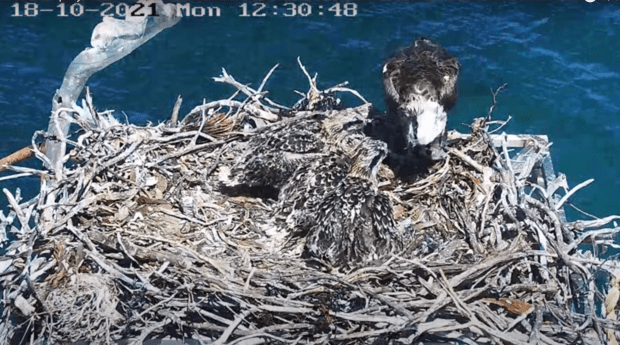
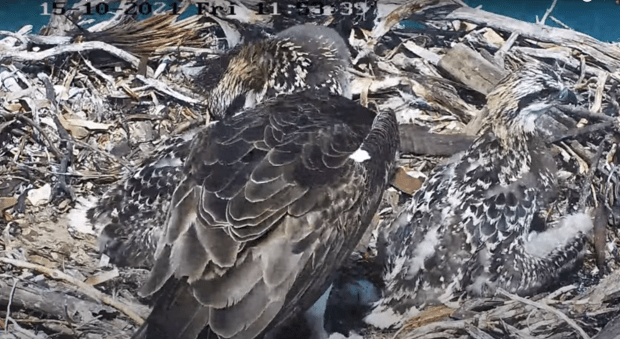
Just look at these beauties. Overnight the three osplets on the Port Lincoln Barge turned into juvenile beauties. Those are serious feathers! Just look, all pushed out from their quills, perfect layering with that gorgeous white line and tip of the juvenile. Each one also seems to have grown a perfectly white beard over night. Their eyes are also that dark amber colour that will, when they are adults, turn to yellow.
Gosh. I can hardly take my eyes off of them. They are stunningly beautiful. If I could look like a bird it would seriously be a juvenile Osprey.
Mum was looking out over the water hoping that Dad was off fishing – and he was. He landed on the nest at 7:46 with a breakfish for everyone.
Little Bob, the closest to Mum’s beak and the front, is 34 days old today while the two older siblings are 36 days old. There is a ways to fledge – thank goodness, but, for now, we can enjoy how grown up they all are and how wonderful this Eastern Osprey nest has been this year. It has brought nothing but tears of joy! It goes to show how having chicks that hatch close together and plenty of food deliveries are a great combination to success.
Dr Victor Hurley heads up the research on the Melbourne Peregrine Falcons. He has been doing this for many years. He wrote a very good article about what the differences are for the two falcon nests in Australia with streaming cams – 367 Collins Street Falcons in Melbourne and Charles Sturt University in Orange and Cilla Kinross. The 367 Collins Street scrape box had 4 hatches this year while the Orange scrape box of Diamond and Xavier had one. So what is the difference to the falcons? is it better to have one or four? Dr Hurley believes for the falcons it is better to have four eyases and be run off your feet feeding them because the chance of one of them surviving to adult hood is greater than a scrape having only one chick. He believes, however, that it is beneficial to the chicks to be the ‘only One’ instead of one of four in terms of food resources. Still, others believe that the stress on the parents to feed four instead of one is immense but, we are looking at it from the chick’s perspective. Anyone watching the scrape boxes just know these growing chicks just want food!
While Dr Hurley did not address other issues, I wonder if being part of a larger hatch group helps in terms of understanding how to live in the real world where there will be pressure from others. Maybe it doesn’t matter? Last year, the male from the Collins Street scrape used to come into the nest and pluck a freshly caught pigeon. It was a terrific mess but those three girls could sure pluck a bird – and do it fast before they fledged – a skill essential to survival. Catch, pluck, eat, and go! I beg to be corrected but it seemed that Izzi had some difficulty with plucking even after an age when he should have had his own territory. So I wonder if they learn quicker and faster as part of a group??? and having plucking imprinted on them so many times?
The little eyas at Orange is 13 days old today while the Collins Street Four are starting their third week. Each is right on track in terms of development. Indeed, the little Orange eyas has been scooting around on its tarsus for a couple of days now and is very strong and healthy. – slightly ahead of the curve The plumage is changing radically on the Collins kids and they are standing and walking.
Kate St John did a wonderful blog on the developmental stages of the peregrine falcons. I want to share that with you.
Dad is trying out larger pieces of pigeon on the four. The prey came in one after another the other day. They are losing the soft down around their eyes and getting the juvenile feathers and they are also getting their wing feathers.
I am afraid that I got a little carried away with the images of Xavier and Diamond’s eyas. Not only is it loud – soon to rival Izzi – but it can also make the cutest faces.
They are all doing well. Last I checked the Bald Eagles in the United States are all still working on their nests. There is some intrigue at the Captiva Nest and the speculation as to who the male will be this season. Joe is gone and it appears Martin has been ousted also. Meanwhile, Harriet and M15 along with Samson and Gabby are steady as you go! To my knowledge there has not been a fledge at the WBSE nest in the Sydney Olympic forest but this could happen any time. And – for the lovers of Jack and Diane – it seems that the couple might be back on the Achieva Osprey nest in St Petersburg together. They have a lot of nestorations to do!
Thank you for joining me for this quick catch up. I will be shaking my head and smiling at just how beautiful three juvenile ospreys look in the PLO nest. Take care all. See you soon.
Thank you to the following for their streaming cam where I took my screen shots: Charles Sturt University at Orange Falcon Cam and Cilla Kinross, the Collins Street Falcons by Mirvac, and the Port Lincoln Osprey Project.
It was 19 or 20 degrees C, depending on which weather station you listened to, on the Canadian Prairies this afternoon. Those temperatures are traditional summer ones, not middle of October! As a result, my foray to photograph Wood Ducks went sideways. It was a beautiful Sunday and everyone was outside in their summer clothes with bikes or skateboards, picnic lunches or books or both.
We may get our first frost on Wednesday evening but until then the days are going to be brilliant. No doubt those ducks will still be around awhile longer.
There was a small altercation at the Port Lincoln Osprey barge around 09:24. It is unclear what got into Middle Bob but he had a bee in his bonnet and decided he wanted to take it out on Little Bob. The skirmish lasted three eyelid blinks and it was over. And it did not put Little Bob off in the slightest. He was up front and ready to eat when the next fish was delivered at 12:16:01. Indeed, there had been two fish deliveries and feedings already – at 6:34:35 and another at 8:21:17. All of the chicks have been preening feverishly. Wonder if it is the itch from the feathers that is making Middle Bob out of sorts?
The juvenile feathers are really coming in and depending on the way the light hits the nest you can hardly find the chicks.
Little Bob is up at Mum’s beak with Middle Bob to its right. Big Bob is facing off the nest and has a rather robust tummy and crop.
No one seems to have moved. Little Bob is eating first. Anything Middle Bob have done to try and intimidate him has not worked. I am just going to put it down to Middle Bob waking up on the wrong side of the nest! If Little Bob turns out like Tiny Tot Tumbles from the Achieva Nest, Middle Bob will wish he had not been naughty.
It was a nice sized fish – not a whopper – but, it topped the kids off, all of them. In six hours, three fish. Pretty good, Dad!
That is Little Bob in the middle showing his nice crop in the image below. Look at how the tail is growing on the chick to the right.
Little Bob is 32 days old today. That makes Big and Middle 34 days or if you count the other method – Big is 34, Middle is 33, and Little is 32. There is 51 hours between the time Big and Little hatched. That surely has had a strong impact on the peacefulness of this nest, this year.
There were some very tender moments between Diamond and her baby yesterday evening in the scrape box at Orange. Here is one of those.
What a difference it makes when the chick’s eyes are fully open and they can see their parent and that food coming in that big beak. This chick is 9 days old. Just imagine. A week ago it was hardly bigger than one of those eggs. It is healthy and strong.
One but, probably both, of the White Bellied Sea Eagles is going to fledge really soon. They can hardly contain their wings from flapping and their legs from jumping. Typically, fledges occur in the morning or evening. Keep your eyes open for news from this nest in the Sydney Olympic Forest.
For those of you following the Royal Cam Chick, Tiaki, this season, there were a few tense days when her sat-pak was not plotting her GPS. Today it began working – possibly due to needing to be charged -. She is well past the International Date Line on her way to the waters of Chile. That was such a relief for everyone. When those GPS units quit working everyone fears the worst.
Last year’s favourite Albatross, OGK, Pippa Atawhai’s Dad, has been in and out at Taiaroa Head waiting for the arrival of YRK, his mate. Oh, I hope she arrives soon!
Lady Hawk posted a video showing Tiaki’s location and OGK having to defend his territory.
Apparently, OGK left and the two love birds spent the night on a spot near to Pippa Atawhai’s nest.
First feeding for the 367 Collins Street Four in Melbourne. Everyone has a nice polished crop and that scrape box sure needs a good wind to hit it! They are soooooo big. Three seemed a lot to handle last year with those big females but imagine when they are ready to fledge. These parents are going to deserve a really good rest.
They were the stars of one of ABC’s breakfast television shows yesterday. Melbourne sure loves their falcon family! They also included Diamond and Xavier from Orange. It was wonderful that the Peregrine Falcons made it into the last round of voting for Australia’s Bird of the Year. Maybe next year!
One of the most interesting prey items was a quail that Dad brought in. Everyone is wondering where he found it. I mean, seriously, where do you expect to find a quail in a large city? the zoo?
What a wonderful way to end the day – all of the birds are fed and well taken care of. Life really is good on the nests. We are so very fortunate to be able to watch their lives.
Thank you so much for joining me. I hope to have some good images of the Wood Ducks this week. Take care. See you soon.
Thank you to the following for their streaming cam where I took my screen captures: Sea Eagle Cam @Birdlife Australia Discovery Center, 367 Collins Street Falcons by Mirvac, Charles Sturt University Falcon Cam at Orange and Cilla Kinross, and the Port Lincoln Osprey Project.
Xavier and Diamond are on a roll to keep their week old chick fed. Xavier came in with a pigeon while Diamond was away. He might not have had long to feed his baby before Mum returned but, Xavier did a splendid job and Only Bob got some very nice bites.
Xavier was very good at connecting with the little one’s mouth.
It is so cute when they can finally see their parents and that beak of food. Look at it opening wide. What a little sweetheart.
Priceless.
Xavier had really been enjoying feeding his chick. He has demonstrated repeatedly that he wants – very much – to be more involved in the care of the eyas. Hopefully, Diamond will be less protective soon.
Bye Xavier!
There were, of course, many more feedings during the day.
Xavier had some time to cuddle with the little one after he brought in the prey for Diamond for one of the evening meals. So sweet, that little one leaning up against Dad.
Only Bob is ready for its 17:30 meal – beak wide open!
Look at how big the little chick’s wings are getting. Yesterday, this wee one was only a week old.
There might be only one but it looks like it is going to be big and strong!
Thank you so much for joining me. So many of you really enjoy watching Xavier and Diamond. If you haven’t ever looked into their scrape box, here is the link. They are fantastic parents – lots of fun with the prey and Xavier trying to get some ‘chick time’.
Take care all. See you soon!
Thank you to Charles Sturt University at Orange Falcon Cam and Cilla Kinross for their streaming cam where I took my screen shots.
For those of us who only have the Internet and not any television or cable stations, it might be a bit difficult to watch the documentary on the Ospreys, Season of the Osprey on Nature PBS. For those of you with cable television, this is a reminder to check your local station for when Season of the Osprey is showing. For the rest of us, I will be checking for the release of the DVD and, also, to see if the documentary will be streaming on the Internet. Will keep you posted! Do check your local stations. You do not want to miss this if you love ospreys!
I am including the URL for the company that is distributing this special. Why? Because, if you scroll down, you will see that there are a host of podcasts that you might be interested in.
Oh, what amazing birds. I am already getting excited about our local nests and the birds have only been away for two months! This year I will be checking on several nests and submitting information on arrivals, hatches, juveniles, fledges, and departures. It is an honour to add the Ospreys that consider Manitoba their summer home and breeding territory to the lists of nests from around the world.
Speaking of migration and raptors around the world, Jean-Marie Dupart reports that there were 50 birds this morning on the shores at Casamance, South Senegal. He has counted 432 arrivals so far this season and said he has 10 more locations to check. That is fantastic.
Many of you will be members of one or another of the many groups pressing for businesses and residents to stop using rodenticide. You might also be lobbying various levels of government to ban these designer poisons. It is well known that it is not only cheaper financially but also much more effective to use raptors. Raptors will clean up the critters – just don’t poison the mice and rats because, ultimately, they will also poison cats and birds that eat them. It is a horrific way for a raptor to die.
Today, in the Fall 2021 issue of Bay Nature magazine, the leading article is a vineyard that is employing Red-tail Hawks to keep the rodents out of the fields. They are turning away from using rodenticide. Oh, this could seriously be a start of a movement. Here is that article:
Xavier and Diamond’s only eyas is one week old today. Only Bob can see the world! And Xavier has had some time to spend with his wee one. Here he is brooding Only Bob. How precious.
I have not reported on the White-Bellied Sea Eaglets in their nest in the Sydney Olympic Forest for several days, if not a week. It is really interesting watching the two of them interact together. One will do something and the other will try to outdo the first. Here they are flapping their now very large wings.
I really hope that they do not knock one another off the nest. The more they flapped those wings the more energetic they got and the more air they stirred up. It was like the centre of the nest became a trampoline.
WBSE 27 and 28 will have a wing span of 1.8-2.2 metres or 6 to 7 feet. If I remember correctly, the nest in the old Ironbark Tree is 1.8 metres or 6 feet across to give you some idea of the wing size of the pair today.
WBSE 27 hatched on 29 July 2021 and WBSE 28 hatched on 31 July. This makes the little sea eaglets 78 days old (27) and 76 days old (28). The average fledge period for the nest is 75-85 days. We are now in that window. Ideally, the eaglets will do some branching, will make their first flight, and return safely to the nest where they will strengthen their flying and be furnished prey by the parents. In reality, the Pied Currawongs often chase the newly fledged chicks out of the forest. It is hoped that the parents are providing food off nest or the eaglets find a beach area full of carrion (what most juvenile sea eagles survive on til they hone their fishing skills).
This nest has produced two very healthy Sea Eaglets this season. Just look at them spreading their wings, one looking over the rim of the nest. That first flight could happen at any second. It has been a fantastic nest to watch this year and I do hope that these two strong eagles will survive and have very long lives. Lady and Dad have done an amazing job.
The Osplets at the Port Lincoln Barge nest are not ready to fledge – thank goodness! But they are growing like wild weeds in my garden. The juvenile feathers are now growing in thick and fast. They have had several fish deliveries today. I reported on two and there was a third at 11:28:54 and there will be more during the day.
Mum trying to get the fish off of Dad’s talons.
Little Bob is lined up waiting for some more fish. He is on the right. You can see the more circular mark on the top of his head and the white painted effect under his eye. It coats the lower lid a little like white eyeliner might do. From this angle you can also see some of the white on the cere. Little Bob has a rather large crop. It seems to be sagging from the weight.
Now when I write ‘Little’ Bob it seems a bit silly because he is definitely not little! It will be nice when they get their bands, satellite packs, and names in a few weeks. I wonder what they will name these three?
While we can only see two of the osplets, both of them have big crops. Little Bob is looking out from the nest on the right and another is preening, showing off its big ping pong crop, in the middle.
Look at how those lovely dark grey/black juvenile feathers tipped with white are. They are growing fast. Soon they will cover all of that dark grey wooly down. Much of the fish they are eating is helping them produce these beautiful feathers, feathers essential for their success as raptors. They cannot fledge without them.
Everything is looking good. I cannot wait for their measurements to be taken. Little Bob looks like he could be the biggest or close to it. Little Bob certainly does not take anything off Big Bob.
Thank you so very much for joining me. Take care everyone. Have a terrific Friday.
Thank you to the following for their streaming cams where I took my screen shots: the Port Lincoln Osprey Project, Sea Eagle Cam@Birdlife Australia Discovery Centre, Charles Sturt University at Orange Falcon Cam and Cilla Kinross.
It is a miserable 9 degrees C on the Canadian prairies. It is grey and wet. We have yet to have frost but it is certainly feeling like the time has arrived to bring out the jumpers and wool socks and put away the summer linen. A few of those gorgeous Dark-eyed Juncos are still in the garden pecking away at the Millet and Mr Blue Jay is working his way through a cob of dry corn.
A few have written to find out where to get the dry corn. Many specialty bird seed shops carry dried corn. You can purchase it by the cob or by the bag of 25 or so cobs. It will vary by supplier. If you live near a feed and seed store or a farmer who grows corn to feed their livestock, you might want to compare pricing. It is thoroughly dried corn you want. While I just lay the cobs out for the Blue Jays and the squirrels there are also specialty holders that prevent one or the other from taking the entire cob.
Do you have a garden? If so, you might want to plant some corn meant specially for drying. Check with your seed supplier.
Everyone seems to have recovered from the sadness of Xavier and Diamond not having a second hatch. If there was a pip and beak showing, it appears that the chick was simply not strong enough to break out of the shell. As you all realize, life for the birds is challenging. They need to be strong and healthy and that is certainly what that first hatch of Xavier and Diamond’s is. You can hear it today calling and, if you listened to Izzi last year, you will know that they can be very vocal. This one might even rival its big brother!
Today, Dr Cilla Kinross, the chief researcher for the past twelve years on the Peregrine Falcons, has posted a list of names for the wee one. They are all Maori names and relate to the weather. Everyone can have one vote. If you wish to take part, here is the link:
This wee one has amazing parents. A viewer caught a super video clip of Xavier delivering prey and Diamond feeding the chick. Have a look!
The Port Lincoln streaming cam is down this morning and it is not yet dawn in Australia. Fingers crossed it is back working soon. All of the other nests – the WBSE and the Collins Street kids – are fine. In the United States, the Bald Eagles are busy working on their nests. At 07:23 this morning, Anna and Louis were caught on camera at the Kisatchie National Forest Bald Eagle nest. It is wonderful they have each returned safely for a second season. I wonder if Louis will contain his enthusiasm for feeding his family?
Thank you for joining me today. Please vote for the wee one at the Charles Sturt University Falcon Cam. You have until 5pm on 22 October Australian time to tick your favourite. I will bring you an update on the PLO this evening if the streaming cam begins working. Take care everyone.
There was a lot of chatter over the Melbourne Peregrine Falcon scrape at 367 Collins. The concern was because the Mum had not been ‘seen’ since 19:06:24 when she left the little ones after feeding them.
The chicks at Melbourne are enormous! I honestly can’t even find the small one anymore. Underneath the fluffy down that remains there are pin feathers coming in and if you look closely, those sweet pink little beaks are turning into a rather adult looking beak.
There is no need for concern for Mum. The problem is that the eyases are simply too big for her to brood anymore because there are four of them. Can you see where Mum is?
The image on the left is a week ago. The one on the right was yesterday.
I haven’t reported on Port Lincoln Ospreys for a day. These were the feeding times for yesterday: 6:52, 10:02:43 (small), 10:43:15, 14:43:39, 14:55:50, 16:11:51, 16:23 (mum caught this one), and another fish delivery somewhere around 17:59:58. It was hard to differentiate when the osplets started eating one fish and began on another during the afternoon.
The Mullet that came on the nest at 10:43:15 was still alive and Mum flew off with it, killed it, and returned at 10:44:30. When Mum brought the 16:23 fish onto the nest, part of the fish that dad had brought earlier was still there. This could have been the 17:59 feed. It is not clear. What is certain is that the chicks had massive crops throughout the day. With Mum fishing – and she seems to catch the bigger fish these days – the nest is eating well. The supplementary fish she brings in is making a huge difference to all including Mum who also needs to eat. And Dad.
One thing that I found very interesting was our dear Little Bob. Later in the evening on the 10th, the Middle sibling had caused a bit of a spat between Big Bob and Little Bob. Middle Bob seems to do this and then it ducks to get out of the way. Little Bob was not having any of it and well, we might begin to believe that Little Bob is the ‘boss’ of the nest. This was the second time that I have seen Little thwart any attempts by Big to be the dominant one in the nest. (The other was awhile ago0. I say this because Little Bob took the fish tail at 10:02 yesterday and ate it with no problem. The fish tail is a bit of a prize in an Osprey nest.
These are just some shots from the various feedings. Notice that they all line up and eat very civil!
Little Bob has the fish tail!
Little Bob had no difficulty eating the fish tail. Well done, number 3.
By the time the last fish arrived, many were so full they couldn’t even think of eating much more. Mum had a really nice feed. How grand!
Diamond and Xavier’s Only is growing well.
Today will sort out if there was a pip or not in one of the eggs. It is simply not clear. For the chick to survive, it would need to hatch today. Diamond rested better last night and wasn’t shuffling the eggs around so much. Perhaps we will have another Only Bob like Izzi last year and that is just fine. Cilla Kinross says they have never had three hatch at this nest despite three eggs being laid. In many ways raising one is so much less stressful than four. The Melbourne parents have to be worn out!
Everything is fine for the nest and the two scrape boxes. I will check in with the White-Bellied Sea Eagles later today. I understand that they are fine but that the Pied Currawong continues to be a nuisance. The Bald Eagle couples are restoring nests from last season and the Albatross for the upcoming breeding season are landing on Taiaroa Head. The world is working as it should be.
Thank you so much for joining me this morning. Take care. See you soon.
Thanks to the following for their streaming cam where I took my screen shots: 367 Collins Street Falcons by Mirvac, the Port Lincoln Osprey Cam, and Charles Sturt University Falcon Cam at Orange and Cilla Kinross.
The males have been working overtime it seems making sure that there is food for all of the nestlings.
As many of you know, the weather in Port Lincoln has been anything but ideal. The winds were blowing from 40-50 kph and there were white caps on the water. At one time the barge and nest appeared to be rocking around quite a bit. Still, a miracle happened. Having been hunkered down, Dad brought in the first fish for the osplets at 8:37:58. It was truly remarkable. But what was more outstanding was that he delivered a second fish at 8:38:02, a third at 10:14:25, and a fourth at 13:53. It is just now turning 15:00 on the nest. This is simply joyous. Everyone has eaten, they have had crops, and there has been complete civility.
I put in the image below for two reasons. The crops of the two osplets on the front row are getting bigger. Secondly, because that is Little Bob who is on the front left. I want you to have a very good close look at his cere, the lighter bits below the beak and the black line through his eye. Look at its thickness. It is thinner than the other two. additionally, his head is just a wee bit lighter, for now.
I believe that it is Little Bob and Big Bob eating with Middle Bob holding back. It will get fed. Do not worry!
You can almost lose them on the nest these days. Little Bob has decided to flap his wings a bit while Middle Bob eats some fish.
Just look at Little Bob. Chubby tail, wings, fat little bottom and those soft pantaloons to go with the big white clown feet. They are so adorable. I never knew pin feathers could be so strikingly beautiful.
Oh, dear, watch out Mum!
Ah, look at those legs! These osplets are nice and healthy.
In Melbourne, the eyases are being fed just about every hour. Birds, mostly pigeon, arrived at 6:12:50, 7:10:34, 8:07:39, 9:12, 10:20:07, 12:42:14, 14:40, and 15:51:06. Everyone who was hungry got fed until they fell asleep. We will be seeing some remarkable growth for these little fluff balls. Tomorrow their eyes will be open wider, their necks will be getting more stronger and the amount of space they take up in the scrape box will be larger. Of course, we are only mid-afternoon, and already eight feedings. There will be quite a number before it is time for these wee ones to tuck it in for the night.
Oh, wonderful. They are ready for a snack.
Oh, relief. It is not a pigeon.
Here I come with another Melbourne Blue Plate Special kids.
Wake up everyone! It’s tea time!!!!!
Open wide!
Sleeping babies.
Let us all remember the great joy that the birds brought us last year and now. Hopefully you had an opportunity to take a deep breath. Maybe you were able to enjoy your garden or the wildlife in your area. Perhaps you came to love many of the bird and animal families on the streaming cams. I know that I felt more joyful just by becoming more connected with nature. So when someone asks you if you are ready for things to return to normal, think about your answer carefully.
Chris Packham and Megan McCubbin remark, “Under a dark cloud of fear and confusion people all over the world found solace and respite in nature; it improved the quality of their lives and their physical and mental health.” I believe that everyone reading my blog finds joy and inspiration in birds. You also do whatever you can to make their lives better. Each and every one of you has either aided or is aiding birds in one or in many ways. We all do what we can. The simple act of providing water during migration can be a huge help. Making sure your windows are left dirty or have deflectors so the there is no bird strike is another. Writing to people who can lobby for laws that ban lead in hunting and fishing equipment as well as the designer poisons such as rodenticide help tens of thousands a year. Educating people and working with your local parks authority to eliminate the feeding of bread to ducks can keep the waterfowl healthy. Donating even the smallest amount can keep the streaming cameras running for some not-for-profit nature centres and bring joy to hundreds of others. The list is endless.
Thank you for popping in to check on these two nests. Take care of yourself and enjoy the rest of the weekend!
Thank you to the following streaming cams where I took my screen shots: 367 Collins Street Falcons by Mirvac and the Port Lincoln Osprey Project.