Oh, Little Bob!

Oh, another glorious fall day on the Canadian Prairies. The sun is shining bright and the sky is blue. The leaves of the vines looking like stained glass ranging in colour from rust to orange, light yellow, and chartreuse. Just stunningly beautiful.

I always worry about the third hatches. I have worried about the third at the Port Lincoln nest the minute the egg was laid. Last evening one of the chatters called #3 “Tuffet.” That is a great nickname for Little Bob.

And Little Bob looks like such an angel. If you are having trouble telling who he is, he still has his egg tooth today. That is him wide awake smiling at the camera.

My goodness. I have begun to feel sorry for Mum. She has only to wiggle or get up to stretch and he has his mouth wide open!

Big and Middle are not bothered at all. Little Bob still has a crop but he is sure curious as to whether or not Mom will give him some bites!

“What cha’ doin’ Mom?”

Little Bob is decidedly not hungry. When I last left the family Dad had brought what was left of the ‘whale’ that he had brought in at 12:35:44.

There was another feeding around 13:08.

If you are wondering, yes, that is Little Bob being fed!

By 13:24 Mum has them all tucked and Dad is over on the ropes.

Around 16:00 the chicks are fed again.

With the whale finished, Dad is going to need to go out and fishing. At 16:49 Dad comes to have a consultation with Mom. She puts in an order for a fish as the kids are growing restless.

The delivery comes in half an hour. Well done, Dad. I wonder if he has a stash of these nice large fish?

Notice that all of the chicks have some fish still in their crop from the earlier feeding.

Oh, dear. That fish was flapping. Hope that little one is OK. It sure isn’t stopping Little Bob with his crop from wanting a meal. There he is near that flapping tail.

Oh, these three are really going to be a handful when they are older. Dad is going to have to bring further reinforcements for the walls. Mom finishes feeding them and then…

She moves the fish and starts again! They all line up again.

Look carefully at the back of Little Bob on the end. Can you see the two dark stripes starting to emerge? and just look at how adorable those little wings are. Gosh these kids are cute.

Dad will remove the fish and return it at 18:20:01.

There’s Little Bob flaunting his crop – wondering if his is the biggest or not.

Mom probably thought she could have a few bites in peace and quiet. What do you think? Yes, that is Little Bob with his mouth open! Poor Mom.

Now another wants some fish. You can still see their crops from the 18:22 feeding. But there is also something else we can see. Look, pin feathers are coming. Soon they will look like reptiles. Their light coat of down will be replaced by a darker woolier coat at 10-12 days. That is followed by the reptile phase.

We are entering the second week. Already these chicks have more than likely tripled their body weight. It should, in fact double again in the next three to four days. The fastest period of growth will come at 15-30 days. This is when we need fish on this nest.

It is possible that when Mom got up to eat some fish she fed some of the Osplets around 21:13.

It was hard to tell because Mum swung herself around so we couldn’t see.

Little Bob wiggles his way out from under Mom in the middle of the night and is calling for fish!

And we are back where we started. Around 1:13, Mom wants to stretch her legs and Little Bob thinks it is time to eat again – crop or not.

It is now 2:51 in the morning, 22 September in Australia. Mom and chicks are fast asleep. No doubt Little Bob will be right up front at the table the minute that fish lands on the nest.

This third hatch is anything but shy or afraid. This nest has really turned itself around thanks to the good deliveries of fish by Dad and the continuous feedings by Mom. No one on this nest has been hungry.

The crucial period is not here yet. We need to make it through weeks 3 and 4.*

Looking for hatch watch with the Peregrine falcons in Melbourne in 6 days. That will liven things up a bit. Over at the WBSE in the Sydney Olympic Park, the parents are dropping prey now that the eaglets are self-feeding. Most of the time 27 gets the food. Yesterday, Mom did the feeding. 28 had a nice crop. The first seen in awhile. The pair continue to work their wings.

Thank you so much for joining me today — and thank you for your interest in the Eastern Ospreys at Port Lincoln, Australia. So far, so good. Continue to send warm wishes to all the nests.

Thank you to the Port Lincoln Osprey Project and the Sea Eagles @ Birdlife Australia Discovery Centre for their streaming cams where I took my screen shots.

* Last year, the feedings were not as good at the PLO. Around Day 15 there was a perceived drop in food delivery. Siblicide occurred and sadly, little Tapps died when he was 18 days old.

Tracking…birds and hurricanes

Hurricane Ida has made landfall on the sixteenth anniversary of Hurricane Katrina that wrecked havoc and caused so much destruction to Louisiana. Throughout the day I have been checking on the Kisatchie National Forest, the home of Bald Eagles, Anna and Louis. The Bald Eagles are likely north of the storm area as they do not spend the hot summer, as far as is known, at Lake Kincaid (although they could).

The winds were getting stronger and the waves more choppy as the morning broke into the afternoon. That camera quit working at 15:39:19. You just get a circle. The KNF is in parishes that are northwest of New Orleans. They include Grant, Natchitoches, Winn, Rapides, and Vernon.

Isn’t that just the most beautiful area to raise a Bald Eagle family?

Cody and Steve did a great job running the camera, answering all of the chatters questions, and even held a contest to name the eaglet. Please send them warm wishes to stay safe.

At 18:00, Hurricane Ida just went through Mathews, Louisiana.

There are several other maps that I am also watching today. One of those is just fantastic. If you want to follow the Black Storks on their migration, you need to know this link.

http://birdmap.5dvision.ee/EN

The ‘Birdmap’ has several Ospreys along with the Black Storks who have satellite trackers. They are first sorted into species and then by name of the bird. Click on the name of the bird and you can see where the birds are located. It is magnificent.

I clicked on Karl II’s name. Then I clicked on the player at the bottom and I could see the precise route that Karl II has taken since he left the nest in the Karula National Forest. He is heading to the Black Sea. I wonder if Karl has a favourite spot there?

I owe Karl a big apology, too. I know that Pikne and Udu are ‘his’ storklings and brain keeps telling my fingers to type Grafs. Big apology, Karl!

Oh, how I wish Tiny Little had a tracker. It would be so much fun (well, if everything went well) to watch her journey rather than hoping by mere chance that someone would see her blue Darvic Ring and record the number. Perhaps it would be too much to ask them to take a photo, too?

There is not a lot of news in Bird World. Maya was photographed at Rutland Water today so she has not left for her migration. The Collins Street Falcons have started the hard incubation now that the 4th egg has been laid.

This is mom. She always has a bit of grumpy face and she takes up most of the scrape box.

This is cute little dad. He is much smaller as you can see – he doesn’t take up so much room in that scrape box. If in doubt, he has really neat bright yellow “goggles” around his eyes.

I know that it is hard to see what is going on and you are afraid that you will miss all of the action. There is another scrape box at the other end of the ledge with a camera and these parents have a tendency to move the chicks about. There is nothing funnier than seeing 3 large juvenile females chase after poor little dad with his pigeon. This year it will be 4! I hope the pigeon population in Melbourne is robust!

Diamond is keeping everyone guessing. The latest that she has ever laid an egg is the 31st of August and that is tomorrow, Australia time! At this point I am not even going to guess. Diamond has been fooling me for days on end.

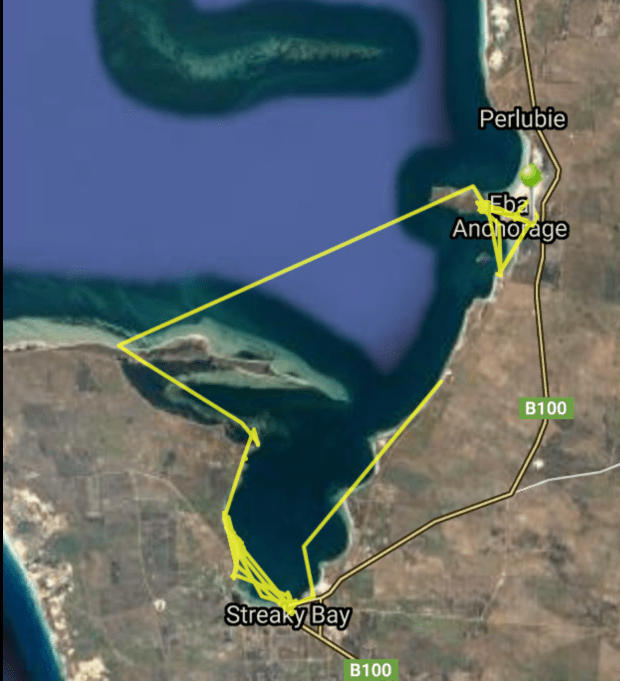
When in Australia, I have to remind myself to check on Solly. She is 344 days old – my goodness, almost a year since she hatched on the PLO barge. Look at this map of her travels. She is so confident now that she is taking the short cut back to Eba Anchorage from the coast near Streaky Bay instead of going the land route. Well done, Solly! So proud of you.

The nest of Mom and Dad looks so much more together than it did after Solly and DEW fledged last year! Oh, I hope that there is lots of food and all three of those eggs hatch and fledge. Wouldn’t that be wonderful? I have to admit that I did not feel so kind towards Solly last year but, in the end, I was glad to see two strong birds fly off that old boat. The satellite tracker put on Solly opened up everyone’s eyes to how far the Eastern Ospreys travel from their natal nest. I do hope they will do this again this year. At the same time, I would like to see trackers on all the birds from this nest. Everyone wants to also know where DEW is. If it is the cost, do some crowd funding up front – there will be people from around the world willing to chip in and help with the costs.

‘S’ sent me some images of the Osprey juveniles in Alberta this morning. My goodness did I ever feel guilty. I checked in on them for the first time yesterday in ever so long – and that was because I had heard of an unmonitored nest fledging two from the interior of British Columbia this morning.

There were three eggs that hatched at the Red Deer Osprey nest in June. Two of the three died on 3 July during the wretched heat and then rainy/stormy weather.

This beautiful juvenile fledged sometime the first two weeks of August when the cameras were down. This is a strong bird, a real survivor. It has been given the name, Little Braveheart, by her fans.

The two juveniles at the Fortis Exshaw nest up at Canmore are doing really well, too. Both fledged and they are waiting, just like the juvenile in Red Deer, for the call to fly south. That is such an incredibly beautiful spot to have an Osprey platform with the Canadian Rockies in the background.

Thank you so much for joining me. Do check the Birdmap and see how it works. Satellite trackers are wonderful tools. And please send your warm wishes and positive thoughts to those in the path of Hurricane Ida. Take care and stay safe. See you soon.

Thank you to the following for their streaming cams where I took my screen shots: Fortis Alberta Red Deer, Fortis Alberta Exshaw, 367 Collins Street by Mirvac, The Falcon Cam Project at Charles Sturt University in Orange and Cilla Kinross, the KNF Bald Eagle Cam, and the Port Lincoln Osprey Project.

Late Friday and Saturday in Bird World, 28 August

It is late Friday night on the Canadian Prairies. The much needed rain has paused and the weather news says it will start again soon. The rosemary and thyme growing in the garden boxes are thriving as are the Vermillionaires, planted specifically for the hummers. Perhaps they will find them as they return to their winter grounds.

This is the first year that there have not been hummers in early July around the flowers.

The tracking information for Pikne and Udu is in. These are the two fledglings of Karl and Kaia. Sadly, Tuul passed.

26 August tracking map shows Pikne flew only 11.5 km from her last stop. The Forum postings says, “S/he is still between the villages Mykhailivka, Khvoshchivka and Stavychany, Khmelnytskyi Oblast in Ukraine.” Do not let this short distance worry you. She has found a nice place to rest and feed for a day or two.

It looks like a beautiful area for Black Storks to pause in their long journey.

“File:Khmelnytskyi, Khmel’nyts’ka oblast, Ukraine – panoramio (59).jpg” by durik1980 is licensed under CC BY 3.0

The report for Udu on 26 August indicates that he is also taking a bit of a break. He flew only 6.19 km. He is eating and gaining strength from all the flying near a wildlife park in Niezgoda, Poland.

There is also a big water area for Udu similar to where Pikne is eating and resting.

This is the latest map for Udu:

The only surviving Black Storkling, Julge which means brave one), seen recently on Jan and Janika’s nest has begun his migration. This is remarkable – five days after fledging. He travelled 224 km and appears to be flying the same direction as Udu, Karl II’s male fledgling. Well done Julge. You have survived the horrors of the forest and the Raccoon Dogs that killed your siblings and you are flying. Stay safe!

One of the chatters for the Latvian Forum has been to the feeder to check on it and on Grafs and Grafiene’s storklets. The heron that we see often in the photographs remains at the feeder. Live carp could still be seen in the pond. While there, two black storklings came flying over him and into the forest. Sadly, in the excitement, he lost the card from his camera so there are no pictures. But the good news is that the feeder still has fish and that the two storklings of Grafs are together and alive. The third is believed to have followed Grafs off the nest and is feeding in a different area. This is all fantastic news.

There appears to be no activity on the Foulshaw Moss Nest in Cumbria. Polly Turner caught White YW looking for our Tiny Little but no Tiny Little. She is believed to have begun her first migration. White YW and Blue 35 raised three lively chicks. Dad stayed on until Tiny Little had the call of the winds to leave and made sure she was fed well. This is a great nest and we look forward to the return of White YW and Blue 35 next spring and to Tiny Little, Blue 463 (remember that number), when she returns in two years.

That nest looks so lonely and empty without Tiny Little there screaming her head off! The visual clue for an Osprey fledgling wanting food is that yelling that Tiny Little to White YW every time she saw him —- in case he forgot that she was hungry!

Diamond is still holding that egg! She had everyone excited yesterday but no, no egg yet.

Mrs G and Aran are still in Wales. The lovely couple sitting close to one another on the perch looking over the beautiful valley that is their territory and fighting off any intruders.

Mrs G, the oldest Osprey in the United Kingdom. Lovely. We hope they both return safe and well to raise a lovely clutch next year.

The camera operator gave a tour of the other side of the nest. Have a wee peek.

The nest has everything! A river with fish!

What a magnificent valley, so serene.

Maya is still at the Rutland Water Manton Bay nest with Blue 33. She was caught on camera for a couple of brief seconds today. So like Mrs G, Maya is still hanging back from starting her migration.

I have received word that WBSE 28 ate well and had a crop at one of the feedings yesterday. Here is a video that the Sea Eagle Cam posted to reassure everyone.

At Taiaroa Head, the Royal Cam Princess for 2021, Taiki, is getting really good at hovering. She is busy as a bee these days wandering around and visiting with her neighbours. If you want to see more of this little fluff ball, now is the time to watch her. It is near the beginning of September and fledge is usually the middle of the month. Perhaps she is precocious and will fly off earlier!

Can’t you just hear her saying wheeeeeeeeeeeeee!!!!!!!!!! She is destined to spend the next 5 or 6 years of her life flying over the seas of the Southern Ocean in search of food. Remember – every chance you get lobby to stop long-line fishing without bird protections. They are easy fixes and every fishing trawler can use these covered hooks and sparkly lines without much cost. They can bait the hooks and lower them at night at no cost with no harm to the sea birds.

About the time Tiaki flies off, Gabby will be arriving at the Bald Eagle nest to meet her handsome Samson near Jacksonville. Doesn’t time go by so quickly?

Every day I learn something new. In researching nature centres and the rights of animals I have come across some interesting information. I thought I would share it with you in the form of a very short little game. Meant for fun!

  1. Approximately how many birds were killed in 1886 to provide feathers for women’s hats in the US? a) 10 million; b) 15 million; c) 2 million; d) 7 million; or e) 5 million.
  2. Which of the following, mixed with Xylene and fuel oil, was sprayed in the Patuxent River in 1945? a) chlorine; b) Agent Orange; c) DDT; d) 2.4 D; or e) MPCA.
  3. Which of the following began in elite hunting circles? a) environmentalism; or b) conservation
  4. Which of the following was first concerned with air and water pollution? a) environmentalism; or b) conservation
  5. Who is the individual credited with lobbying to protect the Bald Eagle from hunters in the early 20th century?
  6. Can private citizens in the US sue over alleged violations of the US Endangered Species Act on behalf of a tree, an Osprey, spotted owls, red squirrels, etc? a) Yes or b) No
  7. Jackie and Shadow are Bald Eagles who have their nest at Big Bear, California. What chemical, not outlawed for nearly 50 years, continues to cause their egg shells to be thin?
  8. In 2021, deep sea explorers discovered something horrific off the coast of Catalina in California. It was a dumping ground for barrels of what pesticide?
  9. What is the biggest killer of songbirds in Canada?
  10. I am a nestling raptor. I am flapping both of my wings up and down in unison with my head held low. What am I doing?
  11. I am a nestling raptor. I am pancaked in the nest cup, keeping my head as low as I can. Am I happy that food is arriving on the nest? Afraid of a predator? or signalling that my mum is flying to the nest?
  12. How many deer hunting licenses were sold through the Department of Natural Resources in Wisconsin (or on line) in 2020? a) 226,718; b) 873,001; c) 174,569; d) 820,299; or e) 547,223

Thank you so much for joining me. It is cool and the day promises more rain on the Canadian prairies – and that is a good thing. After the heat of the summer, so many are telling me the crisp air of fall is their favourite time of year.

Several are working behind the scenes to get the information over what happened to Malin and what the outcome might have been — remember that video by Scotty Watson rescuing the juvenile Osprey on its initial flight — to the responsible authorities of Collins Marsh. This may take time but it is done so that Malin’s tragedy is not only remembered but also used to educate those who have Ospreys in their care.

Thank you to the following for their streaming cams where I took my screen shots: The Cumbrian Wildlife Trust and the Foulshaw Moss Osprey Nest, Bywyd Gwyllt Glaslyn, Cornell Bird Lab and NZ DOC, and The Falcon Cam at Charles Sturt University in Orange and Cilla Kinross. I would also like to thank the Forum with the tracking for Karl II and his family.

Here are the answers to the fun quiz. Maybe we should do another just about the birds we love one day!

  1. The answer is 5 million, E. Birds of every species was used in millinery not just in the United States but also in Europe. It was one of the reasons that our beloved Ospreys became extinct. Some women decorated their hats with not only feathers but the stuffed remains of entire birds with their beaks, feet, and glass eyes!
  2. The Patuxent River was sprayed with DDT mixed with Xylene and fuel oil, C. When individuals returned from World War II having used DDT in various ways, it was accepted that it was harmless. Almost immediately, when DDT began to be used as an insecticide, problems were noted but this was not before vast areas of rivers were sprayed with DDT to lessen the mosquito population. The result was dead fish floating to the surface within days.
  3. Conservation is linked to the elite hunting and fishing clubs, B. Conservationists believe/d sport hunting was a worthwhile pursuit and they sought to protect entire species so that they could be hunted!
  4. Environmentalism is focused on a global connection and a global vulnerability of all life on the planet. Their early work was on air and water pollution and how they relate to every species. They promoted the interconnectedness of every living thing. When one thrives, we all thrive.
  5. Rosalie Edge took on the Audubon Society and hunters and lobbied to get the Bald Eagle protected. She eventually purchases Hawk Mountain and puts an end to sport hunting there.
  6. The answer is ‘yes’. The Endangered Species Act was signed into law after an argument before the US Supreme Court on giving legal representation to natural objects. The argument was first presented in a law review article titled, “Should Trees Have Standing?’. Supreme Court Justice William O Douglas wrote the preface. The first case was The Sierra Club versus Disney Corporation. The Sierra Club lost but, various legal arguments have been held to uphold the rights of owls, Florida Key deer, etc.
  7. The residual DDT in the ground and Big Bear Lake continues to wreck havoc on the shells of many birds including Shadow and Jackie at Big Bear. See Pesticides Documentation Bulletin, Volume 2, Issues 21-24.
  8. Deep sea divers have discovered leaking barrels of DDT at 3000 feet below sea level off the coast of Los Angeles near Catalina as reported in the LA Times, 26 April 2021, by Rosanna Xia. https://www.latimes.com/environment/story/2021-04-26/ddt-waste-barrels-off-la-coast-shock-california-scientists
  9. Cats. Some areas are now requiring that domestic cats be licensed and kept strictly inside. https://www.cbc.ca/news/canada/british-columbia/cats-the-no-1-killer-of-birds-in-canada-1.3130437
  10. Mantling to protect my prey item.
  11. Keeping still so a predator near the nest will not see me.
  12. 820,299. The sales of hunting licenses during the first year of the pandemic were up 3.5% in Wisconsin. https://www.uppermichiganssource.com/2020/12/01/wisconsin-dnr-releases-deer-hunt-harvest-totals-license-sales-information/

Waiting for diamond to lay her first egg, 2021

Diamond laid her first egg of the 2020 season at 04:16:09 on 27 August! She looked uncomfortable during the day with her rear all puffed up. How grand! Here is the video of that magical moment last year. If you have never seen a bird lay an egg, have a good look. They go into labour just like human females. The egg inside is very soft. You have probably noticed that the female birds do not immediately begin incubating the egg once they have laid it. This is so the air can harden the shell. In fact, Diamond is not going to start serious hard incubation til all of the eggs are laid. This is so the eyases will be born closer together, be a similar size, and not have the issues that eagles and ospreys have with the tiny third hatch.

There are now two Peregrine Falcon nests in Australia on streaming cam. If you miss Annie and Grinnell then please check out either of these. This is the link to Diamond and Xavier’s camera. There is a chat and excellent moderators. There is also a FB page.

We continue to wait for the 2021 egg!

The other Peregrine Falcon nest is on Collins Street in Melbourne and that happy couple are already incubating three eggs. Last year they raised triplet girls. I just love this couple.

And before everyone gets nervous, don’t. There is more of a ledge in front of this scrape box than in Diamond and Xavier’s.

Falcons are amazing to watch raise their clutches. You do not get the sibling rivalry like you do in WBSE, Eagles, or Ospreys. That again is because the eggs are not hard incubated until all of them are laid. So sit back, relax and watch the fun!

Here is the link to their camera. There is no chat.

Tiny ‘Not so Little’ is still around! She was eating a nice fish after 20:00 last night. Some are beginning to wonder if she will be too heavy to fly for migration! LOL. She certainly will be well prepared. Tiny Not so Little is a very clever girl. Let those others go first. Let dad work and stay a little later, too.

Tiny Little, there are so many people who admire you and cannot wait for you to return in 2023. Meanwhile I keep thinking that you might be like the Sharp-shinned Hawk that frequents my garden in the winter. He is an anomaly. Are you?

Migration is really in full swing here in Manitoba. There will be a number of celebrations beginning in a week as the various species make their way south to get away from the harsh winters of northern Canada. I headed off to one of the biggest environmental projects in our City – Fort Whyte. More about that later. Surely there would be ducks and geese and other species. Well, not so many. A very cranky male Canada goose did not like me within 13 metres or about 40 feet of his two juveniles and the female. He kept a good close eye on what I was doing.

It was early afternoon and the geese were obviously very thirsty. Their goal before the male noticed me was to get to the pond and have a big drink.

Some of them did this sort of gargling motion!

This beautiful little female mallard didn’t seem to mind my presence across the boardwalk. She watched me for awhile and then began preening.

And if you ever wondered, mallards are dabbling ducks. Much of the time this afternoon they were busy searching for food.

Often nature centres have special events surrounding migration. Our first is on 2 September but the one that I really look forward to is later in September or early October. It is the Goose Flight dinners at this very nature reserve I visited today. Enjoy a great meal with local ‘everything’ and then enjoy the thousands of Canada geese that fly in at dusk. It is unforgettable.

We are now putting out extra suet cylinders and topping up the feeders during the day plus all the water bowls. Just like Tiny Little needs a nice layer of fat reserves, all of the migrating birds need to eat well to help them be successful.

Brush up on the difference between the terms environmentalism and conservation. We are going to play a game in my blog on Saturday!

Take care everyone. Thank you for joining me today. Stay safe.

Thank you to the following for their streaming cams where I took my screen shots: Cilla Kinross and The Falcon Cam at Charles Sturt University in Orange, 367 Collins Street by Mirvac, The Cumbrian Wildlife Trust and the Foulshaw Moss Osprey Cam.

The featured image is Xavier in the scrape box.

Checking in on Australia

It is raining in parts of Australia. Orange got 50 mm and there are floods about while there was 37 mm out at the Campus where the scrape box of Peregrine Falcon couple, Xavier and Diamond, have their scrape box.

Diamond has spent time on the ledge and going back to the scrape box looking like she is concentrating on that first egg. What do you think? Maybe today?

Sadly, the poor weather might be impacting Dad’s ability to bring in prey to the two babies in the Ironbark Tree. Until now, there has been little to no demonstrations of dominance but yesterday the prey diminished and WBSE 27 started telling the little one who is boss. It is unclear if WBSE 28 had any of the morning fish. WBSE 27 is 26 days old today and WBSE 28 is 24 days old. Oh, I hope this stops. There is enough for everyone! Most people say that the parents will not step in. And, as you know, if I hear survival of the fittest one more time I might scream loud enough for someone to hear me in Australia! All you have to do is to think about Tiny Tot on the Achieva Nest or Tiny Little — those tortured little ones turned out to be a force to be reckoned with. I wish Tiny Tot had a tag and a satellite transmitter. I sure would like to see what she is doing in a couple of years. If there are two Ospreys that will survive it is those two. And they started out like WBSE 28. Of course, only worse for Tiny Tot.

Mom was looking particularly beautiful over in the Port Lincoln Osprey Nest. The colour of the water contrasted with the nest lining — well, it is gorgeous.

The female at Collins Street in Melbourne certainly looks like she is going to lay her second egg today. She is getting full in the bottom just like Diamond. She is certainly plunked down in that scrape box with that stern look she can give. It must be quite uncomfortable laying eggs!

I don’t do a lot of reporting on the Albatross despite the fact that not only am I fond of them but I really want our oceans to be cleaned up and the fish stocks renewed so that all of the sea birds are promised some kind of a decent life. Sharon Dunne does a great job running the FB group as well as keeping us abreast of everything ‘Tiaki’, the Royal cam chick of the 2021 year.

Ms Pippa Atawhai was just the cutest little albatross chick and her parents were incredible. She was the 2020 Royal Cam Chick. Her nest was close to the visitor’s centre. Tiaki’s nest is down close to other nests. Some are less than 3 metres away. This has led to a lot of ‘drama’ between the chicks! Seriously. I thought it was only the juveniles that caused mischief. Oh, no. These gals can seriously get with the squabbling.

The Cornell Bird Lab caught that on camera today. Have a look:

It reminds me of my garden. Before I seriously started watching birds and their behaviour, it seemed they all got along and lived in some kind of sing song happy land. Oh, geez. There is even a hierarchy in our garden! Incredible. Have you noticed this behaviour at your feeders? Is this why we say ‘Pecking Order’?

This was a quick check in. I am restless – not knowing for sure if Malin is alive or dead or nothing can be determined. But I want to leave you with an uplifting story and a lesson. Yesterday I reported on the Osprey that had been hanging upside down in a tree for two days because of being entangled in fishing line. The beautiful bird had pulled all of its muscles from being upside down. The bird, at 45 feet, was ten feet more than the climber could reach so he used an extension net and a pole saw to cut the line and catch the bird in one swoop. On the ground the bird was detangled from the line. A stainless steel treble hook – for catching 3 fish at once – had gone through the talons of this baby. Today, this young one is healing. The lesson is ——- clean up after you go fishing. Join in groups to clear the shores of rivers and lakes of fishing debris that gets caught in them. Help our water birds!

I took these screen shots from A Place Called Hope’s FB page. They have a wonderful video on their site of this rescue and I urge you to search FB, find their home page, and watch it. It is very moving. What wonderful people these people are – there is not a situation too challenging and if a bird can be saved, A Place Called Hope will give it that chance.

Thank you for joining me today. I am certain that Collins Street will have another egg tomorrow and well, Diamond might have one as well. Take care everyone. Stay safe.

Thank you to the following for their streaming cams: Sea Eagle Cam, Birdlife Australia and the Discovery Centre, 367 Collins Street by Mirvac, Cornell Bird Lab, The Falcon Project with Cilla Kinross and Charles Sturt University, the Port Lincoln Osprey Project, and A Place Called Hope FB page.

The Great White Egret

Sometimes there are birds that seemingly get forgotten as I rush to find out if Tiny Little beat the big older siblings to the fish or to check on Malin’s feather growth. Clearly one of those has been the Kakapo. There are now only 202 Kakapo, parrots that cannot fly and who love to eat Rimu, on a couple of small islands near New Zealand. They are continually monitored and all have satellite transmitters. They get health checks and are flown off island for care, if needed.

The Kakapo Recovery has partnered with On the EDGE Conservation to create the Kākāpō Run game. As a player you can help the Kakapo evade their predators will collecting Rimu Fruit. Because it is filled with facts about these amazing birds, it is a good way to learn about them. You can download the game here:

https://play.google.com/store/apps/details…

https://apps.apple.com/us/app/kakapo-run/id1569861836

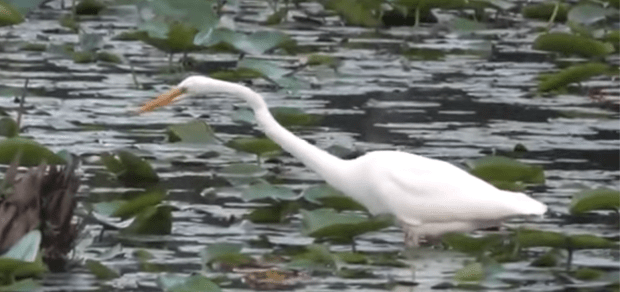
Ferris Akel spent most of the Saturday tour at Sapsucker Lake near Ithaca, New York. It was magical. We never made it to see Big Red and her family at Cornell University but it was a great time. One of the highlights was a Great White Egret which is rare to Sapsucker Lake.

Great Egrets are also called the Common Egret or Great White Heron.

Great Egrets will generally stand and wait to see their fish. They also slowly and quietly wade through the water until their neck snaps quickly and they get their fish.

Patience. Quiet. The Great White Egret gets its dinner.

Great Egrets nest in trees.

The beautiful white plumage that adorns these graceful wading birds was used for women’s hats in the late 19th century. Those silky white plumes are called aigrettes – which gives the bird its name. At the beginning of the 20th century, an ounce of Great Egret feathers was worth $32 USD, more than an ounce of gold according to the authors of Birds of Canada. People were so outraged that some of the first legislation to protect birds and their feathers was because of the Great Egret being brought to near extinction for hats!

In Canada, the Great Egrets nest in a very small number of places – in the very southern parts of Saskatchewan, Manitoba, a small part of southeastern Alberta, and southern Quebec. They are found in the Americas, Asia, and parts of southern Europe.

“Great egret rising” by wolfpix is licensed under CC BY-ND 2.0

The Great Egrets are large birds. They are 94-104 cm (or 37-41 inches) with a wing span of 1.3 m or 4.2 feet. They weight about 1000 grams or 2 pounds. They are all white with black legs and a yellow bill like the one shown above. During breeding season, a patch between its eyes turns neon green and long plumes grow out of its back.

“Great Egret Pointing the Sky” by TexasEagle is licensed under CC BY-NC 2.0

Non-breeding Great Egrets have a small yellow patch between its eyes and bill.

“Great Egret on nest with chicks” by Photomatt28 is licensed under CC BY-NC-ND 2.0

Great Egrets build a flat nest or platform of twigs and sticks. They will lay between 1-6 eggs which are incubated for a period of 23-26 days. It will be another 21-25 days til fledging for the youngsters. Aren’t they cute!

I am getting so excited for Peregrine Falcon season to begin in Australia. The male at the 367 Collins Street Nest also known as the CBD Nest arrived with prey for the female today. He is just such a cutie. The nest camera that streams on YouTube is not up and running. It will begin operations after the eggs are laid (normally). For now there is a camera operated by the owners of the building, Mirvac. Here is the link:

https://367collins.mirvac.com/workplace/building-overview/falcons-at-367-collins?fbclid=IwAR3vGCMkdnScju_KTKjhCrcHRnbsYxJm3kAKTLIOzylSVe8PX3UmwaJEn-s

The other Peregrine Falcon nest is that of researcher, Dr Cilla Kinross, at Charles Sturt University. The scrape box is home to Xavier and Diamond and they have been working on the scrape for some time now. We expect eggs at both nests by the end of August.

If you watch both nests you will get a good glimpse into the difference between a falcon nest on a high rise building in a major city, Melbourne, and the more open rural area of Orange, Australia. The prey is very different!

As it turns nearly midnight on the Canadian prairie, the day is just starting on the Foulshaw Moss Osprey nest in Cumbria. No doubt our beautiful Blue 463, Tiny Little, will fly out from where she is roosting on the branches of the tree in the distance, to the nest. White YW has a trio of big Osprey fledglings to feed. He has demonstrated that he is perfectly capable of feeding a family of five.

Thank you so much for joining me. Take care everyone. I hope to have some local images of bird life in Manitoba for you shortly.

Thank you to the following for their streaming cams where I get my screen shots: Ferris Akel and Cumbrian Wildlife Trust and the Foulshaw Moss Osprey Nest.

Feature Image Credit: “Great egret (Ardea alba) in flight at sunrise at Venice Rookery, Venice, Florida” by diana_robinson is licensed under CC BY-NC-ND 2.0

Late Wednesday and early Thursday nest check in

Kindness, the Bald Eagle nestling in the Glacier Gardens Bald Eagle Nest in Juneau, Alaska is 70 days old today (5 August). Bald Eagles are considered fully grown at 12 weeks. The average age of fledging on the Glacier Gardens nest is 89 days while the rest of Alaska is 80 days. Kindness had a quiet Thursday. It was misting rain. Mid-afternoon Dad brought Kindness a small live fish. She ate it all!

Kindness is very good at mantling.

Kindness was fascinated by the flopping of the tail of the live fish.

She is growing into such a beautiful juvenile.

Kindness is such a sweet little Eaglet.

You can watch her here:

The little osprey nestling, Malin, on the Collins Marsh Nature Cam, had at least five feedings on Wednesday. A big shout out to ‘S’ in Hawaii for counting those feedings! Malin’s tail and wing features are looking so much better.

It was nice to see Malin with a bit of a crop early Wednesday afternoon. Those feathers are really developing and that girl loves to use her eye liner. Can’t wait to see what Malin looks like when she has all of her juvenile plumage.

Malin’s crop got bigger. So happy to see this. When Tiny Tot on the Achieva Nest needed food to really grow and begin to catch up, it arrived. Everyone’s warm wishes must be working for Malin! I do hope she grows feathers back over that shiny crop. I don’t think I have ever seen that in an Osprey chick, have you?

Malin is becoming quite the character. She is so happy when mom is on the nest. I wish I could sit in that yoga position like Malin does!

The Collins Marsh Osprey Cam is here:

At the White Bellied Sea Eagle nest in Sydney, it is all about the feedings. Unlike Kindness who eats more and requires less feedings, these little nestlings require lots of feedings with fewer bites. Lady and Dad have both been taking turns feeding and brooding. Lady does do all of the night time brooding. 27 and 28 can melt your heart. I have been told the bonking is minimal.

27 is 7 days old and 28 is 5 days old. These two are really sweet.

Lady just adores these little ones. She is so happy to be a mom again.

You can catch all of the action at the WBSE Nest in the Sydney Olympic Park here:

Hob Osterlund reports that Amazonia, the last of the Laysan Albatross Colony to hatch, fledged sometime between Monday and Tuesday off Kauai. For me, there are always a few tears when the birds fledge but no more so than for the Albatross who spend 4-6 years at sea before ever returning to land. What a leap of faith that first flight brings and how astounding it must be to fly. Take care H958. We hope to see you in Kauai in a few years with your sea legs on.

@ Hob Osterlund

There is troubling brewing down in Orange, Australia. Xavier and Diamond have been preparing the scrape box for the 2021 season. Izzi was officially 10 months old yesterday. There was a confrontation in the scrape box with Xavier. Neither bird was injured but it was Xavier that left the box. Most people feel that Xavier and Diamond will now have to treat Izzi like any other intruder – unless, of course, he wants to join in raising his siblings. It has happened – actually worked well – in the UK. We wait and watch.

Cilla Kinross posted a very short video of the unfortunate encounter:

It is a new day in the scrape box. Xavier arrives with a male Red-rumped Parrot as a food gift for Diamond around 11:20. He calls Diamond and she quickly arrives accepting the gift and fleeing the scrape box. Xavier waits and leaves after. This is good. I did not see anything of Izzi!

Diamond must have been so happy that Xavier brought a parrot than a Starling!

She grabs it quickly and goes out to enjoy her meal.

Here is the link to the camera for the Falcon Cam at Charles Sturt University:

The female at the Port Lincoln Osprey Barge laid her first egg of the 2021 season two days ago. Today should be egg#2. It wasn’t there at 12:32 on August 5 (nest time) but Mum looked restless and uncomfortable.

Still only one egg. Old timers tell me that there can be 4 days between eggs.

The 2018 hatch, Calypso, has been seen hunting just north of the barge. She was the first Osprey banded for a long, long time in Australia. She stays within 10 km of the barge – a real difference from Solly who remains up near Eba Anchorage, more than 200 km away.

Those beautiful Black Stork nestlings are doing very well. Everyone worries because these lovely nestlings hatched so very late. It is hoped their parents will stay with them and not leave for migrate before they can fly.

My friend in Latvia, ‘S’, also included a video that was made showing how the nest looked after last year’s season was ending. Wow, that nest is really narrow at the base. Have a peek!

The light in the forest changes throughout the day. There has been lovely misty rain in the early mornings with the sun bursting through later in the day. I must rewind the streaming cam today to find the parents returning to this nest to feed this trio.

There is still plenty of time before these beauties fledge. You can watch this rare Black Stork nest in Latvia of Grafs And Grafiene here:

Thank you so much for checking in with our birds today. It looks like everyone is doing fine except for Xavier and Izzi. We hope that is sorted and Izzi, the little cutie pie that no one wants to leave, is on his way to start his journey and find a mate! Take care all. See you soon.

Thank you to the following for their streaming cam where I took my screen shots: The Latvian Fund for Nature, the Glacier Gardens Bald Eagle Cam, Collins Marsh Nature Centre, Sea Eagles, Birdlife Australia and the Sydney Discovery Centre, Port Lincoln Osprey Project, Falcon Cam Project at Charles Sturt University in Orange, and to Hob Osterlund for the photo of Amazonia on her FB page.