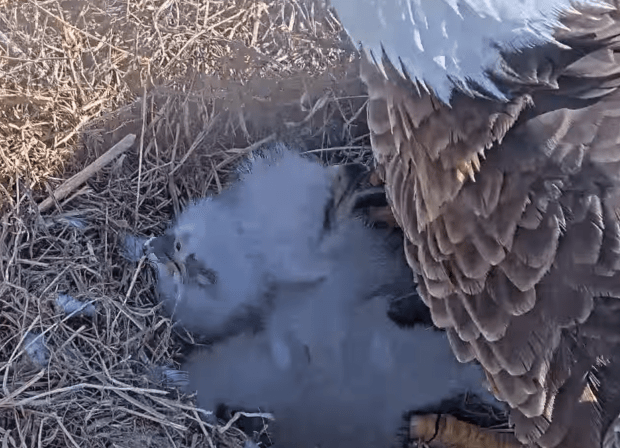
Ervie. It is quite easy to tell, from the time the three boys hatched, that Ervie the third born, was my favourite. I will not deny it. I look for third hatches that become the dominant bird on the nest and Ervie is certainly that.
So a question came in – did Ervie’s reservation on the nest yesterday include a later fish and a breakfish?
Last night, Ervie got a huge fish delivered to the nest. It was one of the largest I have seen there. The time was about 20:09. Ervie has been eating for about 20 minutes. If you look very carefully – sorry the sun is setting and it is difficult to see – you will see how big that fish is. Falky and Bazza on the ropes as Ervie munches his way into full Osprey heaven.
And, yes, Ervie did get the breakfish this morning. Mum delivered it around 07:08.
In the image below Ervie is on the nest and Falky is his usual spot on the corner ropes fish calling. They can see Mum flying in with the fish.
It is a kerfuffle. Everyone wants that fish.
Mum gets out of there. All three are after the fish. Bazza is hovering over Ervie and Falky.
They scramble.
Ervie, facing towards us, has the fish!
As you can see everyone wanted that fish. Falky flew in from the ropes and Bazza flew in from being off camera. If you ever wonder where Bazza is, he is usually on the barge somewhere just not on camera.
Dad delivered a fish that Falky got at 07:23:25. Falky is down in Dad’s man cave working on that fish.
Falky decides to take it to the ropes.
So Ervie and Falky have eaten. I wonder if Bazza is being fed elsewhere??? is he also fishing? Mum used to favour him and there is no reason to believe that they only deliver to the nest.
So, yes, Ervie got his full reservations worth. Now if the rota is working correctly, Falky will be on the nest tonight. We wait.
Thank you for joining me and thank you for sending me your questions and comments. Take care everyone!
Thank you to the Port Lincoln Osprey Project for their streaming cam where I took my screen captures.
If you have been reading my blog regularly, you will know that I am tracking the Port Lincoln Osprey lads in terms of ‘who is on the nest’. Ervie and Falky have been alternating. Ervie spent the afternoon and evening and slept on the nest. He is on there right now.
Ervie is fish calling to Dad.
Bazza has been shut out and yesterday he attacked Ervie when Ervie was on the nest. If you missed it, here is that dust up.
We are on hatch watch this weekend for three Bald Eagle nests. That is Captiva, Kistachie National Forest, and Berry College. The eggs for both Captiva and KNF were laid on 4 Dec and 7 December. One of the KNF eggs was broken. Eggs at Berry College were laid on 5 Dec and 8 December. You might remember that it was the female at Berry College, Missey, that survived that horrific hail and wind storm. I hope those eggs are alright. This is a new female for Pa Berry – their second season together. If you were a fan of Ma Berry, she was seen having a spa day at the end of January 2021. Yes, birds do get divorces.
This is the Kisatchie National Forest nest of Anna and Louis. Anna is incubating now.
Here is the link to the KNF Bald Eagle Nest.
This is the Berry College Bald Eagle Nest.
Here is the link to the Berry College streaming cam:
This is the link to the Captiva Nest. This is Connie and Clive. I hope that they have a very successful year. This is probably the most narrow Bald Eagle Nest in the world!
R1 and R2 at the WRDC nest are doing just fine. Rita did some clearing of the nest yesterday and some new grasses were brought in. The nest looked amazing but after several hours, little eaglets wandering around and food can cause it to look messy again. Rita used the grass to go to the edges and sticks are still being brought in to this new human made nest for the sides.
Little eaglets full to the brim. The weather is good. It is 24 degrees. They do not need Rita to brood them in that temperature.
Ferris Akel is streaming live as I type. I love to lurk because he finds some amazing birds on his Saturday tours of the Finger Lakes area of Upper New York State. So far today there have been lots of hawks – Northern Harriers and Red Tails. The Harriers are really difficult to photograph.
The Ducks below are American Black Ducks, females. They might look like Mallards but their bill is tinged more green than the orange of the Mallard and their feathers are darker. They are virtually the same size and shape of a Mallard.
This is a female Hooded Meganser looking for food – going in and out of the water flapping her wings.
There you can get a good look. This looks to me like a first year female. Mergansers like to live in forested swamps but today they are in the wetlands. They nest in tree cavities and will also use nest boxes, unlike our favourite little duck, Daisy! They winter in the estuaries and creeks in the eastern United States and along the Mississippi Flyway.
Ferris found a Red-tail hawk hoping to find some lunch. Many of the Red-tail Hawks around the area of Ithaca do not migrate but remain in the region because the winters are not too harsh and there is plenty of prey. Indeed, the one thing that does determine over winter areas is the availability of food.
There continue to be lots of Canada Geese in the Finger Lakes region of NY.
Today, there were also some swans.
Swans feed by submerging their heads into the vegetation below the surface of the water.
These are young Tundra Swans with an adult. The Tundra Swans are smaller than the Trumpeter.
Aren’t they beautiful? We have so many waterfowl in Canada but it was not until Daisy the Duck in Australia that I really began to appreciate the ones around me.
There were also Mallards and Redheads mixed in with the Tundra Swans who are searching for vegetation to eat.
Just look at all of the Redheads!
The GHOWs are becoming a real problem for the health of the Bald Eagles. There was another owl strike at the SWFlorida Bald Eagle Nest of Harriet and M15. Lady Hawk has it on video. Additionally, there are GHOWs attempting to take over the Minnesota DNR Bald Eagle nest of Harry and Nancy, the Savannah Osprey Nest, and, as we know, a GHOW named Bonnie and Clyde took over the nest of a young Bald Eagle couple in Newton, Kansas last year and raised two owlets to fledge.
I am beginning to not like GHOWs at all!
The temperatures on the Canadian Prairies warmed up and we got more snow! It can stop now. The birds have already been fed and it looks like a great day to stay in and read and watch for those pips.
Over the past month I have become very fond of DanniConnorWild. She is a young wildlife photographer who has taken up residence in Northern Sweden. She is living her dream. That is fantastic! She is very keen on squirrels. Indeed, the squirrels in this video are eating spruce cones. I have never seen this. She is earning a living through her videos and photographs so there are ads but, just don’t mind those. I am posting her video from the end of the year that includes squirrels, Reindeer, and beautiful Northern Lights in case you want to have a look.
Thank you for joining me today. It is so nice to have you with me. Take care everyone. See you soon.
Thank you to the following for their streaming cams where I took my screen captures: Ferris Akel Tours, Port Lincoln Osprey, Captiva Bald Eagle Cam, Berry College Eagle Cam, KNF Bald Eagle Cam, and the WRDC Bald Eagle Cam.
There is never a dull moment at the Port Lincoln Osprey.
Falky had nest reservations along with his breakfish from Dad which arrived some time around 06:55. Ervie tries to steal that first fish in the morning to “break the fast” but Falky is not having it. Part of the reservation agreement appears to come with breakfish. After a few minutes, Falky decides it is safer eating his fish over on the corner ropes.
Meanwhile, Ervie is on the nest and Bazza is on the perch and well, let us just say that Bazza is in a bad mood. In fact, it is interesting that neither Falky or Ervie have any particular love for Bazza. They both continually kick him off the nest – and unfed at least on camera. Bazza decides to mix it up a bit with Ervie around 06:54. Bazza wants on the nest – indeed, it was almost his sole domain for a long time.
Bazza flies off the porch to knock Ervie off the nest.
They fly off battling. Ervie is coming back around.
They engage again!
They go around the nest. Look at Falky just taking it all in. He is glad he is eating a fish!
Ervie is intent on getting Bazza as far away as he can.
Those are just a few of the screen captures. The pair will fly around the nest and will be battling still. It is best to see it in video:
As nestlings, these three were amazing. They lined up like members of a choir for Mum, Ervie at the beak, and ate without conflict. There was hardly anything that prompted concern. Bazza, the first hatch, tried to push Ervie around a few times but, Ervie simply wouldn’t stand for it and ignored any untoward advances by Bazza. And then, Bazza stopped. They all ate well and even seemed to cooperate with their wingersizing on the nest. Now that they are independent juvenile males instead of nestlings, wanting to have a fish delivery instead of fishing (that is hard work and requires upmost physical condition), the competition is huge. I am so glad that it is now and not when they were little. They have to learn how to live in the real world away from the parents and keeping their territory and their food is all part of that. Needless to say, Bazza was run off today by Ervie. Yesterday, Falky chased him away.
Ervie is on the nest.
Does Ervie have reservations for today? We wait.
I don’t think either Falky or Ervie told Bazza about the new on line reservation system as he has been locked out for a few rotations. Don’t you love them?
Thanks for joining me. These lads are serious but, they are also fun. They are growing up. Take care everyone!
Thank you to Port Lincoln Osprey for their streaming cam where I took these screen shots and video clips.
Ervie kept quite a few people worrying yesterday. We all know Ervie. He is off flying around finding his own fish (we think) and sitting over on the perch, right? Well, his behaviour changed a bit and it had some of us wondering what was ‘wrong’. Ervie stayed on the same spot on the nest for over 12 hours. Seriously. We watched to make sure his feet or talons were not tangled in fishing line. They weren’t. And then he flew off the nest only to return to the same spot! ERVIE!!!!!!!!! Ervie was pulling a Bazza waiting on the nest to get a fish. Meanwhile the water was a bit choppy and the winds were blowing at 21 kph but gusting much higher.
Indeed, Ervie was still on the spot on the nest at 16:29 when he flew off for a second time. Ervie should have stayed a little longer!
Bazza does a quick fly over at 16:57:26.
Bazza returns to the nest to wait for a fish delivery.
Bazza intercepts the fish at 17:15:09. No one else is around.
Bazza protecting his fish dinner. Notice the waves and the white caps. The water is very rough. Dad is a great fisher!
I still do not know if Ervie managed to get a fish from Dad yesterday. The water is far too choppy for the juveniles to have much luck, if any, fishing. It is supposed to be windy today, too, at Port Lincoln.
M15 has been stepping in and feeding E20 when 19 is sleeping. It is really sweet. M15 also brought in a tree branch this morning just about knocking the babies out as he put it in place.
The branch incident happens at 07:33.
This is E20 sitting up. How did I know that? Two clues. First look at the size of the feet. The baby standing has smaller feet than the one sleeping. The one asleep also has a ‘dirty’ spot on its bad. That is E19.
You can see this a little more clearly. E20 is standing up.
Sweet sleeping babies!
So sweet.
Our great parents – M15 on the right and Harriet on the left.
So far there is no Daisy on the nest and the Sea Eagles have not returned since they were harassed so much.
Can you find Ruggedy the Kakapo? Hiding in plain sight. The rangers took a break and are now back at work checking transmitters and doing health checks on our favourite non-flying parrot!
I want to leave you with one of the most interesting radio interviews that I have heard. It is especially dear to me because the young woman being interviewed is from Oklahoma. She got her falconer’s license in 14 and went on to study in Mongolia. You can listen to this while you do other things or you can start and stop. You will be so inspired. She talks at length on what it was like living in Mongolia and being trained as an Eagle falconer. It is on Bird Calls Radio.
It is warming up on the Canadian Prairies. It is -15. Feels almost like summer!!!!!
Thank you so much for joining me today. It is so nice to have you with me. Take care.
Thank you to the following for their streaming cams where I took my screencaptures: Port Lincoln Osprey, SWFlorida Bald Eagle Cam and D Pritchett, Kakapo Recovery, and Sea Eagles@Birdlife Australia Discovery Centre Sydney Olympic Park.
The Audubon Society has posted a list of five rules when photographing Bald Eagles. I think that they apply to every bird. Be respectful. Prey is often scarce and if you see a raptor hunting food don’t disturb it, please. Their life could depend on it!
The other day I called E19 and E20 little stinkers. What a pair! One of them was even beaking an adult this morning! E20 holds its own – it just makes everyone a little anxious. They are strong and healthy. The images are a little fuzzy as I tried to crop them so you could see the little ones better.
Here they are going at it first thing while Mum tries to get over to feed them breakfast. Both had huge crops and at the second feeding weren’t interested in eating just dusting it up.
This cheeky eaglet facing Mum was beaking at her feathers!
Even with all the action, they are both adorable with their spiky tops.
Harriet has just finished feeding the pair some nice fresh fish.
Harriet is so experienced. It is often one bite for you and then a bite for your sibling.
Here is a video showing Dad, M15 giving E19 and E20 the last meal of the day yesterday!
It was a gorgeous morning at the NEFlorida Bald Eagle nest of Gabby and Samson.
Gabby is having a break looking over their territory in the morning mist.
Samson always enjoys getting some time with the eggs. Oh, so handsome.
Anna and Louis seem to have perfected transitioning incubation duties while protecting that one precious egg of theirs.
It is a beautiful nest full of pinecones for this little eaglet to use to learn how to grip with its talons.
It is already New Year’s Day in Australia and the Port Lincoln Lads were up early trying to get the first fish from Dad. It was 06:23 and Falky was on the nest!
Dad didn’t even eat the head!
Well done, Falky.
Diamond does not seem to have spent the night in the scrape box on the water tower at Charles Sturt University but she did arrive early. There was a lot of eee-chupping. It sounded like she was calling Xavier to come and join her. Xavier might have been off hunting for breakfast. It was a beautiful morning.
You are so beautiful, Diamond.
Everyone in Bird World seems to be doing just fine today. Big Red and Arthur have been spotted hunting together over by the power plant. It is comforting that all are doing well. We hope that all of the 2021 fledges fly safe, stay healthy, and have lots of prey items.
Thank you so much for joining me. Wishing you all a healthy and happy start to 2022. See you soon.
Thank you to the following for their streaming cams where I took my screen shots: SWFlorida Bald Eagle Nest and D Pritchett Family, KNF Bald Eagle Nest, Port Lincoln Osprey Project, Charles Sturt University Falcon Cam and Cilla Kinross, and NE Florida Bald Eagle Nest and the AEF.
Let’s start off with what is on everyone’s mind: Has there been a confirmed sighting of Yurruga? Yesterday, Dr Cilla Kinross was inspired by a very quick prey drop at the scrape. Diamond flew into the trees. Cilla was in the trees looking half an hour later – she only saw Diamond. Diamond returned to the scrape with quite a large crop also. Some believed they had heard Yurruga calling but, Cilla is unable to confirm that. So the answer is – we simply do not know. Yurruga has not been seen since last Thursday when he was on a building during a storm. We can only wait.
My goodness that little one was such a cutie.
October 20. Yurruga and Diamond
Diamond was really beautiful this morning as the soft glow of the sun worked its way through the fog.
Both parents, Xavier and Diamond, have been inside the scrape – scraping. They also had some bonding moments this morning at sunrise.
My heart aches for them.
The second question of the day is what is going on with Grinnell, the male Peregrine Falcon of the Campanile, mate to Annie, that was injured by a male intruder that is trying to cosy up with Annie? Here is the latest news.
The New Zealand Department of Conservation rangers on Taiaroa Head are shutting down the streaming cam so that they can move it to the site of the Royal Albatross family for 2021-22. There are lots of guesses as to who the couple might be. The announcement is due tomorrow.
One of my favourite Bald Eagle couples, Samson and Gabby, at the NE Florida Bald Eagle nest near Jacksonville have been putting the finishing touches on their nest. They are perfecting the Spanish moss lining the nest cup. Now all we need are some eggs!
Gabby doing some final inspections this morning.
The three lads at the Port Lincoln all had fish yesterday. Falky had more than Ervie or Bazza. Falky has become a master at slipping the fish out of Dad or Mum’s talons. A magician.
There is a lovely shot of the PLO Mum. She has done an extraordinary job raising these three boys to fledge this year (with Dad’s good help). Yesterday she even spent some time feeding Bazza. He is definitely a Mum’s boy!
Bazza can be a bit naughty. I know that the banders were certain that there were three males. Someone looking at Bazza’s legs and that beautiful necklace in the image below might mistake him for a lovely female.
Bazza and Falky sleep with their heads tucked under their wings – adult style – standing on the nest. Ervie is sleeping over on the perch or the ropes. They are all doing well. I continue to pinch myself. This Osprey nest really turned itself around this year to fledge all three hatchlings.
There are many articles coming out in international newspapers and academic journals on the effect of warming oceans on the seabirds including the beloved Osprey. I picked one of those for you as some are frustrating. They allow me to embed the article but then want you to subscribe to read it! That is a major irritant to me – like Subarus are to Ferris Akel!
It is a grey damp day, 3 degrees C. The snow is melting. There are lots of birds at the feeders. A large European Starling is sharing the peanut and bark butter feeder with some cute little House Sparrows.
The tiny suet balls called Bark Butter by our supplier are a really big hit since winter has set in. Junior has been around to get the corn while Dyson was busy elsewhere. Nice to see all of them.
One of my former students posted this today on FB. It is a perfect little giggle for all of us!
Thank you so much for joining me today. Take care everyone. Stay safe.
Thank you to the Port Lincoln Osprey Project, Charles Sturt University Falcon Cam and Cilla Kinross, and NE Florida Eagle and the AEF for their streaming cams where I took my screen captures.
I want to thank ‘L’ for asking if I would share parts of that amazing book Australian Birds of Prey by Penny Olsen. I am so happy to do this! We can all learn together.
There are 24 species of raptors at the time the book was written in Australia, 1995. I know that many of you are familiar with the Eastern Osprey and the Peregrine Falcon so I want to start with some gorgeous raptors that you might not know. My plan is to introduce 1 or, at the most, 2 species a week. Our first is the Black-shouldered Kite. The scientific name is Elanus axillaris. Just look at that lovely bird. She is simply gorgeous.
The Black-Shouldered Kite is easily identified by the black patch on their wing. There is also a small black underwing patch. This is a small to medium bird with a gorgeous white head, body, and tail. The shoulders are black as is the beak. The back and upper wings are mostly a very pale grey. The eyes are a captivating red! The cere is a brilliant yellow as are the legs and talon.
The female is 36 cm and the male 35 cm in length. The female weighs approximately 300 grams with the male weighing 260 grams when fully grown. As you can see, the female is slightly larger than the male which is known as Reverse Sex Dimorphism.
The Black-shouldered Kite has two front toes and two in the back (as opposed to three forward and one back). The wingspan is 80-100 cm.
In terms of its habitat, the Black Shouldered Kite prefers open grasslands, woodlands, and croplands in lower altitude areas that are within the tropical or temperate climate zones. At the time the book was written the population numbers were climbing.
The birds prefer rodents as their first choice of prey while their second is insects. The Black Shouldered Kite tends to breed when prey numbers are higher. They raise one clutch per year normally between May-November. Clutch sizes vary between 2 and 5 with the majority being 3 or 4 eggs. In a poor year with little or no food, it is expected that Black Shoulder Kites would have a much smaller clutch or lay no eggs at all. Eggs are on average 4.2 cm. This can be compared to an Osprey whose eggs are, on average 6.1 cm long. Eggs are incubated for 31 days with chicks fledging at 5 weeks. The chicks will have their adult plumage in one year, after their first moult.
The image below is a juvenile. Notice the rusty brown wash on its head and shoulder. What a beauty. Even though this chick is waiting for food, at 5 weeks it is fully capable and does hunt mice.
Oh, what a beautiful bird! I hope that you have enjoyed learning about one of the raptors that live in Australia (and other parts of Asia). Like every species of bird, the protection of their habitat (and keeping it from fragmenting into small patches) is important to the continuing health of the Black Shoulder Kite. Other threats are egg collectors (yes, they still exist), pesticides, rodenticides, and electrocution on power lines.
Thank you so much for joining me today. Take care. See you soon!
The FB of the Orange Australian Peregrine Falcons posted an interesting article with the vocalizations of Peregrine Falcons. Want to understand what those falcons are doing or saying?
When Victor Hurley did his Q & A session about the Melbourne Collins Street Falcons, he mentioned a book. That volume, Australian Birds of Prey by Penny Olsen is one of the most informative and beautiful books. Published in 1995 most of the information remains relevant today. The statistics on how many birds exist will change but the information on all of the falcons, size, ID, brooding, etc remain the same. One of the things I love about it are the drawings of the raptors.
Note: Do not be fooled by books of a similar name. Check and make sure it is Penny Olsen 1995.
Images from old print collections. In this instance it is the Wedge-tailed Eagle, the largest raptor in Australia, in a hand coloured drawing from the early 19th century.
The stories of how these early drawings came to be made just wrenches your heart especially when foreigners to Australia would injure the birds and hope to take them back to England. This bird managed with a wound to claw its way through a rope and escape, thankfully. Our ideas of the rights of animals are changing but we still have much much more to do!
The image below is of a Hobby. Olsen comments that young raptors spend much more time lying down than they do standing. The photographer has caught this small falcon resting. What a lovely capture!
The Hobby is also known as ‘The Little Falcon’ or the ‘Little Duck Hawk.’ It is a member of the Falconidae family of diurnal, day time hunting, raptors.
One of the things that I like about the book are the tables that compare the various raptors in Australia to one another and the topics that cover everything from ecology (habitat, dispersion, , mortality), predators, reproduction, health, raptors and humans as well as conservation.
This is an impressive book and if you can get your hands on a copy – there are no reprints – it is, as Victor Hurley says, ‘essential for a library’.
Continuing on with the raptors from Australia, Cilla Kinross posted a video of a bonding session between Xavier and Diamond. Listen for the vocalizations (after you read and listen to the first article today).
There is no current update on Yurruga. He was seen day before yesterday on a roof. It rained hard and steady yesterday and Orange and I imagine our wee fledgling was hunkered down somewhere wanting to stay dry. Not good to try and hone your flying skills in a down pour!
I have not seen any updates or sightings of the 367 Collins Street fledglings. If something comes up I will let you know! It is still bittersweet looking at the four of them and the wee male not making it. But, on the brighter side, we could have lost all of the eyases this year. “Be thankful for what we have and don’t wish for what we don’t” was a common mantra of my grandmother.
The season in Australia is winding down as our lads on the Port Lincoln Osprey barge continue to get stronger and stronger and will become more independent and learn how to fish soon. It is wonderful that we will be able to follow Ervie on his adventures with his sat-pak. Let’s see if PLO has posted anything today!
This is the last posting when Ervie flew over land on 23 November. To the surprise of many, Solly also flew over land and into the interior a bit which will go a long ways to informing the power companies where they need to put those protectors on the hydro poles.
All three are sleeping adult style, standing up with their head tucked under a wing.
As to the situation with Annie and Grinnell and the interloper, the interloper male flew in to the Campanile and was greeted by Annie. UC Falcons have not seen Grinnell and Annie together as yet. Challenges and conflict over territory could happen. Fingers crossed.
As things go quiet in Australia, I will begin to list some of the Bald Eagle and Osprey nests in North America that you can watch. If you have a favourite, let me know and tell me why you like it so I can pass that along to others. Thank you!
Thank you for joining me today. Stay safe. See you soon!
Thank you to the following for their streaming cams or FB pages where I took my screen captures: Orange, Australian Peregrine Falcons, Charles Sturt Falcon Cam and Cilla Kinross, 367 Collins Street Falcons by Mirvac, and Port Lincoln Osprey Project.