Early Tuesday in Bird World

23 August 2022

Today turned out to be a very special day (22 August). OK. It is always special when I can go out to the nature centre and do my long walk. It is also a good way to check every nook and cranny for the geese and ducklings. A few had moved from where they were yesterday but many stayed in or close to their normal pond area. I continue to be fascinated that there simply are no Wood Ducks at the nature centre. It is like the two species – Mallards and Wood Ducks – sat down and signed a truce and decided who would go where! There were a lot of birds at the ‘winter’ feeding stations — they must fill the feeders year round. There were several Downy Woodpeckers, two American Goldfinches, a number of Black-capped Chickadees and then a bird sitting in the squirrel feeder that I did not recognize. After going through the birding book, it appears that the little lovely below is an immature female Rose-breasted Grosbeak. I certainly welcome any help with this ID.

The most excitement came this evening, however. It is hard to imagine sitting next to a pond which is about 6 metres away from, perhaps, the busiest highway in our City and seeing a Great Egret fly to a tree to join two others. They are part of the heron family but they are very large. In North America they have black legs and a yellow bill. They gather in groups near ponds and wetlands if there is plenty of food. Otherwise, if food is relatively scarce, you will see them alone.

What a magnificent creature.

In the mailbox. Following up with the question about Titi and Boris and the reason for the Janakkalan nest cam in Finland to go offline. We have answers. Thank you ‘S’ for getting back so quickly to us. Boris was seen on the nest two days after Titi’s fledge. It was the morning of 12 August. Titi did not return to the nest while the camera was still operating.

There is a video of Boris’s nest visit.

There were difficulties with the camera and it completely broke down. It will be fixed and will be up and running again next year. ‘N’ did receive a response from the Finnish Osprey Foundation stating that there were a number of Osprey fledglings in the Muonio in Northern Finland. Thank you ‘N’.

Can you help? There is a new book on Peregrine Falcons being written by Richard Sale in the UK. Susan Sale writes with the following information and a question. “My husband is self-publishing a book on the Peregrine Falcon and I am trying to source the following Peregrinus Casini, Japonensis and Pealei. Do you have any photographs of them or perhaps give me some contacts who may and if you or they would be willing to allow use in the book.” If you have any images of any of the three sub-species of Peregrines or you know someone who might be able to help, please contact Richard and Susan at this e-mail address: Richard@snowfinch.co.uk

Several have been wondering about Big Red and Arthur’s L3 and L4 that are currently in care. They ask “Will they, if ever released, be placed near their family so BR and Arthur can find them? If not, Who and How will they learn to hunt after all these WEEKS in the clinic???” L3 and L4 are in very good hands. Just like they would if they were patients in my local wildlife rehabilitation centre, they will learn to fly and they will also be taught how to hunt and catch their own prey. I do not know where they will be released.

‘B’ sent a note and wondered if I had seen Thunder and Akecheta on the West End nest together. I had not and went quickly to rewind and there they were. Thanks ‘B’. We are always happy to see the parents on the nest as well as the fledglings!

‘L’ wrote: “When I grew up in the north of England, along the Pennines…near the Lake District….I never saw an Osprey, Kite, Goshawk, Golden Eagle that were native to our islands as we had eradicated them… I thought all was lost .it wasn’t and these efforts wipe away the despair that can overwhelm you when you ask how can we make a difference. WE make a difference.”

‘L’ you will then be thrilled to learn that the National Trust, RSPB, and the Peak District RaptorGroup just announced two successful Hen Harrier nests this year! And, as you know, the Ospreys are thriving and so are the Goshawks. Isabelle Tree’s re-wilding at Knepp is taking off…there will be more raptors.


Nest News. It is hard to imagine sitting in the heat of summer in the Northern hemisphere but, the forecast is for snow in Orange, Australia. Holly Parsons who heads up the FB group was posting an image of Xavier and Kelli HissiFit Walker, one of the new mods on the streaming cam chat, dressed Xavier for the occasion. I chuckled so loud – I hope you enjoy it. If I were Diamond I would not want to lay eggs in that cold!

Thanks Holly and Kelli for letting me share!

Like Titi at the Janakkalan Osprey nest, LC at the Osoyoos nest doesn’t seem that much interested in fledging — yet. LC is 66 days old today.

As of the 22nd, Telyn was still at the Dyfi Osprey nest. She has not begun her migration yet. There is no rush and the females need to be in top form before they depart. Taking care of three big female chicks really has to be draining because they require much more food.

I went to check on the Sydney Sea Eagles and Lady was feeding SE29 and 30. It was very civil. SE30 did a few quick grabs and kinda looked to make sure 29 wasn’t going to do anything. Lady had it all in hand – a bite for you and then one for you. Back and forth. How lovely.

Sometimes 29 did seem to get more bites than 30.

and then 30 would get a few more…

There is plenty of fish. Both will be full. Just look at the ‘blood feathers growing in on SE29’s back and wings. Oh, they are changing so quickly — and the are simply adorable.

It rained later in the day and Lady spread her big wings and covered those babes who do not, as you can see above have their feather covering.

Dad was in the nest and on alert to any intruders that might be around,

Migrating tracking. Kaia flew in a big loop today staying in the same area that she flew to after she flew north out of the Ukraine.

There is considerable worry for Kaia’s mate, Karl II, and migration has not begun. He normally spends much time at a nature reserve on the Black Sea near Odessa. The area is currently a war zone.

A lovely image of Little Bit 17 was posted by S Basly on the Notre-Dame FB page. It was taken on the 28th of July.

What a wonderful way to end today’s blog with a look at Little Bit 17. He is, of course, a prime example of what an intervention and wildlife rehabilitation can do to give a raptor a second chance at life. Little Bit deserved it and he is living it. Such a beautiful juvenile.

Thank you so much for joining me today. Please take care. See you soon!

Thank you to the following for their streaming cams and/or posts that made up my screen captures: Notre-Dame Eagles, Looduskalender, The Eagle Club of Estonia, Sea Eagles@Birdlife Australia Discovery Centre Sydney Olympic Park, Osoyoos Ospreys, Dyfi Osprey Project, Raptor Persecution UK, Explore.org and the IWS, Finnish Osprey Foundation, and the Orange Australia Falcon Cam FB.

Featured image is Thunder and Akecheta on the West End Bald Eagle nest in the Channel Islands. 22 June 2022

Monday morning in Bird World

22 August 2022

Good Morning Everyone! The sun is out and it promises to be another hot day, 28 C. No rain forecast until tomorrow — and they might well change that. I am delighted to report that Dyson was seen in the garden this morning. One of the juvenile Blue Jays was screeching so loud – at Dyson – who was helping herself to ‘his peanuts’. The three juvenile Crows were in the garden on Saturday and again this morning. The little female was cooling her feet off in the bird bath.

I have also been out checking on the ducklings. Some are really growing!

Last week, there were 11 with this female. I am now counting 9.

This little sweetheart watched me quietly walk towards and around her. She never moved. How delightful.

If you are a duck and it is hot and humid, what do you do? Try to find some shade and/or a breeze. Duck Siesta time.

Then I found these two ducklings. They do not have their tails and are still sporting their downy fluff. Oh, I am going to worry about them and, hopefully, I can find them today or tomorrow when I am out checking again.

Update. There was some concern about the situation with AX6, Axel, at the Loch Garten nest. Yesterday, I posted that AX6 had not been seen on the nest and was feared to be ousted by the intruder, KL5, injured, or worse since 15 August at 0635.  Good news arrived from ‘DV’ who wrote to tell me “AX6, Axel, was seen on the Loch Garten nest this morning (Sunday), according to watchers.” Oh, fantastic. I checked on the Loch Garten FB page and they confirmed the time as 0835. Axel remained on the nest for 5 minutes. There is YouTube video confirmation. Thank you so much DV! Now has he been feeding the sole surviving chick from the nest 1C2 off camera? That is the question. He looks good!

The nest was empty later.

From the mailbox. There are several nests that many of you might have been wondering about. First up, Titi and Boris at the Janakkalan Nest in Finland. I have heard nothing since the camera shut down quickly and abruptly. I do not know why a decision was made to go offline at that time.

The streaming cams operate for many reasons but research and education/entertainment seem to be the main categories. The owners of the streaming cams often do not take into account the impact that watching a family of raptors has on viewers. Each of us has our favourite nests. Some may be the same for all of us but there are always nest surprises. We have our favourite nestling and we cheer them on and yell at the screen, fret when the weather is bad often staying up with them. We worry when there is not enough food. We clap and jump when they fledge and then we worry about where they are and if they are alright Sometimes (and it was a lot this year), we cry when one or another or all die.

For me the streaming cams have always been a way for us to connect with nature. They became particularly important during the pandemic as shown by Loch Arkaig having over 400,000 viewers watch Louis and Aila raise JJ5, JJ6, and JJ7 in 2020. Many have written to tell me that they are in hospital dying and it is the birds that are keeping their spirits up. One of my readers who became a good friend had cancer. Anyone on the Sydney Sea Eagle chat will remember Phyllis. The sea eagles and the chatters kept Phyllis going much, much longer than the doctors could ever imagine. The birds enrich our lives. I have had people say why not go outdoors and watch the birds, why on screen. I always tell them that it is like going to a sporting event or a Formula 1 race – you actually get a better view on the telly. Of course we go outside and see the birds if we are able! But where could you see up close an Osprey, an Eagle, a Peregrine Falcon raising their chicks? I surely couldn’t! They have brought us joy and touched our hearts so when that camera is suddenly turned off without an explanation or warning, we wonder why. It is shocking.

And so it was with Titi and Boris. They had lost their mother and their sibling. Dad continued to bring food and the goshawk was around. We worried about Titi who waited so long to fledge and then boom…nothing. We never got the opportunity to see if Titi would return to the nest. Some of you have written to ask the Finnish Osprey Foundation why did they turned the camera off so early. You have not received an answer. I have written to one of my Finnish contacts and readers to see if they know anything. I will certainly post any news here for everyone if I should hear.

My inbox has been full of letters about Malalam the little Red-tail Hawk adopted by the Bald Eagle family on Gabriola Island, British Columbia. When her nest mate turned sibling, Junior, was electrocuted on a pole owned by BC Hydro, GROWLS posted all manner of information so that a campaign could be directed towards BC Hydro. Many groups joined in. I carried their request to you. Malala is not ringed. The Red-tail Hawks and hawks in general are beginning their migration. Will we ever know what happened to Malala? is anyone watching the nest to see if she returns? She could be heard on the cam on the 30th of July. That same day, GROWLS FB said that the season was closed and the camera was immediately turned off. No information has been posted since. It felt abrupt especially after so many wrote to BC Hydro on their behalf after the call to do so on July 22, ‘Justice for Junior’.

I am fortunate to have a friend and former student in the area. They have confirmed for me that there are a number of red-tail hawks and without any method for identification no one will know unless they happen to see Malala at the nest or eating fish. If I do hear anything – or if you do – please let us know.

Many of you fell in love with this family and the story. That is the missing link in the streaming cams that I am trying to emphasize. If we are to try to make any positive impact in the lives of wildlife, then it would be good if the administrators of the streaming cams would agree to post any updates and warn individuals when and why cameras are being turned off. Annual maintenance is one of the biggest reasons and well established cameras with high traffic always warn their viewers. I am thinking of SWFlorida Bald eagles. In this instance so many of you wrote to BC Hydro and it would be reassuring if we heard that the pole that killed Junior had been made safe for any future fledglings. I would love to see a FB post about that and if GROWLS had their new camera. I think you would, too.


Just when we should be expecting the nests to be so empty, there continue to be surprises. Lancer visited the old Two Harbours nest and the cam operators were simply fantastic, getting great captures.

The Channel Islands just look like a perfect place for Bald Eagles to live. What a magnificent view of the water.

A video was put together of Lancer’s visit to the original Two Harbours nest. No one is sure why Chase & Cholyn decided to move their nest. Here you go:

Thunder visited the West End nest with a fish today, too. She must be lonely without any one of the three fledglings not rushing her to grab that fish out of those talons!

I decided that perhaps there might be some luck checking on the other nests. There was no one to be seen at the Fraser Point nest of Andor and Mama Cruz. I have had quite a number of letters asking about Trey and what happened to her after Mama Cruz winged her. I have heard nothing and there seems to be no mention on any of the normal sites associated with the Institute for Wildlife Studies. This time it would seem that no news is good news – she has gone on her way. If I should see or hear anything otherwise, I will definitely let you know. I will also add that this is not the first time that Trey -who hatched and fledged from the Fraser Point nest – has returned home. She fledged on 6 June 2019. Her first return to the nest tree was 15 July 2021. She returned again on 25 July 2021 and then again this year on the 16 August 2022.

There was no one about the other nests in California that I could see. I then went over to Florida to the nest of Samson and Gabby at Jacksonville and got a pleasant surprise – it was a Red-shouldered Hawk having a rest.

Migration has begun, of course, and there will be many raptors (and other birds) stopping to rest along the way. What a beautiful, beautiful hawk this one is! And what a delight to get to admire the gorgeous plumage for a bit.

Karl II is still feeding the four Black Stork fledglings at the nest in the Karula National Forest. Bonus was there so all four are still around and have not left.

Meanwhile Kaia remains in Belarus near the fields and marshes near Lake Veluta.

If you are a fan of the Kielder Forest Ospreys, here is a full up-to-date report on each nest! It was joyful reading that Mum had managed to fledge her two chicks after losing her mate, YA. They flew on 9 and 13th of August. She remained another 11 days fattening up for her big trip.

Dorcha has not been seen at the Loch Arkaig nest for several days. I am presuming that she has begun her migration, too. Louis is keeping Willow and Sarafina satisfied with fish — as he always does. What a fantastic mate he is. Louis delivered a fish to both this morning.

At the Foulshaw Moss nest in Cumbria, Blue 35 and fledgling Blue 480 have not been seen for a number of days and, like Dorcha, are believed to be in the midst of their migration. White YW is supplying fledglings Blue 481 and 497 with fish at the nest.

Dylan is delivering nice trout to the Llyn Clywedog nest…and the fledglings are not always holding on tight enough and oops…off it goes. As long as the fledglings are around, Dylan, like all the males, will continue to bring fish to them. Then they will feed and go on their way to their winter home. Seren Blue 5F was still seen fishing on the 21 August.

Mrs G is still at the Glaslyn Valley nest she shares with her mate, Aran.

It is a little soggy at the Dyfi nest of Idris and Telyn. The information below the camera states that Telyn was last seen on the 20th. As it happens, however, Telyn was seen on camera at 16:08 today and there were great views of the second hatch, Padarn.

Here is a lovely video of Telyn bringing a Mullet to the nest with Padarn and Paith doing some loud fish calling!

It is raining with some wind at the Mlade Buky White Stork nest in The Czech Republic. I have seen only one stork on the second nest that Bukacek built. Awaiting confirmation that Betyhka has started migration along with the four fledglings.

In the UK Raptor Persecution news, the Moy Estate in the Scottish Highlands has lost its license (in an appeal) for the poisoning of a Red Kite on its estate.

There will be more and more prosecutions of estates where grouse hunting takes place and when the wildlife estate managers kill the raptors that the UK is working so hard to reintroduce. Indeed, there is a growing movement to end the practice of grouse hunting.

Dad brought Lady and SE 29 and 30 a nice big chunk of fish yesterday. All ate and then, surprisingly, Lady decided to brood the chicks. This nest appears to be doing very, very well this season.

Waiting for eggs at the scrape of Xavier and Diamond. The rejected Starling in the corner appears to be ‘past its sell-by-date’. If the amount of mating that these two have been doing is any indication of the number of eggs, this scrape should be full from top to bottom and side to side. I am hopeful that we might have the first egg in a few days!

367 Collins Street in the CBD (Central Business District) of Melbourne has not gone live so no eggs there yet either.

It is pouring down rain in Port Lincoln this morning. Mum is really tucked in so those precious eggs do not get wet.

It’s a wrap! Thank you so much for joining me today. I hope that the start to the week is a wonderful one for each of you. Please take care. See you soon.

Thank you to the following for their streaming cams, posts, and videos that form my screen captures: Loch Garten RSPB, GROWLS, Explore.org and IWS, NEFlorida-AEF, Eagle Club of Estonia, Looduskalender, Kielder Ospreys, Friends of Loch Arkaig and the Woodland Trust, CarnyxWild, Bywyd Gwyllt Glaslyn, Dfyi Ospreys, Mlade Buky, Sea Eagles@Birdlife Australia Discovery Centre Sydney Olympic Park, UK Raptor Persecution, Charles Sturt Falcon Cam, and Port Lincoln Ospreys.

Featured Image: Thunder at the West End Bald Eagle nest, 21 August 2022.

Early Sunday in Bird World

21 August 2022

Good Morning Everyone. It is a gorgeous sunny day – a good day to go out checking on ducks! It did get a little excited and a little tragic. There was a scratch scratch behind one of those switch covers. For awhile I worried that a squirrel had gotten into the wall but listening carefully you could hear the flutter of wings. All light had to be shut out, all doors closed and two layers of plates and plugs had to be undone…and we still could not get to a cavity where the bird could fly free out the open door. If the birds make their way down the chimney in the wood stove, we have a fool proof way to deal with this but…not where this little bird got itself. I have to admit that at first all I could imagine was as squirrel leaping out. The key now is to find out how that bird got where it did so that no others get themselves in this predicament. Sadly we cannot save it.

As many of us wait with much ‘impatience’ for eggs to appear at either the Charles Sturt scrape in Orange or the ledge scrape on the 367 Collins Street skyscraper in Melbourne, I will try and find as many short video presentations or articles so that we can learn more and more about the Peregrine Falcon, the fastest raptor on Earth. In this less than four minute video, David Attenborough shows us how the Peregrine sets about to catch its prey in Rome.

Cal Falcons caught Annie and Alden doing some bonding in the scrape….and then Alden saw a moth!!!!!!!! It is so amazing how a parent’s behaviour influences eyases (or human parents on their children). I had never seen any of the chicks at the UC-Berkley scrape box in The Campanile ever chase moths until his year! ‘B’ commented that it is a great strategy for teaching eye-talon coordination – essential to being a falcon.

Stephen Basly worked for a very long time cleaning up the images that he took of Little Bit ND17 on his perch at the St Joseph River so we could really see this fine juvenile. There are two other images on the Notre-Dame Eagle FB page.

It is so wonderful to still be able to see this amazing fledgling. So grateful.

Someone else is still coming to her nest, too, and that is Iris! Every visit to her nest and every time we see her is so very, very precious. Iris is possibly 29 or 30 years old this year and she lives in the wild. She migrates. No one knows where but it is often thought it could be the south of Texas. Other Ospreys from this particular Montana area have transmitters and either go to Central America or parts of Mexico.

Many of the females on the Osprey streaming cams are still at home. Maya, the mate of Blue 33 at Rutland, is still home as of Saturday morning, the 19th. It appears that 1H2 and 1H3 have begun their migration leaving the eldest daughter, 1H1, at the nest with Mum and Dad.

At the nest of Rosie and Richmond, Rosie is the only one of the couple that migrates. Richmond remains in the San Francisco Bay area. Here is Rosie in the golden glow of a fine August morning.

During the week of 11 August at the Dyfi Nest in Wales, it was 30 degrees C – the exact same temperature that the Ospreys will have in Africa. Emyr Evans says that he never remembers this happening before ever. Telyn, the mate of Idris and the daughter of Rutland’s Maya, was still at the Dyfi nest as of Friday the 19th. Yesterday she flew to the nest with a mullet which Padern and Paith were very much interested in…

Meanwhile, the first hatch of Idris and Telyn for the 2022 season, Pedran, has not been seen at the nest since the 11th of August. She was 77 days old and it is believed she started her migration earlier than all.

Mrs G is also still with us, too. Here she is with all three of her 2022 fledges on the Glaslyn Valley nest she shares with her mate, Aran.

Mrs G is the oldest UK Osprey – at 23 (?).

In the world of Bald Eagles, Chase & Cholyn were caught perched together. They have been raising chicks at the Two Harbours nest together for at least 19 years. They are the parents of Thunder who is breeding at the West End nest with Akecheta.

Their fledgling this year was Lancer — and thanks to Dr Sharpe, Lancer got a second chance at life when he fell off the nest and was clinging to the side of the cliff for 24 hours. Thank you Dr Sharpe for always taking such good care of the Channel Island eagles.

The camera at Two Harbours – the one for the old Overlook Nest that they used to use – has Lancer on it. The camera cuts in and out of ‘Highlights’ but Lancer can be seen around 0702, 0710, and 0721. Here are some of those lovely images this morning of Lancer looking out to the sea.

What a lovely wild place to hatch — and return to, Lancer.

Andor is spending the night on the Fraser Point nest that he shares with his mate, Mama Cruz. They are the parents of Victor who is in care at the Ojai Raptor Centre and Lilibet.

I have seen no other mention of the three year old, Trey, who returned to her natal nest (parents Mama Cruz and Spirit). Mama Cruz had taken exception to her being at the nest while Andor had ignored the visit. At one time Trey was under the nest like Victor. Many of you wrote and asked me if Dr Sharpe would rescue her. I have written to find out the status of Trey. I will let you know if I hear anything. If, however, you are aware of Trey’s status, please let us know.

Speaking of Victor in rehab because of heavy zinc toxicity. ‘C’ writes me today to tell me that one of the serious issues with bird cages. He asks, “Did you know that cockatiels raised at home have a problem with zinc in the body? There is an interesting research done by veterinarians in Brazil. It is common to find a lot of zinc in cockatiels when they go to the vets. They found in the research that the source of zinc was in the cages. There is a lot of zinc in the cage bars. And when the cockatiels are biting the bars, they consume zinc.” This is very, very interesting. Victor would have been larger than a cockatiel so how much lead would he need to consume to be so sick? And wouldn’t all caged birds including Budgies be threatened by the zinc in the bars?

Mark Avery was with the RSPB for nearly 30 years. He writes a blog about many things including governmental policies, the end of grouse hunting calls, etc. in the UK. Yesterday, however, he published a blog by Les Wallace. The focus was the promotion of a documentary film looking at what wildlife would have been in the UK if humans had never existed. It is all about rewilding and Wallace draws some very interesting connections on which species should be introduced first. It is a good read.

Kaia is still in Belarus. I can only imagine how wonderful it would be for the Black Storks of Estonia if there were no humans living in any area on their migration route. What will happen? where will she go? The Ukraine is dangerous for the wildlife and many of the natural areas that the storks visited to eat and eat and get their strength to fly to the centre of Africa have been destroyed.

Big Red and Arthur were spotted by Suzanne Arnold Horning. Big Red is in her stage of moulting where I often call her ‘Big Blond’. L2 has not been seen since Thursday and it is now fully possible that s/he has left to find their own territory. Big Red and Arthur do not migrate. It is entirely possible that the other hawks in the region do not migrate either. Must find out!

Big Red. August 20 2022
Arthur. August 20 2022

Karl II has brought fish in for Iks, Waba, and Voog. Bonus was not at the feeding. You will remember that Bonus is the only surviving chick of Jan and Janika. He was fitted with a transmitter. If he has begun his migration the information should be showing up on one of the migration charts. Will check and report later today or tomorrow.

Hatch is not expected to happen at the Port Lincoln Osprey barge until the 18th or 19th of September.

This is the latest satellite tracking of Ervie. There is some speculation as to why he might have headed to the same area as Calypso.

Port Lincoln has also posted some information about their new Friends of Osprey FB and Website. As many of you are aware, Port Lincoln could not take donations as much as everyone asked to help pay for the streaming cam. They formed this group as a response and it has morphed into a good site for information. There is a $20 AUD charge.

We are expecting eggs at the CBD 367 Collins Street scrape any day now. If you want to check out the status there is a 367 Collins Falcon Watchers FB group. Victor Hurley has said they will turn on the camera the minute eggs are laid. Yahooo.

The Sydney Sea eaglets are doing great. SE30 does not always trust 29 and for good reason. Yesterday it found some ingenious ways to eat including between Lady’s legs – something seen on numerous Bald Eagle nests.

The only eaglets on a North America streaming cam left to fledge are those at the Glacier Gardens nest in Alaska. The larger eagles take longer to fledge than those in the south. Love hatched on May 29 with Peace hatching on June 1. Historical records indicate that GG1 fledged on day 86, GG2 on day 83, GG3 on day 85, GG4 on day 97, GG5 on day 98 and Kindness, GG6 last year, fledged at 86 days.

Unfortunately there is a branch that always seems to make it impossible to see the entire nest. So GG7 Love is 84 days old if we count hatch day and Peace is 82 days old. It is entirely conceivable that both will fledge within the next week.

I want to thank you so much for joining me today. Please take care of yourselves. See you soon.

Thank you to the following for their streaming cams and/or their FB posts and websites where I took my screen captures: Cal Falcons, Notre Dame Eagles, Montana Osprey Project, LRWT, Golden Gate Audubon and SF Ospreys, Dyfi Osprey Project, Bwywd Gwyllt Glaslyn, Explore.org and IWS, Mark Avery, Looduskalender, Suzanne Arnold Horning, Eagle Club of Estonia, Port Lincoln Ospreys, Friends of Ospreys, and Glacier Gardens.

3 year old eagle returns to natal nest while Sloop decides to fly…or not

16 August 2022

Sometimes events are so heart warming that they need to be spread throughout the community. Sitting on a perch as I write is a 2019 hatch of the Two Harbours nest and Mama Cruz. Trey is the female eagle’s name because she was the third to hatch. She survived her migrations to return to the Channel Islands as a three year old! Just splendid.

My goodness even moulting she is gorgeous. A survivor. When you look at this three year old eagle be amazed. As we know most simply do not make it to their first birthday.

The Channel Islands eagles have graced us with their beauty in the past few days – Lancer at Two Harbours, and Thunder and Akecheta at the West End. Andor and Mama Cruz and now Trey.

Remember that the research tells us that it is the males that return to their natal nests. Well, this is a female! I hope that Victor’s natal nest GPS coordinates are hard wired into his system so that no matter where he is released, we will see him on this same perch in 3 years time.

In Canada we are familiar with Spunky, the Red-tail hawklet raised by the Bald Eagles in Sydney, British Columbia. This year it was Malala’s turn – another Red-tail Hawk – to be raised by Bald Eagles along with their chick,, Junior, on Gabriola Island, British Columbia. Well there was, at the same time, on the other side of the US, another Red-tail Hawk being raised by a Bald Eagle family in New Jersey.

Here is the story:

A New Jersey First: Hawk Raised by Eagles

It would seem that the raising of a hawklet on an eagle nest might not be as rare as we think.

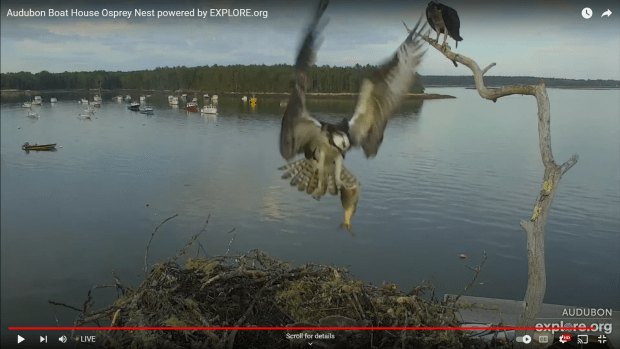
A note from ‘H’ came flying across my computer screen. It is about Sloop, the third hatch at the Boathouse who has not fledged. He made his way up to the high perch and it would appear that he is afraid to come down. ‘H’ says Dory has been trying to lure him down with a fish. He has now not eaten since 1230 — and we know that Sloop loves his fish.

Sloop has now been joined by a sibling.

I have a great fear of heights and have so much empathy with our dear Sloop who has been up on that perch for almost 7 hours! Poor thing. The water looks calm and he can fly —– he just does not know it.

‘B’ gave me an idea. I am going to send Stephen Basly and Doreen Taylor snail mail thank you cards to St Patrick’s Park. I am certain they know them well – from all of us. It has been such a treat to be able to see Little Bit 17. So grateful for their efforts.

Thank you so much for joining me. Send good energy and a gentle wind to our dear Sloop in the morning. After his huge meal yesterday he will not starve. Remember in the wild eagles can go for days without eating and he had some crop. Yesterday he was too full to fly.

Speaking of crops…one last image. SE30 is the one on the right. No words needed. Take care everyone.

Thank you to the following for their streaming cams and/or posts where I took my screen captures: Sea Eagles@Birdlife Australia Discovery Centre Sydney Olympic Park, Audubon Explore, Bald Eagles 101, Explore and the IWS.

Ervie, fledges and more – early Tuesday in Bird World

9 August 2022

First a correction! Shame on me for saying we know where Telyn winters. It is not Telyn but, the beautiful Seren from Llyn Clywedog that spends her winters in The Gambia. I knew that and wrote Telyn. Thanks, ‘C’ for alerting me. Much appreciated!

One other clarification that ‘CE’ caught that needs explaining. Osprey fledglings are the raptors that do not require their parents to teach them to hunt or fish. Others do. You will have seen the eagles and hawks showing their fledglings how to hunt prey! I bet Ervie did chase Dad around in his efforts to find some good fishing spots, though!

Ervie, dear Ervie. Port Lincoln posted images after I had sent out my blog last evening so our dear Ervie is up first. Thanks to ‘B’ for alerting me to these.

As so many of you are aware, Port Lincoln Ospreys is working hard to introduce our fish eagles to Southern Australia. They are getting attention from government agencies and, of course, the population is growing to love these birds – many because of our dear Ervie. Here are the latest postings from Port Lincoln and the beautiful pictures of Ervie out fishing with Dad by Fran Solly. There are more on the Port Lincoln Osprey FB page. Head over and have a look. This is the place to continue checking on Ervie and his antics with Dad — or alone.

It is always good to see you, Ervie.

Is there room for you, Ervie??????!!!!!!

Remember when we worried that Ervie would only be able to catch puffers? Well, he has certainly adjusted to fishing without that other talon (I have not seen it fully grown in on the pictures but I would love to be corrected!). That is a beautiful fish. Well done, Ervie.

At the Black Stork nest in the Karula National Forest of Karl II and Kaia, Bonus, the adopted storklet of Jan and Janika, Bonus, fledged first today. He was followed by Volks who hears Bonus in the forest and flies off to the left.

Both returned to the nest. Ilks is looking at his reflection in the camera. Will you fly next? So funny when they find themselves. After fledging the Black Storks will stay at least a week around the nest being fed. If the food is plentiful they may stay longer before venturing out to find food for themselves and beginning migration.

As ‘B’ says, it is hard to beat the WBSE for cuteness. SE30 is a bit of a corker. When it was 2 days old, 30 beaked at 29. Not a good thing to do. We have all worried about 30 but unless there is an unexpected ‘something’, they should both be fine. SE30 gives as good as it gets and they both fool around with one another and then seem to stop before it gets too rough.

Chubby little bottoms. Their soft down on the head is giving way to pin feathers and the feathers are coming in nicely along the wings. They will begin to do a lot more preening as things get itchy. You can see their black talons and those big clown feet getting started. So cute.

Of the streaming cams in Australia, we now have the WBSE eaglets and the first egg at the Port Lincoln Osprey barge for Mum and Dad as of yesterday. We are awaiting the beginning of the season for Peregrine falcons Xavier and Diamond and the Melbourne CBD – 367 Collins Street. Xavier and Diamond are amping up the bonding in the scrape! Eggs before the end of the month?

The only chick on the Landscape Arboretum platform at the University of Minnesota fell off yesterday. It has not fledged. Here is the video of that incident. This could have turned out badly – and would have if not for the quick actions at finding the chick and getting it back on the nest. Thanks to all involved!

Boris and Titi (yet to fly) on the Janakkalan nest in Finland. 9 August 2022. Handsome!

All of the White Storklings of Betty and Bukacek have fledged. They seem to spend their time finding the parents and following them back to the nest for good feedings.

Look carefully. Bukacek is flying into the nest from the left (right above the grassy area at 930 on the nest).

All of the storklings came to the nest quickly so as not to miss a meal.

All of the UK chicks have fledged. This year the three at Foulshaw Moss did not get the best attention from me – in terms of publicizing the nest activities here on the blog. Last year I followed every move because of the third hatch – Blue 463 who survived and did extremely well. Waiting for her return next year! The Cumbrian Wildlife Trust have put out a very nice blog with an overview of the nest activities including some links to videos.

https://www.cumbriawildlifetrust.org.uk/blog/alasdair-mckee/there-were-three-nest-and-littlest-fledged?fbclid=IwAR3EmfM6q7y1XNIqdvENXGlh8x4VhZve9AwmrsA4vAFcs_XRrvXubF76BhM

There appears to have been a fledge this morning at the Fortis Exshaw Osprey platform near Canmore Alberta. Thanks ‘H’ for the tip off! They seem to all be relatively equal – perhaps the others will fly today. You can see Mum looking on over the nest at her three beautiful chicks from the perch.

The fledge was a quick take off, fly around the nest and return landing on the right side.

I am counting a fledge as a flight off the nest and a return. In my mind, the chicks jumping up or getting to the many perches is equivalent to branching for Eagles, not a full blown official fledge. The real question is how far away is the perch? It is too difficult to tell. Mum certainly looks small and if it is a distance, then it might be counted as a fledge. If that is the case, then there were two fledges at Canmore this morning so far.

Big Red, Arthur, and L2 have all been accounted for by Suzanne Arnold Horning this week. Excellent news. Still no recent updates on L3 or L4.

L2 in the top picture screaming for a prey item and Big Red and Arthur calmly relaxing in the second.

Everyone remains curious as to how Victor got so much zinc in his system that he almost died. The Institute for Wildlife Studies has indicated that there are fishing lures coated with zinc. Thanks ‘B’. Here is the posting on the chat at the IWS. The question still remains: how much zinc does a fledgling eagle have to ingest to almost kill it? I do not know the answer to that question but I hope to find out.

The posting of the images of Little Bit 17 prompted a lot of mail. Everyone is thrilled and so very reassured that it is our little tenacious eagle. So grateful to the boots on the ground for chasing after this family and sharing their photos and videos with us on the Notre Dame Eagles FB.

‘CE’ had a very interesting analogy that seems quite fitting given the sponsors of the camera and the university that they are associated with – Notre-Dame. CE noted that the image of Little Bit looks like a Franciscan Friar with his friar’s crown. He said, “In the 5th century, the tonsure was introduced as a distinctive sign. In the East, the Pauli tonsure was used (all hair was cut), in the West, the Petri tonsure (only the top of the head was shaved). This was also called Corona Christi (Crown of Christ). Since the 16th century, the tonsure of regular clerics has been reduced to a small circle.” Friar Little Bit. It sounds nice.

Thank you so much for joining me today. It is lovely to have you with us and the birds. I will continue to monitor the nests during the day. Tomorrow I am heading north for two days to count and enter the GPS for the Bald Eagle nests in and around Hecla Island. That information will be sent to David Hancock whose foundation monitors bald eagle nests in Canada. I hope to get some good images of the adults and juveniles before they leave for their winter homes. There will not be a newsletter tomorrow morning but I will try my best to get some images out to you tomorrow evening. Please take dare. I look forward to seeing you again soon.

I want to thank everyone who wrote in and sent me news. I still have some of your images to post! Much appreciated. I want to also thank the following for their streaming cams and/or posts or their photographs that I used for my screen captures: Fran Solly and the Port Lincoln Ospreys, Suzanne Arnold Horning, the Notre-Dame Eagles FB, the Eagle Club of Estonia and Looduskalender, Mlade Buky White Storks, Fortis Exshaw, the Finnish Osprey Foundation, the IWS, Charles Sturt University Falcon Cam, Landscape Arboretum Ospreys, and Sea Eagles@Birdlife Australia Discovery Centre, Sydney Olympic Park.

First egg of the 2022 season for Port Lincoln!

8 August 2022

I hit ‘send’ and the blog went out. It was one of the first days that I did not check on the little sea eagles, the falcons, or Mum and Dad at the Port Lincoln Osprey barge. Serves me right! Thanks ‘A-M’ for sending me that time stamp! I am over the moon. The official time is 03:17 on the 9th of August in Southern Australia.

I just love this Dad. He is there with Mum giving her support! He also takes very good care of his fledglings – I wonder if he will tell Ervie today if they go out fishing together?

Incubation period for Eastern Ospreys is 34-42 days, normally. Mark your calendars. Hatch watch will begin on the 12th of September.

Here is the link to the Port Lincoln Osprey streaming cam:

Port Lincoln also has a very informative FB page with lots of images of the Ospreys. You do not have to join anything to see the latest news.

Thank you for joining me for this quick announcement and thank you to Port Lincoln Ospreys for their streaming cam. We will be looking forward to eggs 2 and 3.

Ervie, Victor, and Little Bit ND17

30 July 2022

I was not going to do another posting today but, in case you did not see the update on Victor or the posting of Ervie, I wanted to share them with you.

First, yesterday Dad had a terrible day. It is not clear what happened to him on the nest but he flipped over, his eyes looked terrified, and Mum thought it best to beak him to get him to come out of it. I was worried. Dad, we need you! Dad was later caught fishing with Ervie and he looks good.

Christine Georgiou took these great shots of the pair of them and posted them on the Port Lincoln FB. Ervie on top and Dad below sans transmitter. Look at that nice fish Ervie has! I do not know if anyone has realized what a treat it is to watch Ervie mature and how lucky ‘we’ were that he lost his talon and stayed home. He has had a good start on life…Dad certainly taught him where to fish and served as a great example.

If you look closely I believe you can see Ervie’s missing talon on ‘the right foot’. Ervie has learned to carry the fish with only three talons and the fish is backwards!

If you did not see the most up to date posting about Victor, here it is again. The good news he is getting better. Notice that he is standing quite well. Victor is such a young eaglet – where in the world would he have gotten so much zinc?

Several have written to ask about Little Bit NC17. The biggest question is: has anyone seen him eat? Little Bit was released at St Patrick’s Park near the nest and treed area by the nest on 20 July. That was ten days ago. This image was 25 July and it is the three fledglings from the Notre-Dame nest flying together over the nest and the trees. There are lots of people who love Little Bit and who are making a point to go and check on the eagle family. Little Bit has pulled that tenacious resourcefulness out and he has had to have eaten ——–he could not live for ten days without food! Little Bit ate everything that came to the nest. Fledglings normally exist on carrion – dead animals – their first year. We know he can eat fur pelts!!!!! The fledglings have been seen down by the river with the adults. I am extremely hopeful that he is doing well.

Send good wishes to Victor as he continues to go through all the therapies. Let us hope that just has he has been able to stand he will be able to eat by himself soon. Send good wishes for Little Bit to have a nice fish supper – and for Ervie and Dad to be safe.

Take care everyone. Enjoy your Saturday evening. Thank you for being with me this evening.

Thanks to the Ojai Raptor Centre, the Notre-Dame Eagles FB and Port Lincoln Osprey Project FB where I took my screen captures.

Update on Victor and other Bird World News

13 July 2022

Good Morning Everyone. I hope the start of the week was a good one as we celebrate the rescue of Victor at the Fraser Point nest in the Channel Islands.

Here is the latest news on the Fraser Point eaglet of Andor and Mama Cruz:

As new birds go into wildlife rehab, it is easy to forget some that remain in care. At the Pitkin County Osprey nest, both chicks were pulled off the nest when the female’s talon was tangled in nest material that had fishing line. Here is an image of the chick in care and below it is the mass of fishing line and nest material that came off. One chick died. This one will be in rehab for some time and will not be returned to the nest area as the parents will have migrated when it is ready to be released.

How possible is it for every nest that is on a streaming cam to have the nest material examined and any fishing line, hooks, or other dangerous items removed when the camera gets its annual maintenance? That would help – it certainly won’t keep new items from coming on the nest but it would go a long ways to mitigating issues. Then, of course, there is the whole issue of educating the public about fishing line and hooks! And how dangerous they are to the water birds.

There has been no update on Little Bit ND17 this week. Will post as soon as I see one. No news is good news!

The Patuxent River Park Osprey nest 1 is empty. Was there a fledge?

Tonight there is a huge storm with thunder and lighting at the Patuxent River Park #1 nest. It could even scare me! You can see the nest because the lightning is making the entire sky glow.

Yes, it was a fledge at Patuxent River Park and the new flier has returned to the nest to the delight of Mum and Dad.

It has been 25 hours without her brother, Victor. Lillibet is on the nest panting and hot in the California sun.

The mother has returned to the Janakkdan nest in Finland to her two osplets. There has been lots of fish and she has been feeding them. Let us hope that what has been ailing the female is getting better. They are super beautiful and big osplets. It was just lovely to see her and the chicks are getting stronger and older and should be feeding more to themselves. That will certainly help. Mum does look better than the past couple of days. Fingers crossed. Send those good positive warm wishes to her. They help!

The first egg at the Sydney Sea Eagle nest is 35 days old today. Pip watch begins on day 40 which will be July 16/17. Lady and Dad are busy incubating and rolling the eggs. The cam operator gave us a good look. Thank you!

The White-bellied Sea Eagles are the second largest bird of prey in Australia.

Diamond looking out of the scrape at Charles Sturt University in Orange, Australia.

The scrape box on the water tower has been used by falcons for the past twelve years. Before that they made their nest on the water tower itself. The first couple were Swift (female) and Beau (male). In 2015, an entirely new couple were in the scrape. They were Diamond and Bula. In 2016 just when their three eggs were hatching, Bula disappeared and was presumed dead. Xavier means ‘savior’. He came along, just like Alden, right at the moment he was needed. He saved the breeding season. Xavier provided prey for Diamond and the chicks. He proved to be a very capable mate and Diamond accepted him with wonderful bonding displays in the scrape. Xavier is a darling. This will be Diamond and Xavier’s 6th breeding season. Diamond is at least eight years old and Xavier is at least seven years old.

The average life expectancy of a peregrine falcon in the wild is often considered to be quite low, 2-4 years. Our Princess in Winnipeg lived to be 19 years old. It is unclear to me how accurate that 2-4 years estimate is.

Diamond. 13 July 2022
Xavier. 13 July 2022 with a prey offering for his mate.

The other peregrine falcon nest in Australia is in Melbourne. They will start streaming nearer to hatch once eggs have been laid. It is quite interesting to watch the rural nest of Xavier and Diamond with the urban one in Melbourne.

Do you like Great Horned Owls? Would you like to learn more about their lives on the prairies? Here is a free Zoom talk that you might wish to join.

Louis and Dorcha’s two osplets were ringed yesterday. They have two girls! LW6 was 1760g with a wing of 300mm and LW5 weight was 1910g with a wing of 350mm.

Chick LP8 fledged at Loch of the Lowes today. In celebration of this achievement, Louis brought in a fabulous fish! Congratulations LOTL.

The three girls at the Dyfi Nest of Idris and Telyn are really hovering. Who will be next to fly?

Thank you so much for joining me this morning. We send our good wishes to L3, Little Bit ND17, the Pitkin Osprey, and Victor as they continue to work hard to get better in care. Stay safe. See you soon.

Thank you to the following for their streaming cams and/or FB pages where I took my screen captures: the Ojai Raptor Centre, Patuxent River Park, the Finnish Osprey Foundation, Pitkin County FB Page, Charles Sturt University Falcon Cam, Sea Eagles@Birdlife Australia Discovery Centre, Explore.org and the Institute for Wildlife Studies, Prairie Conservation Action Plan, Friends of Loch Arkaig, People’s Postcode Lottery, and Woodland Trust and the Dyfi Osprey Project.

Early Monday in Bird World

4 July 2022

Good Morning Everyone. I hope that you had a marvellous weekend and for those celebrating independence day in many countries around the world, have a fun and safe time.

With all the talk about storks, ‘L’ asked a question in the comments. Did I know what happened to the White Stork couple, Malena and Klepetan? Thank you ‘L’ – that is a great question and I bet many are wondering too.

Klepetan and Malena are the best romance story in all of Bird World. The intervention to save Malena’s life after she was shot by a man in Croatia is a testament to what love can move us to do for our wildlife friends.

If you do not know the story, before you read further, please watch at least the first one of these videos so you know the background to this truly remarkable story.

Perhaps the most famous stork couple in the world were Klepetan and Malena. Malena stayed year round with Stjepan Vokic in Croatia. As you will know from the video, Malena was shot and it was only through the gentle care of Vokic that her life was spared. What devotion to keep her, clean her, feed her, prepare the nest and fish for both adults and chicks so that Klepatan and Malena could spend all their time together.

For 20 years, Klepetan migrated back and forth from South Africa to Brodski Varos, Croatia. Malena died peacefully on 7 July 2021 of old age. She was 28 years old. Klepetan was by her side when she died along with her other faithful companion, Vokic. Malena was buried in one of her favourite places. Klepetan continued to come every day wondering where his mate was. They had been together for 20 years and had raised 66 storklets. Klepetan was fitted with a transmitter. He did not return to the nest he shared with Melana in 2022. Did he also die? or find a different nest with a new mate? I am hoping to be able to find the time and help to see if Klepatan’s transmitter is still working.

Want to help out Humane Wildlife Indiana? They have an extensive wish list on Amazon including a xylophone for chickens. I have learned through one of our readers, ‘L’ how important it is to have creative stimulation or enrichment for all of the animals in care. Who would want to live strapped to a perch with nothing to do? There are lots of things on the list from a few dollars to $30 or $40. Here is the link. It is good to see what the wildlife clinics are asking for. You can always help out your local clinic too – they always need laundry detergent, bleach, hand sanitizer, wipes, and those old clean towels I keep repeating…Even if you do not intend purchasing anything for the clinic, have a look. It is possible that you intend to get rid of items that could be used at your local clinic.

Here is the link.

https://www.amazon.com/hz/wishlist/ls/12TH5G1M7K4DC?fbclid=IwAR26cBDgVhsmN3_U_rzTCKHLaamk0zys4DS3eN8P0piyppMkdBox9oJs1Ms

So busy with Little Bit and the JJ storklets that some others get forgotten so I am also playing catch up this morning. The only surviving eaglet at the Fort St Vrain nest in Colorado, 46, fledged on the 1st of July. Congratulations everyone!

It is not just Annie and Alden bonding in the scrape! As breeding season in Australia gets closer, Diamond and Xavier are doing a lot of bonding rituals in the scrape – some short, some long. Oh, you are going to fall in love with little Xavier if you don’t know him already. Here is that video clip.

‘B’ sent me a newspaper article on the rescue of the US Steel Eaglet. It is a good read with one troubling bit – they state that he eaglet will learn to fly and be released in an area away from the natal nest. My concern is that they must teach that eaglet to hunt – just like Little Bit needs that training. In order to do that the eagles need a little of time, trained professionals, and specialized structures. It is expensive and time consuming and well worth it if neither wind up back in care. Thanks ‘B’.

https://www.post-gazette.com/life/outdoors/2022/07/03/bald-eagle-pittsburgh-pennsylvania-us-steel/stories/202207030127

I want to include a screen capture that ‘H’ sent me on Sunday. It is just a beautiful sunrise at the Boathouse Osprey nest on Hog Island, Maine. How stunning. Thanks ‘H’ for sharing this beautiful image with all of us!

The boathouse osprey cam on Hog Island is currently offline and is only showing highlights.

Two chicks on the Osoyoos Osprey nest on a misty wet morning. Let’s hope that dad gets a pile of fish on the nest today since the weekend festivities have passed.

There is a severe thunderstorm watch in the area of the Canmore Fortis Exshaw Osprey nest…send positive wishes to all!

There was also beautiful sunrise in Mlade Buky, The Czech Republic. Betty has flown in and is feeding those four great big storklings.

It is early morning in the Karula National Forest in Estonia. The four chicks of Karl II and Kaia are sound asleep. It is so good that Bonus, one of JJ’s chicks, has integrated so well into this family. It is Day 5 for Bonus.

‘T’ sent me an image of Karl II. Last year he discovered the fish basket that Urmas provided. It is about 9-10km from the nest and this year Karl II has been visiting the fish basket and bringing lots of fish to the four storklets on the nest. They are hoping that the herons do not find the basket as it will limit the fish Karl II will find.

This is the other nest where Janus, the middle chick of Jan and Janika, in Urmas and Dr Madis V’s experiment has been placed. It is doing well. Thank you ‘T’.

Takoda decided to come and visit the National Arboretum nest on Sunday. He has found his reflection in the camera. There are some great ‘selfies’ that Takoda is taking! Have a peek.

Some of you became very interested in what your country is doing to help stop avian electrocutions. Knowing what is being undertaken to help the birds is a good way to begin understanding what you can do to spread the word about the dangers and solutions. ‘A’ wanted to find out what Japan was doing and she discovered that there is a special institute working on this problem on the northern most island of Japan, Hokkaido.

“Birds of prey have the habit of perching on high places with a good view and will use tall trees as well as man-made structures such as streetlights and utility poles as perches. When raptors perch on utility poles or pylons, or when they are about to take off from a perch, they are electrocuted when their wings or other body parts come in contact with parts of the body that conduct electricity.

In Hokkaido, accidents involving electrocution of Blakiston’s fish owls, hawk eagles, white-tailed eagles, and Steller’s sea eagles have occurred to date. Electrocuted birds of prey may show severe burns and blackened feathers. Red spots called electric current spots may also be seen on the skin where the electric current was applied.

To prevent electric shock accidents, electric power companies install insulators on current-carrying parts and devices to prevent birds of prey from perching on utility poles. They also install safe perches on top of utility poles to prevent electrocution. The Institute for Birds of Prey Medicine is working to prevent electric shock accidents by analyzing electric shock accidents and consulting with electric power companies and other parties in order to develop more effective countermeasures in areas where electric shock accidents have occurred or are likely to occur.”

Thank you, ‘A’.

I wanted to see what work the Institute for Birds of Prey Medicine is doing and came across something very interesting. Fifteen years ago the use of lead (Pb) ammunition was outlawed in Japan. Today, lead poisoning remains a serious problem for raptors who accidentally consume lead pellets from illegal hunting in various places in Japan but the overall testing of raptors and discovery of those who have ingested lead has dropped significantly (lower than 25%). In comparison, the US Geological Survey discovered that between 2010-2018 (the end of the study) more than 50% of all raptors in the US had been poisoned by lead either in hunting or fishing equipment. The soft lead bullets that break into fragments have the worst impact on the raptors. Other lead fishing equipment can be mistaken by birds such as Loons who think these lead weighs are pebbles and eat them!

There is no nationwide ban in the US for the use of lead. California is the only state to ban the use of lead entirely. New Hampshire, New York, Vermont, and Maine have partial bans in fishing gear. In 1987, Minnesota banned the use of lead shot for waterfowl hunting. In 1991, a federal law in the US also banned lead shot for waterfowl hunting. The problem rests with the DNR who has lobbied against imposing any other lead restrictions on hunters. In April of 2021, three states – Maine, Minnesota, and New York introduced bills that would ban lead completely in all hunting and fishing gear. I am checking to see if HF2556 has been signed into law in Minnesota in 2022.

https://www.sciencedaily.com/releases/2022/02/220217141324.htm

Do you remember the ‘Old Warrior’? He was taken into care after being found on the side of the road lethargic. He went to A Place Called Hope, another great wildlife rehabber. His lead levels were measured at 49. Very extensive lead removal treatments resulted in the old eagle with the broken leg and beak being able to go into an outside enclosure. A Place Called Hope applied to the USFWS for a license to keep the Old Warrior as an educational bird. I reached out to A Place Called Hope and they said that sadly the lead issues had caused so much damage that the Old Warrior had died. He was a poster child of trying to beat the odds. There are other kinds of ammunition – stainless steel and copper. Lead is not the answer!

There has been some concern about Blue 022 at the Poole Harbour nest. He has now been caught on camera and all is well. The two chicks have been ringed and they are both girls! Well done Poole Harbour. Congratulations and relief.

At the Rutland Mantou Bay nest of Maya and Blue 33, 1H2 and 1H3 fledged this morning. All girls are flying about and there is definitely an empty nest! They will return to harass dad for fish, no worries.

Whew! You might need an extra cup of tea or coffee to make it through this today – sorry! Lots happening in Bird World. The kids up at Loch of the Lowes are starting to get the hover going, too. Thank you for joining me today. Please take care. Thanks to everyone who sent news, photos, or comments. They are always appreciated. See you soon!

Thank you to the following for their streaming cams and/or FB pages or videos where I took my screen captures: The Dodo, HRT, Ft St Vrain and Excel Energy, Falcon Cam, Audubon Explore.org, Osoyoos Osprey Cam, Fortis Exshaw, Mlade Buky, Eagle Club of Estonia, NADC-AEF, A Place Called Hope (APCH), Poole Harbour Ospreys, and LRWT.

Star Fledges at Redding and brief news in Bird World

19 June 2022

We have been watching and waiting and Star fledged today at the Redding nest at 17:12. It was off camera. Congratulations to Liberty and Guardian, to Star, and to everyone who loves these beautiful eagles.

The camera found her. She will learn about which branches to land and take off. There were two prey deliveries after – Liberty and Guardian want Star and Sentry to come to the nest for food until they get their full flying credentials.

Another fledgling from today, L4, is trying to figure out how to land and take off! It looks very difficult.

Peregrine Falcons and Hawks eat pigeons. They love them! If you know of buildings that are putting out poison on their roofs because of the pigeons, speak to them. That rodenticide kills more than the pigeons. But there is now another threat to the falcons and the hawks – and that is pigeon nets. Stop with trying to get rid of the pigeons! Let the raptors do it!

This Peregrine Falcon at Leeds University was lucky!

https://www.itv.com/news/calendar/2022-06-13/university-pledges-to-remove-pigeon-nets-after-bird-rescue-goes-viral?fbclid=IwAR05H94OudOx9OkDWH3nVWtA0geQh3EjYzG9UYtmaaJzZY9RRSBuBz09J9o

At 15:19:47 Dad brought in a sucker to the ND-LEEF nest. 15 got it first. Little Bit watched and waited and at 15:45:53 did his now-famous ‘Snatch and Grab’ and stole the tail and a whole lot of fish on it! Way to go Little Bit 17. After working on that Raccoon earlier, that fish must have tasted really good!

Little Bit has moved in for the steal. You can see how much of that nice fish is left.

He goes for it!

Still eating. How could anyone not admire Little Bit 17? He has sure fought hard to live on this nest and now we are all anticipating a good fledge from this third hatch. Way to go Little Bit.

There is no good news coming out of the Loch of the Lowes. No fish deliveries. My own personal opinion is that something is wrong with Laddie – he is injured in some way and cannot fish ———–or there are otherwise no fish in that loch for him to catch! Blue NC0 has left the nest twice and returned wet but talons empty. If you hear anything about what is happening at this nest, please let me know.

There is a kestrel nest in Germany. The wee ones are so cute. They are also so hot. It is part of the heat wave that is hitting western Europe. 37 degrees C. The parents are Nanny and Ricky. It is unclear how the heat is going to impact this lovely family.

There were originally 9 eggs and there are five eyases. Here is a video of a feeding and below is the link to the camera.

You could hear him coming! Grinnell Jr returned to The Campanile after fledging. These visits will become less frequent and I know from hearing from many of you that you are having Lindsay and Grinnell Jr withdrawal. Cal Falcons will continue to post videos when the fledglings are in camera range. There is also the Instagram account of moon_rabbit_rising

Here is Junior’s visit today.

There are going to be two Peregrine Falcon nests to watch in Australia. One has a 24/7 feed from 3 cameras at Charles Sturt University at Orange. The other are the CBD (Central Business District) couple at 367 Collins Street in Melbourne. Both are worth watching at the same time. One is rural and one is as urban as you can get! Melbourne will come on line when there are eggs. Here is the link to Diamond and Xavier’s scrape in Orange. They are precious and you can often see prey deliveries from Xavier to Diamond in the scrape and ritual bonding there. There are two other cameras. Check them out on YouTube. One looks out to the exterior view from the back and the other is of the entire water tower where the scrape is located.

This is a very short posting. Was very very happy to see Little Bit had a good feed today – lots of raccoon and sucker. Just wonderful. The hot weather in Germany and in Europe might impact a lot of the nests in a very negative way – let us hope not but it could happen. And send every positive wish you can to the Loch of the Lowes nest. We have lost one chick to siblicide due to poor food deliveries. I just feel Laddie is injured. Will someone help Blue NC0 and the chicks? Ospreys are rarer than Golden Eagles in the UK. Let’s hope!

Thank you for joining me today. Take care everyone. See you soon.

Thank you to the following for their streaming cams where I took my screen captures: ND-LEEF, Friends of Redding Eagles, Cornell RTH, and Windsbach Kestrels.