Bird World 13 December 2021

Samson and Gabby, the resident Bald Eagles on the nest in ‘The Hamlet’ near Jacksonville, Florida have been working on their nest all day. Yesterday, Samson brought in a really nice meal for Gabby – an American Coot. While they are a large waterbird breeding in the shallow marshes, ponds, and wetlands of my province and others in Canada, they are also what is called an ‘all terrain bird’. They are equally at home grazing in water or on the land looking for small fish, aquatic invertebrates, and plants. They can reach 40 cm in length and 70 cm wide. They are black with a white bill, red eyes, and yellow green-blue legs. Notice their lobed feet in the image below. Wow, those are different than Daisy’s!

“American Coot Feet 2” by bruce_fulton is licensed under CC BY-NC-ND 2.0

Here is a video of that breakfast delivery:

I have been spending so much time with Daisy that I have neglected all those other amazing birds that we all love.

Gabby and Samson continue to work on their nest. They have been mating and many hope that eggs will be laid today or tomorrow. Gabby continues to tease everyone!

Samson is delivering another large stick for the walls of the nest.

What a gorgeous couple. Gabby is on the left and Samson is on the right.

The Mississippi River is home to many species of birds. Did you know that there is a live camera? The types of birds vary by the season, the day, and the time of day. Right now there are loads of Sandhill Cranes!

There has been an update for WBSE 27. You might recall that 27 was taken into care twice. The Pied Currawongs were unmerciful to the beautiful fledgling. I am thrilled beyond words for the latest announcement. To my knowledge none of the fledglings over the past two years – 25, 26 (deceased), 27 (in care). and 28 have been trained by their parents to ‘be a sea eagle’ – in other words, how to hunt prey, fish, and have the time to hone their flying skills. Without these skills, they simply cannot survive. WBSE 27 will receive this training and hopefully will emerge a confident bird who can live in the wild.

I have seen no update on Annie and Grinnell and the interloper. We will wait until breeding season starts and see who Annie is with!

The Kakapo Recover posted a humorous cartoon about some of the male Kakapo. I needed a giggle. Maybe you do, too?

Sadly, the time to adopt a Kakapo is over. If you missed it, make a note for next year. Those Kakapo stuffies are really quite sweet and blend in with all your indoor plants.

Daisy has had a seemingly uneventful morning. Her first break of the day and foraging – before sunrise – did not happen because the Ring-tail Possums were crawling all over the nest. She has been sleeping most of the morning. There are lots of birds in the forest but I have not heard the Ravens yet and the cam operator did not find the WBSE on their River Roost earlier but she did capture several sea eagles flying. Fingers crossed. So far the WBSE have not been an issue. So all is well with our wonderful duck. It is 08:29. The Daisy update will be later this evening unless something untoward should happen.

Thank you so very much for joining me today. Take care everyone. See you soon.

Thank you to the following for their streaming cams or their FB pages where I took my screen shots: Sea Eagles@Birdlife Australia Discovery Centre, NEFlorida Eagle Cam and the AEF, Kakapo Recovery, and Explore.Org

Catching up with Ervie

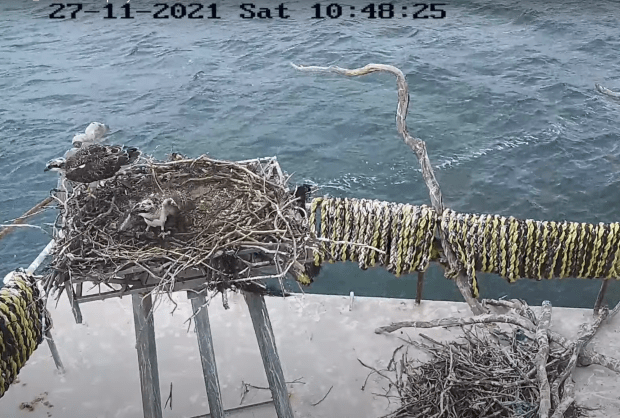
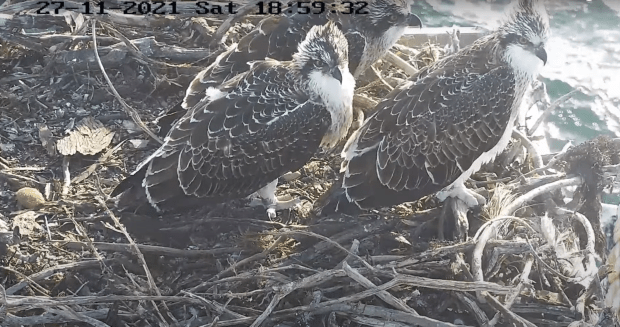
I have spent so much time watching Daisy, recording the happenings on the nest, and sleeping at odd hours that many of the other nests have been neglected. One of those is the Port Lincoln Osprey nest in Australia. I stopped in today to check on Ervie’s movements by the Sat-Pak and there were some gorgeous images of this juvenile male Osprey by Take 2 Photography, Fran Solly.

Ervie has been all over the place. Many are expecting him to leave the area of the barge. I wonder how far Ervie will go?

These were Ervie’s movements yesterday. Oh, he does love to fly.

Fran Solly went out and took these images of Ervie flying around the coast. Isn’t he just such a handsome bird?! My goodness, Ervie. You are doing Mum and Dad proud.

Male Ospreys tend to return to where they hatched to make their nests. I wonder if all three lads will show up at the same time? And I learned a new word today ‘Dust Up.’ Do you know this word? Remember when Ervie and Bazza were knocking one another about the nest – or off it – that is apparently a ‘Dust Up.’ Love it. Sounds so much better than saying Bazza just knocked Ervie off the edge of the nest! or Vice Versa.

Other Bird News: Gabby and Samson continue to have a sub-adult intruder coming around. No eggs on that nest yet. Aren’t they gorgeous?

Samson on the left and Gabby on the right.

We could be less than 2 weeks away from the first hatch at the Southwest Florida nest of Harriet and M15.

I have seen no weather warnings for Florida – like the disturbances going through the Midwest and the winds up in the Finger Lakes area of upstate New York.

Harriet is alerting. There is a predator around. Is it the Great Horned Owl (GHOW)?

Anna is incubating two eggs at the Kistachie National Forest Bald Eagle Nest in Central Louisiana. Louis continues to be so exciting. He is great for bringing in the fish but he is also softening up that nest with tonnes of Spanish Moss.

Connie is incubating two eggs over at Captiva, too. Her new mate is Clive. Hopefully this nest will have some luck. That said, local pelicans are being brought into care for red algae.

All of the Bald Eagle nests outside of the tornado and storm areas in the US are fine. More Ospreys are being spotted on the Iberian Peninsula and in Africa which is a grand sign. Ferris Akel was thrilled to see three Snowy Owls today on his tour. One even flew for him. I should invite him to Manitoba for the winter. One of our birders spotted 25 Snowy Owls in a short drive around the agricultural fields. — And a reminder. The owls in the Central US have been found to be thin and dehydrated. They are blaming this on photographers trying to get images and scaring away their prey. As you know I am a raptor lover – they often do not eat for several days so when you see one hunting or eating – leave it alone, please. Stay way, way back. Invest in a long lens!

It is very quiet morning at Daisy’s nest. A couple of times I have heard the cawing of the Ravens but Daisy has been peaceful, unfluttered would be a good word. There will be a late night catch up on her nesting activities.

This is not a Raptor Time: Watch this Titmouse modify its nest, bring in nesting materials, and hatch and fledge 11 chicks in Japan. Seriously it will put a smile on your face. I wish I could transport Daisy and her eggs into a box like this! Oh, she even wiggles her little bottom like Daisy. Here is the link:

Happy Saturday everyone. Take care. Thank you so much for joining me.

Thank you to the following for their streaming cams, their photos, or their FB Pages where I took my screen captures: Port Lincoln Osprey, Port Lincoln Osprey FB Page, Fran Solly, SWFlorida Eagle Cam and D Pritchett Family, NEFlorida Eagle Cam and the AEF, KNF Bald Eagle Cam, Captiva Bald Eagle Cam.

Thursday in Bird World

The camera for Daisy’s nest is offline. This is the last image and it was raining at the time. Daisy will come to the nest just as she has done for the first 7 days to lay egg 8 today. It will become increasingly difficult for Daisy to cover the eggs as the number increases unless there is a miracle on the nest and a bunch of leaves fall for her to gather. As I pointed out in an earlier blog, Daisy had much more down last year and this was helpful but – it is not helpful in the rain as it shrinks and is for naught. We can only hope that Daisy’s luck continues but we must be prepared that it is a long slog for our little duck until these eggs hatch. Anything and everything can happen.

I will bring a brief update on Daisy later this evening if the camera starts streaming. Just wish our little duck all the luck you can.

There are wonderful reports coming from Jean-Marie Dupart in Senegal. The Osprey count is more than he would have imagined and he is having to report early. Dupart believes, by the end of the month, that he might have counted 1000 individual Ospreys!

At the Kalissaye Reserve, there were 127 for the entire month of November. Already in December for one week, the count is 160. Saloum Park had 64 birds for all of November and now already there are 90. Dupart is overjoyed.

The Kalissaye Reserve is a small nature centre or reserve near the Casamance River. The Casamance Region is know as ‘The Green Garden of Senegal’.

Wet lands and the Casamance River in the background. This is the area of the Ospreys. Wikimedia Commons.

This is Saloum Park or Delta in Sengegal. These look like perfect places for our Osprey to over winter.

Wikimedia Commons
Wikimedia Commons

The Port Lincoln Lads had plenty of fish yesterday. Ervie had the first two fish at 06:19 and 08:39. Bazza had the next four deliveries! At 14:22, 15:58, 17:33, and 20:40. Falky did steal one of Bazza’s fish so he did get something to eat yesterday. Mum delivered the 14:22 fish to Bazza – she even looked like she might have even fed her big boy! I think Bazza is indeed Mum’s ‘baby’ despite the fact that he was the first hatch.

The Captiva Osprey Pair, Andy and Lena, arrived back at their nest early.

I will give you this link to watch this nest but there is a word of caution. Andy and Lena have had many successful hatchlings but have never fledged any Osprey. The reason is that the Crows come and eat the chicks. That is so sad. Maybe this year Andy and Lena will have good luck like Port Lincoln.

The Kakapo Recovery has announced that 2021 adoptions are closing today – that is the 10th of December in New Zealand. If you are a supporter of the Kakapo Recovery, you might wish to adopt one of the non-flying parrots as a holiday gift to all your family.

There are two eggs at the Captiva Bald Eagle nest with Connie and Clive and two eggs with Anna and Louis at the KNF nest in central Louisiana.

Connie’s new mate, Clive, looks at the two eggs.

You can watch Connie and Clive here:

Louis is just a great dad down at the KNF Bald Eagle nest. Last year he was so excited when Kisatchie hatched that there were 18 fish on the nest for the eaglet and Mum. There was no way they could eat all of them. This year he is really helping to build up a really cosy nest!

This is Anna and Louis’s second breeding attempt. Last year they fledged Kisatchie. They are in a very old nest in the Kisatchie National Forest. It had belonged to another Bald Eagle couple who had fledglings up to 2013. Kisatchie, last spring, was the first eaglet to fledge from the nest in 8 years. It was a wonderful event.

Here is the link to Anna and Louis’s nest. I promise they are a fun couple.

Thank you for joining me today. It is so nice to have you stopping in to check on the birds. Isn’t that a great count of Ospreys in Senegal? Wow. I am hoping that Blue 463 might be spotted — our very own Tiny Little Bob from the Foulshaw Moss nest in Cumbria. Take care everyone.

Thank you to the following for their streaming cams or their FB Pages where I took my screen shots: the Kakapo Recovery, the KNF Bald Eagle Cam, the Captiva Bald Eagle Cam, Port Lincoln Osprey Project, Sea Eagles @Birdlife Australia Discovery Centre, Wikimedia Commons, Captiva Osprey Cam, and Jean-Marie Dupart for his report on the Ospreys in Senegal.

Watch Iniko live – and other Bird World news

For those of you excited about the release of California Condor #1031 Iniko, you can watch her and all the other condors up by the sanctuary live! Remember that Iniko and those released with her wear an Orange tag with black numbers!

The camera moves around the sanctuary. Here are a couple of screen captures of the site for you.

For those who love the Royal Albatross, OGK arrived home at 18:40:19 to relieve YRK so she could go and feed. There was a lot of allopreening (preening of another not yourself), sky calling, and cuddling. YRK let OGK on to incubate but stayed close to the nest for awhile. What a lovely couple.

Ranger Sharyn checks OGK’s egg and gives the thumbs up.
OGK admiring his egg and talking to it. So sweet!
OGK allopreening YRK on arrival.

Sharon Dunne posted a video of the exchange. Enjoy!

Last year was a very sad year for many bird nests. I recall the great sadness when both Peace and Hope died on the Captiva Island Bald Eagle nest. Those were two very unnecessary deaths. Someone near Lori’s property where the nest is located used rodenticide! Just crazy. The two beautiful chicks died. The parents, Joe and Connie, were overcome with grief. Indeed, it was that grief that Joe suffered that – well, caused him to leave or not defend his area well. It reminds me so much of Samson’s father Romeo’s grief. Connie is now with another male, Clive. Connie laid her first egg sat 05:55:37 this morning. We wish them well – and I certainly wish that people would remember and recommend RATS: Raptors are the Solution!

Good luck this year, Captiva!

Here is the link so that you can watch Connie and Clive. There is also a side camera. I just prefer the overhead to see all the action.

It has been a really busy day. Daisy did, as she has done the past two days. She stayed with her three eggs now until the newly laid one was dry and hard. She stretched to try and find leaves. This seems to be an issue – fewer leaves on the nest this year. One of my friends told me that there is also something different this year than last – a pair of Ring-tailed Possums has a nest in that same tree. That could be the reason that Daisy has not pulled out any down yet. Lady and Dad, the White-Bellied Sea Eagles that are unwittingly leasing their nest to Daisy were at Goat Island. It is hoped that they will remain there for the full month! My friend also noticed that the egg cup is very small this year. She hopes Daisy does not lay very many eggs so they can be covered properly allowing us the hope and Daisy that we will see ducklings jump. Anyone have any ideas on how to dump several huge baskets of leaves on that nest? The Port Lincoln lads continue to do well.

Thank you for joining me today. Take care all. See you tomorrow for Day 4 of the Daisy Chronicles.

Thank you to the following for their streaming cams where I took my screen shots: Sea Eagles @ Birdlife Australia Discovery Center, Captiva Bald Eagles, Ventana Wildlife and Explore.org, Cornell Bird Lab and the NZ DOC.

Falcon and Red-Tail Hawk Cams

I had a lovely note form ‘M’ asking about other peregrine falcon cams. Thank you for your letter, ‘M’.

Each one of us feels a little ’empty’ when the eyases fledge. Without trackers, we have no idea what happens to them. We just wish them well and I know that everyone is working hard to make their environment better. The only birds on the nest who have fledged and not left permanently are the PLO Lads – Ervie, Bazza, and Falky. It is winter in the Northern Hemisphere and the birds have migrated to warmer climates. I will, however, be checking on nests in Asia to see if there are any for you to watch.

This is not an exhaustive listing but it is a beginning and I will be adding to it for all of you as the camera streams return. We have streaming cams on the falcons in Winnipeg as part of the Manitoba Peregrine Falcon Recovery. I will post those at the beginning of the summer. Most of our birds are in southern Texas or Mexico right now.

So here goes – and if you have a favourite falcon or hawk cam, let me know!

One of my favourites are the Peregrine Falcons in Melbourne. They are known as the CBD or 367 Collins Street Falcons. The cam is currently not live. Will come back on line September 2022

Cornell Red-tail Hawks (Big Red and Arthur), Ithaca, New York. The construction work at Bradfield has caused a power outage on the Athletic Fields. Those building works are winding down and this camera should be live shortly. Big Red and Arthur will be very busy once late February and March roll around. There are only two Red-tail hawk streaming cams in the world and this is the best. Big Red is 19 this year. Arthur is 5 or 6 years old. They are a fantastic couple that normally fledge three eyases a year. There are birders on the ground that keep track of the fledglings so you get to see the parents do team training in hunting, etc. Highly Recommended.

Charles Sturt University Falcon Cam in Orange, Australia. Yurruga has fledged. Look for egg laying in the fall of 2022. This is the scrape box of Diamond and Xavier. They are a well established couple. For the past two years three eggs laid but only one fledgling each year which is fine. It is a nice comparison with the Melbourne falcons who fledge 3 consistently. Orange is more rural and, of course, Melbourne is urban. The camera is left on and the falcons come and go regularly.

The Campanile Falcons on UC-Berkeley. This is the scrape box and cams for the Peregrine Falcon Couple, Annie and Grinnell. Grinnell was injured by a male interloper on 29 October. He was in care, as a result, and has been returned to his territory. The male interloper is still at The Campanile. It is unclear which of the males Annie will choose. Nesting activity late March, 2022. Annie and Grinnell are incredible parents who traditionally fledge three adorable babies.

The following are falcon cams that I have watched ‘on and off’ and that have come highly recommended to me from viewers:

Illkirch, France:

Great Spirit Bluff, Minnesota

Anacapa Island, California. There are current a large number of Pelicans to watch.

I will definitely be posting more including a couple of streaming cams from the UK. All of that action will begin when spring arrives. I also want to post some sites in Asia which I will do over the weekend. There will also be the Northern Hemisphere Ospreys, White-tailed Eagles, Golden Eagles, as well as the returning storks to Latvia and Estonia.

For now, things are really pretty quiet except for the Port Lincoln Ospreys, Diamond and Xavier coming in and out of the scrape box in Orange, and the Bald Eagles laying eggs in the US. There are two nests that you might wish to consider and if you have never watched a Royal Albatross nest then you definitely need to check out the Royal Cam Family in New Zealand who are incubating an egg laid on 9 November. They are very experienced and adorable parents, OGK (Orange Green Black) and YRK (Yellow Red Black). They are already grandparents. I often suggest this site to individuals who have a difficult time watching any nest if there is sibling rivalry. The Albatross lay one egg every two years. Parents rotate all of the duties. Last year the Royal Cam chick, Tiaki, had a sat-pak attached to her. We are currently watching her fish off the coast of Chile.

It is a bit wet in NZ this morning. This is YRK’s 6th day on the nest. OGK will be flying in soon and they will switch. Should something happen, the NZ DOC rangers are there to step in and intervene. No one goes hungry, injuries are taken care of, etc. It is a great site and in the process you will bear witness to a country that really protects its wildlife!

There are way too many Bald Eagle streaming cams to list them all. For now, I am only going to recommend one. These are experienced parents Harriet and M15 at the SWFlorida Bald Eagle nest on the property of the Pritchett Family. Their eggs are due to hatch soon – December 25-28. Once Gabby lays her egg in NE Florida I will post that information. For now, you can have fun watching Harriet and M15 change places. The only un-fun thing is the GHOW that attacks the eagles regularly.

There is no word on Yurruga. Cilla says she will look for a few more days. Just so you know the building that Yurruga was last seen on is a gabled (triangle) pointed roof, a bit steep. It is a single story building with clay tiles. Yurruga is not there – not alive, not dead. He was there on Thursday – seen twice during a big storm. I would expect to hear this fledgling screaming for food. Falcons are loud! Is it at a distance from the tower? is Yurruga injured? is Yurruga somewhere else? There are no answers I am afraid. If I hear anything you will be the first to know. Now, it is time for me to go and take care of all my feeders. The gang will be here soon!

Thank you so much for joining me. Take care everyone. See you soon.

Wednesday in Bird World

Let’s start off with what is on everyone’s mind: Has there been a confirmed sighting of Yurruga? Yesterday, Dr Cilla Kinross was inspired by a very quick prey drop at the scrape. Diamond flew into the trees. Cilla was in the trees looking half an hour later – she only saw Diamond. Diamond returned to the scrape with quite a large crop also. Some believed they had heard Yurruga calling but, Cilla is unable to confirm that. So the answer is – we simply do not know. Yurruga has not been seen since last Thursday when he was on a building during a storm. We can only wait.

My goodness that little one was such a cutie.

October 20. Yurruga and Diamond

Diamond was really beautiful this morning as the soft glow of the sun worked its way through the fog.

Both parents, Xavier and Diamond, have been inside the scrape – scraping. They also had some bonding moments this morning at sunrise.

My heart aches for them.

The second question of the day is what is going on with Grinnell, the male Peregrine Falcon of the Campanile, mate to Annie, that was injured by a male intruder that is trying to cosy up with Annie? Here is the latest news.

The New Zealand Department of Conservation rangers on Taiaroa Head are shutting down the streaming cam so that they can move it to the site of the Royal Albatross family for 2021-22. There are lots of guesses as to who the couple might be. The announcement is due tomorrow.

One of my favourite Bald Eagle couples, Samson and Gabby, at the NE Florida Bald Eagle nest near Jacksonville have been putting the finishing touches on their nest. They are perfecting the Spanish moss lining the nest cup. Now all we need are some eggs!

Gabby doing some final inspections this morning.

The three lads at the Port Lincoln all had fish yesterday. Falky had more than Ervie or Bazza. Falky has become a master at slipping the fish out of Dad or Mum’s talons. A magician.

There is a lovely shot of the PLO Mum. She has done an extraordinary job raising these three boys to fledge this year (with Dad’s good help). Yesterday she even spent some time feeding Bazza. He is definitely a Mum’s boy!

Bazza can be a bit naughty. I know that the banders were certain that there were three males. Someone looking at Bazza’s legs and that beautiful necklace in the image below might mistake him for a lovely female.

Bazza and Falky sleep with their heads tucked under their wings – adult style – standing on the nest. Ervie is sleeping over on the perch or the ropes. They are all doing well. I continue to pinch myself. This Osprey nest really turned itself around this year to fledge all three hatchlings.

There are many articles coming out in international newspapers and academic journals on the effect of warming oceans on the seabirds including the beloved Osprey. I picked one of those for you as some are frustrating. They allow me to embed the article but then want you to subscribe to read it! That is a major irritant to me – like Subarus are to Ferris Akel!

https://www.downtoearth.org.in/news/climate-change/climate-change-threatens-survival-of-albatross-60906

It is a grey damp day, 3 degrees C. The snow is melting. There are lots of birds at the feeders. A large European Starling is sharing the peanut and bark butter feeder with some cute little House Sparrows.

The tiny suet balls called Bark Butter by our supplier are a really big hit since winter has set in. Junior has been around to get the corn while Dyson was busy elsewhere. Nice to see all of them.

One of my former students posted this today on FB. It is a perfect little giggle for all of us!

Thank you so much for joining me today. Take care everyone. Stay safe.

Thank you to the Port Lincoln Osprey Project, Charles Sturt University Falcon Cam and Cilla Kinross, and NE Florida Eagle and the AEF for their streaming cams where I took my screen captures.

New Zealand’s falcon, the Karearea

It is almost the end of November and in about 25 days there will be at least one bobble head, if not two, on the Fort Myers, Florida Bald Eagle nest of Harriet and M15. Bald Eagles are strikingly beautiful – the gorgeous pure white head of the adult with that large bright yellow beak, espresso brown body plumage and watery light blue eyes. The hatchlings are just as adorable with their light grey down. They are called ‘bobble heads’ because they do not have the strength

While we are waiting for those eggs to hatch in Florida, there is a new streaming cam focused on a small New Zealand falcon, the Karearea.

Wikimedia Commons

They are adorable. Thanks Sharon Dunne for mentioning this new cam. The chicks are delightful! Here is the link:

Here is a short video of the chicks trying to get settled in the nest cup.

The Kareara are indigenous to New Zealand. At present, they are very vulnerable. They believe that there are between 5-8,000 birds in the whole of New Zealand. Their threats are loss of habitat, cats, mustelids (they are like wolverines), and hedgehogs. Hedgehogs like their eggs.

The falcons have also been found on several islands but, the area with the highest population is the Kaingaroa Forest between Rotorua and Taupo on New Zealand’s central North Island. You can see Taupo on the map above. The Kaingaroa Forest is the largest forest plantation in New Zealand and is the second largest forest in the Southern Hemisphere. It is 190,000 hectares. The first trees were planted in the early 1900s. They are harvested for the construction industry.

“Kaingaroa Forest” by russellstreet is licensed under CC BY-SA 2.0
Wikimedia Commons

The adults are 40 cm and 50 cm in length. Like almost all raptors, the females are larger than the males.

Wikimedia Commons

In fact, the female can weigh almost twice as much as the males who weigh between 240 g and 350 grams. The females are between 410 g and 720 grams. They cannot fly nearly as fast as the Peregrine Falcons but the Karearea do reach speeds of up to 100 kmh. They are also capable of catching prey that is larger than they are. Wow! They do not eat carrion (dead animals). Their diet consists of mammals, lizards, birds, and insects. These small falcons hunt by watching from a high point flying fast, grasping the prey with their talons and then killing it with a bite to the neck.

Wikimedia Commons

Oh, I hope that you enjoy these adorable little falcons. It is a perfect time to watch them. The Port Lincoln lads will be taking the fish deliveries off the nest to eat them soon. Ervie has already tried fishing and last night he slept on the post not in the nest. He is growing up! No word yet on who will be the Royal Cam family and Cilla Kinross is planning to hunt in unexpected places for Yurruga. And one of my favourite Bald Eagle couples, Gabby and Samson, have been working on their nest. Oh, they are a stunning pair.

Gabby on the left and Samson on the right. Northeast Florida Bald Eagle Nest, Jacksonville.

Thank you so much for joining me. Take care. See you soon.

Thank you to the following for their streaming cams or their FB pages where I took my screen captures: Northeast Florida Bald Eagle Nest and the AEF and Southwest Florida Bald Eagle Nest and the D Pritchett family.

From Port Lincoln to Kauai to Juneau

Oh, gosh. We really are going to miss these three boys when they finally leave the Port Lincoln barge. Ervie was wet this morning. He has been focusing very hard on finding a fish and catching it. We might never know, sadly, when that moment occurs – unless he brings it up to the ropes like Dad. Wouldn’t that be wonderful?!

Bazza seems to have landed the first fish this morning on the nest. Falky doesn’t seem bothered and Ervie had flown off earlier.

Port Lincoln gave us a nice image of Bazza over on the ropes. These three males are quite handsome.

When Ervie flew back to the barge he was really keen on preening those feathers.

You can really see that sharply hooked beak that helps to tear the fish so they are easier to eat. Unlike Peregrine falcons, Ospreys do not have a tomial tooth. In my images it is a bit difficult to see that valve which seals the Osprey’s nostrils when they dive for their fish but, it is there.

Looking at that beautiful image of Ervie below you will notice that the Ospreys lack that very heavy eyebrow of some of the other raptors. Instead, they have that incredible black line which passes from the eye down to the neck. That black line helps them with the glare.

Ervie missed the the 8:14:14 fish that Dad brought in. Falky claimed in.

Port Lincoln has reported that Ervie has been flying farther. They also note that he has been checking out the coast. Here is the latest map of Ervie’s movements from the barge.

Ervie and his siblings will get their adult plumage at their first moult which is fully completed by the time they are a year old. That change in plumage does not indicate Ervie’s sexual maturity. Osprey do not normally breed until they are three years of age. The 2019 fledgling from Port Lincoln, Calypso, has been spotted sitting on a branch with a male. Might there be chicks next year? That would be marvellous!

When Penny Olsen’s book on the raptors of Australia was published in 1995, the map of Australia indicated that the Eastern Ospreys were located only around the coast. Ironically, that map did not indicate any ospreys in the Eyre Peninsula. This is one of the things that has changed since its publication. We have to look no further than the Port Lincoln Opsrey Barge and Thistle Island. We also know from Solly being the first tracked Osprey that the birds do go inland. Not all that far but further inland than anyone had understood previously. We are fortunate that Solly was able to provide so much information to us in the 14 months that she was alive. Port Lincoln can now compare the dispersal of a female to that of a male with the tracking of Ervie.

There are many threats to Osprey. I imagine that everyone reading my blog can name at least four. I want to add warming seas and the decline in fish numbers as yet another.

As you know, I highly recommend Dr Marc Bekoff’s book, The Emotional Lives of Animals. He also wrote The Ten Truths with Jane Goodall. A very moving story is coming from the island of Kauai, Hawaii. Some of you might recognize the name of Hob Osterlund. She posted a very moving story that can be added to the cornucopia of evidence that Bekoff and Goodall have that support animals having emotions which they express. Once you have read those two reasonably priced books, you will never ever apologize again for anthropomorphizing animals again.

Here is that posting:

Tears.

One of my readers ‘B’ asked me if I had seen the snow at Glacier Gardens. I had not! So I went to check. Oh, my goodness, it is so beautiful. If you close your eyes you can see that beautiful Kindness using that nest and those branches like a trampoline. What a magnificent juvie Kindness was. She is off eating Salmon along the river.

On Taiaroa Head, 122 birds have been seen so far and there are 36 eggs laid. No mention yet on who the Royal cam stars for 2021-22 will be! Soon. And there has been no update on Grinnell. No further updates on WBSE 27 either.

Thank you so much for joining me today. Take care. See you soon.

Thank you to the following for their streaming cams where I took my screen shots: Glacier Gardens Bald Eagle Cam, Port Lincoln Osprey Project, and to Hob Osterlund and her FB page for that moving story. Much appreciated.

Saturday in Bird World

Are you having Peregrine Falcon withdrawal since the Collins Street kids and Yurruga fledged? Did you know that there are a pair of falcons living in Baltimore, Maryland that do not migrate? Their names are Barb and Boh. Barb will lay her eggs in March (normally) but for now the camera is live every day! The history of the scrape is located on the web cam page.

Urban hawks are very fascinating as are the amount of wildlife that exist in the very large urban parks such as Central Park in NYC. I always recommend this site. There are some good videos on Cedar Waxwings and the Peregrine Falcons as well as the RTH’s. The blog is run by Bruce Yolton who is extremely knowledgable. Check it out if you are interested in how wildlife survives in some major cities like New York.

https://www.urbanhawks.com/

There is also an Osprey streaming cam in Maryland that you should have on your radar. It is the home of Tom and Audrey 2 on the property of The Harrison Family.

This Osprey family, Tom and the original Audrey, were the subject of a book full of wonderful images, Inside An Osprey’s Nest. A Photographic Journey through Nesting Season. The images and text are for year 2015 when Tom and Audrey became adoptive parents – twice! The story is as good as the images showing the arrival of the two chicks to the nest and then, a little later, another chick lands on the nest and wants to be part of the family.

The eggs of Tom and Audrey are determined to be non-viable. The eldest two nestlings are removed from a nest with four chicks. Imagine Audrey’s surprise when she returns to her nest from a break to find not three eggs but two chicks and an egg. It is a very heart-warming story!

One of our readers asked if I would share some information from that big book on Australian birds of prey – and the answer is definitely yes! It is too difficult to find that volume and too expensive to purchase but, oh so wonderful to share! We will work our way through Australian birds of prey!

The latest news on two peregrine falcons that we are watching – Grinnell, the mate of Annie at UC-Berkeley’s Campanile – and Yurruga, the recent fledge at Orange is no news. The last posting from UC Falcons is that the interloper male appeared briefly on the ledge and was greeted by Annie. It was raining in Orange. Diamond and Xavier were about but Yurruga was not seen. He could be in the trees staying quiet out of the weather. Perhaps he will be spotted today.

The boys at the Port Lincoln Osprey Barge are doing fine. Bazza decided to be a little aggressive when he received one of the morning fish deliveries from dad. Afraid that Ervie might steal his late breakfast, Bazza decided to mantle and then thrust himself at Ervie just to make sure Ervie understood.

Bazza was very quick to protect its fish and mantle Ervie. The mantling is not the problem it is that beak. They can do a lot of damage to one another if they decide that is what is necessary.

Bazza finally settles and goes back to eating his fish.

Later. All is forgotten. Simply beautiful fledglings. Falky is on the right, Bazza with his great crest is on the left and Ervie is behind with his sat-pak.

Someone said that Falky had a wing or feather injury but I can see nothing to indicate that in these images. Falky is definitely one beautiful elegant bird. He has really come into himself in terms of flying. I also hear rumours that Ervie is trying his hand at fishing. Wonderful!

Just beautiful. Sometimes I just stare at these three boys. What joy they gave to us this year. I wish each had a sat-pak because we get so attached to them and then – poof. Nothing. What happened? Rather than think things are well, I like to know. If something happens, then we need to deal with it. Like Solly’s electrocution. Put the protectors on the poles. It is simple.

As we prepare for Bald Eagle season, I want to stop and say that there are so many many nests. You have your favourites and I have mentioned mine in the last few days. Some of the first eggs that will hatch belong to M15 and Harriet at the SWFlorida Eagle nest in Fort Myers on the property of the D Pritchett family. Those eggs are set to hatch from the 25-28 of December. They are an experienced family with little trauma – the GHOW being the exception. If you are after an eagle family to watch, SW Florida should be your first go to this season. There are three cameras. You can find the others on YouTube.

Ithaca, New York is the same temperature as the Canadian prairies today, 0. Yes, it warmed up and the sun is out! Ferris Akel’s tour is live at the moment. He is on Wildlife Drive and it is snowing but he did find some beautiful swans.

If you are reading this at the right time you can still join the tour. On Thursday Ferris found Big Red and Arthur on the Cornell Campus. Maybe he will do the same today!

I am also happy to report that so far, knock on wood, Dyson has not found the new feeder for Little Woodpecker! Yippee.

Take care everyone. Thank you for joining me today. I hope you have a marvellous Saturday. See you soon.

Thank you to the following for their streaming cams where I took my screen shots: Port Lincoln Osprey Project and Ferris Akel.

Harriet and M15 have 2 eggs!

Harriet and M15 are the resident Bald Eagles on the D Pritchett Farm in Fort Myers, Florida. The couple are blessed with a gorgeous nest tree, a pond to fish and bathe if they wish – or play -and a family dedicated to their well-being. Last year, we worried over the eye infection of E17 and E18 who went into care at CROW. The little ones returned well and happy. No one will ever forget them being fed with their little towel donuts or E17 getting ‘time out’ for being too aggressive.

Harriet and M15 are very experienced parents. They shared the feeding duties often to make sure that each of those eaglets was fed. In the end, E17 and E18 were the best of pals. Many dreamed that they would fly off together finding a territory where they could remain close. That is, of course, some whimsical thinking but, it would have been lovely.

Of course, w would all like to know how their destiny played out and it is sad that the two are not banded. I am so very curious about the dispersal area from this nest!

Harriet and M15 with the two wee eaglets. 28 January 2021
E17 and E18 at CROW for care for eye infection.
The two became best buddies.
Look at these two gorgeous fledglings!

Around 17:10 Harriet was on the nest. Her tail was going up and down in the characteristic movements of laying an egg.

It has been confirmed that the second egg came at 17:10. It was seen on the 360 degree camera. The average number of days from laying to hatch is 35. That could mean that the first egg could hatch on 25 December followed by the second on 28 December. I actually hope they are closer than that! But, hey, healthy eaglets are what we want.

There are still no eggs at Northeast Florida with Samson and Gabby, no eggs for Jackie and Shadow at Big Bear, and no eggs yet at Captiva. There are other nests that already have two and that includes Hilton Head in SC.

Congratulations to M15 and Harriet, to the D Pritchett Family and all those who love this wonderful Bald Eagle family. You can join the fun by watching one of three streaming cams. Here is the link to one of those:

Thank you so much for joining me on this update. Take care. See you soon.

Thank you to the Southwest Florida Eagle Cam and the D Pritchett family for their streaming cam where I took my screen shots and to the SW Florida FB page where I obtained the images of E17 and E18 in care at CROW.