I have heard the name but have never seen the bird – or, at least, I do not think I have. With my lousy shorebird IDs, I might have even confused this beautiful long-legged shorebird with a Greater Yellowlegs. Of course, everyone would have laughed.
Godwits are ‘very’ long legged shorebirds but their legs are not yellow! Their beak is ‘very, very’ long and is bi-coloured – light rose and espresso -and ever so slightly upturned at the end. They are called waders because they live in the mudflats and the estuaries. See how their legs go deep into the mud, too. They feed by sticking that very long beak into the mud, rooting around for worms and small shellfish.

The breeding adults have a chest that ranges from a deep terracotta for the males to a brighter orange for the females. The wing and back feathers are more brown and white overall with a touch of the breast colour, sometimes. They have gorgeous dark eyes.

The juveniles have a cream coloured breast with overall brown and white feathering.

What is so miraculous about these shorebirds is their migration. They breed in Alaska and fly in September to New Zealand! They make only one stop, normally. And they do the trip in record time. It is an 11,265 kilometre journey or 7000 miles. They accomplish this in eight days! Yes, you read that correctly, eight days.

Neils Warnock, the Executive Director of Alaska Audubon in 2017, remarked, “These godwits are epic migrants. We had a bird, E-7, that we had tagged, and she left New Zealand in the spring. She flies non-stop seven days, ten thousand kilometres, to the Yellow Sea. All of the Bar-tailed Godwits of Alaska, they stop at the Yellow Sea.”
The Yellow Sea is located between mainland People’s Republic of China and the Korean Peninsula.

Historically the mudflats of the Yellow-Sea have been rich with food for the Bar-tail Godwits so they can fatten up and make the rest of the journey to their winter homes in New Zealand without having to stop. Today, the mudflats of the Yellow Sea are under threat – they are disappearing with coastal development. This could prove to be a major challenge for these beautiful shorebirds. There have been many studies and the researchers have seen a drop in the number of shorebirds by 30% in the last few years because the mudflat areas have been reduced by 65%.
https://www.science.org/news/2017/04/migrating-shorebirds-danger-due-disappearing-mudflats
The reports of the shrinkage of the mudflats has been coming in since 2013 with alarms sounding.

Today the Pukorokoro Miranda Shorebird Centre in New Zealand reported that Bar-tailed Godwit 4BYWW made his flight in 8 days and 12 hours arriving home at 03:00 on 26 September. He flew 12,200 km. His average speed was 59kph. 4BYWW may have set a new distance record for the Bar-tail Godwits. We will know when the others return home. Isn’t that amazing?
What I found most interesting was her route. She does not appear to have gone via the Yellow Sea. Is this because of the decline of the mud flats? Have the birds adapted their migratory route? I definitely want to look at this more closely.
This was the satellite tracking image posted by the Pukorokoro Miranda Shorebird Centre FB page:

The Centre was tracking another four adults and 3 juveniles on their journeys home. One of those, 4BWWB, has been reported as flying non-stop for 163 hours and over 10,000 km. Seriously, my head can’t comprehend what that must be like. I am also truly amazed at what these sat-paks can tell us about the birds and their amazing resilience. Just incredible.
Tiaki officially fledged on the 25th of September. The Royal Albatross cam chick of 2021 is foraging off the coast of New Zealand at the present time. She will eventually make her way to the waters off of South America near Chile. We wait for her return in four to six years to Taiaroa Head where we will hear that beautiful Sky call, again.

While millions and millions of birds are moving from their summer breeding grounds to their winter homes, others are waiting for eggs to hatch. Holly Parsons posted a table of Diamond’s incubation history.

Xavier and Diamond’s first egg was laid in the scrape box on top of the water tower at Charles Sturt University in Orange, Australia on 31 August this year. Cilla Kinross, the main researcher, is expecting a hatch from 6-9 October with the most promising day being the 7th. Can’t wait!
Diamond was catching some sleep this morning. If all of the eggs hatch, her and Xavier are going to be very busy!

If the hatch is expected around the 7th of October at Orange, then what about those Melbourne Peregrine Falcons? The first egg was laid on the 21st of August – yes, that is right. Ten days before the Orange falcons. So, I am going to be looking for a hatch at Melbourne starting in two days!!!!!! This means that all of the Melbourne eggs, if viable, will hatch before those in Orange. It will be nice to get to enjoy them without trying to watch both at the same time!

For those of you wondering about those beautiful White-bellied Sea Eagles, 27 and 28, here they are. Talk about gorgeous.

Things will really be starting to ramp up shortly. Bald Eagle breeding season in the United States begins in a few days. Looking forward to checking on some nests to see if the birds have returned – such as Anna and Louis who had the first hatch on a nest in the Kisatchie Forest last year since 2013. His name was Kistachie – very appropriate.
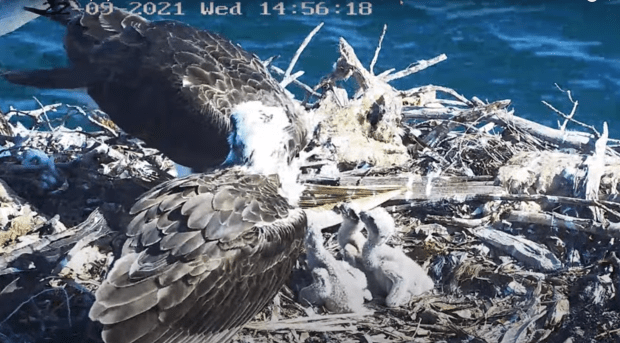
Then there is always the trio at Port Lincoln. They had two feedings this morning and a third at 11:31:27 when Dad brought in a very small fish. All of the chicks were well behaved – quite civil to one another. And, of course, Little Bob is right there in front! Look carefully you can see him.

Life is good. Everything seems to be going really well for all the nests.
Thank you so much for joining me today. I hope you enjoyed learning about the Godwits as much as I did. Incredible birds. Take care everyone!
Thank you to the following for their streaming cams where I took my screen shots or for postings on their FB pages that I have shared with you: Port Lincoln Osprey Project, 367 Collins Street Falcons by Mirvac, Falcon Cam Project at Charles Sturt University and Cilla Kinross, Pukorokoro Miranda Shorebird Centre, Sea Eagle Cam @Birdlife Australia Discovery Centre, and Cornell Bird Lab and NZ DOC.
Feature image credit: “Bar-tailed Godwit” by 0ystercatcher is licensed under CC BY-NC-SA 2.0