The Daisy Chronicles, Day 14-15

It is 15:00 in the Sydney Olympic Forest. You can hear the old Ironbark Tree creaking as the 23 kph winds twist the branches about. It sounds like old doors that need to be oiled. The gusts seem to be more. Daisy seems undaunted. I cannot hear any bird vocalizations in the forest.

The camera operator checked to see if the Sea Eagles were at the River Roost. There was one bird – WBSE or Gull? – flying over the Parramatta River. It is that white dot against the far dark trees up at the top – almost in the middle of the background.

I continue to keep in my mind that last year we kept saying, ‘If Daisy had only come in late November or December.’ Gosh, we surely got that wish this year. But, this year feels like a ‘cake walk’ compared to last year. (Still I do not want to get complacent – anything can happen!) I don’t think anyone slept while Daisy was on the nest. We did not know how the Sea Eagles would react – we didn’t know when they would be coming to try and catch Daisy. You could almost see the steam coming off the top of Dad’s head last year trying to ‘catch’ whatever bird was brave or stupid enough to lay their eggs in ‘his’ nest. I am posting one of my blogs from last year. Every moment was tense. In the image below, Dad has landed on the nest. You can see that Daisy had no time to cover her eggs!

Daisy had only a split second to get off the nest and no time to conceal her eggs.

https://wordpress.com/post/maryannsteggles.com/2957

People from around the world were cheering this brave duck. There is another difference this year also. The temperatures. It is 23 degrees C today. Last time Daisy had eggs on this nest, it rose to 40 degrees C. The sun was so hot she had to leave frequently for breaks and she often left in the middle of the afternoon. That is how the Ravens got the eggs. This time it appears it is after sunset and before sunrise that could at least hold off the Ravens. Maybe there is a ‘finishing school’ for future duck mothers???

The weather forecast has now posted a 40% chance of a shower – not rain – with the winds gusting to 30 kph. Here is a very short video clip of our little Daisy – gosh, she looks tiny in that big tree – as it is swaying with the gusts.

I am not expecting anything to happen – famous last words – until Daisy leaves for her evening break. Sunset is at 20:03.

Daisy surprised me and left at 17:22:30 for her evening foraging. This was two and a half hours before sunset! This is unusual compared to her pattern. She did spend considerable time covering up her eggs and she appeared to be looking for more leaves.

Off she goes! That blur of feathers under the branch on the right.

I had convinced myself that I could fall asleep and wake up and check that Daisy had returned and the eggs and her were both alright. The problem was she left too early. Who would come to get those eggs? Would the ravens be around on a quick fly through before roosting? Normally Daisy departs for her break right at sunset. So I waited with a pot of spiced tea, a box of shortbread, and Mark Bittman’s recipe for No-Knead Bread from The New York Times. Our forecast was for thin layers of freezing rain – the kind that covers everything but you can’t see it. Black Ice. And then snow as the temperature plunges from -1 to -14. Daisy is enjoying cooler temperatures than her incubation time last year. It was 19 C during the evening and early morning hours.

Daisy did return and no one bothered the nest. She was a very lucky little duck. She landed back on the nest at 19:43:23 ——- 20 minutes before sunset.

Oh, I hope we get some close ups today. Just look at the down – it must feel good compared to those hard sticks.

Doesn’t she look adorable?

It is 04:16:00 and Daisy has not left for her morning break. She fooled me yesterday by slipping out for a quick foraging trip at 04:46. I wonder if she will do that today?

Daisy flew off the nest at 05:09:04. She spent considerable time before leaving covering up her eggs.

And she is off! Daisy is a Dabbler. I hope that she finds lots of yummy plants to enjoy.

In the background you could hear the Noisy Miners and Sulphur-Crested Cockatoo easily over the hum of the camera. The forest is waking up just as Daisy is leaving. They are particularly loud this morning. I wonder if they alerted her that she should get going?

The cam operator gave us some beautiful shots of Daisy’s nest covering. Thank you!

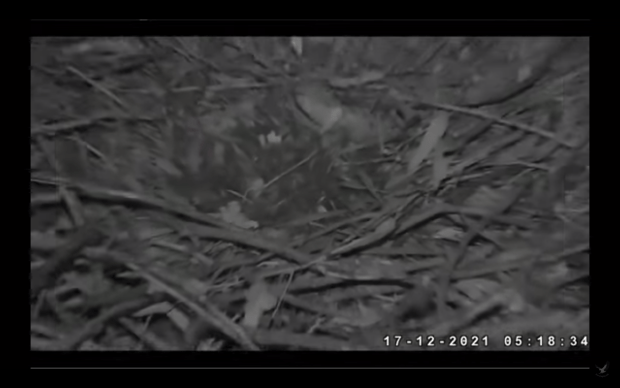
Sunrise is at 05:39. Yesterday Daisy was back on the nest a little after 06:00. Fingers crossed.

It is Day 15 of the Daisy Chronicles and so far all is well.

Thank you so much for joining me. I will bring an update on Daisy in about six or seven hours. Let us hope that today is as uneventful as all the others. Please take care. See you soon.

Thank you to the Sea Eagle @Birdlife Australia Discovery Centre for their streaming cam where I took my screen shots.

The Daisy Chronicles, Day 12

Daisy has not taken a break since Day 12 began at midnight on 14 December in Australia. She had a short break after sunset on Day 11.

This morning Daisy did have a number of visitors. The first was a Galah and then some Rainbow Lorikeets arrived. At one time the Galah screeched and it woke up the Ringtail Possum who came out of its nest.

The Galah flew away and the Lorikeets stopped chattering.

The Ravens flew around the tree making noise checking on whether anyone was sitting on those eggs. Daisy was there and they left – just stirring up a little anxiety. It is interesting that they have not landed on the nest the last few days. Maybe that little duck scared them enough that they will never come if she is there.

Once the Ravens left, the Lorikeets came back up on the nest.

It is nearing noon. It has been so quiet that it is almost eerie.

The cam operator must have left as we have had a wide shot most of the day. I scrolled back through the footage and found a few close ups for us to enjoy.

Look at all that lovely down!

Don’t you love how the golden light of the sun falls on our beautiful duck?

Daisy must be very tired and hungry.

Daisy is going to have to take a break. Let us all hope that she can wait until sunset.

It has been so quiet on Daisy’s nest the past couple of days. I would love for it to stay this way but anything can happen in a second. There is rain forecast for tomorrow. If Daisy goes out foraging at sunset – which she has to do (or go before) and if she does the same before sunrise, she might be on those eggs to protect that down when the rain comes. That down is precious because it is making up for a lack of leaves.

It is after lunch on the nest and everything is so quiet. It is like all of the other birds were boxed up and sent out of the forest. I can hear the hum of the streaming cam and about every half hour a bird. So strange. Maybe it is siesta time.

Can you see Daisy?

That said…I do wish it would be his way til about the 6th of January when those ducklings leap off that nest. If Daisy does manage to get those eggs to hatch – against every obstacle she could have – I think we should each toast her with whatever your favourite beverage is when Daisy and her babies leap. My goodness I cannot think of a better way to enter into 2022.

I have the sound turned up way too loud. If anything happens on this nest I will be alerted. For now, I am going to go and look through a book on raptors and have some nice green tea.

Take care everyone. Thank you so much for joining me and Daisy. She is so hidden in the shade of that big tree – she blends in perfectly with the nest. See you soon!

Thank you to the Sea Eagles@ BirdLife Australia Discovery Centre for their streaming cam where I took my screen captures.

Catching up with WBSE 27 and 28

The WBSE are both in the 11th week after hatching. With the average of 75-80 days after hatch for fledgling, WBSE 27 and 28 are ready. Their feathers have developed, they have grown, and you can see them getting excited with all the wing flapping and catching air enabling them to rise above the nest.

What are they watching so intently from the nest? Is it a Pied Currawong?

Of course, the Pied Currawong are right there. The Pied Currawong is closely related to the Butcherbirds or the Magpies in Austrlia. They are a medium sized passerine. They have a large black beak with yellow eyes.

Here is a short video of the calls/songs the Pied Currawong make:

The Currawong become more of a menace around fledging time. Their attacks increase in number and they could injure the chicks, knock them off the branches, or chase them out of the forest before they can imprint the route back to the nest in their mind’s GPS system.

Lady was on the nest honking and flapping her wings at the Currawong so the eaglets could finish their lunch. At other times, the eaglets have to learn to defend themselves or hunker down really low in the nest. Because the WBSE are at the top of the ‘food chain’, they will always be followed and attacked by the smaller birds. What do the smaller birds want? They want the WBSE to pack up and leave!

Lady is honking really loud, warning the intruder to leave.

Lady was in the nest much earlier feeding both of her eaglets. Many of you have probably noticed that despite the fact that the nestlings are fully capable of self-feeding, she seems to enjoy feeding them.

The eaglets know to stay alert for intruders while flapping their wings and jumping to stretch their legs.

They honk at the Currawong just like the adults.
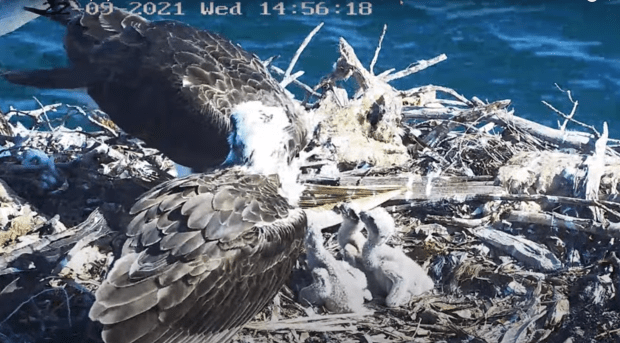
The Pied Currawong are very brave. Indeed, their attacks on the almost-fledglings is relentless. Ironically, I don’t believe the WBSE eat Currawong. Sometimes I think that they should rethink that!

Both of the nestlings have branched. They are standing on the parent branch looking around. Soon they will fledge.

It has been a wonderful season for Lady and Dad at their nest. Both of their eggs hatched and both of the nestlings thrived under their care. Both are healthy and fit and we hope that they both fledge successfully, returning to the nest or other areas so Lady and Dad can continue to feed them while they learn to fly better.

We wish them a long and successful life. It has been a remarkable year.

Lady and Dad are ‘honking’ their duet in June. It is a really special way to end another good day!

Thank you for joining me this evening. Take care everyone. See you soon.

Thank you to the Sea Eagle Cam @ Birdlife Australia Discovery Centre for their streaming cam where I took these screen and video captures.

Godwits…and more

I have heard the name but have never seen the bird – or, at least, I do not think I have. With my lousy shorebird IDs, I might have even confused this beautiful long-legged shorebird with a Greater Yellowlegs. Of course, everyone would have laughed.

Godwits are ‘very’ long legged shorebirds but their legs are not yellow! Their beak is ‘very, very’ long and is bi-coloured – light rose and espresso -and ever so slightly upturned at the end. They are called waders because they live in the mudflats and the estuaries. See how their legs go deep into the mud, too. They feed by sticking that very long beak into the mud, rooting around for worms and small shellfish.

“Bar-tailed Godwit” by naturalengland is licensed under CC BY-NC-ND 2.0

The breeding adults have a chest that ranges from a deep terracotta for the males to a brighter orange for the females. The wing and back feathers are more brown and white overall with a touch of the breast colour, sometimes. They have gorgeous dark eyes.

“Bar-tailed Godwit” by 0ystercatcher is licensed under CC BY-NC-SA 2.0

The juveniles have a cream coloured breast with overall brown and white feathering.

“Bar-tailed Godwit” by 0ystercatcher is licensed under CC BY-NC-SA 2.0

What is so miraculous about these shorebirds is their migration. They breed in Alaska and fly in September to New Zealand! They make only one stop, normally. And they do the trip in record time. It is an 11,265 kilometre journey or 7000 miles. They accomplish this in eight days! Yes, you read that correctly, eight days.

“Bar-tailed Godwits” by naturalengland is licensed under CC BY-NC-ND 2.0

Neils Warnock, the Executive Director of Alaska Audubon in 2017, remarked,These godwits are epic migrants. We had a bird, E-7, that we had tagged, and she left New Zealand in the spring. She flies non-stop seven days, ten thousand kilometres, to the Yellow Sea. All of the Bar-tailed Godwits of Alaska, they stop at the Yellow Sea.”

The Yellow Sea is located between mainland People’s Republic of China and the Korean Peninsula.

Historically the mudflats of the Yellow-Sea have been rich with food for the Bar-tail Godwits so they can fatten up and make the rest of the journey to their winter homes in New Zealand without having to stop. Today, the mudflats of the Yellow Sea are under threat – they are disappearing with coastal development. This could prove to be a major challenge for these beautiful shorebirds. There have been many studies and the researchers have seen a drop in the number of shorebirds by 30% in the last few years because the mudflat areas have been reduced by 65%.

https://www.science.org/news/2017/04/migrating-shorebirds-danger-due-disappearing-mudflats

The reports of the shrinkage of the mudflats has been coming in since 2013 with alarms sounding.

Today the Pukorokoro Miranda Shorebird Centre in New Zealand reported that Bar-tailed Godwit 4BYWW made his flight in 8 days and 12 hours arriving home at 03:00 on 26 September. He flew 12,200 km. His average speed was 59kph. 4BYWW may have set a new distance record for the Bar-tail Godwits. We will know when the others return home. Isn’t that amazing?

What I found most interesting was her route. She does not appear to have gone via the Yellow Sea. Is this because of the decline of the mud flats? Have the birds adapted their migratory route? I definitely want to look at this more closely.

This was the satellite tracking image posted by the Pukorokoro Miranda Shorebird Centre FB page:

The Centre was tracking another four adults and 3 juveniles on their journeys home. One of those, 4BWWB, has been reported as flying non-stop for 163 hours and over 10,000 km. Seriously, my head can’t comprehend what that must be like. I am also truly amazed at what these sat-paks can tell us about the birds and their amazing resilience. Just incredible.

Tiaki officially fledged on the 25th of September. The Royal Albatross cam chick of 2021 is foraging off the coast of New Zealand at the present time. She will eventually make her way to the waters off of South America near Chile. We wait for her return in four to six years to Taiaroa Head where we will hear that beautiful Sky call, again.

While millions and millions of birds are moving from their summer breeding grounds to their winter homes, others are waiting for eggs to hatch. Holly Parsons posted a table of Diamond’s incubation history.

Xavier and Diamond’s first egg was laid in the scrape box on top of the water tower at Charles Sturt University in Orange, Australia on 31 August this year. Cilla Kinross, the main researcher, is expecting a hatch from 6-9 October with the most promising day being the 7th. Can’t wait!

Diamond was catching some sleep this morning. If all of the eggs hatch, her and Xavier are going to be very busy!

If the hatch is expected around the 7th of October at Orange, then what about those Melbourne Peregrine Falcons? The first egg was laid on the 21st of August – yes, that is right. Ten days before the Orange falcons. So, I am going to be looking for a hatch at Melbourne starting in two days!!!!!! This means that all of the Melbourne eggs, if viable, will hatch before those in Orange. It will be nice to get to enjoy them without trying to watch both at the same time!

For those of you wondering about those beautiful White-bellied Sea Eagles, 27 and 28, here they are. Talk about gorgeous.

Things will really be starting to ramp up shortly. Bald Eagle breeding season in the United States begins in a few days. Looking forward to checking on some nests to see if the birds have returned – such as Anna and Louis who had the first hatch on a nest in the Kisatchie Forest last year since 2013. His name was Kistachie – very appropriate.

Then there is always the trio at Port Lincoln. They had two feedings this morning and a third at 11:31:27 when Dad brought in a very small fish. All of the chicks were well behaved – quite civil to one another. And, of course, Little Bob is right there in front! Look carefully you can see him.

Life is good. Everything seems to be going really well for all the nests.

Thank you so much for joining me today. I hope you enjoyed learning about the Godwits as much as I did. Incredible birds. Take care everyone!

Thank you to the following for their streaming cams where I took my screen shots or for postings on their FB pages that I have shared with you: Port Lincoln Osprey Project, 367 Collins Street Falcons by Mirvac, Falcon Cam Project at Charles Sturt University and Cilla Kinross, Pukorokoro Miranda Shorebird Centre, Sea Eagle Cam @Birdlife Australia Discovery Centre, and Cornell Bird Lab and NZ DOC.

Feature image credit: “Bar-tailed Godwit” by 0ystercatcher is licensed under CC BY-NC-SA 2.0

Everyone is Fine

One of the problems with the streaming cams is the ‘chat’ feature. There, I have said it. The same persons come on at different times of the day, every day or every other day and say the same negative things. There is one on the PLO chat that always says, ‘The mother never feeds the youngest’. ‘Mama feed in order never feeds youngest.’ Seriously! Either they can’t rewind, they don’t watch, or they just want to stir the pot of negativity. I think that it is all three. So I go back to an old cry out of mine, Streaming cams need 24/7 knowledgable moderators. They need them to stop the bots coming in and they need them to stop the negative chatter. Even more so, if something happens on the nest they need to have emergency numbers to call or place them on the streaming cam site at the top.

The Port Lincoln Osplets are doing fine! And it is something to celebrate. One of the most exciting things is to watch them grow and grow they are. these chicks are losing their light grey coat to get their second, darker grey down. You can see the little pin feathers starting. still, each retains a tiny bit of its egg tooth. The feet are getting bigger, wings are growing and the tiny tails are starting. If you didn’t know the different species at this age of 9-10 days, just look at that beautiful dark mask going from the cere to behind the eye. that is the distinctive bandit mask of the Osprey!

Dad comes in with another fish. the big one that arrived earlier is all gone.

The chicks are getting bigger and they don’t like sleeping under Mum like they did when they first hatched. Indeed, these little ones seem to be tumbling around underneath her much of the time.

Awwww. Such sweeties.

Because it is winter in Australia, the light changes early. Mum and dad are on the nest and the little ones are getting another feed. Notice how much they have grown. It is as if someone took them and stretched them in the last couple of days. They no longer appear like short fat little chicks but they are entering another phase where they will begin to look like thin reptiles with long necks.

Each is doing fine. There were not as many big fish yesterday as during the high winds but everyone was fed and no one was left out.

I literally checked into the White Bellied Sea Eagle nest to see how WBSE 27 and 28 are doing. Lady was feeding them.

That is WBSE 28 at the front of the nest with its big crop. 27 is practicing its self feeding with a small piece of prey.

This nest will have two fledges this year. I so hope the Pied Currawong do not chase them out of the forest so they can fly and return to the nest for more meals while they get their piloting in order.

Lady Hawk did a video of 27 learning to self-feed and 28 nibbling at her toes. Have a look:

The strongest earthquake in recorded history hit Melbourne, Australia yesterday.

https://www.heraldsun.com.au/news/victoria/earthquake-tremor-felt-across-melbourne-and-regional-victoria/news-story/f8dca1048e48a500e3308dabedfdb1c1

The first thing many thought of were the four eggs of the Peregrine Falcons at 367 Collins Street.

Dad was on the eggs at the time and stepped off wondering what was happening.

Everything appears to be fine. Some buildings were damaged but no one was killed. Thankfully! We are nearing hatch watch for this couple.

In Orange, the running joke has been Xavier wanting his time to incubate the eggs.

Xavier doesn’t want to give up his incubating time!

Do you know why the male Peregrine falcon is called Xavier? It is one of those heart wrenching stories that makes you love this little male bird even more.

Diamond’s eggs were ready to hatch. Her mate, Bula, disappeared and was presumed dead. As we all know, the chicks would have died. Instead, enter a new male who starts helping with the chicks and raises them as if they were his own. Because he was a ‘saviour’ of the family, he was named Xavier.

The researcher at Orange is Cilla Kinross. She did a cute video of the negotiations between Diamond and Xavier over the incubation duties.

Everything is changing at these four nests in Australia. The White-Bellied Sea Eagles are exercising their wings, jumping, and hopping about. They are getting more adept at self-feeding although 27 still is the one that gets to the prey first it seems. Lady does come in and feed them. Branching will be next but not for a bit, thankfully. We will be watching for the four at Collins street to hatch in about four or five days. Diamond and Xavier’s chicks will follow but not for a week or a little more. And, of course, the change in the Osplets at Port Lincoln will be significant. They will look like skinny reptiles all wound around one another. The key is that everything, at this moment in time, is just fine. There are no worries. So enjoy them!

It is another beautiful fall day in Manitoba. The Green Heron has departed and I always missed it. Perhaps another will come next year! The Blue Heron is also gone but I hear there are waves of Dark-Eyed Juncos headed towards the city. I cannot wait. They love to pick apart my red outdoor carpet. Such cuties. I am going out for a long walk and to check on the Wood Ducks. Perhaps they will cooperate and there will be some good photos for me to share with you.

Thank you for stopping by. Check out the streaming cams – the birds are doing great. And, if you feel up to it, shut down the negativity. There is already enough in the world. The birds bring us joy. Take care all. See you soon.

Thank you to the following for their streaming cams where I took my screen shots: Port Lincoln Osprey Project, 367 Collins Street by Mirvan, Falcon Project Cam at Orange, Sea Eagles @ Birdlife Australia Discovery Centre.

Monday in Bird World

If you are looking to take ‘decent’ photos of Canada geese, if it is a hot day in the afternoon, don’t bother. They are all taking siestas! Best time is in the morning and early evening. The Cooper’s hawks were not about either.

We had a lovely walk through the park anyway. It was just a beautiful end of the summer day i. The flowers are still blooming in the English Garden and there were more than eight people with their cameras cuddled up by the Bee Balm trying to see if they could catch a glimpse of a hummer. They were probably sleeping like the ducks.

Most of the time this pond is full of Canada geese. Not a one. A couple of lonely ducks out on the water.

This is the tower at the Duck Pond at Assiniboine Park in Winnipeg, Manitoba, Canada.

All of the water features and the move from full sun to shade gardens made the stroll delightful. There were a few people wishing they could put their feet in the lotus pond.

So we drove to a different, small park. That is actually where we found the geese sleeping and alerted me to why we could not see them in the big park. Only a few were foraging in the grass.

The juvenile wood ducks are getting bigger! They have tripled in size in a couple of weeks.

The Mallards were so busy digging in the dirt under the bark they hardly noticed me.

What is she looking for?

They are sifting through the mud and bark near the pond searching for bugs, maggots, and anything else that they can feed on including little plants. The behaviour is perfectly normal!

This gentleman got back in the water and cleaned himself off later.

There were a few geese not sleeping. These were hot and stood at the edge of the pond drinking for about five minutes.

Then they decided to do a lot of preening.

Mr Crow was simply upset at everyone today. There were people having picnics not too far away. I wonder if he was looking for some treats? It was actually good to see that no one was feeding the ducks cakes and bread. The signs are working!

Gosh, isn’t this male Wood Duck lovely? What stunning colours and that big red eye.

Another one of the juvenile Wood Ducks.

This little male decided to swim right up so I could get a good shot of him. They have the most gorgeous patterning. The swept back crest and those iridescent feathers are just stunning. He had to be the most handsome male at the pond today.

He swam away.

And then he turned around again.

Male ducks are called ‘drakes’.

This is a male Wood Duck undergoing eclipse during the summer. During this time he will lose his beautiful male plumage but he will get it back in the fall. Some ducks are unable to fly when they molt. The females also molt too.

Oh, isn’t this female Mallard gorgeous?

She might not be as colourful as the male Wood Duck but she is always a beauty. Did you know that female ducks are called ‘hens’?

The Mallards were simply going crazy splashing up and down in the water today. It was like they were trying to shake the plants up from the bottom of the pond so they could eat them.

What a beauty. Just before she flew off.

All of the ducks will hatch their eggs, take care of their babies, molt, regrow their feathers, and everyone will hope to eat well before they migrate.

The ducks in the nature centres and parks are not ringed so that they can be counted if they are shot! We enjoy learning about their life cycles and watching their babies grow. Oh, I would not be popular in places where hunting is popular!

Just a some notes about what is happening in the rest of Bird World. The people running the Sydney Sea Eagle cam have turned it back on. They believe that the danger for WBSE 28 has passed. Both of the little sea eagles have been eating well and prey has been regular. This is fantastic news.

The last of the Black Storklings that was fed on the nest in Jegova County took an unusual flight path when it left for migration. And then,Julge decided not to fly but to get on a boat and it is now heading for Primorsk, Russia. It should be there on 31 August. Julge is the purple line showing in the middle of the sea on the Birdmap tracking. I hope that Julge is OK and corrects his flight path. It would be very cold in that northern part of Russia in the winter.

Diamond even accepted a Starling from Xavier today for her lunch. There has been lots of mating – sounds heard on the camera – but no egg yet.

This morning Idris was on the Dyfi nest defending it. What expressions came on this Osprey! His son, Dysynni has not been seen since Saturday the 28th at 10:57.

I know that lots of people like to plan trips – when we can travel again – to see the Osprey. It seems that those down in Poole Harbour, England have hit the jackpot. All of the migrating birds are stopping there to feed and rest. So think end of August – Poole Harbour!

Thanks for joining me today. Tiny Tot and Tiny Little are out somewhere making their way in the world. We want them to stay safe – all the birds – and all of you. Take care.

Thanks to the following for their screen cams where I took my screen shots: Dyfi Osprey Project, The Falcon Cam at Charles Sturt University, Orange, and Cilla Kinross, the Sea Eagle Cam, Birdlife Australia, and The Discovery Centre and the folks running the BirdMap.

The Hornbill

There are over 50 different varieties of Hornbill. The one that I want to focus on today is the Rhinoceros Hornbill. It is the State Bird of Malaysia. I became acquainted with these amazing birds during a trip to the Sarawak in East Malaysia many years ago.

The arrow points to Sarawak. The Rhinoceros Hornbill is present also in Sabah as well as Borneo, in yellow.

You could not move through the area around the harbour of Kuching without seeing ‘something’ decorated with the motif of a hornbill – from table cloths, batik wall hangings, phone cases, and old and not-so-old wood carvings. To actually see these highly endangered birds you needed a guide to take you to the jungle areas where local tribes still live in their long houses. There the hornbill was also used as a design for the totems on the poles supporting their roof as well as on many of the art of tattoos.

“Iban? Long House near Kuching” by rosskevin756 is licensed under CC BY-NC-SA 2.0

The weavers of the area specialize in ikat. Ikat is a type of resist dying. The threads are resist dyed before they are woven. The pattern in the textile below is called the ‘Feather of the Hornbill’.

Old carving of Hornbill, Ironwood. Sarawak Museum, Kuching.

The Rhinoceros Hornbill is depicted in numerous designs in wood carving. The wooden figure above is a Kenyalang. Historically, these carvings were associated with many of the tribes in Sarawak, Sabah, and Borneo. For the Iban, the figure is an essential part of a celebration called the Gawai Kenyalang. Its role was as a messenger. It called upon the spirit world to give courage to the warriors who went out headhunting. The carvings are still made today and they are still important for the various tribal communities. Head hunting ended in the 20th century and most of the carvings are considered cultural icons.

The Rhinoceros Hornbill is a large bird, 80 to 90 cm (31–35 in) long. The males are larger than the females. The birds are covered with black feathers except for the white tail that has a single black band. Their legs are white. The Hornbill is most notable for its colourful bill which is huge. In fact, that orange and red bill is what gave the bird its name. The Hornbill uses this lightweight beak to gather its food, build its nests, seal the nest, and feed the chicks. The structure on top of the bill is called a casque. It is hollow and its function is to amplify the call of the birds. The eyes of the male are red with black rims while those of the female are white with a red rim like the one below.

“Rhinoceros Hornbill” by shankar s. is licensed under CC BY 2.0

In comparison, this is an image of the male so that you can see the difference in their eye colour. It is the easiest way to recognize each of the genders.

“Rhinoceros Hornbill” by Steve Wilson – over 10 million views Thanks !! is licensed under CC BY 2.0

The Hornbills are very unique in their nesting habits. They are cavity nesters but with a twist. When the female is ready to lay her 1-3 eggs, she will locate a cavity in a tree trunk (or sometimes a rock formation) to make her nest. Once made she helps her bonded-for-life mate seal her into the cavity with mud. The only opening is a small oval hole where the male feeds the female during her confinement that lasts 50 days. He also feeds the nestlings. This arrangement is very practical. It helps protect the nest from any type of predator including lizards and snakes. Ninety days after the chicks hatch, the female will break open the mud covering to the nest.

The Rhinoceros Hornbill is listed as vulnerable. One of the biggest threats to its existence is the loss of the rainforest where it lives and builds its nest. It is also hunted for food as well as for items that are believed to give men virility including the feathers and the skull. The large trees that occupied the forested areas of Borneo are being cut down at an alarming rate. When I was there the wood was being shipped to China on those huge boats. It was overwhelming to see the forest being obliterated.

“Rhinoceros Hornbill (Buceros rhinoceros)” by Mark Louis Benedict is licensed under CC BY-NC-ND 2.0

In other news, Tiny Little Bob or Blue 463 nabbed the first fish of the morning on the Foulshaw Moss Osprey Nest in Cumbria. Tiny Little was busy eating it while sibling 462 waited on the nest. Tiny Little is off to a great start to the day! Go Tiny Little!

Karl II arrived at 8:10 to feed the three fledglings on the Black Stork nest in Estonia. The fledglings were incredible.

The glare of the sun on the camera creates a strong glow so you can’t see clearly what is going on. Karl arrives on the right and feeds the hungry storklings quickly. The nest is in the Karula National Park in Estonia.

One of the Storklings on the Siguldas Black Stork nest in Latvia has decided to get up close and personal with the camera and its supports while it waits for Grafs or Grafiene to bring them their breakfast.

The good news at the Peregrine Falcon Nest in the scrape box on the grounds of Charles Sturt University in Orange, Australia is that Izzi – cute little Izzi – has not been in the scrape box for six days. He has been heard but he has not gone in after several altercations with Xavier. Diamond, Izzi’s mother, is expected to lay her eggs by the end of August. Here is Diamond looking out over her territory.

Also in Australia, the two little sea eaglets, 27 and 28, are just cute. They are really growing. Dad brought in a life fish and was going to feed them today. Lady flew in and stepped on the fish before it could flop all over the chicks. Then she took over the feeding. Both ate well but 27 had an enormous crop.

It continues to be as good a day as it can be in Bird World. The juvenile Ospreys are eating and eating preparing to being their migration. For some of the UK nests the average number of days is around 90 hatch days old for fledging. We will be keeping our eyes open to see who is leaving.

Thank you so much for joining me. Have a wonderful Friday everyone. See you soon.

Thank you to the following for their streaming cams where I took my screen shots: WBSE Sea Eagle Cam, Birdlife Australia and the Discovery Centre, Cumbrian Wildlife Trust and the Foulshaw Moss Osprey Nest, Falconcam Osprey Project, C Sturt University and Cilla Kinross, the Eagle Club of Estonia, and the Latvian Fund for Nature.

Birding Action has started in Australia

Wow. At 00:52:40, Mom goes into labour. She is the female Osprey on the Port Lincoln Osprey Barge in Australia. Dad is sitting right at nest side in support. It was magical. The minute the egg was, Dad was off. My time said 00:57:58. And with that single significant event, the Port Lincoln Osprey season for 2021 is underway!

Mom looks very content in the early morning Australian sun.

I was very glad to see Dad there. Last year Dad just about ended my love of Ospreys. The death of Tapps, the third hatch in 2020, practically cemented that. The Achieva Osprey nest brought back the pain but the triumph of Tiny Tot gave me faith. It also has made me question the entire notion of ‘survival of the fittest’. So this year I am wishing for consistent fish drops when the eggs hatch – Dad, that means enough fish for everyone every day with no breaks.

The Northern Hemisphere fledglings are preparing to migrate (if they hatched in an area where the birds travel to warmer climates during the winter) so for all Osprey lovers this is a chance to start at the very beginning again — in Australia.

The adults spent a lot of time bringing in new twigs and lining the nest cup with bark. It is quite beautiful. This nest looks like someone cares!

Of the chicks that have fledged from this nest, Calypso (2019) fishes and is seen regularly in the Port Lincoln area. Solly (2020) was fitted with a satellite tracker as well as a leg band. It is reassuring to know that she is well. There have been no reported sightings of her brother, DEW, that I am aware of.

Solly is 317 days old and she is at her favourite place, Eba Anchorage.

The two eggs have hatched at the White-Bellied Sea Eagle cam in the forest of the Sydney Olympic Park. They are WBSE 27 and 28. Both are doing fantastic. Dad has been bringing in Bream, Pigeon, several other types of birds, and Eel-tailed Catfish. The chicks are not wanting for food or variety!

The link to the Sea Eagle Cam is here:

Are you a Peregrine Falcon lover? There are two excellent nests in Australia on streaming cam. One is on all year round and has covered the antics of Xavier, his mate Diamond, and their son, Izzi. The scrape box is on the water tower on the grounds of Charles Sturt University in Orange, NSW. This family is part of a research project of Professor Cilla Kinross.

I should tell you that this nest is hilarious. Xavier is such a sweetie and he is courting Diamond now even though they have been a bonded pair for a number of years. He brings her gifts of prey to the scrape box and they do a courtship dance. Sometimes Xavier forgets and brings Diamond a Starling. Diamond hates Starlings and refuses to accept the gift from Xavier! And then there is Izzi. Izzi is like the cutest almost one year old falcon. He should not be at the nest but he is. You see, Izzi fledged three times. The first was accidental so he was taken back up the 170 stairs to the scrape box on the water tower. The second was a good fledge but he ran into a window. He was in care for several days and returned to the scrape box. The third time was the charm. The problem? Well, Izzi should have left his parent’s territory before the beginning of 2021. Yes, it is now August. That is the problem.

I mean seriously – could you tell this cutie pie to leave home?

Both Diamond and Xavier have been ‘scraping’ in the scrape box. The indentation they are creating is where Diamond will lay the 2021 season eggs. The couple have already been mating on the top of the water tower.

This is Xavier. The yellow around the eyes, the cere (part above the beak), and the legs and feet are a deep yellow when falcons are adults. Look at the beautiful plumage patterning.

This is Xavier scraping in the scrape box.

This is Diamond scraping in the scrape box. Notice the colour of the stones. In his book, The Peregrine, J.A. Baker states that “Peregrines bathe every day…The bed of the stream must be stony and firm…They favour those places where the colour of the stream-bed resembles the colour of their own plumage.” Absolutely. Camouflage. But why do they take so many baths? Baker believed that it was so they would not transfer any lice or other parasites from their prey onto them that could cause illness or disease. The same is true of the scrape box. Peregrine falcons lay their eggs in gravel and not on a twig nest to avoid illness or disease.

Here is a very short but loud pair bonding in the scrape box. Have a look at the dance that Xavier and Diamond do together. Xavier is the smaller of the couple. Falcons, like other raptors, have reverse sex size diamorphism – meaning the female is larger.

Here is the link to the box camera. There are in fact two cameras: one looks at the inside of the box as above and the other is positioned to look forward from the back taking in the ledge and a bit of the outside world. That is cute little Izzi looking out to that big world beyond.

The chat feature has moderators, often Professor Kinross, as well as a FB Page where you can get great information.

The second is the Collins Street Falcons better known as the CBD Falcons in Melbourne. The camera is not operational yet. There are many videos from last year if you search for Collins Street Falcons on YouTube. In 2020, the couple had triplet girls. Triplets? Three eggs hatch within a period of 24 hours. These girls grew like crazy. They grew bigger than their dad.

I am including one video of the male delivering a pigeon to feed them. I just love this tiny little male. He melts my heart every time I look at him.

The diet of the two falcon families is different. The Melbourne falcons are urban. Their diet is almost exclusively pigeon. In contrast, the falcons in Orange are rather rural with a more varied diet including Starlings (remember Diamond dislikes those), Galah, sometimes a Supreme Parrot, other parrots, and birds. One thing that eyases love are cicadas. They hold them in their foot and eat them like a popsicle. It is crazy. In one day last year, Izzi ate 17 cicadas in a row. There had to be a swarm of them! It was incredible.

As night comes to the Canadian prairies the sun is rising on a new day in Europe for all of the birds. The rain falling in the Latvian forest where the three Black storklings nest sounds wonderful.

It was reported today that my city had only 1/10 the average amount of rain in July. It has been 150 years since this small amount of rain was last recorded. We long for a day just to listen to the sound of rain falling like it is here on the Black Storklings in Latvia:

Thank you so much for joining me today. It is wonderful to have you with me. Take care everyone!

Thank you to the following for their streaming cams where I took my screen shots: The Latvian Fund for Nature, Sea Eagle Cam, Birdlife Australia and the Discovery Centre, Charles Sturt University and the Falcon Cam Project, Port Lincoln Osprey Project and PLO FB Page for Solly’s transmitter data.

Note: The next newsletter will appear late Tuesday.

Sunday news in Bird World

The sun is bright but not too hot, the Hibiscus continues to bloom, and Tiny Little is on the Foulshaw Moss nest eating a large fish. That is a great beginning to the day.

This is actually ‘the tea time’ fish for our favourite little fledgling on the Foulshaw Moss nest. It is about 16:00 in Cumbria.

Tiny Little is so smart. She doesn’t waste her time and energy fighting with the mouth and eyes of the fish, she rips a part of the belly open and begins to eat the side and the bottom of the fish. She is ever mindful that there are also two hungry siblings lurking about.

Tiny Little ate off that fish for more than an hour. She got a lot of really nice fish Great work, Tiny Little!

After what appears to be an hour and a half, big sibling 464 arrives. I missed the hand off. Was Tiny Little finished or did 464 come in and take the fish? We will never know. 464 has been fighting with the front of that fish for over an hour now. Sibling 462 is waiting their turn! Tiny Little has flown off.

In the White-Bellied Sea Eagle Nest in the Sydney Olympic Park, Lady has been busy feeding 27 and 28. Oh, they are so cute! I love this stage. Lady is so gentle feeding them with her big beak. They look like two little snow people with arms.

The Only Bob or Bobette in the Collins Marsh Osprey Nest in Wisconsin has had a couple of feedings this morning and perhaps more by now; it is now 13:33 on that nest. The fish that are being brought to the nest by both parents are quite small. I wonder if all the fish are that small? or are the bigger fish lurking around in deeper water?

The chick is being watched for feather development. It is hoped that the ‘blood’ feathers will grow fully and, at the time of fledging, the chick will have a full set of juvenile plumage.

In the image below, you might want to look at what some people call the quills on the left wing. As the feathers grow, those quills break open and eventually fall off. This is what we are watching.

Yesterday I reported that Bonifac, one of the male storklings cared for by the people of Mlade Buky had been electrocuted just like its mother. The other male, Servac had not been to the nest but was seen flying with other storks. Pantrac has been to the nest to be fed. There were no storks on the nest so far today. This is not unusual! The storks are beginning to gather for their migration to Africa. Yesterday might well have been the last day for them in Mlade Buky.

Before the age of Immarsat M and GPS, the only way to study the migration of the storks was if they were ringed. In 1933, a short entry in Nature Magazine (30 September, p 509) says that ‘Storks nesting east of the River Elbe have been found to use the Asia Minor route when migrating, and those nesting west of the Elbe are stated to take the route through Spain.’ Today those similar routes are simply called the Easter and the Western. The western is through Spain and the Straits of Gibraltar while the eastern has the birds flying through Egypt following the Nile. With Satellite tracking, the birds are now known to winter in Ethiopia, the Central African Republic, Senegal, Nigeria and the Niger River Basin.

The observations of the success of the migration and the concerns in 1933 are similar to those in 2021. It is a two month journey for the Danish storks – anything can happen between the time the storks leave and arrive. Even with laws protecting migrating birds, these lovely creatures have been known to have been shot down in France, Malta, and in parts of Egypt. There are many other things that impact this hazardous journey – changing climates, lack of food and water can all contribute to the loss of the birds.

Because we are talking about European laws, it is essential that the countries that make up the European Union – and many who do not- work together to ensure that the killing of migrating birds in European states is halted. There also need to be uniform protections in the territories where the birds migrate. As the world changes, following the SARS Covid-19 pandemic, countries in African that have been devastated by wars, famine, droughts, and epidemics need to understand that ‘birding’ can be an economic success story. People will begin to travel. Bird Tourism can bring vital monies into these struggling economies.

There is, however, another very troubling trend. As the climates change some of the storks are not migrating. Traditionally, they travelled to Africa where food supplies were plentiful during the winter when they were not in Europe. One troubling occurrence is that many of the European storks who take the western route are now stopping and living in garbage dumps in Spain and Portugal during the winter. There are groups that are not happy with the storks being there year round. One of them is called ‘Stop Storks’. A discussion of the issues is in an article, “European Storks become Couch Potatoes and Junk Food Junkies” in Environment.

https://www.dw.com/en/european-storks-become-couch-potatoes-and-junk-food-junkies/a-19172154

Speaking of storks, one of the nests that I have, embarrassingly not mentioned for some time, is that of the Black Storks in the Karula National Park in Estonia. The camera was broken during a severe storm on 25 June and was not operational again until 15 July. Oh, those wee babies sure have grown. Their parents are Karl II and Kaia.

The trio was ringed on 9 July. You can see the bands. Those bands contain Kotkaklibi transmitters. To my knowledge this is the first instance this type of satellite tracker has been used on the Black Storks. The band numbers are as follows 716U for the oldest chick, 716P for the middle, and 716T for the youngest. Names are pending.

In the image below you can see both the banding ring and the transmitters on the legs a little better. Hopefully reports will come back on a regular basis so that we can follow these three as they undertake their first migration.

Here is the link to the streaming cam of the Black Storks in the Karula National Park in Estonia:

Thank you so much for joining me today. Please go and see those lovely Black Storks. We are now at 1 August and they will not be with us for much longer. I hope everyone is well. Take care. Enjoy.

Thank you to the following for their streaming cams where I took my screen shots: Cumbrian Wildlife Trust and the Foulshaw Moss Osprey Cam, the Sea Eagle Cam, Birdlife Australia, and the Discovery Centre, the Collins Marsh Nature Centre and Osprey Cam, the Mlade Buky White Stork Cam, and the the Eagle Club of Estonia.

Please Note. I have very strong opinions and will always advocate hard for ways in which to protect birds. My son sent me an article with some videos on a troubling conspiracy theory in the United States. It is the ‘Birds are Not Real’ group. They believe that birds are equipped with transmitters and are actually drones that are for surveillance. Those beliefs would cause the killing of innocents. If you know of someone who believes this, please have a gentle conversation with them. If you want to check out their beliefs and what is happening, please Google: Birds are Not Real.