An evening with Big Red, Arthur and the Ks

If you hear the name Ferris Akel, you might recognize the individual that gives a regular Saturday afternoon virtual birding tour of the area around Montezuma National Park, Wildlife Drive, Sapsucker Lake, and the Cornell Campus at Ithaca. Ferris also surprises us with ‘pop up’ tours of the Cornell Campus at other times so that he can see what is going on with Big Red and her family and share it with us. Tonight, we got a special tour and were able to see all four members of the Big Red family.

For those of you unaware, Big Red is a Red-tail Hawk. Red tail hawks are easily identified by their bright orange-red tail feathers once they are adults. The females are larger by approximately 30% than the males. This is called reverse sex size diamorphism. Red tail hawks have amazing eye sight. They will scan for food while they are soaring or are know to sit quietly on a perch for long periods of time watching for their prey. They will immediately fly to get it. Unlike the Peregrine Falcons who take their prey in the air, Red tail hawks normally fly down and get their prey on the ground. They do not normally eat carrion (dead animals) unless they are really starving. Their wing span is 1.2-1.5 metres for both males and females or 3.9 feet to 4.9 feet.

Big Red is a huge celebrity within the birding community. Big Red is now 18+ years old. She was banded near Ithaca, at Brooktondale, on 20 October 2003. Her current mate, Arthur, hatched in a territory next to the Cornell Campus in 2016. He has been Big Red’s mate since her mate, Ezra, died in March 2017. Arthur was first spotted visiting the nest in April of 2017. Big Red and Arthur were an ‘item’ by the fall. Their nest is on one of the light boxes across Tower Road from the Fernow Building. This year they hatched three chicks, the Ks. Two of the three fledged – this is the only time that Big Red did not have all of her chicks that hatched fledge. K2 sustained an injury to her right cheek and beak in the nest and had to be euthanized. She would never have been able to live in the wild nor would she have been able to have any quality of life in captivity. The two surviving chicks, K1 and K3, have already proven themselves to be excellent flyers and it looks like K1 has already had some successful hunts.

K3 on the nest. 21 June 2021. She was taken into care the following day.

Big Red was named after the territory she dominates, the Cornell Campus. She is also a large Red-tail Hawk with a lot of the beautiful rusty brown colour and bring orange-red tail feathers. In the image below she is beginning to become ‘Big Blond’ as she is moulting.

She is the matriarch. It is estimated that she has probably hatched chicks for fifteen years. Ezra was probably her first mate. If she hatched three chicks per year, that means that she has fledged 44. That is an incredible record! Sadly none of the chicks were banded so there is no knowledge of their whereabouts or status. A small number are known to have died after fledging. One was injured and is an ambassador bird for Cornell, E3.

Big Red is noted for her very dark plumage and that amazing red feathered apron.

Ferris first spotted one of the Ks on a light tower.

Big Red was spotted on the Water Cooling Plant.

You can see that her feathers look a little ruffled, untidy. This is the moulting.

Those piercing dark eyes just make you melt.

Can you spot the hawk? Seriously I believe that Ferris Akel has ‘hawk eyes’!

Oh, look it is Arthur! He is Big Red’s mate and is one of the most amazing hunters I have ever seen. He is also moulting!

This is K1 looking out. She is a really good flier and is also believed to have already made a couple of ‘prey kills’. Yesterday she had a little chipmunk and was doing a war cry when K3 came around hoping to get some of it. Normally if the bird is war crying they are the ones that caught the prey and will not share! Even if it is their cute little brother.

At first Ferris and the gang were not sure but once we saw the stripes on the tail, we knew it was K1. K3 has a muddy tail almost verging on red – a first for all of Big Red’s chicks.

K1 is gorgeous and very dark. These images are soft not because Ferris could not focus but because of the heat shimmer off the buildings.

And here is cutie pie, K3. All those little third hatches just soften my heart.

Oh, you wanted your sister to share her chippie and she told you to go and catch your own! Poor little thing.

And that was a wrap. Ferris persisted in finding all of the Ks and trying to get some good images of them despite the heat shimmer and the fact that it was getting dark.

Good night Big Red, good night Arthur, good night K1 and K3.

Big Red and Arthur are moving the Ks around the buildings on the Cornell Campus. They can now be found around the Water cooling buildings, Bartels, and across the ravine. It will not be long til they have them out by the buildings with the cows and the open fields. It is part of their training – enlarging their territory bit by bit. How do they do thus? Food is a great motivator and the adults will carry prey to different areas of the campus and the Ks will follow! It is that easy.

If you see the hawks coughing and shaking their heads and necks and something gets ‘thrown’ out of their mouth, this is called a ‘cast’. It is the bits and bobs of the prey that cannot be digested that is sort of compressed into a small pellet. The raptors cannot digest this and so they throw it up. This is properly called ‘casting a pellet’. This is with the exception of the owls that have a gizzard for digesting these parts of the prey.

It is now getting towards the last week of July. The Ks will be with us for a bit longer. I remember last year. Once J2 and J3 had been catching their own prey around the barns they began soaring. It was not long after that that J3 went poof and was gone with the winds to be followed by J2 the following day.

The last bit of news this morning is that Tiny Little and siblings were fed by White YW (dad) this morning. 462 was first followed by Tiny Little.

It is now around tea time, late afternoon, and Tiny Little has been like a ducking food crying in the nest for a bit.

Thanks so much for joining me. It was a great evening with Big Red and the Ks. They are progressing so well towards their own independence. Sadly, they do not get bands and we will not know where they go or what they do. Lucky for us Tiny Little is Blue 463! Take care all.

Thank you to the following for their streaming cams where I took my screen shots: Ferris Akel’s Livestream and Cumbrian Wildlife Trust and the Foulshaw Moss Osprey Nest.

Thursday in Bird World

There are a number of Ospreys named Louis but the one that I am writing about today is the Louis of the Loch Arkaig Osprey Nest. His mate, Aila, did not return from migration this year and there is a new Mrs Louis. Her name is Dorcha. Louis chose not to make their nest on the one that he had shared with Aila. As a result, news of Louis and Dorcha comes from those who have access to see the nest. Today’s news is from the person who ringed the chicks. They report there are two healthy 4-5 week old nestlings. How grand. Louis is a fabulous dad – he even went fishing at night for Aila and the three chicks last year.

I am doing a bit of nest hopping. For whatever reason I am unable to access the Foulshaw Moss Osprey Nest. Others are having difficulties too but some seem to have some success. It is, of course, slightly frustrating because this is the nest of Tiny Little!

The eaglet on the Bucovina, Romanian Golden Eagle nest is hungry. Yesterday he only had a small bird and a bone. There seem to be days of bounty and then not much of anything on this nest. Is there enough prey? how far to the parents have to travel? are both parents still delivering food for the baby? For many this is the haunting memory of Spilve and Klints last year. The young Golden Eaglet cannot live on a little bird. Zenit is a beautiful bird and it will not be long til fledge. Let us all hope that Zenit gets a large prey drop today.

Zenit saw his reflection in the camera for the first time yesterday. It is so cute when they do this – the reactions to seeing another bird like them! Lady Hawk caught this precious interaction.

Wishes come true! I checked on Zenit just a minute ago and Zenit has an enormous crop! Looks like he swallowed a softball.

Scrolling back, Zenit’s mother came in to feed him. This was at 14:12. It also appears that a bird delivery was made around 17:00. It is not clear what the mother brought but as you can see above, Zenit has a very large crop and this is a good thing. It remains unclear to me how much prey there is in the area. Let us all hope it is good!

When the Royal Albatross chick was weighed on Tuesday (NZ time), she had dropped from 8.2 kg to 8.0. The rangers were monitoring Taiki’s weight and were considering whether or not she needed a supplementary feeding. Perhaps that won’t be necessary after today because her mother Lime-Green-Lime flew in for two feedings and her dad, Lime-Green-Black was there for one. Three feedings in a single day at 9:58 (LGL), 13:57 (LGK), and LGL arrives twenty minutes after LGK departed at 14:17. These were quick in and outs but it looked like Taiki got a lot of food.

LGL is so happy to see her daughter. Taiki would like her mum to dispense with all the formalities – the sky calls, the welcome – but LGL will insist. Her daughter needs to learn all of these and imprint them in her mind. Taiki will fledge in mid-September. She will not return to land for 4-6 years. At that time she will do a skycall just like Mum is doing now. Can you imagine being at sea and never stepping foot on land for that long?

Taiki is so excited to have a parent come in for breakfast.

LGK saunters in after Taiki has had her breakfast and is ready to feed her lunch at 13:57. It always looks like the adults have difficulty walking – and maybe they do if the chicks are digging holes and building play nests everywhere. Here comes dad!

It is so interesting that these little Albies stay put on their nest without moving about so much (at least at this stage). LGK does several sky calls but Taiki just wants food!

Taiki settles down to work on her play nest after LGK leaves and gets dirt all over her beak. It sure doesn’t matter. Look at how beautiful she is.

This is LGL’s second visit to feed her daughter. Taiki is so excited to see her again. I wonder if she told mum that she just missed dad? LGL does several skycalls when she greets her daughter.

The baby down is falling off and revealing a beautiful pattern on the back of Taiki.

LGL always looks like she is smiling.

Taiki must be about to pop after three big feedings! LGL must be fishing near to Taiaroa Head as she is returning so often. Taiki is lucky.

It was a golden morning on the Loch of the Lowes. No one was on the nest- they were all out flying and learning to fish. There are some trees around the nest that are apparently good perches for the birds. What a beautiful place. It looks so tranquil —- and safe for Ospreys.

It was just as beautiful at Mlady Buky in Czechoslovakia this morning. There is a mist, low lying clouds, or a fog hugging the mountains. The three storklings are on the nest. Everything is so quiet – you can almost hear the stillness.

Father Stork arrives at 6:19 with breakfast for the three almost fledging storklings.

The three continue to find small morsels on the nest after the frenzy when dad arrives.

The feeding gives them energy. The sun is up and they are warm and two are flapping madly on the nest.

The female is really covering the nest and moving her wings. She was getting some lift this morning as well. Father Stork and the people of Mlady Buky have done well. After the loss of the female, it has been simply a miracle to watch these three thrive. In a way, the people of the community stepped in and took over when supplementary feeding was necessary – just like the New Zealand Department of Conservation rangers.

Sadly, there is no one stepping in for Zenit if it is needed. I wonder if the people who operate the camera would consider setting up a food table if it were needed?

My goodness. Blue 022, the two year old who returned from his migration and stopped off at the Poole Harbour nest of CJ7, is so enthusiastic. He has been helping fix up the nest and has even provided fish for CJ7. He has also been seen ‘sky dancing’ on several occasions. This morning was no exception!

They make such a lovely couple. Oh, goodness. Everyone is already crossing their fingers and toes that these two return from their migration safely. The months will not pass quickly enough. Imagine – no chicks born in this area of England in 200 years! Incredible. There will be lots of celebrating!

Dylan and Seren are both on the nest at 7am watching and waiting for Only Bob to come and have some breakfast. He loves to go and fly often landing on the camera stand. It is so different when they fledge – at first babies always on the nest and hungry and then parents having to wait with food as they fly about.

Kindness is getting her legs stronger every day. She is standing straight and walking some on the nest. She is certainly growing fast – an advantage to being the only chick on the nest.

Kindness loves to do kissey-kissey with Mom. It is so funny watching these two.

At the Osprey nest on the Port Lincoln barge, Mom is on the nest and Dad was over on the ropes. Eggs arriving soon.

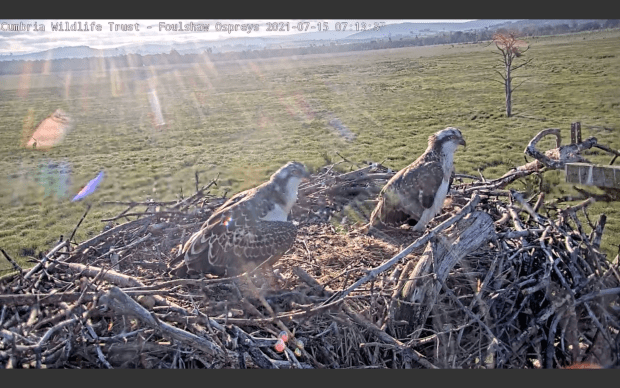
Oh, it is a bit like a bad joke. The camera at the Foulshaw Moss Osprey nest just started working. Both 462 and Tiny Little are on the nest. It is around 7am and they are watching for a parent to arrive with breakfast. Look at that nice necklace that Tiny Little has. Interesting. (TL is on the right) They are being kissed by diamond rain from the sun.

And when he wasn’t watching for a delivery, Tiny Little was flapping his wings dreaming of flying.

The more flapping he does the more the last tidbits of baby down disappear. It won’t be long Tiny but you were four days younger than everyone and you were behind in growth. You will get there just like Tiny Tot!

Hopefully that fish arrives! These two are both hungry. And it did. Tiny Little went over and ate some of the remaining fish and Blue 35 comes in and removes what is left (piece at the front) and will fly off with it.

The camera was still on the blink. I just checked and Tiny is fine. It is tea time and both Tiny and big sib are waiting for a delivery. It is so interesting that the big siblings know when to show up for food.

And last but never least, a lovely picture of Aran and Mrs G on the Glaslyn Nest together. This is a beautiful sight. There has been some bonding over the last few days. I was concerned that Aran was not in top form and Z2, Aeron, of the PC nest might want to take over this one. They are being kissed by golden raindrops, too! Mrs G doesn’t look like she is 21 years old, the oldest osprey in the United Kingdom. She is in really good shape. So sad that they lost their three chicks this year. That can cause issues but they seem to be a solid couple.

Thanks for joining me everyone. It is lovely to see the Golden Eaglet doing well today. That nest is a constant worry. And speaking of worry. The comments section on my blog seems to not be working all the time. It is like Tiny Little’s camera. Please feel free to send me an e-mail: maryannsteggles@icloud.com. I know that some of you had concerns and I regret that technology has caused you any worry. For the next while, til things step up in Australia, there may be only one blog per day. I hope to get more local Osprey news for you this coming week.

Thank you to the following for their streaming cams. This is where I grabbed my screen shots: Bucovina Golden Eagle Nest Cam, Cumbria Wildlife Trust and the Foulshaw Moss Osprey Nest, Cornell Bird Lab and NZ DOC, Mlady Buky, Port Lincoln Osprey Cam, Glacier Gardens Eagle Cam, Dyfi Osprey Project, Clywedog Opsrey Cam and Carnyx Wild, Byrwd Gwyllt Glaslyn, Poole Harbour Ospreys, and Scottish Wildlife Trust and Friends of Loch of the Lowes.