I needed to check my glasses

It took me a few minutes to comprehend what I was looking at. For several weeks now the osplets on the Port Lincoln Barge nest have been looking more like dinosaurs than fish eagles. But, this morning with the rain, their plumage looked much different. There was a strange white over the water so my first response was – the camera has a problem. Then the water was blue and the chicks were having their meal and well——.

Here they are lined up for the 12:36:06 delivery. Gosh, they had to have been hungry despite all those feedings yesterday. The weather must have hampered Dad’s fishing.

Still, there was no fighting. The chicks are all lined up as normal with Tiny Little right up at Mum’s beak! Oh, this kid really does love its fish.

So let us remember what we know about osplets plumage. When they hatch, they are covered with a very light greyish coat of down. You can see this in the image below.

It is 21 September. That was 22 days ago. Little Bob is 5 days old; the other two are 7 days old. Note the prominent dark eye line and the light soft down. Gosh they were so little! The hatchlings will keep this light coat of down from hatch until they are 10-12 days old, according to Alan Poole.

Oh, just look at Little Bob. So cute with that great big crop. He is the one closest to the viewer.

It is 5 days later. A darker charcoal coloured woolier down replaces that soft light grey down.

This is a huge period of change in terms of plumage. As the dark wooly down comes so do the feathers. The feathers show up first on the head and back and then on the body, later on the wings and tail. The feathers on the head and neck are a coppery-gold colour. This phase is called the Reptilian phase because they look more like their ancestors of 65 million years ago than the juvenile ospreys they are becoming.

You can see those coppery-gold feathers in the image below. The osplets are also growing at a fantastic rate.

The image below of Little Bob was taken three days ago. He was definitely in the Clown Foot stage! You can also see the dark grey wooly down as well as a few of the copper feathers on the back of his neck.

The image below was taken yesterday. You can see that the juvenile plumage is really starting to come in. It appears as little round tufts growing out of the blood quills.

In the image below, Little Bob is eating the prize fish tail. He is in his usual spot near the beak of Mum!

The image below was taken just a few minutes ago. I realize that feathers, like hair and paint, can appear darker when wet so use your imagination. It is as if a huge amount of juvenile plumage came in since last evening. Those feathers are really pushing out of those quills!

That is Little Bob at the very back. He is facing to the left and looking down slightly. He still has that spot and the white on the cere with the white swipe under his eye. Right now I can still find him but I might not be able to tomorrow.

In a blink. We will begin to notice considerable changes in their size along with the continued growth of feathers. The very last feathers to emerge will be the primaries and secondaries also known as the flight feathers. Only when all of their feathers have emerged from the blood quills will the osplets be ready to fly. We will know that when they really begin to exercise those wings and attempt hovering.

To give you an idea of the ‘look’ of the plumage and the size of the feathers I have included an image of Tiny Little, the third hatch of the Foulshaw Moss Osprey nest in Cumbria. This was taken on 24 August just before she migrated. Blue 463. Look at the length of her tail and the beautiful symmetry of her feathers. This is how the trio on the Port Lincoln nest will look by the time they are 50-60 days old.

As a reminder, Little Bob hatched on 16 September so he is now 26 days old. They have a long way to go but their plumage and their size are going to change right before our eyes. We really do not need to get our glasses adjusted! It is them, not us.

Beautiful Tiny Little Blue 463 survived and became the dominant bird on the nest. She is on her way to Africa. We hope to see her again.

I couldn’t wait to show you those miraculous changes in the plumage of the three. It really is miraculous. Thank you so much for joining me. I hope to see you soon. Take care.

Thank you to the Port Lincoln Osprey Project and the Cumbria Wildlife Trust Foulshaw Moss Osprey Nest for their streaming cams where I took my screen shots.

Bird World Happenings

For those of you hoping for a second hatch at Diamond and Xavier’s scrape box, it is not to be. Either the eggs were not viable or the second chick died trying to hatch. What we have, however, is one really healthy eyas whose eyes will open in the next few days and what a delight that will be. One healthy baby is just fine!

A video was made of one of the chick’s feedings. I cannot wait til it can see its parents! How wonderful.

It is pitching down rain in Port Lincoln. Mum and the three osplets are absolutely soaked to the core.

Mum is the best. She is trying as hard as she can to keep her three babies from catching a chill. Sadly, Melbourne’s weather says it is to have rainy periods through Saturday. I do hope the nest gets a chance to dry out for this incredible Osprey family.

To my knowledge no breakfast has come in yet. Mum is really tired and would appreciate the sleep. She has a smelly wet pillow!

It is an hour later and Mum is beginning to dry out just a little. Hopefully Dad will be in with a fish soon.

The Melbourne Four have already had three meals today – before 8:30! These parents are working overtime. It has to be exhausting. Look how big that little one is and how big its crop is. These four are also healthy and strong. Well done Mum and Dad.

Skipping over to the US, those who fell in love with Anna and Louis during their first year as Bald Eagle parents will be excited to know that the streaming cam is up and running. Here is the link to that nest at Lake Kincaid in the Kisatachie National Forest. Last year, Anna and Louis had one eaglet fledge, Kisatachie. It was wonderful to watch the parents grow into their roles as parents. One time Louis was so eager to provide food early on that he had 18 fish in a pile. I can sure imagine quite a few nests that would have liked some of that! Kisatchie grew big and strong and honoured this old Bald Eagle nest that had not had an eaglet hatch or fledge in 13 years. Incredible.

Cody, Steve and the gang are handling the chat to answer any of your questions.

I have not checked on the Black Storks from Latvia and Estonia for some time. There is some troubling news, perhaps. regarding Julge. This latest report is on Birdmap.

“In the morning September 8, Julge crossed border between Germany and Belgium and from next overnight there was not long distance up to France border, anymore. 20-30 km, depends in what direction Julge continues migration. But perhaps, there is time to improve energy sources? Interesting, if quarry is good place to find food for stork…. Anyway, Julge flew south in September 12. That means France is next country Julge visits. And stayed in a village called Saint-Hilaire-le-Petit. Nor dare not fear the closeness of people. He could be seen picking up insects from the lawn in the parking lot of the nearby Pontfaverger supermarket … But on the afternoon of September 21, Julge flew some 30 km in direction of Paris. On 22 September, Julge reached a stopover between Paris and Reims, where the latest data were received on the morning of 25 September. Next behaviour of Julge is unknown. A local newspaper is also involved in the searches of Julge.”

You can check the migration status of the Ospreys, Black Storks, White-tailed Eagles, Eurasian Cranes, and the Lesser Spotted Eagles here:

http://birdmap.5dvision.ee/EN

I also wanted to check on Karl II and his three children and on their migration status.

First is Udu. This is from the Forum: “It is now becoming unlikely that Udu will find/follow the ‘usual’ eastern migration route, I fear. All other options to cross the Mediterranean Sea are far more complicated, difficult and dangerous. Unless Udu will winter in southern Italy, or in Greece?” Udu is now in Kosovo.

Here is the map showing the three members of the family: Karl II, his daughter, Pikne, and son, Udu . They are making wonderful progress!

You can follow the Black Stork family whose nest was in the Karula National Forest in Estonia here:

This was just a quick check on the developments at the Orange Australian scrape box of Xavier and Diamond. I am certain that chatters and followers would loved to have seen two eyases hatch but, it was not to be. We can, however, wait with wonder to see the little one open its eyes and see its parents for the first time – and grow, thrive, and fledge. Send positive wishes for a fish to arrive at the PLO and for the rain to let up so the nest can dry.

Thank you for joining me. It will get chilly on the Canadian Prairies tonight – down to 4 C. It will certainly feel more seasonal. Take care everyone. See you soon.

Thank you to the following for their streaming cams or Forums where I took my screen shots: the Port Lincoln Osprey Project, 367 Collins Street Falcons by Mirvac, Charles Sturt University at Orange Falcon Cam and Cilla Kinross, the KNF Bald Eagle Cam, the Latvian Fund for Nature, the Estonian Eagle Club, and BirdMap.

Checking on Chicks

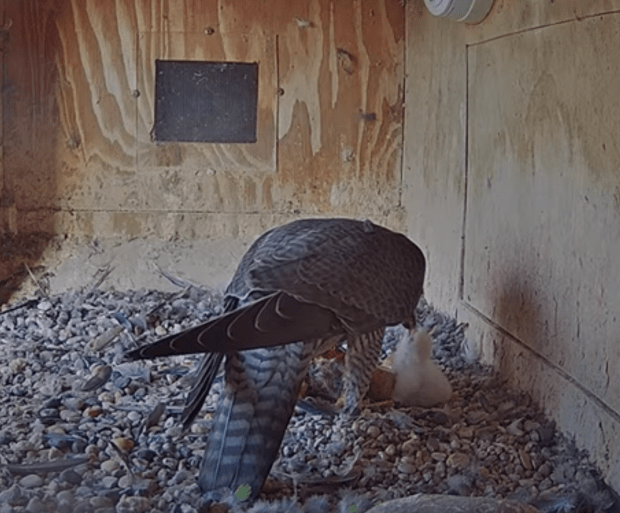
There was a lot of chatter over the Melbourne Peregrine Falcon scrape at 367 Collins. The concern was because the Mum had not been ‘seen’ since 19:06:24 when she left the little ones after feeding them.

The chicks at Melbourne are enormous! I honestly can’t even find the small one anymore. Underneath the fluffy down that remains there are pin feathers coming in and if you look closely, those sweet pink little beaks are turning into a rather adult looking beak.

There is no need for concern for Mum. The problem is that the eyases are simply too big for her to brood anymore because there are four of them. Can you see where Mum is?

The image on the left is a week ago. The one on the right was yesterday.

I haven’t reported on Port Lincoln Ospreys for a day. These were the feeding times for yesterday: 6:52, 10:02:43 (small), 10:43:15, 14:43:39, 14:55:50, 16:11:51, 16:23 (mum caught this one), and another fish delivery somewhere around 17:59:58. It was hard to differentiate when the osplets started eating one fish and began on another during the afternoon.

The Mullet that came on the nest at 10:43:15 was still alive and Mum flew off with it, killed it, and returned at 10:44:30. When Mum brought the 16:23 fish onto the nest, part of the fish that dad had brought earlier was still there. This could have been the 17:59 feed. It is not clear. What is certain is that the chicks had massive crops throughout the day. With Mum fishing – and she seems to catch the bigger fish these days – the nest is eating well. The supplementary fish she brings in is making a huge difference to all including Mum who also needs to eat. And Dad.

One thing that I found very interesting was our dear Little Bob. Later in the evening on the 10th, the Middle sibling had caused a bit of a spat between Big Bob and Little Bob. Middle Bob seems to do this and then it ducks to get out of the way. Little Bob was not having any of it and well, we might begin to believe that Little Bob is the ‘boss’ of the nest. This was the second time that I have seen Little thwart any attempts by Big to be the dominant one in the nest. (The other was awhile ago0. I say this because Little Bob took the fish tail at 10:02 yesterday and ate it with no problem. The fish tail is a bit of a prize in an Osprey nest.

These are just some shots from the various feedings. Notice that they all line up and eat very civil!

Little Bob has the fish tail!

Little Bob had no difficulty eating the fish tail. Well done, number 3.

By the time the last fish arrived, many were so full they couldn’t even think of eating much more. Mum had a really nice feed. How grand!

Diamond and Xavier’s Only is growing well.

Today will sort out if there was a pip or not in one of the eggs. It is simply not clear. For the chick to survive, it would need to hatch today. Diamond rested better last night and wasn’t shuffling the eggs around so much. Perhaps we will have another Only Bob like Izzi last year and that is just fine. Cilla Kinross says they have never had three hatch at this nest despite three eggs being laid. In many ways raising one is so much less stressful than four. The Melbourne parents have to be worn out!

Everything is fine for the nest and the two scrape boxes. I will check in with the White-Bellied Sea Eagles later today. I understand that they are fine but that the Pied Currawong continues to be a nuisance. The Bald Eagle couples are restoring nests from last season and the Albatross for the upcoming breeding season are landing on Taiaroa Head. The world is working as it should be.

Thank you so much for joining me this morning. Take care. See you soon.

Thanks to the following for their streaming cam where I took my screen shots: 367 Collins Street Falcons by Mirvac, the Port Lincoln Osprey Cam, and Charles Sturt University Falcon Cam at Orange and Cilla Kinross.

Mom landed a whopper for the PLO chicks

The female at the Port Lincoln Osprey nest was not gone two minutes before she landed back at the nest. She was wet. It was 16:30:28. She had caught a massive Leather Back for her and the chicks.

The Leather Back has many names including Brown-striped Leatherjacket, Donovan’s Leatherjacket, Southern Leatherjacket, and the White-banded Leatherjacket. They have very small mouths with beak-like teeth. Their skin is often rough feeling – a bit like sandpaper, they say. There is a single serrated spine. There are 20 separate species of Leather Backs in Australia ranging in size from less than 1 kg to 3 kg.

“Leather Jacket” by Anna Barnett is licensed under CC BY 2.0

Here is Mum landing back on the nest with her catch. Two of the chicks are watching her.

They put their heads down as Mum finishes the landing. It seems to be an automatic response – heads down when someone approaches the nest. You can just see the head of the fish she has in her talons at the bottom right.

Mum returns to the nest wet. Dad never appeared on the nest so it is clear she is the one who caught that nice big fish. Yeah for Mum!

In the image below, the chicks have been eating for 23 minutes. There is still lots of fish left.

Little Bob is the one up at Mom’s beak. Big Bob has eaten and is already passed out.

Just look at that crop! And, of course, you know who is still up there even though his crop is popping. Yes, it is Little Bob!

Mum and the chicks ate from 16:33 to 18:05:25. It was a glorious feast that Mum provided. She certainly got to eat her fill along with the three babies.

I was reminded of the Mum at the Achieva Osprey nest in St Petersburg, Florida. Diane started fishing. Those actions saved the life of Tiny Tot Tumbles. Diane was an expert at catching catfish. There was no threat to the life of Little Bob here. These three have been doing very well. They are now 27 days old (Big and Middle) and 25 days old for Little Bob.

Many times the female does not provide food for the nest until after the osplets have fledged but more and more I am seeing them going off and topping up the day’s deliveries. Blue NC0 at the Loch of the Lowes is a really good example. Iris demonstrated she could really catch fish, big ones and haul them in to the nest. Louis was often hoping she would share!

I wonder if Mum will continue to bring fish to the nest? or did this Leather Back just catch her eye or should I say talon?

It is a grey cold rainy day on the Canadian prairies. We need the rain! The Dark-eyed Juncos are eating the millet seed regardless and this morning there was a group of Starlings in the yard. I won’t be going out to check on the Wood Ducks today!

Thank you so much for joining me. Have a fantastic Sunday. See you soon.

I am grateful to the Port Lincoln Osprey Project and their streaming cam where I took my screen shots.

Dad brought in a whopper

At 8:56:34, Dad brought in a massive fish (despite having eaten his fair share) to the Port Lincoln Osprey Nest.

The image below shows the size of the fish a little better despite much of it hidden under mom. Imagine that the top part is up at her beak where she is feeding one of the chicks to get an idea. Little Bob is in the middle. You can see the white lace on his cere and the black circle on top of his head.

Dad returned at 9:11:33 to see if Mum was finished feeding the chicks. She wasn’t and she did not let him take the fish.

The trio lined up again. Big Bob, who had eaten first, is full and is moving away from the feeding line. She is letting the two younger siblings have their share.

Middle and Little are right in there. Their feathers are growing so quickly. Look along the edge of Little Bob’s wing. They are beginning to look like fringe.

Oh, goodness. Dad is rather anxious this morning. He returns a second time at 9: 28:20.

Mum is still feeding Middle and Little Bob. Oh, and look. Big Bob is waking up again. Is he ready for another round of fish?

You can see that there is still lots of fish left. The chicks have now been eating for 34 minutes and it looks like half the fish is left. Dad is really having a close look. Mum does not give the fish to him, again. She seems to have decided that he is not going to rush her today.

Ah, Big Bob is back up at the end of the line wanting some more. This is such a polite nest. Big Bob does not push his way to the front of the line, she waits.

By 9:29, Mum decides to move the fish around to the other side. Maybe she thought Dad was going to take it. She continues to feed the chicks and herself.

Despite the fact that the chicks have moved so that they can pass out in their respective food comas, Mum continues to feed Little Bob.

Little Bob is ‘stuffed’ and has turned away from any more bites of fish. Mom is doing a good job eating that nice fish near the tail. She needs to eat, too! Dad seems to have nodded off waiting! In the end, I do not think Dad even got a nibble of the tail. We have to remember that he did have a big chunk before he brought the fish to the nest.

The trio and Mum finished off that extra large fish in 47 minutes. Amazing.

Dad brings another fish to the nest at 13:29:38. Everyone is fed and it is not even the middle of the afternoon. This is a good example of how the feedings change. When the three were wee, they needed more feedings with less fish at each one. Now they will eat much more fish but, there will be less feedings. They are really, really growing. Little Bob is 24 days old today while Middle and Big are 26 days old.

Xavier watches from the ledge of the scrape box as Diamond feeds their wee babe. So far there appears to be no pip or crack on a second egg. It is unclear if there is even a pip.

It is the middle of the afternoon and Xavier is again resting on the ledge. He was seen limping and he is probably resting that leg. Instead of Starlings and Parrots, Xavier has been bringing in pigeon which is a much larger prey item. He might have strained his leg when he was hunting.

I also wonder if he can hear the second chick? or if he just wants to be there with Diamond in the scrape? or wants to brood the chick and incubate the eggs?

The waiting must be frustrating for these two. Big Bob (or Only Bob) is poking its head out from under Diamond to the right of the egg. Cute.

At the nest of the White-Bellied Sea Eagles in Sydney’s Olympic Park forest, a Pied Currawong will not leave WBSE 27 and 28 alone. It has been harassing them on and off all day. It is the Pied Currawongs who are intent on chasing the little sea eagle fledglings out of the forest. Normally, eagles fledge and return to the nest for the parents to feed them while they strengthen their flying skills. Many will return to the nest for feedings for up to a month. If they are rushed away, the ‘map’ or return to the nest might not be imprinted in their memory.

27 and 28 are smart. They can hunker down duckling style and watch but the Currawong cannot harm them. These birds can knock them off if they were standing on a branch or injure them if they were standing up.

These two will be branching so soon and then fledging. They can walk and stand and both are self-feeding. We are entering the 11th week. From hatch to fledge for the Australian White-Bellied Sea Eagles is 80-88 days. The median is 83.1.

Here is a video of WBSE 28 stealing the prey from 27. Fantastic!

At the 367 Collins Street Peregrine Falcon scrape, Mum has left the scrape box and is off for a break and to retrieve prey for the eyases. Look at how much room they take up today!

They look like a large white Persian cat if you squint.

Time for your mid-afternoon pigeon everyone!

Dad had it prepared and ready for Mum to bring and feed the youngsters.

Yummy.

The oldest two are getting more hawk like in their appearance.

Except for the Pied Currawong’s harassment, all of the nestlings are doing very well. It is, indeed, a pleasure to be able to watch them grow from hatch to fledge. How fortunate we are!

Thank you for joining me. Take care everyone. See you soon.

Thank you to the following for their streaming cams where I took my screen shots: the Port Lincoln Osprey Project, 365 Collins Street Falcons by Mirvac, Charles Sturt University Falcon Cam at Orange and Cilla Kinross, and Sea Eagle Cam @ Birdlife Australia Discovery Centre.

Saturday in Bird World

There is still time for you to put in your count for the October Big Bird e-Bird Count. You have until midnight as far as I know. In one hour we had 37 Dark-eyed Juncos, 3 Blue Jays, 3 Harris’s Sparrows, 1 American Robin, and a host of House Sparrows. There were also 3 grey squirrels and 1 red and then Little Woodpecker came when the new suet cylinder went up. I wonder if they sit and watch? or how good their noses are.

Everyone of them seems to know the minute the feeders are full and once the suet cylinder is finished when a new one is put in place. It is much cooler than it was a few days ago and the sky has been a light grey all day. I wonder how long the Dark-eyed Juncos will be with us?

There is, as far as I know, only one hatch at the Peregrine Falcon scrape box in Orange. The little one has been fed several times already. It gets full with 3 or 4 nice bites of prey.

And then it will pass out quickly in a food coma! It is quite frightening the first time you see this happen, especially with a newly hatched chick.

Yesterday I made a video clip of one of the feedings at the 367 Collins Street Peregrine Falcon Scrape.

The Collins Street Kids are really growing. The two larger ones now jump a bit to get up to Mum’s beak for the prey.

There was a beautiful golden glow on Mum at the Port Lincoln Osprey Barge this morning. Viewers got a treat. The cam operator showed the Calypso Star I taking clients out for shark cage diving. You might know it but it was that business that allowed the Port Lincoln Osprey Barge and streaming cam to come into existence. Thank you Calypso Star!

It is 8:23 just now and the kiddos are still waiting for breakfast. They will certainly not starve! Never. Last night when they went to sleep their crops were bursting.

Once of those funny crop shots when they lean back to preen. Look how big that is. Each of them was the same.

Here’s Little Bob! Look at that crop and then look at his feet!!!!!! I love Clown Feet Time.

I am learning just to keep quiet on bird chats. A couple of days ago, a dear woman, who has been quite ill and is recovering, was more than put down because she suggested that birds have emotions. There is a lot of research on this subject. For the next week or so, I will post some academic/scientific papers on this topic. Some will be shorter and some longer. The one today concerns two particular emotions: fear and frustration. It is titled, “Avian Emotions: Comparative Perspectives on Fear and Frustration.” It was published in Frontiers of Psychology in December 2018.

https://www.ncbi.nlm.nih.gov/pmc/articles/PMC6344452/

I grew up in Oklahoma (home of the Five Civilized Tribes before it became a state) where there are strong beliefs about animals and birds. They serve as messengers of the Spirits of the Indigenous people. Some offer warnings – others are there to help. Here is an interesting article birds as symbols.

We are looking for a hatch for Xavier and Diamond today. It might not happen. If it doesn’t, it is just fine. Those who watched their scrape last year certainly came to love their only hatch, Izzi. He was quite remarkable.

Thank you for stopping in today. Remember to turn in your bird count if you haven’t already. Take care. See you soon!

Thank you to the following for their streaming cams where I took my screen shots and video clips: the Port Lincoln Osprey Project, 367 Collins Street Falcons by Mirvac, and Charles Sturt University at Orange Falcon Cam and Cilla Kinross.

And now for some cuteness…

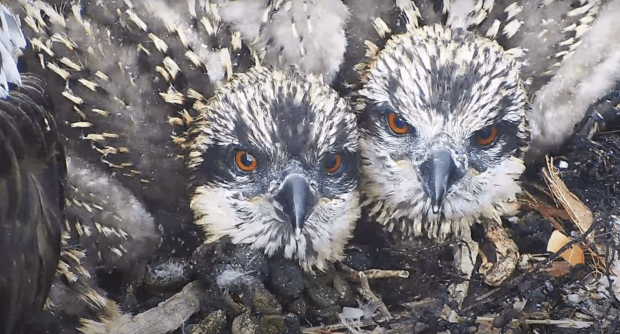
As soon as you read that title, I bet you thought I was going to bombard you with more floofs, cute little Peregrine Falcon eyases. Not today. Surprise! The Port Lincoln Osprey Barge cam operator gave everyone a present by zooming in on the adorable faces of the osplets.

There are several interesting things about these close ups. First, notice that the chicks still have remnants of their egg tooth remaining at the tip of their beak. Can you see the white dot? That will grow and wear off. Ospreys must keep their beaks clean and sharp! You can also see the dark charcoal down that is actually underneath the feathers. It remains while the white fluff disappears. I cannot see any quills but the feathers are growing out of quills that contain blood. Feathers have to have blood to grow. For those who have been reading my blog regularly, they will know that I have carried on and on about how to identify Little Bob. Because he is a third hatch Osprey, I have a special interest in him and his survival and future success so I have to be able to recognize him. So, I discovered that his cere, the part above the beak but before the feathers, has a lot of white. It looks like someone sloshed white paint. That white continues more under Little Bob’s eyes, too. Big Bad Bob has a smooth black cere with little white. As it happens, Big Bob and Little Bob hang out together. So on the left is Big Bob and on the right is Little Bob. Throughout the images below, Big Bob will remain on the left and Little Bob will be on the right. The portraits were snapped off the streaming cam every 5 seconds. There are subtle differences in their expressions.

Oh, just look at that face staring directly at us! So cute.

The angle of Little Bob’s head shows you all the white on the cere and under the eye. It is a degree more than the other chick.

Oh, how I wished Little Bob had looked up like Big Bob earlier.

They are adorable. Several of those will become fridge magnets. Awhile ago now, my ‘eagle expert’ that I consult with my questions, told me that they always make magnets out of their favourite juveniles for each year. I started doing it. It is a super way to wake up in the morning when you open the fridge and say hi to all of them!

There is the following thinking in raptor circles. The first theory is that two females never hang out together. Female raptors do not get along. There is the further belief, since medieval times, that the third, the tiercel, is always a male. Additionally, there is also a belief that the first hatch is a female. If all of those things are true, then Big Bob is a female and Little Bob is a male. In the end, of course, only DNA tests and an egg prove one way or the other. However, since these three will get satellite-paks and will be banded, I am assuming that they will also determine the gender just like was done with Solly and DEW last year. You do not want to band the chicks too early but, the rule is before they are 35 days old. After that, the stress and the approach by humans might force an early fledge. Any earlier and their legs would not be the size of an adult bird and the bands might prove to be problematic.

Tomorrow is the October Big Bird Day. You can help. All you need to do is look out your window for at least 15 minutes and count the birds that you know. You do not have to spend all day and you don’t have to travel if you don’t want to or can’t. Here is the information to sign up. The information helps track declining and increasing population numbers, locate migrate waves, check on how climate change is impacting the birds during migration, etc. Everyone can join in. It is free and it would be very helpful if you did a count. Go to this link for all the information that you need.

https://ebird.org/news/october-big-day-2021

There is still only one hatch for Xavier and Diamond. And at 367 Collins Street, Mum finally let dad feed the kids.

It is easy to look at the scrape and think it is a mess. Falcon experts say that couples look for a scrape box where there is a lot of ‘ps’ markings everywhere as they know that means it is a prey rich area.

After Dad fed the little ones, Mum came in with a huge fresh pigeon and fed them again! No one goes hungry on a Peregrine Falcon scrape.

Thank you for joining me today. I hope you enjoyed the close ups of the Ospreys. I have to admit that out of all the birds of prey I am extremely partial to Ospreys, falcons, and hawks. Take care of yourself. Have a lovely weekend. See you soon!

Thank you to the following for their streaming cams where I took my screen shots: the Port Lincoln Osprey Barge and 367 Collins Street Falcons by Mirvac.

First Feeding at Orange

Diamond brought part of a pigeon into the scrape box at 13:37 to see if the eyas was ready for its first feeding. It was not. The little fluff ball continued to sleep, all tired out. The egg was full of nutrients and the chick does not need a feeding til tomorrow morning. Still, Diamond will continually check and when the chick sits and opens its beak by instinct to be fed, she will know it is ready for food.

Diamond first went to the corner in the image below where she considered leaving the pigeon. Then she went to the other corner.

Eventually she decided to fly out with it.

She returned in ten seconds and immediately went over to brood the chick and incubate the two remaining eggs. The eggs were laid on 31 August at 10:40, 2 September at 20:55, and the last on 4 September 6:28. Diamond started incubation with second egg and then hard incubated with the third.

Last year Diamond and Xavier also had three eggs. One did not hatch. The second hatchling was not strong and died and Izzi, that beautiful character, was their only fledge. Xavier is an amazing hunter and this family can certainly provide for three.

Half an hour later, Diamond decides to try and feed the eyas again. She gathers the prey from the left corner pantry. I have taped a portion of that first feeding for you. This chick is very strong. It is approximately 7 hours old. It fell over and lifted itself back up. I was amazed at how long it held its head relatively still and its beak open. This first hatch definitely had some nice bites of the prey.

Just look at that little one. So happy for Xavier and Diamond.

Over in Port Lincoln, Dad brought a fish in at 10:05:13. All three osplets lined up to eat. I noticed several times that Mum fed them in sitting order. It was quite interesting. Food security remains in the positive. It is simply grand. Little Bob is now 22 days old. The other two are 24 days old.

In the image below, the chick at the back has a nice crop from the earlier feed. You can see it clearly.

It is definitely getting difficult to tell who is who unless you can get a glimpse of their beak. Little Bob has on the left side of the cere a kind of white netting pattern.

Dad brought in another fish at 14:17.

Now looking carefully, see the little osprey’s head in the middle of the image below. That is Little Bob. I want to point him out to you because you can clearly see that whitish netting on his cere. It sometimes looks like someone took a white paint brush and went over the cere and under the eye of this third hatch. You will also notice that Little Bob is being himself – getting to the front of the table where Mum is feeding and never taking his eyes off that fish until he is full.

Little Bob is in a very good position to get a lot of fish.

You might also notice that spot in the feathers between Little Bob’s eyes. That pattern might not stay there but for now, it is also helpful in finding him in the group.

In the image below you can see those two indicators clearly.

Little Bob has quit eating. There you can see him on the far right. Just look at that crop. Talking about ready to pop. I think that Mum fed Little Bob most of the fish in the beginning. He should really sleep well. Dad should be in with another fish in a couple of hours! Oh, these three are so well fed and behaving so nicely.

So far, the feedings at Port Lincoln have been at 07:49, 10:05:13, 11:26, and 14:17. That is four and it is only the middle of the afternoon. Well done, Dad.

It is time to call it a night. So happy for Xavier and Diamond that their first hatch is so strong. It ate so well and so did our little Ospreys at Port Lincoln. As I sign off the day continues to look good in Australia. Oh, and I almost forgot. The Superb Fairy Wren was voted Australia’s Bird of 2021. That is an image of a male Superb Fairy Wren below. That plumage is amazing. During breeding season, the electric blue plumage becomes iridescent. They are common across Southeast Australia and are known to sing to the chicks when they are in the egg – the chicks recognize the parents by their voice when they hatch.

“superb fairy wren male” by Ralph Green is licensed under CC BY-NC 2.0

Over 400,000 votes were cast this year. The Guardian said, “The superb fairywren has been voted bird of the year for 2021, narrowly defeating the tawny frogmouth in a nail-biting finish.” Here is the story:

https://www.theguardian.com/environment/2021/oct/08/superb-fairywren-crowned-2021-australian-bird-of-the-year-winner-in-hotly-contested-vote#:~:text=The%20superb%20fairywren%20has%20been,during%20the%2010%2Dday%20competition.

Take care everyone!

Thank you to the following for their streaming cams where I took my screen shots and video clips: The Port Lincoln Osprey Barge and Charles Sturt University Falcon Cam and Cilla Kinross.

A Red Rump Parrot for Diamond!

The wait is now over. The first of the three eggs of Xavier and Diamond has now hatched. That was at 04:56.

In the image below you can catch a glimpse of the little furry ball and the shell that Diamond has moved.

At 06:42, the eyas was much more dry and fluffy.

But where is Xavier? He hasn’t been in the scrape at the usual time. There he is caught doing a fly by at 07:44. Whew.

Diamond will be very protective of the eyas for the first several days when it is so vulnerable. We continue to watch and to hope that all three eggs hatch and that there are three healthy chicks that fledge for this adorable couple.

Everyone joked that Xavier was out hunting for a very special breakfast for the chick and Diamond and Xavier did not disappoint. He delivered a Red-rumped Parrot! Remember. The main diet of the Melbourne falcons is pigeon while it is other birds in the rural areas. I am told that parrots are as plentiful in rural Australia as the pigeons are in the cities.

Diamond is taking it from Xavier. She will pluck it but she decides not to try and feed the newly born eyas but, instead, to take a break herself. Indeed, the eyas has had the advantage of the nutrients in the egg and does not require feeding right away. Look how tiny it is between those two eggs. Meanwhile, Diamond is going to enjoy her parrot breakfast. Thank goodness it is not a Starling – Diamond hates Starlings.

This is a male Red Rumped Parrot. They are considered to be highly intelligent and are often sought after as pets as they have a very pleasant voice. They are also called the Red back or Grass Parrot. They are large populations of them in Austral-Asia.

A nice image of the new family! Xavier gets to see the new baby!!

The little eyas is a little wiggly but showed no signs of interest in food. It was hard work getting out of that shell and that was only a couple of hours ago. It must have been exhausting work. Diamond continues to pluck the parrot but takes it away from the scrape to eat it.

It is hot in Australia. The chicks in Melbourne have been fed and Mum is being the umbrella. It will be 21 degrees C in Melbourne today.

Just look at how much they have grown! Look carefully at the one sitting up. See the shiny spot with no feathery down? That is the crop. It is full. When the eyases sleep on the gravel and wiggle around, the crop is hard and the feathers come off. It is nothing to worry about.

The camera has been acting up at the Port Lincoln Osprey barge. The trio of nestlings had a large fish arrive this morning.

Everyone was still eating 25 minutes later. no doubt they will all be full and as you can see they are lined up in their typical manner. Look at the one on the right. Notice that there are more feathers coming on the top of the wings and on the back. That is Little Bob in the middle.

All of the birds are doing well. It is exciting to have a new chick to watch grow and hopefully those other two eggs will hatch quickly. Last year Diamond and Xavier had one chick, Izzi.

The voting for Australian Bird of the Year 2021 has closed. The Peregrine Falcons made it to the final voting. The winner will be announced at mid-day on 8 October in London.

Thank you for joining me today. Take care. See you soon.

Here is the link to the streaming cam in Orange, Australia where you can watch Xavier and Diamond:

Thank you to the following for their streaming cams where I took my screen shots: the Port Lincoln Osprey Cam, Charles Sturt University at Orange and Cilla Kinross, and 367 Collins Street Falcons by Mirvac.

Waiting for hatch at Orange

We are all waiting with Xavier and Diamond for the first (or all) of the eyases to hatch in the scrape box at Orange, Australia. There is, perhaps, a pip. Fingers crossed. BTW. The Peregrine Falcons made it to the final vote in the Australian Bird of the Year. We now wait to see who wins.

The chicks on the Port Lincoln Osprey nest certainly did get another big feed at 16:28. A small fish tail was brought on the nest at 19:57 but everyone had a big crop. Mum got off the nest for a bit a little later. Everyone is great. As I continue to say, all three chicks are doing well and I sure haven’t seen any of the rivalry of past years.

The chicks are still eating the whopper of a fish brought in at 14:49. This is going to really fill them up. It is also late in the day.

Some are still eating at 15:23.

Dad is still on the nest after delivering the 16:28 fish. You can see that the chicks still have large crops from the feeding they just finished.

This fish will really top them off.

There was certainly not a lot of fish left on that tail that Dad brought in. It does not matter. I hope that Mum got some of it. The chicks are definitely full and will be fine til tomorrow.

I am always looking for great videos by the people that advertise for the various camera companies. The reason? Their footage is simply the very, very best. So when I spotted Mark Smith’s video about the migration of the mullet off Florida, I knew there would be some great Osprey images. I would also like to think that our very own Tiny Tot, Achieva Osprey’s miracle third hatch survivor in 2021, might be out there during that annual mullet run filling her crop. Here is the link. It is about 8 minutes long and worth all of it.

Enjoy those wonderful shots of Mark’s.

Thank you for joining me this morning. All of the nestlings in Australia are doing great. I have one last image to leave with you. One of the FB members posted this gorgeous screen shot of the 367 Collins Street Falcon faily. I am reposting it here because it is priceless and a lovely way to leave our blog. Take care everyone.

Thank you to the following for their streaming cams where I took my screen shots: the Port Lincoln Osprey Project and the 367 Collins Street FB Page.