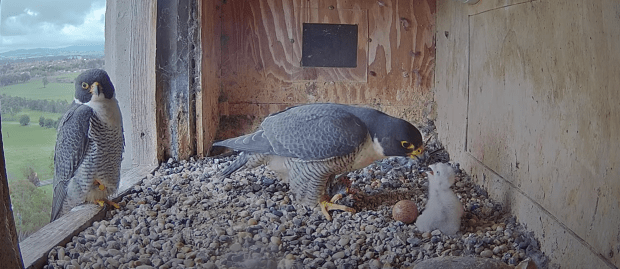
I haven’t checked to see if Cilla Kinross posted the total numbers for the names that people voted on. This morning I woke up in Canada to discover that the little one of Diamond and Xavier is to be called Yurruga. I am so glad. It means ‘sunny’. And we hope that this little one brings lots of light and happiness to all!
Here is a video that was posted of one of the feedings. You can hear how loud Yurruga is. She will rival Izzi (or he). Just adorable. Started to get pin feathers and is rather itchy. Notice how Yurruga tries to grab the pigeon when it comes in and watch her stand on her legs being fed. This is one strong and healthy chick.
If you noticed the Collins Street streaming cam was down, it is now back up. This seems to be happening more and more with cameras going off line in Australia (and elsewhere). I wonder if the weather plays a part????
This is an image from the late feeding yesterday for the Port Lincoln Ospreys. Just look at them! The size of them. Now look at Mum. Incredible growth.
The following was posted on the Eagle Cam FB page. The 3:30 pm update is very promising. Mobile means they are flying. I was quite worried that 28 would have issues because of their first notice of it being on a low branch. Send positive energy to these two. I hope that they find the area of the river where their parents fish and the parents can feed them there til they are stronger fliers. Oh, it would be so wonderful. Beautiful birds. The situation with the Currawongs every year is just tragic. Hopefully these two will beat the odds!
If you are just reading this WBSE 28 fell off the nest trying to land on a branch by 27 yesterday at 07:22. WBSE 28 flew to the cam tree at 8:33:56 after being harrassed by Pied Currawong. This posting is good news. I hope that some of the locals will get some images of them with their parents near the water.
Take care everyone. This was meant to be a very quick notice telling you of Xavier and Diamond’s chick – whose name is Yurruga. I wonder how many will call it Sunny?
Thanks for joining in!
Thank you to the following for their streaming cams where I took my screen shots: the Collins Street Falcons by Mirvac, the Port Lincoln Osprey Project, and the Charles Sturt University Falcon Cam and Cilla Kinross.
Tomorrow I am going for the annual tour at our local wildlife rehab facility, Wildlife Haven. Every year they do this as a fund raiser but it is a good way to get a really good look at the varied and in-depth work that these people do. There doesn’t seem to be an animal or bird too difficult to try and help mend. I do not know if they will allow photographs but, I will try and take some to show to you.
This video was posted. It is the little ‘waiting to get a name’ eyas in the scrape box of Xavier and Diamond on the grounds of Charles Sturt University in Orange, Australia. Prey items come one after another. The chick already has a fine crop but will be fed more. But, turn the volume up and listen to this little one. Last year’s only chick, Izzi, was know to be such a character and part of it was his very loud voice. Everyone is beginning to wonder if this chick will be even louder than Izzi!
Have a look. It is such a cute clip.
One of the things that you can see are the chick’s ears. Look closely. It is also scooting around, and there are some pin feathers coming. This chick is, of course, doing very well under the excellent care of Xavier and Diamond.
Clearly as Dr Hurley notes, an Only chick gets all the food!
For those fans of Anna and Louis whose Bald Eagle nest is in the Kisatchie National Forest in Central Louisiana, both eagles were working on the nest this evening around 18:54.
Wrestling with sticks seem to be what all the Bald Eagle couples are doing now – as well as trying to keep any would be intruders out of their territory.
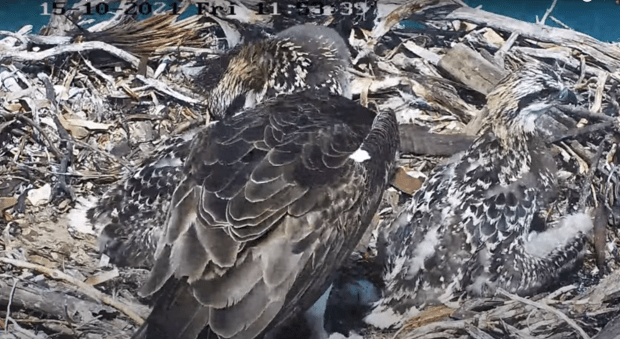
It wouldn’t be right not to go and check on those gorgeous osplets at Port Lincoln before I sign off. They are just simply so beautiful in their full juvenile plumage. Here is the trio looking out probably seeing the parent flying in with their lunch.
That lunch arrived a few seconds later.
Everyone lined up and as I write this, they are still eating.
This is a reminder that Xavier and Diamond’s chick needs a name! This is the information as Cilla Kinross posted it under the information for the streaming cam:
VOTE FOR NAME FOR THIS CHICK You have until Friday 5 pm 22nd October to vote. You can only vote once. Note that multiple votes will be deleted. All names are in the Wiradjuri (local indigenous) language and relate to weather terms: cloud etc. Here is the link: https://forms.gle/iPQhxDCLtEh19jp38
Cilla Kinross, Charles Sturt University
I want to note that Cilla would like everyone to cut and paste the link into their own browser. So the time for voting is closing quickly. Why not join in?!
I will not be posting my newsletter until tomorrow late afternoon or evening depending on the tour at the wild life facility. Fingers crossed I can get you some good inside views of what goes on when animals come in needing attention.
Thank you for joining me. Please take care. See you soon.
Thank you to the following for their streaming cams where I take my screen shots: the KNF Bald Eagle Cam, the Charles Sturt University Falcon Cam at Orange and Cilla Kinross and the Port Lincoln Osprey Project.
I am sorry to be so late in sending off my newsletter today. It was not intended and if you have worried, I apologize. The day wasn’t meant to be so busy but it simply turned out that way with a last minute trip to get 200 lbs of bird seed tacked on to the end.
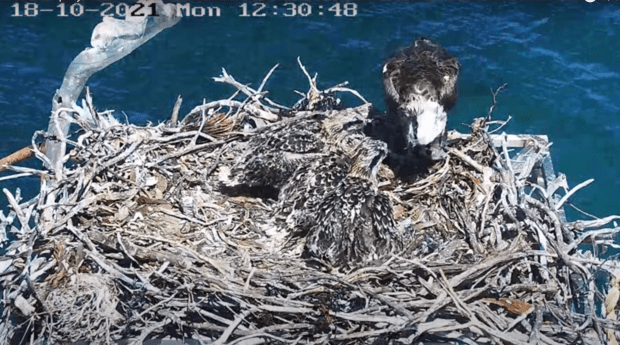
Just look at these beauties. Overnight the three osplets on the Port Lincoln Barge turned into juvenile beauties. Those are serious feathers! Just look, all pushed out from their quills, perfect layering with that gorgeous white line and tip of the juvenile. Each one also seems to have grown a perfectly white beard over night. Their eyes are also that dark amber colour that will, when they are adults, turn to yellow.
Gosh. I can hardly take my eyes off of them. They are stunningly beautiful. If I could look like a bird it would seriously be a juvenile Osprey.
Mum was looking out over the water hoping that Dad was off fishing – and he was. He landed on the nest at 7:46 with a breakfish for everyone.
Little Bob, the closest to Mum’s beak and the front, is 34 days old today while the two older siblings are 36 days old. There is a ways to fledge – thank goodness, but, for now, we can enjoy how grown up they all are and how wonderful this Eastern Osprey nest has been this year. It has brought nothing but tears of joy! It goes to show how having chicks that hatch close together and plenty of food deliveries are a great combination to success.
Dr Victor Hurley heads up the research on the Melbourne Peregrine Falcons. He has been doing this for many years. He wrote a very good article about what the differences are for the two falcon nests in Australia with streaming cams – 367 Collins Street Falcons in Melbourne and Charles Sturt University in Orange and Cilla Kinross. The 367 Collins Street scrape box had 4 hatches this year while the Orange scrape box of Diamond and Xavier had one. So what is the difference to the falcons? is it better to have one or four? Dr Hurley believes for the falcons it is better to have four eyases and be run off your feet feeding them because the chance of one of them surviving to adult hood is greater than a scrape having only one chick. He believes, however, that it is beneficial to the chicks to be the ‘only One’ instead of one of four in terms of food resources. Still, others believe that the stress on the parents to feed four instead of one is immense but, we are looking at it from the chick’s perspective. Anyone watching the scrape boxes just know these growing chicks just want food!
While Dr Hurley did not address other issues, I wonder if being part of a larger hatch group helps in terms of understanding how to live in the real world where there will be pressure from others. Maybe it doesn’t matter? Last year, the male from the Collins Street scrape used to come into the nest and pluck a freshly caught pigeon. It was a terrific mess but those three girls could sure pluck a bird – and do it fast before they fledged – a skill essential to survival. Catch, pluck, eat, and go! I beg to be corrected but it seemed that Izzi had some difficulty with plucking even after an age when he should have had his own territory. So I wonder if they learn quicker and faster as part of a group??? and having plucking imprinted on them so many times?
The little eyas at Orange is 13 days old today while the Collins Street Four are starting their third week. Each is right on track in terms of development. Indeed, the little Orange eyas has been scooting around on its tarsus for a couple of days now and is very strong and healthy. – slightly ahead of the curve The plumage is changing radically on the Collins kids and they are standing and walking.
Kate St John did a wonderful blog on the developmental stages of the peregrine falcons. I want to share that with you.
Dad is trying out larger pieces of pigeon on the four. The prey came in one after another the other day. They are losing the soft down around their eyes and getting the juvenile feathers and they are also getting their wing feathers.
I am afraid that I got a little carried away with the images of Xavier and Diamond’s eyas. Not only is it loud – soon to rival Izzi – but it can also make the cutest faces.
They are all doing well. Last I checked the Bald Eagles in the United States are all still working on their nests. There is some intrigue at the Captiva Nest and the speculation as to who the male will be this season. Joe is gone and it appears Martin has been ousted also. Meanwhile, Harriet and M15 along with Samson and Gabby are steady as you go! To my knowledge there has not been a fledge at the WBSE nest in the Sydney Olympic forest but this could happen any time. And – for the lovers of Jack and Diane – it seems that the couple might be back on the Achieva Osprey nest in St Petersburg together. They have a lot of nestorations to do!
Thank you for joining me for this quick catch up. I will be shaking my head and smiling at just how beautiful three juvenile ospreys look in the PLO nest. Take care all. See you soon.
Thank you to the following for their streaming cam where I took my screen shots: Charles Sturt University at Orange Falcon Cam and Cilla Kinross, the Collins Street Falcons by Mirvac, and the Port Lincoln Osprey Project.
It is a grey and windy day. As the weather channel promised, our summer heat wave in October seems to have come to an end (for the moment) with the arrival of single digit temperatures. The recent rains have caused the ground and old tree stumps to come alive and the sparrows and thrashers are thumping the ground having a good old time. It reminds me – continues to remind me – why we should not be raking our leaves or mowing the grass. Gently rake them into a corner if you have to. The birds really will thank you!
It is also nearing Halloween and all around me I can see the windows and doors decorated – many have elaborate displays outside.
I believe Halloween was the favourite holiday of my children – you got to dress up, get candy, and have parties at School. I recall pulling the two oldest in a sled one year as the snowflakes fell faster and faster. We did not need to go more than a block. Their pillowcases were full because they were the only ones out on such an incredible wintery night. The grandchildren enjoyed decorating the trees and, sadly, I remember using some of that web material with little black plastic spiders. That was a long time ago when I did not know better – but I do now. As a reminder to everyone, please be careful if you decorate. It will be a tragedy if animals get caught and have to be euthanized just for a bit of fun.
Oh, gosh, golly. Xavier and Diamond’s little chick just took its first steps!
Meanwhile, the Collins Street Four – which are a week older – are now standing up. They are also getting curious about the outside world and one nearly gave several streaming cam viewers a heart attack when it walked up to the edge of the ledge.
The Collins Four having some fun. Look at the size of the wings!
In case you are wondering why the scrape box is so messy this year, it is because the wind does not blow through it like it did at the other end. On a positive note, the chicks have been supplied with some shade and neither them or Mum have been as hot and panting as much as last year.
At the Port Lincoln Osprey Nest, the osplets had, at least, five fish yesterday – probably a couple more. I could not rewind the camera prior to 16:00 and all had big crops at that time. One of the most interesting interactions was between Little Bob and Mum. They had a tug-o-war with the fish tail. Mum won!!! It was very cute. that fish tail was from the 18:02:17 fish Dad brought in.
The osplets are doing really well walking around in that twig lined nest, too. They are covered more and more with feathers each day. Those feathers seem to be pushing out of those quills right before our eyes.
Dad brought in a bedtime fish for the family at 19:39:16. It is difficult to tell one from the other but there is Little Bob in its usual spot, right up by Mum’s beak.
Where is Solly, the first hatch of the Port Lincoln Osprey Barge in 2020? She seems to have decided to take a quick trip to Streaky Bay before heading back to her special tree in Eba Anchorage. It is such a relief to see the movements of the birds – to know they are safe, living their lives well.
If you were following some of the Montana Ospreys, a map of their locations has been released on the Montana Osprey FB page this morning. It shows that all of the Ospreys arrived in Mexico or Central America. Such good news. Their satellite trackers are working splendidly.
Both of the little sea eagles, WBSE 27 and 28, were still on the nest early this morning. That doesn’t mean that they will be there in a couple of hours.
I am a huge fan of Gabby and Samson’s at the Northeast Florida Bald Eagle nest near Jacksonville. The morning was just starting. The couple spent the night on the branches and as the sun came up, Gabby could be seen working on the nest.
At various times during the day, Samson, Gabby, or both, can be seen preparing their nest for the new breeding season. Here is a link to the streaming cams (there are several but this one looks directly into the nest), so you can check on them.
Tiaki, the 2021 Royal Albatross Cam Chick, is making really good time on her way to Chile. She was well beyond the International Date Line this morning. So, with that news, everyone in Bird World is doing well today. Smile. It is all good!
The sun is out and the Slate-grey Juncos are on the deck and the sparrows are having a drink out of the bowls. I wonder what other garden critters will show up? No Halloween candy for them! But they are getting extra dry corn cobs.
Thank you for joining me. Take care each and every one of you. See you soon.
Thank you to the following for their streaming cams where I took my screen captures: Port Lincoln Osprey Project, NEFlorida Bald Eagle Cam and the AEF, Sea Eagle Cam@ Birdlife Australia Discovery Centre, and the Montana Osprey Project and the Port Lincoln Osprey Project FB Pages for the sat-pak maps showing the location of the migrating Montana Ospreys and Solly.
It was 19 or 20 degrees C, depending on which weather station you listened to, on the Canadian Prairies this afternoon. Those temperatures are traditional summer ones, not middle of October! As a result, my foray to photograph Wood Ducks went sideways. It was a beautiful Sunday and everyone was outside in their summer clothes with bikes or skateboards, picnic lunches or books or both.
We may get our first frost on Wednesday evening but until then the days are going to be brilliant. No doubt those ducks will still be around awhile longer.
There was a small altercation at the Port Lincoln Osprey barge around 09:24. It is unclear what got into Middle Bob but he had a bee in his bonnet and decided he wanted to take it out on Little Bob. The skirmish lasted three eyelid blinks and it was over. And it did not put Little Bob off in the slightest. He was up front and ready to eat when the next fish was delivered at 12:16:01. Indeed, there had been two fish deliveries and feedings already – at 6:34:35 and another at 8:21:17. All of the chicks have been preening feverishly. Wonder if it is the itch from the feathers that is making Middle Bob out of sorts?
The juvenile feathers are really coming in and depending on the way the light hits the nest you can hardly find the chicks.
Little Bob is up at Mum’s beak with Middle Bob to its right. Big Bob is facing off the nest and has a rather robust tummy and crop.
No one seems to have moved. Little Bob is eating first. Anything Middle Bob have done to try and intimidate him has not worked. I am just going to put it down to Middle Bob waking up on the wrong side of the nest! If Little Bob turns out like Tiny Tot Tumbles from the Achieva Nest, Middle Bob will wish he had not been naughty.
It was a nice sized fish – not a whopper – but, it topped the kids off, all of them. In six hours, three fish. Pretty good, Dad!
That is Little Bob in the middle showing his nice crop in the image below. Look at how the tail is growing on the chick to the right.
Little Bob is 32 days old today. That makes Big and Middle 34 days or if you count the other method – Big is 34, Middle is 33, and Little is 32. There is 51 hours between the time Big and Little hatched. That surely has had a strong impact on the peacefulness of this nest, this year.
There were some very tender moments between Diamond and her baby yesterday evening in the scrape box at Orange. Here is one of those.
What a difference it makes when the chick’s eyes are fully open and they can see their parent and that food coming in that big beak. This chick is 9 days old. Just imagine. A week ago it was hardly bigger than one of those eggs. It is healthy and strong.
One but, probably both, of the White Bellied Sea Eagles is going to fledge really soon. They can hardly contain their wings from flapping and their legs from jumping. Typically, fledges occur in the morning or evening. Keep your eyes open for news from this nest in the Sydney Olympic Forest.
For those of you following the Royal Cam Chick, Tiaki, this season, there were a few tense days when her sat-pak was not plotting her GPS. Today it began working – possibly due to needing to be charged -. She is well past the International Date Line on her way to the waters of Chile. That was such a relief for everyone. When those GPS units quit working everyone fears the worst.
Last year’s favourite Albatross, OGK, Pippa Atawhai’s Dad, has been in and out at Taiaroa Head waiting for the arrival of YRK, his mate. Oh, I hope she arrives soon!
Lady Hawk posted a video showing Tiaki’s location and OGK having to defend his territory.
Apparently, OGK left and the two love birds spent the night on a spot near to Pippa Atawhai’s nest.
First feeding for the 367 Collins Street Four in Melbourne. Everyone has a nice polished crop and that scrape box sure needs a good wind to hit it! They are soooooo big. Three seemed a lot to handle last year with those big females but imagine when they are ready to fledge. These parents are going to deserve a really good rest.
They were the stars of one of ABC’s breakfast television shows yesterday. Melbourne sure loves their falcon family! They also included Diamond and Xavier from Orange. It was wonderful that the Peregrine Falcons made it into the last round of voting for Australia’s Bird of the Year. Maybe next year!
One of the most interesting prey items was a quail that Dad brought in. Everyone is wondering where he found it. I mean, seriously, where do you expect to find a quail in a large city? the zoo?
What a wonderful way to end the day – all of the birds are fed and well taken care of. Life really is good on the nests. We are so very fortunate to be able to watch their lives.
Thank you so much for joining me. I hope to have some good images of the Wood Ducks this week. Take care. See you soon.
Thank you to the following for their streaming cam where I took my screen captures: Sea Eagle Cam @Birdlife Australia Discovery Center, 367 Collins Street Falcons by Mirvac, Charles Sturt University Falcon Cam at Orange and Cilla Kinross, and the Port Lincoln Osprey Project.
There is a superb little video of Dad delivering Mum a pigeon carcass to feed the Melbourne Four. You will notice that the chicks really come to attention when they hear the ee-chupping that signals that a food delivery and meal are eminent.
I wonder how many prey items have been delivered to this nest so far? Awww…cute little dad just melts my heart. He is such a sweetie.
The Port Lincoln Ospreys had 7 feedings yesterday, 7 different fish deliveries. They were getting off to a good start today with a delivery very early in the morning and several quickly following. This nest just amazes me this year. Everyone is doing so well. Just look at those beautiful juvenile feathers growing in and the tails! Those magical tails with their white fringe.
I have been interested in birds since I was a child – enjoying the ones in my family’s garden and feeding them as well as the regular trips to the duck pond. It was not until I was an adult and had an encounter with a female Sharp-shinned hawk that my life catapulted into a different direction. Today I have two very focused ‘bird interests’ – Osprey nests with three hatches and urban raptors.
Today I turned back to thinking about the need for large parks within cities so that there would be a diversity of wildlife. One person who covers the Central Park area of New York City has a great blog with incredible photographs and short videos. His name is Bruce Yolton and he covers all of the birds and sometimes other species that live in the urban parks of New York City. This is the address of his blog, take a look. He has recently written about a beautiful Belted Kingfisher and Great Horned Owl.
Indeed, the very first streaming cam I ever watched was a pair of Red-tailed Hawks raising eyases in a nest on the ledge of New York City University’s library. I learned so much about the challenges that urban wildlife faces watching their daily lives unfold, learning the history of the nest, and chatting with many of the other people watching. Then one year, the female died of rodenticide poisoning. The male tried to incubate the eggs but, as we all know, it generally takes two full time adult birds to raise a nest. It was quite sad. Eventually, I discovered Big Red up at Cornell.
Bruce is an expert on the notorious Pale Male whose nest is on Fifth Avenue across from Central Park. You might have seen the full length documentary The Legend of Pale Male and the fight for this raptor to maintain his nest at this prestigious address. Pale Male is, I believe, coming on 32 years of age. He arrived in Central Park in 1991, thirty years ago. Bruce just uploaded a video of Pale Male hunting in Tupelo Meadow for a Brown Rat.
One of the greatest causes of death to urban raptors is rodenticide. Every time I hear or see a bird of prey eating a rat or mouse I worry that they will die from secondary poisoning. As you well know, raptors kill more rodents than any poisons. So why aren’t the designer poisons banned?
It was, however, Bruce’s video of Chimney Swifts, hundreds of them, flying into the chimneys of New York City that intrigued me. I think it will you, too.
All of the birds are doing well. Really well actually. It is reassuring in a world full of anxieties.
Thank you for joining me. I will put the link to the movie about Pale Male in case you haven’t seen it. If that is the case, grab your favourite snacks and enjoy watching the lobbying for a bird to keep its nest. It is quite remarkable. Take care. See you soon!
Thank you to the following for their streaming cams where I took my screencaptures: 367 Collins Street Falcons by Mirvac and Port Lincoln Osprey Project.
You can find the Legend of Pale Male here. It is free and well done.
For those of us who only have the Internet and not any television or cable stations, it might be a bit difficult to watch the documentary on the Ospreys, Season of the Osprey on Nature PBS. For those of you with cable television, this is a reminder to check your local station for when Season of the Osprey is showing. For the rest of us, I will be checking for the release of the DVD and, also, to see if the documentary will be streaming on the Internet. Will keep you posted! Do check your local stations. You do not want to miss this if you love ospreys!
I am including the URL for the company that is distributing this special. Why? Because, if you scroll down, you will see that there are a host of podcasts that you might be interested in.
Oh, what amazing birds. I am already getting excited about our local nests and the birds have only been away for two months! This year I will be checking on several nests and submitting information on arrivals, hatches, juveniles, fledges, and departures. It is an honour to add the Ospreys that consider Manitoba their summer home and breeding territory to the lists of nests from around the world.
Speaking of migration and raptors around the world, Jean-Marie Dupart reports that there were 50 birds this morning on the shores at Casamance, South Senegal. He has counted 432 arrivals so far this season and said he has 10 more locations to check. That is fantastic.
Many of you will be members of one or another of the many groups pressing for businesses and residents to stop using rodenticide. You might also be lobbying various levels of government to ban these designer poisons. It is well known that it is not only cheaper financially but also much more effective to use raptors. Raptors will clean up the critters – just don’t poison the mice and rats because, ultimately, they will also poison cats and birds that eat them. It is a horrific way for a raptor to die.
Today, in the Fall 2021 issue of Bay Nature magazine, the leading article is a vineyard that is employing Red-tail Hawks to keep the rodents out of the fields. They are turning away from using rodenticide. Oh, this could seriously be a start of a movement. Here is that article:
Xavier and Diamond’s only eyas is one week old today. Only Bob can see the world! And Xavier has had some time to spend with his wee one. Here he is brooding Only Bob. How precious.
I have not reported on the White-Bellied Sea Eaglets in their nest in the Sydney Olympic Forest for several days, if not a week. It is really interesting watching the two of them interact together. One will do something and the other will try to outdo the first. Here they are flapping their now very large wings.
I really hope that they do not knock one another off the nest. The more they flapped those wings the more energetic they got and the more air they stirred up. It was like the centre of the nest became a trampoline.
WBSE 27 and 28 will have a wing span of 1.8-2.2 metres or 6 to 7 feet. If I remember correctly, the nest in the old Ironbark Tree is 1.8 metres or 6 feet across to give you some idea of the wing size of the pair today.
WBSE 27 hatched on 29 July 2021 and WBSE 28 hatched on 31 July. This makes the little sea eaglets 78 days old (27) and 76 days old (28). The average fledge period for the nest is 75-85 days. We are now in that window. Ideally, the eaglets will do some branching, will make their first flight, and return safely to the nest where they will strengthen their flying and be furnished prey by the parents. In reality, the Pied Currawongs often chase the newly fledged chicks out of the forest. It is hoped that the parents are providing food off nest or the eaglets find a beach area full of carrion (what most juvenile sea eagles survive on til they hone their fishing skills).
This nest has produced two very healthy Sea Eaglets this season. Just look at them spreading their wings, one looking over the rim of the nest. That first flight could happen at any second. It has been a fantastic nest to watch this year and I do hope that these two strong eagles will survive and have very long lives. Lady and Dad have done an amazing job.
The Osplets at the Port Lincoln Barge nest are not ready to fledge – thank goodness! But they are growing like wild weeds in my garden. The juvenile feathers are now growing in thick and fast. They have had several fish deliveries today. I reported on two and there was a third at 11:28:54 and there will be more during the day.
Mum trying to get the fish off of Dad’s talons.
Little Bob is lined up waiting for some more fish. He is on the right. You can see the more circular mark on the top of his head and the white painted effect under his eye. It coats the lower lid a little like white eyeliner might do. From this angle you can also see some of the white on the cere. Little Bob has a rather large crop. It seems to be sagging from the weight.
Now when I write ‘Little’ Bob it seems a bit silly because he is definitely not little! It will be nice when they get their bands, satellite packs, and names in a few weeks. I wonder what they will name these three?
While we can only see two of the osplets, both of them have big crops. Little Bob is looking out from the nest on the right and another is preening, showing off its big ping pong crop, in the middle.
Look at how those lovely dark grey/black juvenile feathers tipped with white are. They are growing fast. Soon they will cover all of that dark grey wooly down. Much of the fish they are eating is helping them produce these beautiful feathers, feathers essential for their success as raptors. They cannot fledge without them.
Everything is looking good. I cannot wait for their measurements to be taken. Little Bob looks like he could be the biggest or close to it. Little Bob certainly does not take anything off Big Bob.
Thank you so very much for joining me. Take care everyone. Have a terrific Friday.
Thank you to the following for their streaming cams where I took my screen shots: the Port Lincoln Osprey Project, Sea Eagle Cam@Birdlife Australia Discovery Centre, Charles Sturt University at Orange Falcon Cam and Cilla Kinross.
It might still be drizzly and cold on the Canadian Prairies but the rain has stopped on the Port Lincoln Osprey nest – Thankfully! The kids had a last feed at 19:44:28 yesterday. Today, two fish were delivered before 08:30.
Dad is eating his share before the delivery to the nest.
The second fish that arrived, in the image below, is a flat fish. The previous one was a round. You can check the difference quickly. There are Leather Backs and Mullets in Australia. But, sadly, while my father and sons and grandson could tell you the names of most fish, I can’t.
Little Bob is the only one left eating.
Little Bob is usually first to the table and the last to leave. That may be the only way that we recognize him in the future.
Even Little Bob finally got full down to the tip of his talons and Mum was able to enjoy some of that nice fish. Beautiful.
Yesterday, Xavier delivered a food item to the scrape box at Orange. Diamond was not home! He looked at his little one and went over and fed it some of the bird. What a sweet moment.
There have been several feedings already this morning. Diamond and Xavier’s Only Bob can see them – its eyes are wide open.
Peeking out!
Remember that very tired little one that could not hold its head still so you could count to 3? Look today! Those eggies will turn out to be props and toys to play with for this little one other than competition in the nest.
It looks like the Collins Street Four were treated to having a pigeon plucked in the scrape box. Here is the before. The scrape isn’t all that tidy but…
Did Mom make this mess? Or was it Dad?
That is the little one that look so hawk like with that bulging crop. Cute. Everything that they see they imprint. By plucking the pigeon in the nest they will quickly learn the method.
Everything is alright in Bird World and there is still most of a day to come.
This is a quick check on everyone. Thank you so much for joining me. Take care!
Thanks to the following for their streaming cams where I took my screen shots: 367 Collins Street Falcons by Mirvac, Port Lincoln Osprey Project, and Charles Sturt University Falcon Cam and Cilla Kinross.
The streaming cam has been down at the Port Lincoln Osprey barge most of the morning. It was also a dreadfully wet and miserable start to the day. Mum tried as she might to snuggle up with her three babies (can we call them babies anymore?). At 10:30 they were wet, cold, and probably hungry.
The first fish arrived at 11:09:12. Even the sun came out for the occasion. Mum was still feeding the trio at noon.
In the image below, Dad is eating his share and making certain the fish is dead before he delivers it to Mum and the chicks.
Mum has the fish and she is getting ready to feed the three hungry chicks. It is late for the breakfast fish.
There is Little Bob at the end. What is he looking at so intently?
I wonder if it is Dad flying away. Look at the expression on his little face.
Whatever it is, Little Bob is more interested in what is happening off the nest than eating his first fish of the day. That is pretty incredible. Little Bob is always the one who wants to be fed first!
Oh, two of the chicks are watching instead of eating. Is Dad giving a flying demonstration? These chicks are developing just as they should. They are becoming much more interested in things happening outside of the world of the nest. They are standing more and beginning to flap their wings. Think they are dreaming of flying? Little Bob is 29 days old today. The two older siblings are 31 days.
For those that are worried, Little Bob has stood up to ‘sometimes nasty’ Big Bob. Little has done that twice that I am aware. This nest is really calm and the chicks are so big that we should all expect them to fledge with their satellite packs. I understand they will be ringed, get their sat paks, and get their names in early November. Oh, I cannot wait to find out what the names will be this year.
When the three fledge, this will be a historic moment for this nest. Perhaps with the first fledgling of all three hatches, the curse of this nest will be lifted. These two adults have demonstrated clearly that they are highly capable parents and can easily raise a nest of three chicks from hatch to fledge.
Oh, look at Little Bob and look carefully – there is another chick looking up in awe, too. What an expression!
Now down to the business of breakfish!
After eating for 40 minutes, the chicks are beginning to get nice filled crops.
By noon, the fish is finished. Everyone is full and ready for a bit of a snooze.
The three osplets had no more than settled down when the second fish arrived on the nest at 12:35:28. Little Bob is on the right. He is turning around and probably cannot quite believe what he is seeing – another fish!
The role of the crop is to grind up the food before it enters the stomach. It also serves as a storage tank. The chicks can ‘drop their crop’ when they need nourishment. The reality of a raptors life is that they might eat well one day but not have any food for another two days. They need to eat as much as they can when they have the opportunity.
There they are lined up very politely for Mum again. I do not believe I have ever seen such a civil nest of growing ospreys. They might have their spats but not at the table. They line up and Mum feeds them. She is very fair. I have not noticed her favouring one over another. She does, in fact, often feed them as they appear in the line – one bite each and then back to the beginning. The other thing that is noticeable is the chicks do stop eating when they are full allowing the line to close so the other two are only being fed.
Is this behaviour down to the simple fact that they are so close in age? There is only 51 hours separating Big Bob from the time Little Bob hatched.
Just look at how close they are in size.
One of the chicks has left the table. Little Bob (see the roundish spot on the top of his head?) is still hungry. Of course, he is.
The second fish was done and dusted by 13:02. Little Bob is still looking. Maybe he sees some fish skin? or is there a piece of tail? He has a very nice crop.
In terms of size, I can no longer tell Little Bob from the other two. If the roundish spot disappears I will no longer be able to identify him as easy. He is growing so much. Wonder if Little Bob is a female?
Ah, it is silly to try and guess the genders but we all do it. They will measure the chicks when they are ringed. Of course, the measurements are not foolproof. Only DNA or an egg or mating can confirm.
Once the three are fed and all is well, it is much easier for me to sleep. The wee eyas of Xavier and Diamond’s have also had several meals today. You can clearly see that it has more than doubled in size from hatch.
Xavier is on the ledge while Diamond feeds the chick the prey he delivered. Look at the size of the wee one’s wing. Is it looking over to Xavier?
When Xavier turned around, I thought it was last year’s chick, Izzi.
Only Bob is looking directly at the beak and eyes of Diamond. Diamond is so delicate with the tiny little bites she feeds her baby.
The chick’s neck is now so much stronger. It can hold its head still for longer so that Diamond can feed it. The bobbling days are pretty much over. Notice, at times, that the chick instinctively keeps its balances by placing its wing tip on the gravel.
I absolutely love this image of Xavier looking so tenderly at his baby.
All full. The little one has now had four meals. Unlike the Ospreys, Only Bob needs many meals and fewer bites. Her crop is tiny. She is now collapsing into a food coma.
Awww. I wonder if Xavier wishes that Diamond would let him brood the chick? Perhaps she will in a few days but the falcon mothers are extremely protective in the beginning.
The Collins Street Four have been eating, sleeping, growing, and decorating the walls around the scrape. Their world is that of the scrape box. They are not as interested – yet – in what is happening outside of their world. They will become more interested, just like the Osplets at Port Lincoln, in a couple of weeks.
As the days pass, we will begin to notice a difference in size. This is not due to the amount of food the eyases eat individually. It will be because some of them are males and some are females. The females will be approximately 30% larger than the males and they will consume about 25% more food (nothing staggering). When fledge time comes, it is normally the males that fledge first. Their feathers will have covered them quicker because they are smaller! It is that simple.
Last year we did not notice a difference in size in the triplets. That is because they were all females. I do hope Dad gets a break this year and has a couple of males. I cannot even imagine what it would be like to try and feed four large females!
They are beginning to look slightly different in their faces. Notice the one facing the back who looks more ‘hawk’ like.
These eyases are more than full. Look at that shiny big crop. My gracious.
If you missed the live streaming of Iniko 1031 arriving at the pre-release containment area at Big Sur, here is the video of that moment. The condors are so endangered and there is no telling how many more wildfires will rage. Fingers crossed!
It is late on the Canadian Prairies. Our damp is supposed to go away on Saturday. Meanwhile, it is the annual birdseed sale at our nature centre this weekend. It is a great time to get high quality feed for a big discount and help out the centre as well. You might check and see if your local nature centre does this. The savings can be substantial. I will also continually remind people that if you have a local feed and seed store, you might be able to find Millet, corn, Black Oil seed, peanuts in their shells at a substantially lower price point. My neighbours introduced me to this years ago but, sadly, the big feed store moved. The distance makes it no longer viable as a source.
Thank you for joining me. It is always a pleasure to receive your notes and letters. I appreciate the time you take to write to me whether it is an e-mail or a public comment. You take care. See you soon. All of these nests are doing so well that we can all rest easy. Life is good!
Thank you to the Port Lincoln Osprey Project, Charles Sturt University Falcon Cam at Orange and Cilla Kinross, and Collins Street Falcons by Mirvac for their streaming cams where I took my screen shots.
The streaming cam is now back on line at the Port Lincoln Osprey Barge. Instead of being late Wednesday it is Thursday. It is a wet miserable day there, too. The osplets are waiting for their breakfast fish to arrive. It is currently 10:30.
The stark contrast between that gorgeous blue of the Port Lincoln waters and the white of the talons makes it almost appear as if Mum and the chicks had gone shopping for those vinyl ‘mod’ boots of the Twiggy era.
Mum is amazing. She tries absolutely everything to try and crowd the chicks under here so they will not get wet. Of course, their feathering will not keep them dry but there is nothing so nice to keep a chill off as being toasty warm under Mum.
The chicks are standing a bit more. Isn’t that one cute? You can really see the development of the tail. Their pantaloons are showing, too. The term has been adopted for decades when talking about the upper leg feathers of the raptors. Originally, the casual name for them was ‘britches’. They are actually the crural feathers and they cover the tibial area of the leg. They continue up to the chest.
Look at those wing and tail feathers! Wow. Growing before our eyes they are.
The skies open again around 9:37 and Mum works hard to crowd in next to the chicks.
Once the rain stops she is off to try and catch a fish for everyone’s breakfast. She has been fishing more and it is certainly keeping the wee babes happy – and full.
It is really beginning to be difficult to tell which chick is which. Each had some type of a mark on their head. Little Bob had a big circle and he had the white webbing pattern on his cere with a huge white swipe with a wide paint brush under his eye. If that him in the middle?
Big ‘sometimes-not-so-nice’ sibling is in the very front. Her eye is much darker with a wider eye stripe. She has always appeared much darker than the other chicks. Did you know that professional ball players adopted adding a black line under their eyes to keep off the glare?
You can really see the very dark wooly down on the chick standing up. You can also see how the crural feathers continue on to the chest area easier, too.
Now look. Is that our Little Bob at the back? I think so. The circle and the white are there as is the white on the cere. Oh, but they could be fooling us. Even their sizes are coming together so that it is difficult to recognize one from the other.
Let us hope that a nice fish for their breakfast arrives soon!
Ah. There is Little Bob turned around facing Mum in case a fish lands right there.
Awwww. Xavier. What a sweetie. He has arrived with the third item of prey for the baby at 10:14 but Diamond is ignoring him. The chick is full having had two feedings already. Maybe Xavier will get a chance to enjoy that Starling himself.
Remember to go and vote on the names for Xavier and Diamond’s baby. Cilla Kinross selected Maori names for weather. You can find the form here:
As the sun sets in central Louisiana, Anna and Louis are still on the nest making adjustments for the upcoming eggs. They have now flown off and are roosting elsewhere.
Wish for a fish! The trio at Port Lincoln will be very hungry when it arrives.
Take care. Thank you so much for joining me this evening.
Thanks to the following for their streaming cams where I took my screen shots: the KNF Bald Eagle Cam, Charles Sturt University Falcon Cam at Orange and Cilla Kinross, and the Port Lincoln Osprey Project.