I had no intention of writing another update on today’s birds. However, sometimes something wonderful happens.
The weather cooled off at Notre-Dame and a really nice fish came on the nest. Early today, little 17 had only a bite of fish and not much yesterday. This sweet little third hatch was conserving what energy it had and we were all hoping that food would come. The wee one had a small ps – not good. It was really showing how dehydrated 17 was getting.
17 did what we have seen many who are dominated by older siblings do – he was hungry and he needed to eat. How could he get around the pecking siblings? He went around on the rim of the nest. How many times have we seen desperate eaglets or osplets do this?
17 is on the rim watching until that one big sibling moves away from the fish.
Once he gets up to eat the sibling on the far left will move its head threatening to peck. 17 keeps its head away and moves in to grab a bite of fish and throws its wings out in a mantle.
It had to be such an anxious feeding. A human being would be sick under that kind of pressure.
17 keeps snatch and grabbing until all that is left is an inch or so of fish and the tail.
17 mantles, then grabs and turns his head away. What determination. Go 17!
That fish is getting shorter and by the time 17 finishes eating – he is going to have a great big crop for his size.
Mum leaves the tail piece. 17 eats on it holding it down at times while the Big siblings ignore it all. Eventually one of them will try and self-feed, too but, 17 knows to hold it down and they don’t.
The ND-LEEF camera does not have good definition. But look straight down. See the fluffy grey on either side of 17’s head. That is how big his crop is! He can hardly walk he is so full. This is wonderful. He hasn’t ever had such a good meal that I can remember. We were also at the point to start worrying a bit – so that is all avoided. Yipee.
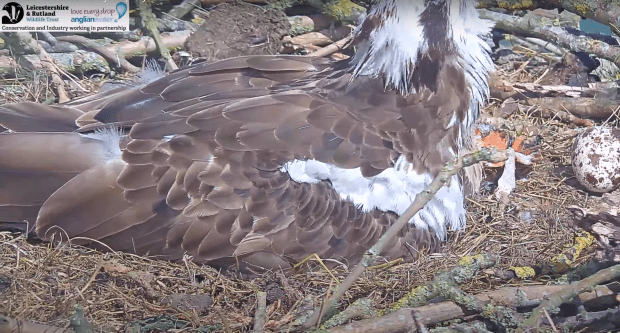
The second egg of Richmond and Rosie had a crack in it a few hours ago. About an hour ago that crack went completely around the egg and you could see the little osplet inside the shell! Oh, how grand. A hatch for the SF Ospreys. How wonderful. It is a good way to end the day. A full tummy for 17 and a hatch – finally – for Richmond and Rosie.
There it is! Oh, sweet wiggly one.
Back to brooding. Was sort of hoping that they would move that other part of the hatchling’s shell out of the nest.
But goodness, welcome wee one!
I simply cannot think of a better way to end the day than with a big smile. All is well in Bird World.
Thank you for joining me. Take care.
Thank you to ND-LEED and SFOspreys and Golden Gate Audubon for their streaming cams where I took my screen captures.
It has turned out to be a brilliant day on the Canadian prairies after the morning’s dreariness. At 18:33 the sky is clear blue, not a cloud anywhere. This, of course, could bode very well for the lunar eclipse tonight which I should be able to see – providing the sky stays the same – around 22:30-23:15. Will see if I can grab some shots of it for all of us!
It was a pretty good day in Bird World taken as a whole. The smallest eaglet in the Notre-Dame nest could really use some food. My goodness he is a tiny little tiercel compared to those two sprawling big siblings. I always get nervous when I check on that nest.
A fish was brought in to the UFlorida-Gainesville nest around 17:55. Middle managed to get a few good bites at the beginning by the old snatch and grab and screaming. Then Mum proceeded to feed almost the entire fish to Big. Middle is hungry but not starving. Holding my breath for tomorrow or another fish tonight.
The other super star of the male Ospreys in Wales is Idris. He has his nest with Telyn near the River Dyfi. Idris is ‘Daddy Longlegs’ and he is known for bringing whoppers onto the nest just like Blue 33.
I can’t wait for the chicks to start hatching on this nest! Last year these two fledged two brilliant osplets – a male, Dysynni and a female, Ystwyth. They have just been ringed and we will be looking for their return next year.
Blue 33 did as Blue always does – he brings in the fish, sometimes too much, and Maya has him remove them. The three chicks continue to thrive. No worries here.
The weather turned and it began to rain and blow in the late evening. Blue was on the nest with Maya and the kids. He is extremely protective and one of those ace providers! He also likes to feed his chicks.
The Dale Hollow eaglets are 77 days old. The average age for fledging is 84 days. So we still have some time, hopefully, with them.
The nest is falling apart in some places and River and Obey will have some work to do for next season. These two are gorgeous.
Just look at what was the rim of this nest. It is almost entirely gone!
E1 at the MN-DNR nest is pancaked down on the nest right now. Is there an intruder somewhere? or is this food coma?
Nancy was in to feed E1 at 19:00. These two are doing alright. Nancy is taking good care of E1, Harriet.
I have not checked on the Goshawk nest at Riga, Lativa for a few days. It is another one of those times when you blink and the chicks are getting bigger. There are four. I have checked and all seem to eat fine.
It rained heavily on the nest yesterday. Mum comes in with food and here is a video of that feeding of these Goshawk chicks. Goshawks are beautiful birds. I just don’t like them around Osprey nests!
One of the best books on the Goshawk continues to be T.H.Whites, The Goshawk. It has been reprinted in a small paperback for a very reasonable price.
There is no news that I am aware of coming from Richmond and Rosie’s Osprey nest in San Francisco about a pip.
When Big Red and Arthur laid their fourth egg many became quite concerned that the last hatch would simply not survive with three bigger siblings. It is always good to remember that this is a hawk nest – like the Goshawk above – and all of the chicks will be fed. In fact, when L4 hatched he was just a cracker. Nothing stood in the way of L4 and Mum’s beak. He learned quickly from a few days old just to heave himself over or through the big siblings. Of course, they are not beaking him or intimidating him onto the other side of the ledge. That is why watching Big Red’s nest is the best. The absolute best.
I made a video clip today of L4 doing his stunt to get in front. It is about 3 minutes long. At 1:54 L4 decides to pull a chippie. I thought he might be going to self-feed. At 2:22 he makes for the front. I am calling it the L4 scramble. Enjoy!
Thank you so much for joining me today. Take care everyone. See you soon!
European Starling. 15 May 2022
Thank you to the following for their streaming cams where I took my screen captures today: DHEC, UFlorida-Gainesville Ospreys, Cornell Bird Lab RTH, Latvian Fund for Nature, MN-DNR, SF Ospreys and Golden Gate Audubon, Dyfi Ospreys, ND-LEEF, and the LRWT.
Good afternoon everyone. It is a coolish, perhaps, rainy day on the Canadian Prairies. So far it feels like a really good day to read rather than planting all the annuals. There are rumours that are temperatures will drop this coming week and that would kill all the delicate flowers and vegetables! So far no Baltimore Orioles today but a whole host of White Crown Sparrows, Pine Siskins, European Starlings, and House Finches. It is also a good day to check on some of our favourites and some that have been overlooked for awhile.
Alden always surprises me. I adore him for his quirkiness and his devotion to Annie and the chicks. Alden was up hunting and delivered ‘something’ that resembled a gull early this morning. Annie ran out and retrieved it for the kids at 04:44. The kids were wide awake and ready for breakfast. Both of those chicks are growing and doing very, very well. What could have been a disasterous season has turned into a truly joyful blessing.
Here ‘it’ comes!
If you have been watching the Weissenburg Peregrine Falcon nest and you cannot see the eyases, do not despair. They are losing their white down and their feathers are coming in. They are also very mobile and all are out on the ledge when prey is delivered as the scrape is very cramped. You can just catch a glimpse of them at the far right.
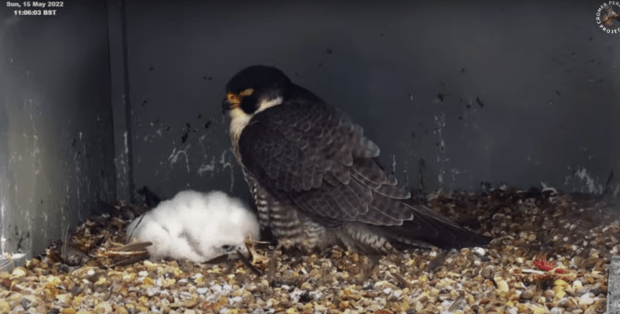
Only chick at the Cromer Peregrine Falcon scrape is doing great. Indeed, look at the colour of its legs and feet in the second inmage. That bright yellow is a sure indication of a chick that is in good health.
This is a short video clip of a feed at the Cromer scrape on the 13th.
There are four eyases at the scrape in the Salisbury Cathedral. The parents are doing a great job keeping each one of them fed. Every one has a huge crop.
There is a continuing fear by many watching the falcon and hawk nests that have 3-5 chicks that one will suffer like they do on eagle, boobie, osprey, heron, etc nests. This is not normally the case. The falcon and hawk parents feed the eyases til each is full and the % of siblicide is so low on these nests that we do not even have to think about it!
The three in a scrape over looking the city of Warsaw, Poland are doing well, too.
All five eyases at the Manchester, NH scrape appear to be doing just fine. I cannot even imagine the work that these parents are going to have to do in terms of getting prey as these chicks grow and grow and grow.
It is amazing how many Peregrine Falcon scrapes have streaming cams! There is always a new one and the scrape in Warsaw is new to me!
It is raining lightly on Theo’s Osprey nest in Latvia. It appears that he has not attracted a mate to the nest. Is it because all the female Ospreys know that this Osprey nest is close to the Goshawks and that those hawks will kill the chicks? That is sad. This is the only Osprey nest in Latvia.
If only we could get Theo together with Iris! A male sort of suitor has been coming to Iris’s nest. She did not fight him off until yesterday. Iris wanted to see his intentions and when he approached the nest several times without a fish, she wasn’t having it. Good for you, Iris!
The Patuxent River in Maryland has been home to Ospreys for more than thirty years. They chicks are ringed and one female has been returning for 20 years! So don’t forget about these Osprey if you are searching around for a nest to watch. I will also add that it was here, last year, that many of us were able to rally one of the staff to return to the part on a Friday evening to retrieve a chick that had fallen off and was in the water. A good intervention!
Here is the link to the streaming cam for nest 2.
Mum is bringing in catfish to the Osprey nest at the UFlorida-Gainesville. Middle has been working hard to get the food off of them unlike Big who really does like to be fed by Mum. Both chicks appear to have moved beyond the food competition phase. Middle is a lovely bird – a survivor.
Big gives up working on the catfish – getting the meat off of a catfish head is very, very hard work. Middle does not mind.
I have been thinking a lot about this nest and I am grateful to ‘R’ for helping me to understand what might be impacting the fishing for this family. ‘R’ was able to establish that Lake Alice which ‘was’ a very large lake supporting the Ospreys has been partially taken over by dormitories and parking lots! Bivens Arm Lake in the second image is covered with green algae/plants making it impossible for Dad or Mum to see fish and catch them. This is quite tragic. Thank you ‘R’ for finding this out for all of us. Much appreciated.
There is also concern that Dad might be trying to keep two nests as one is clearly seen on a light pole leading up to the campus not far from the nest on the practice field. Both could explain the prey deliveries to the nest for Big and Middle.
The triplets at Manton Bay are doing well. Blue 33 continues to bring in lots and lots of fish including those pesky perch that have several lives.
Blue 33 is getting his breakfast order from Maya.
Rosie and Richmond are not giving any hints as to a pip happening at the San Francisco Osprey nest on the Richmond Shipping Yards.
The eaglets on the Dale Hollow nest are really getting the last of that juvenile plumage in. It will not be long til they begin to hover and fledge.
Big is on the right and just look at Middle’s crop!!!!!!!
Only Eaglet at Duke Farms is really going up high on the branches and is quick to get to the nest when food is brought in. (You may recall that there were originally two eaglets at the nest. The much smaller one did not survive).
That is a quick check in on some of our nests. So far, so good! It is always lovely to start the day knowing that everyone is as good as they can be! Thank you so much for joining me today. Please take care!
Thank you to the following for their streaming cams where I took my screen captures: Duke Farms, DHEC, SF Bay Ospreys and Golden Gate Audubon, LRWT, Google Maps, UFlorida-Gainesville Ospreys, Patuxent River Park, Montana Ospreys, LDF, Peregrine Networks, Warszawa Peregrines, Salisbury Cathedral Peregrines, Cromer Peregrines, Weissenburg Peregrines, and Cal Falcons.
It is really sad when a ‘bird Mum’ seems to consistently favour one healthy chick over another especially when the eldest has already killed the third hatch. Today, at the UFlorida-Gainesville Osprey nest, this preference for the dominant one over a healthy chick crying for food was so evident despite Middle making every effort to get around to the beak to eat even after being intimidated. Yes, Middle held back for his own survival. But it is ever so sad. He is a big healthy osplet! A fish came in at 18:24. Big did the dominance stance and Middle pulled back. By the time Middle got around on the rim to Mum’s beak, she had already given Big part of the tail. Big ate the entire fish! At 18:37 Mum find a few little scraps on a bone and gives it to Middle. At 18:38 Middle takes the bone to self feed trying to find any meat no matter how dry to eat. Middle has not had much food today but he has had some. Yesterday he ate well so we are still good.
Middle will be a survivor if he does not fall off or get shoved from the nest – he reminds me so much of Tiny Tot Tumbles at Achieva last year. She dug around in the nest eating very old, very dry leather hard pieces of fish. They kept her alive. She was self-feeding proficiently before the two older siblings. TTT became the dominant bird on the nest and if any of those three chicks were to survive their first year, my money would be on her. In fact, this winter Tiny Tot Tumbles was photographed at least once on the Achieva nest so she is still alive. That is wonderful and it will be the same for Middle. I just wish these osplets were banded.
It is worth noting that Big already had a ‘big’ crop before the last feeding of the day ever took place! There she is in the middle of the nest standing proudly with all the commotion going on around her. Middle is trying to get to the fish.
Sadly, all Big has to do is raise her head and walk towards Middle and he cowers. This behaviour was noted to have changed over the weekend by ‘R’. Prior to Friday, Middle had been getting up to the fish faster and, therefore, getting more food. The assumption is that food was scarce over the weekend when there was a big storm and the camera kept cutting in and out. It is also believed that Big took this out on Middle.
Middle is watching Big and trying to move up to get some food. If Mum would just turn herself 45 degrees both chicks could eat. It is very frustrating.
Mum found a few bites for Middle. Just think. Big ate an entire fish and Middle got a few bites.
Middle is continuing to chew on the fish bone to try and find some food.
Is there enough food coming on the nest for Mum and the two chicks? There was yesterday and with Big having a crop before she ate this entire last fish today, I would say yes. Certainly 50% of the fish could have gone to Big with 25% each to Mum and Middle and everyone would have been fine. It is not a case of everyone starving. It is sad.
This female is not the only one that has favoured one chick over another. I am certain that you can think of several instances if you have been watching streaming bird cams for awhile. One thing I have noticed – at least in Bald Eagles – is that the Dad will often step in and feed the ‘left out’ sibling. I know it sounds crazy but some of those males that are now Dads would have had big sisters who demanded and took everything. Do the males remember?
The two eyases at the CalFalcons scrape do not have the problems Middle has at UFlorida. Alden caught a pigeon today and I am absolutely certain Annie was delighted. Everyone can fill up and there will be leftovers in the pantry.
Precious.
Look at those two. Talk about a different atmosphere in a nest! I will take a falcon any day.
Bursting little crops. These two will cuddle up under Annie and sleep well.
Cal Falcons put this feeding into a short video clip.
So happy to see the promotion of the Peregrine Falcons and their chicks on The Campanile. Anything that will bring awareness to the raptors so that we can help make their lives a little better is welcome – and one way is to educate people.
It is so far, so good at the Manton Bay nest. Both chicks have eaten and it appears that the third chick is hatching. It will be a relief for Mum to be only brooding instead of brooding and incubating. I really hope that chick is doing just fine in the morning – the one that was exposed. It looks good so fingers crossed.
Ferris Akel has a pair of Red-tail Hawks near to where he lives and today he has discovered that Betty and Barney have three chicks!
Two Habours 1 is doing just fine. She looks out on that gorgeous cobalt coloured water that surrounds her nest in the Channel Islands.
The winds are really gusting at the West End nest of Thunder and Akecheta not far from Chase and Cholyn’s nest at Two Harbours. Let us all hope that the eaglets do not want to stand up and get near that ledge. Hunker down.
There are big storms about and it is very, very gusty at the MN-DNR nest of Nancy and E1 Harriet, too.
Harriet has brought in a really nice fish. You can see it in the image above. She is trying to stand in the violent wind gusts and feed Harriet. Sweet. These two are doing well under the circumstances.
We have another storm coming that is predicted to drop 40 mm of rain in a short period of time tomorrow. I wonder if this same system will hit the MN-DNR nest?
Those same winds are blowing at the Osprey platform at the Arboretum on the grounds of the University of Minnesota. The couple have one egg so far. Last year they fledged one chick.
Here is the link to their streaming cam:
The prey that is brought to the urban nests versus those in rural areas can be very different. In New York City, the Red-tail Hawks seem to live on pigeons and rats. Today a rat was delivered to the Presidio Red-tail Hawk nest in San Francisco. It makes me nervous. I am very much against the use of rodenticide and when the rodents are slow and easy catches they are often poisoned. The hawks thus die of secondary poisoning. It is tragic and unnecessary!
Fingers Crossed!
All White-bellied Sea Eagle fans should be checking in on the nest around the beginning to mid-June. Lady and Dad have been making nestorations and mating.
Of course, we will also be gearing up for the CBD Peregrine Falcons in Melbourne (late August or September for the cam to return), Xavier and Diamond at their scrape in Orange, and of course, the Ospreys at Port Lincoln. It is mid-May now. Time is passing.
Thank you for joining me this evening. Hopefully we will wake up to three healthy chicks at the Manton Bay platform tomorrow and several more fish for UFlorida-Gainesville! Tomorrow is pip watch for Richmond and Rosie. Take care everyone.
Thank you to the following for their streaming cams where I took my screen captures: Sea Eagles@BirdLife Australia Discovery Centre, Cal Falcons, Presidio RTH, Ferris Akel, Minnesota Landscape Arboretum Osprey Cam, Explore.org, UFlorida-Gainesville Ospreys, MN-DNR, and LRWT Manton Bay.
Gosh, golly. 21 degrees C. This means summer!!!! The parks, both of them, were full of joggers, walkers, people having picnics, playing ball, or tennis. The Cricket pitch was busy. Canadians are wearing short sleeves and shorts and we are happy and smiling! Last week was a different story. If it rains again on Thursday we will be back grumbling. I promise. Summer is way too short. You realize I did not say ‘spring’. Honestly we don’t have it any more. A normal summer temperature a couple of decades ago was 18 degrees C. Of course can hit 35-38 C easy. Then we all go inside grumbling. There is a sweet spot around 21-23 degrees C that is just perfect for humans and for the birds on the Canadian prairies.
Note: Bear with me. I did not edit this today!
I left this morning in search of wood ducks. Where are they? I found one couple at one park and three males and one female at another. Even more absent were the Mallards. Sadly, what else I found was that the torrential rains and rising water levels everywhere have made many of the duck and goose eggs non-viable. If the outside coating gets wet, there is no oxygen. This was sad.
The water has receded and you can see some of the clutch that has been abandoned. This area is a small island – there are two islands – in the centre of the pond. It appeared very, very crowded with geese further back incubating and a pair of Wood Ducks walking through.
I wonder how man of our waterfowl lost their eggs this season? Some goslings have hatched but I did not see a single one today. Last year I could not walk for wee ducks and geese. Let’s see what next month brings.
This Mallard couple were taking turns trying to find pond vegetation and keeping an eye on me – I was about 20 metres away but they still knew I was there. The birds around the Witches Hut at St Vital Park are very friendly. During nesting season they get a bit touchy but I think they were waiting to see if I brought any food with me.
The light was not great today. In fact, it gave some rather bizarre colours to the birds.
The colours on this Mallard might even make a Peacock envious.
The Black-capped Chickadees, six of them, were dive bombing me. Did they know I had seed for them in my pocket? or do they now see humans and think seed? Probably the latter. It is a very popular spot for walkers and people that live close by to spend an afternoon, always with birdseed. The lens I had on the camera really compromised what would have been great images taken with a phone camera rather than a 600mm lens.
They came and went many times while I stood and watched. Picking up a single seed, flying up to the tree nearby to crack it on a branch and then back for another one. I wonder how many calories they burn flying back and forth??
The Canada Geese were everywhere – and I do mean everywhere.
Tucked in near to them was a Chipping Sparrow hunting for sees and bugs.
None of those images will win any awards for photography but they are a nice memory of my day and some of the birds that I saw.
When I got home I went back and checked on the Manton Bay Osprey Nest in the UK to see if the third chick had hatched for Blue 33 (11) and Maya. Not yet but you could clearly see a crack forming. One of the reasons that this couple has such huge success is that the eggs normally hatch within a couple of days. Maya always delays incubating the first two eggs until the last has been laid. Talk about a remedy to help with food competition. Of course, it helps to have a big lake with lots of fish in it and not much competition right under your nest!
There was Blue checking out his newly hatched Big and Middle Bobs.
Big Bob looks like it is going to have an attitude.
If you stare at the egg long enough at the back on the left at about 2100, it appears there are some cracks forming. Of course, I could be losing my mind also.
So all is well at Rutland. Then skipping over to the UFlorida-Gainesville Osprey nest and gosh. Middle had a crop at 16:18. So I went back and it appeared that another fish had come to the nest around 15:00.
The fish has arrived. Middle is just lucky. If Mum moved the wrong way she would knock him off that nest. He is on the far side. The chick you are looking at is Big.
Mum is feeding Middle!
Mum continues to feed Middle.
So, today, Middle ate and had a couple of crops. This nest is like a roller coaster. Did you know that birds can get stress lines in their feathers? I don’t know if all banders check but when they checked the three lads at the Port Lincoln Osprey nest they checked for stress lines and found none. Of course, they would not have. Those three males were like three choir boys until they fledged. They they really began to do the ‘dust ups’ shoving one another off the nest, intercepting fish, stealing fish and whatever else three brothers can think to get into. Here is a ‘dog fight’ between Ervie and Falky.
And here is the ‘dust up’ between Ervie and Bazza on the nest where one falls off:
For those of you that do not know the PLO nest it is on a barge at Port Lincoln, Australia. The nest always had a history of siblicide. This year everyone held their breath when the three eggs hatched and there was Little Bob. Well, Little Bob was quite the character. He had to always be at the beak, in front. When Bib Bob tried to bully him, Little Bob just didn’t let it happen and Big Bob got tired and quit. Still we worried until everyone realized that Little Bob was getting rather dominant. At the time the three were to be banded, it was decided that the heaviest of the three would get the one satellite-pak. Everyone was sure it would go to Bazza the eldest. No. Ervie – who never missed a meal and who had been right up front that morning – got the GPS system! And we cheered! The three were Bazza the eldest with the red band, Falky the middle with the yellow, and Ervie the youngest with the dark green band. Falky – being the middle – did not always get much attention until he dove off the barge and caught a fish! Falky was also the one spotted 300 km north of Port Lincoln. Bazza was the reluctant flier and stayed on the nest to let Mum feed him. Then he left. I hope we hear about Falky and Bazza. Ervie was flying about and then Ervie got one of his talons pulled out. Who knows how. As a result he stays around Port Lincoln and has a fondness for Puffer Fish! He is adored by many.
Sometimes it is nice to sit back and remember those really wonderful nests and last year, PLO was one of the best!
If you are into the translocation project that has been going on in the UK, you will be excited to read the announcement by Poole Harbour today on their FB page:
Single Bald Eagle Mums have a difficult job especially if the nest is in an area where there are constant intruders. There had been a bit of a dry spell at the MN-DNR nest but today around 16:15 nest time, Nancy brought in a huge fish. E1 ate well. I understand that a group of school children are calling E1 – Harriet. If it isn’t official, it should be. It is a perfect name to honour her missing and believed dead young dad, Harry.
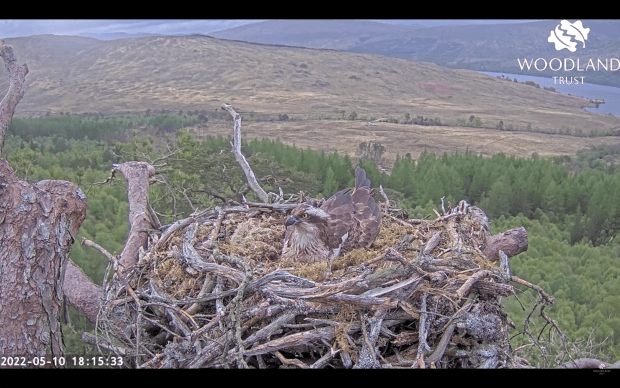
The winds are still blowing strong in Scotland and the rain will start pelting down at the Loch Arkaig nest in the West. Dorcha is doing a great job keeping those eggs incubated.
At the Loch of the Lowes, the wind is blowing but you can hear the ducks and geese flying in for the evening. Blue NC0 looks pretty content on the nest of hers and Laddie’s. Not long til there will be chicks here.
One of the things that people/researchers/naturalists and lovers of Osprey look at it is the return rate. How many fledglings from a nest in a particular year with particular parents return as juveniles and are officially seen? Well the Llyn Clywedog nest is doing a bit of celebrating today. So far two out of three of the 2020 trio have returned – 550 and 551. They only need 552 and they would have a 100% success rate. They are going to have bragging rights regardless for some time. This is fantastic news.
Richmond and Rosie have been fighting off intruders this entire season. We are a few days til hatch watch. Here is the banner for SF Bays Hatch Watch announcement at the SF Bay nest of these two great Ospreys.
Here is the link to Richmond and Rosie’s streaming cam:
This is the 15:49 feeding at the Cal Falcon nest of Annie and Alden. Cute. So cute.
This is the 16:55 feeding at the Manchester New Hampshire Peregrine Falcon scrape. Crazy!
Everything is perfectly fine at the nest of Big Red and Arthur on the Cornell Campus. L4 can almost be heard saying, “My crop’s as big as your crop! Nah, nah, nah!” Every time L1 does something, L4 seems to copy her.
Big Red looks like she is ready for an evening break before she snuggles down with these four Ls.
So far, so good. Food was on both the MN-DNR and the UFlorida-Gainesville nests. One day at a time. Today it was all good. So from me and all the garden gang and TH1 at the Two Harbours nest in the Channel Islands, good night. Take care. See you soon!
Thank you to the following for their streaming cams or FB pages where I took my screen captures: LRWT, UFlorida-Gainesville, PLO, Birds of Poole Harbour, MN-DNR, Woodland Trust, Loch of the Lowes, SF Bay Ospreys, Cal Falcons, Peregrine Network, Cornell Bird Lab RTH, and Explore.org
It is a gorgeous morning with the promise of 20 degrees C. There is a blue sky and that tinge of green on the trees. By afternoon many of those leaf buds will be leaves. It is also a good day to go and check on those cute little wood ducks!
I lucked out this morning at the UFlorida-Gainesville Osprey Nest. There was a fish delivery around 10:00. The nest was civil! So, I am going to make a assumption and see how far I can go back. There had to be at least one big fish, if not two, for Big to be nice and let Middle eat first.
Yes, there is a fish that is being fed to the two that comes prior to 06:35. I cannot tell you what happened when this fish arrived. Mum is feeding Middle nicely when I re-wind.
At 07:23:06, the pair are snuggled together in the centre of the big nest. It is hard to tell them apart. The hint is the plumage. Big remains darker than Middle. There is a little more juvenile plumage coming in. Big is bigger but when they are moving around on the nest, it is really difficult to determine who is who. Both are walking well now.
At 09:09, Big is self-feeding on a piece of fish left on the nest.
This is interesting. This is at least a second fish (perhaps there was an earlier one also to the first). Big has no interest in harassing Middle who is obviously hungry and up at Mum’s beak.
Big does come up for food and Middle begins to do his quick grab. There is no attempt to harm Middle, however.
It helps to have Big get caught up in eating a small piece of fish. Indeed, both of the chicks appear to have a piece of fish tail that they are trying to eat.
Mum was still feeding Middle at 10:25.
Now, I would like to rewind to what happened when I wasn’t able to access the camera so that we can appreciate what is happening this morning. I am very grateful for a very detailed report on the nest from ‘R’ who also knows the area well and was able to clarify where Dad goes fishing.
This is a broader map of the UFlorida-Gainesville campus showing several lakes. ‘R’ tells me there is no boating on most of them and limited boating on the larger lake. When I am looking at the reasons for there to be issues of food competition, the first thing I wonder about is the source for the fish. As some of you may realize, in Montana the Ospreys up near Missoula whose nests are on the Clark Fork River are having difficulties – or will – if the high temperatures and lack of snow pack and rain continue. The trout die. Here, this does not seem to be an issue. I did have to giggle. We know nothing about alligators in lakes in Canada that I am aware of – but apparently the lakes in Gainesville have gators and they do eat the odd dog when the walker gets it too close to the shore. Goodness, that would be a shock! As ‘R’ pointed out, the gators should not be a problem to the Osprey.
The nest is located on the Soccer Practice Field. That is the red indicator below. You can see that Dad has a large lake close by and further to the right another. Unless something is killing off the fish in those lakes, access is not an issue. Perhaps temperature is? It is 69 degrees F this morning in Gainesville. A respectable temperature for fishing. Does the temperature impact fish delivery if it gets up in the high 80s? Good question to find the answer.
‘R’ reports that Dad brought in little food on Friday. That evening, that big storm with the high winds that swept through the area and the nests – they were blowing on Captiva – took out the camera. There was on and off camera access Saturday but nothing steady with the camera until Sunday. It is unclear about food deliveries during this time but typically it is difficult for an Osprey to fish if it is a very bad storm. There is also an issue of barometric pressure. Easier to fish when the pressure is falling as opposed to rising. I am going to have to set up a graph and see if this is impacting Dad. ‘R’ was sadly able to report that a few years ago in another storm both of the chicks were knocked out of the nest. How tragic.
The report for Sunday and Monday were not good. As ‘R’ notes, this was probably due to a lack of fish deliveries. Bit was extremely aggressive attacking Middle constantly. Middle tried to position itself to get away from Big but this did not help. At this point Mum is favouring feeding Big over Middle.
The pattern continued to Monday morning – Big being clearly aggressive and Mum favouring Big in the feeding. It was estimated by ‘R’ that Big got ten bites to Middle’s one. Also noted was the fact that Middle went into submission easily whereas last week, Middle was showing some ability to deal with Big’s dominance.
The factors that are leading to food competition continue to be a lack of fish delivery by Dad, weather, and at least one instance of an intruder that was seen landing on a light near the nest.
I am extremely happy that something has happened this morning to turn this aggressive behaviour around this morning. If it is possible I want to go back and build up a graph checking on the barometric pressure in Gainesville and compare it to the days we know there were good fish deliveries and little. Is this the culprit? or is it intruders? the temperature?
I want to take you to an Osprey nest where – for the past five or six years – there has been not a single problem. That is the Manton Bay nest of Blue 33 (11) and Maya. Three eggs this season. Two have now hatched. I will expect the next one to hatch tomorrow. The eldest hatched last evening and the second is still wet! You can barely see it in front of Big Bob. — A note. All of the Ospreys are Bobs in the UK. The Bob refers to the bobbing head. so it will be Big Bob, Middle Bob, etc.
That is that big fish I was talking about yesterday. The Manton Bay nest is right in the water at Rutland. There is nothing cuter than a day old Osprey chick. Nothing. OK. Maybe a Red-tail Hawk or a Peregrine Falcon.
Big Bob is already eating well.
Maya is a bit like Big Red, the Red-tail Hawk matriarch at Cornell. She wants her babies full to the brim and more. No need for a hungry wiggly baby while one is trying to dry off and get used to having hatched and the other is thinking about hatching.
Brooding and incubating. It will be much easier for Maya when the third hatches. Again, I am not expecting any issues at this nest over food competition. Blue 33 (11) always has the fish on the nest at dawn. If he doesn’t then we should start worrying about him! This is a terrific nest.
Here is the link to the streaming cam at Rutland Manton Bay:
I have not checked any other nests this morning but I will do later today. The sun is bright and it is getting warmer and it is time to do a hike around a lake to check on some ducks and geese.
Have a wonderful day everyone. Thank you so much for joining me. See you soon!
Thank you to the UFlorida-Gainesville Osprey Cam and the LRWT for their Manton Bay cam where I took my screen shots. A special thanks to ‘R’ who educated me in potential fishing sources for Dad at Gainesville and for bringing me up to speed with great detail over the weekend and Monday happenings at Gainesville.
Some of you will know this story. Last year, my friend, ‘T from Strasbourg’, asked me if I were an Osprey which of the males would I want for my mate. I knew she was going to say Monty! I didn’t pick one of the Welsh lads nor any of the Scottish ones but, rather, Blue 33 (11) at Rutland. And this is why. He is extremely supportive and he will have a fish on that nest for Maya and their chicks at the crack of dawn. He likes to snuggle in the nest with her when the chicks are hatching.
Poor Maya was restless. There was a chick hatching during all that squirming. We get a peek at 23:02 but, from all the action it appears that hatch was finalized around 23:00. You can’t see it but Blue 33 (11) has a big fish on that nest ready for Maya and the chick or chicks when she wants it. He is definitely not a dead beat dad!
Speaking of Dead Beat Dads — I know, some of you are going to get mad at me but, seriously, there are excellent males and then there are not so good ones. The variety of Bird parents is not a lot different than humans.
I have had trouble with accessing the UFlorida-Gainesville Osprey nest since the end of last week. This evening I was sent a very thorough report on the comings and goings on that nest by ‘R’. Thank you so much! It makes for sad reading. There could still be intruders at that nest. There is not a lot of fish coming on the nest and when it comes, Big is getting the advantage. Middle is getting some food but at a high price. I hope things turn around. Tomorrow I will bring you ‘R’s report and a look at what is happening at that nest. That Dad is certainly not Blue 33 (11). Nor is the Mum Maya. Blue and Maya have raised a clutch of four with a total of 15 to fledge in 6 years. That is a pretty impressive record. I understand that they might be grandparents now. Fantastic.
Annie, Alden, and Grinnell’s chicks are in the news again. Had to share. Seriously these two chicks look like they are smiling all the time.
For those of you watching the nest of Big Red and Arthur, it is time to get your virtual worry beads out. The eyases have moved out of the nest bowl and they are very interested in what is happening in the world around them. This means that they will be hovering over the side of the nest. This is only the prelude to them jumping, flapping, and running up and down the ledge! So far none have fallen off but I thought I should warn you ahead of time.
Notice the crops. That is Little Bit right there in front again with a crop as big as Big’s. No chick is favoured over another. All are fed til they are full.
Big Red will lose about 30% of her weight raising these four eyases. Once they leave the territory around the beginning or middle of May, she will go back to taking care of herself.
Nice fat little eyas. That is what you want to see.
That’s it. It is still raining here. Apparently the entire southern half of our province is under threat of overland flooding until next week. Oh, I so longed to hear rain but, we can do without it now. The farmers should be planting and, of course, their fields are under water. The wildlife are looking for places to go. From 4 or 5 years of drought – I had forgotten how rain sounds or smells – now we have way too much! The garden critters are fine although I just saw Dyson and it looks like he has lost half her tail. Gracious. I must get a better look tomorrow.
Take care everyone. See you soon.
Thank you to the following for their streaming cams where I took my screen captures: Cornell Bird Lab and RTH and the LRWT.
I have not spent the time I should have observing the UFlorida-Gainesville Osprey nest since the third hatch starved to death because of siblicide. The nest appeared to have ‘calmed’ down after that. I am, thus, very grateful to ‘R’ who took the time to write to me telling me about the change to aggression.
While my research focuses on that third hatch, it appears from the instances of aggression that we have seen this season – that ‘something’ is happening out there in the nests. Before we chat about these sorrowful avian behaviours, I want to go back to the book I am reading, The Eagle Man. It is about Charles Broley, a Canadian, who spent his time between here and Florida observing Bald Eagles and banding thousands. Broley’s observations are from direct observation or information provided to him by others. He did not have the benefit of the streaming cams and data collections that we have today. Still, some of his observations continue to hold true such as the ‘Northern’ Bald Eagles are larger than the ‘Southern’. In another instance, he notes that the ‘Southern’ eagles are more aggressive than their ‘northern’ counterparts. In terms of nest aggression, Broley said: “The more demanding of the babies gets the greatest amount, however, for the weaker, smaller one is always neglected for the more aggressive one. As a consequence on that is a little smaller, a trifle weak, perhaps, tends to grow weaker through lack of food, abuse from the older bird, and general neglect, while the stronger one, because it gets all the food, increases in size and strength rapidly (52).
In their article, “Why do some siblings attack each other? Comparative analysis of aggression in avian broods” by Alejandro Gonzalez-Voyer, Tamas Szekely, and Hugh Drummond (Evolution, 2007), the authors list eight traits that they are testing to determine if any, some, or none drive aggression on nests. Those traits are:
feeding method (monopolization of food). Direct feeding when food passes directly from the adult beak to the chick’s beak. This allows the dominant bird to violently exclude any competition. The authors believe that when food is placed on the nest floor in indirect feeding it is more difficult to monopolize. The feeding method theory predicts that “a greater use of aggression in species in which direct feeding predominates throughout the nestling period).
effective weaponry (pointed or sharp beaks)
limited escape possibilities (nest site typography)
differences in age and size of broodmates (hatching asynchrony)
large food parcel size
small brood size. As brood size increases the authors observe that it is more difficult to intimidate and attack.
aggressive potential (maturity and body size)
slow food transfer
The researchers studied and compared several species including the Accipitridae (eagles, hawks, and buzzards) along with Boobies, Anhingas, Ibises and Spoonbills, Egrets and Herons, Pelicans and Kingfishers. I was, of course, disappointed that they did not include Ospreys. Following lengthy observational study, the authors concluded that indirect feeding, small broods, and long nesting periods are significantly correlated with broodmate aggressive competition. They also agreed that more studies needed to be conducted because exchanging or removing even one factor might alter the results of the research. I did find it interesting that out of 58 Eagle nests studied compared to 52 falcon nests, the eagles were 81% more inclined to nest aggression. They thought that factors such as larger clutches, a shorter nesting period, and one other factor — that the broodmate aggression being eliminated through evolution- could be at the heart of why falcon nests have little siblicide. It is rare to find siblicide in falcons and hawks while, as we have seen recently, it is much more common in eagles and ospreys.
Within this season, we have seen siblicide, the deliberate killing of a sibling, at several nests. These include the third hatch, DH16, at the Dale Hollow nest on the border of Tennessee and Kentucky; the third hatch at the UFlorida-Gainesville Osprey nest; the second hatch at the MN-DNR nest who was physically abused (with holes in its head) in the nest and, ultimately, successfully shoved off the nest on the third attempt; and the biological chick killed by the foster chick at the Pink Shell Osprey nest in Florida. In addition, it is difficult to know what the outcome would have been at the Captiva Osprey nest if the oldest sibling had lived. Big did prevent the female and the two younger siblings from eating for a period of 72 hours before it literally dropped dead. Would the death of the youngest sibling at the Duke Farms Eagle nest be classified as siblicide?
The situation at the UFlorida-Gainesville Osprey nest has not stabilized. The information I received this afternoon from observations on the nest indicate that the eldest sibling is relentless in stopping the middle sibling from eating. Observations of the behaviour include – the mother feeding the dominant sibling, the dominant sibling abusing the younger even if its crop is full to overflowing, the younger one having to expend energy and become aggressive to even get a few bites of fish. I do not know the number of deliveries in a day or the size of the fish. The camera re-wind is such that it is not conducive to discovering this information. Tomorrow I plan to write to Gainesville and see if I can get the data which someone must be keeping – and also to find out precisely how old these osplets are. While there is no truly ‘safe period’ against broodmate aggression, it is normally expected to stabilize around the age of one month. That said, the dominant aggressive osplet in the Port Lincoln nest did throw its sibling over the nest to its death when the chick was 65 days old. This is why we cannot predict what will happen.
In the top image, the eldest chick, Big, has learned to get between the mother’s legs preventing Middle from getting food and from the advantage of having the adult in between the two birds. Thank you ‘R’ for drawing this to my attention.
Middle had to expend a lot of energy flapping its wings and trying to mantle to get a few bites. The ratio was more than 10 bites to 1 with Big having the advantage. I do not know when the Middle sibling last had a good meal with a crop.
We must remember that the more food Big gets the bigger and stronger that bird gets to the detriment of the younger. It is hot on top of that light stand in Florida and the fish is the only hydration the chicks get.
Middle is once again rushing at the Mum to try and get some food.
Another small fish comes on the nest later. In the image below, Big has been eating and has a huge hard crop. Middle has no crop. Big has been eating but Middle moved slightly and caught Big’s attention who went on the attack.
Big goes back to eating.
Eventually Middle gets a few bites of fish once Big passes out in a food coma. In essence, Big ate almost two entire fish with the Mum and the Middle sibling getting very little.
One thing that is missing in this discussion is the fact that the Mum also needs to eat. It was 25 degrees C today or 77 F on the ground and later in the day (9pm). It is very hot on top of that light stand. I cannot predict what will happen on this nest or on Middle’s survival. Normally I would say not to worry but Big has tried to push Middle off the edge – when I see this behaviour my antennae really begin to alert. It is going to depend on many factors some of which we just do not know – will there be an increase in size and number of fish being delivered? is there a genetic disposition towards aggressive behaviour at this nest?
I am sorry to bring you this sad news. I had so hoped that the aggressive behaviour would have ended with both chicks thriving. I will be keeping a closer watch on this nest and I am very grateful for the letter alerting me to the change. If you know of other nests where siblicide has occurred since 1 July 2021 to the present, please do let me know. It would be much appreciated.
Thank you for joining me. Take care everyone. See you soon.
Thank you to the UFlorida-Gainesville for their streaming cam where I took my screen captures.
The father, Harry, – his second year as a young Dad in 2022 – went missing Tuesday evening. Nancy the Mum hunted and got a huge fish on the nest on Wednesday for E1 and E2 when Harry did not return. Since they were small, E1 had marginalized E2, beaking it, and not allowing it to eat. Three weeks ago, according to my great source “P” who loved that eaglet and watched that nest, E2 was self feeding. Sadly, E1 became more and more aggressive with the absence of Harry and regular food deliveries. On Friday, it tried to push E2 off the nest. Today, it tried again in the morning and was successful in the afternoon. This is siblicide. Nancy has not been able to go and hunt since Wednesday because of the adult eagle intruder in the area. A search party extended 3 miles and did not find Harry. I hope that Harry is only slightly injured and is resting and healing away from the territory and will return like Bella did.
The boots on the ground found E2. He was taken into care.
Sadly, this is the last announcement from the MN-DNR.
He was a vibrant young eaglet with so much promise. Fly high Little One, fly high.
Thank you again to “P” for keeping me constantly informed. I know how much she loves this wee babe.
It is a beautiful morning on the Canadian Prairies. The sun is out a little bit and white snow fell overnight. The birds are very happy. They do not like the 45 kph gusts last night or the torrential rain on Saturday. I am also feeling lucky that we are not flooding and sad for the people and wildlife that are struggling with continuing flood waters in southern Manitoba and at various parts of Winnipeg.
I am going to begin with the sad news.
I wanted to make sure before I provided any more incorrect information about Little Bit. I have been monitoring the nest for many hours at UFlorida. Despite being fed Sunday after 86 hours without food, Little Bit lost its struggle to live. The precise time is unknown. The tiny wee one was almost delirious eating fish yesterday. It was such a joyful ten minutes watching Little Bit have some fish. It made us hopeful. At the time, the little one had not had a ps in a long time and at what point are its internal organs damaged? The heat at the top of the nest is hugely problematic in terms of hydration if fish are not consumed for that is where the osplets get their water. Little Bit got to eat because three fish came on the nest in quick succession. With the arrival of the third one, Big beaked Little Bit and fought with Middle. After some fish, the older two finally collapsed. It was only on their collapse that Little Bit got to eat and eat it did for ten minutes. I bet fish never tasted so good. Then another fish arrived, a 4th one, at 18:32:45. The female dragged that fish right across Little Bit’s head. It looks as if that is the precise place where Little Bit passed on. I had hoped for a miracle for this third hatch who wanted to live and who had such a wonderful start to life. This nest truly looked promising. The turn came on 10 April and for the past two weeks the baby suffered great abuse. There was a bit of a reprieve on the 18th and then the programme of siblicide began again on the 19th. — Those are a summary of the facts as we know them of Little Bit’s struggle to live on this nest. I had so hoped you would be alive and eating this morning, Little Bit. It was not meant to be. Fly high, Little One. Fly high. Soar.
The Osprey nest at Captiva is vacant this morning. Middle (or Little) was there yesterday. The parents should be feeding the chicks off camera. There has been no word on Little (or MiniO) since she fledged. If you look at the tree closest to the shore to the left of the scrape box you will see what I believe is an Osprey. This was Middle (or Little’s) tree that it liked to sit on. Perhaps it is him.
If you are in the market for a property at Captiva with an Osprey and Eagle nest, Lori Covert’s property is for sale.
The falcons and the hawks have been ignored, at times, in favour of the eagles and the ospreys so I want to check on some of these other nests while returning to a couple of Osprey nests that are normally very stable.
There is a Red-tail Hawk nest streaming cam in San Francisco at The Presidio. I had no idea. What a surprise in the wee hours of the morning when it just appeared. There are two chicks. They still have their white down and they are feisty!
The Presidio’s resident Red-tailed Hawk pair have been hard at work preparing their nest 100 feet up in one of the Presidio’s blue gum eucalyptus trees. The information tells me that “The Presidio is an important stop on the Pacific Flyway, the major north-south flyway for migratory birds, which means it’s a hotspot for birdwatching with 323 different types of birds spotted (so far!) in the park.”
The two eggs were laid the middle of March. The site does not state when they hatched but they look to be less than a week old but slightly older than Big Red’s chick, L1.
I do not know anything about this nest but I am quite excited. With only two chicks in this nest, both of them should grow happily. In general, it is easier to watch the hawk and falcon nests than the eagles and Ospreys as food competition and sibling rivalry are much less frequent.
Breakfast Monday morning. So well behaved like little falcons normally are.
This is simply fantastic news. Here is the link to follow this Red-tail Hawk family in California!
Early morning at the Buckinghamshire Council offices in the UK and there is that beautiful Peregrine Falcon. No eggs yet. Predicting soon!
We also have Peregrine Falcons in Manitoba. There are several streaming cams as part of the Peregrine Recovery Project. Ella and Pip have their scrape on the top of the Radisson Hotel in downtown Winnipeg. The couple have three eggs. Check out The Peregrine Chick on Twitter for news.
The last of the three eggs were laid on the 22nd of April and now it is hard incubation. Egg 1 was laid on the 17th with egg 2 on the 20th. Ella was tucked up tight as the cold weather returned to the ‘peg.
One of the great things that the local group has done is to compile a listing of Peregrine Falcon cameras in North America as well as world sites. It is not comprehensive as I see it does not include the Utica, New York scrape. Utica, you might want to send them a note and ask to be included. On that same page as the listing are a number of books related to Peregrine Falcons and other links. For the cameras, you just have to click on the site and presto – another cam with falcons to keep you awake!
It was a gorgeous morning at the Cape Henlopen Osprey Nest in Lewes, Delaware this morning. Mum and Dad were both on the nest. Dad kept coming to see if he could have a turn at incubation and Mum kept refusing!
The site will not let me embed their camera link so search for the nest at YouTube.
L3 has hatched for Big Red and Arthur at the Cornell nest in Ithaca. That happy event happened at 06:03 this morning. Lined up from left to right: L3, L2, and L1. Big Red is trying to convince them that they want an early morning breakfast!
It looks like it is hard to keep 3 moving chicks and an egg comfortably under you, Big Red.
It is hard to see from the glare but Rhett and Scarlett are back making nestorations and mating on the Savannah Osprey Nest that was previously leased to the Great Horned Owls. I wonder how the season will go. It is late Osprey eggs in the region but, I guess we will find out!
Here is the link to this camera. Note that the Ospreys are not always on the nest.
Annie and Alden at the UCalifornia-Berkeley’s Campanile scrape are doing fantastic. What a great team they are! During the Q & A a question was asked about Alden’s personality or character. We learned some very intriguing things about Annie’s new mate. The first is that he ‘sings or talks’ a lot more than Grinnell. Alden also likes to hunt at night. The raptors are asleep but the other birds are awake and flying. The light pollution aids in hunting but the falcons have good night vision. This could also help Alden with his hunting since he has a badly healed injury in his left ankle area (this is what CalFalcons believes observing him). Alden has no trouble killing his prey but he might have difficulties holding on to it so if he dropped it at night there is less chance that a predator would get it! Smart one, Alden. It might surprise you but Cal Falcons noticed that Alden is much more aggressive in his defence of Annie and the eggs and the territory than Grinnell. For now, Alden is working hard for Annie and those three eggs. That is his only focus!
Hatch watch is May 5-6 and Sean and Lynn will be holding another Q & A at that time. These are great opportunities to learn about falcons! If you miss them, the couple are great to archive them on YouTube for you. Here is the link to the CalFalcons cam:
If you are wanting to watch an Osprey nest, I cannot recommend one more highly right now than Richmond and Rosie at the Richmond Shipping Yards in San Francisco Bay. They are a solid couple that has no trouble raising three osplets! This year they have three eggs that hatched on April 5, 8, and 11.
Here is the link to the camera of the SF Ospreys and Golden Gate Audubon:
Do you love kestrels? The first egg has been laid in the Yorkshire Dales kestrel nest! It arrived yesterday, the 24th of April at 12:50.
The Jackdaws have been a problem for this raptor couple. I hope they do not return! Here is the link to the camera which is operational from 08:00-20:00 daily, nest time.
The Cornell Bird Lab also has a kestrel nest that has four eggs. The fourth was laid on 23 April at 12:11 and it appears that hard incubation may have begun. This nest has not had a problem with Jackdaws that I am aware of!
Here is the link to this Kestrel nest in Wisconsin:
At 10:39, Mum and the two eldest surviving chicks on the UFlorida-Gainesville Osprey nest all had large crops. It is very possible that like the Dale Hollow Bald Eagle nest, this Osprey nest will settle down and there will be no more food rivalry. Only time will tell if the fish deliveries can keep up with the demand.
Thank you for joining me today. This has been a hop and skip around some familiar nests with some new ones added. I will check on all our favourites later today. Take care everyone. See you soon.
Thank you to the following for their streaming cams and/or FB pages or Twitter feeds: UFlorida-Gainesville Ospreys, Captiva Ospreys and Window for Wildlife, Presidio RTH SF, Buckinghamshire Council, Peregrine Chick, Utica Peregrine Falcons FB, Cape Henlopen SP Ospreys, Cornell RTH, Landings Savannah Osprey, and Cal Falcons.