Remembering Dory…late Sunday in Bird World

10 May 2026

Hello Everyone,

It was one year ago today that dear Dory, the mother at the Audubon Boathouse Osprey nest, was dragged off the nest and killed by a GHO. The owl’s presence was known and many have wondered why measures were never taken to protect the ospreys and their chicks from the owl. I continue to wonder because it is a boathouse. If you can rig up a camera you can set up red strobe lights that have been effective in keeping owls away from osprey and eagle nests protecting them and ensuring that neither the adults or the chicks die from those silent deadly attacks. Heidi included a remembrance for Dory today on FB. It is so sad.

It is a reminder for us to advocate for the protection of our beloved raptors (all wildlife).

An osprey named Dory sitting in her nest at the Audubon Boathouse, with a focus on her third egg laid on May 10, 2025.

Thanksk ‘SD’ for posting this as I might have missed it.

A Facebook post discussing the challenges faced by ospreys nesting near a highway in Wayzata, detailing the removal of their nest, attempts to deter them, and the legal protections for their eggs.
A close-up view of a bird's nest made of sticks, perched on a metal structure, with a bird on a nearby pole decorated with flags. The background features greenery and a cloudy sky.

Ospreys delay construction! Thanks, ‘P’ and ‘Geemeff’, for bringing this to my attention!

https://www.kare11.com/article/news/local/ospreys-delay-mndot-construction-highway-12-reclaiming-nest-site/89-18f53bef-2e19-4f3b-beb7-9f8ec8544d80

SK Hideaways brings us all the news – and there is certainly drama – in their weekly videos! Thank you, SK.

SK Hideaways Videos, Week of 3 May 2026

FOBBV Eagles ~ Big Bear Valley, CA ~ Jackie, Shadow, Sandy, and Luna
Courtesy FOBBVCAM | Friends of Big Bear Valley
Nest Cam: https://www.youtube.com/watch?v=B4-L2nfGcuE
Wide View Cam (Cam 2): https://www.youtube.com/watch?v=41eq4VzCYc4
LIVE Recap & Observations https://bit.ly/3Md8TSz

Sandy Practices Bird Calls with Luna on Standby
 (2026 May 7)
Sandy continues to engage with other birds, watching and responding to their calls. Perhaps Sandy is practicing to be the habitat hospitality manager. Seems quite fitting.
Videohttps://youtu.be/U-hHp0IQR4o

On 1-Month Hatch Birthday, Sandy & Luna Turn In Early🧸Sleeping Beauties (2026 May 4)
Happy 1-month hatch day Sandy, closely followed by Luna! After a 6-feesh birthday celebration, the eaglets snuggled up to sleep early. Sure looked like they were having some sweet eaglet dreams.
Videohttps://youtu.be/iua1Uf9HgOM


Sauces Canyon Eagles ~ Santa Cruz Island, CA ~ Audacity & Jak
Courtesy Institute for Wildlife Studies | explore.org | Sauces Canyon Eagles Cam Ops
Nest Cam: https://www.youtube.com/watch?v=rnTsOesC6hE

Jak & Audacity Play Fish Keep-Away & Tinker On Both Nests 
(2026 May 8)
Jak (21 years old) and Audacity (20) are as devoted and bonded as a couple of newlyweds. Jak teased Audacity with fish keep-away, they preened and chortled together on the dead snag, and, as always, tinkered on both their main nest and treehouse nest. What an endearing couple they are.
Videohttps://youtu.be/0D26L3qqKmg


Fraser Point Eagles ~ Santa Cruz Island, CA ~ Cruz, Andor, Sasha, Zuma, and Ryder

Courtesy Institute for Wildlife Studies | explore.org | Fraser Point Eagles Cam Ops
Nest Cam: https://www.youtube.com/watch?v=OY4V_AppZ6s


Cruz & Andor hook 7 fish  in under  2 Hours = 3 stuffed eaglets!
 (2026 May 5)
Sasha, Zuma, and Ryder had already enjoyed 6 fish from Cruz and Andor earlier in the day. As evening approached, these super parents seemed to have a made a little wager about who would end the day as best angler. In under two hours, Andor won the prize, hooking 5 fish to Cruz’s 2. We’re absolutely certain the Princess let her Prince win, but let’s not tell him. Needless to say, the eaglets were dragging ginormous crops across the nest as they settled down for the night.
Videohttps://youtu.be/mg1jz5Kv7V0


San Jose City Hall Falcons ~San Jose, CA ~ Hartley, Monty, and 4 chicks
Courtesy San Jose City Hall Peregrine Falcon Cam 
Nest Cam: https://www.youtube.com/watch?v=VBSxPjy5sow
Ledge Cam: https://www.youtube.com/watch?v=-pp9TisLmLU
Roof Cam: https://www.youtube.com/watch?v=RQLhmV6bP6o

Chicks Go From Fluffy Angels to Disgruntled Diners (2026 May 7)Early this morning, the chicks lined up for mealtime as usual, behaving like perfect angels. However, meals #1 and #2 seemed unsatisfactory to the little ones. They had much to say about the matter. Fortunately, meal #3 hit the mark. By the way, these 3 meals were delivered in under an hour. Hartley and Monty are super parents. Many thanks to the excellent cam ops team for capturing some priceless expressions (and thus allowing me to get super silly!).
Videohttps://youtu.be/reg9uBNq8Dg

Size Matters !  At 13 Days, Can You Tell If We Have 1 Male Again? (2026 May 3)
At 13 days old, the chicks are beginning to show some personality and slight size differences. One chick in particular seems a bit smaller, so we could have a mini Monty again this year. We’ll find out for sure at banding time (exact date to be announced). 
Videohttps://youtu.be/3tmjhIRtKz0

Wakefield Falcons ~ W. Yorkshire, England ~ Mr. P, Mrs. P, and 4 chicks
Courtesy Wakefield Peregrine Project at Wakefield Cathedral
Nest box: https://www.youtube.com/watch?v=TicU6Kvv52c
Internal nest camera: https://www.youtube.com/watch?v=6VLXJIceuec


Mr. P Feeds Everyone ~ Brooded Chicks Pop Heads Out for Bites
 (2026 May 6)
Mr. P and Mrs. P are extraordinary parents. Mr. P is a very keen dad, always wanting to feed someone ~ anyone. When the chicks aren’t interested, he feeds Mrs. P.  If the chicks pop their heads out from beneath mum, he feeds them, too. This family has taken “cuteness overload” to new heights.
Videohttps://youtu.be/G9En47Jdiy4

3 & 4 Day-Old-Chicks Await Meal as Dad Feeds Mum & Wind/Rain Squalls (2026 May 2-3)
Mrs. P enjoyed an evening meal fed to her by Mr. P. We didn’t know that a storm was brewing nor what laid beneath Mrs. P. The wind and rain whipped through the nest all night, but Mrs. P kept her treasure well-covered. When the storm calmed, we finally learned that there were four 3- and 4-day old chicks with beaks ready and waiting for breakfast. Congrats Mr. & Mrs. P! 
Videohttps://youtu.be/e5MAJD0M6QE

Geemeff’s Woodland Trust daily summary for Loch Arkaig Sunday 10th May 2026

Apart from a change in the weather to cooler and wetter, today was much like yesterday – calm and routine, with fish deliveries and incubation changeovers. Louis brought three fish for Dorcha taking the Nest Two tally to fifty three and is on the verge of overtaking Garry LV0. Garry brought two fish for Aurora 536, taking his tally to fifty five, but did she drop the first one? And is what we call the first one actually a second one, is Garry bringing a fish during the nest cam down time, based on Aurora not seeming frantic when the first fish we see is delivered? That’s all speculation as only fish deliveries seen on camera are counted toward Steve Quinn’s fabulous fishy facts. The overnight forecast for the nest area is a low of 1°c

 and the rain tapering off to partly cloudy, changing to light cloud and a gentle breeze tomorrow with a high of 11°c.

Today’s videos:

https://youtu.be/LIM2h3FtYVI N2 Breakfast for Dorcha, a whole trout  09.53.39

https://youtu.be/fevm5-7XjyA N1 Garry & Aurora keep tabs on a passing Hoodie 09.06.09

https://youtu.be/QjHdnX2Nlls N1 Has Aurora dropped fish number one? 13.40.10

https://youtu.be/o1u-5paXvZk N2 Louis settles down happily as Dorcha leaves with fish two 14.29.11

https://youtu.be/U466e2fbsVA N1 Aurora sensibly has a nibble of fish two on the nest 19.13.23

https://youtu.be/SjIrhR5Qb18 N2 Louis brings a fish supper, third fish today 20.37.16

Bonus read – with the two Arkaig males providing a steady supply of fish, this article has some interesting facts on how Ospreys fish: 

https://www.dyfiospreyproject.com/facts-about-osprey-fishing

Blast from the past, this day in previous years:

https://youtu.be/WRJVln57L5w  N1 Cheeky Tawny Owl perches next to Aila 2019 (slo-mo)

https://youtu.be/1IEDIyo9rCQ  N1 Louis adds to the chaos on a windy day 2020

https://youtu.be/zcl511TMr_0  N1 Louis resists Aila’s blandishments 2020

https://youtu.be/e_xzfE0KTlk  N1 Louis chases a pesky Hoodie 2020

https://youtu.be/iStLjLcvl2I  N1 Eurasian Wren pays a visit 2021

https://youtu.be/VPfvH9XEqzU  N2 Unringed female intruder steals Dorcha’s fish 2022 (zoom)

https://youtu.be/AM_UsK1riDg  N1 Juvenile Tawny Owl plays on the nest 2023

https://youtu.be/0Mbyxj-Wr90  N1 A handsome Jay visits 2023

https://youtu.be/Pe8lgQ2Pdbs  N2 Season’s earliest breakfast for Dorcha 2024

https://youtu.be/lz68zyEX6Uw  N1 A Tawny Owl perches, calls but no response 2025 (zoom)

https://youtu.be/NKSslCjZ2AY  N1 Garry’s dramatic encounter with an unringed Osprey 2025

https://youtu.be/yr5AUEabxDk   N1 Unringed intruder returns but is startled by a Jay 2025

Come and join the friendly community at Woodland Trust’s Osprey forum, it’s fun, free and everyone’s welcome:

https://www.woodlandtrust.org.uk/trees-woods-and-wildlife/osprey-cam

There was a lot of worry about the third hatch at Big Red and Arthur’s nest and many questions as to whether or not Big Red had fed it. She certainly has! Big Red loves to feed her chicks. She even had them sunning themselves and knew to let the breeze and nature dry out that nest and her chicks. She is an incredibly experienced mother who will often fill up the big one and then offer more and more, a practice that stops a lot of competition for food.

A red-tailed hawk feeding its chicks in a nest made of twigs, with a view of the surrounding urban landscape.

H72 fledged/fledged at Duke Farms today and was located nearby in a tree.

A fledgling bird with wings spread is preparing to take flight from a nest perched on a tree branch, surrounded by greenery.
A hawk perched on a branch surrounded by foliage at night.

It was a good Mother’s Day for Jill at Achieva as Jack came in with three fish today to add to her own catches for the nest.

Ater the successful rescue at the Dale Hollow Nest, the AEF has decided to name the adult eagles. Here is their announcement:

Facebook post by American Eagle Foundation introducing Dale and Willow, the adult pair at the Dale Hollow Eagle Cam.
Two bald eagles, Dale and Willow, are shown caring for their nest, with text overlay announcing their introduction.

Thank you so much for being with me today – a day where we remember those females, whoever they are and whatever species, that care for others. I hope your day was lovely. Take care. See you soon!

Thank you to everyone who sent me notes, to those who posted information on FB, to Heidi for remembering Dory, to SK and Geemeff for their great videos and news, and to the owners of the streaming cams that allow us to watch our favourite birds.

P3 hatches at Cornell…late Saturday in Bird World

9 May 2026

Hello Everyone!

Thank you so much for your lovely comments and notes. I am so glad you enjoyed the post about those amazing female raptors! They are truly incredible.

Jill was up early Saturday morning catching a breakfast fish for her and the kids. It is hard for her – Big and Little are growing leaps and bounds and eating more and more and she still must maintain her own strength in order to go and fish for all of them. The nest cannot count on Jack who has an odd pattern of fish deliveries.

‘PB’ caught this great screen capture of Jill coming in with that early fish. She really is quite amazing.

An osprey in flight carrying a fish with its talons, surrounded by trees and a glimpse of a road below.

I don’t recall worrying so much about a hatch at Big Red’s nest. It must surely be because we lost the first one and the nest has been so soggy this year with all the rain. The little one did make it! Thank goodness. There is so much prey. No one ever goes hungry on Big Red’s nest and never will unless there is a physical reason they cannot eat!

A Red-tailed Hawk sitting in a nest made of twigs and branches, with visible chicks in the nest.
Two young red-tailed hawk chicks resting in their nest, surrounded by twigs and feathers.
A red-tailed hawk tending to its nest with several hatchlings visible among twigs and branches.
A red-tailed hawk feeding its chicks in a nest made of twigs and branches, with urban scenery visible in the background.

Saturday was always Ferris Akel Day. We watched and often chatted every Saturday during or was it after? the pandemic. I miss being able to sit and go on a bird tour with Ferris who is incredibly knowledgable. Today, I stepped in for a few moments. He was at the Blue Heron rookery and they had babies!

A close-up shot of two birds near their nests in a tree, surrounded by branches and foliage.
A bird perched on a branch near its nest, which contains chicks, surrounded by tree branches in a natural setting.

Ferris is a great distance away, which makes these images just that more special. Check him out on YouTube.

A work of art ‘Ghost Sky Dance’ that documents the illegal killing of the Hen Harriers in the Yorkshire Moors.

Some good news and some bad from Knepp Wilding about Turtle Doves.

Turtle doves are back!
This year our most longed-for winter migrants have been bang on time. Our first turtle dove was recorded at Knepp on 24 April. Already we’re hearing several male ‘turtle’s doing their territorial ‘turr-offs’ from dead trees in the Southern Block. 
Once common in the 1960s, the UK now has fewer than 3,000 turtle doves, thanks mostly to the loss of protective habitat and the wildflowers which provide them with tiny, protein-rich seeds to eat. Numbers at Knepp remain around 20 singing males every year – that’s a quarter of the population in Sussex. 
Last year, however, just as their numbers were beginning to recover, the European Commission overturned a ban on hunting turtle doves in parts of Western Europe. Every turtle dove arriving in the UK is a tiny miracle.

The parents have returned to the nest and brought fish to the Dale Hollow Eaglets. One had fishing line and the AEF team was able to remove it.

Three young birds nestled in a nest among tree branches, with green leaves in the background.
Three young bird nestlings resting in a nest among green leaves and trees.
A live stream image capturing a nest of young bald eagles resting on a tree branch, surrounded by green leaves.
Two young eagles resting in their nest, surrounded by green leaves and tree bark.

The Sandy Steers Celebration of Life will be on 13 June 2026. It will be live streamed. Check their FB page for details.

Banner for Sandy Steers' Celebration of Life event, featuring a scenic background of Big Bear Valley and an image of a smiling woman.

Forestry England has another nest that has a streaming cam.

A close-up image of an osprey sitting on its nest, surrounded by twigs and foliage, overlooking a lush green forest and lakes in the background under a partly cloudy sky.

Olivia was not getting fish deliveries at the Severna Park Osprey platform in Maryland. She, like so many others last year, has abandoned her eggs, which have been eaten by crows. This is the first nest on a streaming cam in 2026 that the adults have had to abandon due to a lack of food. Please if you live in Virginia, please help those rally to stop the commercial fishing of Menhaden which is vital to the ecosystem for that entire area – including Maryland!

I want to give a shout-out to all those folks who are designing ingenious ways to feed the ospreys that live near or on their property. I won’t ever tell who you are, but I hope that what you try works and that those adults and babies thrive. You are my heroes.

Geemeff’s Woodland Trust daily summary for Loch Arkaig Saturday 9th May 2026

Today was pretty much a repeat of yesterday, a calm routine of fish deliveries and incubation changeovers. Exactly what’s needed as life develops inside those beautiful speckled eggshells, moving slowly towards hatching day sometime in the first half of June. Louis delivered three fish for Dorcha taking the Nest Two tally to fifty, and Garry LV0 delivered two fish to Aurora 536 taking the Nest One tally to fifty three. Ospreys are migratory birds and this weekend celebrates International Migratory Bird Day, therefore tonight’s bonus item is a programme on bird migration. 

Today’s videos:

https://youtu.be/W5LTMlv0XbA N2 Dorcha’s dulcet tones ring out as she summons fish one 05.27.59

https://youtu.be/8A0rloqPT3U N1 Aurora refuses a fish, did she have one during cam down time? 09.11.42

https://youtu.be/cedJn2Xd8tU N2 Louis gets to egg-sit when Dorcha leaves with fish two 12.38.38

https://youtu.be/zsNnPyCm_Zc  N1 Aurora doesn’t pass up fish number two  17.26.03   

https://youtu.be/HJ6GBAbxGKI  N2 Dorcha transfers fish three to her talons in mid-air 18.44.11

Bonus listen on International Migratory Bird Day – an ‘In our Time’ episode on Bird Migration (thanks MTL)

https://www.bbc.co.uk/sounds/play/b08wmk5j

Blast from the past, this day in previous years:

https://youtu.be/NqE_YC8NTWQ  N1 Graceful Aila does a fishy flypast 2020 (slo-mo)

https://youtu.be/AlayYBTfRbw  N1 Louis leaves the eggs to chase an Intruder Osprey 2020 (slo-mo) 

https://youtu.be/gTF4db9pYiQ  N1 Hurricane force gust nearly blows Aila off the nest 2020

https://youtu.be/Tt0NmWwPiAw  N1 Male & female Siskin pay an early morning visit 2021 (zoom)

https://youtu.be/Z_f1lAL9g68  N2 Undignified upside down Dorcha 2022 (slo-mo)

https://youtu.be/Q4KTtgMN_mI  N2 Ouch! Dorcha crashes into the nest 2023

https://youtu.be/fju0tKjGYbg  N1 On again, off again male visitor LV0 visits 2023

https://youtu.be/261d7botW24  N1 Garry pays a 20-second flying visit 2024 (zoom)  

https://youtu.be/SjXAu0qtxe4 N2 Fish number two does a fast flypast before landing 2024

https://youtu.be/3ersPiqRQ9I N2 A cuckoo calls as Louis brings breakfast 2025

https://youtu.be/5tHDrDx6lpw N1 Aurora leaves her perch to grab Garry’s second fish 2025

https://youtu.be/RPVpjzsMhKA N1 Handsome Garry bathed in the light of the setting sun 2025

Come and join the friendly folk at Woodland Trust’s Osprey forum – everyone’s welcome!

https://www.woodlandtrust.org.uk/trees-woods-and-wildlife/osprey-cam

The osplets at Lake Murray are doing great according to Heidi – and the little one has just the cutest bottom. Nice, round, and fat. This is all thanks to the new male at the nest!

An osprey family in their nest, with two adult ospreys feeding their three chicks. The nest is made of sticks and branches, surrounded by leaves.

The American Bird Conservancy (ABC)’s bird of the week, The Yellow-breasted Chat. Have a good read – see how much you can learn about this special feathered friend.

One of the things that I love about my tiny urban plot is that it is home to so many species of wildlife. Every year, we try to plant more shrubs and flowers to attract more bees and butterflies while making certain there are always decaying logs scattered about the property, providing a home for insects and a feast for so many of the birds. I can’t fight the big commercial enterprises that are destroying our planet, but I can make a difference right where I live – and so can you! It only takes one plant, specifically designed for your region and the bees or butterflies that live there, to make a difference. Why don’t you find a spot to plant something this year so that you can sit and watch the visitors come? And remember – please leave out water. It is the gift of life.

In London, the Queen Elizabeth II garden is attracting all manner of creatures! Enjoy the images.

A new haven for wildlife: London’s Queen Elizabeth II garden opens to the public – in pictures

https://www.theguardian.com/environment/gallery/2026/apr/28/new-haven-wildlife-london-queen-elizabeth-ii-garden-opens-public-aoe?CMP=share_btn_url

It has been a week of ups and downs at our house. The weather is not helping. I find that warm days when we can be outside, even if it’s just sitting on a chair on the deck, are so beneficial to one’s mental health. As I have mentioned many times in recent years, Don is now in his fifth year of being diagnosed with Lewy Body Dementia. For those that are unfamiliar, it is different than Alzheimer’s. This AI overview is rather good:

Lewy Body Dementia (LBD) and Alzheimer’s differ primarily in their initial symptoms and progression: LBD features early hallucinations, significant cognitive fluctuations, and Parkinson-like movement issues, whereas Alzheimer’s typically begins with memory loss. LBD often progresses faster and includes REM sleep disorders, whereas Alzheimer’s is generally slower and affects memory first.

Key Differences at a Glance

  • Initial Symptoms: LBD often starts with attention, executive function, and visual-spatial issues, while Alzheimer’s starts with short-term memory loss.
  • Fluctuations: LBD patients experience drastic, daily, or hourly changes in alertness and attention; Alzheimer’s symptoms are usually more consistent.
  • Movement: Parkinsonism (rigid muscles, slow movement, tremors) appears early in LBD, often within one year of cognitive decline. Movement issues appear in late-stage Alzheimer’s.
  • Hallucinations: Early, detailed visual hallucinations are common in LBD, while they typically occur in later stages of Alzheimer’s.
  • Sleep: REM sleep behavior disorder (acting out dreams) is a common early indicator of LBD, not Alzheimer’s. Alzheimer’s Association +4

Brain Pathology and Progression

  • LBD: Caused by abnormal deposits of alpha-synuclein proteins (Lewy bodies) that deplete brain chemical messengers.
  • Alzheimer’s: Caused by Amyloid plaques and tau tangles.
  • Progression: LBD tends to progress faster than Alzheimer’s, with a survival rate often averaging 5 to 7 years.

Why Diagnosis Matters
An accurate diagnosis is critical because LBD patients may have severe adverse reactions to certain antipsychotic medications commonly used to treat behavioral symptoms in Alzheimer’s.

Many of you have written to me about a family member or partner that is suffering from memory loss. Please, please get them to a doctor for a diagnosis. The earlier, the better. It is incredible what treatments and medications they have now that they didn’t have five years ago!

Don’s disease is beginning to progress rapidly now. We enjoy every good moment as his apathy and hallucinations grow. I always remind everyone to also enjoy life as much as you can. Don’t sit and cry over what happened a year or ten years ago or more or worry about next year. Enjoy your life right now. You never know what is coming around the corner.

I will end there. Thank you for being with us today. Please take care. I am going to take tomorrow off. See you Monday evening.

Thank you to all of the contributors today – those great people with their daily summaries, videos, articles, and investigative reporting. Thank you to ‘PB’ and Heidi for keeping track of the US ospreys and to the owners of the streaming cams and UK Osprey Information FB.

Can you help the Bird Banding Lab?

21 May 2025

Hello Everyone,

This is happening tomorrow and that is why I am posting tonight!

One of our readers sent this to me and I wanted to forward it to you in case you would like to voice your opinion! Over the years one of the many things that is said to me is: all of the birds need to be banded. Well, now that this practice is under threat it is time to tell them why banding/ringing is important.

Tuesday in Bird World

9 January 2024

Good Morning Everyone,

It is -21C on the Canadian Prairies. The cold weather has arrived. It was a good day to wake up to hot coffee and warm cardamon rolls out of the oven. LOL. The girls didn’t care! They wanted breakfast and story time before I started my day. Calico now ‘walks’ me out to the conservatory sofa to read. It is too funny. The cats have me fully trained. 

As you know, if you have read my blog over the summer of 2023, a large family of Crows lives in my neighbourhood. They bring their fledglings to the garden to get peanuts and for the bird bath, where they dunk their food and have baths. The numbers have decreased since the end of autumn, and I am worried about them. Today, I was happy, but simultaneously sad, to see a single crow at the corner waiting for another person who feeds birds. I know she specifically feeds the crows, but where are the others?

I have also been reading more about Crows, and if you are interested in the intelligence level of the members of the Corvid family include Crows, Ravens, Magpies, and Jays, I have a book for you! It is called Bird Brains, and it is by Candace Savage. This is the latest edition from 2018. 

I was impressed by the writing that drew me in and made the new findings on this amazing species’ intelligence level relatable. The photographs are top-notch. (Sorry about the glare from the light)

The introduction included mention of anthropomorphism. Put simply it is ascribing human traits to animals. if, however, you study the behaviour of animals, the apologies of individuals such as many on chat for doing just that will more than irk you. 

Savage discusses the ‘ascription of meaningful intelligence to nonhuman creatures’ as problematic. She notes that at a point, scientists and researchers into behaviourist psychology who looked into memory, insights and thoughts stopped looking at nonhumans. Some had been tricked, and she noted that no one wanted to be embarrassed. It paused the subject of knowledge and intelligence…She notes that anyone who dared to state that nonhumans were intelligent was accused of the dreaded anthropomorphism. Savage’s entire book bunks the notion of ‘dumb animals’, stating that humans ‘have a lot invested in keeping animals dumb’ (19). Think about it – humans can treat animals any way they want if they believe they do not feel pain, have feelings, share emotions, solve problems, etc. Savage points to the research of many, including Irene Pepperberg from the University of Arizona, who concludes that Corvids are superbly intelligent, capable of identifying items by name, able to distinguish similarities and differences in objects, as well as ‘capable of acquiring complex vocal and nonvocal behaviours that many scientists believe are co-or prerequisites for referential communications’. Pepperberg, in her research, discovered that Corvids have the same cognitive capacities as primates. Indeed, their superior powers might be higher than primates (18).

If you are interested in avian behaviour and love the Corvid family or want to learn more about the intelligence of our feathered friends, this is an excellent book. It is well-written, wonderfully illustrated, and at a good price point. 

One of my favourite Corvids, the baby Blue Jay from the summer, came to visit the feeder on Monday. Delighted to see it!

The girls are doing great. The plumbers were here again today – they will be finishing up tomorrow – and I could not ask for better behaviour. They all stayed out of the way of any danger!

Missey has a new sleeping spot. It is on top of one of the tallest cabinets – almost touching the ceiling – next to a carved cat on a skateboard that my late friend, Charlie Scott, made. Missey is very smart. What a safe place and out of the way of Calico. They do not always get along. I would say they tolerate one another.

Hugo Yugo and Calico slept on the cat tree together, ignoring the workers who dumped the vanity behind them piled with anything and everything.

I was so delighted when ‘AM’ sent me some beautiful images they had taken of Blake Kites near their home in Japan.

Nature Japan gives us some information on one of the country’s most beautiful raptors: ”The Black Kite or “Tobi” トビ as it is known in Japanese is a common sight in the skies throughout Japan. This raptor is thought to be the world’s most abundant bird of prey. Its numbers are healthy and is under no threat.

This bird can be mainly found in Eurasia, Australasia, Oceania and is a year-round resident here in Japan. You can see this powerful looking bird often soaring in the thermals high above coastal areas, rivers and lakes. I’ve also seen them in farming areas throughout the Kansai region of Japan. They are very graceful flyers that soar with ease and turn with precision.

Male and female Black Kites look very similar and are very opportunistic hunters. They prey upon fish, rodents, and other birds. They are also known to scavenge which is one of the reasons they are so successful a species. I have watched them dive towards the ocean plucking fish from the water and I have also seen them dive-bomb people at highway rest stops trying to steal their rice balls and bento box lunches.” Their only predator is the Eurasian Eagle-owl. “This powerful owl can easily pick off even adult Black Kites and can sometimes be found in northern parts of Hokkaido (common throughout Europe and other parts of Asia).”

Wilde Nature gives us the size variations for these birds of prey: “The Black-eared Kite is a medium-sized bird of prey, measuring about 45–55 centimetres in length with a wingspan of up to 150 centimetres. The distinguishing feature of this subspecies is the black patch of feathers on the sides of the head, located behind the eyes, which gives it its name. Its eyes are dark brown; its bill is short and hooked. The outer wing feathers are black, with dark crossbars and a mottled base. The underparts are pale brown and become lighter towards the chin. The body feathers have a dark shaft, giving it a striped appearance. The corner of the mouth is yellow, but the bill is black. Male and female birds look the same, but females are slightly longer with a larger wingspan.”

Black-eared Kites are opportunistic hunters and feed on various prey such as small mammals, birds, insects, and reptiles. They are often seen soaring high in the air on thermal updrafts, effortlessly gliding while searching for potential prey on the ground.

Thank you ‘AM’ for allowing us to share these beautiful images of the kites.

Look at this beautiful White-tailed Eagle that visited one of Finland’s Osprey (Selli Island) nests on Monday. Gorgeous.

Connie with C10 and C11 today. Note more dandelions are missing! There are pin feathers coming in along the wing tips.

‘A’ comments on these little eaglets: ”Speaking of having enormous appetites, so does CE10, who is absolutely massive in comparison to baby brother CE11. I am still not entirely sure that CE10 has the temperament of a female, but certainly she has the physical characteristics of one. Little CE11 seems to eat his fill most of the time, but she can eat SO much more. Today, both of them had very big crops mid-afternoon (of course CE10’s was larger), and then Connie came in and CE10 was fed the majority of a good-sized speckled trout! CE11 lifted his head from his afternoon nap and initially decided not to bother, but about 20 minutes later, he eventually got up and made his way to the table, by which stage you might have expected CE10 to have long since fallen into a food coma, but no, she was continuing to eat, so that CE11 still had to wait some time to get perhaps a dozen mouthfuls out of the entire fish. CE11 is definitely getting enough to eat, but CE10 is bottomless. She is making no specific effort to prevent CE11 from eating, and has not really done so at any point in their development. She eats and eats and eats, while CE11 is a confident eater but not a pushy eaglet at the table. Occasionally, when big sibling is asleep, CE11 gets a quiet private feeding, usually from Connie, but the size differential continues to grow between the two eaglets. Fortunately, there has been no real food shortage (except one day where there was an inkling of ‘hungry’ experienced on the nest). The bonking has been minimal throughout (and instigated often by CE11, who has been prepared to look his older sibling in the eye from an early age, despite the inevitable results). “

‘J’ has a reminder: Today is also Connick’s first birthday. Connie and Clive’s 2023 hatch will be the Ambassador at the Smithsonian. Maybe you will be able to travel to see him!

Changing before our eyes. Thanks for the close-ups, cam op.

Faxinating caught the whole fish drop to F23 for her and E23 today – we all cheer when the Dad doesn’t eat the head, but we also cringe when the fish flops everywhere. Not to cause alarm, but these live fish have killed eaglets and Osplets. (more on SW Florida below)

Tonya Irwin reports on the action at the Kistachie National Forest E1 nest that Louis shared with his late mate, Anna.

Not a lot of action at the nest of Beau and Gabby. I really hope Gabby is getting to eat enough. It looks like Beau is busy with the defence of their territory.

All is well with M15, F23, and E23 at the SW Florida Eagle nest after the earlier fish delivery. Dad stopped in before bedtime to feed the cutie pie some fish.

The Great Horned Owls are nesting at the Hilton Head nest it seems.

On their social media page, the Hilton Head Island Land Trust posted a short video of the male bringing prey and being in the nest with the female. You can see the two eggs.

Meanwhile at the nest of Bonnie and Clyde on Farmer Derek’s property in Kansas, it is snowing. No sign of the owls.

Just northeast of Kansas, in Iowa, the snow is coming down in Decorah, home to the Decorah North Bald Eagle family as well as the Hatchery Bald Eagle Family.

Snow was also coming down on the Denton Home Nest.

Baiba caught Blazer going after a squirrel coming up to the Eagle Country nest where he is incubating his and Abby’s eggs.

At Port Lincoln, Gil got himself a really nice fish off the nest. This is not just any fish – this is a delivery by the fish fairy at 0938.

The lads have been fighting for the fish and today Gil was the clear winner until…

Mum came in with a really large fish at 1344. The lads struggled. Gil had a nice crop – come on, Gil. Let Brad eat! Brad was hungry and got that fish and really enjoyed it. Well done, Brad.

‘A’ sends the report for the WBSE: “January 9: Early this morning, just one eagle was spotted at the river, moving between roosts. Just before 9am, SE31 was finally seen soaring high above the wetlands and the river. Then, at 9:15am, she was at River Roost with Lady, both flying back and forth a bit. At 9:20am, SE31 took flight, followed by Lady, up high, circling then off over Homebush Bay. Neither had returned at 10:15am. Just after 12 noon, SE31 was seen at River Roost, but no parents. But then we heard that at 11:06am, she had been seen catching a fish shortly after returning from her flight with Lady. At 4:30pm, one adult was seen at River Roost, and it then flew off to the west. Shortly after, at 5pm, both adults were spotted on the island, then SE31 was seen there as well.” 

BirdGuides review of the week for the UK, including some unusual finds.

Oak Hammock Marsh Interpretative Centre is closed for renovations, but they have some online events for people living in my province. Want to know where to go birding? Check this virtual information session on the 14th of January from 1300-1400.

Thank you so much for being with me. Please take care everyone. See you soon.

I would like to thank the following who also helped me with my blog today: ’A, AM, J’, Nature Japan, Wilde Nature, Finnish Osprey Foundation, Window to Wildlife, Faxinating, Tonya Irwin, Carol Shores Rifkin, Hilton Head Island Trust, Farmer Derek, Raptor Resource Project and Explore.org, Denton Homes, Baiba, PLO, Bart M, Eagle Cam, Bird Guides, and Oak Hammock Marsh Wetland Centre.

First egg for Duke Farms, Ringo stops beaking, Royal cam chick hatches…life in Bird World for Saturday

21 January 2022

Good Morning to Everyone,

To all of our readers celebrating The New Year, The Year of the Water Rabbit or for those celebrating Tet, the Year of the Cat, in Vietnam, we wish you joy, good health, prosperity, and a long life. Have a wonderful holiday. I hope that you were able to spend it with your family, friends, or loved ones.

So what is entertaining the kittens! The Dove was as fascinated with them as they were with it. Tomorrow we are putting up a high table feeder for this Dove so that it might be able to eat without fear of the neighbourhood cats killing it! It spent part of the afternoon in the tree that you can see. That is a ‘female’ Maple. It has those helicopter seeds. I do wonder if the dove was able to eat some of those.

Making News:

Oh, my goodness, tears of joy. Redwood and Phoenix’s chick is now a fully grown juvenile and seen for the first time at Big Sur.

A little history for those that do not know the California Condor community. Prior to the Dolan Fire that began 18 August 2020 and destroyed much of Big Sur, the top male condor in the Big Sur Colony was Kingpin 167. Redwood Queen was known as ‘Slope Slug’. She spent all her time down the slope of the hill because the other condors harassed her so much. She was the one at the bottom of the hierarchy (just like all new ones are). THEN something magical happened. Kingpin 167 paired with Redwood Queen 190 and she instantly rose to the top of the ranks. Their most famous chick was Iniko 1031 who survived the Dolan fire as a nestling in a large Redwood Tree. Iniko was famous. Images of the young condor with the fire crackling around the tree went viral. Iniko survived the fire only to be injured when a male condor came into the nest. Redwood Queen arrived to save her chick. Iniko was injured when it was shoved out and down the nest. Iniko was taken to the Los Angeles Zoo for medical care and rehabilitation. Kingpin 167 is presumed not to have survived the fire and died. He has not been seen since. Redwood Queen pairs with 477 Phoenix, aptly named because he also survived a horrific wildlife, earlier. Their first egg laid in the old tree where Iniko hatched was not viable. The pair moved to a tree in Pinnacles National Park that Phoenix had shared with his former mate. There they raised 1174 in 2022. How lovely for both of them – both survivors of wildfires.

The VENTANA WILDLIFE SOCIETY has all the information about all of their condors and their programme to protect and improve their lives on their website. Today, however, there are many celebrations because the chick of Redwood Queen and Phoenix has been seen at the feeding station at Big Sur. This is a place, high in the hills, where the VENTANA WILDLIFE SOCIETY brings carcasses (without lead or any other toxins) for the Condors to feed on. We all know about the dominance issues with the little eaglets and ospreys, so you can well imagine what it is like in this pecking order!

In the UK, fury is growing over the most recent killing of raptors. Hopefully the voices of the people will become so loud that those politicians and police that are to protect the birds and obey the laws will change and do what is right.

I love Goshawks despite their raids on Osprey nests. Just like I love Red Kites – all raptors. Geemeff reposted this Tweet. It is so difficult to explain how people feel when day after day and week after week, the illegal killing of raptors in the UK continues in or on those estates where grouse are hunted and killed. The entire country should rise up against the privileged — and it is the privileged that own these estates and have hunting weekends on them. A small group that have loyal ties (both figuratively and literally) that allow this to keep happening.

I would also like to say the it takes skill to kill one goshawk but five??? So many of the bird community offering rewards to find the culprits which will be individuals associated with the hunting estates. Mark Avery says “Both RSPB and Wild Justice have each offered rewards of £5,000 for evidence leading to a conviction and Rare Bird Alert has started a crowdfunder to add to that sum. Let’s see the British Association for Shooting and Conservation and the Game and Wildlife ConservationTrust do something similar if they are serious about rooting out wildlife crime, but it would take a lot more than that to persuade me that they are. By the way, I haven’t heard or seen any comment from the local MP –  a guy called Matt Hancock.” The collusion needs to be stopped…and people need to do the right thing.

For those of us worried that something might have happened to Richmond, the resident male Osprey mated with Rosie, at the Richmond Whirley Crane in SF Bay, Richmond is fine. There he is in the streaming cam below! Oh, wonderful. Rosie migrates and she normally returns to her Richmond right around Valentine’s Day. The couple raised Brooks and Molate in 2022. Sadly, we lost Molate when he died on the nest. As far as I know the precise cause of death is not known.

Kakapo Recovery have positions open. If you or anyone you know might qualify to work for them for the next year, please check this out. I wish I were younger! What a privilege to help this species thrive and grow in numbers.

A Check on the Nests:

So happy to announce that there was a peaceful feeding at the Webster TX Bald Eagle nest. Yes!!!!!!! No beaking at all. Thanks Paul White for letting us know. The pleasantness has continued all day. The real question is why did it start and excel to such viciousness…but, the great news is that it is over for a day, so let’s add another day, and another one and see two fledge. Yes.

There is only one day separating them in age. Ringo is the oldest – hatched on the 12th of January – so 9 days old today.  Ringo stopped beaking on his 8th day. Boots is the youngest and hatched on the 13th.  There is only a day’s difference.  8 days old.

I have been checking Duke Farms now and again but, not often. Thanks Paul for posting these images on Bald Eagles 101 for us. Congratulations to Duke Farms.

Beautiful Jackie first light. 20 January 2023.

This is a video to go with Shadow flying in and wanting a turn at incubation on the 15th. What a great guy. I love these two…they are so funny. Shadow with his big sticks and wanting time with the eggs. Precious.

Elain’s highlights from the 20th at the scrape of Diamond and Xavier. No worries. Indigo is there in full volume. Gosh, we will miss him when he leaves the territory!

All is well at the Captiva Bald Eagle nest.

CE9 and the parents really have this feeding thing down…the little one is going to get stronger and stronger. Isn’t this just such a relief? Just look at the fish on that side of the nest!!!!!! This baby should never be hungry.

Nice crop after the first feeding of the morning. Little one is stronger, is using its wing tips to balance – and is eating well. Bravo.

CE9 snatched that big piece of fish out of Connie’s beak before she could change her mind. Way to go CE9!!!!!!!!!!

Here comes another biggie!!!!!!!!! Never fear. CE9 is on top of this. He has figured it out. Mum gets a big bite, then wants to think about whether she should feed it or eat it. CE9 says ‘feed it!’ and he grabs. Gets it.

CE9 is getting fluffier and fluffier, too and you can see this cute little eaglet with its little tail. So thankful that all that fish juice did not cause any problem to its eyes.

Fish everywhere! This nest has really turned around. Thanks, Clive for all the fish and giving the little guy a boost the other evening. It sure helped.

Life is good at Superbeaks. Seriously. These eaglets are huge!!!!!!!! They will absolutely be the size of their parents in about 10 days. Like all other raptors, their wings will be longer than their parents to help them fly at the beginning. Think of a very large turkey!

Pearl.

Tico is panting to regulate his temperature in the hot Florida sun.

Working those wings.

The Royal cam chick has hatched. Congratulations to L and GLY and to all the NZ DOC rangers and everyone at Taiaroa Head.

I did not watch the KNF E3 nest today but, ‘A’ filled me in. Her description of what happened is detailed and wonderful and I want to share it with you (with her permission). This flowing record is a precise recount of how the dominant eaglet often gets fed and the others down the line might not. Were the parents preoccupied with something? We do not know. It is, however, a relief that E02 was full to the brim. A week ago I was giving Adrian the Mum of the Week award. Things change quickly and E01 did quite a bit of beaking and shaking – enough to give E02 pause to be cautious. Survival. Survival out of the eyes of both eaglets.

Alex brought a new breakfast fish in to the KNF3 nest at about 06:48. Mum flew up to a perch branch and left things to dad, who looked a little confused. The eaglets were ready for breakfast! At 06:51:20 mum flies off. Dad is still unsure, and eventually he flies up to a perch branch, then away. The chicks are surprised and disappointed and go back to sleep. Mum reappears at 07:03:51 and starts feeding 01, who is first to the table. Little 02 waits a few  moments for 01 to have some food, then edges up to mum’s beak but at 07:12 it still has not had a mouthful. 01 considers turning away from the table, full already, but sees 02 getting close so considers changing its mind and going back for more fish. In the end, it decides not to bother, Finally, at 07:12:38, 02 reaches the beak but by now, Andria is eating her own breakfast. The little one waits patiently, while 01 waddles away and collapses in the middle of the nest, in a food coma.  The little one moves even closer to mum, reminding her that it still has had no breakfast. At 07:13:18 it gets its first (and only) mouthful. It tries to nibble at the fish. Mum flies off at 07:14:14, having fed 02 a single mouthful of breakfast and nothing more!! The little one continues to attempt to self-feed. The headless, largely uneaten fish is a much easier proposition for 02 than yesterday’s ancient coot, and it is getting some bites from the fish but soon gives up. The pair settle in for a snuggle. 

When mum returns at 07:28:04 she is empty-taloned. She does not attempt to feed the chicks, instead aerating the nest, moving some sticks around, and then brooding the eaglets! She flies off the nest at 07:37:36, having still not fed 02 more than one mouthful of breakfast. There is a hardly touched, decent-sized fish sitting on the nest. Just before 08:08 a parent (Alex?) arrives, surveys the scene, and aerates the nest. He goes to the fish and little 02, having just had a reasonable PS, rushes up to his beak to be fed, as 01 watches but doesn’t get up. Finally, 02 is getting some breakfast. But not much, as Alex feeds it only a mouthful, at m two,08:09:56. before flying off at 08:09:56. Little 02 resumes nibbling at the fish (try the headless end, sweetie, not the tail) but eventually gives up. Dad returns a few minutes later with a stick, which he positions carefully. He then flies off again, without feeding either eaglet. By now, 02 is getting really hungry. It falls asleep in a cuddle puddle with 01. 

Dad is back with another stick at 08:32. As he moves around the nest to place his stick, dad is followed by 02, who is desperately hoping for food. But dad flies off the nest at 08:40:15. Mum is back at 08:53:42 but sits on the nest for a full 20 minutes. It is after 09:13 before she finally moves to the fish. Little 02 is up to the beak in a flash and finally gets some bites of fish. It is soon joined by 01, who takes over front position. Little 02 remains patient and finally gets fed breakfast. Afterwards, both eaglets have massive crops. 

‘A’, 20 January 2023

There were many other feedings during the day. Both eaglets ate well and there is no cause for alarm.

11:00:53

12:22:20. E02 getting fed. E01 in food comma from the earlier feeding at 11:00.

4:56:44. E02 eating again.

By 15:10, E01 is up at the table getting the bites. Good thing little one was up there first!

Zoe is quite the character. She is 126 days old today. And yesterday, Dad brought her 2 fish. She had to wait on Saturday until 15:23:40 for a fish delivery and oh, wow. She was so excited to see that fish coming in. What is interesting is that Zoe had been away from the nest for approximately an hour. She flew in to the nest, did the toe dance, and the fish arrived. What I am suggesting is she was where the parents were fishing and saw them heading to the barge with the fish OR was somewhere near enough to see them flying in with her dinner.

If you are wondering when Zoe might leave the nest, Calypso the 2019 female fledgling left on 9 February; Solly left the nest area for good on 2 February. Zoe has some time yet before parents begin to think about eviction. Of course, Ervie was there a way longer!!!!!!!!!!!!

Gabby and her ‘man’.

E22’s eye is fine. Is there a pip at Berry College – will find out in the morning! So much going on but, for right now, it is all good.

Thank you so very much for joining me today. Take care. See you soon!

Thank you to the following for their notes, their posts, their announcements, videos, and streaming cams that make up my screen captures for my blog: Ventana Wildlife Society, Raptor Persecution UK, Geemeff, SF Ospreys and Golden Gate Audubon, Kakapo Recovery, Webster Texas Eagle Cam Watchers, Paul Kolnik Bald Eagles 101 and Duke Farms, FOBBV, Elain and Charles Sturt Falcon Cam and Cilla Kinross, Window to Wildlife, Superbeaks, Sharon Dunne and the Royal Cam Albatross Group NZ and the NZ DOC, KNF-E3, Port Lincoln Ospreys and NEFL-AEF.

Would you like to subscribe to this blog? We would love to have you as part of our daily mailings. You can unsubscribe at any time! There is normally only one posting a day unless something ‘big’ happens in Bird World.

Captiva eagle feedings are better…Thursday in Bird World

19 January 2022

Good Morning Everyone!

It was a wonderful day yesterday. Wonderful in that – for the second day in a row – a beautiful Mourning Dove was in the garden. Yesterday, she was eating on the snow under the feeders. Today, she spent the entire day pecking at the snow on my neighbour’s roof. Why? Five cats in the garden. Five. One had the nerve to sit right under the feeders. These are fat cats, pets, let out to go to the loo, and then called to come in. How do you spell furious? No one follows the by-laws and why should they? The City doesn’t even enforce them!!!!! Why bother then?

Prior to the demise of the Passenger Pigeon in our province in 1878, the Mourning Dove appeared. Normally they are only present in our province the south and central areas from April to mid-October. A few, however, remain in the winter and wow! I feel so lucky to have seen one. The shiny patch below the ear (rather round spot) signals the difference between this Dove and the Eurasian Collared Dove with its dark crescent collar.

In the mailbox:

‘L’ sent a link to a great article on Wisdom. What is it that allows some birds to live so long? Wisdom will be 71. How is this possible? Thanks, ‘L’!

https://www.audubon.org/news/why-birds-are-anti-aging-superstars

‘H’ wrote to tell me that there is a problem with sibling rivalry at the Bald Eagle nest at Paul White’s in Webster, Texas. The older sibling has apparently plucked all of the feathers off the back of the wee one. There is plenty of fish on the nest. These two are so very tiny.

Paul White says:


Webster, TX copyright Paul W. White 1/18/2023 Boots gets most of this feeding. Boy, his back has been taking a beating, it’s bloody! Ringo bites him even when he is sleeping and there is no reason for rivalry. I have never seen the bonking this vicious before.

Pat Burke, a very wise eagle loving woman shared her thoughts with the Webster Texas Eagle Watchers FB page. I always value Pat’s wisdom.

I get so many questions every year about why raptors in the US are so much more aggressive than those in the UK. The question usually focuses on ospreys because there are no Bald Eagles in the UK. So the real question is why on nests with plenty of food does one eagle turn on the other? Admittedly, the eaglets on the Webster nest are really quite young. We need to remember that eaglets are blind when they hatch and acquire their sight and focus over a period of a few days. That is why they are often called ‘bobbleheads’. Every beak is a potential adult with food! But what about if they are older? like the eaglets at KNF-E3? We often think of dominance but are there more subtle underlying issues? Toxins/pollutants/contaminated soil and water where the eagles get their prey? DNA? There sure are a lot of refineries and pipelines around Webster, Texas. Check it out. How about Alexandria, Louisiana? Check it out. They are there, too. You just need to Google: are there any refineries around Webster, Texas? are there any refineries around Alexandria, La? Not saying. Just thinking. Always so many questions about the level of aggression in US raptors versus those in the UK.

Making News:

Some good news!

But, there is also sad news today. The female Red-tail Hawk at Syracuse University has died from head trauma – either a building or window strike or a car/bus. How very sad for all of our friends at Syracuse who watched Sue raise her eyases for the past 12 years. .

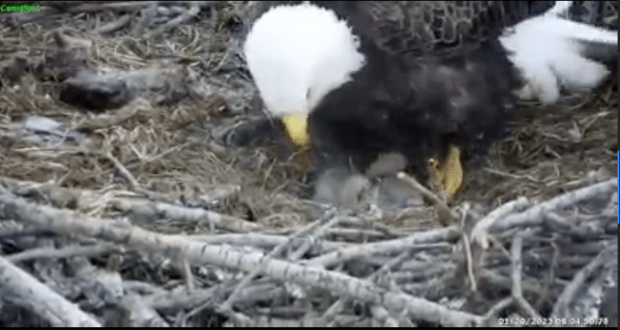
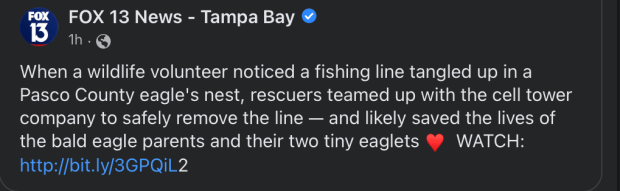
Oh, more good news. Teaming together to save the Bald Eagles and their chicks – the culprit: monofilament line. Please, please clean up after yourself if you fish, tell others to do so, and help out if you see fishing line, old masks, mesh bags…A good idea is to take a couple of bags with you if you go for a walk. You can use one as a glove. Pick up and try to properly dispose. Cutting the fishing line into tiny pieces helps. Then clean your hands!

A Place Called Hope is where you want to wind up if you are a raptor. They are fantastic. They have put out a FB announcement. If you know of anyone in this area who has lost a pet Cockatoo, get in touch.

Monitoring the Nests (some of them):

Let’s start with a wonderful Peregrine Falcon scrape and the amazing and ever loud, Indigo! This should put a smile on our faces.

Elain has her great daily summary video from Diamond and Xavier’s scrape. Yes, Indigo is still home! Love that loud kid, don’t you?

After the rain it is so nice to see Annie and her new ‘stingy male’! Thanks SK Hideaways. If he wants to win her heart, he had best part with that food. Note to self: maybe he is shy and gives her prey off camera?

Jackie and Shadow were both on the nest at 12:43. Early alerting and then relaxed. No signs of a fish delivery from Shadow so far on the 18th (til noon nest time). It looks like he might have been busy protecting the territory.

Shadow never likes to give up his turn to incubate.

At the Northeast Florida nest of Gabby and V3, the couple are working on their nest. Looks like more material being brought in. What a lovely couple.

There were some good views of Pearl and Tico at the Superbeaks Nest today. Gosh, these are lovely eaglets. Very attentive parents, lots of prey. An amazing nest! Pearl is the darkest – on the right and Tico is on the left. This is the difference in one day in eagle development.

The adults at the Duke Farm nest have been on and off and are working to get restorations finished before egg laying. There was a juvenile that flew to the nest and made a bit of a mess but all seems to be well.

It is, at times, very difficult to say what is happening at Captiva but, it is clear that Clive is a great male. The nest is full of fish – 7 or 8 of them and some pieces. Clive is doing a smacking job feeding the little one. I want to be hopeful.

At the last feeding of the day, 17:57, the eaglet has a smallish crop and is covered in fish juice.

The features of the eaglet are exaggerated because the feathers around its head, neck, and throat are all glued to its body from the fish juice. Hopefully a good night under Mum will help with that. It looks as if it has some fish today. Please keep sending your positive wishes towards this family. It will help you to see that ‘lump’ in the throat – the crop. So hopeful. There were 8 feedings on Wednesday and it would appear that baby and Mum are figuring out this feeding.

Feedings much better Thursday morning at Captiva. Feeling so happy for the little one.

So what happened to all the fish being delivered to the KNF-E3 nest? The kids have been eating off that old piece of Coot all day Wednesday. KNF-E3-01 was walking today and moving sticks about just like the adults, too! Making great strides including having a go at self-feeding. At the same time, the oldest eaglet has prevented the youngest from eating until it straddles up close to Mum and gets a few beakfuls. There are no piles of fish on this nest and when 02 did get some food, it was the hard old parts of the Coot. Where is Alex? and where is some fresh fish?

Is the beaking that began in earnest a couple of days ago because the adults cleaned up the nest and there is not a pile of fish? food insecurity?

The streaming cam went out shortly after 14:42 and this feeding. 02 is so hungry but 01 filled itself to the brim at the expense of the younger sibling. 01 can hardly stand its crop is so big. You can see that tiny little crop of 02’s.

Notice how much bigger 01 – probably a female – and 02 – probably a male – is.

Coot and fish on offer at KNF-E1 and their cam is off line also. Hoping everyone is safe.

Harriet and M15’s eaglets are getting curious about the outside world. Still so tiny! And sweet. No obvious beaking on this nest.

No word on any pips yet at Berry College.

Both eagles at the US Steel nest in Pittsburg, PA today.

Oh, I love these video clips that HeidiMc does of Ron and Rose…I wish we could get this kind of cute interaction on the nest of Gabby and V3! You have to pay really close attention…look at what Rose does!!!!!!!!!!!!!!!

I am still laughing. Great job editing, Heidi. Do we think Ron is going to get the hint?

There was some excitement with Diane and Jack over at the Achieva Credit Union. Diane is certainly better and was feeling frisky. Bonding took place on top of the perch pole. Now – that is a feat and it really shows how much improved and healed her leg is. Fantastic. Not sure how successful that mating attempt was but, it was a first me – ospreys on a pole.

In South Australia, Zoe is 123 days old today. On Wednesday, Mum and Dad delivered 3 fish to their girl (Dad 2 and Mum 1). Zoe is not starving!!!!!!!! Delivery times were 09:55, 13:45, and 21:19.

So much news…so many nests!

Thank you so much for being with me today. Please take care. Hope to see you soon!

Thank you to the following for their letters, their posts, videos, tweets, and streaming cams that make up my screen captures: ‘L’, ‘H’, Audubon.org, Webster Texas Eagle Watchers FB, Terry Carman and Bald Eagles Live Nest Cams and News, Red-tail Hawk Tales, Judy Eddy Bald Eagles 101, Fox 13 News Tampa Bay, A Place Called Hope, Elain and Charles Sturt Falcon Cam and Cilla Kinross, Cal Falcons, FOBBV, NEFL-AEF, Superbeaks, Duke Farms, Window to Wildlife, KNF-E3, KNF-E1, SWFL Eagles and D Pritchett, Berry College, US Steel Eagles, Heidi Mc and WRDC, Achieva Credit Union, and Port Lincoln Ospreys.

If you would like to receive the Bird World blog in your inbox, please fill in the following form. Thank you so much!

← Back

Thank you for your response. ✨

Worry for Middle at Port Lincoln as fish are few…and other bird world news

1 November 2022

Good Morning Everyone,

I hope that your beginning of the week has been a good one. We are on the third bad weather day at Port Lincoln and Middle has had little food. It is a very somber day. We wait to see if the weather changes and then to see if Big will allow Middle to eat. Things are not looking good. I wish I had great news for you this morning but ever so sadly, I do not.

Some of you are coming in late to the Alphabet-Name Game. It is for fun but, I have also discovered that it is a really good way to remember our feathered friends. Someone wrote that SE26 needed to be remembered and, well, the tap started running. That sea eaglet was such an inspiration to so many. I am so utterly deflated that she is not with us! — But, back to the fun part. Take a digital or physical piece of paper and put down all the letters of the alphabet. See what names of the streaming cam birds you come up with for each one. E is for Ervie. A is for ______________. Who can come up with a name for U? Anyone watching those Finnish Osprey nests? Send me your list by e-mail before midnight the 2nd of November. I will then set about collating them hopefully with some pictures! I hope to have the list complete over the weekend. Thank you to those that have already sent in their names. I saw so many that I knew and had forgotten! And do not feel bad if you come up with a lot for one letter and none for others, just send them in to me and join the challenge! That e-mail is: maryasteggles@maryannsteggles.com

In the Mailbox and Comments:

‘F’ comments: ‘The Port Lincoln nest is the hardest I’ve seen since I started seeing ospreys at the beginning of the year, very hard, the only thing missing is for the mother to be sick.’

You are so right, ‘F’. Yesterday I thought we had lost Mum and my heart just sank watching Dad try to feed the two osplets, Big and Middle, and failing miserably. It is very difficult to watch a nest that does not have enough fish. As I continue to mention, I have huge concerns over the commercial tuna fishing fleets that are based in Port Lincoln. Are they taking all the fish? I hope to find out more about this later.

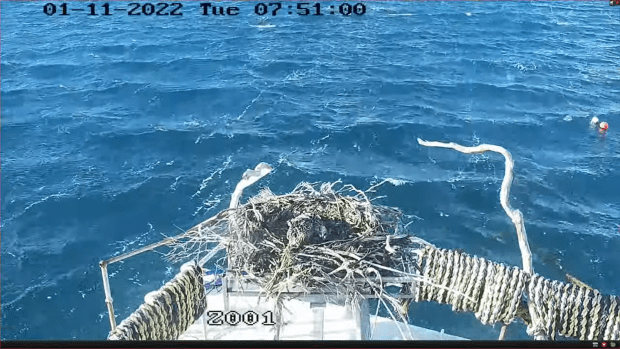
NOTE: There was only 1 fish yesterday, 1 November, in Port Lincoln. Big attacked Middle many times. Mum is currently sleeping on top of Middle. I am concerned now that Middle will not survive unless there is a massive amount of fish brought to the nest. There will be no intervention. Port Lincoln would not have permission unless as Ian Falkenberg and others have said they deem the bird to be ‘near fledge’. There have been ospreys taken into care who have done well at Audubon’s Centre for Birds of Prey at Mailand, Florida such as Smedley who lived to be 28 and Bailey. I am attempting to find other factual information on Ospreys in care. If you know of any, please let me know.

Smedley and Bailey at the Audubon Birds of Prey Centre in Maitland, Florida. Smedley passed away in the past year at the age of 28. Bailey is still alive at the Centre and I understand there is another osprey in care…perhaps more. I must check with our friend ‘L’ that works with these amazing raptors to find out precisely how many ospreys have gone through the centre. Some have stayed as ambassadors while others are returned to the wild.

Making News:

Just more research findings supporting birds and nature are good for our health and might, in the future, be prescribed by doctors! Have a read and smile.

https://www.theguardian.com/environment/2022/oct/27/bird-birdsong-encounters-improve-mental-health-study

There is a new article on birds and pollution by the British Trust for Ornithology. Have a read when you get a chance. We can all learn something new every day!

https://www.bto.org/understanding-birds/articles/birds-and-pollution-%E2%80%94-masterclass

Australian Nests:

One of the older siblings of the Melbourne Four looks up perhaps seeing the parents flying about. Next to her in the gutter is the wee 4th hatch, a little boy.

Victor Hurley, the head researcher for the Victoria Peregrine Falcon Research Group, has posted what he believes are the genders of the Melbourne Four on FP. Here is that announcement:

Oh, goodness. Ervie’s tracker has been off line for a few days and last night the camera went down on the Port Lincoln Osprey barge just when we were all getting more than concerned for Middle. Ervie has been seen roosting on a tree near the water so he is fine. He had flown away early probably hoping to find some fish.

The waves are really, really choppy at Port Lincoln. Rain and gales have hit the nest and the number of fish deliveries has been dwindling since the start of the stormy weather. There was only one fish delivered on Tuesday.

This is one gorgeous osprey looking at us with their crest up high.

They are hard to differentiate between unless they are standing up and you can compare size and then see both head’s. Middle is missing feathers from the nape and so is this bird with this gorgeous crest. Is this Middle? or is it Big fooling me?

‘A’ tells me that there is even snow predicted for Port Lincoln. I simply cannot believe this is happening. This nest is ‘fragile’.

Everything is fine at the scrape box on the water tower in Orange. Indigo is really flapping those wings and Little Rubus watches and then he does some precious little flaps, too. He copies everything that Indigo does – my goodness what an utter joy it is to watch these two grow up together.

Indigo works her wings all during the day. Little Rubus often watches closely and if you look, he will give a little flap to his wings.

Xavier brings in a European Starling for breakfast. Indigo gets frightened and moves back toward the wall and then scurries to the Cilla Stones.

Just look at that beautiful Dad, our loving Xavier.

Xavier decides to take the prey and prepare it elsewhere. By this time Indigo is curious and hungry and comes down from the stones. Will that Starling return?

Yes, it does. Xavier returns in about 50 minutes and Diamond flies in to take the prey and feed Indigo and Rubus. Oh, dear. Look at that is left on the stones!!! The Starling Head. Indigo is going to be scared out of her wits when she sees it.

Just look at those beautiful tail feathers now revealed. If you look at Rubus, he is now losing the soft down from around his eyes and on his wing tips.

Every time Indigo really gets to flapping more down flies through the scrape.

The eyases had a Starling feeding but the head was left. Diamond comes in to take it and Rubus rushes over to take it. Poor Indigo. Rubus is going to put it right near the wall where she is sleeping. Will she be frightened when she wakes up and there is that beak and eyes staring at her? Rubus has never been frightened and Indigo is so easily scared. It would be a trick a younger sibling would pay on its older one!

Rubus grabs the head.

He carries it over and places it next to Indigo!

Diamond returns in a few minutes and retrieves the head and feeds it to Rubus. I don’t think Indigo even moved. Rubus is an endless pit when it comes to prey. Where does he put it? Definitely not in his skinny long legs.

Indigo and Rubus had a European Starling and a Large Honeyeater (Noisy Miner) for their morning meals. Rain is forecast for Orange, too. You can see some dark clouds looming in the distance.

The Melbourne Four continue to be fed and to find out when you have to listen and watch them scurry down the gutter towards the adult with the prey. Their legs are certainly getting stronger and the oldest is starting to look like a juvenile falcon!

Just checking on some of the Bald Eagle nests in the US as the couples continue to do nestorations or rebuilding.

Jackie and Shadow’s nest at Big Bear in California.

Gabby and Samson’s nest near St Petersburg, Florida.

Ron and Rita’s nest in the Miami Zoo.

Bella and Smitty have been bringing in nesting materials to the NCTC nest.

Lady and Dad were bonding at the WBSE nest in the Sydney Olympic Forest.

My thoughts go out to the Port Lincoln nest this morning as we wait to see if Middle will survive. I am sure that I speak for all of us when I say that it feels like our heart has been pulled out of us. The turn in the weather and the amount of fish at Port Lincoln has put our beautiful Middle’s life in jeopardy.

The other two scrapes we have been watching are doing just fine. Much of the fluff is now off three of the falcons at 367 Collins Street. There is plenty of food available at both scrapes.

Take care everyone. Thank you for being with me. See you soon.

It is freezing in Port Lincoln tonight. Turned really, really cold. Mum is working hard at keeping Middle warm. Beautiful Mum.

Thank you to the following for their posts, videos, and streaming cams where I took the screen captures: ‘A’ and ‘H’, Audubon’s Birds of Prey, The Guardian, Port Lincoln Ospreys, 367 Collins Street by Mirvac, Charles Sturt Falcon Cam and Cilla Kinross, Victor Hurley and 367 Falcon Watchers, FOBBV, NEFL-AEF, WRDC, Sea Eagles@Birdlife Australia Discovery Centre Sydney Olympic Park.

Late Sunday in Bird World

23 October 2022

Hello Everyone,

I hope that each of you has had a fabulous weekend!

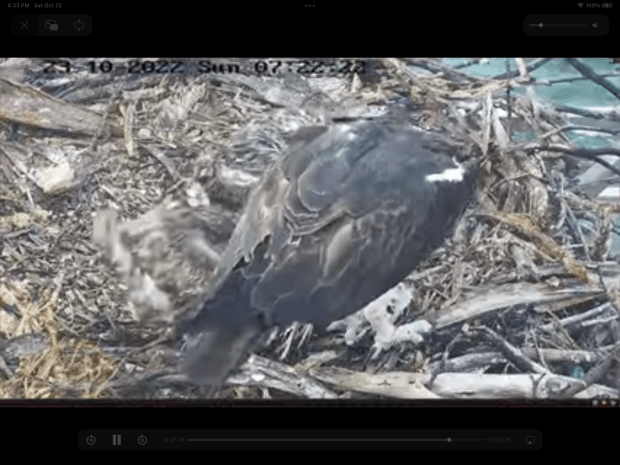
In my earlier blog today, I did not catch the ‘auto correct’ of Samson when I posted that him and Gabby were working on their nest. It is, of course, Samson not Damon!!!! Goodness.

The Sparrows thought it was warm enough for a bath today. And it is. It is a beautiful 14 degrees C – for me the absolute perfect temperature. It could stay like this forever and I would never get tired of it. They had such a good time! For well over an hour, one group after another spent time in the bird bath. They were so excited! I really do love sparrows…and I hope that those that think they will go extinct are wrong! And those that refuse to feed them because they are ‘not special’ will think again. They are so varied that I have a 8 cm thick book on them and still have trouble sometimes with Clay Sparrows and Vesper Sparrows — and I shouldn’t!

During the last month I have seen hundreds of Crows fly over my house around 1700. I did not know what they were doing until ‘N’ posted a YouTube video on Crows flying to join one another at a communal roost. It happens an hour before sunset. Thanks, ‘N’.

But, why did Crows get the moniker ‘Murder of Crows’? Apparently the use of the name goes back to 15th century English literature but, the Crow expert at Cornell University said the term is incorrect. ‘Scientists would call it a flock’. Indeed, Crows are often connected with death because they are black and because they eat carrion (dead animals) like Vultures, Condors, and Eagles. So remember, the next time you see a large group of Crows it is a flock!

As you will know, from reading my blog, I love ‘my’ Crows. Mr Crow has been around the garden for a number of years but, this year, he was joined by three fledglings that grew and grew and grew. (I always say Mr Crow…it could well be Mrs Crow!). This summer they started alerting me to when the wandering well-fed domestic cats were in the garden. They were so loud that their caws could not be ignored. For several days it seemed that they were wanting more food. They must have think I am truly daft. It wasn’t food – it was the cats. I am so grateful to them for protecting the other garden animals. In fact, most of the garden animals live in harmony. There is enough space and lots of food. It is the cats that cause the unhappiness.

But back to the Crows. ‘H’ wrote to me that Crows are signs of bad luck or death in Australia. In North American Indigenous traditions, the Crow and the Raven are good signs. They are signs of protection and often are viewed as messengers of wealth. In Manitoba, the Crow is part of the Creation Story of many of the local tribes just as it is with those in northwestern California. There are ceremonies that use the symbol, the power, and the prayers of the Crow to invoke protections – and these are very sacred, only used and known by those who deal with the Spirits. For the Inuit who live in the far north of Canada, the crow and the raven are often considered the same. You will find the creation stories of the Inuit and the Haida from British Columbia, using the Raven or the Crow, to tell their myths. The myth ‘The Crow Brings Daylight’ describes the moment when the people who lived in total darkness first saw the light that was brought by the Crow.

https://prezi.com/r9jz3ih7karv/crow-brings-daylight/

I hope that the Crow will bring you much luck and will guard and protect you.

All of the nests have had breakfast in Australia early. No one has had to wait for food to arrive despite the ominous clouds that you can see out the window of Xavier and Diamond’s scrape or the rain drops collecting on the camera at Port Lincoln.

Xavier brought in a Starling for Diamond to feed Indigo and Rubus. That was at 063320. Indigo and Rubus watch everything their parents do intently – each is a learning opportunity. The chicks will learn how to pluck and feed through observation. They will watch their parents fly from the scrape and, after they fledge, Xavier will teach them how to hunt. (With hawks and raptors it is often the role of the Dad to teach the fledglings to hunt.) Still, I have seen many, if not most, of the females do this as well. The exception would be the female Ospreys that leave the nests in the UK prior to the chicks fledging.

Notice that Little Rubus is in the corner with Indigo. Everything Indigo does, Rubus copies.

Indigo was so frightened by the Starling head last week. And here is another Starling head dangling! Do falcons have nightmares?

Just about the same time in Melbourne, at 0634, a plump freshly caught pigeon landed on the ledge at 367 Collins Street.

This morning you could really hear the stomping on that metal gutter! The eyases ate and began running up and down getting their legs strong. They are also flapping those little wings. Soon the white dandelions will be covering everything as the down flies off revealing the gorgeous juvenile falcon plumage.

It did not take long for the Melbourne Four to ‘decorate’ the far end of the gutter. Did you know that when falcons are looking for a good territory/scrape box/cliff, they will check to see how much guano is spread all over. The more ‘ps’ the better – it means that the area is rich in prey. An ideal location to have a nest!

Flapping and flapping. The others are almost all the way down to the other end of the gutter. The little one, however, chose to stay in the scrape. Cute wings!

Thankfully, Dad was out fishing early at Port Lincoln (as I am told he always is) and he hauled in a flat Zebra fish at 065757. The feeding was absolutely civil. In fact, it looks like Middle got the largest portion of that early fish.

It is difficult to describe how thrilled I am that Big has settled down and that life on the Port Lincoln Osprey platform is civil. It helps everyone. Middle can now eat without too much fear of reprisal. Still, he should be a wee cautious just in case Big wakes up on the wrong side of the fish one morning.

The nests have had their first meal for Monday in Australia. All is well.

There is no further news on Sea Eaglets 29 or 30 – both are in care. Dad and Lady have been working on their nest. They must wonder where their fledglings have gone. I wonder if they will leave for Lady’s favourite spa location, Goat Island, soon?

Thank you so very much for joining me. Take care of yourself. See you soon!

Thank you to the following for their posts and streaming cams where I took my screen captures: Pinterest, Charles Stuart Falcon Cam and Cilla Kinross,. 367 Collins Street by Mirvac, Sea Eagles@Birdlife Australia Discovery Centre, Sydney Olympic Forest, and Port Lincoln Ospreys.

Egg shells and pelting rain…late Saturday in Bird World

22 October 2022

Good afternoon everyone,

It is a miserable day in Port Lincoln and in Orange…I have not checked Melbourne but, it is also kinda’ miserable in Winnipeg today, too. Grey skies, bare branches on brown trees, spits of rain falling.

The view of the landscape looks dead and barren – but, we all know that, in fact, those leaves are protecting all of the pollinators and invertebrates. This is why you must Leave the Leaves! It will annoy your neighbours to no end but, you will be doing yourself, your garden, and the birds a huge favour.

Ah, I have a retraction. Books do not work for everyone. My friend, Sally Michener, a Vancouver ceramic artist, told me once that “getting old is only for the brave!” She was 83 at the time and stunningly beautiful, always in red, and still working on her ceramic sculptures. She is right. Eye sight goes. Our minds still think like the 20 somethings we once were but, sadly, not always our eyes. ‘H’ reminded me that e-Books are fantastic as you can adjust the size of the font. Of course! ‘H’ also tells me that both of David Gessner’s books on Ospreys are available as e-Books. Thanks, ‘H’.

Wow. A ‘V’ of Canada Geese just flew over my head. They were as low as the top of the telephone poles in the back lane. Incredible.

——————————————————————————————————————————

It is pelting down rain in Port Lincoln. Mum is soaked and I wonder how miserable the kids will be with their circumstance? Dad has proven himself quite capable of catching fish in rain and wind but the waters look pretty chopping. Wishing him luck today.

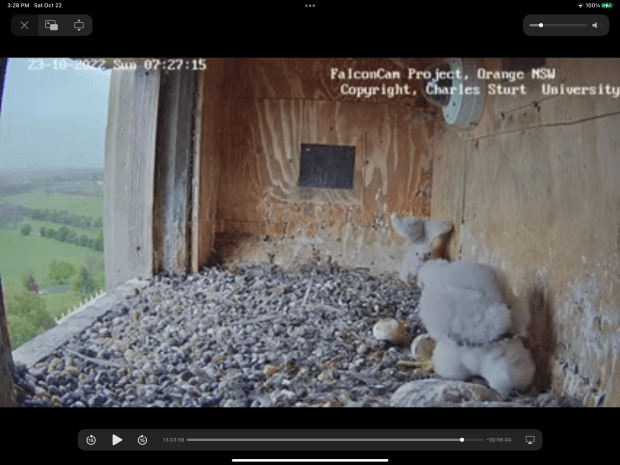
The weather at Orange is rather bleak also. So bleak that Diamond was finding scraps to feed Rubus and Indigo decided she would just eat one of the egg shells being tossed around all over the scrape.

Look at Rubus in the corner flapping those little wings. Oh, this eyas melts my heart.

Indigo’s wing feathers are growing, can you see them? And if you look closely you will see the feathers on the tail coming as well. Such a beautiful healthy big sister for little Rubus.

The skies look heavy with rain – like the ones above me. But, oh, look at that green…green fields and trees. Beautiful.

The little raptors hatch so that by the time they fledge, their prey will be waking up from winter.

The first prey of the morning came in at 062814 in Melbourne. Am I seeing things? Has it stopped raining in Melbourne?

I absolutely cannot tell you what it is!

Well, Dad did not disappoint Mum at the Port Lincoln Osprey barge. he brought in a nice big fish for breakfast. I cannot tell you precisely how much fish Big got or Middle but Middle stayed by the side of Big and you could tell from his movements that he was snatching and grabbing. At one point I saw a small crop. This is all good. There was no cowering in the corner in submission to Big. Let us all send warm wishes to this nest for continued fish and both chicks eating. Here are a few images of that feeding – and bravo Dad!

It is always reassuring to see the chicks on all the nest fed first thing in the morning. The three are starting out the day absolutely fantastic. Let us hope that this continues.

Thank you so much for joining me. Everyone is good. Let us hope that all of the nests in Australia continue with many prey deliveries today. Take care everyone. See you soon!

Thanks to the following for their streaming cams where I took my screen captures: Leave the Leaves!, Port Lincoln Ospreys, 367 Collins Street by Mirvac, and Charles Stuart Falcon Cam and Cilla Kinross.

Port Lincoln’s Middle Bob is getting some confidence…and other tales in Bird World

22 October 2022

Oh, good morning to everyone,

I hope that you are already having a wonderful weekend by the time you read this update on our feathered friends. Things are really beginning to look up at Port Lincoln. I am cautiously optimistic that Big is moving out of her aggressive stage.

My friend “S’ and I were talking about books – holding books, feeling the paper, turning the pages – a few weeks ago. She is encouraging her graduate students at university to read real books, to go to the library, to feel the pages. Of course, she was talking to a ‘member of the choir’, so to speak, when we had our chat. I love books, good quality books with beautiful images. Today, it wasn’t a book that arrived in the post but Cornell Lab of Ornithology’s Living Bird magazine that arrived. The cover featured a beautiful goshawk. Inside was a treasure trove of information for every species lover. There was a lot of information on migration, loss of biodiversity and what this means alongside reports on projects aimed at mitigating loss. The core of every article is how each of us can help mitigate the issues- sparking action to bend the curve.

As researchers and citizen scientists discovered with the great bird counts, the number of songbirds increased dramatically when ordinary people, just like you and me, began putting out bird feeders. Today, one of the most pressing issues is biodiversity. It is the word of the moment. One of the articles in this edition of Living Bird, ‘The Most Distinct Birds are at Greatest Risk of Going Extinct’ goes straight to the heart of the loss of entire species. On that list of Red Species, to my surprise, was the House Sparrow and the European Starling. The lead researcher, Emma Hughes from the University of Sheffield, said that birds with unusually long or short beaks, long or short legs were more likely to go extinct than others. Climate change and habitat loss is at the heart of the loss of these others such as the Red-headed Vulture, Giant Ibis, Seychelles Scops-Owl, the White-headed Duck, the Bee Hummingbird to name only a few on her list. They are going extinct because of their weirdness and the particular ecosystems that support them are being lost. For Hughes, the only way to stop the extinction is to increase efforts at biodiversity (21). This is precisely what they are trying to do with two species that depend on one another for survival – the White-barked Pine and the Clark’s Nutcracker. As the author of the article in Living Bird states, ‘Some pairings are so iconic that one is not complete without the other: Macaroni and cheese, Abbott and Costello. Peanut Butter and Jelly. In the northern Rockies and Sierra Nevadas, that duo is the white bark pine and Clark’s Nutcracker.’ (28)

To read the latest addition of Living Bird magazine, go to this URL: https://www.allaboutbirds.org/news/living-bird-latest-issue

There is a lovely video of the work being done on the Clark’s Nutcracker in this latest edition. Be sure to check it out.

I used the term ‘Red List’. Do you know what this means? It is the full name is the International Union for Conservation of Nature’s Red List of Threatened Species. It just so happens that there are two wonderful and exquisitely produced books on these threatened birds. They are Red Sixty Seven and the most recent edition, Into the Red, by Kit Jewitt. Both editions are collaborations between authors and artists whose goals are to call attention to at-risk-birds as well as to raise funds to support conservation work to halt their extinction. The books were published by the British Trust for Ornithology. Go to bto.org for more information, to view some pages and read about the artists, and to purchase. The purchase will go directly to helping. I urge against buying through on line book sellers as the prices on their sites are way too high or they say not in stock.

———————————————————————————————————————————

It is nearly 2300 on the Canadian prairies. There are no stars out tonight but there is one brave little Osprey in Port Lincoln, Australia who needs a round of applause. That ospreys name is Middle.

At 111232 a whole large live fish landed on the nest. Middle is being overly cautious not trying to grab any bites. Letting Big get those precious first bites and get her crop a little full. Meanwhile, Middle is pecking away at the tail of the fish. This is very interesting. You have probably seen, as I have, siblings eating from the tail while the breaking sibling is fed up at Mum’s beak. It is a good strategy once Middle figures out how to unzip that tail. By 112218 Middle is up by Big and is doing the snatch and grab. Sometimes Middle pulls back – he is very cautious. Mum gets to eat some fish. In fact, she is feeding the ospreys a little slower than usual. Big moves away from the fish feeding a couple of times. The first is at 112506. Big has been eating for 13 minutes and is getting full. Mum begins to feed Middle. At 112951 Big moves away. Middle remains cautious and then, at 114139, Middle pecks Big before he moves up to begin getting fish. So to summarize, even thought Middle is afraid and displays this as we watch, he is hungry and he is getting braver in order to get fed. Eating is essential to his survival. Middle is doing well. He will end the feeding with a nice crop.

I also noticed that Big is not as grumpy as yesterday despite there being 5 hours between fish deliveries. Perhaps she is slowing down, hitting that plateau. That would really bring peace to this nest.

By the time the 1637 Zebra fish arrives on the barge, Middle is feeling much better, more confident, and Big is being nicer. That feeding went well and even at 1817 when Mum and the two ospreys saw Dad and were feverishly calling for another fish, Middle (and Big) had enormous crops from the day’s takings. I have spent much time watching this nest as opposed to the two falcon scrapes because the fate of Middle was not quite clear. I will have said it twice today, at least, but, it appears that Port Lincoln has turned a corner.

Look carefully at the bottom image. That is Middle, full to the brim. Just sit and smile. Cry. Life appears to be good at Port Lincoln. Still, send all your best and warmest wishes to this family for continued supplies of fish.

It is getting more difficult to tell the female Peregrine Falcons from the males. You must look closely. Diamond just about fooled me yesterday. They lose weight. All of the females lose approximately 30% of their body mass during incubation and raising their chicks. Diamond now has the look of a male with his tight little striped pants.

The same is true for Melbourne where the camera is now positioned so we can see the happenings at the far end. Mum seems to be enjoying it. She has a nice perch above the chicks so that she can watch them but not have any one or all of the Melbourne Four rumbling around underneath her all night. Like human parents, she can get some sleep now!!!!! Thank you to ‘H’ who watched and clocked the feedings at 367 Collins Street yesterday. Much appreciated. There were 5 of them. At 0650 a large unprepared prey arrived on the ledge. The erases were fed for 22 minutes. Leftovers came at 1153 and that was an extremely short feeding of 4 minutes. At 1358 D arrives with a big prey item and feeds the eyases and then Mum arrives and takes over. That lasted 16 minutes. The final two feedings at 1657 and 1836, were large prey items fed for 24 and 18 minutes, respectively. Four active growing eyases can eat a large unprepared bird in such a short time!

This is just a short catch up. Everything is absolutely fine at the two scrapes in Australia – at the 367 Collins Street location and at Orange. I am cautiously delighted about the happenings at Port Lincoln and extremely proud of Middle Bob who is getting ever so clever. Middle Bob is a ‘survivor’.

Thank you so much for joining me. I hope that you are all well. I am back to normal. it was the flu shot that caused me to feel like I had been hit by a big truck. It is cloudy this morning but it appears to be a reasonable day to go and check on ducks. Take care everyone. See you soon!

Thank you to the following for their streaming cams where I took my screen captures: Port Lincoln Ospreys, Charles Stuart Falcon scrape, and ‘H’ and ‘A’ and 367 Collins Street by Mirvac.