Uplifting stories in Bird World

A lady in Manitoba is trying to figure out if anyone has ever seen what is happening at her house. Keely calls it a ‘strange domestic situation’. The nest has 3 robin chicks. The couple taking are of them are a Robin and a Sparrow. Both of the birds sit on the nest, feed the chicks, clean up the nestlings pop sacs, as well as standing guard. The couple often sit next to one another on the telephone line. Keely finds it fascinating. Have you ever seen such an adoption?

The little sparrow’s head almost fits into the mouth of the Robin nestling when he comes to feed it.

The proud couple!

In Montana, there has been a second life given to an Osprey chick. Ospreys are known to be very good foster parents. The researchers at the Montana Osprey Project have been busy. They are trying something very complicated called cross-fostering.

Yesterday they found a second chick that was found tangled in baling twine at the Steinbrenner’s House. It was an only chick. If they removed it to care the parents might leave for their migration. At the same time, the original chick that was taken to care for baling twine entanglement was ready to go back to its nest. That chick’s name was Kona. But its older sibling had fledged and the parents weren’t at the nest much.

So Kona was put in the nest at the Steinbrenner’s house. The plan is to keep the parent’s busy taking care of Kona until their chick is out of rehab in a week or so. Then they will have two chicks to look after.

So how did it work? Kona was placed in the Steinbrenner nest and she begin flapping and wingersizing. At the same time, the person with the Montana Osprey Project put two trout in the nest with her.

Kona with her two gift trout in the Steinbrenner House nest. @ Montana Osprey FB Page

The female landed on the nest and there was no aggression spotted. The female took one of the trout and flew to eat it. Kona began eating the other trout. Meanwhile, the male arrived with a fish which, when seeing everyone eating, he took off to eat himself. The female went back to the nest and both her and Kona are eating on the fish. Another great intervention to help the birds. Smile. It is fantastic! The latest news is that all is well.

Those stories just make you feel really good!

Other Nest News. If you are needing to see some Bald Eagles, Harriet and M15 are back hanging out at the SWFlorida Bald Eagle Nest on the Pritchett Property in Fort Myers. Samson was seen on the NE Florida Bald Eagle nest and that streaming cam is up and running after its annual maintenance. The Collins Marsh Osprey is looking good.


The Achieva Osprey nest has had an adult visitor today. Rumours have it that it could be Jack, the female, just checking on his territory. Blue 463 otherwise known as Tiny Little Tot on the Foulshaw Moss Nest has become the dominant bird on the nest – wow. A mighty third hatch. She was there today waiting for a fish delivery and looking good.

Zenit continues to grow and stay close to the nest for prey deliveries. This Golden Eagle juvenile has really grown! The Asociata Wild Bucovina that sponsors this nest have received enough donations to have two cameras operating next season. Congratulations to them.

It has been a really uplifting day in Bird World. Thank you so much for joining me. Take care.

Thank you to the following for their streaming cams where I took my screen shots: Asociata Wild Bucovina, Cumbria Wildlife Trust and Foulshaw Moss Osprey Cam, and the Collins Marsh Osprey Nest Cam. Thanks also to Keely on the Manitoba Birding & Photography FB Group for allowing us to share her story and to the Montana Osprey Project FB Page.

Saturday morning in Bird World

Lady and Dad at the White-Bellied Sea Eagle Nest in the Sydney Olympic Park Forest welcomed WBSE 28 at 5:41 pm on 31 July.

The egg began to split open at 17:08. You can see the egg tooth of the chick that is banging away at the shell. Once it is all cracked like it is now, the chick will wiggle and push to get out. Lady often helps by pulling off the bottom of the shell. She removed the shell of 27 so that it would not adhere to 28’s shell and cause difficulties. The females often eat the shells to help them regain their calcium that has been partially depleted making the eggs.

By 17:41 WBSE 28 was completely out of the shell and for some crazy reason the streaming cam decided to switch to IR mode! Let us all hope that 27 is a gentle and caring older sibling til these two get big enough and out of the bobble head stage!

Congratulations to everyone down in Sydney!

It was wonderful luck to wake up in Canada and see Tiny Little on the Foulshaw Moss nest in Cumbria. It was 14:15 and she was busy eating a nice big fish all alone. Wow.

Tiny Little kept looking about while devouring her afternoon meal. With two big siblings and no where to hide I am certain that she is hoping they don’t show up.

Tiny Little has grown into a beautiful fledgling. At the time of banding they believed that Tiny Little (or Little Bob, LB) was a female but could not say for certain as her growth was so much behind the other two but, she has caught up. Look at those strong stout legs. She is a gorgeous female.

Thinking maybe I might get lucky, I decided to check on the Collins Marsh chick just in case there was an early morning fish delivery. At first, it did not look hopeful and then the chick and Mum began food calling. Dad must have been in sight of the nest.

Ah, what a relief to see this little one getting fed early in the day. Let us hope that the deliveries continue in rapid succession. This chick needs a lot of fish to grow as big as Tiny Little before it needs to migrate.

It seems everyone is eating! Zenit, on the Bucovina Golden Eagle Nest in Romania, has received a delivery, too. Here is Mom arriving with the prey at 11:01:09. She calls out to Zenit.

It is not even a second before Zenit arrives, very excited, on the nest.

Mom moves off that nest quickly as Zenit mantles his lunch.

In Romania, as in other cultures, the Golden Eagle is a symbol of noblility and power. Images of double-headed eagles can be found on the buildings and coins of ancient civilizations in the Middle East such as Sumer and Babylon. The Romans, the Holy Roman Empire, and the Byzantines each used the symbol of the Golden Eagle for their empires. The Aquila (eagle) appears on the standards (the top of the spears of the Romans while the Byzantines were fond of the double-headed eagle which symbolized the dual role of the emperor as both secular and religious head.

An illustration of the vexilloid of the Roman Empire with the Golden Eagle standard:

This is the flag of the Holy Roman Empire:

Wikimedia Commons

Today the Golden Eagle continues to appear as an emblem of the government for various countries and rulers of Europe including that of the President of the Russian Federation. So even in contemporary times the beautiful eagle adorns the coins, buildings, flags, and uniforms representing their power and authority.

Historically, the Golden Eagle was widespread throughout Romania. There was a steep decline in the numbers of breeding pairs in the 20th century due to the use of pesticides both for agriculture and the control of mosquitoes. Hunting and the lack of sufficient food also caused a decline in the numbers. In 2002, it is estimated that there were only 30-40 nesting pairs in the country. This figure doubled in 2012 to 50-60 pairs. There are approximately 300 breeding pairs in Romania today. Current threats to the Golden Eagles continue to be a lack of prey, illegal logging, loss of habitat, poaching, and poisoning. The Golden Eagle is, thus, very rare in Romania.

“Golden eagle (2)” by jack_spellingbacon is licensed under CC BY 2.0

When Zenit is an adult, his wings will be up to 2.1 metres or 7 feet and he will weigh from 3.2 to 6.6 kilograms or 7 to 14.5 lbs. Females are one quarter to one half larger than the males. Juveniles have been known to travel up to 1000 km or 621 miles after they leave their natal nest. Zenit will reach maturity when he is around 5 years old. Golden Eagles have been known to live up to 32 years but the average is 15-20 years.

At the time he is an adult, Zenit will be an ‘Avian Apex Predator’. That means that healthy adult birds are not prey to any other raptor or mammal. They are at the top of the food chain. Zenit’s eyesight is 8 times that of a human – much better than mine! He will hunt rabbits, young deer, goats, and ibex but he will also eat carrion, birds, and squirrels.

It has been a great learning experience watching Zenit grow from being a chick into this beautiful juvenile.

It is a dark and gloomy Saturday. It is difficult to tell if the strange look in the sky is from the fires, perhaps an impending rainy day, or both. It might be a great day to sip hot tea and read. A copy of The Scottish Ospreys from extinction to survival arrived from a used book store in the UK yesterday. It looks like it is a perfect day to dig into it.

Thank you so much for joining me. I hope that you have a wonderful Saturday.

Thank you to the following for their streaming cams where I obtained my screen shots: Sydney Sea Eagles, Birdlife Australia and The Discovery Center, Collins Marsh Nature Reserve Osprey Cam, Asociata Wild Bucovina, Cumbrian Wildlife Trust and the Foulshaw Moss Osprey Nest.

Fledge at Mlade Buky and other news in Bird World

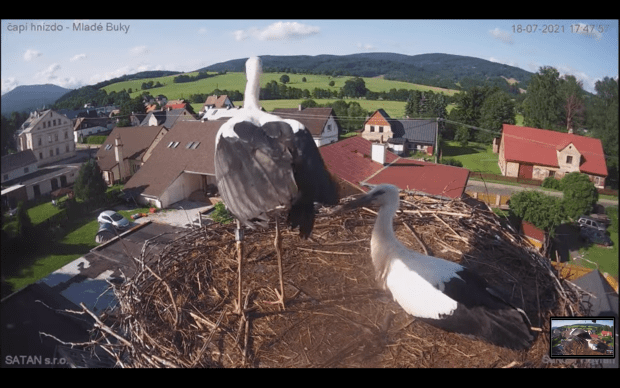
We have a fledge at the White Stork nest in Mlade Buky!

Oh, this is just so wonderful. The people of this community can be so proud as these three beautiful birds leave their nest. It was their help that made it possible for these three to be alive today. Bravo.

Here is the video so you can watch it.

The heat wave has taken more tolls on birds in the Pacific Northwest not just the Osprey chicks that literally roasted in the nests. Cooper’s Hawks have been jumping off the edge of the nests so they do not get cooked by the hot sun. This is a real tragedy in the making. Even the number of birds at my feeders is down. They spend the day in the myriad of vines in the shade of the house and the lilac bushes only coming out to drink and return to shade. The outside temperature near the water bowls reads 34 C. That is hotter than it is in the West Indies! So please put out water for the birds! Find old dishes and provide them with something. Thank you!

I hope that you are able to open this. If not you could Google ‘hawks jumping out of nests to avoid heat’. This is just so sad.

The streaming cams for many of the nests are being turned off as the season ends. Glaslyn will turn off the feed to Aran and Mrs G’s nest shortly as will Rutland Water on the Manton Bay Nest of Blue 33 and Maya. We will look forward to another season with them in the future. Blue 33 and Maya are a super Osprey couple – celebrities if you will allow me to call them that. They have been together since 2015 and have fledged 17 chicks. They raised a nest of four in 2019. That is almost unheard of and really takes a strong male to feed that many. I am impressed. I told someone if I came back as an Osprey in another life I wanted Blue 33 for my mate. He is incredible. They will return to the Rutland Manton nest in late March – usually within an hour of one another.

I expect many others will follow as it is costly to run the cameras. If you go to the camera and it is not functioning check the nest’s FB page. They have probably turned off the camera til the next season. But please remember that the breeding season is only beginning in Australia with the Peregrine Falcons, Port Lincoln Ospreys, and the WBSE.

NC0 up at the Loch of the Lowes nest is out fishing for her chicks. She is incredible. She spots the fish from the nest and dives down and gets it. Here is a very rough cut of a video of the two Loch of the Lowes chicks enjoying themselves.

I never thought I would say that a Golden Eagle nestling was cute but Zenit certainly is.

Zenit is really working on his wing flaps and from his crop it appears that he has had a feeding. That is good. I am just thinking how lucky Zenit is to be in a tree nest with shade.

Kindness is one of the cutest Bald Eagle nestlings I have ever seen! Here she is again trying to nibble around mom.

Oh, how beautiful. Kindness sitting next to Mom. Everyone thinks Kindness is a female because her Dad loves to feed her!

You are getting to be a big girl, Kindness. You are 52 days old today! More than halfway to fledge which will be around 89 days – the average for the Glacier Gardens nest. (The average in Alaska is 80 days).

Tiny Little has been in the nest every time I checked on her. A fish came in and 462 ate and ate. Then 464 came and couldn’t get the fish tail down. Tiny Little was playing with it when White YW brought in another fish. Tiny Little ignored it and dad left with the fish! Silly Tiny! Some dads will feed their chicks but White YW doesn’t seem to do this very often preferring that Blue 35 take on those duties almost exclusively. Tiny Little has yet to get confident in opening up a fish with a head.

White YW returned to the nest at 17:39 and Blue 35 flew in to feed Tiny Little. Tiny did not ignore that fish this time!!!!!!!

Oh, she just loves being fed by mum. Tiny Little eats for about forty minutes.

This kiddo should be stuffed.

At 21:00, Tiny Little and big sib 462 were cuddled up duckling style read to sleep.

It is not clear to me if Tiny Little ever did a second flight today. She was flapping those wings really hard and walking around the nest looking down for a long, long time. Often I had to leave only to return to find Tiny on the nest. Maybe someone saw her fly again?

Tiny tried everything but getting over on the middle left side of the nest and just going for it like she did when she fledged was something she did not do. There were a few good hovers. Fingers crossed for tomorrow. Need to get those wings strong and self-feeding down for migration.

The couple who saved the little osprey chick that fell into the river at the Putuxent Osprey Nest 2 were surprised that so many people from around the world watch their birds! I mentioned to them the need for an emergency number on the streaming cam. Fingers crossed! Thank you to everyone that sent them a thank you note. The chick is doing well.

Thank you for joining me for a quick look at a few nests on a Sunday evening. Take care. It is very hot in so many places or there are torrential rains and flooding. So where ever you are be careful.

Thank you to the following for their streaming cams where I took my screen shots: Glacier Gardens Park, Cumbrian Wildlife Trust and the Foulshaw Moss Osprey Nest, Mlade Buky White Stork Cam, Patuxent Park Osprey Cam 2, and Asociatia Wild Bucovino.

Nest Hopping News for 1 July

Juvenile Osprey Blue 096 has fledged from the Rutland Manton Bay Nest of Maya and Blue 33 (11). It happened at 12:12:27 pm.

He looks up.

Wings begin flapping. Blue 095 goes, “oh, not this again! This nest is getting too small for flapping. I wish you would just go away!”

He’s on tippy toes and grabs the wind and…

Blue 096, male chick of Maya and Blue 33 (11) fledges on 1 July 2021.

Jack delivers a breakfish to Tiny Tot this morning. Oh, thank goodness! It is 28 degrees C and the weather service says there is a 40% of a thunderstorm around 5pm in St Petersburg, Florida. Thanks, Jack!

By 9:29 Tiny Tot will have that fish out of dad’s talons and she will be saying ‘Yum’.

There were, to my knowledge no fish deliveries to Tiny last evening. She was really waiting and watching for dad. Turns out it is a small headless fish, a bit of a teaser for our gal who chowed down on that whopper the other day, this morning.

Look at those magnificent wings. Tiny, you are such a gorgeous bird!

Well, one of those nests that I suggested you watch when others get stressful just turned up the noise. Lady Hawk posted a video of the Royal Cam chick going to visit her neighbor SSTrig and the neighbour gets into a big territorial dispute. Taiki is very social and meant no harm but we now know there won’t be any afternoon tea parties with these two. Here is that video:

There is great news coming out of New Zealand. Remember I love this country for the way in which it takes care of its wildlife. Well, today, New Zealand announced that it is putting surveillance cameras on all of its fishing boats to make sure that they comply with safe fishing so that no seabirds are caught as bycatch. Way to go New Zealand!

The landscape at the Glaslyn Nest of Mrs G and Aran in Wales is stunningly beautiful. I admit to dreaming of trees and places where you can look out and see birds and not the concrete of the city. Of sitting and smelling the wet grass and hay and not the petrol fumes of cars. Of disappearing into the wilderness.

Aran and Mrs G are spending more and more time together. Aran is able to fish after his injury in early June but he is still healing. There will be no more chicks this year but the couple was seen bonding. That is fantastic!

Aran brought in a big fish earlier that he was eating. I wonder if he shared it with Mrs G who now has a nice chunk and the tail in her talons. He has provided at least one fish to her that was caught on camera which is a great indication of Aran’s continuing progress in healing.

The two Bobs at the Dyfi Osprey Nest in Wales are enjoying a lovely fish that Idris delivered. Telyn is a fantastic mom but that nest is getting a little crowded. She may have to stand on the rails to feed her babies soon. These two are growing like crazy! You might remember that Dysynni, the male, is the largest male Osprey born on this nest ever. Idris has really brought in some of the large fish. It has been determined that many of those fish actually weigh more than Idris – breaking another myth that Ospreys can only carry a % of their actual weight.

It also demonstrates how much food and the quantity of it matter to the health and well being of the chicks. This is the nest of a super dad – as are many of those in Wales and other parts of the UK.

Meanwhile, over in Scotland, the two Bobs on the Loch of the Lowes nest are waiting for NC0 or Laddie to bring them in a tea time fish. Gosh these Bobs are beautiful. The time has flown by and they will soon be hovering and fledging but, in those very first days, I really wondered if Bob 2 would survive the bonking from Bob 1.

And goodness, I woke up this morning and had to look twice to figure out which of the chicks on the Foulshaw Moss Nest of White YW and Blue 35 was Tiny Little Bob! Which one do you think is Tiny Little?

If you said the one closest to the right looking out, you would be right. She or he is watching for one of the parents to arrive with a fish! As noted from the people who ringed the chicks, they could not determine the gender of Tiny Little from the measurements because of its small size at the time. Rumours had gone around that Tiny Little is, in fact, a female.

Today, the Cumbrian Wildlife Trust put out their announcement about the ringing of these three Ospreys. Part of the celebration is that Tiny Little was the 100th osprey chick to be banded in Cumbria since 2001. That is amazing. Here is part of the text that was posted:

“I’m incredibly pleased that we have ringed another three osprey chicks at Foulshaw Moss Nature Reserve this year. For a time we we’re unsure if the smallest chick was going to make it. It was rapidly being outgrown by its bigger siblings but it carried on fighting for its share of the food from mum and dad. Now there’s not much difference in weight – and it was the smallest one that was the 100th osprey chick to be ringed in Cumbria since 2001! Osprey chicks are weighed by the licenced bird ringer and each chick is given a coloured leg ring. This year we have Blue 462, a female weighing 1.6kg, Blue 463 weighing 1.5kg – gender unknown, and Blue 464, a male weighing 1.6kg”.

Paul Waterhouse, Cumbria Wildlife Trust

I wanted to check in on the little Golden Eaglet in Bucovina, Romania. He has changed so much in just a few days. Most of the white feathers are gone and are now replaced with the beautiful dark black kind of espresso coloured ones for the juveniles.

The female has come to the nest to feed the eaglet. There were lots of bones and scraps of meat left on them. It is unclear to me whether or not the mother has brought in new prey or is using what is in the pantry.

You can look and see the remote mountain area where this nest is located. I continue to hope that the parents are able to find enough prey for this little one to thrive and fledge.

Thank you so much for joining me today. I regret I have no images of the Ks for you – maybe later today. They are off exploring the trees and some of the buildings with Big Red and Arthur. Everyone is fine; they are just not around the nest!

Thank you to the following for their streaming cams where I obtained my screen shots: Bywyd Gwyllt Glaslyn, Cumbria Wildlife Trust and Foulshaw Moss Osprey Nest, Scottish Wildlife Trust and Friends of Loch of the Lowes, Achieva Credit Union, Asociatia Wild Bucovina, LRWT and Manton Bay Osprey Nest, Cornell Bird Cam Royal Albatross and NZ DOC, and Dyfi Osprey Projec. I would also like to thank Lady Hawk for her video clip of the territorial dispute between Taiki and SSTrig.