Monday in Bird World

15 September 2025

Good Morning Everyone,

We are one week away from the autumn solstice. It is a beautiful Saturday on the Canadian prairies. It is 24 C. The sky is a hazy light blue with the sun beating down on the garden. The cranberry bushes are turning flame red, the leaves have been turning for some time, and early in the morning, sitting on the deck with Toby and a coffee, we can hear the geese far above us honking.

Time passes too quickly. Not two blinks ago, the children were getting out of school for the summer holidays, and now they are back. We are even having our annual street party tomorrow. It felt as if the last one was just months ago. Do you ever feel this way? Like time is melting between your fingers? Still, it will feel like aeons until Gabby and Beau have their first egg. Time will drag til the ospreys return, and then it will fly again!

I am happy to report – thank you to all the good energy you sent – that Baby Hope is completely healed and new fur is growing over her injury! I cannot tell you what a relief this is. We worried that she would continue to scratch at the injury so that it wouldn’t heal. Toby is also fine. He is a little ‘stiff’ going down the stairs but he is back to wrestling some with Hugo Yugo. They continue to sleep together in the big dog bed. It is so sweet. Missey and Calico are well, too. I cannot ask for more.

So what is happening in Bird World? For the most part, the ospreys are gone. Tiger Mozone reminds us it is approximately 178 days til they return in the UK. What will we do without them? — Watch Port Lincoln! And the Bald Eagles, right?

We will start with two video offerings by SK Hideaways to get us excited! None other than Monty and Hartley and, of course, our favourite Big Bear Valley Eagles – Jackie and Shadow.

San Jose City Hall Falcons Hartley & Monty (2025 Sep 14)

Monty arrived to tidy up the nest prior to Hartley’s arrival. Their meeting was a veritable beaky kiss fest. Guess three successful broods is the key to a successful relationship.

Courtesy San Jose City Hall Peregrine Falcon Cam

Nest Cam: https://www.youtube.com/watch?v=VBSxPjy5sow

Ledge Cam: https://www.youtube.com/watch?v=-pp9TisLmLU

Roof Cam: https://www.youtube.com/watch?v=RQLhmV6bP6o

Facebook https://www.facebook.com/SanJoseCityHallFalcons/

Wiki https://sanjoseperegrines.editme.com/

Big Bear Eagles Jackie & Shadow (2025 Sep 12-13)

Jackie and Shadow perched on their Roost Tree overnight and Lookout Snag at dawn. Such peaceful, soothing scenes.

Courtesy FOBBVCAM, Friends of Big Bear Valley

Resident Bald Eagle male: Shadow (unbanded) since May 2018. Estimated hatch year: 2014

Resident Bald Eagle female: Jackie (unbanded) since September 2016. Estimated hatch year: 2012

Nest Cam: https://www.youtube.com/watch?v=B4-L2nfGcuE

Wide View Cam (Cam 2): https://youtube.com/live/LCGYWfbyBWc

LIVE Recap & Observations https://bit.ly/3Md8TSz

There are a few ospreys still at home. Dinas is one of those in the Glaslyn Valley with Oscar still in Nova Scotia.

Others are being spotted as they move through the UK on their way to the coast and off to the Iberian Peninsula or West Africa.

The last hatch, the fourth, remains at Dunrovin Ranch in Colorado with Dad, Swoop.

Looks quiet at Charlo Montana.

Rosie is still at Golden Gate Audubon. She migrates while Richmond remains in the territory over winter.

Iris was still eating fish at Hellgate Canyon on Saturday! Lucille Powell caught her on camera on Sunday. Iris is staying late.

Fledgling White Tail Eagle, Leo, is still at Milda’s nest in Durbe County Latvia! https://youtu.be/H-0dVRE5nfg?

Heidi reports that the male is still at Field Farm feeding his two juveniles who fledged mid-August.

It has gone quiet at Rutland Manton’s Bay Osprey platform.

Making the departure of Blue 33 and Maya complete, Colin, the Cormorant has moved into the nest!

As I shift the blog to Mondays until the first hatch at Port Lincoln, I hope to fill you in on some of the books that Calico and I have been reading. Yes, it has been more than two years, and we are still having story time – four cats and a dog! Here are our first offerings. Some will make great holiday gifts.

The Naturalist’s Notebook for Tracking Changes in The Natural World around You by Nathaniel T Wheelwright and Bernd Heinrich (2017).

It is a beautifully illustrated book with gilt edges and just the right size to hold and read comfortably. The authors discuss their ancestors and how they learned to observe the changes in the natural world, day by day and month by month. In the back is a five-year calendar divided by the seasons, reminding us to be present in our lives. I am particularly fond of the extensive calendar, which allows me to easily compare the arrival of the Starlings, the fledge of the Blue Jay babies, and the first honks of the geese flying overhead to their winter homes. It would make a lovely gift for someone just beginning to learn about the world around them, or for someone like me who wants to keep track of what is happening in my garden. $24.95 CDN.

The Company of Owls by Polly Atkin.

This is a review on Goodreads – and it is spot on! Atkin, like Wheelwright and Heinrich in The Naturalist’s Notebook for Tracking Changes in the Natural World around You, observes owls that live near her. She doesn’t travel far and wide, and like so many, she is not a professionally trained expert in the behaviour of owls. She is a person, just like all of us, who loves animals and birds and is a keen observer of their lives. That review reads: “Polly Atkin does not profess to be an expert on owls or anything else. This refreshing book brings the love of birds, especially owls, right from her heart to yours. It also brings the sights, sounds, and weather (oh, the weather!) of England’s Lake District right into your sitting room.

In The Company of Owls, we are treated to the author’s observations of the owls that choose to live near her. This nips off to other places she’s lived and visited, which adds richness to her descriptions, but it is her ‘home’ birds, and particularly one year in their lives, that is the primary focus.

The author has wonderful descriptive powers, and it is no surprise to glean her interest in poetry from her tale. Her description of the bog habitat where she went looking for short-eared owls is superb, although given the daily walks that provide the basis for her writing about her local owl family as they grow, it is amazing that there is no hint of repetitiveness.

Atkins supports her story with solid research, comparing owl numbers now with the records since Victorian times. These details tend to slip in as anecdotes, and more narrative quotes combine to give a really good picture of how owls have fared over the last century or so.

It’s a very personal record, and she isn’t afraid to reveal her own mistakes, which brought me back after a slight dip in attention in the middle of the book. On the whole, I think this is a really good book for the cosy bird lover, and people who like to know all the birds on their patch, rather than the twitching variety. I’m a patcher, of course.”

Both of these books take a very personal look at the natural world that is around them. They are inspirational to each of us to look just outside our back door – we don’t have to travel the world checking off lists – great things are happening beside us – now.

The power couples of Florida’s Bald Eagle streaming cams are returning to their nests and restoring them for the new season.

M15 and F23 have been home at SW Florida working on their nest.

Beau was absolutely delighted when Gabby arrived home to their nest in NE Florida early.

Ron and Rose are at the WRDC nest near Miami.

Now what is going on with Connie and Clive at Captiva?

In California, Andor and Cruz are at Fraser Point.

‘A’ is keeping a close eye on the Royal Cam chick for us as well as the others in Australia.

“Dad came in a couple of hours ago and fed his big girl breakfast. She was very excited to see him, and watched him closely as he took off after the feeding. It is hard to think this may be the last time they see each other. We (the viewers) hope not because Miss SS Trig still has what the viewers are calling a belly mohawk, with quite a bit of tummy fluff we would like to see gone before she leaves. Her feather development when compared with dad’s this morning was obviously still a week or so away from being ready, so we do hope she doesn’t get overexcited (or caught in a storm Lillibet style). Miss SS Trig is 229 days old today (Lillibet fledged at 219 days, the second youngest ever, the youngest being 218 days old a few years ago). And that number I was trying to read the other day wasn’t 555 at all – her number is YE55 (so the E looked like a five and the Y was further around her leg and not readily visible). This may become important later on, as she will lose the GPS device with her first moult, I presume. I did read something about this being a better GPS device but can’t remember what it was.”

Wow. Doesn’t SE35’s feather development over the last few days astonishing? So much more advanced than SE36, who is still a fluffball with few discernible black lines along its wings. This afternoon, the pair have been left alone on the nest in the dappled sunshine, working as hard as they can at converting fish into eaglet feathers. The effort is obvious, as they are flat out like a lizard drinking (sorry – old Australian saying). SE36 has a huge crop so has obviously eaten well today. SE35 is never hungry so there’s no need to update you there! Oh they are exquisite at this age, are they not? Every bit as gorgeous as they were last week and probably just as beautiful as they will be next week when their plumage will be completely different to what we see today. (In other words, they are absolutely lovely every single day of their growth, from the moment they hatch to the day they fledge, and even then, their plumage has many stages to go through before (hopefully) they finish up looking like Lady and Dad. 

I did mention to you that the juvenile red wattlebird in my garden has breast plumage that reminds me of the young falcons but from doing a bit of reading, I think those vertical striations (in either greys or caramels with cream) must be common to many (perhaps most) young birds – the red-tailed hawks have a similar pattern. Obviously, it is an excellent camouflage because it is very similar to the way objects appear when struck by the rays of the sun glinting through leaves. 

But I digress. I came here to Olympic Park to say that the littles are doing fabulously well, as usual. Lady is such a devoted mum, and Dad, despite or perhaps because of his advancing years, is an incredibly reliable provider, even in difficult conditions. I have to believe that is the result of his experience – he must know exactly where he can fish when the winds are coming from a particular direction or when there is prolonged rain or whatever the prevailing conditions are. These are the advantages of old age I suppose. And Lady is no slouch herself – she often brings in a late afternoon fish when she has the chance to stretch her wings. It’s easy to forget how old these two actually are. Their fertility appears stable – two fertile eggs per year.”

Incubation continues at Port Lincoln Osprey barge.

It has been a wonderful year at the Osprey House Environment Centre. If you didn’t follow the nest, the fledgling from 2024, helped the parents to care for the little ones in 2025. It turned out marvellous. The babies thrived and now the first one has fledged.

Incubation is still going well for the falcons in the CBD of Melbourne at 367 Collins Street.

Little Gimbir is winning hearts and minds as he has proven to be an exceptional hunter and provider for Diamond at the Charles Sturt Falcon scrape in Orange.

The Wedge-tailed Eagle is the largest in Australia. This is a short film, 18 minutes by Filming Wildlife, of this large raptor hunting! https://youtu.be/TEJ7gSYUOek?

Meldrs, the Golden Eagle fledgling of Spilve and Grislis, no longer comes to the nest in Latvia but is out following the adults, learning to hunt.

‘L’ from South Carolina sends me the most gorgeous images of a Cooper’s Hawk that visits their garden often, drinking at the bird bath. It is a reminder that we should all put out water for the birds that stay and those, so thirsty, that are passing through on migration. (The hawk is enjoying a Shrike lunch).

Emergence Magazine is launching its next volume, Seasons. I am attaching a link to a film, Crying Glacier by Lutz Stautner. The author says, “In the trickling, creaking, and gurgling heard through hydrophones and contact microphones, sound artist and composer Ludwig Berger listens for the voice of Switzerland’s dying Morteratsch Glacier. Directed by Lutz Stautner, this short film follows Ludwig on one of his many visits to the glacier, where he gathers its hidden sounds, the pop of centuries-old air bubbles and the groan of ice, inviting us into the intimacy of listening to more-than-human voices. One hundred years from now, we may only be able to hear the sounds of glaciers through recordings like these.”

https://emergencemagazine.org/film/crying-glacier/?utm_source=Emergence+Magazine&utm_campaign=5f28ad1708-Newsletter_20250914&utm_medium=email&utm_term=0_-0be9b497cf-356972785

Dedicated individuals continue to fight to end the industrial fishing of Menhaden if the osprey and other species are to survive in the Chesapeake Bay and region.

It’s migration. Please encourage everyone to turn off their lights!

One lucky little gosling.

Your smile for the week comes from Toby who is busy excavating peanuts in the flower pots where the squirrels have hidden them!

Very pleased with himself.

Toby had his operation on Tuesday. He can’t have a bath for another week and a half! He is so dirty and stinky!!!!!!!!!!

Thank you so much for being with us today. We hope that you had a lovely weekend and were able to get outside and enjoy lots of fresh air and bird song. Take care. We will be back with you again on Monday the 22 of September. Fall will have officially begun!

I want to thank our notable contributor, ‘SK Hideaways’ for their videos highlighting the nests we are following, the owners of the streaming cams listed in bold, the individuals who take the time to create videos and the authors of posts such as Jeff Kear at UK Osprey Information, and all others, often too many to name but whom I have tried to cite in bold. I am very grateful to you and to the newspapers and journals that still cover environmental issues as they relate to our precious feathered friends. My blog would not be what it is without your input into the world of birding.

When is the last goodbye? Late Monday in Bird World

2 September 2025

Hello Everyone,

Our family knows this truth all too well. You never know when you say ‘Goodbye, I love you’ if it will be the last. I will never forget the morning that our son walked out the door on his way to his summer job, and his employer phoning me two and a half hours later, wondering where Will was – because he was never late. I am so grateful that our morning was spent having breakfast together in the warm breeze of a Canadian summer. It was calm and it was beautiful. Twenty-six years later, I still miss that amazing kid. We have learned that you must treasure every moment – live life as if it is the last day, always. Never leave with a harsh word, never have to say you are sorry to someone. Surround yourself with love. And that brings us to this post…We generally do not know when the moment will come when we will see a person, a pet, or a treasured ‘bird’. We do not realise it until it is past.

Today as I drove out to Oak Knoll Farm to pick up the week’s produce and eggs, skeins of Canada Geese filled the skies. Others have photographed the Bald Eagles gathering on the river. The great migration has really begun in earnest as our temperatures dropped from 30 C two days ago to 8 C today. Fall is here, not by the calendar but by the movement of the wildlife.

And so, we must treasure all the years we have spent with these amazing birds and hope that those who are departing, or have departed, on their great fall migration will return to us in the spring.

Iris stood and posed on the nest on Tuesday 2 September as if she was ready to depart. Iris has outlived all other female ospreys that I know about and if this is her last visit to the nest and the last time we will see her this year, I hope that her migration is safe, full of huge fish, and that she returns safely to raise yet another nest of checks with New Guy in 2026.

Tiger Mozone told me years ago that it is, in part, good DNA and luck that allows some adults to thrive as long as Iris has. She will be at least 30 when she returns next year, if not 31. She has definitely had luck on her side. We have no idea where she spends her winters, but she would have honed the trip over the years, landing at the same tree and making the same stopovers. We have learned these things from the ringed birds from the UK spotted in The Gambia and Senegal.

We didn’t know when Xavier delivered that yummy parrot to Diamond five days ago, that it would be the last prey delivery. Xavier was a ‘real’ character. He always seemed so small compared to Diamond, and the poor little guy often got scolded for only being able to find a Starling. It will be Xavier’s acute desire to help incubate the eggs, brood the babies, and his sneak attempts to try and feed his children that will remain with me. He was a good provider, and we will not forget him. He takes a little piece of our heart, just like Annie and all her mates, beginning with Grinnell, when they did not return.

Life in the wild goes on. Diamond will hopefully have chicks this year. She is no youngster and has now outlived two mates. Let us hope that this new chap will warm our hearts by his intense caring for her.

At the falcon scrape on the grounds of Charles Sturt University in Orange, Australia, Diamond is bonding with the young male who has been delivering prey to her on the tower. https://youtu.be/uwc9J40eGps?

Cilla has named him Gimbir. Dr Kinross posted this:

From the Box Cam live stream info in Youtube:

GENERAL INFORMATION This site is about a family of peregrine falcons using a nest box since 2008 in a water tower at Charles Sturt Unversity, Orange, Australia. The adult female is Diamond and the new male (just arrived 31/8) is called Gimbir (Wiradjuri for spring or fountain, pronounced more like Kimber, not Jimbeer). The previous male, Xavier, disappeared on 27/8 and is assumed dead, probably from a hunting accident. He had been with Diamond since 2016 and is sorely missed.

NEWS 2nd September 2025 We don’t know yet whether Gimbir will be accepted as a new mate but there have been at least three bonding session and we know he is a good hunter as brought two large prey to the tower yesterday. I’ve made several videos of him already. He still has to prove that he can provide for a family by giving his catch to Diamond so we shall see.

Tributes to Xavier are filling FB and YouTube. I will have those for Friday. In the UK: Brianne is getting ready to break the Dyfi record for being the longest remaining fledgling. Idris is there with her, delivering fish, and he is set to beat Monty’s time between arrival and departure, which was 166 days in 2013. Idris arrived back at Dyfi on 21 March 2025 (earliest ever for any Dyfi osprey). Harry is delivering fish to Forest at Alyth. The entire family is reportedly still at Llyn Brenig. Heather saw two ospreys at Glaslyn in the distance – too far away to identify. 8 remains at the Rutland Manton Bay Nest with Blue 33 and Maya. At Poole Harbour, Blue 022 is still home but hasn’t been seen at the nest today.

Thank you to the Montana Osprey Project, Charles Stuart Falcon Cam Project, and Orange, Australia Peregrine Falcons FB for the streaming cams, videos, and posts, and Bywyd Gwylld Glaslyn for their streaming cam and Emyr Evans for his reminders.

The Good, the Ugly, the Terrific in Bird World

23 March 2022

I am going to start with the ‘Ugly’ so that the ending of this posting can possibly be joyful. Please forgive any typos or grammar today. It has been crazy!

The Dale Hollow nest continues to be quite unsettled. Yesterday morning both of the chicks enjoyed about half an American coot each. They were still filled late in the afternoon. As many of you know the camera was turned away from the nest for some time. It was speculated by many, including me, that River had been digging in the nest and fed Little Bit’s body to Big.

There was, however, an unidentified object on the nest that I have now IDed. I finally put a scope up to view it. Go down to the bottom. Those are the whitish-pink feet and talons of a nestling Bald Eagle. Move up. You can see the wing. The ‘fur’ is the thermal down of an eaglet and it is not Little Bit who did not have her down and was not that big. This object is no longer on the nest. But it is decidedly a nestling eaglet.

Is it possible that the reason the camera was turned away was the delivery of live nestlings to be eaten taken from another nest?

Middle has had nothing to eat since the Coot. There was an unidentifiable object that appeared to be a pelt of some kind brought on and today at 13:24:29 River flew in with what looked like a sheet of dry fish skin. Big clearly wanted to send a message to Middle. “There is only enough for me!” and Big went on the attack before the dried skin landed on the nest.

There needs to be a couple of big fish or another Coot brought on to this nest right away to calm Big’s warpath down! So where are the fish? or the Coot? It is nearly 14:00 – every other Bald Eagle nest had food early this morning!

Update for Dale Hollow: At 14:18:49 a big fish with head is brought on to the nest. The adult begins to feed Big immediately.

Middle is listening and carefully watching. He begins to mov slowly around to the right of the nest rim at 14:26:22.

At that same moment, the adult moves the fish and Big who stopped being fed notices Little and goes on the attack.

Middle is so terrified that once it gets up to the beak of the parent – thankfully they turned to face the rim so it could be on the opposite side – it first refuses. Middle takes its first bite at 14:40:36.

It is extremely difficult to see how much fish – during the feeding – that each of the eaglets got.

At 15:16:07, you can see that Middle has a nice crop. There is also some fish on the nest.

So, Middle has eaten today and that is wonderful. There is enough fish for each of them to have something later but…that will depend on the mood of Big. It is terrifying to the garden birds when Sharpie comes and is successful in its hunting. I cannot image what it would be like to live with something like a ‘hawk’ right in the nest with you. Middle will need to continue watching and listening. He did well today. It was only when the adult moved the fish that Big noticed Middle was moving. If that did not happen, Middle would have quietly gotten up front. Still, after being beaked many times, he moved up to eat. It is wonderful.

I was getting ready to close and well, Middle gets the ‘Gold Star’ of the day. It quietly went up to one of the two pieces of fish and began self-feeding. Not the full blown self-feeding we think of but it was holding the tail piece down and getting fish. Big had no idea what was going on!

River has flown in to feed both of the eaglets the remaining fish. Big did beak and tower over Middle because it was already up there ready to eat.

It did, later, get some of the fish.

Middle has a nice crop and has moved away from the feeding area.

At the Dulles Greenaway Bald Eagle nest, Martin has been fishing. He brought in another big one for Rosa’s pantry with several on the nest! This little one is never going to have to worry about being hungry.

Martin took time to feed Rosa some of the fresh fish before the baby was fed. Sweet.

No one is going to mess with the three eaglets at the West End nest of Akecheta and Thunder. Dad is doing a great job shading the babies from the hot California sun today.

For those of you who might have missed it, Big Red and Arthur now have 4 eggs on their Cornell University campus nest. Four. The newest egg was laid at 12:17:40.

Here is the link to Big Red and Arthur’s camera, one of only two RTH cams:

My first and continuing loves were hawks and falcons. While Big Red was laying that 4th egg, Annie was spending an awful lot of time in the scrape box. In fact, it is 13:47 in Berkley California and Annie is still there. She first arrived at 07:39 staying until 10:18. She returned for a really quick visit at 11:06 returning at 12:40. She has been in the scrape since then.

If you have not watched Peregrine Falcons raise their chicks, I highly recommend that you do. You will learn a lot and can compare them to the bigger raptors.

Congratulations to Harry and Nancy at the MN DNR nest. Their first egg hatched yesterday. Poor Nancy was soaked to the skin but she kept those eggs and that baby warm and dry. This is a really beautiful couple. Here is the video.

This is today. You can just see the one fur ball. Harry was an amazing day last year at the age of 4. Looking forward to this season. Just hope the rain and cold will blow away!

‘B’ sent me a note while I was out shopping for birdseed. R1 at the WRDC nest flew back into the nest at 13:10. Thanks ‘B’. I would have missed it. This is wonderful news.

If you are looking for the eagle cam link at the Miami Zoo, here it is:

https://www.zoomiami.org/bald-eagle-cam

E19 has been enjoying the pond at the Pritchett Farm. I wonder how many times the eaglets watched their parents enjoying the water? Beautiful view.

Mr North is on the Decorah North nest in Iowa. We are on pip/hatch watch.

It is time to turn the attention to the Ospreys in the UK. At the Loch of the Lowes nest, LM12 or Laddie has been working to create the most wonderful nest for Blue NC0 since March 13. NC0 arrived at 18:19. The same bit of cool greeting for Laddie when he flew in as met Blue 33 (11) at Rutland. Go and get a fish Laddie. She has flown a great distance to get back to you safely. Oh, it is getting dark. Hurry up! or she will be hollering all night.

Last Osprey breeding season, person or persons took a boat and chainsaw and cut down the Osprey platform at Lyn Brenig. This halted the breeding season of the Ospreys that were there. They never recovered. A new pole has been installed and the streaming cam is now live.

At Rutland Water Manton Bay, Blue 33 (11) and Maya are working on the nest. Maya is supervising after Blue kept hitting her with that branch.

Here comes Maya with soft nesting material. Blue brought Maya a nice fish later and there has been mating on the nest.

Reports of an Osprey just south of Loch Arkaig. Is it Louis? We will find out tomorrow!

It is all good. Middle at Dale Hollow is full and sound asleep.

If you missed the talk on restoring Bald Eagles to the Channel Islands, here is the link. Explore.org does a lot of very interesting presentations – not just on eagles! The one prior to this was about the need to maintain the large Sequoyah Forests and how this might done.

It has been a pretty terrific day in Bird World except for the Sauces nest of Jak and Audacity. It appears that their egg might not be viable.

We are almost at the point that other than tossing him off the nest, Big’s actions will not mean much other than intimidation. Thank goodness. Both hatched on 28 Feb so they are 25 days old today. Oh, River started feeding the remaining piece of fish. Big ate first but she positioned herself and Middle moved up and is being fed. It is 17:17:41. Look at middle’s fat legs and bottom. This eaglet is filling out. Tears!

Will close on this magical moment.

Thank you for joining me today. It is lovely to have you here with me and the raptors. Take care!

Thank you to the following for their streaming cams where I took my screen captures: Dale Hollow Eagle Cam, Dulles-Greenaway BE, Rutland Manton Bay, Loch of the Lowes and Scottish Wildlife Trust, Pix Cams, Decorah North, WRDC, MN DNR, Cal Falcons, Cornell Bird Cam RTH, and the West End Bald Eagles.

Fish delivered to the Estonian storklings!

There are some very interesting developments going on in Estonia with the Black Storklings of Jan and Janika. On the 18th of June, Jan fed the storklings one time. He has not found the feeding pond, dug especially for him, with the decoy of Janika but, a Blue Heron has!

@Forum of the Jergova Black Stork Nest in Estonia

After dark, Urmas and a helper delivered a pail of fresh fish for the three storklings. You can see the pail that he is holding and all of the fish that have been poured onto the nest. Urmas was hoping to clean up the old fish with a branch but he did not because it could harm the storklings or the storklings might bite him. Everyone is doing an amazing job to make sure that these three rare Black Storklings will live and fledge! I cannot imagine another thing that Urmas and his team could possibly do for these beautiful young birds. Thank you Urmas!

@ Eagle Club of Estonia and the Form of the Black Stork Nest at Jergova

After Urmas has left, the storklings went back to sleeping. They will wake up to a fine meal.

@ Eagle Club of Estonia and Black Stork Nest Forum at Jergova

Grafs has delivered two feedings to his storklings at the Siguldas Latvian nest. They were so hungry and so glad to see him for the second feeding. We can only continue to hope that a miracle happens and Grafs finds the feeder with all of the little fish. This nest is not stable like the one in Estonia so no one can climb with a pail of fish and deliver them.

In stark contrast, Malin, the Osprey in the Collins Marsh Osprey Nest has a crop that is so big that it looks like it could pop. I have seriously lost track of all the feedings today, the size of the fish, and what might have been left from last night.

This Osprey chick has not seen so much food in its entire life! His system has adjusted to eating more fish. Originally, Malin would eat and then stop before he had a crop. Now he eats and eats as much as he can.

Marsha has flown in and is feeding an already full Malin that fish that was on the nest.

A few minutes ago, around 4:20 nest time, Malin still has his crop and Mom is looking pretty good, too. I wish there was someway to measure Malin. He looks like he is twice as big as he was at the beginning of the month with much more feather development.

By the size of the feet most people would say Malin is a little male. I know when the banders ringed Tiny Little on the Foulshaw Moss nest they could not tell if Blue 463 was a male or female. That was because of the lack of food. And that is precisely the problem with Malin – a lack of food might trick us. Malin could be a female but my ten cents worth is on a small very handsome male.

Don’t you just love how those wing feathers are crossing over the tail? This chick has been such a worry but it feels like that anxiety is all gone. Let us hope that the good feedings keep up for all three of the birds – Marsha, Collins, and little Malin. We want them healthy for their migration.

Ha, ha. My friend, S, in Hawaii just sent this picture to me – the one below. She is calling it the ‘Battle of the Bulges’. ‘My crop is bigger than your crop!’ Too funny. It is so nice to be able to relax and laugh. For so long we thought Malin was doomed but wow. I wish this kind of happiness for the Black Stork nests.

There is something troubling brewing. EC from France has posted images on FB of the fire, now four days old, burning the Massif des Maures in France. It is a huge mountain range. This is the worst fire in that area in 20 years he reports.

@ Eric Calvete
@ Eric Calvete

The fire is in the area with the red teardrop marker.

Google Maps

Here is the map showing the two main routes of the European birds. You will see on the top left that the birds from the UK normally fly over France, through Spain and across the Straits of Gibraltar and then the Sahara and Atlas Mountains. This is an extremely challenging journey. If they stay west in France, they will miss the fires currently burning at Massif des Maures. The good news is they should. The Eastern routing through Turkey and Greece still has major fires burning and is causing much difficulty. You can see how the arrows in the dark green – from The Netherlands to Latvia and Estonia converge and go through both Greece and Turkey to reach Africa.

We are told that the heat we are experiencing will now not go away. I hope that if that is the case our birds make adjustments to their schedules.

@ Open University

Some quick news from other nests:

NC0 is still feeding her fledglings at the Loch of the Lowes. LR2 snagged a really nice fish delivery from mom. So this is one female who has not started her migration.

Idris has been feeding Dyssni and Yestwyth at the Dyfi Nest in Wales today. Telyn has been seen so she has not left on her migration despite earlier reports that she might have.

All three chicks were on the Foulshaw Moss Nest. It looked like 464 had snagged the fish delivery with the other two waiting to see what happened. I have not seen Blue 35 and I do not know if she has departed or is just allowing White YW to do the feeding duties while she fattens up for migration.

Maya was caught on camera at the Rutland Manton Bay nest yesterday. Will continue to monitor her whereabouts. Both chicks, 095 and 096, are at Rutland.

There is our beautiful albeit somewhat grumpy looking Tiny Little on the right. It was nearing 7pm at the nest. Her crop looks good. Gosh she is a big bird! That look reminds me of Mrs G. So stern. That also makes me think she is a female!

It is always nice to see Tiny Little with a crop! And that is a good place to close for today. I hope everyone is keeping well. Sending off prayers and warm wishes to the nests and people in Latvia and Estonia and to the birds trying to make their way to their winter homes.

Thank you to the following for their streaming cams where I took my screen shots: The Cumbrian Wildlife Trust and the Foulshaw Moss Osprey Nest, The Scottish Wildlife Trust and the Loch of the Lowes, Collins Marsh Osprey Nest, The Eagle Club of Estonia, The Latvian Fund for Wildlife.

Fledge at Mlade Buky and other news in Bird World

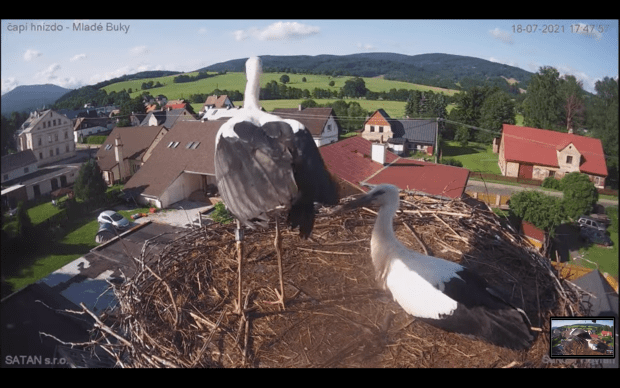
We have a fledge at the White Stork nest in Mlade Buky!

Oh, this is just so wonderful. The people of this community can be so proud as these three beautiful birds leave their nest. It was their help that made it possible for these three to be alive today. Bravo.

Here is the video so you can watch it.

The heat wave has taken more tolls on birds in the Pacific Northwest not just the Osprey chicks that literally roasted in the nests. Cooper’s Hawks have been jumping off the edge of the nests so they do not get cooked by the hot sun. This is a real tragedy in the making. Even the number of birds at my feeders is down. They spend the day in the myriad of vines in the shade of the house and the lilac bushes only coming out to drink and return to shade. The outside temperature near the water bowls reads 34 C. That is hotter than it is in the West Indies! So please put out water for the birds! Find old dishes and provide them with something. Thank you!

I hope that you are able to open this. If not you could Google ‘hawks jumping out of nests to avoid heat’. This is just so sad.

The streaming cams for many of the nests are being turned off as the season ends. Glaslyn will turn off the feed to Aran and Mrs G’s nest shortly as will Rutland Water on the Manton Bay Nest of Blue 33 and Maya. We will look forward to another season with them in the future. Blue 33 and Maya are a super Osprey couple – celebrities if you will allow me to call them that. They have been together since 2015 and have fledged 17 chicks. They raised a nest of four in 2019. That is almost unheard of and really takes a strong male to feed that many. I am impressed. I told someone if I came back as an Osprey in another life I wanted Blue 33 for my mate. He is incredible. They will return to the Rutland Manton nest in late March – usually within an hour of one another.

I expect many others will follow as it is costly to run the cameras. If you go to the camera and it is not functioning check the nest’s FB page. They have probably turned off the camera til the next season. But please remember that the breeding season is only beginning in Australia with the Peregrine Falcons, Port Lincoln Ospreys, and the WBSE.

NC0 up at the Loch of the Lowes nest is out fishing for her chicks. She is incredible. She spots the fish from the nest and dives down and gets it. Here is a very rough cut of a video of the two Loch of the Lowes chicks enjoying themselves.

I never thought I would say that a Golden Eagle nestling was cute but Zenit certainly is.

Zenit is really working on his wing flaps and from his crop it appears that he has had a feeding. That is good. I am just thinking how lucky Zenit is to be in a tree nest with shade.

Kindness is one of the cutest Bald Eagle nestlings I have ever seen! Here she is again trying to nibble around mom.

Oh, how beautiful. Kindness sitting next to Mom. Everyone thinks Kindness is a female because her Dad loves to feed her!

You are getting to be a big girl, Kindness. You are 52 days old today! More than halfway to fledge which will be around 89 days – the average for the Glacier Gardens nest. (The average in Alaska is 80 days).

Tiny Little has been in the nest every time I checked on her. A fish came in and 462 ate and ate. Then 464 came and couldn’t get the fish tail down. Tiny Little was playing with it when White YW brought in another fish. Tiny Little ignored it and dad left with the fish! Silly Tiny! Some dads will feed their chicks but White YW doesn’t seem to do this very often preferring that Blue 35 take on those duties almost exclusively. Tiny Little has yet to get confident in opening up a fish with a head.

White YW returned to the nest at 17:39 and Blue 35 flew in to feed Tiny Little. Tiny did not ignore that fish this time!!!!!!!

Oh, she just loves being fed by mum. Tiny Little eats for about forty minutes.

This kiddo should be stuffed.

At 21:00, Tiny Little and big sib 462 were cuddled up duckling style read to sleep.

It is not clear to me if Tiny Little ever did a second flight today. She was flapping those wings really hard and walking around the nest looking down for a long, long time. Often I had to leave only to return to find Tiny on the nest. Maybe someone saw her fly again?

Tiny tried everything but getting over on the middle left side of the nest and just going for it like she did when she fledged was something she did not do. There were a few good hovers. Fingers crossed for tomorrow. Need to get those wings strong and self-feeding down for migration.

The couple who saved the little osprey chick that fell into the river at the Putuxent Osprey Nest 2 were surprised that so many people from around the world watch their birds! I mentioned to them the need for an emergency number on the streaming cam. Fingers crossed! Thank you to everyone that sent them a thank you note. The chick is doing well.

Thank you for joining me for a quick look at a few nests on a Sunday evening. Take care. It is very hot in so many places or there are torrential rains and flooding. So where ever you are be careful.

Thank you to the following for their streaming cams where I took my screen shots: Glacier Gardens Park, Cumbrian Wildlife Trust and the Foulshaw Moss Osprey Nest, Mlade Buky White Stork Cam, Patuxent Park Osprey Cam 2, and Asociatia Wild Bucovino.