10 November 2022
Good Morning Everyone,
I hope that this finds you well. The kittens are very active this morning. The Starlings have discovered the Butter Bark! And the Blue Jays are eating peanuts and what better entertainment for the kittens than watching birds safely behind glass!
Lewis is a charmer.

Oops. Turn your head! Missy is sideways smelling the orchids and moved quickly to see the Blue Jays.

They are adorable and are tied at the hip to one another. It doesn’t matter what they are doing, they must be together – eating, sleeping, and being a poopinator.
Late Wednesday, Nicole was upgraded to a Hurricane. As she went over Florida last night, Nicole was again down graded to a Tropical Storm. These are the latest images.


I will be posting my blog when it is approximately 1000 Thursday the 10th of November. This system will not be moving out of the region of Samson and Gabby’s next until much, much later in the day. Harriet and M15 got a right soaking. Continue to send your good wishes to all in this region.
_________________________________________________________________
The real news of the day is ‘waiting’. Waiting for fledging in Australia and waiting for Hurricane Nicole to pass in Florida. Yes, Nicole is now upgraded to a hurricane from the previous tropical storm. Winds and rain are increasing across the state of Florida.
Before I go any further, we all love Harriet and M15. They are weathering Hurricane Nicole together – in the nest! Talk about love and devotion. They have rebuilt after Hurricane Ian and they are staying together Wednesday night as Nicole approaches. Send them all the love you have! These two are amazing.
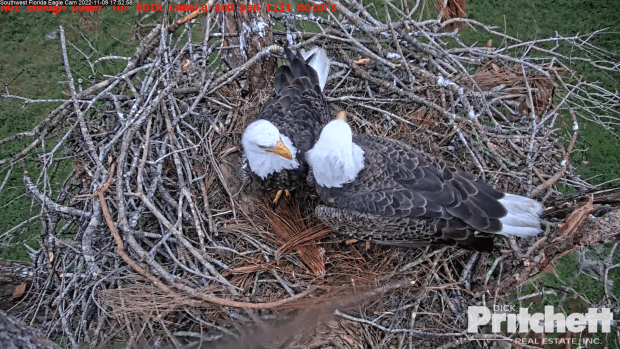


It is starting – the winds are swaying the nest. Harriet and M15 are both still in the nest together. Oh, my heart just goes out to them. They need that nest to hold. It will not be long until Harriet is laying eggs.

Early Thursday morning. Together and wet. Oh, did I tell you? Harriet is 28 years old!

In the News:
I am so happy. The wildlife rehabbers who cared for the Pitkin County Osplet did not have staff to deal with messages after the osplet came into care. Pitkin County gave me their name and I wrote to them a couple of days ago and now they have posted the information for the public. This is really important. I want each of you to remember because pre-fledge osplets really do well in care! They survive and they have a second chance at life. The image of the beautiful osplet below is the evidence.
Birds of Prey in Colorado has two waiting for release in the spring. Let us all debunk this urban myth.

Last June, the female at the Pitkin Open Spaces and Trails pulled her two osplets off the nest accidentially. One died, this one went into care and is waiting to be released in the spring.

I have been slowly gathering up evidence of successful treatments for pre-fledge Ospreys or any Osprey that has been taken into care. If you are aware of any ospreys in care or that were in care and released, would you please contact me with any details that you know. It will really help make my case to Port Lincoln that there is good evidence – hard evidence not anecdotal – that pre-fledge ospreys do well in care. By poking a hole right in the middle of the rumour that has spread and established itself as fact, it is possible that ospreys like Middle can survive. For Little and Middle, let’s work to change this to: Pre-fledge Ospreys do as well in care as do Post-fledge Ospreys!
Let’s take another look at Coots. Do you have Coots in the ponds or wetlands where you live? Sometimes called the ‘black duck’, the author of this article fell in love with them when he was a wee child.
https://www.theguardian.com/environment/2022/nov/09/birdwatch-coots-gadwall
Why is Bird Flu so important and, what happens if it mutates causing another pandemic?
https://www.theguardian.com/commentisfree/2022/nov/09/bird-flu-mutation-h5n1-virus-strains-pandemic
The Melbourne Four, those precious babies, made the news!

3 Red List Bird:

“Roseate Terns” by MyFWC Florida Fish and Wildlife is licensed under CC BY-ND 2.0.
The Roseate Tern is the most rare of all the sea birds that breed in the UK. There has been a lot of interest in the migration of the Roseate Terns from the UK and from Ireland. Satellite trackers have discovered that they migrate to the West African coast and spend their winter in the Gulf of Guinea. Those Roseate Terns from North America also have an impressive migration. They travel to the eastern part of Brazil. These journeys are more than 15,000 km return made across the open seas.
They are such beautiful sea birds. They are called Roseate because of the pink tint to their gorgeous plumage. Their beak is slender they have a long forked tail, a white cap with grey wings and white under belly. Their legs are longer than other Terns. This means that they can walk through higher and thicker undergrowth and this is where they make their nests so they are not in competition with other terns.
The Roseate Tern is globally threatened. One of the greatest challenges these beautiful birds face is the human disturbance of their nesting sites and the collecting of their eggs. Climate change, flooding, and frequent storms are also major contributing factors in the decline of the species.
The following contains information on the threats to these amazing sea birds.

https://wildlifepreservation.ca/roseate-tern/
http://roseatetern.org/threats.html
Australian Birds:
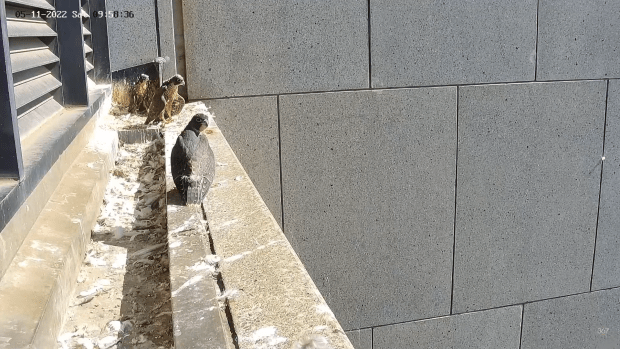
The camera turned and all of the Melbourne Four were still home! Gosh, if you didn’t know it, at a glance, these look like fine full grown Peregrines.


Hot in Melbourne. Some are looking for shade!

It is raining in Melbourne and ‘A’ tells me that it is not a good day to fledge now and won’t be for a few days more. Hopefully the Melbourne Four will stay put!

According to my eagle-eyed and ears friend ‘A’, the Melbourne Four were on the ledge when Mum brought a prey item in at 181203. They ran down to the other end where the 4th eyas was.


A small fish came on the Port Lincoln Opsrey barge. Mum took control and then gave it over to Big. I think Mum was hoping for the tail but Big took it, too.
Big is as big as Mum now. Look at those legs. Here the pair of them are prey calling Dad who is on his way with breakfast.


Big is not going without food. Dad brought in the small fish this morning and then, seeing Dad over on the ropes, Mum decided she best get out there and bring in the afternoon meal. Big might have thought she would get the whole thing to herself but Mum had other ideas and started out feeding her girl. She managed to get some bites. Big will take the fish and would take all fish if left to her own now.


Dad will bring in another fish. There were three delivered on Thursday in Port Lincoln. Those times were 09:33, 15:01, 19:22.
If the weather is good, Big will be banded, measured, and named sometime between the 12-14th. That is a few days away. I hope to find an announcement with the specific day for you.
Lots of Starlings and other prey coming into the scrape. Both Indigo and Rubus are excellent self-feeders. It is wonderful to see. Indigo continues to look out at the world beyond and poor Rubus, he still has so much flu that it will be a bit of a wait. Don’t worry Rubus, Mum and Dad will feed you – they won’t forget!


Indigo is adorable.

It is just after midnight on Thursday and this is the recap of Thursday up until late afternoon at Orange: RECAP 6 02 26 D w/grebe, Rubus takes; 08 45 13 X w/juv starl, leaves; 10:17:16 X w ER, Indigo takes; 10:24:23 D in, feeds Rubus; 14:50:29 X w/prey, Indigo takes.
At one point, Indigo was running around the scrape flapping her wings and chasing Rubus. Remember. Indigo does not have the room that the Melbourne Four have to run off some of the energy and to really get the wings and legs going.
Rubus had no idea what on earth was going on with Indigo. There was a piece of prey stuck between her talons. Was that the cause of all the restlessness? or is it that Indigo will be fledging soon?


Indigo was able to get the piece of prey out from her talons and she settled. Look at Rubus watching everything that she is doing. He will miss her when she flies. If she does what the others have done, she will fly down to the trees where she sees the parents. They will also lure her with prey items and begin teaching her how to hunt. They will do this for 4-6 weeks until Indigo leaves their territory. Now that I say that we must not forget that Izzi did not leave home until Diamond would no longer let him in the scrape many, many months after she should have left.
Indigo will not fly back to the scrape box. She is not strong enough to undertake that steep upward flight yet but, she will get those muscles really going once she is down chasing after Diamond and Xavier.
Rubus will either love having the prey all to himself or miss Indigo or both.

In other news:
Continue to send your best and most positive wishes to the nests in Florida. Ron and Rita’s human designed nest on the grounds of the Miami Zoo is really beginning to rock and sway. You can see the movement of the palm trees caught in the image below. There are so many, many nests in Florida and it is the wintering grounds for some of the birds from the north.

Gabby and Samson’s nest near Jacksonville is really blowing and rocking. It is in one of the areas that is expecting the highest winds.

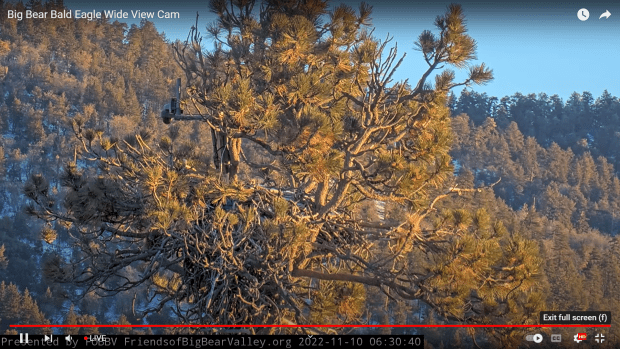
The record snow and wind has caused power outages at Big Bear Valley. The cameras for Jackie and Shadow are offline at the moment. We will wait and see if they are up tomorrow. Thursday. The camera is up over the valley but the nest camera remains offline. The storm has passed. Yippee.
Thank you so very much for joining me today. Please take care of yourselves. See you soon.
Thank you to the following for their posts, videos, and streaming cams where I took my screen captures ‘A’ and ‘H’ for their eyes and ears on Collins Street, National Hurricane Centre, SWFlorida Bald Eagles and D Pritchett, Pitkin County Open Spaces and Trails, ABC News, Port Lincoln Ospreys, 367 Collins Street by Mirvac, Charles Sturt Falcon Cam and Cilla Kinross, WRDC, and NEFlorida-AEF.