Understanding the osprey family tree…the last hatches of Mrs G and Aran at Glaslyn

8 October 2025

Good Morning,

Tuesday was a beautiful day in the Canadian prairies. Oh, you cannot know how grateful I am. We have been planning to take Anne to Bird’s Hill Park to hand-feed the Black-capped Chickadees. She has heard us talk about our walks there and how the wee songbirds land on your hands to take the Black oilseed. It is a pre-Thanksgiving ‘thank you’ to Anne. I could not survive without her help and support.

It was so warm that we had a wee picnic of sorts at Pineridge Hollow. Toby was so good, and I am certain that The Girls were happy to have a wee break from their brother for the afternoon. It was just a perfect day. Walking the trails among the tall pine trees was renewing!

The little birds did not disappoint!

It was a wonderful surprise Tuesday evening to see that the Dark-eyed Juncos have returned from the north and have stopped over in the garden to fatten up for migration! There were at least two dozen of them pecking away at the seed on the deck. I hope to get some decent images of them for the next blog. They are so cute!

Several have asked about Brock. He is still here despite Toby. Toby seems to know when Brock is around. So Brock and I have developed a method of getting his food to him without Toby knowing. Brock comes to the door and lets me know he is waiting for food. Once I see him, he goes under the deck and waits. I take out the food, sometimes with Toby, and then as I close the door and secure Toby inside, I call ‘kitty kitty’. Brock will come out to eat within five minutes.

Migration count is underway in West Africa, posted by Mary Cheadle:

Dyfi have posted a wonderful blog, and I urge each of you to read it. Mrs G is the ‘UK Iris’ equivalent who bred at Glaslyn. Her last mate was the adorable Aran, who was usurped this year by Teifi. Perhaps Aran will return and take his nest with Elen in 2026, as the nest failed this year due to all the drama. We will wait. Aran will need to return early and work to win Elen’s heart. Elen might be smart to breed with Aran again because his chicks (along with Mrs G’s great DNA) are returning!

Blue 497 -talk about a handsome bird!!!!!!!!! Just look at him. The first Glaslyn male known to be breeding in Wales. Two chicks this year, but one possibly fell out of the nest at 5 weeks, and the other disappeared at 7 weeks, possibly predated by a goshawk.

The cameras at Captiva’s Window to Wildlife Bald Eagle and Osprey nests are going live today.

Ashley Wilson continues to find Newmann and Elaine at the scrape at Spirit Bluff. They will migrate soon.

The fledgling at the Selati Black Eagle nest has brought its first caught prey to the nest!

Meanwhile, like other Bald Eagles, Jackie and Shadow are returning to their nest to kick start the 2025-26 season at Big Bear Lake.

At the West End, the juvenile Bob returned to spend some time with Haku. https://youtu.be/Hlct5mJkthw? SK Hideaways caught it!

Gorgeous Haku on Tor:

Beau and Gabby are ready for a very successful season at the NE Florida Bald Eagle nest.

The Majestics are working on their Denton Homes nest.

Andor with his blue wing tag at the Fraser Point nest on the Channel Islands. Cruz flew in, too.

The IWS is having its annual fall fundraiser. You could be a winner! At least one of my readers has named one of the eaglets at the West End nest (Treasure), and I was selected to name one of the other eaglets – Phoenix – at one of the other nests without a streaming cam. Many have won beautiful photographs and kit. We are eternally grateful to Dr Sharpe and his team for all the work they did to restore the Bald Eagle population to the islands after the DDT debacle.

There is much discussion over the female (or perhaps both) eagles at the John Bunker Sands Wetlands nest. Is this Mum? Or is it a new female? Is this even Dad??? Without definitive markings (the mark on the head could be an injury, prey blood, etc), it is impossible to know without Darvic Rings.

Checking on the Australian nests –

The 367 Collins Street adults are doing an incredible job feeding and taking care of their triplets in Melbourne.

Dad took over incubation so Mum could have his breakfast. She returned with a really full crop. Oh, hatch is coming so soon – seriously, I cannot wait to see a baby osprey. It seems like forever.

There have been at least nine different species of prey delivered to the kiddos at the 367 Collins Street falcon scrape in Melbourne since they hatched. Nothing short of adorable with their pink beaks and feet but now their eyes appear to be open (normally after five days).

ABC Science discusses the life of urban birds in Melbourne. Have a watch and a listen. They even mention the falcons! https://youtu.be/0EA3VNP2vJM?

Oh, how I love the Sydney sea eaglets. Lady and Dad are doing a magnificent job bringing in prey. Their plumage is stunning. About this time in their development, my stomach gets a little queasy. The mobbing of the eaglets as they fledge, causing them to bolt out of the forest, on occasion, or to be injured and hanging around the Discovery Centre, sends me running for the Gaviscon.

Calico urges you to help her and her feathered friends. Educate those you know who might be opting to get their lawns ‘greener’. The toxins kill the ‘food chain’.

‘PB’ asked me when I plan to publish the results of this year’s Osprey data. I hope to have finished entering my data by the end of October. Heidi is finished! I have the following to enter: 35 nests in Nova Scotia, 18 nests in Italy, and 15 failed nests from Maryland. There are, of course, hundreds and hundreds, if not thousands, of failed nests in Virginia and the surrounding area that will not be in the forms, sadly. We do not have enough information other than that there were no Menhaden for the adults, and the nests failed, resulting in no eggs, eggs being abandoned, or chicks starving to death on the nest.

The report from William & Mary University is below and paints the stark picture that Heidi and I have seen and predicted for a couple of years. I am embarrassed that this is a Canadian Company that is killing the entire ecosystem. It makes me so angry.

Could the Tawny Frogmouth be Australia’s Bird of the Year?

Tawny frogmouths take patience to appreciate. They will reward you with insights into their remarkable lives | Stephanie Converyhttps://www.theguardian.com/environment/2025/oct/08/tawny-frogmouths-take-patience-to-appreciate-but-they-will-reward-you-with-insights-into-their-remarkable-lives?CMP=share_btn_url

I think they are utterly adorable!

Bush Heritage Australia tells us more about these little sweethearts:

If the waters of New Zealand are warming up faster than we can blink, when will the impact hit the various seabird colonies? This article in The Guardian discusses the warming seas.

New Zealand oceans warming 34% faster than global average, putting homes and industry at risk, report findshttps://www.theguardian.com/world/2025/oct/08/new-zealand-oceans-warming-34-per-cent-faster-than-global-average?CMP=share_btn_url

It is always good to be thankful for all the good news we can get in Bird World and the latest newsletter from Poole Harbour in the UK does just that.

There is other good news – not just for us but for the birds. I am forever an optimist that we can change the way we live and, in turn, create better spaces for wildlife, including our feathered friends. For the first time, considering the international scene, renewable energy is powering homes and industries instead of fossil fuels. PRC is leading this change. China is rapidly expanding its solar and wind energy capacity, surpassing the total of the rest of the world combined. India has turned to renewables and is lessening their need for coal. Solar power is gaining momentum in Pakistan and various African countries, including Nigeria, Algeria, and Zambia. In fact, solar power provides more than 80% of the new energy.

It’s migration season. Some tips on when to help a bird from Wild Birds Unlimited.

Thank you so much for being with us today! Please take care of yourself. We will see you next Monday if not before! Looking for a hatch at Port Lincoln. Wonder when it will come?

Thank you to the individuals and owners of streaming cams and individuals posting for various FB groups listed in Bold. You keep us informed. A particular shout-out to SK Hideaways for their videos. The Guardian and Bush Heritage Australia continue to publish great articles on wildlife and the environment. We are grateful.

Harriet and M15 weather Nicole together…and other news in Bird World

10 November 2022

Good Morning Everyone,

I hope that this finds you well. The kittens are very active this morning. The Starlings have discovered the Butter Bark! And the Blue Jays are eating peanuts and what better entertainment for the kittens than watching birds safely behind glass!

Lewis is a charmer.

Oops. Turn your head! Missy is sideways smelling the orchids and moved quickly to see the Blue Jays.

They are adorable and are tied at the hip to one another. It doesn’t matter what they are doing, they must be together – eating, sleeping, and being a poopinator.

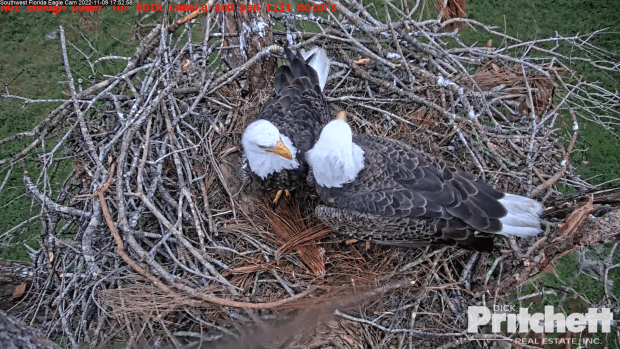
Late Wednesday, Nicole was upgraded to a Hurricane. As she went over Florida last night, Nicole was again down graded to a Tropical Storm. These are the latest images.

I will be posting my blog when it is approximately 1000 Thursday the 10th of November. This system will not be moving out of the region of Samson and Gabby’s next until much, much later in the day. Harriet and M15 got a right soaking. Continue to send your good wishes to all in this region.

_________________________________________________________________

The real news of the day is ‘waiting’. Waiting for fledging in Australia and waiting for Hurricane Nicole to pass in Florida. Yes, Nicole is now upgraded to a hurricane from the previous tropical storm. Winds and rain are increasing across the state of Florida.

Before I go any further, we all love Harriet and M15. They are weathering Hurricane Nicole together – in the nest! Talk about love and devotion. They have rebuilt after Hurricane Ian and they are staying together Wednesday night as Nicole approaches. Send them all the love you have! These two are amazing.

It is starting – the winds are swaying the nest. Harriet and M15 are both still in the nest together. Oh, my heart just goes out to them. They need that nest to hold. It will not be long until Harriet is laying eggs.

Early Thursday morning. Together and wet. Oh, did I tell you? Harriet is 28 years old!

In the News:

I am so happy. The wildlife rehabbers who cared for the Pitkin County Osplet did not have staff to deal with messages after the osplet came into care. Pitkin County gave me their name and I wrote to them a couple of days ago and now they have posted the information for the public. This is really important. I want each of you to remember because pre-fledge osplets really do well in care! They survive and they have a second chance at life. The image of the beautiful osplet below is the evidence.

Birds of Prey in Colorado has two waiting for release in the spring. Let us all debunk this urban myth.

Last June, the female at the Pitkin Open Spaces and Trails pulled her two osplets off the nest accidentially. One died, this one went into care and is waiting to be released in the spring.

I have been slowly gathering up evidence of successful treatments for pre-fledge Ospreys or any Osprey that has been taken into care. If you are aware of any ospreys in care or that were in care and released, would you please contact me with any details that you know. It will really help make my case to Port Lincoln that there is good evidence – hard evidence not anecdotal – that pre-fledge ospreys do well in care. By poking a hole right in the middle of the rumour that has spread and established itself as fact, it is possible that ospreys like Middle can survive. For Little and Middle, let’s work to change this to: Pre-fledge Ospreys do as well in care as do Post-fledge Ospreys!

Let’s take another look at Coots. Do you have Coots in the ponds or wetlands where you live? Sometimes called the ‘black duck’, the author of this article fell in love with them when he was a wee child.

https://www.theguardian.com/environment/2022/nov/09/birdwatch-coots-gadwall

Why is Bird Flu so important and, what happens if it mutates causing another pandemic?

https://www.theguardian.com/commentisfree/2022/nov/09/bird-flu-mutation-h5n1-virus-strains-pandemic

The Melbourne Four, those precious babies, made the news!

3 Red List Bird:

Roseate Terns” by MyFWC Florida Fish and Wildlife is licensed under CC BY-ND 2.0.

The Roseate Tern is the most rare of all the sea birds that breed in the UK. There has been a lot of interest in the migration of the Roseate Terns from the UK and from Ireland. Satellite trackers have discovered that they migrate to the West African coast and spend their winter in the Gulf of Guinea. Those Roseate Terns from North America also have an impressive migration. They travel to the eastern part of Brazil. These journeys are more than 15,000 km return made across the open seas.

They are such beautiful sea birds. They are called Roseate because of the pink tint to their gorgeous plumage. Their beak is slender they have a long forked tail, a white cap with grey wings and white under belly. Their legs are longer than other Terns. This means that they can walk through higher and thicker undergrowth and this is where they make their nests so they are not in competition with other terns.

The Roseate Tern is globally threatened. One of the greatest challenges these beautiful birds face is the human disturbance of their nesting sites and the collecting of their eggs. Climate change, flooding, and frequent storms are also major contributing factors in the decline of the species.

The following contains information on the threats to these amazing sea birds.

https://wildlifepreservation.ca/roseate-tern/

http://roseatetern.org/threats.html

Australian Birds:

The camera turned and all of the Melbourne Four were still home! Gosh, if you didn’t know it, at a glance, these look like fine full grown Peregrines.

Hot in Melbourne. Some are looking for shade!

It is raining in Melbourne and ‘A’ tells me that it is not a good day to fledge now and won’t be for a few days more. Hopefully the Melbourne Four will stay put!

According to my eagle-eyed and ears friend ‘A’, the Melbourne Four were on the ledge when Mum brought a prey item in at 181203. They ran down to the other end where the 4th eyas was.

A small fish came on the Port Lincoln Opsrey barge. Mum took control and then gave it over to Big. I think Mum was hoping for the tail but Big took it, too.

Big is as big as Mum now. Look at those legs. Here the pair of them are prey calling Dad who is on his way with breakfast.

Big is not going without food. Dad brought in the small fish this morning and then, seeing Dad over on the ropes, Mum decided she best get out there and bring in the afternoon meal. Big might have thought she would get the whole thing to herself but Mum had other ideas and started out feeding her girl. She managed to get some bites. Big will take the fish and would take all fish if left to her own now.

Dad will bring in another fish. There were three delivered on Thursday in Port Lincoln. Those times were 09:33, 15:01, 19:22.

If the weather is good, Big will be banded, measured, and named sometime between the 12-14th. That is a few days away. I hope to find an announcement with the specific day for you.

Lots of Starlings and other prey coming into the scrape. Both Indigo and Rubus are excellent self-feeders. It is wonderful to see. Indigo continues to look out at the world beyond and poor Rubus, he still has so much flu that it will be a bit of a wait. Don’t worry Rubus, Mum and Dad will feed you – they won’t forget!

Indigo is adorable.

It is just after midnight on Thursday and this is the recap of Thursday up until late afternoon at Orange: RECAP 6 02 26 D w/grebe, Rubus takes; 08 45 13 X w/juv starl, leaves; 10:17:16 X w ER, Indigo takes; 10:24:23 D in, feeds Rubus; 14:50:29 X w/prey, Indigo takes.

At one point, Indigo was running around the scrape flapping her wings and chasing Rubus. Remember. Indigo does not have the room that the Melbourne Four have to run off some of the energy and to really get the wings and legs going.

Rubus had no idea what on earth was going on with Indigo. There was a piece of prey stuck between her talons. Was that the cause of all the restlessness? or is it that Indigo will be fledging soon?

Indigo was able to get the piece of prey out from her talons and she settled. Look at Rubus watching everything that she is doing. He will miss her when she flies. If she does what the others have done, she will fly down to the trees where she sees the parents. They will also lure her with prey items and begin teaching her how to hunt. They will do this for 4-6 weeks until Indigo leaves their territory. Now that I say that we must not forget that Izzi did not leave home until Diamond would no longer let him in the scrape many, many months after she should have left.

Indigo will not fly back to the scrape box. She is not strong enough to undertake that steep upward flight yet but, she will get those muscles really going once she is down chasing after Diamond and Xavier.

Rubus will either love having the prey all to himself or miss Indigo or both.

In other news:

Continue to send your best and most positive wishes to the nests in Florida. Ron and Rita’s human designed nest on the grounds of the Miami Zoo is really beginning to rock and sway. You can see the movement of the palm trees caught in the image below. There are so many, many nests in Florida and it is the wintering grounds for some of the birds from the north.

Gabby and Samson’s nest near Jacksonville is really blowing and rocking. It is in one of the areas that is expecting the highest winds.

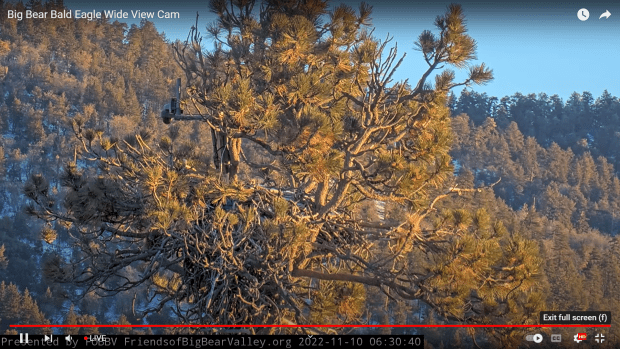
The record snow and wind has caused power outages at Big Bear Valley. The cameras for Jackie and Shadow are offline at the moment. We will wait and see if they are up tomorrow. Thursday. The camera is up over the valley but the nest camera remains offline. The storm has passed. Yippee.

Thank you so very much for joining me today. Please take care of yourselves. See you soon.

Thank you to the following for their posts, videos, and streaming cams where I took my screen captures ‘A’ and ‘H’ for their eyes and ears on Collins Street, National Hurricane Centre, SWFlorida Bald Eagles and D Pritchett, Pitkin County Open Spaces and Trails, ABC News, Port Lincoln Ospreys, 367 Collins Street by Mirvac, Charles Sturt Falcon Cam and Cilla Kinross, WRDC, and NEFlorida-AEF.

Late Monday in Bird World

1.28.2022

It has been a bit of a very sad day in Bird World with the announcement that Grinnell’s Annie has been missing for a week plus the death of HH4 at the Hilton Head Island Trust Bald Eagle nest. I really hope that Annie is off healing and will return and reclaim her place. We must send out positive wishes.

In the middle of all that grey there was some sunshine and there is more to come.

Dale Hollow 16 (DH16) hatched at 13:21 today. (DH14 hatched at 11:16 on the 25th and DH15 hatched at 11:51 on the 25th).

River pulled the last bit of the shell off so that the wee one could join the twins. She quickly disposed of the shell making room in the nest bowl for all three of the nestlings.

Oh, 16 you are ever so tiny!

Of course, 16 is wobbly but holding its head up much better. after a couple of hours Looks like a strong little hatchling.

River and Obey are incredible parents. These three will be well fed and all the tandem feedings should keep any rivalry down to a minimum.

Babies are fed for the last time today.

Good night, River. Enjoy your dinner, Obey.

It was a much better day for the Captiva nestlings. I know of three good feeds. Maybe there was a fourth? All of the fish were Sheepsheads. Someone mentioned that this species of fish frequent the oyster beds by the mangrove roots. Andy might not have to go far to get his fish! The last fish brought in was at 17:33. Just in time to fill up the nestlings so they can sleep well tonight. They are growing so fast it must be difficult for Lena to get them organized to brood.

This time Andy had eaten the head so that he was sure to get some dinner. He did not get any of the noon fish – Lena and the kids were stuffed and there was not a flake left.

There is Little Bob right in front. I say it way too often but he really does remind me of Ervie. First one up at the table and most often the last one to leave.

Little Bob keeps his place after Andy flies off. I noticed that his head is slowly changing. It is not as soft and fluffy looking as yesterday. Oh, by Wednesday, Little Bob is going to look like someone poured the oil can over him, too!

At one point, Middle Bob was passed out in a very short food coma and Big Bob wanted to move back from the table. Big Bob got tangled up with Little Bob. It was a momentary mess of osplets. Little Bob managed to get undone. He immediately moved back up to Lena so he could have some more fish. Did I say this kid loves to eat?

Big Bob is in a food coma, Middle Bob is back up at the table, and Little Bob is ready to pass out next to Big Bob after eating so much. I hope there is something left for Lena! Gosh, these three can really put away the fish.

Little Bob actually looks like he ate so much he is going to be sick.

If you are a fan of Irvin and Claire at the US Steel Bald Eagle nest, Claire laid her first egg yesterday, 27 February, at 18:29. The view of that first egg is here:

There are still more than 3000 people watching the nest of Shadow and Jackie at Big Bear Lake. Shadow has been at the nest three times (plus when he brings in food for Jackie) wanting to incubate the two eggs and Jackie is not giving in an inch! Does she hear or feel a pip?

Beautiful Jackie.

Many of you are fans of the Royal Albatross Family of OGK, YRK, and QT chick with their nest at Taiaroa Head. The parents have been flying in and out, sometimes in less than ten hours, to feed the chick. At the same time, they get to spend time with one another. Those are really tender moments.

Quarry Track chick is growing fast. This little man doesn’t fit in the sock anymore! Today when the NZ DOC rangers came to weigh QT, they had to use the basket for the first time!

Look at that little QT sitting up so straight like it has its own nest next to Mum or Dad. Precious.

Here we go.

Last week QT weighed 2.4 kg or 5.29 lbs. They have not posted the weight for today as I finish my blog. I will post that weight tomorrow.

Ouch! This chick is too big to brood! The parent looks a little uncomfortable. I want to say that this is OGK just from the way he was standing over QT but it could well be YRK. She was on the nest yesterday. They change so frequently I cannot keep up and I cannot see the coloured leg band.

This little Royal Albatross chick is adorable. Look carefully at the light filtering through that soft down. We are on our way to puff ball stage. So sweet.

While the albatross are enjoying the warmth of summer in New Zealand, the storks on top of the church in Dreisamtal, 10 km from Freiburg, are working on their nest in the winter cold. Oh, they are so gorgeous and a reminder to all of us that spring and the beautiful light and warmth it brings is less than a month away.

There is a pip rapidly moving to hatch in the second egg at Duke Farms. You can really see that egg tooth working away. Tonight, sometime, there will be a new eaglet!

I wish I could close with an image of Ervie on the barge with Dad. Maybe another day! This is the most recent tracking of Ervie. He remains along the North Shore and it looks like he has found a good fishing spot. I wonder if he is still catching Puffers?

Wouldn’t it be grand to be sitting in a boat – at a distance so as not to disturb – watching Ervie with binoculars go about his fishing? I can’t think of anything nicer today.

Thank you so very much for joining me this evening. Take care everyone. See you soon!

Thank you to the following for their streaming cams and/or FB pages where I took my screen captures: Port Lincoln Osprey Project, Cornell Bird Labs and the NZ DOC, Dale Hollow Bald Eagles, Friends of Big Bear, Captiva Ospreys and Window on Wildlife, Stork Nest Streaming Cam, and Duke Farms.

Royal Cam Chick Hatches!

YRK and OGK laid their egg at the Quarry Track nest, created by OGK, on 9 November 2021. Yellow-Red-Black (YRK) and Orange-Green-Black (OGK) are no stranger to the Royal Cam spotlight. They are the parents of the very popular Miss Pippa Atawhai, Royal Cam Chick at Top Flat in 2020. The moments viewing Atawhai with her dad, OGK, melted people’s hearts. Those who watched these very gentle birds will never forget the pair of them together.

YRK is 28 years old and OGK is 26 years old. They have been a bonded pair since 2006. This year is their 8th breeding attempt. They are also grandparents. This year their son RLK (Red-Lime-Black) successfully fledged SSTrig, the chick in the nest close to Royal Cam chick, Tiaki.

It took five days for the little one to hatch. The rangers say that the reason it takes the seabirds so long to get out of their shells is that they are such long lived birds. The Royal Cam chick is the 11th to hatch this season.

Ranger Sharyn returned the new hatchling to its mother, YRK, at 19:40 on 26 January. Before placing the chick under the mother, the area of the nest is sprayed with a bird-friendly insecticide in order that there is no fly strike on the youngster.

Ranger Sharyn carefully removes the chick from the insulated container.

She has already removed the dummy egg and sprayed the nest area before placing the chick under YRK.

Ranger Sharyn watches with delight as YRK accepts her little one.

YRK gives a shimmy and settles down to brood.

Once Ranger Sharyn is away, YRK raises up and looks down with the most gentle love to the new bundle.

It is extremely windy today. I wonder when OGK will fly in to relieve YRK and have his first look at the baby?????

Southern Royal Albatross are endemic to New Zealand. After the chick hatches, it will fledge in mid-September, spending 4-6 years at sea foraging for food in the waters off the coast of western Chile. Then the juvenile will return to Tairoa Head to find a mate. This choosing and bonding could take years. These seabirds are known for their socializing and elaborate dancing as well as the beautiful sky calls.

Once a couple have bonded, they will lay one egg every two years. Why not every year? It is too physically difficult to raise chicks that close together. The adults have to travel many hundreds if not thousands of miles to forage to feed their chick. They each take turns incubating. Once the chick has hatched they will take turns flying in and out of the headland to forage and feed their chick. They will do this until the chick fledges and begins its life on the sea. Imagine flying for the first time and not landing back on ground for another 4-6 years. I often cannot get my head around that!

The Albatross has the largest wingspan of any living bird at 3 metres or 9.8 feet. They stand 115-123 cm or 45-48 inches and weight 8.5 kg or 19 lbs. The males are larger than the females.

The population of the Southern Royal Albatross is vulnerable and stable at the moment. The challenges they face are longline and trawl fisheries, oil and plastic waste in the sea waters, natural disasters, and warming seas as part of climate change. The New Zealand Department of Conservation makes every effort to ensure that all of the Royal Albatross on Taiaroa Head are healthy. They provide supplemental feedings to both chicks and adults as well as elaborate sprinkler systems to cool the birds and medical care.

Here is the video of Ranger Sharyn returning the chick to YRK:

Here is a very short video by Liz of YRK revealing the chick three times.

You can watch the streaming cam for YRK and OGK here:

What wonderful news! I have peeked at all of the other nests and everyone is fine.

Ervie looked like a wet rat Wednesday afternoon late in Australia.

Ervie was alone on the barge last night while the rain is caught by the camera pelting down.

Thankfully the rain has stopped!

Gabby has been giving Samson time to brood the babies and feed them. Both 26 and 27 are doing very well! Gabby is much more relaxed this year with her third clutch.

Aren’t they so cute??

Thank you so much for joining me today. Take care everyone. See you soon.

Thank you to the following for their streaming cams where I took my screen captures: the Cornell Bird Lab and the NZ DOC, Port Lincoln Osprey Project, and the NEBald Eagle Nest and the AEF.