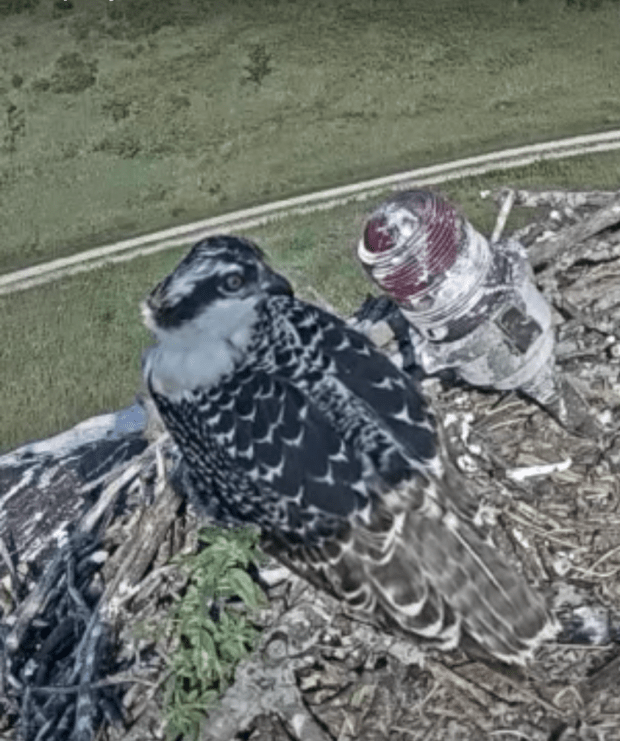
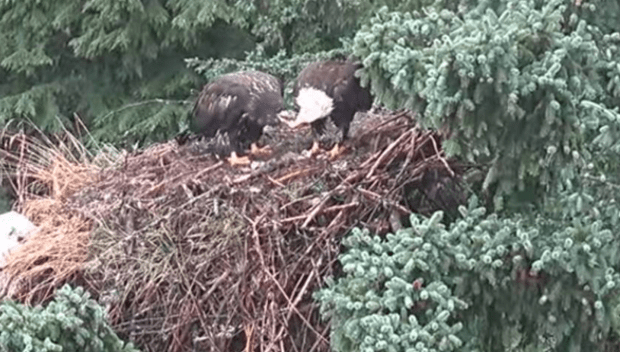
It is so nice to wake up and have some positive news after the last week of Osprey sadness. Between the two Ospreys near to fledging being euthanized so a light bulb could be replaced and the issues surrounding Malin’s fledge, well, it has been a week of frustration. However, I was so delighted to see that there is some hope for the Black storklings!
At 10:43 on 22 August, after a period of 44-46 hours, Grafs, the male adult at the Sigulda Black Stork Nest returned to feed his storklings. All of the storklings have now fledged. When Grafs arrived only one was on the nest.
While White Storks will feed their fledglings off the nest, it is unclear whether this is the case with Black Storks. The one – starving storkling on the nest – hit the jackpot and got lots of fish. Then a second flew in and there were fish left. The last did not get food but two of the storklings had crops for the first time in ages!
Amanda caught this on video:
This takes away the fear that Grafs had left the storklings and begun his migration! That is wonderful news. It is possible that he had to travel some distance to find this amount of food. We will wait patiently for his next delivery and hope, at the same time, that both Grafs and the storklings might find the feeder. This surely has to bring some relief to my Latvian friends.
In Estonia, Karl II remains near to the nest. His mate left long ago for her migration as have his three children. The transmitter reading for each shows they are all traveling southward.
Jan has arrived at his nest in Jergova County in Estonia to feed his three storklings shortly after 9 am on 22 August.
The storklings of Jan and Janika are beginning to hover and jump. It feels like such a relief that the storklings were fed. Hopefully Jan will return later with more small fishes or some larger ones for the three.
Osprey stuck for 2 days on the top of the Cottonwood Tree entangled in fishing line. This is really getting to feel like a DVD stuck in the player.
A Place Called Hope did the rescue! If I ever come back in another life as a raptor and am injured or entangled, please let me be found and taken to either A Place Called Hope or the Cape Wildlife Centre. They give 200% and aren’t afraid of a challenge!
The Scottish Wildlife Trust has announced today that LR1, the oldest fledgling of Laddie and NC0, left for its migration on 15 August 2021 ahead of the adult female. They waited a week to be sure. This is NC0’s second breeding season and she has surprised many with her fishing skills and her independent attitude. No one has yet has established what her particular behaviour is surrounding migration. In the history of the Loch of the Lowes Osprey nest, a fledgling leaving before the female has only happened once. Normally, the females leave 2-4 weeks prior. The experts at Scottish Wildlife feel that LR1, the female, was very confident and “she just felt it was the right time to go.” A short video clip was made of the last time LR1 was seen.
This is one of the best short documentaries on Peregrine Falcons featuring Annie and Grinnell at the U of California, Berkeley. It goes through all the stages from beginning to fledge. Just fantastic. Guaranteed to put a smile on your face and to get you ready for both the Collins Street and Xavier and Diamond kids.
The wind is blowing in Cumbria but that doesn’t stop Tiny Little, Blue 463, from screaming at dad that she wants a fish ———- and she wants it NOW! Blue 463 is definitely a female.
She flew down to the nest from the perch in anticipation.
And off she went chasing White YW!
Tiny Little you make me smile every time I see you. Go girl, get that fish!
Thank you for joining me today. I have no news of Malin. When I do I will share it with you. Take care. Be safe.
Thanks to the following for their streaming cams where I took my screen shots: The Cumbria Wildlife Trust and the Foulshaw Moss Osprey Nest, The Eagle Club of Estonia, and The Latvian Fund for Nature. Thank you to A Place Called Hope for the image from their FB feed.
Oh, my goodness. The male at the Collins Street Peregrine Falcon nest is nothing short of adorable. I spent all last year wanting to scoop up this stealth fighter in my arms and cuddle with him. Or dreaming of a Peregrine Falcon onsie. Wouldn’t that be cute on a toddler?
The first egg of the 2021 season has been laid on 21 August. Wow. It is eggciting.
You might be asking why the female is not incubating that egg. The female will not start incubating the eggs until the last one is laid. This is because the adults want the nestlings to be about the same size for the first fortnight so that there is no rivalry over food. Last year, the three big girls all hatched within a 24 hour period. There was never any sibling rivalry – that is what I love about falcons and kestrels. Once the last egg is hatched, they will be incubated for 32-40 days.
Mom looks so proud of herself!
These are some images from last year:
Mom brooding the triplets.
Dad feeding the girls when they are a little older – before they lose all that fluffy white down.
This year Mirvac, the property owners, are in charge of the streaming cams of the Victorian Falcon Project. You can watch these falcons from the very beginning.
Telyn at the Dyfi Nest, Wales. 20 August 2021
Some more great news. The Season of the Osprey will premier on PBS October 27 at 8pm! Please check your local stations for the exact time in your area. This is what they are saying about this documentary:
“Birds of prey exist in myriad shapes and sizes. Scores of eagles, hundreds of hawks and countless kites and falcons have all adapted form and behavior to fit diverse habitats. But in all the world, there is only one osprey. Following a single evolutionary path, it has conquered every continent save Antarctica. One bird, one design, unchanged. It is the only truly aquatic raptor, the sole member of its own taxonomic family. This one-hour, blue-chip special brings viewers into the life to this incredible raptor with a depth and intimacy never before attempted. Shot in and around Great Island Marsh, where the Connecticut River meets the Long Island Sound, cameraman Jacob Steinberg has achieved unlimited access to an osprey nest and captured the struggles, failures and triumphs of a single osprey family.”
Oh, I can’t wait!
I am afraid that I am having Malin withdrawal. A week or more ago I took a few video clips of Malin being fed by Marsha. I would like to share one of those with you now.
And another one of Malin exercising his wings.
It is so much easier when you know that the little one fledged, returned to the nest for food for 36 days or so, and then flew off to find their life. There is a level of anxiety when it doesn’t happen that way. I sure miss that little one. I have not, as yet, received any images of the two Osprey chicks found or any other news. I am hoping for tomorrow or Monday. It is a busy time of year for the wildlife rehabbers.
Two of the storklings have fledged at the nest of Grafs and Grafiene near Siguldas – the youngest was first and then the oldest yesterday. Only the middle remains. All have returned to the nest safely. The one that had its wing up against the far branch seems to be alright as well. That is good news. I have heard of no feedings since Grafs came in with some very small fish for the trio on 19 August. That means that if the storklings did not find the feeder – the two that fledged – they have had little food but nothing for two days. This is critical. There is concern that Grafs has left for his migration — it was the very initial concern. I want to remain hopeful.
Jan has fed his storklings but the meal was only tiny fish or worms. Urmas has not brought any more fish to the nest. Since he has fed them once and they accepted the fish, I hope that Urmas will do this again (he also left fish when he banded them and put on the trackers). It is not clear whether the anxiety of starvation is worse than having a human bring food to the nest.
These are very difficult times for everyone but they are especially difficult circumstances for these six starving Black Storks – rare Black Storks!
At the Black Stork Nest in the Karula Forest in Estonia, Karl II was still in the nest area. His transmitter told us. The two early fledges, Tuul and Udu, headed the wrong direction due to weather concerns and then turned south. Pikne travelled south from the beginning. New tracker information should be coming in soon. Safe travels all of you!
Oh, this youngster can really scream for food on the Loch of the Lowes nest. What a beauty. This is another good example of a ‘normal’ fledge. The chicks return to the nest to be fed and fattened up for migration.
I really want to put a plug in for the administration of the lochs in Scotland. No one is allowed on those lakes from April to the end of September so that humans do not disturb the birds. It means that motor boats with their leaking fuel are not chasing the Ospreys and making the water toxic. Gosh, I hope that only human powered boats are allowed. What a great idea – leave the lakes to the birds during breeding season. Three cheers for Scotland! This could well be the case throughout England and Wales also. I will try and find out.
And look what is on the Foulshaw Moss Nest. It is a flounder for the lucky chick that makes it to the nest first. Tiny Little!!!!!!!!! Where are you Tiny Little?
It’s a few minutes later and I missed that lucky fledgling that snagged that flounder! It’s gone. That leads me to believe that it was probably Blue 464, the male, the first to fledge. He likes to take the fish and eat it on the branch of the parent tree.
Thank you so much for joining me. I hope that you are looking forward to those falcons hatching as much as I am. Take care. See you soon.
Thank you to the following for their streaming cams where I took my screen shots and video clips: Scottish Wildlife Trust and Friends of Loch of the Lowes, Mirvac Corporation and the Collins Street Falcon Cam, The Cumbrian Wildlife Trust and the Foulshaw Moss Osprey Nest, The Eagle Club of Estonia, The Latvian Club for Nature, Collins Marsh Nature Centre, and The Dyfi Osprey Project.
I want to begin with the Black Stork nests today. For those just learning about the situation of the Black Storklings in both Latvia and Estonia, here is a very brief summary. The storklings at the nest of Grafs and Grafiene in Latvia and that of Jan and Janika in Estonia are late hatchlings. There was concern from the beginning that both parents might leave for their migration before the storklets fledged. Currently, the mothers have left and the fathers, Jan and Grafs, are the sole providers. Neither male can provide enough food for three storklings to thrive. There is also a question of the supply of the fish. In both Latvia and Estonia, feeder situations have been established with decoy female Black Storks. To date, neither male has found these feeders.
‘S’ in Latvia reports, “The good news is that it seemed that yesterday Grafs had encountered a generous feeding place on the way, not so far away. We were already a bit sad thinking that the storklets will have to spend another day with just one small noon feeding, what a celebrated surprise it was when he came back less than 4 hours later with plenty of food. Many of us bursted into happy tears:) It is good to know that he can still manage to get food elsewhere even if it is not from the feeder. And the most important thing is that he is still here caring for his young.”
aGrafs and Grafiene’s Storklings, Sigulda, Latvia 19 August 2021
At the very beginning, M. Strazds, a Latvian Black Stork specialist, warned that he felt that there was only 0.1% chance that Grafs would find the feeder because birds do not normally search for new feeding spots at the end of the nesting season. Still, as I understand it, the storklings, once they fledge, will find the feeder and it will be very good for them.
In Estonia, Jan has made only one delivery that I am aware of. The storklings have supplemented that with the fish that Urmas delivered last night. I was made aware that the storklings were playing with the fish but, it appears now that they have been eating them as the pile of fish is almost gone as I write this. I am aware that there are controversies about the effect of humans getting close to the nest because of the stress that it causes on the birds. But starving is also a major stressor. I believe that Urmas and his team know what they are doing and I hope they continue to feed these birds.
Jan and Janika’s Storklings, Jegova County, Estonia
There is one other nest with a fledgling, Pikne, the female, still being fed by a parent and that is the nest of Karl and Kaia in the Karula National Forest in Estonia. ‘S’ reports, “The feeder approach has been very successful with Karl’s nest in Karula for the sole reason that he has a transmitter and it is possible to track his usual feeding places.”
Pilkne, the last remaining storkling being fed by Karl II at the nest in the Karula National Forest in Estonia. The other two have fledged.
It has been a very difficult year for those who care for the birds and who watch the streaming cams. Osprey chicks died due to weather related issues and Cooper’s Hawk eyases got so hot on the nests in Canada, they lept off the nests to avoid literally being roasted. Many are dying as they undertake their migrations which are challenging enough without having fires and smoke enroute.
At the same time, there have been some remarkable situations. Around the world, humans have stepped in to save birds of every variety. In the interior of British Columbia, the wildlife rehabbers climbed the Osprey nests and removed the chicks taking them into care because of the extreme heat and fires. At various places around the world, Osprey chicks have been fostered and received a second lease on their life. A Canada Goose named Arnold had his digits fixed so that he could live a full life with his mate, Amelia. A very old Bald Eagle full of lead was given treatments and is now thriving and waiting for A Place for Hope to get its permit so he can be their ‘forever’ bird. Every day I read about a group of people and trying to help fix what many believe is unfixable. I hope that this is just the beginning of a change in intervention and our understanding of what works and what doesn’t. The key is not to give up.
There are, however, three miracles. I am thinking of the three Ospreys that should have died but did not – they have thrived – two of them to become dominant on their nests! Those were Tiny Tot aka Tumbles at the Achieva Osprey Nest in Florida and Tiny Little Bob aka Blue 463 on the Foulshaw Moss Nest in Cumbria. To me these are simply nothing short of a miracle.
Tiny Little Bob aka Blue 463, Foulshaw Moss Nest, 19 August 2021
The third has yet to fledge but has shown remarkable growth. I am aware that many on the chat rooms in Latvia and Estonia are concerned about feather growth. This was also a big concern for Malin on the Collins Marsh Nest in Wisconsin. Malin is our third miracle.
Malin, Collins Marsh Osprey Nest, 19 August 2021
I cannot tell you what happened to make the food deliveries on this nest turn around. All I can say is that they did and there are no more missing feathers, the tail now has 7 dark bands when 3 weeks ago there were 2 with the hint of a 3rd. It has been a remarkable recovery. At one time, there was concern that Malin might survive but not be able to fly. Those concerns have now vanished. Today, Malin has had 3 fish deliveries before 1pm and one of those was a whopper. Malin actually walked away from being fed by mom, Marsha, he was so full.
One of the major concerns for the Collins Marsh Osprey Nest is that the parents would also leave Malin on the nest and begin their migration. So far everything is going smoothly so I will just ‘knock on wood’ that it continues to be that way.
One other good news story is that the fires in Turkey are dying down or are out.
And there is more. Aran, the mate of Mrs G on the Glaslyn Valley Osprey Nest, was injured and was missing a couple of primary wing feathers,. There was a huge concern that he would not be able to fly — and consequently that he would not be able to fish or be able to migrate. Well, look at Aran’s feathers today! Yahoo. He is good to go. Tears. This is an amazing couple who lost their three chicks due to starvation when Aran was injured. The Glaslyn community kept the birds alive with a fish table until Aran was able to fly and fish.
Indeed, I do not want people to think that feeder areas or fish tables do not work. It depends on the circumstance and in the case of Aran and Mrs G as well as the Mlade Buky White Storklings, those fish tables saved the lives of those two families.
Aran at the top sitting on edge of nest! 19 August 2021.
We have a lot to be thankful for – and there is a lot of work to do to figure out how to help our precious birds – all of the wildlife. Humans stepping up to take responsibility and to “try” even if they are met with low odds and negativity should be the norm not the exception.
What can you do today to help the birds and all of the wildlife?
I want to close today with a bit of a giggle. If you watch Ospreys you understand how difficult it is for both the male and female to raise three. Actually that is true of eagles as well. Well, what about five? Now consider the fact that those five are all female. The poor dad would need a set of sound cancelling headphones!!!!!!!!!! You can hear females clear across a lake. Oh, my. The parents of these Westport, MA fledglings will certainly deserve their winter break.
Thank you for joining me on this quick update on what is happening in Latvia and Estonia. Send them all of your positive energy – and take care.
Thank you to the following for their streaming cams where I took my screen shots: Collins Marsh Nature Centre, Cumbrian Wildlife Trust and the Foulshaw Moss Osprey Nest, the Eagle Club of Estonia, the Latvian Fund for Nature, Brywd Gwyllt Glaslyn and the anonymous reader of my blog that sent me the image of these five beautiful female Ospreys. Thank you.
Today is a gorgeous day on the Canadian prairies. The rains helped to contain or put out many of the wild fires in our province and this morning, for a second day, we woke up to blue skies and white clouds! All of the plants are a vibrant green and the birds continue to sing. There was not enough to fill the dry creeks but the downpours we did get are a reminder of how much all life depends on water. The nestlings and fledglings would add ‘food’ to that list!
There is a constant worry that some of the late hatches are seeing dwindling food deliveries and that the parents might leave for their migration with young still on the nest. My friend, ‘S’ is concerned, as are many others, for the nestlings on two Black Stork nests – one in Latvia and the other in Estonia. Some others worry about the little osprey on the Collins Marsh Nature Centre nest that we have been calling ‘Malin’. (The official contest is underway for the official name).
Malin self-feeds from small Bullhead. 11 August 2021
Malin was receiving 5 feedings on occasion. Those were good days. The chick has not been fed well by the standards of other nests. This past Sunday, 8 August, Malin had no food. Yesterday, 10 August, he had two feedings. Today, there have already been 2 – one at 9:35 and the other around 11:42. Always these are small whole fish or pieces of fish. I have not seen a whopper on this nest.
Malin is hungry and several of us are trying to ascertain if the fish are ‘fished out’ or if the Dad has another nest – it really is unclear. A report by the Wisconsin DNR on the number of Bald Eagle and Osprey nests in the state indicate a drop of Ospreys in area 3, where the Collins Marsh nest is located, by -25.2%. While every other area saw an increase in Ospreys, Collins Marsh was only one of two that showed a decline. Does all of this reflect a growth in Bald Eagle Nests in the area? If you would like to read the report from 2019 (I have not found one for 2020), I am attaching a copy. A big shout out to ‘S’ who found this and sent it to me. Thank you.
The feedings for the nestlings of Grafs and Grafiene at the Sigulda Nest show a similar up and down pattern to that at Collins Marsh. However, there has not been a day without food to my knowledge at Sigulda.
‘S’ reports that on 9 August, the storklings had four feedings – which is considered low – but yesterday, they had only two. Today, there have been 2 deliveries by the female, Grafiene, and one by the male, Grafs. Grafiene is also like the female at the Collins Marsh nest, Marsha, who leaves for periods up to 24 hours at a time. The behaviour of these two females is very curious.
It is hoped that there is time for both the Black Storklings and the Osprey to fledge. ‘S’ advises that the minimum is ten days for the storklings. The Ospreys tend to migrate at the end of August or beginning of September in Wisconsin.
Malin is not ready to fledge. It is very worrisome for many reasons. I look at the development and growth of the Osprey fledglings in the UK and then compare this with Malin. Those in the UK have fully developed feathering and have really perfected their flying skills. They are self-feed with ease. Most have been fledged for a month. Will Malin have a month to further develop his body and skills? Will the storklings? The nest that is on the branch of the pine tree in the forest near Sigulda is so very narrow and has collapsed in the past. Will the hopping and flapping cause the little ones to fall?
The storklings are so excited when a parent arrives with fish that it does make you wonder if the could make the branch nest collapse. Grafiene covered the nest with little fish around 17:20. There was lots of food for each of the nestlings.
The storklings were eating and eating and had large crops. I wonder if a parent will bring another delivery before night?
I am including the link to the Black Stork Nest in Sigulda County, Latvia. If you wish to find the chat room or forum (with lots of information) please check the information under the streaming cam.
In Alaska, Kindness is not short of food. She has gone some days with few deliveries and other days, Dad not only leaves her food for self-feeding but today, he fed his baby girl. Dad just can’t help himself. He has an enormous soft spot for Kindness. The image below of Dad feeding Kindness is right after he had delivered prey 20 minutes earlier! Oh, Kindness, how lucky you are.
Did you know that Bald Eagles have a polarizing lens that helps them see fish in muddy waters? (Just like those who fish often wear Polarizing sunglasses.) That said Bald Eagles normally only feed in the top 15 cm or 6 inches. Their bare legs are designed to only go into the water 15 cm or 6 inches. Like the Ospreys and Sea Eagles, if they had feathered legs, they would get water logged.
You can watch Kindness here. The moderator on the camera chat is reminding everyone today that Kindness is 76 days old today. She is already flapping and jumping. The average act for fledge on this nest – not the whole of Alaska – is 89 days. (The whole of Alaska is 80 days). If she behaves like the other eaglets on this nest, you should be able to watch her until mid-September. Here is the link to that camera:
The White-Bellied Sea Eagle, Lady is feeding 27 and 28. Those little ones continue to look like white fluff balls but if you look carefully, their necks and wings are getting longer and there is a hint of ‘dark plumage’ underneath that natal down. The WBSE nest had a fright a few days ago. Dad showed up on the nest with a laceration on his leg and a cut near his throat that was bleeding. That seems to have subsided and Dad is busy catching fish for the family. (I am wondering about the small amount of salt water in the Parramatta River and its healing effects on Dad’s foot.)
27 and 28 do bonk but not much anymore. Some of the time it is instigated by the ‘little one’! They really are a good match for one another and unlike past years, viewers are remarking that they are really enjoying seeing the nest this year.
The egg tooth is disappearing as their beaks grow longer.
If you wish to watch then, here is the link to the cam:
There is some troubling news coming out in Bird World. ‘S’ informs me that the storks crossing over Greece where the wildfires are raging are being injured in large numbers as they migrate to Africa on the eastern routing. Various news agencies are reporting that people in Athens have been picking up dead storks off their lawns. This is more than sad. Here is a short news report by Reuters. I hope you can open it.
A second is the number of raptors going into care. In the United States, there is an all out assault on plant life. Various levels of government are asking for and receiving permission to undertake ‘aquatic treatments’ using either Tribune or Harpoon. These are chemical herbicides and they poison birds!!!! At the moment, A Place Called Hope, has raptors in its care because of these treatments.
In Jacksonville, crews have been up doing maintenance on the NE Florida Bald Eagle cam. The presence of humans on ‘his’ nest brought Samson out from the trees and onto the nest yesterday. Wow. What a wonderful treat. Samson remains in the area and does not migrate while Gabby leaves early to travel north to cooler weather. Ironically – and sadly – this year it has been as hot in Ithaca, New York as it has been in Florida.
All three of the fledglings at the Foulshaw Moss Osprey nest were present yesterday. Poor White YW. Tiny Little Bob almost ripped his leg off trying to get at a fish delivery. Tiny Little! To steady himself, White YW had to put his talon on Tiny Little’s head. Gracious. It ended OK – no bird was injured.
For some reason all of the fledglings have been coming to the nest for fish. One will get the fish from dad, one will stalk that sibling, then they will get it and then White YW will arrive with another fish and confuse the entire situation. It is really quite hilarious. The fledglings are as big (or bigger) than Dad! You can watch them here:
Oh, wow. Tiny Little just snagged a fish from sibling 462. Fantastic.
Tiny Little is a ‘scrapper’ just like Tiny Tot. They both learned ‘street smarts’ to survive. Well done, Tiny Little! It was not that long ago that Tiny Little was shy. Her aggression will help keep her alive in the future.
News Flash. The female companion of Bucacek on the Mlade Buky White Stork nest in Czechoslovakia has been named Marketa.
Everyone reading my newsletter loves birds and animals or you wouldn’t be here. I was sent a delightful story – a view of rewilding through the eyes of a deer. Since we have so many deer in our city that have been displaced for ever more condominiums and roads, it really struck home to me. Perhaps you would enjoy reading it, too. Here is the link to ‘Rewilding is a Two Way Street. A letter from your neighborhood deer’.
Whew. That was a long newsletter. Sorry. Thank you so much for joining me. Send warm wishes to all the birds – for food and for the storks to survive as they travel from northern Europe to Africa. Take care everyone.
Thank you to the following for their streaming cams where I took my screen shots: Collins Marsh Nature Reserve, Glacier Gardens Park in Juneau, Latvian Fund for Nature, WBSE Sea Eagle Nest, Birdlife Australia, and the Discovery Centre, Cumbrian Wildlife Trust and the Foulshaw Moss Osprey Nest.