How is Diamond?

Diamond is the female at the Charles Sturt University Peregrine Falcon scrape box on the University’s water tower. Her mate is Xavier and their only chick this season is Yarruga. Yarruga is 27 days old today. Its name means ‘Sunny’ in Maori.

Several days ago Diamond injured herself, probably in a hunting incident. Her right wing was a bit droopy and she continues to have difficulty putting all of her weight on her right foot. Her mate, Xavier, has often taken over the feeding duties of Yarruga because feeding requires putting pressure on the feet to hold the prey and pull up to get the bites off for the chick.

Yarruga was particularly hungry this afternoon. Diamond was on the ledge of the scrape watching over her baby, trying to get some sleep, and also attempting to keep the weight off the right leg.

Instead of writing how Diamond is doing, I thought it was just best to take a few video clips so you can see for yourself. They do say a picture is worth a 1000 words.

Here is the first one. Diamond has been resting on the ledge of the scrape. She has kept her right leg slightly elevated and has been able to sleep some. Yarruga is hungry and, since this is the big growth spurt for Yarruga, she sees a parent and thinks it is dinner time. Poor Diamond. Yarruga is prey begging.

Xavier brings in the Starling that was left over from an earlier feeding. The falcons have a place where they stash food. It is a great idea. They never waste a single bit of the prey they kill for food. (We could all take a lesson from them!). Diamond wants to feed Yarruga. The following two clips are from later in the feeding.

The feeding went on for some time. This is the last bit of where Diamond finishes feeding Yarruga and then flies off with the rest of the Starling. Despite the fact that she doesn’t like Starling (prefers pigeons and parrots), it would not be easy for her to hunt now while she is healing so she will happily eat the Starling leftovers.

It still appears that Diamond is in a lot of pain. She is really limping but her wing appears to be better. It must be difficult because she wants to take care of her baby. I think that is why I actually believe she is improving. She could have flown out and let Xavier feed Yarruga but she chose to do it herself. It is going to take some time for her to heal and we need to continue to send her our best and most positive wishes.

A quick glance at other nest news:

The 367 Collins Street ‘Four’ decided to run along the gutter and let us have some really good glimpses of how they are growing and changing today. Remember when you look at them that they are precisely one week older than Yarruga. It is hard to imagine that they were mostly covered with white down a week ago! Here they are wanting to fly – and way too soon, they will.

The down is really coming off. They are so curious about the world outside of the scrape. Mum and Dad have been doing aerial demonstrations for them. This is something that the adults do to try and entice the eyases to fledge.

The Port Lincoln Osplets will be banded, named, and at least one will get a sat-pak on Monday 8 November, Australian time. Remember! It is possible that we will only get to see the event on tape. It is exciting. I cannot wait to see if Little Bob is a female with those thick stubby legs!

Just look at the size of Dad’s wing. Together they would be wider than the nest! He is bringing in the second fish of the day. Now when Mum begins calling the chicks join in. It is really sweet.

Mum is so quick to pull that fish off Dad’s talons. I often wonder if the males ever get injured when this happens.

Today, Little Bob is more interested in watching Dad go down to his man cave on the deck of the barge than being first in line to eat. That is almost shocking.

The trio are pancaked. They have eaten so much. Mum brought another fish in at 13:50 – their third of the day. On average, the osplets have 7 feedings a day so far. Fantastic parents. Can’t say enough good things about how well they have worked together this season.

There has been no new updates on WBSE 27 since 1 November, Australian time. When I hear anything, I will let you know.

Thank you for joining me and checking in to see how Diamond is progressing. We just have to be patient – and that is hard when we see her in pain. Take care everyone. See you soon.

Thank you to the following for their streaming cams where I took my screen shots: Charles Stuart University Falcon Cam and Cilla Kinross, 367 Collins Street Falcons by Mirvac, and Port Lincoln Osprey Project.

The Falcon

We patronize the animals for their incompleteness, for their tragic fate of having taken form so far below ourselves. And therein we err, and greatly err. For the animal shall not be measured by man. In a world older and more complete than ours, they are more finished and complete, gifted with extensions of the senses we have lost or never attained, living by voices we shall never hear.

Henry Beston, The Outermost House, 1928

If you have not read Henry Beston’s book, The Outermost House. A Year of life on the Great Beach of Cape Cod, you might want to check and see if your local library has a copy. Or, like me, you might want to check out the many on line used book shops unless, of course, you happen to live close to one. It is also very reasonably priced new at $17.99

Beston is entranced by his surroundings. His intent was to spend only a fortnight in the cabin on the windblown dunes but, as he became more and more enthralled with the seaside, the migrating birds, the blowing sand and the waves that surrounded him day in and day out, he could not leave. Beston spent a year living on the shore. He listened, observed, and began to understand the natural world. Beston would sit and write, often looking out a west window, observing the Terns and the Hawks. His descriptions of their lives is nothing short of vivid. You can almost reach out and hear the splash of the waves as a storm approaches or feel the warmth of the sun on a summer’s day or hear the birds.

As an art historian (at least in another life), I appreciate Beston spending some time reflecting on how the ancient Egyptians depicted the birds and animals in their art. He said, “The longer I live here and the more I see of birds and animals, the greater my admiration becomes for those artists who worked in Egypt so many long thousand years ago, drawing, painting, carving in the stifling quiet of the royal tombs.” Beston believed that the Egyptians were the only ones who were able to portray their true psyche. “A hawk of stone carved in hardest granite on a temple wall will have the soul of all hawks in his eyes. Moreover, there is nothing human about these Egyptian creatures. They are self-contained and aloof as becomes folk of a first and intenser world.”

Indeed, the Egyptians covered the inner chambers of their burial tombs with images of hawks, carved statues out of stone, painted their portraits on papyrus, and cast small amulets.

“Horus” by swanksalot is licensed under CC BY-NC-SA 2.0
“Horus – Temple of Seti I” by Riley and Amos is licensed under CC BY 2.0
“Sheet gold collar depicting a falcon representing the god Horus found in King Tutankhamun’s tomb New Kingdom 18th Dynasty Egypt 1332-1323 BCE” by mharrsch is licensed under CC BY-NC-SA 2.0

Horus is the son of Osiris and Isis. Osiris is the God of the Dead as well as the God of Resurrection. His partner, the goddess, Isis , helps the dead through the afterlife. Together with their son, Horus, who is depicted with a falcon head wearing a crown with a cobra, they are to Egyptians, the holy family.

The name Horus means ‘the one who is above’ or ‘the one who is distant’. The eye of Horus, the Wedjat, is depicted in many works of art. It is said that the god’s right eye held the sun while his left eye held the moon. They represented power and healing and appear on many works of art and amulets as protective devices.

“The Eye of Horus, the Great Hypostyle Hall, the Temple of Hathor, Dendara, Egypt.” by ER’s Eyes – Our planet is beautiful. is licensed under CC BY-NC-SA 2.0

The Eye of Horus, seen in the centre of the tomb painting above, became a powerful amulet in Old Egypt. The notion that Horus can protect a person continues today. Talismans of all types appear at the stalls in the old markets throughout Cairo and even on running shoes worn by teenagers.

Horus is a falcon. All one has to do is look at the profile of the peregrine falcons to see the similarity between the Egyptian representations of Horus. Peregrine Falcons are Apex Predators. That means that there are very few animals that will harm them – they are at the top of the food chain, so to speak. They are capable of flying at 390 kmh making them the fastest bird or animal on the planet. The falcons would have been known, of course, to the ancient Egyptians. There are written records of the falcons as early as 10,000 BCE in the Middle East.

There are many books on falcons. One that I particularly like was released in 1967. It is The Peregrine by J.A. Baker. There is a recent reprint with an excellent introduction by Robert MacFarlane, British nature writer and critic. If you are into falcons, I highly recommend it.

I have been thinking a lot about falcons. Yesterday when Diamond did not return to the scrape box at Orange for nearly ten hours, Xavier just stepped in and took care of their eyas. Just watching Yarruga or the 367 Collins Street Four in Melbourne gives me pause to contemplate Beston’s quote at the beginning of this blog. I can also ‘hear’ the falconer, Laura Culley, answering someone who asked if Big Red, the Red-tailed Hawk at Cornell, would know that one of her fledglings had died. Laura fired back, “And why wouldn’t she?!” One of the ways that we can move forward to find a balance between humans and the natural world is for us humans to stop thinking that we are superior. Beston is right – we aren’t. For so many people that I know, the birds continue to be the messengers of the gods giving us signals and warnings – if only we could recognize them.

Xavier did a top notch job of taking care of little Yarruga. This morning he brought in a Starling for Diamond to feed the little one. Diamond’s right wing was still a little droopy then.

Diamond gave the chick part of the bird and left with the remainder. A little later Xavier flew into the scrape box with a nice plump pigeon. He stuffed Yarruga til the wee one could hold no more.

Xavier is getting the hang of feeding Yarruga but he gets anxious the more Yarruga begs for food (or screams for it) as he finishes plucking the prey. So today, once again, Xavier fed Yarruga lots of feathers and, also, one of the legs of the pigeon. It had to have been larger than the one the other day. Yarruga struggled for awhile. Then bit the leg into two parts and Xavier then continued to feed her pigeon.

Yarruga’s crop was getting bigger and bigger. Xavier is doing a fantastic job feeding his chick. Do you remember all those days Xavier wanted to feed the newly hatched Yarruga and Diamond wouldn’t let him? Oh, he is making up for that desire to care for his baby now.

At the end, he is still wanting to make sure that Yarruga is no longer hungry. Diamond would be proud.

Diamond rested herself in one of her spots – possibly a nearby tree or on top of the water tower. Her shoulder or wing might just be bruised or sore. However, by the early afternoon, her wing was looking better and was back in place. You can see that in the image below.

The 367 Collins Street Four are losing down and losing down. They now look like Peregrine Falcons instead of fluffy little samurai warriors running up and down the gutter.

Here they were a few days ago:

Here they are today:

They have really changed. Just look at the one in the background standing on the ledge outside the scrape. What beautiful juvenile plumage.

All of the falcons seem to be just fine – including Diamond. She just needed to rest. With only one chick in the scrape and not four, Diamond can let Xavier be more active in both hunting and feeding. Having one is certainly less stress. It is, however, such a relief to have Diamond and her wing back to normal.

The following is an update on WBSE 27:

Thank you so much for joining me. Falcons are wonderful birds. I hope you enjoy them as much as I do. Take care everyone. See you soon.

Thank you to the following for their streaming cam where I took my screen captures: the 367 Collins Street Falcon Cam by Mirvac and Charles Sturt University Falcon Cam at Orange and Cilla Kinross. I would also like to than the Sea Eagle Cam FB Page for the update on WBSE 27 which I have cut and pasted here.

Please note: The blog for Monday, 1 November may not appear until late evening. I hope the weather is not too bad so that I can get out and catch up on the ducks and geese and there is, apparently, an influx of Robins in our City.

Wednesday in Bird World

One of the saddest things is seeing a parent bird look for their fledglings to feed them. That is precisely what WBSE Lady was doing yesterday. She flew around the salt marshes, around the river, and in the area where WBSE 27 (and maybe 28) were looking for them. She had a fish in her talon. With no luck she flew into the forest and left the fish on the natal nest in the old Ironbark Tree. Lady spent the night on that tree.

You can see the fish in the image below.

There is Lady sleeping in the tree on the parent branch. Is she sleeping there hoping that at dawn one of the fledglings will arrive for breakfast like they did before they flew off the nest?

Last year, Lady and Dad would come to the tree with fish trying to lure 25 and 26 back. Once 25 was chased out of the forest by the Currawong there was never another sighting of it. 26 did return to the nest after thrashing about the forest. She was exhausted, and, well, starving. She slept! I do not think that 26 planned to leave the nest the day she did. She flew over to the camera branch. A Magpie helped 26 keep the Currawong away but then, finally, they chased her out of the forest. There was a big storm that night with very strong winds and in the morning 26 was located on a 22nd floor condo balcony about a kilometre away from the nest. 26 was taken into care. There was great hope that she could be ‘repaired’ and become an ambassador bird but that was not to be.

Hopefully 27 will have a much better fate than 26. I hope that they will be able to give it fluids and antibiotics to heal the talons that have been injured. Maybe they will be able to release 27 near to the parent nest but not before it can fly strong. Send your positive wishes its way!

The chicks at the PLO Osprey nest had lots of feedings yesterday – six! They were at 6:39, 7:45, 13:42 (Mum brought it in), 15:01, 19:10, and 20:30. Wow.

I love the image below because of the crest on the chick on the right. Just gorgeous.

Here comes dad! Tiny Little is on the far left looking towards dad.

I do not think the chicks were expecting another meal but here comes the fish at 20:30.

Needless to say, these osplets are really well fed. All that fish is turning into feathers and the bulking up! Within the next 7-10 days they will be banded, measured, and fitted with satellite navigation systems. I understand there are three devices and since there are no other osprey chicks on the other nest (the eggs taken by the crows), then all three should have its very own little backpack.

Yesterday in Melbourne Mum had a terrible time trying to convince the four eyases that it was for their own good that they stayed in the shade of the scrape box. It will be 27 degrees today and no doubt she will be trying to corral them again into the shade. She tried hard to spread her wings to cover them from the glaring rays of the sun but with four it is really difficult.

They are very obedient. One cam running and you can see it pushing under Mum’s wing on the right to get to the shade.

It wasn’t long before the shade covered the entire scrape box area and Mum was not needed. I have often wondered if this is the reason she chose to lay her eggs at that end. Last year it was so hot – trying to keep cool herself as well as the trio was difficult. They were all panting trying to regulate their heat.

In the scrape box in Orange, little Yarruga cast a pellet at 5:55:30. Oh, this chick will be hungry and ready for more food. Wonder if the Starling’s leg was in that cast?? So what does this mean? A pellet is the indigestible material from the crop or proventriculus. Birds of prey or raptors regurgitate this material. Then they will begin to collect more as they eat. The casting of the pellet also cleans out the crop (the proventriculus or granular stomach).

It looks like the chicks are choking when they cast the pellet. It must scare them til they get used to this happening.

Yarruga feels so much better! Now if breakfast would only arrive!!!

It is early morning in Australia and Thursday is just starting for our bird families. I cannot think of anything more grand than having WBSE 28 land on the nest and let Lady feed it! That is really wishful thinking on my part. WBSE 27 will be eating well and by now should be really well hydrated. Warm wishes for a full recovery and return to the wild!

I have been alerted that the satellite tracking for Karl II’s family has not been updated since the 24th. I will be checking on that. It seems highly unlikely that all three of the birds have perished. I simply cannot imagine it. Udu was on Crete, Pikne was in Egypt, and Karl II had not transmitted since the 21st. Pikne’s battery % was quite low. If the GPS works on satellite transmission and it is overcast then the battery cannot function. As well, the birds can get in areas where transmitter signals cannot be picked up. I am so hoping that this is all one big malfunction! I will keep you posted.

It is pitching rain today on the Canadian prairies where I live and it is really, really welcome. The birds are still coming and going from the feeders despite the heavy drops. I noticed when I was picking up all the birdseed, peanuts, and corn cobs that the pet store version of a birdseed story had something interesting. It was a lovely metal holder filled with natural alpaca wool. The idea is that there are no toxins and the birds would pull out small skeins to help with their nest building in the spring. What a lovely idea as a gift for a birder friend! Bags of seed and suet blocks/cylinders would be welcome, too. Gosh. I cannot believe people are starting to get ready for the holidays. Ahhhh…by then Little Bob will have fledged and we will be watching him or her with the satellite tracking.

Take care everyone. Thank you so much for joining me today. See you soon.

Thank you to the following for their streaming cams where I took my screen captures: the Port Lincoln Osprey Project, 367 Collins Street Falcons by Mirvac, Sea Eagle @Birdlife Australia Discovery Centre, and Charles Sturt University Falcon Cam and Cilla Kinross.

Breakfast at 367 Collins Street!

It is 5 degrees C or 41 F on a grey Saturday on the Canadian Prairies. The Slate-Grey Juncos have departed and only a few brave souls are in the lilacs around the feeders. Even the squirrels and Mr Blue Jay seem to still be hunkered down and it is already mid-afternoon.

It is, however, morning in Australia. I have to hand it to the parents of the Collins Street Four, they are really working this year to keep these energetic and healthy eyases fed. Here is a two minute video clip of the first feeding of the day. Watch it all. You will notice that the chick on the far left really gets the first bites and this might cause you to worry that it would eat all the food but as the two minutes progress everyone is getting bites and that is how it is – they will all be fed. Another pigeon will come in shortly to top this one off!

For those Rutland Water fans reading this, sad news has come this morning. Blue 2AA known as Duracell has been killed. Duracell has been wintering in Portugal for the past five years and today, he landed on an unprotected hydro pole and was killed instantly. The authorities responded swiftly to cover the lines but, it is just devastating that an Osprey who has lived for six years navigating migration and poles should come to such a sad end – one that could be entirely avoided if every country had laws that required bird protections on hydro poles. I know that many of you are concerned and steps are being taken but, it generally takes a death of a beloved bird to bring about action. How about prevention?!

Speaking of preventions. I promised that I would do a full scale review of Chris Packham’s and Megan McCubbin’s book, Back to Nature. How to love life-and save it. I will do that but for now, if you live in the UK, I highly recommend this book. It is paperback and very inexpensive. It will give you great insights into what is really happening in the United Kingdom and why some things do not change. For those fans of Roy Dennis, Packham doesn’t hold back any punches when it comes to to why the estates want to keep their grouse hunting and how the tax payer is their major subsidy. Why would taxpayers subsidize hunting I ask. Packham gets to the point and if you are a UK taxpayer, you need to understand the environmental issues at hand and the stakeholders.

If you visit or live in the UK, I invite you to look up Knepp Wildland Estate. It is 3500 acres south of Horsham, West Sussex. It is the vision of Charlie Burrell and Isabella Tree and is the only place you can hear turtle doves. Go to their website and read about what they have done to return the land back to the wild and if you haven’t read it, Isabella Tree’s book, Wilding will give you inspiration. Burrell and Tree have been influenced by the Dutch ecologist, Frans Vera.

https://knepp.co.uk/home

Here is the link to their page that talks about their vision. It is a good read.

https://knepp.co.uk/the-inspiration

I am a huge fan of their short videos showing the wildlife. Here is one of a White Stork but there is a host once you get to their website. I just know that you will enjoy them.

Here is another of the wild pigs and Robins.

And here is Isabella Tree talking about Rewilding – and how it can help save the environment, the wildlife, and us.

On my trip to Scotland next year to see the Ospreys I hope to find a way to get to Knepp as well as to Poole Harbour to see the Ospreys gather before migrating.

Everyone in the nests is fine today. It is just such a relief that all is going well. The individuals that run the cameras in Melbourne have said that they will not move the camera and have asked that this information be passed on. They have also asked that viewers not panic if they do not see all of the chicks. They would be out of sight but perfectly safe with Mum and Dad keeping watch over them. So I am passing it on. I know that we would really appreciate that other camera if the eyases decide to spend the majority of their time at that end. But, for now, let us be grateful to be able to watch this amazing family struggle with those four growing falcons!

Thank you for joining me today. Take care, be safe. Smile. See you soon.

Thank you to the Collins Street Falcon Cam by Mirvac for their streaming cam where I took my screen shots and video clip.

My name is Yurruga

I haven’t checked to see if Cilla Kinross posted the total numbers for the names that people voted on. This morning I woke up in Canada to discover that the little one of Diamond and Xavier is to be called Yurruga. I am so glad. It means ‘sunny’. And we hope that this little one brings lots of light and happiness to all!

Here is a video that was posted of one of the feedings. You can hear how loud Yurruga is. She will rival Izzi (or he). Just adorable. Started to get pin feathers and is rather itchy. Notice how Yurruga tries to grab the pigeon when it comes in and watch her stand on her legs being fed. This is one strong and healthy chick.

If you noticed the Collins Street streaming cam was down, it is now back up. This seems to be happening more and more with cameras going off line in Australia (and elsewhere). I wonder if the weather plays a part????

This is an image from the late feeding yesterday for the Port Lincoln Ospreys. Just look at them! The size of them. Now look at Mum. Incredible growth.

The following was posted on the Eagle Cam FB page. The 3:30 pm update is very promising. Mobile means they are flying. I was quite worried that 28 would have issues because of their first notice of it being on a low branch. Send positive energy to these two. I hope that they find the area of the river where their parents fish and the parents can feed them there til they are stronger fliers. Oh, it would be so wonderful. Beautiful birds. The situation with the Currawongs every year is just tragic. Hopefully these two will beat the odds!

If you are just reading this WBSE 28 fell off the nest trying to land on a branch by 27 yesterday at 07:22. WBSE 28 flew to the cam tree at 8:33:56 after being harrassed by Pied Currawong. This posting is good news. I hope that some of the locals will get some images of them with their parents near the water.

Take care everyone. This was meant to be a very quick notice telling you of Xavier and Diamond’s chick – whose name is Yurruga. I wonder how many will call it Sunny?

Thanks for joining in!

Thank you to the following for their streaming cams where I took my screen shots: the Collins Street Falcons by Mirvac, the Port Lincoln Osprey Project, and the Charles Sturt University Falcon Cam and Cilla Kinross.

Birds, the Environment, Cop 26

With world leaders set to meet in Glasgow for Cop26, there are plenty of individuals expressing their opinion on what needs to be done to ‘slow’ the impact of climate change. Individuals reading my blog will have seen the devastating effects that the heat surge of summer 2021 in the Pacific Northwest had on the Ospreys and Cooper’s Hawks. Many Osprey chicks died on their nest while the Cooper’s Hawks jumped out of their nests to a sure death because they didn’t want to roast to death. Luckily a few were saved by brave wildlife rehabbers and friends who removed the chicks from their nests and took them into care before the heat could kill them.

Many of you know who Roy Dennis is – the man who translocates Ospreys as well as the individual solely responsible for reintroducing the White-tailed Eagle back into the UK. Dennis, 81, is a big presence on the environmental and bird scene in Scotland and he has just been awarded the RSPB’s most prestigious metal last evening. I cannot think of a more deserving individual.

https://www.rspb.org.uk/about-the-rspb/about-us/media-centre/press-releases/rspb-medal-2021/?fbclid=IwAR39tGEvVUnGRXhUwthohCpEou-0ViAicVAXRAXU7oa3I6SFJxboARYuIIM

Dennis has also written his last blog on swans and what he feels – along with others – must be done to protect the land for both humans and birds. It is an excellent read. If you haven’t found his website this is a good entry point.

We can’t all be a Roy Dennis but each of us can help! It is not too late to tell your government officials what you expect they will do for our future.

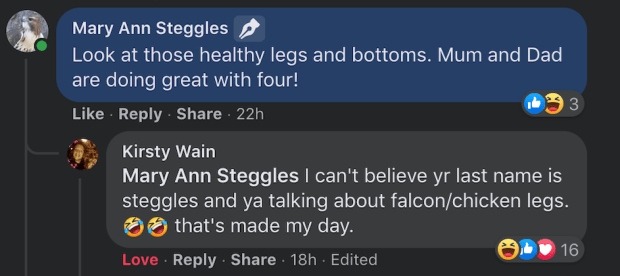
I want to close today (the birds are all crackers) by giving you one of those moments of laughing til you cried – or at least as one Australia woman did when she saw my comment on the 367 Collins Street Falcon FB Page.

This was the image:

Anyone that knows me, knows that I look for falcon and osprey chicks that have some ‘fat’ on them. It shows they are getting more than enough food. To me, that eyas with his ‘necklace ps’ surely qualifies as a fat little bottom and legs!

Once I realized that there is actually a company in Australia that sells chicken legs, I was also laughing til I cried. Enjoy the joke on me. Thank you Kirsty Wain!

Have a great Sunday. I am off in search of Wood Ducks today. It is finally sunny!!!!!!!!! and not raining. Take care. See you soon.

Thank you to the 367 Collins Street Falcon Cam and FB page where I took my screen shots.