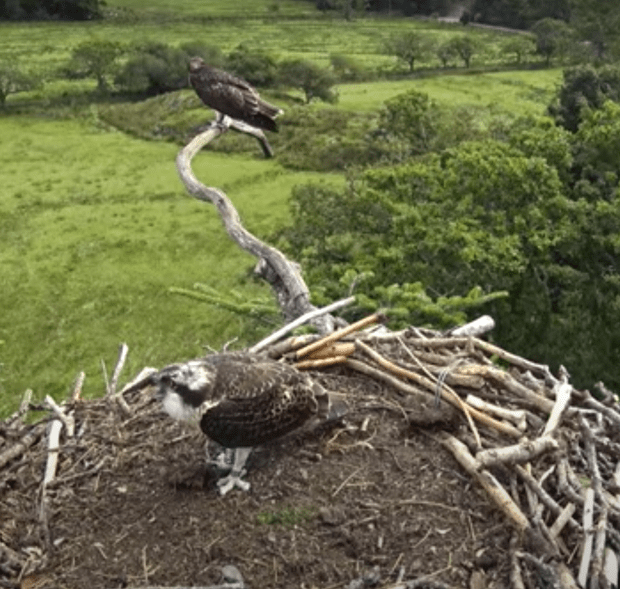
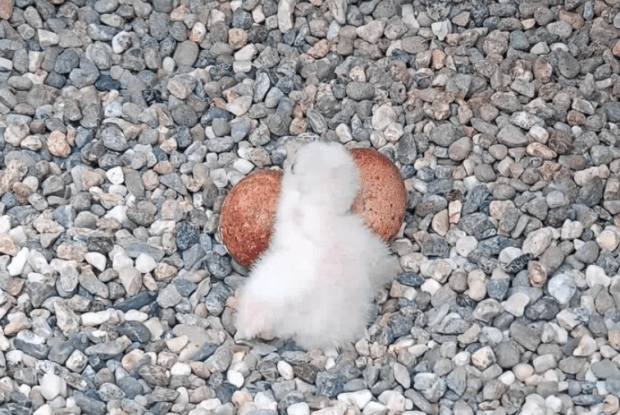
Ervie goes fishing, Egg 2 for Diamond and Xavier and more…Sunday morning in Bird World

28 August 2022

Good Morning Everyone. I hope that each of you had a lovely Saturday. Thank you so much for joining me today!

From the Mailbox:

‘A’ asks: What is the average time difference or gap for Peregrine Falcons to lay their eggs? Diamond looks like she is ready today. Thank you, ‘A’. That is a very timely question as we sit staring at Diamond’s bottom for her tail feathers to begin to go up and down when she is in labour. In the nest notes that Cilla Kinross, the researcher at the Orange Falcon cam compiled, it says that the average time difference is 56 hours. As I write this, the time in Orange is 13:21 on Saturday. That egg is due anytime.

‘L’ asks: What is the purpose of molting? The feathers of our bird friends get damaged just like our clothes from normal living. They break and get tears. Moulting is the annual replacement of the feathers. In fact, think about it. Feathers are so important to birds – they keep them warm and dry and, of course, are needed for flying. They should be in tip top shape which is why birds spend so much time preening. Some birds begin to moult in the spring. Others wait until nesting has finished. Moulting is really hard on the birds and it is normally done when there is an unusually high level of prey so they can keep their energy up.

‘C’ writes: “I’m glad I helped with that information about galvanized steel that contains zinc. But in stainless steel, the component is chromium. Is it also bad for the health of birds? I searched very quickly, and in a very superficial search, I didn’t find anything that chromium is also bad for.” The information you provided was very useful. As one of our other readers ‘L’ writes there are some uses for zinc that are also helpful such as in ‘Zinc Ointment’ for baby rashes. I do not know a lot about chromium. It is also used in ceramics to make certain shades of green glazes and is highly toxic in its powdered form. It is not toxic after the pottery has been fired to a specific degree, however. — We assume that the things that we use for cooking are all ‘safe’. Sometimes it is only later we discover that there could be connections to specific ailments. However, if I had a beloved bird that lived in a cage – the cage wires would be stainless. We have a metal shop in our city that made all the SS backings for my kitchen and my island top. I am certain there are similar facilities in other cities where they could make the wires. I am still finding this whole zinc toxicity that impacted Victor very curious. I wish I knew more!

In the News:

The UK is still celebrating the arrival of more than 100 Hen Harriers.

The New York Times published the following article about how climate change will impact the birds we love and which are more likely to go extinct first. The cover shows the Kakapo and my readers know that the Kakapo Recovery Group is working hard to make sure that the flightless parrots survive. Today there are 205 of them on a couple of mall islands of New Zealand.

Nest News:

Chase showed up with a nice big fish and waited and waited on the Two Harbours nest for Lancer on Saturday morning around 10:38. Lancer never showed up. What a change it must be for the parents from nearly getting their talons torn off to sitting quietly to see if anyone will arrive. If you have left the territory, Lancer – soar high, be safe and always have a full crop!

Such dedicated eagle parents. Did you know that Chase & Cholyn have been together for 19 years?

Ferris Akel had a terrific tour on Saturday afternoon around Ithaca, New York. I was listening and doing other things until he got to the Cornell Campus where he caught Big Red, Arthur, and L2 on camera. Oh, it is lovely to continue seeing L2. According to Suzanne Arnold Horning, the latest a juvenile has been seen at the Cornell Campus is 28 August. L2 looks pretty comfortable. I wonder if she will shatter that record?

Arthur was hunting.

L2 could see Big Red in the distance when she was on the pole and was prey crying really, really loud. Since L2 was the second juvenile to catch her own prey in June I am imaging that Big Red’s answer to that is: “Get your own!”

Big Red looks a little ‘rough’. She is moulting. Like other Red-tail Hawks, Big Red undergoes a complete moult once a year. Normally, hawks begin their moult in spring and every feather has been replaced by September or October. Big Red, however, appears to begin her moult after the eyases fledge.

Xavier has been bringing Diamond some extra special treats during Sunday to help Diamond keep her energy up for the egg laying. One was an Eastern Rosella which is a very colourful parrot and the other was a nicely prepared pigeon. Diamond was excited for both!

The arrival of the Rosella meant that cute little Xavier could have some time with ‘eggie’.

Diamond had a very large crop when the pigeon arrived but she certainly wasn’t going to turn her nose up at that special food gift.

It is 13:57 in Orange and Diamond is sitting on the ledge of the scrape box while we wait and watch for an indication that the second egg might be arriving.

Diamond is back on the egg at 1400.

Diamond is very focused and she looks ‘heavy in the rear’. Egg 2 could be coming shortly. Diamond normally lays 3 eggs. For the past two years, only one egg has been viable each year.

Diamond laid egg #2 at 17:27. Yippppppeeee. Why am I so excited? Well, falcon eggs do not always hatch and for the last two years Xavier and Diamond have had only 1 out of 3 eggs hatch so it makes the chances better of having a successful hatch.

Xavier arrives at 17:33 to see the second egg and to bring Diamond her dinner. Notice that Diamond is being very careful. Falcons lay their eggs standing up. She is protecting the egg while the shell hardens in the air. The gap between eggs is 57 hours.

Diamond did not want to eat. She had already had two big meals. She remained in the scrape box. During the night she would sometimes incubate or, alternatively, stand above the eggs protecting them. Remember the Currawong know there are eggs in that scrape and they will eat them if the opportunity arises!

The Melbourne couple seem to be finished with three eggs and each takes turns incubating. Dad was very anxious to demonstrate that he was well seasoned in incubation. The Melbourne crew even made a video of the persuasion.

It is a very short and cute clip. Oh, do you ever wish you could speak falconese?

Friends of Osprey have posted some photographs of Ervie near the Marina where he had dived and caught the lovely fish he is eating. They were taken by Alex Ditton. Oh, goodness. It is always such a joyous occasion when someone shows us that Ervie is doing very well indeed! Check out the Friends of Osprey for more images of Ervie.

Kaia remains in Belarus around the Priypat River. This is what the area looks like where she is resting and fishing.

Bonus, the only surviving storklet of Jan and Janika that was fostered with Kaia and Karl II has begun his migration. His tracker tells us that he traveled 109 km and is now in Latvia near the village of Vietalva.

Travel safe dear Bonus, fly high, stay out of the war zones, always have a stream full of frogs and fish — prosper.

There should be more news but it appears that all might have left for their winter homes from the Karula Forest nest of Kaia and Karl II. I will confirm this tomorrow.

Bonus was always a very special Black Storklet. He would not have survived without the intervention of Urmas and Dr Madis and his team. They would have died on the nest. Urmas’s foresight to provide fish baskets meant that everyone had lots of fish. A special thank you to all who donated towards the food for the nest.

The Dahlgren Osprey nest in the US has announced that the male, Jack, has not been seen for a few days so that now Harriet, the female, and the sole surviving fledgling from the nest in King George County are on their journey south.

No one has been seen at the Loch of the Lowes since yesterday. Laddie LM 12, Blue NC0 and both of the fledglings appear to also be heading south.

It was another successful year for Ospreys in Wales and John Williams gives us the run down in his last blow of the season for Llyn Clywedog. The numbers of Ospreys in Wales are growing. There are now 7 ‘known’ pairs who produced 17 chicks this year. John catches up with all the nest news.

John also produced a chart for all the chicks hatched at Llyn Clywedog – noting that there is simply too much grey. Were those chicks ever seen or not? Sometimes they do get missed.

Handsome Aran on the perch at the Glaslyn nest this morning. He remains bringing fish to the nest for the fledglings. Mrs G was still home as well today.

Handsome, Aran.

Emyr Evans has provided us with the data of the fledges at the Dyfi nest asking the question: what happened to Pedran? Emyr is great with statistics and this is a good read about migration and young fledglings.

https://www.dyfiospreyproject.com/blog/emyr-mwt/pedran-what-has-happened-her?fbclid=IwAR2nZUelKdPCJFEW-3PIjKlcohXunU9JSBevJA8wFl4XpT1ICR9H8O8bepA

Rosie was still on the perch at the SF Bay Osprey nest this morning! Brooks has not been seen at the nest for some time now – this is not alarming. She is out exploring!

Congratulations to Glacier Gardens. Both Love and Peace have fledged. Here is a video of that moment on 25 August when Peace took to the air. Congratulations for another successful year Liberty and Freedom!

Thank you so very much for joining me this beautiful Sunday morning. I hope that you are doing well and I will look forward to having you with us again in Bird World.

Thank you to the following for their streaming cams, their posts, and their videos that form my screen captures: The New York Times, Explore.org and IWS, Ferris Akel Tours, Charles Sturt Orange Falcon Cam, 367 Collins Street by Mirvac, Friends of Ospreys, Looduskalender, Dahlgren Ospreys, Friends of Loch of the Lowes and the Scottish Wildlife Trust, John Williams and The Clywedog Ospreys, Bywyd Gwyllt Glaslyn, Dyfi Ospreys, SF Ospreys and Golden Gate Audubon.

A Victor update and more news in Bird World, early Saturday

27 August 2022

Good Morning Everyone!

Friday turned out to be one of the best birding days I have had in my City because of the birds and the three people that I met — and, of course, an Osprey story. No, I didn’t add lots to my life list but, I will add a few when I can get some help doing the IDs. It was hot in the afternoon for the walk at the nature centre. The little Mallard mother that had 11 ducklings still has the 9 she had the other day. She has moved them to a different pond where the water and plants appear to be a little healthier.

In some areas the algae is just stifling the life out of the pond. The geese were all resting in the shade and only the song birds were exerting themselves. In particular, 5 or 6 Black-Capped Chickadees were around the ‘winter’ feeding area. I had the most glorious chat with a woman about the fate of insects and she mentioned a book, The Insect Crisis.

This lovely woman spent a few minutes explaining the concept behind the book – the collapse of the insect population and the shocking collapse of everything from birds to crops. I suspect that almost everyone who reads my blog is aware of the domino-effect that is or will take place as the insects die. The rest of the population has surely heard about what is happening even if they don’t understand it — or worse, choose to ignore it. Why then do people still hire companies to come and ‘kill’ the weeds on their lawn so that it is pristine all the while what they believe the company is using a green chemical is actually toxic! or the spraying of roses and other flowers? the use of pesticides used in farming? It is time to put a stop to these practices and embrace companion planting or the use of certain birds and animals that will weed but not kill the crops or flowers.

All the while we were talking, the lovely lady, perhaps in her 90s, was pulling out sunflower seeds for the Chickadees.

An hour before dusk I went to another site where a Bald Eagle had been spotted. OK. I am not the luckiest birder on the planet – far from it. All I could find were some Mallards resting….

and then, I didn’t hear it but something caused me to look up. There was an osprey flying overhead. My heart stopped for a second. An Osprey – sorry Bald Eagle people but this was fantastic. I have been trying to find the Osprey living in this area of my City and have always failed…and there it was.

It has been a good year to be surprised by Ospreys flying overhead. I only know where one nest is but that is fine…seeing them flying at dusk is very special.

The sun was nearly setting but, just on the chance that the Egrets were landing near the pond on the other side of the City, I took off…

As the sun set, 7 Great Egrets descended on the pond and their night time tree.

They continued to arrive as the sun set lower and lower in the sky. It was just a calm, beautiful summer evening spent looking at a ‘sedge’ of Egrets – a most unusual sight for a Canadian Prairie city.

I am not a wildlife photographer. Let’s be clear about that. There are people who are and two of them spent time with me taking photos of the Egrets, talking about where the birds might be spending their days and the anticipation of the arrival of ‘THE’ Green Heron this year (he was really lost last year when he landed south of our city in a small little river). Quite the celebrity that heron was! Of course, everyone is looking and comparing the ‘kit’ each of us had….I take photos because I love the garden animals and the birds – to show you! So they are taken with love not great technical expertise although there are many times I wish I had that level of talent.

In the Mailbox:

The Ojai Raptor Centre updated Victor’s progress in an e-mail posting today: Just look at this magnificent eaglet. This is a very special day. His zinc levels are normal!!!!!!!!

Here is the announcement from ORC:

Bald Eagle patient 22-635, who was rescued from Santa Cruz Island with zinc toxicosis on July 11, continues to make progress. The most recent test for zinc showed the patient within normal levels. This means the eaglet no longer needs to go through chelation therapy to remove the toxic metal from the bloodstream. The eaglet’s ataxia (lack of balance) seems to have resolved as well!

‘L’ sent me a lovely screen capture she had in her archives of Ma Berry. The year is 2018. Do you know who she is?

Berry College is located in Mount Berry, Georgia. Ma Berry was the mate of Pa Berry until 2020 when she was last seen the 17th of November. Ma Berry had a injury to her left talon – she was easily recognized. She had no difficulties fishing or catching prey with her injured foot. She was dearly loved despite there being a heavy loss to the chicks on the nest. In 2017-18, two eggs hatched with one chick fledging and the other sadly died from falling off the nest. The following year, 2018-19 both eggs hatched again but the chicks died within a week. The following year one egg cracked and the second was not viable. Ma Berry has a huge fan club and as one article at the time said, “There’s been a scandal brewing behind the Cage Center at Berry College.” A new female and Ma Berry had a bit of a stand off. For awhile many worried that Ma Berry had been injured or killed but on the 21st of January 2021, Ma Berry was seen at a lake (again easily recognizable by her injured and twisted foot). She is enjoying her retirement. The new female named Missy had two eggs in 2021. One was not viable and the other baby died – both of starvation and hypothermia. Missy just didn’t know what to do as a Mum. However, this year Missy and Pa Berry fledged B15 – a fine strong eagle. Pa Berry must have been very pleased.

https://www.northwestgeorgianews.com/rome/news/local/new-female-at-berry-eagle-nest-has-observers-buzzing/article_30c90372-3e2e-11eb-85f9-c717a7baead0.html

Three questions came in from ‘G’: What would have happened to the female at the 367 Collins Street Falcon nest? Did she find a new mate? Second question: What is a scrape? The third question: Why do falcons use gravel for nests and not twigs like eagles? OK. Let’s start at the beginning. I have included some images of the male at 367 Collins Street and his mate from previous years below with their four eyases from 2021. You will often hear that Raptors mate for life. From reading the information about Ma Berry above, you will then know that this is not always the case. Some females get usurped from the nest as do some males. Some are injured and die. Some leave and are discovered elsewhere. Some Ospreys have had two mates. A good example is Seren, Blue 5F in the UK. From 2015-2020, she was Aran’s ‘other woman’ at Glaslyn while Mrs G was his primary mate. In 2020 she decided not producing chicks and have a faithful mate was reason enough to pack her bags and leave. She did. She flew to Llyn Clywedog and became the mate of Dylan! So the saying mate for life is not always the case but it is more the standard than anything else. It is presumed, however, that the female at 367 Collins street has died and a new female has taken her place. If this is her first year as a Mum, let us wish both a very good year.

Scrape is the name of the ‘nest’ that Peregrine falcons use to lay their eggs and raise their eyases. Eyas is the proper term for the chick.

Peregrine Falcons traditionally made their nests on cliffs. There the sand and gravel would be gathered and a small indentation made for the eggs so they would not slide out of the nest cup. It is believed that by using this kind of nest insects and diseases that often form in twig nests – especially if it is cold and wet – would, thus, not impact the falcon chicks. That said, there are some stick nests being used by falcons in Poland that have been very successful.

An early morning question from ‘T’: Why aren’t the falcons in Australia sitting on their egg and eggs all the time? Great question! You can see them leaving the eggs in the images below today. Some raptors practice delayed incubation. They will keep the eggs warm for a few hours a day but will not begin 24/7 incubation known as ‘hard incubation’ until all of the eggs are laid. This ensures that there is not such a discrepancy in their dates of hatch. This lessens the chance of siblicide. In addition, many times the eyases hatch within 24 hours of one another like those at Collins Street the last few years.

In the News:

Hen Harriers remain in the UK news. As their populations begin to recover at 100 birds the illegal killing of the raptors remains a huge problem for the reintroduction programme.

https://www.theguardian.com/environment/2022/aug/26/more-than-100-hen-harriers-fledge-in-england-for-first-time-in-a-century

In Australia, there is dismay as to the protection of the forest industry and the lack of concerns from some of the wildlife going extinct. In 2022, people are starting to get upset and angry. Will the government respond?

https://www.theguardian.com/australia-news/2022/aug/25/swift-parrot-recovery-plan-changes-downplay-logging-threat-experts-say

Nest News:

Holly Parsons has posted the links to the four Falcon cameras at Orange along with a link to FAQs. Thanks, Holly! Here it is:

Diamond has been the female at the Charles Sturt Falcon scrape at orange since 2015. Xavier has been her mate since 2016. This means that they are at least 9 years old for Diamond and 8 years old for Xavier. Peregrine Falcons have been known to live for nearly 20 years in the wild.

Diamond is looking out the window of the scrape at Orange. Galahs, a pink and grey parrot, are flying by the tower. Do they not know they would be a remarkable mid-morning snack for Diamond? If Xavier sees them, she will have one!

Later Pied Currawong were observed doing flybys while checking out the scrape box. They eat eggs! Diamond and Xavier are going to have to be vigilant.

There is no hard incubation yet at 367 Collins Street in Melbourne. Does this mean that Mum and Dad Peregrine Falcon are thinking of a 4th?

For those of you who have watched the Melbourne nest in previous years and, perhaps, did not notice or know. This is a new female this year with Dad. My first thought was is it possible that Mum died from trichomonosis like the 4th eyas last year? We might never know – unless Victoria Hurley does, the researcher at this nest.

Dad has the biggest eyes. Oh, such a cutie with one of his prepared pigeons for the kiddos.

It would be very difficult to forget these four. They were incredible. The year before Mum and Dad had 3 girls…they towered over little Dad.

Mum and Dad with the four eyases for the 2021 season. Mum was amazing. She often appeared to be gruff but if you are having to chase after four eyases with independent minds, she seemed to have to be to keep them from falling off the edge of that ledge. Thankfully birds are afraid of heights (or so I am told). Soar high, Mum. You took such great care of your little ones.

The new female shows Dad the third egg early on a misty Melbourne morning. It arrived at 22:18 on the 26th of August.

Oh, I adore the little male falcon at Collins Street. Sometimes he looks like a toy in his cute little pajamas.

A few more images today of Dad and the new Mum taking turns incubating the eggs. You will get to know Dad rather quickly with the thick yellow around his eyes and if he is next to New Mum, he will be quite a bit smaller

Neither Diamond or the Melbourne Mum will begin ‘hard’ incubation until all of their eggs are laid. This is one of the reasons that there is less competition between all the eyases as they are close in size and birth date. Some Ospreys and eagles begin hard incubation immediately and this means that the third catch could be several days difference in size and development than the first.

Just look at SE 29 and 30. 29 is standing so tall with its big crop while 30 is enjoying a private feeding from Lady. Look very carefully at 30 since we can see the top of the head, the chest, the wings and back and – of course those pink legs standing so tall. Weeks 5 and 6 show the biggest change from the fluffy chicks with their down to the stage of an eaglet. There is now down left on the head (maybe a dandelion or two on 30). Dark feathers are starting to show everywhere – they are the most gorgeous espresso brown. The chicks are spending a lot of time preening now as feather growth is said to be itchy (how does a human know that?). They are now able to stand like 29 is doing without the aid of the wing tips. They will begin flapping and might make some attempts at self feeding.

Notice that beautiful light rust that is appearing on both of the eaglets. If you have never seen a juvenile Sea Eagle you are going to be so surprised at how stunning their plumage is. Notice also how those beaks continue to grow long and strong.

Dad was nudging Mum at the Port Lincoln Osprey nest to get up and give him a turn. It was 23:42!

Andor visited the Two Frasers Bald Eagle nest in the Channel Islands. It looks like he now has some time to regain his strength after helping Mama Cruz raise Lilibet and Victor. He certainly must have had a nice lunch!

The streaming cam at the Minnesota DNR Bald Eagle nest is now offline until the 17th of November. Mark it on your calendars. I wonder if Nancy will have a new mate for the next breeding season????

Both eaglets at the Glacier Gardens Bald Eagle nest have now fledged. Congratulations to Liberty and Freedom for another successful year. Believe it or not, the Bald Eagle season will be getting underway in Florida in the next 4 weeks or thereabouts. Goodness.

Kielder Forerst posted that one of the 2022 fledglings, Frankham, is now in Spain enjoying himself on the llobregat River in Catalonia. His ring number is Blue 439 and he was the first to leave Kielder this season. Frankham was from nest 1A where Mrs YA raised the chicks after Mr YA did not return after they had hatched. Congratulations Kielder Forest!

Did you know that there are 10 Estonian Black Storks with trackers on them this year? Kaia and Karl II along with Waba and Bonus from the Karula Nest are amongst the ten. It is going to get busy once they start moving. Kaia remains near Liaskavicy in Belarus in the wetlands of the Priyjpat River.

A new book, Birds. A Complete Guide to their Biology and Behavior by Jonathan Elphick has arrived on the desk. Review to come.

Have a lovely Saturday everyone. Take care of yourselves. I look forward to seeing you soon….and remember, if you have a question, send it in. There could be 50 or 100 people wondering about the same thing!

Thank you to the following for their streaming cams, posts, and videos that form my screen captures: Ojai Raptor Centre, Berry College and ‘L’, Charles Sturt Falcon Cam, The Guardian, Orange, Australia FB, 367 Collins Street by Mirvac, Sea Eagles@Birdlife Australia Discovery Centre Sydney Olympic Park, Port Lincoln Osprey, Explore.org and the IWS, and Looduskalender.

Remembering Lindsay…and more. It’s Friday in Bird World

26 August 2022

Amidst the joy of Peregrine Falcon eggs in Australia at both Orange and Melbourne, the loss of dear Lindsay, the eldest of the two siblings hatched at The Campanile on the grounds of the University of California-Berkeley, remains heavy – a real heartbreaker. From the news it is apparent that Lindsay died several weeks ago; her body just being found today. She was last seen on the Campanile on 5 August precisely three months after she hatched on 5 May. A life cut way too short.

Lindsay was one of a two-part miracle. Lindsay’s Mum, Annie lost her mate Grinnell when he was killed after chasing an intruder away from The Campanile. There was worry that there would be no chicks this season. Alden arrived in 5 or 6 hours hours (already a friend of Annie and Grinnell’s) and offered to help Annie incubate the eggs and take care of the chicks. We rejoiced at the love the two siblings had for one another, when they played, and when they chased moths. They grew strong and they flew. It is with such deep sadness that we say goodbye to Lindsay today. Fly high, Sweet Girl. Soar to new heights you never imagined.

Here is the full announcement from Cal Falcons. It appears that Lindsay’s death, from the evidence found from her body, was killed by another raptor.

It is heartbreaking. Lindsay had such potential and, of course, it is very possible that she was the last chick our beloved Grinnell fathered. She brought us such joy! I would like to share a few images of this remarkable falcon moving back in time from the last sighting of her on The Campanile on 5 August to the day she hatched.

Lindsay and Grinnell, Jr adopted many of the quirks of Alden including loafing. Annie has perfected it!

Annie and Grinnell, Jr playing together at The Campanile. The two siblings seemed to really enjoy playing with one another, something that I have not seen for a long, long time. It was refreshing.

Lindsay on the roof of the library on 18 June after fledging. Just look at this exceptionally beautiful juvenile. Stunning.

Do you remember banding day 27 May (on the right)? Lindsay was frightened but quiet. Alden would not stop being loud! Lindsay was still sit ting with a not so scared look on her face in early June.

Lindsay was also sitting in that same pose on 22 May.

Hatch day for Lindsay, 5 May. Grinnell wants to come and help. Annie is not sharing – yet – but she will and each of us will rejoice watching this wonderful family.

‘H’ just sent this press release on Lindsay. Thank you, ‘H’. Just made it before I hit send! Grateful.


From the Mailbox:

‘M’ writes: What do you think about this from Dyfi project? I am not sure I would pass off some of that behaviour as just “playing”, at least not based on how the smaller chick reacts. Wondered about your view, based on your study of third hatches.”

For transparency, I posted the information from Dyfi in one of my blogs. Emyr Evans has a long history with the Dyfi Nest in Wales. I have great respect for him but, in this instance, I choose to disagree.

In the UK Osplet deaths are generally attributed to either very poor weather in the early days after hatching or lack of prey, starvation not siblicide. There is little history of siblicide; there are so few breeding pairs and chicks compared to North America. This year, however, we did see it at the Loch of the Lowes Nest. It was rather horrific treatment of the third hatch that was killed by the eldest during a period of low prey delivery.

As you are aware, my research is on siblicide and, in particular, the success of any third hatch osplets vs the other two siblings. Because I track the juveniles long term this is limited to those that are ‘ringed’ and/or ringed with SAT tracking. My findings also rely on the good fortune of someone seeing the juveniles in the future and providing that information to various data bases! In my experience, the aggression shown by older siblings ranges from mild displays of dominance to more serious concerns that seem to taper off around the age of 26-28 days. Serious aggression often ends in the death of the smaller weaker sibling. There is much research to support the fact that it is not always about food. Sometimes it is just dominance.

‘M’ this, in my opinion, is not play. It is establishing the dominant bird on the nest. The dominant bird will eat first and if there is little food it will be the only chick that eats. Had food been scarce the treatment might have escalated but, thankfully, it didn’t. Gender may play significant roles also with the females requiring more food to grow 1/3 larger and feather a larger body. Thus, the females, especially if they are the first hatch, tend to be more aggressive.

Multiple times this year we have seen the third hatch killed by the eldest sibling and sometimes in conjunction with the middle one. As mentioned, this happened at the Loch of the Lowes this year when food was scarce. It also happened at the UFlorida-Gainesville Osprey nest amongst others. It also happens on eagle nests and other species. However, there appears to be a higher rate of siblicide among North American Ospreys than those in the UK. It is likely that these numbers reflect the higher population of Ospreys in North America. In addition, the lochs are full of fish and there are restrictions on many of them to prevent human intrusion during the breeding season.

Loch of the Lowes

In the News:

We are going to start with some fantastic news. When I lived in the UK, I studied in Leicester but lived in Lincolnshire and Belvoir (pronounced Beaver) Castle was a regular haunt for me – so close to where I resided. For the first time in 200 years, we have Ospreys breeding on top of Belvoir Castle! Oh, my goodness. I am delighted. Here is the BBC News report.

https://www.bbc.com/news/uk-england-leicestershire-62675910?fbclid=IwAR2oh_nwcQ04Sgqp9W2VubAHNIWEVdklHCduT0KiCfsp1lu7y_-92-kc-hI

There is more news coming in about the sad state of the White-tail Eagles on Mull Island — known internationally for the birds and their nests.

https://www.rspb.org.uk/about-the-rspb/about-us/media-centre/press-releases/mull-white-tailed-eagle-chick-dead-from-bird-flu/?fbclid=IwAR1dQ2AI_bU07KxyTS0T6CeKgHBU0FFA5bnjUFrTF1LOCudnRC2vPFJhjhU

Bird Flu is also killing Black Vultures. Deaths from migration, Avian Flu, human disturbance and killings, fires, habitat loss, lack of food…how many of our raptor friends will be left?

https://www.theguardian.com/world/2022/aug/24/bird-flu-has-killed-700-wild-black-vultures-says-georgia-sanctuary

There is a lovely documentary on YouTube on the return of the Black Storks to Germany in the 1980s. The cinematography is excellent as is the narration. So much to learn – 53 minutes. Find a nice quiet time to watch!

Nest News:

The 367 Collins Street Falcon Cam in Melbourne is up and running. So far there are 2 eggs!

Here is the link to the camera:

As you will be aware, the first egg of the season for Xavier and Diamond at their scrape in Orange was laid at 0713:48.

Diamond resting in the scrape after her labour and the delivery of the first precious egg for these two.

Diamond incubating the egg. How beautiful.

Xavier comes to the scrape to relieve Diamond. A short bonding ritual takes place before Diamond flies off.

Xavier scraping and trying to turn the egg as he settles down.

Xavier carefully rolls the egg.

Everything is alright with the world. Oh, what a joy to finally see the first egg for Diamond and Xavier. Let us all hope that their year is as successful as it was in 2020 with the hatch of the ever adorable Izzi.

Here is the link to one of three cameras for Xavier and Diamond:

I am so used to the Ospreys in the UK and the Dads bringing in a fish right before or when the sun is rising in the morning. That first fish delivery for SE29 and 30 at the WBSE nest in the Sydney Olympic Forest did not come until 12:31 today. Thankfully the chicks were civil and it was not huge but was a good size.

Images from early morning to feeding.

Early morning preening of those itchy feathers.

Beautiful Lady listening and waiting for Dad to bring food to the nest.

SE29 and 30 watching Mum aerate the nest. Just look at how carefully they are looking at her every move. This will imprint in their mind’s and they will know to aerate their own nests.

Finally, a fish has arrived!

Things appear to be going good at the Port Lincoln barge except for Mum making cries for fish. On occasion Dad has flown in eaten more than his fair share while Mum is fish calling. He then delivers the remainder to her. Come on Dad! Dad is taking his turns incubating.

Oh, it seems so long until 19th of September – may the time pass quickly! There is nothing cuter than nestlings a couple of days old.

Checking on Kaia’s transmission. She remains in Belarus. On the 25th of August she flew 123 km. She is now near the village of Liaskavicy. It is in an area that is part of the wetlands of the Pripjat River. There is a national park and the area is considered to be quite safe for Kaia.

Karl II is looking a little tired. Thanks to Urmas the supply of fish continues so that he can feed the four Black Stork fledglings. Soon they will fly and hopefully Karl II will have some days to recover and gain some weight before he leaves. Of course, when they do depart we shall all be worried for them. I wonder if by some means Karl II and the children will meet with Kaia and decide another route to their winter home???

It appears that all of the White Storks from the nest in Mlade Buky, The Czech Republic have left for their migration. It is raining heavily and both of the nests of Bukacek and Betty appear so lonely. Safe travels dear family.

Suzanne Arnold Horning has caught L2 on the Cornell Campus! So happy she is here with us. In the history of the nest, it seems that the 28th of August is the last day to see fledglings in the past. Enjoy these moments then with our first fledge of the year. Gosh, she is beautiful. We know that she is catching her own food – she was the second of the fledglings to do so more than a month ago. So all is well with L2.

It is Friday. A friend sent this to me to cheer me up because of Lindsay. I did giggle…love those sour worms. Thank you ‘S’.

Thank you so much for joining me today. If you have any questions, you can send them through the comments page or through e-mail. My address is maryannsteggles@icloud.com Have a fabulous Friday! Take care of yourselves. See you soon.

Thank you to the following for their streaming cams, videos, and posts that form my screen captures: Cal Falcons, Berkeley News, Dyfi Osprey Project, Friends of Loch of the Lowes and the Scottish Wildlife Trust, RSPB, The Guardian, BBC, 367 Collins Street Falcons and Mirvac, Charles Sturt Falcon Cam, Sea Eagles@Birdlife Australia Discovery Centre Sydeny Olympic Park, Looduskalender, Eagle Club of Estonia, Mlade Buky, and Suzanne Arnold Horning.

Monday morning in Bird World

22 August 2022

Good Morning Everyone! The sun is out and it promises to be another hot day, 28 C. No rain forecast until tomorrow — and they might well change that. I am delighted to report that Dyson was seen in the garden this morning. One of the juvenile Blue Jays was screeching so loud – at Dyson – who was helping herself to ‘his peanuts’. The three juvenile Crows were in the garden on Saturday and again this morning. The little female was cooling her feet off in the bird bath.

I have also been out checking on the ducklings. Some are really growing!

Last week, there were 11 with this female. I am now counting 9.

This little sweetheart watched me quietly walk towards and around her. She never moved. How delightful.

If you are a duck and it is hot and humid, what do you do? Try to find some shade and/or a breeze. Duck Siesta time.

Then I found these two ducklings. They do not have their tails and are still sporting their downy fluff. Oh, I am going to worry about them and, hopefully, I can find them today or tomorrow when I am out checking again.

Update. There was some concern about the situation with AX6, Axel, at the Loch Garten nest. Yesterday, I posted that AX6 had not been seen on the nest and was feared to be ousted by the intruder, KL5, injured, or worse since 15 August at 0635.  Good news arrived from ‘DV’ who wrote to tell me “AX6, Axel, was seen on the Loch Garten nest this morning (Sunday), according to watchers.” Oh, fantastic. I checked on the Loch Garten FB page and they confirmed the time as 0835. Axel remained on the nest for 5 minutes. There is YouTube video confirmation. Thank you so much DV! Now has he been feeding the sole surviving chick from the nest 1C2 off camera? That is the question. He looks good!

The nest was empty later.

From the mailbox. There are several nests that many of you might have been wondering about. First up, Titi and Boris at the Janakkalan Nest in Finland. I have heard nothing since the camera shut down quickly and abruptly. I do not know why a decision was made to go offline at that time.

The streaming cams operate for many reasons but research and education/entertainment seem to be the main categories. The owners of the streaming cams often do not take into account the impact that watching a family of raptors has on viewers. Each of us has our favourite nests. Some may be the same for all of us but there are always nest surprises. We have our favourite nestling and we cheer them on and yell at the screen, fret when the weather is bad often staying up with them. We worry when there is not enough food. We clap and jump when they fledge and then we worry about where they are and if they are alright Sometimes (and it was a lot this year), we cry when one or another or all die.

For me the streaming cams have always been a way for us to connect with nature. They became particularly important during the pandemic as shown by Loch Arkaig having over 400,000 viewers watch Louis and Aila raise JJ5, JJ6, and JJ7 in 2020. Many have written to tell me that they are in hospital dying and it is the birds that are keeping their spirits up. One of my readers who became a good friend had cancer. Anyone on the Sydney Sea Eagle chat will remember Phyllis. The sea eagles and the chatters kept Phyllis going much, much longer than the doctors could ever imagine. The birds enrich our lives. I have had people say why not go outdoors and watch the birds, why on screen. I always tell them that it is like going to a sporting event or a Formula 1 race – you actually get a better view on the telly. Of course we go outside and see the birds if we are able! But where could you see up close an Osprey, an Eagle, a Peregrine Falcon raising their chicks? I surely couldn’t! They have brought us joy and touched our hearts so when that camera is suddenly turned off without an explanation or warning, we wonder why. It is shocking.

And so it was with Titi and Boris. They had lost their mother and their sibling. Dad continued to bring food and the goshawk was around. We worried about Titi who waited so long to fledge and then boom…nothing. We never got the opportunity to see if Titi would return to the nest. Some of you have written to ask the Finnish Osprey Foundation why did they turned the camera off so early. You have not received an answer. I have written to one of my Finnish contacts and readers to see if they know anything. I will certainly post any news here for everyone if I should hear.

My inbox has been full of letters about Malalam the little Red-tail Hawk adopted by the Bald Eagle family on Gabriola Island, British Columbia. When her nest mate turned sibling, Junior, was electrocuted on a pole owned by BC Hydro, GROWLS posted all manner of information so that a campaign could be directed towards BC Hydro. Many groups joined in. I carried their request to you. Malala is not ringed. The Red-tail Hawks and hawks in general are beginning their migration. Will we ever know what happened to Malala? is anyone watching the nest to see if she returns? She could be heard on the cam on the 30th of July. That same day, GROWLS FB said that the season was closed and the camera was immediately turned off. No information has been posted since. It felt abrupt especially after so many wrote to BC Hydro on their behalf after the call to do so on July 22, ‘Justice for Junior’.

I am fortunate to have a friend and former student in the area. They have confirmed for me that there are a number of red-tail hawks and without any method for identification no one will know unless they happen to see Malala at the nest or eating fish. If I do hear anything – or if you do – please let us know.

Many of you fell in love with this family and the story. That is the missing link in the streaming cams that I am trying to emphasize. If we are to try to make any positive impact in the lives of wildlife, then it would be good if the administrators of the streaming cams would agree to post any updates and warn individuals when and why cameras are being turned off. Annual maintenance is one of the biggest reasons and well established cameras with high traffic always warn their viewers. I am thinking of SWFlorida Bald eagles. In this instance so many of you wrote to BC Hydro and it would be reassuring if we heard that the pole that killed Junior had been made safe for any future fledglings. I would love to see a FB post about that and if GROWLS had their new camera. I think you would, too.


Just when we should be expecting the nests to be so empty, there continue to be surprises. Lancer visited the old Two Harbours nest and the cam operators were simply fantastic, getting great captures.

The Channel Islands just look like a perfect place for Bald Eagles to live. What a magnificent view of the water.

A video was put together of Lancer’s visit to the original Two Harbours nest. No one is sure why Chase & Cholyn decided to move their nest. Here you go:

Thunder visited the West End nest with a fish today, too. She must be lonely without any one of the three fledglings not rushing her to grab that fish out of those talons!

I decided that perhaps there might be some luck checking on the other nests. There was no one to be seen at the Fraser Point nest of Andor and Mama Cruz. I have had quite a number of letters asking about Trey and what happened to her after Mama Cruz winged her. I have heard nothing and there seems to be no mention on any of the normal sites associated with the Institute for Wildlife Studies. This time it would seem that no news is good news – she has gone on her way. If I should see or hear anything otherwise, I will definitely let you know. I will also add that this is not the first time that Trey -who hatched and fledged from the Fraser Point nest – has returned home. She fledged on 6 June 2019. Her first return to the nest tree was 15 July 2021. She returned again on 25 July 2021 and then again this year on the 16 August 2022.

There was no one about the other nests in California that I could see. I then went over to Florida to the nest of Samson and Gabby at Jacksonville and got a pleasant surprise – it was a Red-shouldered Hawk having a rest.

Migration has begun, of course, and there will be many raptors (and other birds) stopping to rest along the way. What a beautiful, beautiful hawk this one is! And what a delight to get to admire the gorgeous plumage for a bit.

Karl II is still feeding the four Black Stork fledglings at the nest in the Karula National Forest. Bonus was there so all four are still around and have not left.

Meanwhile Kaia remains in Belarus near the fields and marshes near Lake Veluta.

If you are a fan of the Kielder Forest Ospreys, here is a full up-to-date report on each nest! It was joyful reading that Mum had managed to fledge her two chicks after losing her mate, YA. They flew on 9 and 13th of August. She remained another 11 days fattening up for her big trip.

Dorcha has not been seen at the Loch Arkaig nest for several days. I am presuming that she has begun her migration, too. Louis is keeping Willow and Sarafina satisfied with fish — as he always does. What a fantastic mate he is. Louis delivered a fish to both this morning.

At the Foulshaw Moss nest in Cumbria, Blue 35 and fledgling Blue 480 have not been seen for a number of days and, like Dorcha, are believed to be in the midst of their migration. White YW is supplying fledglings Blue 481 and 497 with fish at the nest.

Dylan is delivering nice trout to the Llyn Clywedog nest…and the fledglings are not always holding on tight enough and oops…off it goes. As long as the fledglings are around, Dylan, like all the males, will continue to bring fish to them. Then they will feed and go on their way to their winter home. Seren Blue 5F was still seen fishing on the 21 August.

Mrs G is still at the Glaslyn Valley nest she shares with her mate, Aran.

It is a little soggy at the Dyfi nest of Idris and Telyn. The information below the camera states that Telyn was last seen on the 20th. As it happens, however, Telyn was seen on camera at 16:08 today and there were great views of the second hatch, Padarn.

Here is a lovely video of Telyn bringing a Mullet to the nest with Padarn and Paith doing some loud fish calling!

It is raining with some wind at the Mlade Buky White Stork nest in The Czech Republic. I have seen only one stork on the second nest that Bukacek built. Awaiting confirmation that Betyhka has started migration along with the four fledglings.

In the UK Raptor Persecution news, the Moy Estate in the Scottish Highlands has lost its license (in an appeal) for the poisoning of a Red Kite on its estate.

There will be more and more prosecutions of estates where grouse hunting takes place and when the wildlife estate managers kill the raptors that the UK is working so hard to reintroduce. Indeed, there is a growing movement to end the practice of grouse hunting.

Dad brought Lady and SE 29 and 30 a nice big chunk of fish yesterday. All ate and then, surprisingly, Lady decided to brood the chicks. This nest appears to be doing very, very well this season.

Waiting for eggs at the scrape of Xavier and Diamond. The rejected Starling in the corner appears to be ‘past its sell-by-date’. If the amount of mating that these two have been doing is any indication of the number of eggs, this scrape should be full from top to bottom and side to side. I am hopeful that we might have the first egg in a few days!

367 Collins Street in the CBD (Central Business District) of Melbourne has not gone live so no eggs there yet either.

It is pouring down rain in Port Lincoln this morning. Mum is really tucked in so those precious eggs do not get wet.

It’s a wrap! Thank you so much for joining me today. I hope that the start to the week is a wonderful one for each of you. Please take care. See you soon.

Thank you to the following for their streaming cams, posts, and videos that form my screen captures: Loch Garten RSPB, GROWLS, Explore.org and IWS, NEFlorida-AEF, Eagle Club of Estonia, Looduskalender, Kielder Ospreys, Friends of Loch Arkaig and the Woodland Trust, CarnyxWild, Bywyd Gwyllt Glaslyn, Dfyi Ospreys, Mlade Buky, Sea Eagles@Birdlife Australia Discovery Centre Sydney Olympic Park, UK Raptor Persecution, Charles Sturt Falcon Cam, and Port Lincoln Ospreys.

Featured Image: Thunder at the West End Bald Eagle nest, 21 August 2022.

Falcon and Red-Tail Hawk Cams

I had a lovely note form ‘M’ asking about other peregrine falcon cams. Thank you for your letter, ‘M’.

Each one of us feels a little ’empty’ when the eyases fledge. Without trackers, we have no idea what happens to them. We just wish them well and I know that everyone is working hard to make their environment better. The only birds on the nest who have fledged and not left permanently are the PLO Lads – Ervie, Bazza, and Falky. It is winter in the Northern Hemisphere and the birds have migrated to warmer climates. I will, however, be checking on nests in Asia to see if there are any for you to watch.

This is not an exhaustive listing but it is a beginning and I will be adding to it for all of you as the camera streams return. We have streaming cams on the falcons in Winnipeg as part of the Manitoba Peregrine Falcon Recovery. I will post those at the beginning of the summer. Most of our birds are in southern Texas or Mexico right now.

So here goes – and if you have a favourite falcon or hawk cam, let me know!

One of my favourites are the Peregrine Falcons in Melbourne. They are known as the CBD or 367 Collins Street Falcons. The cam is currently not live. Will come back on line September 2022

Cornell Red-tail Hawks (Big Red and Arthur), Ithaca, New York. The construction work at Bradfield has caused a power outage on the Athletic Fields. Those building works are winding down and this camera should be live shortly. Big Red and Arthur will be very busy once late February and March roll around. There are only two Red-tail hawk streaming cams in the world and this is the best. Big Red is 19 this year. Arthur is 5 or 6 years old. They are a fantastic couple that normally fledge three eyases a year. There are birders on the ground that keep track of the fledglings so you get to see the parents do team training in hunting, etc. Highly Recommended.

Charles Sturt University Falcon Cam in Orange, Australia. Yurruga has fledged. Look for egg laying in the fall of 2022. This is the scrape box of Diamond and Xavier. They are a well established couple. For the past two years three eggs laid but only one fledgling each year which is fine. It is a nice comparison with the Melbourne falcons who fledge 3 consistently. Orange is more rural and, of course, Melbourne is urban. The camera is left on and the falcons come and go regularly.

The Campanile Falcons on UC-Berkeley. This is the scrape box and cams for the Peregrine Falcon Couple, Annie and Grinnell. Grinnell was injured by a male interloper on 29 October. He was in care, as a result, and has been returned to his territory. The male interloper is still at The Campanile. It is unclear which of the males Annie will choose. Nesting activity late March, 2022. Annie and Grinnell are incredible parents who traditionally fledge three adorable babies.

The following are falcon cams that I have watched ‘on and off’ and that have come highly recommended to me from viewers:

Illkirch, France:

Great Spirit Bluff, Minnesota

Anacapa Island, California. There are current a large number of Pelicans to watch.

I will definitely be posting more including a couple of streaming cams from the UK. All of that action will begin when spring arrives. I also want to post some sites in Asia which I will do over the weekend. There will also be the Northern Hemisphere Ospreys, White-tailed Eagles, Golden Eagles, as well as the returning storks to Latvia and Estonia.

For now, things are really pretty quiet except for the Port Lincoln Ospreys, Diamond and Xavier coming in and out of the scrape box in Orange, and the Bald Eagles laying eggs in the US. There are two nests that you might wish to consider and if you have never watched a Royal Albatross nest then you definitely need to check out the Royal Cam Family in New Zealand who are incubating an egg laid on 9 November. They are very experienced and adorable parents, OGK (Orange Green Black) and YRK (Yellow Red Black). They are already grandparents. I often suggest this site to individuals who have a difficult time watching any nest if there is sibling rivalry. The Albatross lay one egg every two years. Parents rotate all of the duties. Last year the Royal Cam chick, Tiaki, had a sat-pak attached to her. We are currently watching her fish off the coast of Chile.

It is a bit wet in NZ this morning. This is YRK’s 6th day on the nest. OGK will be flying in soon and they will switch. Should something happen, the NZ DOC rangers are there to step in and intervene. No one goes hungry, injuries are taken care of, etc. It is a great site and in the process you will bear witness to a country that really protects its wildlife!

There are way too many Bald Eagle streaming cams to list them all. For now, I am only going to recommend one. These are experienced parents Harriet and M15 at the SWFlorida Bald Eagle nest on the property of the Pritchett Family. Their eggs are due to hatch soon – December 25-28. Once Gabby lays her egg in NE Florida I will post that information. For now, you can have fun watching Harriet and M15 change places. The only un-fun thing is the GHOW that attacks the eagles regularly.

There is no word on Yurruga. Cilla says she will look for a few more days. Just so you know the building that Yurruga was last seen on is a gabled (triangle) pointed roof, a bit steep. It is a single story building with clay tiles. Yurruga is not there – not alive, not dead. He was there on Thursday – seen twice during a big storm. I would expect to hear this fledgling screaming for food. Falcons are loud! Is it at a distance from the tower? is Yurruga injured? is Yurruga somewhere else? There are no answers I am afraid. If I hear anything you will be the first to know. Now, it is time for me to go and take care of all my feeders. The gang will be here soon!

Thank you so much for joining me. Take care everyone. See you soon.

Ervie gets the breakfast fish!

The fish arrived on the nest at Port Lincoln at 6:35:01 and immediately Ervie was mantling it.

Needless to say, Ervie really is the boss of this nest and for good reason. He has fabulous survival instincts.

As you know, my interest is in third hatches and how well they do on nest and off. It will be very informative on how well Ervie does when he leaves the area of the nest seeking out his own fishing spots.

Bazza and Falky might wish that Ervie would fly off and not return.

I only commented once but watchers were calling Falky ‘Mellow Yellow’. It is time that Falky was not so laid back. Yesterday, Bazza took the second fish while Falky had the fish tail from Ervie’s earlier breakfast. If I missed Falky getting a fish, I apologize. It would be good if each had one fish per day. They are all well-feathered and Bazza and Falky will fledge when they are good and ready. e

Oh, wouldn’t it be wonderful to watch Ervie learn how to fish?

At 7:43, Ervie is still eating but his two siblings are hanging close hoping to get some leftovers.

Ah, and Falky got it. Well done, Falky.

If you missed Ervie’s fledge, here it is again. It is quite beautiful on the take off and fly by but the landing was not impressive! Still, I applaud our third hatch lad. Ervie, you are amazing. You are definitely the leader of the pack, so to speak.

If you missed Victor Hurley’s Q & A discussion, it was really really super. I posted that link in my blog, Ervie Flies! early this morning. Very informative and you can start and stop it as you like. If you are interested in falcons or Australian birds of prey – it really is a talk not to miss.

Since the shut down of the 367 Collins Street camera, I hope that many of you are filling that gap with Yurruga in the water tower scrape of Charles Sturt University at Orange. As a former academic, we do not like to comment on others’ research. There were a couple of questions to Victor Hurley about the scrape at Orange and he answered in general terms. Someone asked about the low hatch rate and the eggs. VH said that if the eggs are too large (and he does not know that is the case at Orange) it is hard for the chick to kick them to create a crack all around the egg. He also noted that sometimes eggs get turned when a beak is protruding and the chick cannot right itself if the egg is turned around. Of course, VH said that those are general statements and not specific to Orange. He did comment that Yurruga gets all the food while the four at Collins Street had less bites per chick. He also noted that the Collins Street Four developed quite fast this year and that Yurruga appears to be developing normally. So, she is 8 days younger and the amount of floof she has is normal for this stage.

One of the things that I took away from VH’s discussion was how adaptable Peregrine Falcons are. If there is a drop in numbers of a prey item, they will move to something else. For example, some Alaskan Peregrines have been known to eat trout. The image below was shown as an example.

This year I noted a drop in the amount of pigeon delivered to the scrape at Collins Street. This could, according to VH, be a result of the several lockdowns they have had due to the pandemic. Less people eating their lunch and feeding the pigeons. He did note that the male did bring in Quail and Rail. The falcons normally have a 5 km hunting range but are known to go farther. The are for Collins Street is prey rich. The red dot indicates the site of the nest box.

The falcons do not spend a lot of time on the ledge after the eyases fledge. There is a good reason for this – parasites.

As we learned with Grinnell, the male at the University of California – Berkeley Campanile scrape, birds can become loaded with parasites and they might not be able to protect themselves as well as if they were healthy. Grinnell was taking anti-parasite medication to overcome this. We know he is improving and will be released shortly.

One of the most interesting things to come out of this talk had to do with how the females are attracted to a mate. VH said that there are ‘stunning’ Peregrine males. You and I have seen them. They have an almost orange cere and legs. Dark black, really black, hoods with cream chests and very fine pinstripe chests. Those are the extremely healthy males and the females want healthy. Pale yellow indicates unhealthy. So now when you look at a falcon you can tell healthier vs not so much.

Also falcons divorce. If the female hooks up with a male and he does not share incubation duties or bring in prey, she will move on the next year. The male stays with the nest but it could be in a prey deficit area. At any rate, it was a real good discussion! It is nice to listen to the expert in the area – even talk about rodenticide.

Little Yurruga is doing well. She was working on her breakfast the last I checked.

My daughter went to the Assiniboine River for a walk and discovered about thirty-five ducks still on the river. She sent some photos for us. She noted that there was at least one other group this size down the river.

There are a lot of signs on our park ponds not to feed the ducks and geese or they will not migrate. My daughter ran into a neighbour that says the ducks stay at that part of the river year round and people feed them. They added that parts of the river in that location have been open – not frozen over. I sure hope that is the case this year! There is also an American Bittern hanging around one of the creeks. Maybe they know that this big snow is just to scare us into thinking it is going to be a horrible winter and it will be mild. We wait to see.

The garden birds have found the seed left on the deck and Dyson has, of course, been helping himself. I missed getting him hanging upside down on a suet cylinder. The migrating birds are all gone from this area. Thankfully.

Dyson always knows when the food comes out!!!!!!!!!!!!!!!

The feeders – and there are many different kinds – are all full. It was interesting to me that the sparrows did not mind standing on the snow. According to my daughter, the ducks really like being in the water and not having their paddles on the cold ice.

It is a good day to be inside!

Thank you for joining me today. There could be another fledge at Port Lincoln and we know there will be lots of prey for Yurruga. Take care everyone. See you soon.

Thank you to the following for their streaming cams where I took my screen shots: Port Lincoln Osprey Project and Charles Sturt Falcon Cam and Cilla Kinross. I also want to thank the 367 Collins Street FB group for posting the link for Victor Hurley’s talk and my daughter for those great duck images.

Fall to winter

The beautiful weather that we had on the Canadian Prairies yesterday was due to dramatically change over night.

Footpath linking Portage Avenue with Assiniboine Park over the Assiniboine River

Our weather will go from nice blue skies and unseasonably warm temperatures to snow and then snow mixed with rain. It is currently 0 degrees C and will warm up to a balmy 2 degrees C in the morning when the precipitation begins. My daughter messaged me to tell me there were still some Canada Geese and ducks in the Assiniboine River. It seemed like a good time to get out and go for one last nice walk.

The little Red Squirrel at Assiniboine Park knows that the warmth is not going to last. It was busy pulling off the seeds from a Maple tree and cramming them into holes and in the grooves in the bark of a tree. He was so busy he did not even notice the people standing and watching him.

The geese were looking for any blade of grass to eat they could find.

Some were in the duck pond flapping their wings trying to stir up the plants from the bottom of the pond.

Others were simply enjoying a beautiful afternoon in the warm sunshine.

It gets dark around 17:00 and as I was leaving some of the geese were flying away. Are they heading south for the winter?

I really hope that the geese and ducks got out of the City last night like the ones above taking flight. As promised, we have snow. Mr Blue Jay has come to visit and the sparrows are trying to find seed under the snow.

There are many feeders filled with sunflower chips, suet, black oil sunflower seeds, and then that wonderful ‘trail’ mix which looks better than what I make.

The sparrows in the snow on the deck know there are goodies underneath. Why they are not back at the feeders I cannot tell you. There is room for everyone there.

What a handsome little House Sparrow this fellow is. You can always tell them by their grey caps!

So how do birds cope with winter? This article was published by Daisy Yuhas in 2013 but it is still accurate now. Have a read – it is really interesting:

“Each autumn as many birds begin epic journeys to warmer climates, there are always some species that stay put for the winter. These winter birds have a better chance of maintaining their territory year-round, and they avoid the hazards of migration. But in exchange they have to endure the cold.Like us, birds are warm blooded, which means their bodies maintain a constant temperature, often around 106 degrees Fahrenheit. To make enough heat, and maintain it, they’ve evolved many different strategies–some similar to our own.Sparrows, for example, seek out shelter in dense foliage or cavities to avoid the elements. They also huddle, bunching together to share warmth, and try to minimize their total surface area by tucking in their head and feet and sticking up their feathers. Cardinals, impossible to miss against the snow, and other smaller birds puff up into the shape of a little round beach ball to minimize heat loss.”Big birds, like geese and grouse, do what we do,” says physiologist David Swanson at the University of South Dakota. “They put on insulation.” Their insulation often involves growing an extra set of insulating downy feathers.Birds can also put on fat as both an insulator and energy source: More than 10 percent of winter body weight may be fat in certain species, including chickadees and finches. As a result, some birds spend the vast majority of their daylight hours seeking fatty food sources, making feeder food even more precious for surviving a frosty night.When asked which birds are toughest winter survivors, Swanson points to little ones like chickadees. These small creatures can’t put on too much bulk for aerodynamic reasons. Instead, explains Swanson, they are experts in shivering. This isn’t the familiar tremble that mammals use to generate heat. Birds shiver by activating opposing muscle groups, creating muscle contractions without all of the jiggling typical when humans shiver. This form of shaking is better at retaining the bird’s heat.Another adaptation shared by many species is the ability to keep warm blood circulating near vital organs while allowing extremities to cool down. Take gulls. They can stand on ice with feet at near-freezing temperatures while keeping their body’s core nice and toasty.Keeping warm when the sun is up is one thing, but few winter challenges are more daunting than nightfall, when temperatures drop and birds must rely on every adaptation they have to survive their sleep. Some birds save energy by allowing their internal thermostat to drop. Hummingbirds are a famous example of this, undergoing torpor nightly as their body temperature drops close to outside temperatures. But torpor is not too common in winter birds, because the morning warm up would take too much extra energy. Instead, black-capped chickadees and other species undergo a more moderate version of this, reducing their body temperature as much as 22 degrees Fahrenheit from their daytime level in a process called regulated hypothermia.One simple way to help birds when the weather outside is frightful is to hang feeders. To attract a diversity of birds, select different feeder designs and a variety of foods. A tube feeder filled with black oil sunflower or mixed seeds, for example, will attract chickadees and finches. Woodpeckers devour suet feeders. And a safflower or sunflower-filled hopper feeder entices the usual visitors plus larger birds like cardinals and red-winged blackbirds. The birds benefit from the backyard buffet, and you’ll have a front-row seat to numerous species flocking to your plants and feeders.” Some raptor species, lower their body temperatures. More on that another day as we shift from fall to winter.

It is not clear how many birds are on the ledge at 367 Collins Street. The Mum was there overnight with one – the one with some floof still on its back and wings in the scrape box below. There were two. Where is the other one? at the other end? flown off? difficult to tell. The one on the scrape box has just vocalized and headed down the gutter. I suspect it could be breakfast.

It is almost flying along the gutter now.

Fledging will be happening soon down in Port Lincoln and if you want to see how a hungry falcon acts just go over to the scrape in Orange. Yurruga is a week younger than the eyases in Melbourne. It is really foggy in Orange this morning so breakfast could be delayed. That link is:

Look for a lot of wing exercises and hovering from the trio at Port Lincoln. Ervie was doing a fabulous job yesterday.

Oh, I am really going to miss these lads when they fly to find their own way. Last year it was this Osprey nest that almost put me off my interest in third hatch ospreys. Siblicide is horrific. And it is this same nest (along with Achieva and Foulshaw Moss) that gives me hope that things can turn around for the good for the chicks. It has been incredible this season.

It is time for some hot tea. Thank you so much for joining me. Take care everyone. See you soon.

Thank you to the following for their streaming cams where I took my screen captures: 367 Collins Street Falcons by Mirvac and Port Lincoln Osprey Project.

Should we stay or should we go?

As 8 November was beginning to reveal itself in Melbourne, all four of the 367 Collins Street Peregrine Falcon chicks were at the end of the ledge, near the scrape box where they had slept during the night.

At 06:34, Victor Hurley confirmed the first fledge of the 2021 season.

It was absolutely perfect. The sibling on the ledge did not even notice!

and off.

Interestingly, at 08:41:00 when the camera was turned to the other side in anticipation of catching more fledges, there were three falcons at that end and one at the other.

So, did the bird that fledged return? or did it quickly run down to the other end when the camera was turning?

With the camera now pointing to this gorgeous penthouse view of the falcons, we may never know.

These three entertained themselves, bobbing their heads, eating, and watching Mum and Dad do some aerial manoeuvres.

They ate and found scraps of food.

They love walking along the ledge.

In the image below, notice the difference in size. Yes, there is the camera angle and one in front and another behind. Victor Hurley suggests that there are two males and two females this year.

The one in front is likely the much larger female. The smaller male at the back. I think I will go so far as to add that it was probably a male that fledged first also. That tends to be the norm.

They are, of course, perfectly capable of flying. That one flew from the ledge overlooking the street to the window ledge. No problem.

So will these three stay or will they go?

It is nearing 11:10 in Melbourne and all three are on the ledge of 367 Collins overlooking the river.

It is hard to believe that they were ever small fluff balls like they were on 22 October, 17 days ago.

Oh, they still have their pink bills and legs. It is 8 October. The image below was precisely four weeks ago.

This was 1 October. We were all worried that the little one wouldn’t get enough food. That was a bit silly. 39 days ago.

It has been another fabulous year for the Mum and Dad and their chicks at 367 Collins Street in Melbourne. Victor Hurley has given us wonderful information on the FB page of the group, sharing all of his knowledge of Peregrine Falcons in the state of Victoria. The camera has been shifted at least twice. Thank you for that! No one wants to miss anything. It has been a great experience. When these three do decide to take the leap of faith and become birds – indeed, the fasting flying bird in the world – we will, indeed, miss them. But oh what a joy they have brought to each of us. We will always be grateful.

And a lesson learned. Falcons need pigeons, so feed them! Don’t put rodenticide up on your roof trying to kill the pigeons. It could be a beautiful falcon that eats that pigeon and dies. Tell your friends and family, too. Let’s make the world safe for these gorgeous birds.

Thank you so much for joining me today. I am still a bit zonked from staying up for the banding of the Port Lincoln Ospreys last night. Those chicks were also very healthy with beautiful feathering – just like the Collins Four.

Thank you to the 367 Collins Street Falcon Cam by Mirvac for their streaming cam where I took my screen shots and to Victor Hurley for being so patient with all of us and for his ongoing research on the peregrine falcons.

Port Lincoln Osplets have names

Oh, there was such excitement yesterday. The Port Lincoln chicks were banded and, in addition, there were rumours that 3 or 4 of the Melbourne eyases had fledged. Let’s put that rumour to bed. Mum is sleeping on the weather protector above the four. So everyone is still home. That is fantastic. Maybe they will all fledge from this end so we can see!!! Ironically, Victor Hurley said they would turn the camera around to face the other direction after his Q & A session so there was a better chance to see them fledge. With two ends and one camera, it is very difficult to predict which end will prove to be ‘the one’.

Port Lincoln wanted to band a male chick because they wanted to compare his dispersal to that of the female, Solly, who fledged last year from the PL nest and has a tracker. Solly has taught osprey researchers much including the distances that female osprey will disperse. In Solly’s case, she traveled 311 km to Eba Anchorage. There were rumours that osplet 2, Middle Bob, was to get the tracker because it was thought he was the only male. In the end, Port Lincoln had three males to choose from and they went with the one who weighed the most – Little Bob – who turns out to be the ‘biggest’ Bob.

Here are the names and weights:

  • Big Bob, first hatch, has a red band, weighed the least at 1280 grams and is named Bazza. The name celebrates Take 2 Photography’s husband, Barry Hockaday, who did so much to bring the Osprey Barge to a reality.
  • Middle Bob, second hatch, has a yellow band, weighed 1330 grams and is named Falky after Ian Falkenberg, the bander.
  • Little Bob, third hatch, has a dark green almost black band, weighed 1380 grams and is named Ervie. It is the name of the Scottish town where Australia’s current Minister of the Environment grew up. This choice focused on the fact that the growth in the Eastern Osprey population and this project would not be possible without the Minister’s support.

And that is how ‘never miss a meal Little Bob’ became the biggest Bob! And got the sat-pak! Well done, Ervie.

The chicks behaved as expected. When the boat came close they pancaked so much you could not see them above the nest. Each was removed and put in a small sack. There was no stress at all. A gift of fish was put in the nest. The parents returned within minutes of the chicks being put back in the nest. It was a beautiful process and so much will be learned through the monitoring of Ervie’s travels including dispersal and threats. I will not deny that I am a huge supporter of banding and tracking. It is the only way to learn where the birds go, where they breed, what dangers there are in the environment, what happens to them, etc.

I admit to being very tired this morning. I could not stay awake long enough to find out the names last night or, should I say I stopped waiting at 2 am in Canada. It was so nice to run to the computer and see all the information this morning.

Many wondered how they could donate to keep the cam running at Port Lincoln. It is complicated and it is my understanding that they cannot accept donations. That said, if you or someone you know is going to the area why not take one of Calypso Star’s nature tours? Go out to see the sea lions or get in a cage and watch sharks. That would be a great way to thank them.

Update on WBSE 27 on 5 November (in case you missed it): “SE27 is doing well, gaining in strength and is feeding by itself. It has moved to a larger raptor cage to allow it to exercise and recover. The treating vets have advised that SE27 will be in care for a few weeks while it recovers and will be released back into the wild as soon as it’s well enough. Healing takes time so please be patient. Updates will follow when possible.”

It is another gorgeous day on the Canadian prairies. 13 degrees C. The sun is bright and I can see the squirrels already hoping that their breakfast will be taken out to the deck. They are a little early.

Take care everyone. Thank you so much for joining me today. See you soon.

Thank you to the following for their streaming cams where I took my screen captures: the Port Lincoln Osprey Project and the 367 Collins Street Falcons by Mirvac.

Excitement in Bird World

It has been quite the day in Bird World. It started out with gorgeous weather on the Canadian Prairies and my hunt for Wood Ducks. Were they still here? Yes, they were! There was only a pair at Kildonan Park but what cuties they were. I almost didn’t see them at first. They were both standing on a log back in a hollow with an overhang. I have so fallen in love with Wood Ducks the last six months.

The last time I visited the duck area of Kildonan Park, there had to be three dozen in the stream near the Witch’s Hut but, not today. I walked up and down the shore, down close to the water, and well, they had to be hidden really well if they were there.

This time it was also easy to count the Mallards. 25 in total. Each of the Mallards were busy either preening or dabbling for food. I thought I would give you a view different perspectives for a couple of the males. Their plumage is simply gorgeous.

In the image below, I love the soft feathers on the chest in contrast with the two white borders of that deep navy. Look at the curls on the tail and the horizontals on the chest. Stunning.

This is a great example of how waterproof their feathers actually are.

There were about 350 Canada Geese at various locations. Some were feeding on the grass, others were in the water. None of them liked the people walking their dogs.

Today was a problem because I wanted to get back and hear the updates and discussion about Grinnell, the injured falcon from UC-Berkeley. Sadly, I did not have as much patience with a little Red Squirrel that seemed to not like my taking photos of the ducks. It chattered away the whole time. Perhaps it wanted its picture taken? I decided that it didn’t because it would not give me one of those cute squirrel poses everyone else seems to capture. This little one was determined to hide behind that branch!

Oh, it screeched at me til I got out of sight! My phone told me that I had a little over an hour. Would it be possible to check on the duck pond closer to where I live? Were there any Wood Ducks there?

I scoured Duck Island at St Vital Park, walked the entire perimeter of the pond, and could only find three Wood Ducks – 2 females and a male in Eclipse plumage (the one in the middle). All of the others were gone.

There were not nearly the number of Mallards or Canada Geese despite the wide open soccer and cricket areas where they can feed.

It seems that the cooler weather a few days ago really did get many to head South. It will be nice when April comes and we can hear them honking overhead. I can’t wait.

I have reported on the update on Grinnell earlier today. You can read about it here and there is a link to the live event in my blog:

https://wordpress.com/post/maryannsteggles.com/27983

At this point it felt like the day was almost over and I had yet to check on the ‘regulars’ – the PLO osplets set to be banded on 8 November, the 367 Collins Street Four, and Yurruga, the Peregrine Falcon nestling at Orange.

The first was little Yurruga. I think I will stop using the adjective ‘little’. Yurruga is growing and changing. She is really beginning to loose that fluffy down revealing her juvenile feathers. Despite the fact that Yurruga has had short bouts of self-feeding, today was a bit of a surprise. I captured it for you in a short video.

Several hours later, Diamond came into the scrape and fed Yurruga the remaining portion of the Starling.

What wonderful training. Yurruga worked and worked on that prey item until she was tired. She did well. Mum knew to give her time and then come in and feed her little one. These are incredible parents. I also want to add that Diamond is walking much better! Her injury is healing.

Wow. Could it get any better? Well, I don’t know if it is better or not but I can say that the three osplets at Port Lincoln are even civil when wing flapping. They take turns! That said, I just about fell out of my chair watching them. Little Bob is flapping first. The trio are to be ringed on Monday, measured, given names, and at least one will have a sat-pak attached to its back. I just hope they are still on the nest! Can you imagine planning for that and they have literally flown the nest? It could happen!

Little Bob really wants to fly.

I am not certain which of the other siblings is featured in this clip testing out its wings. Mum is feeding – it sure doesn’t take long now to consume an entire fish! What a change from six weeks ago. Little Bob is on the right and unknown sibling on the left eating.

They take turns.

All three are getting some air. Oh, my. I was almost afraid to check on the 367 Collins Street Four for fear they had all fledged while I was away or doing other things. Relief. All four were on the ledge a few hours ago.

These are bittersweet moments. Fledge can happen at any time. At least one of them is more than ready. In an interview today, Victor Hurley, the lead researcher of Peregrine Falcons in Victoria, says he believes that there are 2 females and 2 males this year. How lovely!

It has been an exciting day with more to come in the next week. There will be fledges in Melbourne and Port Lincoln for sure.

Thank you for joining me today. Take care everyone.

Thank you to the following for their streaming cams where I took my screen shots and video clips: the Port Lincoln Osprey Project, 367 Collins Street Falcons by Mirvac, Charles Sturt University Falcon Cam and Cilla Kinross.