First up, Louis brought Iris a fish. He did not stay to incubate their egg at the Hellgate Canyon Nest in Missoula but, hey – he brought a fish. I am grateful. I am not going to get mad and stomp my feet. This is, I believe, the third fish this season. Grateful.
Iris, you are so gorgeous! The oldest osprey in the world and you look better every year.
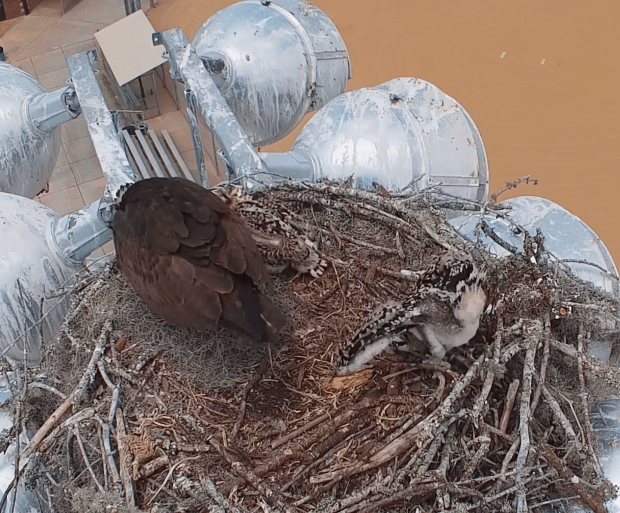
It was also a good day, so far, at the UFlorida-Gainesville Osprey nest. Mum brought in a fish at 11:59:52 and low and behold Dad flew in with another nice fish at 13:04. Both of the eaglets ate. When one chick is dominant and eating the most, it really helps when the bigger fills up and another lands on the nest right after. That way Mum gets food and hydration, too. Happy.
Big wandered about a bit and even did a ps before he thought about more food. All the while Middle was gobbling up the fish as fast as Mum could get it to the beak.
Big had eaten and was not in an aggressive mood. Nice.
Both chicks get to eat. The fish is finished at 13:27.
It has been raining in Ithaca, New York. Not a torrent, thankfully. Big Red is trying to keep those wiggly nestlings dry! Are they cooperating? Not always.
That’s L4 with its head raised up.
CalFalcons posted a short video of Alden incubating the eggs. Gosh, it is possible there will be pips tomorrow but, more likely, on the 6th! Oh, I hope that all three hatch. That would be wonderful. Despite the injury to Alden’s left ankle, he really seems to have adapted and is doing well. He certainly has been a terrific mate to Annie since Grinnell was killed.
Nancy has stepped up and is delivering prey items to the MN-DNR in order that her and E1 survive without Harry. Nancy is perfectly capable of fishing and hunting and E1 has its juvenile feathers so that it can regulate its temperature. We are fortunate that the eaglets were older when Harry disappeared eight days ago. (For those who do not know this nest, Harry disappeared. Chicks were extremely hungry. E1 was very aggressive to E2 and had been for a long time. E1 pushed E2 off the nest and E2 had to be euthanized.)
Unless something dramatic happens, we should expect E1 to fledge and for Nancy to have a new mate next year – unless Harry miraculously, at this stage, returns.
Despite the fact that a UFO, a catfish, and a sucker were brought on to the Notre-Dame Bald Eagle nest, ND17 still struggles to get food. Today there were three feedings and a bit of one before noon. At the last feeding, the small eaglet got food to create a crop. Another Relief but another struggling nest trying to get enough food for everyone. Did I ever say I wish these nests would not have more than 2 hatches?
During the first UFO feeding, ND17 stayed in submission. It did not even try to get up to have something to eat.
He did go up after and try to find a place to nibble on the prey item.
ND17 also stayed away from the second feeding.
The little one managed to get some fish at the last feeding. There was even fish left on the nest. Thankful.
Fish delivery at Dale Hollow. Looks like Middle gets it first and then later Big comes down to have some. Nice sharing. That is Big up on the edge of the nest behind the parent.
The leaves are lush and green at the National Arboretum nest of Mr President and Lotus. The day started off soggy and now the sun is shining on DCD9 and he has dried out.
Martin made two deliveries this afternoon to the Dulles-Greenway eaglet. The first was a duckling at 14:28 and this was followed by something else that I could not identify at 15:19.
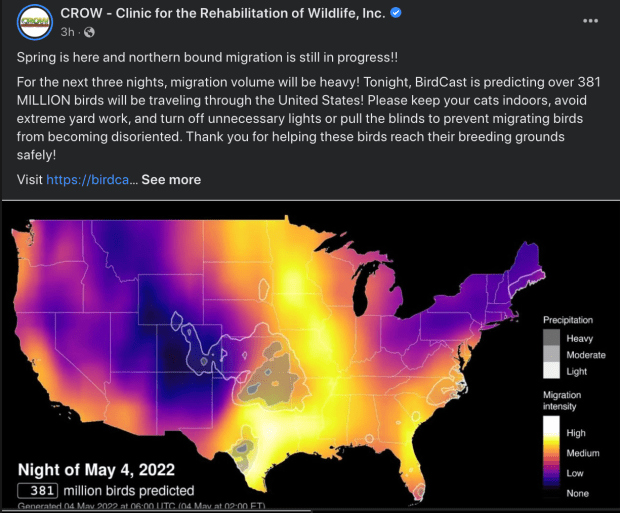
One of my all time favourite wildlife rehabbers is reminding us to help the migrating birds. CROW posted this today on their FB page. Check your region and help! Thank you.
As predicted, we went from winter to summer on the Canadian Prairies. Everyone is outside – and most around me are having their first official barbecue of the season. The birds have not been happy with my clearing up their old seed and I suspect that Mr and Mrs Grackle once again have their nest in the wood shed which is why Mr Raven and Mr Crow have been around so often. My neighbour tells me that he saw about 20 Pelicans in a tree – sounds like the tree with the Great Egrets in Grenada to me. Summer is here. No spring. Just summer.
I hope this blog finds all of you well. Some of the nests are still struggling but life is good and it is pip watch for the Cal Falcons tomorrow!!!!!!!! Yes. I cannot wait to celebrate the three eyases.
Take care. Thank you so much for being here with us. See you soon.
Thank you to the following for their streaming cams and/or FB pages where I took my screen captures: UFlorida-Gainesville Ospreys, Montana Osprey Project, Dulles-Greenway Bald Eagles, ND-LEEF, Cornell Bird Cam RTH, CROW, NADC-AEF, MN DNR, and DHEC.
News has come that the male at Denton Homes, Majestic Dad, has died. Avian Flu has been confirmed. The Denton Homes nest lost three eaglets and an adult male. The female, Majestic Mum, looks good on cam and is being monitored.
For those looking for information, here are two publications that have good solid information as well as some of the latest news on the spread.
This is one of the last images of E2, that sweet little eaglet off the MN-DNR nest that became a victim of siblicide at the age of 5 weeks. E2 hatched on 23 May and was shoved off the nest by E1 and subsequently euthanized on 30 April.
Dr Sharpe has been very busy. Another chick was to be banded on Santa Rosa Island and Dr Sharpe arrived just in time as the nest had collapsed and dropped. Here is that announcement
There are now five baby Peregrine Falcons in the Manchester, New Hampshire nest
Here is the link to that streaming camera (there are 2 of them).
There is an unease this morning on the UFlorida-Gainesville Osprey nest. I have observed fish being brought in but a bewildered adult and no feeding of the eaglets. An adult brought a fish on at 10:19 (or thereabouts). Both of the chicks began to scream for food. It was interesting watching what is happening. The adult eventually gave up and dropped the fish on the nest. Middle began to self-feed. You might have noticed him chewing on other bits of old fish and bones on the nest.
In the image below, the adult has brought in the fish. Middle is trying to get under here to be fed. (Big has the darker back plumage).
Middle anticipated that the adult would be feeding them and is trying to get to a point away from Big so that it gets some food.
The female places the fish in the middle of the nest leaving it. She did not feed the chicks when she brought in the piece of fish.
The chicks look on as the adult flies away. They do not understand what is going on – the same as me!
Middle begins to self-feed.
The chicks give up on the self-feeding. This picture was taken at 10:31.
At 10:47 an adult lands on the nest.
The adult, at first, appears to be a small piece of fish tail that they have brought in. Then the adult pulls part of a catfish – the head and part of the body – out of the nest. Both chicks are prey crying very loud. The adult appears confused as Middle tries to self feed. Is this Dad? and was it Dad earlier?
The adult looks completely bewildered.
Middle is attempting to self-feed. What is going on at this nest?
Middle had very little food yesterday and, if that were the case the day before, is not starving but getting there. It is clear that Big has no crop and is also hungry but not like Middle.
Middle may have gotten a little flesh off the open end.
While the dropping of the fish on the nest is a good strategy for both if there are two pieces and both chicks are self-feeding, it is clear that these two are not ready to feed themselves. Where is the female?
At 12 noon the adult returns, chicks crying desperately for food. The adult looks around. Is this Dad again? (From the behaviour I am assuming Dad). Where is Mum? If you observe the Mum feeding the chicks (or the dad) please send me a note. I cannot watch the nest all day today, unfortunately. I am quite concerned.
This has been posted on the UFlorida-Gainesville Osprey Nest page if you would like to help name the chicks, the adults, and the nest:
All I have to do is flip over to the Red-tail Hawk nest at Cornell and there is an instant smile. The four Ls do not have to worry about getting fed. Arthur is constantly bringing in food and Big Red feeds each beak until there is not one asking for food.
Larger clutch, direct feeding, lots of food on the nest, no history of siblicide – that is the difference at the Red-tail Hawk nest as compared with the UFlorida-Gainesville Osprey nest.
The West End nest of Thunder and Akecheta is an example of two parents working hard to make sure that each of their offspring survive —- and thrive! Both parents were active bringing in food. Several times they had tandem feedings. And look – Sky, Ahota, and Kanakini. They should all fledge and we hope return and raise their own families in the Channel Islands.
The Mum and Dad at Pittsburgh-Hayes consistently raise triplets to fledge. They hatched on 21, 22, and 25th of March making them 43, 42, and 39 days old.
These are Bald Eagle nests. Examples of siblicide that I listed yesterday include both Bald Eagles and Ospreys. It will be enlightening, at the end of the season, to compare data on species in terms of survival rates. It is also complicated and might not reveal a true picture in terms of prey availability, parenting, genetic predisposition to siblicide, etc. unfortunately. Another interesting comparison will be the rate of success of 3 clutch Ospreys in the UK with those in North America.
At the Hellgate Canyon nest of Iris in Missoula, Montana, the oldest osprey in the world laid her first egg of the 2022 season at 08:13.
Louis arrived a little later – fishless – to see the egg and do what Louis does.
I want to repost Dr Erick Greene’s letter about Iris’s relationship with Louis and why I should not be – nor you – upset with the fact that he has two nests. There is a huge change in the Osprey population that use the Clark Fork River for their food supply. Much of what Dr Greene says can also be applied to other species who are under pressure.
The Anacapa Falcons are doing well.
Things seem to have settled for now so that Bukachek and Betty can take care of their five eggs in the Mlade Buky White Stork nest in The Czech Republic. They have had disturbances – as recent as two days ago- from intruders like so many other nests this year.
It is a soaking morning on the Bald Eagle nest at Notre Dame University. There has been some strife at the nest with regard to the third hatch getting feed. It seems that there are good days and not so good. The weather might well impact feeding and behaviour today.
This is the history of this nest back to 2015: One chick, ND1 in 2015; ND2 in 2016; ND 3 and 4 in 2017; ND 5 and 6 in 2018, ND 7, 8, and 9 in 2019; ND 10, 11, and chick 12 who died on May 14 in 2020); ND 13 and 14 with a non-viable egg also in 2021. The hatches this year (2022) are ND 15, 16, and 17. Hopefully all three will make it.
Notice the turtle shells. James Broley commented that the Bald Eagles love turtle and he always found turtle shells in their nests when he went to band the chicks.
Beautiful female with her two eggs in the Barlinka Forest nest in Poland.
Wow! I just came across this Osprey nest at the US Steelworks Plant in Washington State.
It really helps to have metal workers when you need an upgrade. The original nest was on top of a light pole. Look carefully. In 2012, when a lighting upgrade was required, it was felt that a new nest platform should be constructed. The workers incorporated the old nest with the new metal one in hopes of attracting the birds to use it.
I do not know anything about the history of this Osprey nest. It is in Kalamana, Washington State and the Pacific Northwest had tremendous problems with the extreme summer heat causing many nests to fail. Chicks were leaping to their death to get away from the heat. So this is a warning if you start to watch this nest – there could be issues related to weather at this nest.
Eyases have hatched at the Cromer Peregrine Falcon scrape in the UK. The adults are Poppy and Henry.
The nest is on top of the Cromer Church Tower. In 2020, the resident pair fledged three chicks. In 2021, no viable eggs were laid. Now look at the little ones this year. Fantastic.
Here is a short video of their feeding. Notice how the female holds the prey.
Here is a link to the Cromer Peregrine Falcon page that has a link to the camera as well as lots of images and information.
And here is a link to the YouTube streaming cam for Cromer.
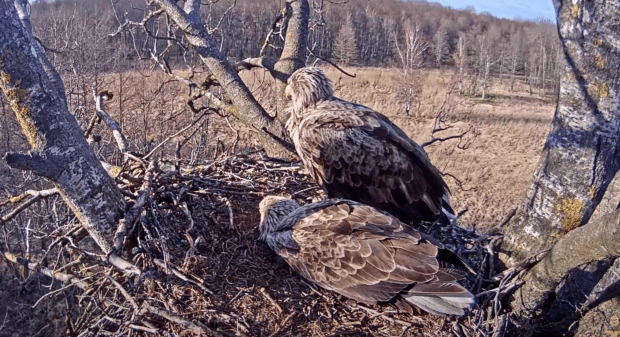
I am very interested in the White-tail Eagle nest at the Matsalu National Park in Estonia. Last year the couple hatched two chicks that perished from Avian Flu. It was the first recognized instance of H5N1 during spring breeding and marked a shift from the Avian Flu being prevalent in the fall and winter when it did not impact the breeding season. The two eagles have returned to the nest where WTE have been raised since the 1870s.
Will they lay eggs this season? If so, they are very, very late. In a normal season the eggs would be laid around the third week in March with hatching in late April. We are now 3 March.
This is the link to this nest in Estonia.
If you are watching the UFlorida-Gainesville Osprey nest today and see a feeding, if you do not mind sending me your observations I would be very grateful and would, of course, credit you for those! I am very worried about this nest. The female has to eat and it is possible that she is as ‘starving’ as Middle. Two fish on a nest is not enough to support the female plus two growing and demanding chicks. Thank you so much!
So many nests and so much happening – lots of good and much sadness recently. Thank you for joining me today. It is so nice having you here. Please take good care.
Thank you to the following for their streaming cams and/or FB pages where I took my screen captures: The Eagle Club of Estonia, Cromer Peregrine Falcons, U-Florida-Gainesville Ospreys, Cornell RTH, Montana Osprey Project, Steelscape Osprey Cam, Peregrine Falcon Networks, Institute for Wildlife Studies, Explore.org, Pix Cams, ND-LEEF, Barlinka Ospreys, Mlade Buky Storks, and Anacapa Falcons.