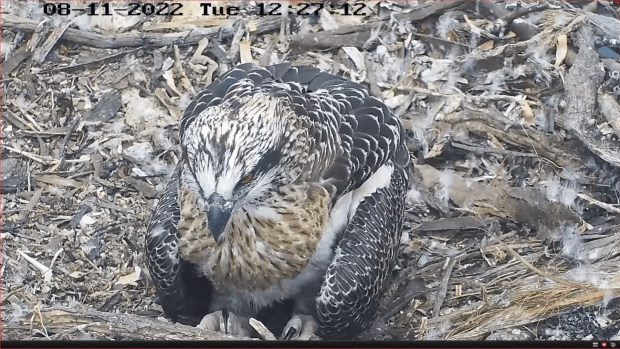
Zoe eats a whopper, Ervie, and where are you, Rubus, darling?

26 November 2022

Good Morning Everyone,

The kittens thought it was about time that they got their pictures in the blog – again! It is almost impossible to actually call them kittens now. They are 4x the size they were when they arrived. That will be a month on Tuesday. If you look closely at Lewis, you will notice that his nose has some scratches. Those scratches are from his ‘sweet’ ‘never do anything wrong’ sister, Missy. Poor little, Lewis. She took a couple of nicks out of his left eye, too. Ah, it is always the quiet ones, eh, Lewis?

I am going to start off with some really good news. I know that any time we are feeling a little ‘low’, Ervie can always make us smile. Port Lincoln Osprey posted a video of Ervie enjoying a freshly caught fish at Delamere this morning. I wonder if he was out fishing with Dad?

Now for the worrisome. Rubus has not been seen since the 23rd when he was on the ridge of the building. There has been a break in the news and I just thought it was because Cilla had not been out and about but, turns out, Indigo has been seen and photographed but not our sweet little lad.

I have received a note from ‘J’ that included this announcement from Cilla Kinross. It says: “I am organising a bit of search tomorrow morning at 0830 with some locals. Not sure how many will turn up, but hopefully 3 or 4 so we can split up and have a good look for Rubus. The bird wil go to a raptor carer and if and when he’s returned, I’ll decide at that stage. Probably I would put him close to Indigo so easy for parents to find.”

This is not the news that we had hoped. Let us all get really positive and send that energy out to the grounds of Orange to help our wee lad.

I found this message from Cilla below the streaming cam: “NEWS 26th November 2022 1900h I had a good look around this morning. No sign of Rubus. I asked Security to keep an eye for him, especially if he was on the ground. Indigo was sitting quietly in the trees in Girinyalanha and I took some photos.”

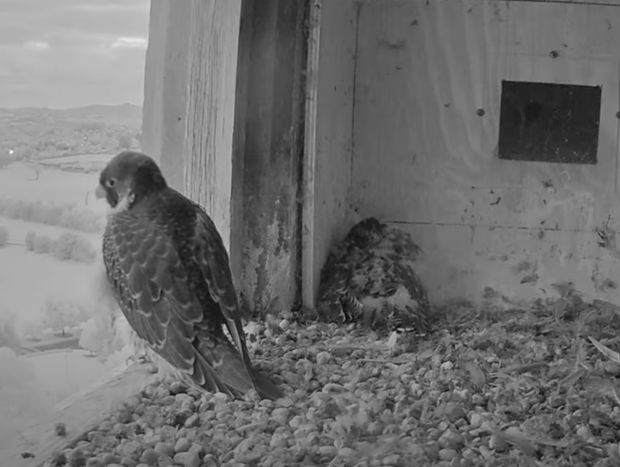
At 1450, Indigo flew into the scrape box looking for leftovers and hoping for prey. He is big and strong and gorgeous.

Here is a video of Indigo arriving in the scrape box with prey!

Oh, what a darling Xavier is. He went into the scrape just to see how Indigo was making out with his prey. They are taking such good care and teaching Indigo such valuable lessons. Oh, I hope dear Rubus is found so that the family can be back together again soon.

Xavier you are the cutest!

It was certainly good news to see that Willow, Louis and Dorcha’s first fledgling of 2022 had been spotted in the same area as Paith from the Dyfi nest. There must be a message board somewhere for young osprey fledglings from the UK on good places to stop enroute to their winter vacation (or should I say their home for the next couple of years?).

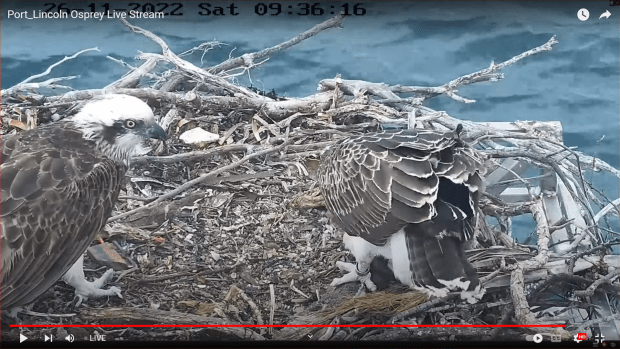
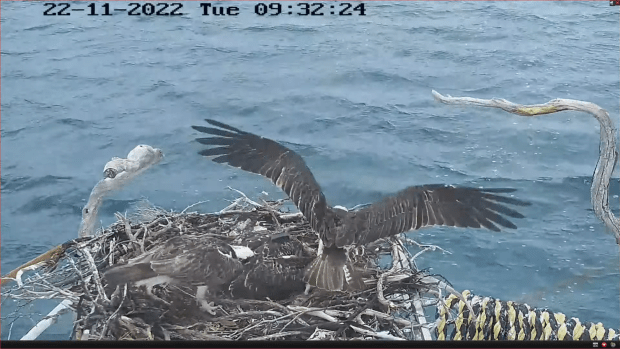
Yesterday it was a bit of a feast at the Port Lincoln Osprey nest and this morning an extremely large flat fish (a flounder? they do have them in PL) appeared on the nest. Mum flew in when Dad arrived but Zoe took charge. Now, that fish was big enough to feed three but, it didn’t. Zoe ate every last bit of it. She worked on that fish for more than two hours!!!!!!!!! Mum gave up and went off to get her own. I can only imagine the number of fish Zoe’s mate is going to have to produce when she has a nest of osplets. Just think about it. I am not certain I have ever seen an osplet eat as much fish as our Zoe.

Mum waited for over an hour hoping to get some breakfast but, the fact is, Zoe does not share.

At one time there were gulls overhead and both Mum and Zoe were alarming.

No 16. The Red List. The White-fronted Goose

Greater White-fronted Goose” by Rick Leche is licensed under CC BY-NC-ND 2.0.

Oh, goodness. Isn’t that a beautiful goose? White-fronted geese are medium sized. The white face is set off by that taupe of the head and back, the splotched chest, and that orange bill of the Greenland geese with legs to match. On occasion, the bill can be pinkish – that of the Siberian birds. There is a fluffy white bottom under those grey-brown back and wing feathers. What is amazing is the ombre – going from the solid taupe head, to the lighter neck, then lighter still on the breast. Just imagine if someone took this into their hair salon and asked for the stylist to copy it! It would be quite stunning, actually. Females and males are similar while the juveniles lack the white face, the black barring, and their taupe colour is not as deep as that of the adults.

Greater White-fronted Goose (Anser albifrons) DSC_0139” by NDomer73 is licensed under CC BY-NC-ND 2.0.

They breed in the cold of the Arctic tundra areas in the spring and summer. Greenland is one of the sites. In his entry, Gill Lewis writes, “This Greenland summer has seen her new brood hatch and grow. Her proud gaggle follow her, tail-waggling and beak-nibbling on the arctic tundra. A family, feeding and fattening.” In his entry, David Stroud said, “…she hatched six goslings and, with her mate, led them three kilometres up the steep valley sides and onto the lake-studded plateau used for brood-rearing and moulting.” Can you imagine, those wee ones following behind their Mum and walking upwards for 3 kilometres? It would be an incredible sight. They eat grasses, clover, grain, winter wheat and potatoes, according to the RSPB.

These lovely geese then fly and spend their winters in Ireland, the Orkneys, and Britain.

Why are these lovely waterfowl on such rapid decline? It is interesting and can be remedied. But, first. In 1982 shooting of White-fronted Geese in the UK was outlawed. Even so, their numbers have been falling rapidly. There are simply not enough youngsters to replace the adults and the cause is well known. The warming of the North Atlantic is the primary cause with its climatic changes and heavy snow falls. Those snows are arriving earlier and earlier at a time when the geese need feed before laying their eggs. So little food. One other cause, the one that can be remedied and is being done so for some species is wetlands. Instead of draining land so that humans can take over more and more vast tracks of it, we need to stop and rebuild the wetlands that are required for all our waterfowl. Whether or not anyone will find a way to halt or even slow the warming of our planet with its land and oceans is another story – a particularly grim one. So sad, these geese have been flying back and forth from the Arctic to the UK for 2 million years – just think about it. And, oh, how quickly we have ruined the entire landscape for them – in a blink of that time.

So when rewilding and news of the creation of wetlands comes to your ears, stand up in support of it – and remember the White-fronted Goose when you do.

Greater White-fronted Goose (Anser albifrons) DSC_0132” by NDomer73 is licensed under CC BY-NC-ND 2.0.

In the News:

Long-Billed Curlews” by FotoGrazio is licensed under CC BY-NC-ND 2.0.

The Curlew. These amazing shorebirds with their extremely long curved beaks are also in rapid decline. Oh, how I love reading these short Country Diary Posts. I hope you do, too.

https://www.theguardian.com/environment/2022/nov/25/country-diary-a-cloud-of-curlews-carries-me-away


Thank you so much for being with me this morning. Let us all collectively send our warmest and most positive wishes to Orange so that Rubus might be found safely and be cared for as he needs. Take care all. See you soon.

Thank you to the following for the posts and streaming cams that make up my screen captures: Port Lincoln Osprey, Port Lincoln Osprey FB, Orange Australia Falcon FB, Charles Sturt Falcon Cam and Cilla Kinross, Openverse, and The Guardian.

Fish feast for Zoe…and other news in Bird World

25 November 2022

Good Morning Everyone,

I hope those of you that celebrated Thanksgiving had a lovely celebration. It was another warm day in the garden. Today it will be 6 degrees C. The sky is a beautiful blue and the sun is bright. There should be a lot of activity in the garden. I am quite enjoying watching the Starlings and the Sparrows flit about their lives enjoying the Butter Bark and the soft suet. It is hard to imagine that they are both vulnerable and in decline and on The Red List in the UK but, as I am told by many, their lives are so precarious and the Avian Flu last year could rear its ugly face again this year.

I just think that the Starling below is quite stunning. The so called ‘white’ spots on their bodies during the non-breeding season actually look silver in the sunlight. That coupled with those magnificent rust and rust tipped ebony wing feathers make them stand out and yet, if you don’t know they are there, they blend in quite nicely with the bark on the branches of the Lilacs.

Dyson has been coming for peanuts for several days but, instead of running about storing them, she has stopped and taken the time to eat several before scurrying about. She is really adorable. I notice that her colouring is also changing. Some of the youngsters have great tufts coming out of their ears now. I will see if they will sit still long enough for me to get a photo for you soon.

Junior was about today along with a least one of the three fledglings but Mr Crow and his family were not about. I wonder where they found food. It always scares me if I see road kill as I know they will chance it to get some food. I wish everyone would stop and if they see road kill get out and move it to the side of the road, way off the shoulder, if it is safe for them to do so.

The Australian Nests:

I cannot possibly tell you how quiet it has gone in Bird World now that all of the Australian birds have fledged. You might already guess that Xavier and Diamond are taking good care of Rubus and Indigo and that Zoe is screaming her head off for a fish. Dad went out and came back with nesting material. What in the world is up with the fishing in Port Lincoln?

Cilla posted a prey transfer for Indigo that took place yesterday in Orange.

Dad brought in a fish for Zoe at 09:56. She ate the entire thing. The fish tail went down at 10:21:08. Dad ‘appeared’ to have a crop. Mum was sitting on the ropes as she is above. Will Mum get anything to eat?

With Dad appearing to have a crop and Zoe getting a fish, what is there for Mum? Has Dad decided now that the chick has fledged, his duty is only to feed it and him and Mum can fend for herself? It is certainly common at other nests.

Mum did not sit around. She has proven herself today. She brought in a nice fish for her and Zoe at 13:30:31 and another one at 14:39:40. Indeed, Mum was on the nest with Zoe and flew off quickly as if the fish had skimmed the water near the barge. Isn’t this just excellent! Everyone will have had a good feed today.

Indeed, Mum was just finished feeding Zoe the 1330 fish when she spotted the next one. We will have to start calling her ‘Eagle-eyed Mum’.

Off she goes!

Zoe and Mum are having feasts today while Dad sits on the perch. Good for Mum. She is going to make sure that her and her daughter are well fed.

In his book, After They’re Gone. Extinctions, Past, Present, and Future, author Peter Marren says of the Ospreys, “To survive the Sixth Extinction, it may help to be useful- useful to humankind, that is” (164). Marren continues on the following page, “In Britain, nesting ospreys and sea eagles attract tourists and hence income to places that need it” (165). Every place that has wildlife should heed Marren’s words. They should consider the environment and rush to bring it back to life because those beautiful animals and birds and the landscape that is cared for and respected will help with the economy in the future. Indeed, my granddaughter is looking for a place for a holiday to see birds and animals. It would be truly sad if I had to tell her to go to a zoo!

Making News:

a little change from plants- hen harrier looking for dinner.” by island deborah- New Book ‘Song of the Sparrow’ vig is licensed under CC BY-SA 2.0.

Well, to tackle this entire issue of the vulnerability and extinction of the Hen Harrier, Hen Harriers will be bred in captivity and released in England on the Salisbury Plain. Twelve birds, six males and six females, have been brought from France and Span to establish the breeding pairs. This is a project between Natural England and the International Centre for Birds of Prey. Their goal is to release 100 birds over the next 5 or 6 years.

Fantastic. You can read more about this intervention to increase biodiversity here:

https://www.theguardian.com/environment/2022/nov/23/hen-harriers-to-be-bred-in-captivity-and-released-on-to-salisbury-plain?CMP=share_btn_link

I have become increasingly aware of these magnificent birds over the past year and have devoured as many new books on them that I could. There are a couple that I have quite enjoyed and will mention if you or someone you know is interested in the life and the plight of these magnificent birds of prey. They are Bowland Beth. The Life of an English Hen Harrier by David Cobham, The Hen Harrier’s Year by Ian Carter & Dan Powell

Hen Harrier male (Circus cyaneus) illustrated by the von Wright brothers. Digitally enhanced from our own 1929 folio version of Svenska Fåglar Efter Naturen Och Pa Sten Ritade.” by Free Public Domain Illustrations by rawpixel is licensed under CC BY 2.0.

The problem is the illegal killing and the destruction of the land that supports these beautiful birds. So when will the courts begin to crack down on those who persecute the raptors?

A nauseating story is coming out of County Down, Northern Ireland of a lovely Buzzard found with a plastic bag around its neck hanging on a tree. Unbelievable. Just look at that face and that gorgeous plumage.

Inquisitive Buzzard” by John C Williams is licensed under CC BY-ND 2.0.

Here is that Story.

Dead buzzard found hanging from a tree in County Down – Raptor Persecution UK

Each year the Raptor Persecution UK puts out a report on the killing of raptors and, sadly, this year – 2022 – has been the second highest record in history. What a tragedy and why is this happening?

RSPB’s 2021 Birdcrime report reveals second-highest figure on record – Raptor Persecution UK

Fieldfare on a cherry tree” by hedera.baltica is licensed under CC BY-SA 2.0.

No 15. The Red List. The Fieldfare

FF 031 ~ Fieldfare~” by Mike Hazzledine — British Biodiversity is licensed under CC BY-NC-ND 2.0.

Fieldfares are a large member of the thrush family. The name Fieldfare comes from the Anglo-Saxon meaning ‘traveller of fields’. Look at the image above. They have the most beautiful light steel-blue-gray heads and wings. Their back, which you can see in the image below, is the colour of a beautiful Horse Chestnut. Their tails are black. Their ivory breast is spotted with a deep espresso tinged with chestnut. A peach wash makes a gorgeous collar. Their back end is a grey and they have black legs with touches of black around the eye. The female looks very similar to the male but has slightly more chestnut than the blue-grey and some consider the colouring more ‘dull’ on the female. There is an image of a female feeding her nestlings below. Make up your own mind if she is dull!

The decline of the Fieldfare from a handful of breeding pairs to now only one or two brings much sadness to many British birders. The author of the entry in Red Sixty Seven, Nick Acheson, writes about Joe Harkness another author whose book, Bird Therapy, speaks to the joy that birds bring to all of us. In writing about the Fieldfare, Harkness says that he is elated when two Fieldfares visit his garden during the winter’s snow and ice. Acheson says that Harness’s joy comes “not from the beauty of the birds, though beautiful they certainly are, not from their rarity, for per se they are not rare at all (globally). His joy comes from their shining witness, perceived – this once – in a place of domesticity.” Indeed, Fieldfares are not found in fields despite their name and do not frequent gardens but are mostly seen on the wet hawthorn hedgehops, Buckthorn bushes in the sand dunes along the sea.

Fieldfare” by Linton Snapper is licensed under CC BY 2.0.

The Fieldfare is not a thrush but it can be found spending time with flocks of thrushes during its migration from Northern Europe to spend time in Britain in winter. In the Scandinavian countries, they are known as Birch Thrushes or Bjorktrast. There they feed on berries until they arrive in Britain in mid-September where they roam the country side, the fields, the hedgerows and the gardens looking for food. In particular, they will search for berries from the Rowan, Hawthorn, and Holly. In farmlands, they feed on invertebrates and earthworms.

Fieldfare on a cherry tree” by hedera.baltica is licensed under CC BY-SA 2.0.

The decline of the Fieldfare is due directly to the steep decline in insects. Studies in Europe have shown that the biomass of insects in Germany has declined by 75%. The decline is serious in other countries and this is due directly to the use of pesticides. Climate change is also playing havoc with these lovely little birds. Milder temperatures in the northern countries and then quick freezes have cost the lives of nestlings. Many Fieldfare have also chosen not to migrate which is one reason there is the decline in numbers in the UK. Of course, the Northern European countries are not the only ones that are using pesticides. In the UK, there are similar issues and declines in birds that depend on insects for their food source.

Oh, thank you so much for being with me today. Take care all. See you soon!

Thank you to the following for their posts and streaming cams where I took my screen captures: Charles Sturt Falcon Cam and Cilla Kinross, Port Lincoln Ospreys, Openverse, The Guardian, RSPB, and Raptor Persecution UK.

Shaded nests for eagles, prey drop for Rubus and other news in Bird World

23 November 2022

Good Morning Everyone!

I hope that you are well. Tomorrow is Thanksgiving in the United States. In Canada, we have already had our harvest festival in October but, as one of the readers reminded me, it is a time to give thanks for all of those in our lives — so to all of you wherever you may be, ‘thank you for being part of this great community’. Your empathy, caring, understanding, and joy are remarkable and this year we have been so much together. And to all of our feathered friends, thank you for the joy and the tears and for reminding us that we are all in this world together, not separate.

Dyson sends greetings from all of us to all of you. She hopes that you have plenty of ‘nuts’ for your celebration while reminding all of us to share with the wildlife.

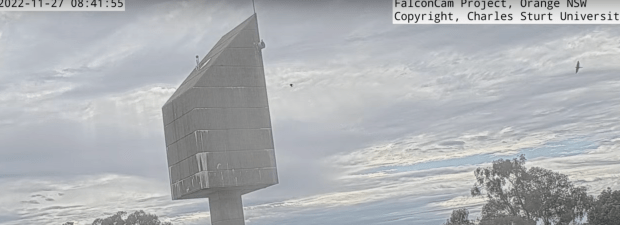
There is simply not a lot going on in Bird World. Only one thing seems to be on anyone’s mind now that Zoe has fledged. When will Rubus fly up to the scrape?  Rubus has flown. Shines reports that Rubus was on the ground and observed to fly 200 m to his perch. Indigo has been up in the scrape box and so have the adults. And he flew some more later and picked up a prey delivery (see below). Life feels good right now. All are well.

Interesting to note that Xavier was in the scrape box ‘scraping’ – is he already thinking about next year? A scrape is a shallow indentation in the gravel or sand in which the eggs are laid.

It is extremely heart warming to know that all of the staff at Charles Sturt University keep an eye out for the falcons. Rubus was found on the ridge of the Printery Roof. Here is a video showing a prey delivery for Rubus from Xavier. So, we can all relax. Xavier and Diamond are taking good care of both Indigo and Rubus and there are all kinds of caring eyes looking out for them!

Thanks ‘A’ for sending me the link to the video and this comforting news!

If you missed Zoe’s fledge, here is my short video clip. She was really working her wings earlier and her first flight took her right down to Dad’s shed. Perhaps Ervie will come and join them for a good old ‘chin wag’. Zoe is 66 days old.

Mum is in the nest and Dad is on the ropes. Zoe is still down in the shed. She will figure out how to fly back up to the nest. If I recall, this is what Bazza did last year! Please correct me if I am wrong.

There should be no worries. Zoe flew up to the nest at 1451 and booted Mum off. She is now prey-calling and I presume that one of the adults will be out to get their girl a nice fish for her accomplishment!

Zoe later flew back and forth to the perch and around the barge. It appears from all the time tables that Zoe did not get a fish after fledgling. Thanks to ‘A’, here are the major events from the observation board for Port Lincoln for the day: Fish count: Dad: 2, Mum: 0 Fish times: 08:37, 11:49 08:37 dad with headless fish, mum takes it away 08:46 mum returns, Zoe self feeds 9:00:56 Zoe eats the tail.

10:54:45 Zoe fledges from the nest and ends up in the mancave Facebook post on fledge 

11:49:45 Fish tail end by Dad. Zoe was in the mancave 11:55 Mum eats the tail. 14:51:55 Zoe returns to the nest, where mum was, who then leaves

18:40 Zoe from nest to close perch (and back and to the perch) and flying around the barge

‘H’ made a video clip that shows Zoe’s fledge and her subsequent flights which are not included in mine. Thanks so much ‘H’.

————————————————————————————-

Making News:

Dave Hancock of Hancock Wildlife is building shaded nests for the eagles to help them with the increasingly number of heat domes that are part of climate change in British Columbia. Here is an image of one of those nests with the Delta 2 Eagles.

The British Trust for Ornithology is watching with great concern as the migrant birds from parts of Europe arrive in the UK for their winter holidays.

BirdLife’s 2022 Photography Awards are in and there are some stunning images.

https://www.theguardian.com/environment/gallery/2022/nov/23/the-2022-birdlife-australia-photography-awards-in-pictures?CMP=share_btn_link

There are many categories and many birds that will be familiar that are in those winning shots including the Albatross, BooBook Owl, Wood Ducks, Petrels, Wrens, and Lyrebirds. Enjoy!

What you might not know is that you do not have to be Australian to enter. Maybe think about submitting some of your images next year. One section of the Birdlife website that fascinated me was the ‘tips and tricks’ to getting bird photos. Mine would never win any awards but I would love to be able to take better photos of our beautiful feathered friends. To check out on the regulations for the annual awards and to see the tips and tricks, please go to:

birdlifephotoaward.org.au

————————————————————————————

In Senegal, Jean-marie Dupart reports that he counted 331 Ospreys in a stretch of beach measuring 143 km. That is fantastic news!

———————————————————————————–

In the United States, the Osprey breeding season starts after the Bald Eagles. Jack and Diane at the Achieva Osprey nest in St Petersburg, Florida have been visiting their nest. I wonder if they even know where to start with all the weeds that have grown up!

I keep heading over to the West End nest of Thunder and Akecheta to see if I can catch them at the nest but, no luck today!

I didn’t find anyone at home at Fraser Point either and they are playing highlights on the Two Harbours cam.

Harriet and M15 have been on and off the nest today. Many thought that today might be the time for the first egg’s arrival but, it doesn’t appear to be the case. Perhaps tomorrow!

Gabby is looking particularly gorgeous these days. She is keeping her eyes out for any intruders near the nest she shares with Samson at Jacksonville, Florida.

————————————————————————————-

No 12. The Red List: Ring Ouzel

Alpine Ring Ouzel (Turdus torquatus), Karwendel mountains, Austria” by Frank.Vassen is licensed under CC BY 2.0.

In his description of this beautiful Blackbird with its white half moon torque on the male, Nick Baker says, “It’s the thinking person’s Blackbird, the connoisseur’s choice; a passerine, that keeps itself to itself and is somewhat exclusive, hiding away from the cheap (ing) twittering masses of other perching birds, other than the odd curved, Wheatear and pipit.”

Ring Ouzel male” by Rainbirder is licensed under CC BY-NC-SA 2.0.

Baker likes the stunning black birds because they are elusive one has to “invest some kind of effort to find one makes them all the more appealing…” Baker lives in Dartmoor, where a small population of these passerines “hangs on.” He says “the situation is about as delicate as the frosted feather edges on the bird’s breast.”

This lovely print shows the adults and the wee one. Notice the silvery wing panels on both the male and the female. You can see them easily in the photograph by Rainbirder above, also. The male’s crescent moon is pure white while the female’s is ivory barred with a rust brown. Instead of a black chin, the female has vertical barring, dark chocolate on white. Once again, I think that the female is just as stunningly beautiful as the male – her head, back and tail are not the pure deeply saturated black. In fact there is more variety to her plumage. The spots on the chest of the juvenile with its brown head, back and wings remind me of the work of Denmark’s most accomplished ceramic artists, Priscilla Mouritzen.

Ring Ouzel (male left female above young right)” by Wildreturn is licensed under CC BY 2.0.

The ring ouzel is a member of the thrush family. It grows to approximately 24 cm or 18 inches in length. They are smaller than Blackbirds but are often misidentified as being a Blackbird unless you see that stunning half moon panel.

They breed in the drags and gullies of the steep valleys from mid-April through to mid-July normally having two clutches. Their nests are located close to the ground in dense heather or in a crevice. It would be very rate to see them nest in a tree. They feed their young earthworms and beetles and as adults they eat insects and berries.

The threats that these birds face are quite numerous. The predation of eggs is a start because of nesting close to the ground. They are disturbed by humans, their habitat has been destroyed due to deforestation in the areas where they winter in Spain and in Africa. Climate change has had a significant impact on the bird. The authors of the book noted below, possibly the very best study of these birds, notes that the landscape of the North York Moors might become completely unsuitable for them in the future.

One of the best books on this species is this volume, The Ring Ouzel. A New from the North York Moors. The retired duo hiked, observed, and gained considerable knowledge which they have passed on to us in a delightful little book. I keep thinking how wonderful they were to find this specific place now and provide us with insights into a bird that is most elusive.

————————————————————————————-

Migration News:

I am still following two of the four fledglings from Karl II’s Black Stork family from the Karula National Forest in Estonia. Those two are Waba and the foster chick, Bonus. The only surviving strolling from the last brood of Jan and Janikka.

Bonus remains in the area of Turkey (Konya Province) where he has been for what seems like forever. It is an area that can get cold in the winter with snow and everyone is hoping that he will decide to get moving!

Waba remains in the Sudan feeding on the Nile River. He travelled 242 km in the last few days (his tracker was not transmitting for some of that time).

Both of the Black Stork juveniles seem to have found water and lots of food and it appears that each is reluctant to leave their respective locations. It is always a relief to know that they are well but, like everyone else, I hope that Bonus will get an itch to fly and that he will head south to catch up with the remainder of his family in Africa.

Thank you so very much for being with me today. We will be keeping an eye on Zoe as she perfects her flying skills along with dear Rubus and Indigo at Orange. Take care everyone. See you soon!

Thank you to the following for their posts, videos, and streaming cams where I took my screen captures: ‘A’ and ‘H’ as always – so grateful, Charles Sturt Falcon Cam and Cilla Kinross and gang, Port Lincoln Ospreys, British Trust for Ornithology, ave Hancock and Hancock Wildlife, The Guardian, Achieva Ospreys with Jack and Diane, IWS, SWFlorida Bald Eagles and D Pritchett, NEFL-AEF, Openverse, and Looduskalender Forum.

Falcons and Football…and more in Bird World for Tuesday

22 November 2022

Good Morning to Everyone!

It has warmed up on the Canadian Prairies – and because of that the heating is not on as much and it is damp and cold. Believe me, we always grumble about the weather. It is to be 0 degrees C today! It will cause things to melt a bit and get all slushy – there is nothing worse than chills to the bone. It will be a good day to go to the pond and see if there are any of those Wood Ducks still hanging about. Images (sadly I do not have permission to share them – yet) have been coming in that are showing 50 or 60 Bald Eagles just south of our City in the trees alongside the Snowy Owls. It is quite incredible.

In the Mail:

There are times when we just need something to put a smile on our face. When I lived in Norman Oklahoma and went to the University of Oklahoma, it was impossible not to be an OU Sooners Football Fan. I can still smell the damp leaves in the fall covering the sidewalks on the way to the stadium. When ‘B’ found out about this, he sent me the most fabulous image. As we all remember – too well – there was a time in 2020 and 2021 when large gatherings of people were forbidden due to Covid. One of those was, of course, the popular football games in the US. So, the University of California at Berkeley, put up cardboard cut outs of viewers. Guess who got the prime seat? Look!

That is fabulous. Our own Grinnell. Alden is wonderful but there was just something about Grinnell that made him ever so special. It is hard to lose them.

Thank you ‘B’.

The other day Annie and Alden attended all the celebrations for the latest football game at Berkeley when the Cal Golden Bears beat the Stanford Cardinals 27-20. Our adorable Peregrine Falcon couple went up to the ledge, spent some time there recuperating (was it 3 hours?). ‘H’ sent me a link to the video of them sitting and leaving together that she made for us to enjoy. Thank you ‘H’.

Making News:

There is news coming in about the streaming cams and nests on Captiva Island -the Bald Eagle nest of Connie and Clive and the Osprey nest of Andy and Lena.

The Dfyi Osprey Project in Wales is reporting that there are two beautiful Red Kites on the Dyfi Osprey nest of Idris and Telyn. Aren’t they ever so beautiful? Just look at that plumage. I don’t know about you but I am simply mystified at how beautiful these raptors are – the falcons, the kites, the kestrels, the Merlins, and the Harriers. You can take the same colours and shake them up and each one is slightly different than the other. I have to admit that the Red Kites are quite stunning with those icy blue heads and amber eyes, bright chrome-yellow cere and short hooked beaks with its black tip. The terracotta or rusty sort of Corten Steel colour of the tails (reminiscent of the Red-tail Hawk) set against the dark chocolate trimmed with white is outstanding.

You can check on all the birds that use this nest by going to dyfiospreyproject.com

There is no rest for Dr Peter Sharpe of the Institute for Wildlife Studies. Those who watched the Channel Island’s Bald Eagle nests will remember Dr Sharpe climbing up to rescue Lancer at Two Harbours, getting a chick of the cliff at the West End, and going in and taking Victor to the Ojai Raptor Centre last season. He is now busy working on the cameras. Here is the announcement from the IWS.

Everyone is getting ready for the Bald Eagle breeding season. Speaking of that, Samson and Gabby were caught mating on the nest today just like Harriet and M15 were a week or so ago. Eggs should be coming shortly. Will there be holiday eaglets?

Philippe Josse reports that progress is certainly being made on the Notre Dame Eagles nest – the natal nest of dearest Little Bit ND17. Please join the FB group Notre Dame Eagles for up to date information on this family.

Terry Carman is keeping track of the Bald Eagle eggs on the streaming cam. Here is the latest report — and all bets are on Harriet and M15 having their first egg today at SWFlorida! If you are looking to track Bald Eagle laying, please head over to this great FB group. There you will always have the latest information.

Checking on the Australian Nests:

Zoe is 66 days old today. She could fledge at any time. She is doing some good hovering and has nailed stealing the fish when Dad brings it to the nest! And you know what? She is gorgeous. When the wind whips her crest up it accents those focused piercing eyes and that very sharp hooked black beak. The dark black eye line just makes her that more gorgeous.

The winds are at 26 kph right now. Gusty for our girl. I hope she does not get swept up when she is practising her hovering. Zoe is getting better each day at that hover but, still. We saw what wind gusts can do with Rufus. I prefer that they take off on their own!

In Orange, Xavier and Diamond seem to be having prey drops with Indigo. She is really doing well!

Look carefully over at the trees!

Yesterday Shines found Rubus on the ground next to the road and put the little fella back up in the Waddle Tree.

I have to admit that I am a wee bit worried about Rubus and that is only because there have been no reports of any feedings. That is not to say they have no occurred. Diamond and Xavier are cracker parents and I think they are decidedly trying to lure Rubus back up to the scrape. It is possible that he does not feel confident to fly. Has anyone seen Rubus flying since he fledged/fledged?

Some more photos of Rubus higher in the Wattle Tree.

Every once in awhile one of the parents goes up to the scrape. I think they are really trying to lure Rubus back into the box.

Xavier is keeping an eye over everything happening with his two fledglings from the ledge of the box.

At 1540 Indigo comes up to the scrape box prey calling, very loudly, and Xavier immediately takes off. Indigo stays in the scrape looking for prey amongst the feathers. Will Xavier return with something from the storage vault?

Indigo spent the night in the scrape box last evening.

I urge you to check out the wonderful website that has gone up at Orange. Cilla Kinross and her great team have put together cracker content and you can get up to date information on our falcon family there with their photographs.

That link is: falcon cam.csu.edu.au

No 12 The Red List: The Merlin

Merlin Falcon” by minds-eye is licensed under CC BY-NC-ND 2.0.

Oh, it is hard to imagine that this lovely little raptor is on the vulnerable list in the UK. But, if it is happening there, it is possible that there are declining population numbers elsewhere. Ruth Tingay, writing in Red Sixty Seven, describes the birds as feisty and dashing with their “rapid fire kek, kek, kek, kek, kek” that demands everyone’s attention. Tingay first saw Merlins in the wilds of the Hebrides, those remote islands off the west coast of Scotland. She then saw them again in an urban setting in Idaho and said she was shocked because she always associated them with great open spaces.

Look at the colour of the plumage! They are smaller than a Peregrine Falcon measuring at most 30 cm or 12 inches in length or the Red Kits who grow to approximately twice their size. The male Merlin has dark steel blue grey upper wings, tail and top of the head. The underwing – the primaries and the secondaries are the same dark grey barred with a lighter grey. There is a fine white eye line, magnificent rusty-orange with dark chocolate barring on the underneath, on the legs and the upper part of the wing. The deepest dark 70% cocoa eyes, a white beard and throat. The beak has a black tip fading into that grey blue and a yellow cere. The legs are chrome-yellow with deep black talons.

Merlins are described as “our smallest falcon, male smaller than the female, not much bigger than a Blackbird.” They live on the moors and open fields where they breed but travel to the south and the coasts of the UK for their wintering grounds. Here is their map.

Seriously adorable but, in the sky and hunting, they are formidable for the smaller birds.

Falcon” by Terry Kearney is marked with CC0 1.0.

The Merlin was a popular hawk of Mary Queen of Scots and became known as the Queen’s Falcon or Lady’s Hawks. Royalty and women of the aristocracy would use them to hunt Sky Larks. They are a fierce hunter capturing their prey from the air, high up meaning that they have to have a very calculated effort. They normally hunt small to medium sized birds bit have been known to take pigeons, ducks, and even plover.

Sadly, they are quickly losing their habitat, pesticides and secondary poisoning, and of course the shooting by the keepers of the estates where Red Grouse hunting takes place. Other causes of death are collision and cat predation. There are many other threats. Corvids, such as Crows and Jays, will eat the eggs and the nestlings if they find them and, indeed, Merlins do not build their own nest but reuse the nests of others including Crows. Larger Raptors such as Peregrine Falcons, Great Horned Owls, and even Goshawks are a threat but all others tend to steer clear of this small falcon because of its aggressiveness.

Climate change will impact this small spirited hawk. Audubon has set up a programme to try and predict the changes to its breeding habitat. As you can see they will be pushed further north to where it is cooler. With the polar ice melting and the seas warming, I wonder how long it will be cooler in the north?

Some new books have arrived and I will be anxious to tell you about them as I work my way through. For now I am trying to scout out all the birding sites on the island of Grenada in the West Indies so that I can – hopefully – send you some images of birds that are either old friends or new ones. My son will probably never invite me again! He gets another location or two each day – . I was told tonight to bring my gum boots and lots of mosquito repellent. So for dear ‘L’ who was worried that the newsletter might stop while I am away, ‘no’ it will not. You are all going on my birding adventure with me!

Thank you so much for being here today. It is so nice to have you with us. Please take care of yourself – and I will see you soon!

Thank you to the following for their letters, their posts, their videos, and their streaming cams where I took my screen captures: ‘B’ so grateful for that image of Grinnell, ‘H’ for her great videos, Captiva Island Eagles and Ospreys FB, Dyfi Osprey Project FB, IWS, Notre Dame Eagles, Bald Eagles Live Nest Cams and News, Port Lincoln Ospreys, Charles Sturt Falcon Cam and Cilla Kinross, the Falcon Cam Blog, Open Verse, and Audubon.org.

Hovering, Nest building…Saturday in Bird World

19 November 2022

Good Morning Everyone!

I hope that you are well. So nice to have you with us this morning. It is a blue sky cold day, -14 C, on the Canadian Prairies. The kittens are up carrying toys and watching the Crows come for their morning feeding. The Grackles have already been to the suet feeder and the little Sparrows are all puffed up keeping warm in the lilac bushes.

It is a type of soft suet that the Starlings like. They can stand back and poke at it with their long sharp beaks.

The Blue Jays that fledged from the nest across the lane are still here. One was eating peanuts while these two were in the lilacs sunning themselves.

Nest News:

Yesterday Zoe got some really good height in her hovers. Thankfully she remained on the nest and did not fledge into those strong winds as that storm did roll in.

If you missed it, here are those beautiful early morning hovers.

Later, Mum is down in the nest with Zoe taking care of her only ‘baby’. Dad was not out fishing. If you remember, Zoe ate really well on Friday so did Mum. On Saturday morning, Mum took Dad’s fish and returned with the tail portion for Zoe. That has been the only meal so far and if the weather stays, it could be it for the day. Zoe will be fine. She is not going to starve.

Indigo continues to fly out of the scrape and return. This is excellent. Most of you watch the Bald Eagle nests as well as the Ospreys and it is ‘normal’ for fledglings to return to the nest for food, to fly and strengthen their wings being fed by the parents for a period of 4-6 weeks.

Rubus continues to do his wingers and the pair enthusiastically eat all that is brought into the scrape. There are still a few dandelions on Rubus but not many.

The brothers 9 days ago.

Just look at them all covered in down with Indigo revealing some lovely back and tail feathers.

Oh, little Rubus had to get to the front and jump in the beginning to get some prey. Hard to imagine now when both of them are screaming and running all over the scrape. Diamond and Xavier have raised two healthy feisty chicks.

‘A’ reports that it was raining so hard in Melbourne yesterday that the wipers had to be on full speed. Of course, all we can think of are the fledglings from 367 Collins Street. Positive wishes out to them to be safe and fed.

As the season in Australia winds down, everyone is on egg watch at the nest of Harriet and M15 in Fort Myers, Florida. The pair have been working diligently to rebuild their nest after Hurricane Ian. Sadly, that GHOW continues to plague our beloved eagle couple. Oh, I wish their nests were further apart!!!!

Harriet and M15 continue to work on their nest together. They are amazing.

Samson and Gabby have been at their nest, too, working away. They have had a three year old Eagle visiting the nest and I began to wonder if it could be Jules or Romey.

Mum and Dad have been rebuilding the nest in St Patrick’s Park in South Bend, Indiana. You will remember that this is the home nest of Little Bit ND17. They are making good progress and now, some snow has arrived. I sure wonder where Little Bit is! Gosh, we long for them to fledge and then we grieve to see them again hoping they survived that almost insurmountable first year.

Humane Wildlife Indiana sent out a clever fundraiser. They are asking for donations for the strays in their care to have a full fledged Christmas dinner. You can purchase one for one animal or more. I wonder why more animal sanctuaries do not do this? You might mention this to your local care group. It is a marvelous idea.

Making News:

Sadly, for the wrong reasons the adorable Melbourne Four make the news.

https://www.theage.com.au/national/victoria/collins-street-falcon-chick-dies-days-after-taking-wing-20221115-p5byi1.html?fbclid=IwAR22J_pnOqqPaRA8JqL7WcplN8ddPreG3bIpfCVw8kNgpVudjgCKWoSHXgI

Oh, our beloved Canada Geese are making news in the UK.

https://www.theguardian.com/environment/2022/nov/18/country-diary-canada-geese-are-on-the-move-with-a-melancholic-honk-but-why?CMP=share_btn_link

No 9 The Red List: The Nightingale

It is the song of the Nightingale that has attracted writers for thousands of years. Pliny the Elder described its song more than 2000 years ago when animals were denied artistic abilities. He wrote: “the sound is given out with modulations, and now is drawn out into a long note with one continuous breath, now made staccato . . .” Ellen Finkelpearl continues in her short article on Pliny and the Nightingale that he did believe, strongly, that the natural world including our feathered friends can be artistic!

https://classicalstudies.org/plinys-cultured-nightingale

If you are a lover of Shakespeare, you will know that the Nightingale shows up in more of the plays, not just when Juliet educates Romeo on the wonderful song of the Nightingale.

Wilt thou be gone? It is not yet near day.
It was the nightingale, and not the lark,
That pierced the fearful hollow of thine ear.
Nightly she sings on yon pomegranate tree.
Believe me, love, it was the nightingale.

Here is a fantastic blog that captures the portrayal of the Nightingale in all of Shakespeare’s works.

https://blogs.bl.uk/sound-and-vision/2016/04/shakespeare-and-the-nightingale.html#:~:text=The%20morning%20after%20their%20secret,is%20not%20yet%20near%20day.

In his entry in Red Sixty Seven, writer Luke Massey says, “…We should be ashamed that in our quest to clean our landscape, in our acrimonious divorce from nature, we have forgotten this songster and let it suffer. Despite its song we have ignored it ; we have let it fall silent in our copses, our scrub and our hedgerows. We have failed it and with that we have failed nature. Will we really let this be the last song of the Nightingale?”

Its very last space in the UK is under threat.

https://www.nationalgeographic.co.uk/animals/2018/04/last-stronghold-of-nightingale-under-threat

There are problems with the Nightingale’s wings getting shorter due to climate change. That is mentioned in this great report for The Guardian.

https://www.theguardian.com/environment/2020/apr/01/nightingales-at-risk-due-to-shorter-wings-caused-by-climate-crisis

Changes in farming practices, the destruction of hedgerow and copses for more modern farming are all adding to end the life of this most beloved bird who nests are on the ground. There are fewer and fewer sites for this beloved bird to raise their young safely.

As I read more and more of what we have done to halt the lives of so many birds, it is readily apparent that the world needs to return to some of the ‘old ways’ and continue policies or re-wilding if we are to save our precious wildlife.

In the Mailbox:

‘EJ’ was wondering how these transmitters work – like the one put on Zoe at Port Lincoln. She found a great article and you might be wondering how these transmitters work, too. Thank you, ‘EJ’. Here is the link. You should be able just to click on it.

Technology (ospreytrax.com)

Thank you so much for being with me today. Take care everyone. As I look at the weather report there is a severe weather alert for wind in both Orange and Port Lincoln. Maybe Zoe and Rubus – as well as Indigo – will take care today. Send best wishes to them!

Thank you to the following for their posts and their streaming cams that make up my screen captures: RSPB, The Guardian, Osprey Research, Port Lincoln Ospreys, Charles Sturt Falcon Cam and Cilla Kinross, The Age, Lady Hawk and SWFlorida Eagles and D Pritchett, NEFL-AEF, and Notre Dame Eagle Cam.

Indigo fed on top of tower…and other Early Friday news in Bird World

18 November 2022

Good Morning Everyone,

I hope this newsletter finds all of you well. It is the end of the week. In a fortnight I will be on the island of Grenada in the West Indies visiting my son and looking for birds. He doesn’t know it but I have plotted the spots on the island and I am hoping that we can see at least 25% of the birds on the island – that would be about 40 new species. There are Ospreys right by his office and I am told hummingbirds and hawks in his garden. Can’t wait. With the pandemic, it has been far too long since I have seen him. There are many birds that I do not know or some that have similar names such as the Coot but the one in the Caribbean has a white shield on its head along with its white beak. There are any number of shore birds. So excited. I have a copy of the small book, Birds of the Eastern Caribbean on my desk to help me get acquainted.

In the Mailbox:

An absolutely timely and great question from ‘H’: “Funny you mentioned about the three Stepdads for Peregrine families. I was just thinking about that yesterday. I had wondered if you had ever known any other species where that had occurred. Have you known of any cases where another male had taken over responsibilities of hunting/incubating/parenting duties at the nests of Ospreys or Eagles, for example? (Not including where a chick had intentionally been placed on a different nest) Is this just a Peregrine Falcon thing?”

A bit of background for those not familiar. It is hard to imagine Diamond without Xavier. I recounted in my last blog how Xavier came and helped Diamond with her eyases when Bula disappeared. He was named Xavier because he was a saviour to our dear Diamond and her clutch. The eyases would not have survived having just hatched without Xavier bringing food to Diamond. We all know that Alden stepped in for Grinnell at the University of California at Berkeley scrape belonging to Annie. And we have recently witnessed Male2022 help raise Male2017’s eyases at the ledge scrape of 367 Collins Street in Melbourne. There are a number of instances coming out of the UK where a step dad or extended family members have helped raise clutches including fledglings. But, to get back to the question at hand.

Ospreys go absolutely crazy at the thought the eggs that are in the nest might belong to another male. I posted a couple of video examples a few months back of an osprey kicking the eggs out of the nest that he believed belonged to another male. I have never seen a male Osprey raise another male’s osplets. I have also never seen an eagle of any species take over the role of the male and raise another’s eaglets.

There are, as you seem to have indicated, many instances whereby the fostering of eggs and/or chicks has been successful but that is an entirely different situation to what you are asking. I have tried to find literature on the topic to more fully answer your question and if there is anyone reading this that knows of examples other than Peregrine Falcons becoming active step-dads, please do bring that to my attention.

After reading about ‘J’s’ budgie, Wolpe, Raj writes that they had a very similar incident with their pet birds. ” My pet budgie Daisy was best friends with Blue. Both inseparable. Loving each other always side by side. One day Daisy died. I held Daisy in my palm. Blue was so distressed and loudly screeched when Daisy died. Blue was very quiet not eating or playing.” When a new budget, Sky, came to the family, Blue was not interested. He was only in love with Daisy.” Thank you, Raj. This another beautiful example of the emotions that our feathered friends feel and express.

In the News:

Humans must steer clear of Yew trees as they are very poisonous to us but, not to our charming Nuthatches!

https://www.theguardian.com/environment/2022/nov/16/country-diary-the-nuthatch-takes-a-toxin-that-can-paralyse-our-hearts

Australian Nests:

Zoe is a big girl. We knew that when they weighed and banded her but today, Mum purposefully left a nice fish (sans head) for Zoe to see what she would do. Well, Zoe took the fish and ate every last bite including the tail as watchers cheered her on. The fish tail was horked at 11:11.

Zoe takes pulls the fish over so she can eat it as Mum looks on. This is crucial – Mum is full and knows that Zoe needs to self feed and will be fledging soon.

“Nice talons you have, Zoe.” “All the better to scratch you with!”

At Orange, panic might have set in if you looked at the scrape and did not see any eyases in there. Indigo flew out and was on top of the tower. Look carefully and you will see Rubus sleeping in the corner – bottom left reveals his tail.

A really nice and informative interview with Cilla Kinross about the history of the scrape and the Peregrine Falcons at Orange.

Indigo left the scrape at 101439 and he returned at 121012. Diamond had been in the scrape with prey and flew out with it right when Indigo came back. Rubus was really wondering what was going on and gave some of his very loud prey cries.

After a busy morning with 4 prey deliveries in 5 hours – and one being removed – the two lads, Indigo and Rubus, settled down to a nice sleep on the ledge.

I don’t know about anyone else but, I am really pleased that Indigo is returning to the scrape box, flying off for short periods to strengthen him flying techniques, and then returning again for prey and rest. Surely this will help him to be much more successful!

‘A’ sent a link to a video of Indigo being fed on top of the water tower. Thanks, ‘A’! Great clip.

The Red List. No 8. White-tailed Eagle

White – tailed eagle” by gcalsa is licensed under CC BY-ND 2.0.

At one time there were thought to be at least 1400 pairs of breeding White-tailed Eagles in the United Kingdom. By the beginning of the 20th century, the White-tailed Eagle was almost extinct. Before their recent re-introduction, the birds last bred in England and Wales in the 1830s, in Ireland in 1898 and in Scotland in 1916.   The RSPB reports that the last UK birds was shot in Shetland in 1918.

White-tailed eagle” by Ignacio Ferre is licensed under CC BY-NC-ND 2.0.

Reintroduction efforts began in 1959 and 1968 in Scotland. They were not successful. Then in 1975, juvenile eagles brought to the UK from Norway were released on the Isle of Rum in the Hebrides. The first pair bred successfully a decade later and now there are 130 pairs of White-tail breeding Eagles across the west and north of Scotland.

White-tail Eagles have added much to the economy and at the Isle of Munn where there are so many, the boost to the local coffers from bird tourism was 5 million GBP. Still, humans kill these beautiful birds.

The reintroduction efforts were the hard work of Roy Dennis and the Roy Dennis Wildlife Foundation. Continuing efforts are now overseen by the Sea Eagle Project Team – a joint effort of the RSPB and Scottish Natural Heritage. The biggest threats are predation by illegal killing particularly around the grouse hunting estates and secondary poisoning.  

Thank you so much for being with me today. Please take care of yourselves. See you soon.

Thank you to the following for their posts, videos, and streaming cams that make up my screen captures: ‘A’, OpenVerse, The Guardian, Port Lincoln Ospreys, Charles Sturt Falcon Cam and Cilla Kinross, and OmarGlobal.

Mourning Budgie, hungry eyases, and more in Bird World

15 November 2022

Good Morning Everyone.

It is Tuesday on the Canadian Prairies. It seems like the days have passed by so quickly – just a blur. One day it is Friday and in a blink, we find ourselves waking up to Tuesday. In part, I attribute this to the time difference between North America and Australia where all of the streaming cam action has been taking place these past three months. At any rate, I hope that you are well and I am so glad that you are here with me on this sunny day. It is only -6. Glorious! The Starlings are eating the suet and the lilacs are full of sparrows. Three grey squirrels have been running about this morning hoping that I will put out peanuts or a new seed cylinder for them. Soon!

Last week I received a letter from someone who had commented on one of the streaming cams and who had been admonished for putting human feelings on the birds. As you might recall, I am an ardent supporter of the research of scientists such as Dr Marc Bekoff at the University of Colorado and others such as Jane Goodall. I reassured my reader that, according to Dr Bekoff, it is currently acceptable within the science community, to anthropomorphise wildlife. Indeed, him and his colleagues do this all the time. I received so many letters in response to this question. It is reassuring that so many people, from every corner of our planet, understand that animals have emotions, that they feel pain, they experience joy and grief and fear. One reader shared the story of one member of her flock and how they grieved following the death of their mate. ‘J’ has given me permission to share the story of her budgie, Wolpe, with you. Thank you ‘J’. Here is a brief recount of how Wolpe mourned and how the death of her first mate changed her attitude towards life and love.

As a child, ‘J’ had a pet budgie that would sit on her shoulder when she was reading. It was her dream to have her own aviary ‘when she grew up’ and to share her life with these amazing birds.

The beautiful budgie below is Wolpe, one of 15 budgies that make up ‘J’s bird family. Each is a rescue that shares ‘J’s flat with her in Europe. In my City, we do not have budgies that look like Wolpe; they are all one colour. I find the colour patterns of Wolpe fascination but, I am disgressing from our story.

Wolpe and Peppi were long term mates. Peppi would preen Wolpe and give her all the love and care that he could. He also showed his affection by feeding his mate. Wolpe loved Peppi but did not reciprocate in showing her affection. She never preened Peppi – never ever – and she never fed him.

When Peppi died, Wolpe physically and mentally went into mourning. She “stood still on a branch for 10 days straight after her mate died last year. It was horrible to see.” She was not her usual self. She did not interact with any of the flock, or the enrichment toys nor was she actively engaged in shredding things – her favourite activity. It was totally clear that she was grieving her lost mate.

At the same time that Wolpe was morning so was ‘J’. One of the hardest things that ‘J’ had to deal with was the fact that most people did not understand her grief. A common response was, “it’s only a bird.” For ‘J’ each time one of her family passes, it “takes away a little piece of my heart.”

This is Wolpe with her mate, Peppi, before he died in 2021.

When Wolpe chose a new mate, it was Kobito. Kobito is also green just like Peppi. It was a huge surprise to ‘J’ that these two began their relationship as a couple. It mean huge changes in each of their behaviours.

For Wolpe, this meant that she became more physically caring for her mate. She now carefully goes through Kobitos head feathers, running each one through her beak cleaning it. She organizes the feathers on his head, something that a bird cannot do for themselves. Wolpe also feeds Kobito. It is as if she realized that she needed to be more tender and more caring. Kobito, on the other hand, always sat in front of the window looking ‘out’ He was isolated and distant as if he wanted to be somewhere else. Once he courted and won Wolpe, it seemed that he “actually turned in Peppi II!” Kobito began to socialize with the other birds; he became part of the flock and even became closer to ‘J’. It was like a 180 degree turn. He also spent much time preening and feeding Wolpe.

It seems as if Wolpe realized what she had lost when Peppi died. She missed that closeness of having a mate, of being able to show her love. She is making up for that now. Grieving can lead to introspection and changes and I hope that Wolpe and Kobito live long and happy lives together with ‘J’.

If you have an example of grieving feathered friend or raptor that you remember and would like to share or remind me, please send me an e-mail!


Indigo and Rubus learned how to sort out who was going to eat. Indigo was famished when she arrived back at the scrape on the 13th. Indigo spent Monday evening in the scrape.

As he calmed down, glad to be back in the scrape, and was fed, the frenzy to eat calmed. At one point Rubus and Indigo had a bit of a tussle over a prey item. They wound up sharing it! One ate off one end while the other was at the other.

Diamond flew in and fed both Indigo and Rubus.

Later, Xavier arrived with more prey and Xavier and Diamond each fed their youngsters.

Indigo was still working on the last prey delivery at 1824.

As the IR lighting was preparing to turn off, Rubus was in her favourite corner of the scrape while Indigo was sleeping on the ledge. It is so nice to have Indigo back in the scrape. We are always so anxious for the birds to fledge but it has to be difficult for them. Indigo is eating and resting. Rubus continues to lose dandelions. Soon they will look alike!

This morning it is only 4 degrees C in Orange.

‘A’ sent me a thorough recap of the happenings at Orange. Thanks, ‘A’.

RECAP: prey at: 5.43.29 Xavier with prey, Indigo takes; 6.03.43 Xavier with prey, Indigo takes; 6.05.25 D w/StubQuail, feeds Rubus; 9.41.51 X w/?juv BFCS (black-faced cuckoo shrike), Rubus takes; 12 57 55 X with star, leaves it, Indigo claims; 13.06.50 X w/star, Rubus takes; 13 12 07 D w/prey, Indigo takes; 14:19:22 X w/pardalote; 16:46:15 prey, 18.06.46 X prey; 19:42:29 D retrieves nestovers from near Cilla Stones and takes them into the centre of the scrape and starts eating herself; 19:43:33 Diamond feeds Indigo. 

The lack of fish continues to plague Port Lincoln. Two fish came in yesterday both brought by Dad. The times were 0836 and 1707. In both occasions, Mum took the fish and flew off to eat a portion. She returned and Zoe got the tail in the morning but nothing in the evening. Mum is obviously desperately hungry. We know that she often fed the osplets to her own detriment. I am glad that she has some food but, what is really going on at Port Lincoln. Is Dad unwell? is there a lack of fish? Dad is notorious for bringing in a historic average of 7 fish per day.

It is 11 degrees this morning at Port Lincoln.

I really hope that more fish arrive on the nest today. We have one big healthy osplet getting near to fledge and a Mum who was desperate for food yesterday. Send this nest your good wishes, please.

‘A’ reminded me that we now also have a true name for the ‘Z’ in our list of birds: Zoe will now take that spot.

As you are probably aware, the camera at 367 Collins Street is no longer streaming. ‘H’ reports that the camera had a technical issue and then with the death of the fledgling, Victor Hurley asked Mirvac to leave the camera off until next season.

‘H’ reports that the injured fledgling was euthanized on 15 November, yesterday. Having hit a window or a wall, the beautiful fledgling suffered a broken spinal column. The clinic determined that the injured bird was a female. Oh, how sad. It is a reminder that live for urban raptors is very challenging. Thanks, ‘H’.

‘A’ sent the following description, comparing Orange and Melbourne. I hope she does not mind that I share it with you as I thought it was particularly appropriate after the death of that healthy eyas. The parents can provide them with prey, teach them to hunt but they cannot protect them in the environment into which they fledge. I wish they could! ‘A” writes: The Orange eyases fledge into a relatively sheltered, semi-private area, a bit like the eaglets at SWFL eagles, whereas the poor Collins Street chicks fledge into an urban jungle filled with concrete and glass and difficult wind currents and gusts (for example, at every cross street, the bird flying down a city street would be hit by a strong wind gust from one side or the other, rushing down the cross street). I am sure you know what I mean about the wind tunnel effect through those walls of massive skyscrapers in modern-day CBDs. It may be a safe scrape but the environment into which they fledge is very dangerous. 

The last to fledge, dubbed Peanut by ‘H’ – and a very fitting name at that – fledged at approximately 0712 on the 15th, yesterday morning.

Send your very best wishes out to this family – may they all soar high, have full crops, remain safe in an area full of prey but also high buildings with deadly wind currents. We will look forward to seeing Mum and Dad 2022 again next year! Thank you to Mirvac and Victor Hurley for allowing us the privilege to watch these incredible falcons. There is rain in the forecast today in Melbourne and it is cool, 7 degrees C.

Making News:

Cornell reports that it was one of their best Bird Count Octobers ever! Excellent news. So many people participated around the world.

Migration:

There will be no news of Kaia and Karl II til spring it seems.

Bonus remains “near Başkaraören, in the Seydişehir district, Konya province in Turkey. He stayed mainly on the north side of the Beysehir Channel.”

There must be really good fishing there for our fledgling Black Stork.

Waba is still in the Sudan. He has also found a very good area to fish.

The Looduskalender Forum indicates with the rainy season this area would be much greener now than in the satellite view that they have of the region.

It is wonderful to know that these two fledglings will do well. Remember that migration is driven by food availability and these two, Bonus and Waba, seem to have found good feeding grounds for now. I wonder if they will try to stay where they are for the winter?

Thank you so much for being with me today. I will resume The Red List of vulnerable birds tomorrow! Take care everyone. See you soon.

Thank you to the following for their pictures, posts, and streaming cams that make up my screen captures: thanks ‘A’ and ‘H’ for the Australian reports, thanks ‘J’ for sharing Wolpe’s story with us, Port Lincoln Ospreys, Charles Sturt Falcon Cam and Cilla Kinross, Cornell Bird Labs, Google Maps, and Looduskalender Forum.

Let’s Talk, Darling Starling

8 November 2022

Good Morning Everyone,

I was a little ahead of myself. The banding at Port Lincoln does not take place until the 12-14th (Australian time).

I have been trying to lure the European Starlings back into the garden. Last January there were 58 eating snow and hard seed cylinders along with butter bark and meal works. Nothing seems to bring them to the garden currently and this is troubling me.

The pictures below were taken in my garden on the 26th of January 2022.

This evening I was thumbing through and reading different entries in the two books – collaborations between writers and artists – that form the fundraiser on the Red Series by the British Trust for Ornithology. How disgusted was I when I found the Starling. So my plan is to introduce you to a different bird every day between now and the end of the year that is vulnerable. Today we are talking Starlings.

“Nowadays you can count them, when at one time they were literally countless.” Scientists think the causes of the decline involve farming practices that have poisoned insect prey with pesticides and chopped down grassland habitat. Other farmland bird populations too are reeling from the impacts.”

This report on the decline of Old World House Sparrows and European Starlings is excellent. It is long and it is thorough, some 244 plus pages divided into sections dealing with each species. It is not for bedtime reading but, even skimming through some sections and pausing to read bits and bobs will underscore the challenges that these two species face. These are two birds that I often hear people complain about at their feeders – there are so many of them. And yet, there aren’t. It is a delusion. If we cannot protect the Sparrows and the Starlings, what birds can we help?

Diamond doesn’t like them but they must be easy prey for the Peregrine Falcons in the rural areas of NSW Australia. Indigo is frightened by them and Rubus just gets down to business and eats them.

Some of you might have seen the recent YouTube video of the Starling that has learned to talk and sing but, did you know that this was common knowledge during the time of Shakespeare? In his entry for the Starling in Into the Red, M.G. Leonard begins with Henry IV and the entry where Hotspur declares that he will teach a Starling to repeat the name ‘Moritimer’ over and over again to drive the King mad since he declared his brother-in-law a traitor. Leonard is fascinated that a Starling would be a proper gift for a King, and that over 400 years ago it was well known how intelligent they were and how they could be taught to speak.

Leonard continues with Mozart who purchased a pet Starling in 1784 and taught it to sing. Mozart trained his pet Starling to sing his concertos. It was well-known that he loved his Starling more than anything in the world. The bird is said to have died a week before Mozart’s father. Mozart did not attend his father’s funeral. Instead he staged an elaborate memorial for his beloved bird.

In order to create a European landscape full of birds and plants, a German brought and released 60 Starlings- along with every other species mentioned by Shakespeare- in New York City in March 1890.

We think of murmurations and we think of Starlings.

Leonard ends blasting humans — “What monsters must we be, that we have reduced it to sit on the Red List.”

I agree. My heart is broken.


Australian Nests:

I have been thinking about the Melbourne Four. Risking getting egg on my face, I am going to come out and say that I think that the ‘Four’ will fledge within close proximity of one another on the same day. They have been very busy today watching the flying demonstrations that Mum and Dad have been doing. And one of them is ‘loafing’ like Alden. ‘A’ says Alden’s stance has gotten all the way to Australia!

Loafing.

Loafing and flapping. There are hardly any dandelions left on these beauties. They have the great DNA of old Dad and the new Mum and the love and care of new Dad. How fortunate.

That must be some aerial display – like 2 Stealth Bombers at an Air Show but for the private viewing of their kids…it is hard to imagine these four a month ago!

‘A’ has alerted me to a storm hitting the Melbourne area causing thunder and steady rain. It is not a good day for the eyases to fledge – and also. Look at the one on the ledge. The size of that crop dictates that bird will probably want to stay put and go into a food coma any moment!

At the nest of Cornell University’s Red-tail Hawk Big Red, she will always fill the eyases up to the brim if she doesn’t want them to fledge.

My goodness, I don’t know how that one eyas can stand she is so full. Gracious. It looks like she swallowed a small beach ball instead of a pigeon. Now, I wonder. Did she eat all of the pigeon leaving only scraps for her siblings??? Sure looks like it!

‘H’ reports that 5 prey items were brought to the Melbourne Four by both Mum and Dad. One of those was eaten almost entirely by Mum who took away the scraps. Thanks, ‘H’.

A super nice fish was delivered to Mum and Big by Dad around 1034. The winds will be gusting up to 30 mph and well, Dad is a great fisher but, he, too, can have difficulties. This is a lot of fish and should keep Big til later in the day. In the real world, a fish this size might be the only prey of the day.

‘A’ sent the observation board from Port Lincoln also. To recap, Big is 52 days old today. Mum and Dad brought in fish – Dad brought in 2 and Mum brought in 1. Those times were: 10:34, 13:15, 19:23. Thanks ‘A’.

I wonder how many more mornings we will wake up to Indigo looking off the ledge to the world beyond? She can fly. Rubus can’t.

Indigo is doing the same exercises that Diamond did in the morning – great stretches.

What a beautiful falcon Indigo is. She is watching carefully as the adults fly around the tower. They will begin to lure her with prey. Many on the chat do not realise that Xavier and Diamond will provide prey for about 4-6 weeks while they teach Indigo to hunt and be independent. Cilla Kinross says she does not monitor them after they fledge but she sees them in the trees about 400 m from the tower.

Rubus is not nearly ready to fledge.

‘A’ sent the days feeding recap for us at Orange: RECAP: 06 56 59 prey, left for chicks; 7:25:02 prey, Rubus takes; 9:17:05 X w/juv starl, leaves with chicks; 9:22:42 D w/GST, feeds; 13:25:17 X w/juv star, leaves with chicks; 16:48:25 pigeon, D feeds. In other notes, one of the prey had a blue leg band and Diamond ate it! Oh, goodness.

Other Nest News:

A major storm, one of the worst to hit the Big Bear Valley, is arriving today. Jackie and Shadow are getting prepared. Please send your positive and warm wishes to them.

Everyone has their favourite species of bird and within that species, most of us have one or two favourite bird families on the streaming cams. I have my own favourites and then I have the nests that I recommend to others to follow. Those nests are steady as you go and reliable and they include Harriet and M15 at SWFlorida, Samson and Gabby at NEFlorida, and Liberty and Guardian at Redding. The Channel Islands Bald Eagle nests have their challenges. The parents are incredibly amazing but, eaglets found themselves clinging to the sides of cliffs last year. It can literally put a hole in your heart while you wait to see if Dr Peter Sharpe will arrive in time to save the baby. So that is why West End and Two Harbour are not in those top 3. Fraser Point is a great nest, only about 2 metres off the ground, and is the home of Mama Cruz and Andor. I do not and will not recommend Dale Hollow which is on the border between Kentucky and Tennessee. The male is currently injured and last year there was siblicide at this nest. There is also a strict no intervention policy by the people that run the cams and that includes if fishing line is on the nest. The Captiva Bald Eagle nest has had its issues and it remains unclear if Connie and Clive will have a successful clutch this year. The last two eaglets to hatch on the nest, Peace and Hope, died from rodenticide poisoning. Glacier Gardens is a great nest but the visibility of the nest is not good. So, if you are starting to make a list and have limited time and want colourful characters and steady as you go then Harriet and M15 along with Samson and Gabby and Liberty and Guardian are your nests. I personally love Shadow and Jackie at Big Bear – talk about characters – and so do about 6000 other people. They did successfully raise one chick last year -Spirit – and that eaglet was amazing. I will be watching them again. Another good nest is the KNF nest 1 of Anna and Louis at the Kisatchie National Forest in Louisiana. Louis is an incredible fisher. One year he had 20 fish on the nest – 20 – for a recently hatched eaglet. They have fledged 1 eaglet for each year of the past two years. There are many, many others but if you want safe and secure for beginning eagle watching head to those three mentioned above.

That storm has hit Big Bear Valley. The winds are horrific and you can hear the rain and/or ice pellets alongside the howling wind. I will continue to check on this nest for today and the next couple of days. The eagles at Big Bear are used to harsh winter weather and, as we saw in Florida, they survived a hurricane. Looking forward to seeing Jackie and Shadow back on the nest when this is over.

Samson and Gabby are making their nest very comfy. Look at the reeds and moss that are coming in for lining. Fantastic. For those of you who do not know this nest, Samson hatched on this very nest. It belonged to his parents Romeo and Juliet. Samson and Gabby have fledged Jules and Romey, Legacy, and last year, Jasper and Rocket – success for the three years they ahve been together. Let’s see what year 4 brings.

Of course, after mentioning Harriet and M15, it would not have been fair to not have included some images. This couple, whose nest was entirely destroyed by Hurricane Ian, have rebuilt and has many of you note and ‘A’ reminds me, Harriet is now giving M15 ‘the foot’ to remind him it is time to fertilise some eggs.

Thank you so much for being with me today. Please take care wherever you are. Looking forward to seeing you soon!

Thank you to the following for their posts, their videos, and their streaming cams and for their notes: ‘A’, ‘H’, BTO, SWFlorida, D Pritchett and Lady Hawk, Port Lincoln Ospreys, 367 Collins Street by Mirvac, Charles Sturt Falcon Cam and Cilla Kinross, NEFL-AEF, and FOBBV.