Late Wednesday Bird World check in

The streaming cam is now back on line at the Port Lincoln Osprey Barge. Instead of being late Wednesday it is Thursday. It is a wet miserable day there, too. The osplets are waiting for their breakfast fish to arrive. It is currently 10:30.

The stark contrast between that gorgeous blue of the Port Lincoln waters and the white of the talons makes it almost appear as if Mum and the chicks had gone shopping for those vinyl ‘mod’ boots of the Twiggy era.

Mum is amazing. She tries absolutely everything to try and crowd the chicks under here so they will not get wet. Of course, their feathering will not keep them dry but there is nothing so nice to keep a chill off as being toasty warm under Mum.

The chicks are standing a bit more. Isn’t that one cute? You can really see the development of the tail. Their pantaloons are showing, too. The term has been adopted for decades when talking about the upper leg feathers of the raptors. Originally, the casual name for them was ‘britches’. They are actually the crural feathers and they cover the tibial area of the leg. They continue up to the chest.

Look at those wing and tail feathers! Wow. Growing before our eyes they are.

The skies open again around 9:37 and Mum works hard to crowd in next to the chicks.

Once the rain stops she is off to try and catch a fish for everyone’s breakfast. She has been fishing more and it is certainly keeping the wee babes happy – and full.

It is really beginning to be difficult to tell which chick is which. Each had some type of a mark on their head. Little Bob had a big circle and he had the white webbing pattern on his cere with a huge white swipe with a wide paint brush under his eye. If that him in the middle?

Big ‘sometimes-not-so-nice’ sibling is in the very front. Her eye is much darker with a wider eye stripe. She has always appeared much darker than the other chicks. Did you know that professional ball players adopted adding a black line under their eyes to keep off the glare?

You can really see the very dark wooly down on the chick standing up. You can also see how the crural feathers continue on to the chest area easier, too.

Now look. Is that our Little Bob at the back? I think so. The circle and the white are there as is the white on the cere. Oh, but they could be fooling us. Even their sizes are coming together so that it is difficult to recognize one from the other.

Let us hope that a nice fish for their breakfast arrives soon!

Ah. There is Little Bob turned around facing Mum in case a fish lands right there.

Awwww. Xavier. What a sweetie. He has arrived with the third item of prey for the baby at 10:14 but Diamond is ignoring him. The chick is full having had two feedings already. Maybe Xavier will get a chance to enjoy that Starling himself.

Remember to go and vote on the names for Xavier and Diamond’s baby. Cilla Kinross selected Maori names for weather. You can find the form here:

https://forms.gle/iPQhxDCLtEh19jp38

As the sun sets in central Louisiana, Anna and Louis are still on the nest making adjustments for the upcoming eggs. They have now flown off and are roosting elsewhere.

Wish for a fish! The trio at Port Lincoln will be very hungry when it arrives.

Take care. Thank you so much for joining me this evening.

Thanks to the following for their streaming cams where I took my screen shots: the KNF Bald Eagle Cam, Charles Sturt University Falcon Cam at Orange and Cilla Kinross, and the Port Lincoln Osprey Project.

Saturday in Bird World

The wind is calm on the Canadian prairies today. The sun is pouring through what leaves are left on our trees, the squirrels are carrying off peanuts while the Dark-eyed Juncos dance around on the deck. It is 22 degrees C. Just a perfect day.

I wish I could trade my day for the one that the Port Lincoln Ospreys are having to endure. The winds at 6am were blowing from 40-45 kph with the promise that they will rise to 50 kmp. That is a horrible storm. There are white caps and rain. Everyone is hunkered down. No fishing for Dad for quite awhile. Mind you, he did well at 34 mph maybe there will be a break for him to go out fishing. The Bobs will be starving when fish does arrive. Or let me put it this way, they will think they are starving. Tiny Tot on the Achieva Osprey nest went without food for 72 hours twice. So it is not like they are really going to starve but, it could destabilize the food security of the nest that these parents have worked so hard to foster. That would be a tragedy so, send positive thoughts to this nest.

In the image below the wind is blowing parts of the nest around and causing them to flap. You can see them hanging over. Dad is hunkered down on his perch. Despite the fact that the osplets can thermoregulate better now, we do not want them to get damp and get a chill. Mom is really down low in the nest so that she can keep them warm and dry. I just bet she isn’t letting anyone poke their head out!

Meanwhile over in Melbourne, the four eyases had their first feeding at 6:12:50. Mom has left the nest for a much needed stretch and break.

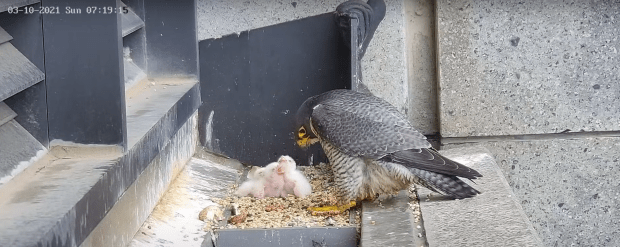
Oh, such sweet little fluff balls. Here comes a parent with part of an old stashed pigeon. Doesn’t that sound just yummy?

Breakfast has arrived. Wake up everyone.

At 7:10:34, Dad comes in to check on the babies and feeds them the remaining pigeon left in the scrape box from the earlier feed.

Mom gets a good break. In fact, one of the things you should be noticing is that Dad loves feeding his babies. So instead of just seeing Mom feed them, look carefully because it could just be dad!

Dad is actually very good, just a bit messy for Mum’s liking.

Mum arrives back. Just look at how beautiful she is. She has to be pleased that she chose such a good mate. Dad is an excellent hunter and when he is not feeding his babies he is out hunting for Mum and them. It really makes this family quite magical!

Dad loved getting time to incubate the eggs but he is no so good at brooding them. He seems quite nervous around those wiggly white bodies.

Mom watches from the ledge. Someone made a joke on the FB page of the falcons. It was Dad telling the kids to listen and make a great effort to eat because Mum was watching to see if he did a good job feeding them. Looking at this image it seems really fitting.

Dad is off and Mum is back to brood. They still have their little mouths open. It sometimes seems that it is an automatic reflex when an adult comes around.

Mom is inspecting the nest and wondering what that thing is that Dad has left.

For those of you that have not watched this nest before, you need to know that Dad is a very messy feeder sometimes. On several occasions he has been known to bring a fresh pigeon into the scrape box and pluck it right on top of the chicks. Imagine dark grey feathers everywhere – and I do mean everywhere. Dad pays no mind. He can also make a real mess of the chicks with these really fresh birds. There is no need to worry if you see blood on them after one of his feedings – they are not hurt, just in need of a face cloth!

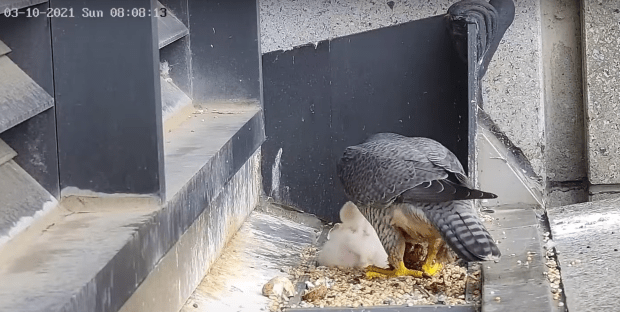
This is the third feeding of the morning and it has just turned 08:07. Here comes Dad with part of a pigeon he had in the cupboard.

Wakey, wakey. Time to eat again!!!!! You want to grow big and strong.

I noticed some of the FB members wondering what Dad is bringing in for the meals. 99% of the time it will be a Melbourne special – a pigeon. Urban falcons thrive on them. Indeed, one old falconer told me that is the only reason for pigeons – so they can be turned into falcons.

In contrast, the little eyases that will be hatching over in Orange, will have a different diet. There won’t be any pigeons. In fact, they might like a nice fat pigeon. Their diet consists of lots of Starlings and various types of parrots. But the real treat at Orange are the Cicadas. They hold them in their talons like a popsicle to eat them. Such a treat. Last year, Xavier and Diamond’s only hatch, Izzi, at them by the dozen. It is a wonder he did not turn green.

A clump of cuteness.

They keep each other warm but oh, they are so wiggly. I wonder how Mum gets any sleep.

Mom returns from her break. That egg shell seems to have caught her attention. I wonder if she will eat it? Those shells are full of calcium and Mum depleted much of hers making those four eggs.

She sure is beautiful! Have I said that twice?

Over in Orange, they are taking bets on when Diamond and Xavier’s eggs will begin to hatch. Yesterday, Diamond was not wanting to share incubating with Xavier. Many thought this might signal an early hatch. My bets are on the 7th or the 8th.

In Sydney, the two White-Bellied Sea Eaglets have recovered from the horrific storm with its very strong winds and hail. The impact on the nest was caught on camera. Notice the trees whirling in the background. This had to be terrifying for these young eagles. Here it is:

It is still misty in Sydney but the bad weather is gone.

Wow. That little sea eagle is really getting some air under those wings. I think it even surprises its sibling.

Now look. “See, I told you I could do it too!”

27 is standing up on the rim of the nest. It will not be long til there is more flapping and jumping all over the nest – and branching. These two are so healthy. Their interactions are so cute. Both would like a big breakfast delivery!

A last glance at the Port Lincoln Osprey Barge. The winds have not let up but the sun is out. The weather report says they might decrease slightly later in the afternoon. Mum is working hard to keep those three under her, out of the wind and the rain. Oh, let us hope that a break in the weather comes.

Other than Port Lincoln, every nest is doing well. Xavier and Diamond continue to incubate their three eggs while Mum and Dad are feeding the four eyases every hour or so in Melbourne. WBSE 27 and 28 survived the storm and are busy getting their wings and legs strong.

Thank you so much for joining me. Take care everyone. Stay safe. See you soon.

Thank you to the following for their streaming cams where I took my screen shots: the Port Lincoln Osprey Project, 367 Collins Street Falcons by Mirvac, Sea Eagles @ Birdlife Australia Sydney Discovery Centre, and the Falcon Cam at Charles Sturt University at Orange and Cilla Kinross.

The Miracle Chick

If I mention the name Aran, who is the first to come to mind?

This morning there was a posting about a ‘miracle’ chick – indeed, 2 miracle eggs and one of those being a chick that never should have hatched but did. These stories always interest me because, I immediately think that they are third hatches. This was not the case with these two little bundles of joy.

What a beautiful couple. They have been together now six seasons. You can see Aran’s prominent feather problem.

Mrs G (left) and Aran (right). July 2021.
Mrs G 3 September 2021
Aran in one of his favourite spots before he migrates. September 2021

Aran arrived at the Glaslyn nest, unringed and, as you know if you follow the Ospreys of the UK or Wales, specifically, in 2015. The public wanted the couple named. The female who had raised chicks at the nest previously was to be Mrs G, after Glaslyn. Aran was named after the local mountains, Eryri. The story is lovely and deserves to be read in its entirety. I am enclosing the news from Glaslyn. The story of how Mrs G and Aran came together and how Mrs G’s sixth and seventh eggs – yes – 6 and 7 – came to hatch is remarkable. It makes you feel good. I can add that WO was last seen a couple of years ago in the north of England. So, he really was a survivor! (I intend to check the listings to see if W0 has been spotted this year and the circumstances).

I did get my hair cut and the minute I got home I went to check on the PLO nest. In his book, Soaring with Fidel, David Gessner explains the term ‘Kathleening’. It is when a person claims to have seen the biggest, and the most after someone tells their story. I do not want to sound like I am ‘Kathleening’ but, seriously, Mum was feeding those kids – again. When I left they were eating and when I got home they were eating.

Are those babies getting squirmy? She hardly got them covered and she is feeding them again1

Mom has decided that she wants the fish on the other side.

Yeah for Mom. She pulled that fish over the nest of babies without clobbering one of them.

Mom has decided that it is time for some more fish. The little ones will make their way to the table shortly.

That’s Little Bob on the left with the two older sibs facing in the same direction. Little Bob has his mouth open and he is looking at Mom.

Little Bob has a nice crop. He is the one on the far left. You can still see his egg tooth. It will be gone soon! Big Bob is in the middle. She is the one with the most pin feathers and Middle Bob is on the right.

Mom is looking for another delivery and the three Bobs are waiting at the table with their napkins tucked in and forks at the ready.

It is 12 degrees C with 11 kph winds. What a difference from the days when it was blowing at 34 kph. Dad was able to get some rather large fish those windy days. I wonder if it is the same with the calm water???

I have been notified that the Season of the Osprey, the much awaited documentary put out by Nature and PBS will be shown in the US on 27 October at 00:00:30. Please do check your local stations to make sure this is correct!

That is it for me tonight. There will be at least another 7 or 8 feedings today before Mom gets some time to rest. I will bring you the details tomorrow. Take care everyone! Thank you for joining me.

Thank you to the Port Lincoln Osprey Project’s and Bywyd Gwyllt Glaslyn’s streaming cam where I took my screen shots.

PLO rock

It seriously does not get better than this: I take a break to check on our federal election results and turn around to check on the chicks at the Port Lincoln Osprey nest and they are being fed —— again!

The whale of a fish that Dad brought in this morning still has some left even after the last feeding. I have genuinely lost count of the feedings but we are up to at least five and I think maybe six. The last one began with Dad bringing the remaining fish to mom at 12:14. The kids ate and it is now 12:36 nest time. They will be fed at least three or four more times before they tuck it in for the night. Fantastic. Like the little songbirds in their nests whose parents fly in and out continually, this trio of osplets are thriving with more frequent feedings at this stage in their development.

It was time for a nap. One of the chatters was worried about Little Bob being out from under Mom. You can also see the heads of Big and Middle Bob sticking out. Little Bob was too warm or he would have been under. And if he got chilled, he would push to get under mom. If she was worried she would have scooped him up. She did look and check on him several times.

There is still some fish remaining that you can see at the bottom right. The chicks were full when mom finished feeding and got them settled again.

Less than an hour later, Dad is back on the nest. Just look at mom’s eyes. You can also see one of the wee babes with its head out.

Mom feeds the babies again! I don’t even know if they were hungry.

Everyone is fed and tucked. Dad is over on the ropes and I bet mum is wanting to catch a little sleep. It looks like the whale of a fish was finished.

During my walk today, I noticed a lovely pine tree. It had three Black capped chickadees on the branches. Then I stopped at another yard and saw no less than 15 bird feeders and various bird baths and watering containers. At the corner was the house with the pollinator garden. Long before it became a stylish phrase ‘I have a pollinator garden’, my neighbour was doing just that. People reported him to the city authorities because, well, his boulevard and yard looked a mess. Today, the flowers are growing in the pots hanging between the trees and the rest are native plants helping the environment. I don’t think anyone looks at that garden with disdain any longer. I mention this because I got a note this evening from a reader asking me what are all the things they can do to help the birds. Gosh, I didn’t know where to start there is so much to be done. So let’s start with the basic principle that everything is connected. Here are a few ideas and we will add to them on a regular basis.

  • Shrinking your lawn is one of the first one that comes to mind. In their book, Planting in a Post-Wild World, the authors suggest that we think of turf or lawn as an area rug, not the whole floor. Use the grass areas to draw attention to something. Most eco-gardeners suggest having no more than 50% turf. It is suggested that you set your mowers to 3 inches or 7.5 cm. You will not kill your grass by cutting it too short and you will also not kill the turtles or little bunnies that hunker down. Do not mow at sunset as many species come out at that time of day.
  • Do not treat your turf with anything. No matter how green the companies claim their products to be, if they kill something they will also kill other things. You can also save a lot of money.
  • If you are doing some fall planting, use native plants and pollinators. These will be good for the insects and small birds.
  • Plant a native tree.
  • Do not rake your lawn. Leave it. Just leave it alone. If you must, rake the leaves into areas and spread them being as gentle as possible.
  • Locally we are recommending leaving out hummingbird feeders. The little ones are still staying in some of our more northern areas. They are migrating through and really can use the energy.
  • The small songbirds migrating have really been eating my suet cylinders. That fat and those specialized seeds and insects give them fuel also.

I will stop there. There is so much we can do from supporting bird friendly coffee and building bubblers (small fountain areas) and little ponds, window decorations to stop bird strike, etc. A friend of mine wrote to me today and they had been in an area where there were no birds. They said that it was ‘eerie.’ Can you imagine a world without birds?

Thank you so much for checking in with me. It is going so well for the family at Port Lincoln. What a joy! Take care all. See you soon.

Thank you to the Port Lincoln Osprey Project for their streaming cam where I took my screen shots.

Late Saturday in Bird World

I want to thank the person who wrote and thanked me for keeping everyone abreast of what is happening with the Port Lincoln Osplets. It is truly my pleasure. The situation of siblicide last year with Tapps really touched our or tore out our hearts. People can say that nature is not like Disneyland – and it surely isn’t – but, it is still hard. How many times did we want to scoop up little Tapps and feed him? I almost quit watching Ospreys entirely because of Tapps. I do understand – completely.

I began to wonder about these third hatches. The Osprey nests had such a hard time last year that there were few with three hatches that survived. The first was Tiny Tot at Achieva. Aka Tumbles. What an amazing bird. I will not bore you with all of the intricate details but, in the first two six weeks of her life, Tiny Tot had 12 days – 12 whole days – without food. At least twice, she went for 72 hours. That bird wanted to live. She was clever! And, yes, she got angry and lashed out at the older ones twice. I believe it was the last instance when Diane, the female, took notice. She began bringing in food to the nest. Those big catfish saved Tiny Tot’s life. And then Tiny Little at Foulshaw Moss. Neither of the Tinys should have survived but they did and were stronger birds for it. My interest in third hatches was cemented with the two Tinys. I want to see if their survival rate is higher than the big siblings. The problem is that so few of them are ringed or have satellite trackers. Someone in France just photographed Blue 494 from the Dyfi Nest. Maybe they will see Blue 463, Tiny Little, too. Oh, I hope so.

What I can tell you is that the PLO are doing fine. Little Bob has a good appetite. He can’t eat as many bites as Big Bob but at the most recent feeding, Little Bob ate enough to go into food coma! Mom seems particularly focused on making sure that each gets bites. She is doing really well this year and so is Dad with bringing in the fish. It is 11 degrees C in Port Lincoln and the winds are still blowing strong at 24 kmh. That is 14.91 miles an hour. It might not sound like a lot but it can certainly disrupt fishing.

Here is a close up. Little Bob is the one that is being fed. You can see that he already has the makings of a very good crop.

This is Little Bob getting some nice bites. The one that looks asleep is actually Big Bob. She has eaten and is taking a ‘breather’. Meanwhile Little and Middle Bob are enjoying the morning breakfast.

There is Big Bob back up at the table! Doesn’t take long. She can eat bigger pieces and more of them now. But there is no problem with Little or Middle Bobs eating. Everyone is doing well.

Every once in awhile their eyes lock on one another and my body goes rigid but, so far, nothing. Mom goes around making sure everyone has bites. It is that kind of security that keeps things tranquil.*

These are really well behaved youngsters. Food is plentiful and they line up with mouths open letting out little peeps. Middle Bob is getting some bites now while Little and Big wait their turns.

As I said, Little Bob has a very good appetite and he won’t leave the table until he falls over in food coma or mom calls it quits. Remember, she does not want them to catch cold. Right now the feedings are lasting about nine minutes.

Little Bob is full and in a food coma. The crops are filling on the older two. Oh, what a delight this nest is to watch this year. Of course, it can all change. Just continue to send the warmest of wishes to this family. We want three survivors! Three.

Closer to home. I was heading out to check on the Wood Ducks at the park. The last time I was there the male Wood Ducks – save for one – were in the equinox. They were moulting and getting their fall plumage. They were certainly not their brilliant beautiful selves.

As soon as I was out the door I could hear the familiar pecking of the male Downy Woodpecker in the garden. He comes several times a day. Rumour has it that he lives inside the 123 year-old Maple tree in front of my house.

In the winter I rub peanut butter suet on the bark and I often see him eating away. This summer he brought his baby to find the suet. The strange thing is – we have never seen the female. It is so odd.

Little Woodpecker is such a sweetie. One day when Sharpie, the Sharp-shinned Hawk, was in the garden, the little woodpecker was on the suet like he is today. For 45 minutes, he held on tight, not moving, just blinking his eyes rapidly. He was so afraid he was going to be Sharpie’s lunch. I felt so sorry for him. Sharpie was sitting on a branch under him pretending to be. feeder! Needless to say Sharpie wasn’t successful that day.

It is a beautiful fall day and the park was full of Canada geese and people having picnics and playing cricket.

Over in the pond, the male Wood Ducks really stand out. They have finished their moult. Just look at the range of colour in those feathers. Even the golden beige ones are gorgeous.

Here is a different one. The shape of the head is slightly different on this one.

The female Wood Ducks have really grown, too. My goodness. What a change in a a week. They were so tiny when I left but they seem to be growing by leaps and bounds.

There were definitely more females than males.

The Mallards were particularly annoying today. We noticed that the female Wood Ducks tended to stay close to one another.

Isn’t she beautiful?

The male Mallards are in the middle of moulting. Soon they will have those beautiful emerald green heads that are so characteristic. For now, they look a little bit like peeling duck decoys instead of living breathing water fowl.

There were lots of female Mallards in the pond today.

Two Canada Geese came flying in creating a bit of a ruckus.

Then they slithered along the surface of the pond. They looked rather strange and everyone stopped to try and figure out what they were doing.

We presumed that they were sipping water.

Speaking of water. The pond is pretty clean this year. There are two fountains and everyone is abiding by the signs and not feeding the ducks. If they do it is wild bird seed. What a huge difference from the algae infested muck of last year.

It is early morning in Australia. There will be more meals for the youngsters. All of the birds in our park are safe and sound tonight. We have had no frost. In decades past there was always a freeze in August. I wonder if this might impact migration dates?

Thank you so much for joining me. Have a lovely rest of the weekend. Tomorrow I am going to try and break my unlucky streak and catch that juvenile Green Heron that is hanging about our City. Take care all. Stay safe.

Thank you to the Port Lincoln Osprey Project for their streaming cam where I took my screen shots.

Saturday in Ospreyland

There is super news regarding the fledglings. Pont Cresor Blue 494, son of Aeron Z2 and Blue 014 was spotted at Point Caillot in Brittany, France by Colette Leclerqu. Blue 494 was also a historic hatch – the first for the Pont Cresor Nest in the Glaslyn Valley.

Blue 494 has a great pedigree. He is the grandson of Monty and Glesni. Looking forward to his return in 2023!

If anyone hears of someone spotting Blue 463, Tiny Little, from the Foulshaw Moss Nest, please let me know!!!!!! Did you know that Foulshaw Moss was one of only a few Osprey nests in the world to successfully fledge three Osplets in 2021? Achieva Credit Union Osprey Nest with Tiny Tot was another.

I did a short report on the feedings at Port Lincoln in the middle of the night. There were at least two other meals for the three after I shut my computer down.

Mom knows with the cool winds coming off the water that the chicks need to be kept warm. They don’t! They are curious and wiggly and want to look around! Too funny. These three are going to be a handful.

Calypso, the 2019 hatch from this nest, a female, lives and is seen often around Port Lincoln. Solly, 2020 hatch, has a satellite transmitter and continues to stay around Kiffin Island and Eba Anchorage. Solly is 364 days old. Tomorrow is her first year hatching birthday!

The Montana Osprey Project has officially said goodbye to Iris for the 2021 season. She did not return to her nest to say goodbye this year and she was last seen about four days ago on the branch at Mt Sentinel eating a fish.

Here is one of the most iconic of Iris images. For those of you just learning about Ospreys, Iris is the oldest Osprey in the world. She is unringed. No one knows where she spends her winters. Her nest for the spring and summer is at Hellgate Canyon in Missoula, Montana. Iris, we wish you safe travels, great fishing, good weather, a wonderful winter break, and a speedy return to us.

It continues to be a good day in Osprey Land. Wishing for lots of fish for the PLO and great feedings today.

What a treat. An Osprey came into view while Ferris Akel was streaming at Wildlife Drive in Montezuma, New York.

I am off to check on the ducks today. Thank you so much for joining me. Emyr Evans if you are reading this, please open the on line store so we can all order our copies of Monty!

Thank you to the PLO Project, the Dyfi FB Page, Ferris Akel Livestream, and the Montana Osprey Project for their streaming cam where I took my screen shots.

Very Impressive

I find myself continually checking on the PLO nest. Do you?

It is a sunny 18 degree C day in Port Lincoln, Australia. The problem is the speed of the winds. The rate is 42 kmh or 26 mph. The water is choppy. The barge is moving a bit. Add that together with three ‘Bobbling’ Bobs and well – could you feed these three hungry Osplets moving about every which way? I am certain that I could not! Dad has even delivered the fish despite the waves and wind. I really am finding myself being totally impressed by these two adults.

After the osplets hatch, the Mom tends to stay on the nest most of the time. That said she does take breaks and, at this nest, Dad can be seen relieving her so she can have a stretch and a relaxation break. Still, his primary role is food delivery – ‘Daddy Door Dash’. Alan Poole reminds us that the number of fish deliveries doubles and triples in the first 20 days after hatch. This is the rapid growth period. It is during these first weeks that we do not want to have cold rainy weather either – it seems to both impact the fishing as well as the health of the wee babes.

Ospreys are semi-precocial. This means that they are not as developed as ducks or chickens who, after 24 hours, can walk, are covered with feathers, and feed themselves. Ducks and chickens are precocial. Songbirds, on the other hand, are born altricial –naked and require complete care. Osplets are in between. They are born with down but still need the parent to keep them warm and feed them. They cannot regulate their own temperature until they are 2 to 3 weeks old.

In terms of growth, osplets should “triple their body weight in the first 8 days after hatch and then double that again in the next 4 days” according to Poole. By the time they are a month old, if all has gone well, they will be 70-80% of their adult size.

Mom has the task of trying to make sure that each open beak gets some fish. She is ever so gentle. The pieces of fish are so tiny. It is difficult to image those small morsels in that large beak of hers meeting up with the tiny, tiny beak of a wee babe. But she does it! Instead of still pictures I thought a couple of videos would help illustrate how impressive this female Osprey is at feeding.

I have to admit that I always worry about the third hatch. In the first video both Big Bob and Medium Bob had some bites. Little Bob had his beak wide open but I didn’t see any fish go in.

In the next video, Mom makes a point of feeding Little Bob. Look at how she stretches over Big Bob to reach Little Bob’s beak. What a relief!

These Bobs are doing so well. They still have their egg tooth that they used to get out of those hard shells. And, of course, we can see that bold dark eye stripe so characteristic of these fish eagles.

One day they will resemble their parents but there is a lot of growth and development that has to take place before then. Right now they have a coat of soft light grey down. This will be replaced by a darker wool and then the osplets will enter the reptilian phase where they look more like their dinosaur relatives than birds. The rusty-gold and coppery red of the pin feathers is gorgeous.

The three osplets in the nest below – not the PLO nest but another just for illustrative purposes show a bit of the range of plumage development. There is the lighter grey down, then the emergence of the charcoal and the one on the left is entering the reptile phase.

“7-10 day old Osprey young” by Conserve Wildlife Foundation of NJ is licensed under CC BY-NC 2.0

Their flight feathers will emerge last.

There are certainly exciting days to come but, for now, I want to focus on the magic as they seemingly grow right before our eyes. The stated range of fledging dates is 55-60 days in Australia. Those days will pass very quickly. Let’s enjoy them while we can!

I do hope you enjoyed the short videos of the three Bobs at the PLO nest having a feeding today. I do find myself continually commenting on how cute they are — and they are ever so precious.

Thank you for joining me. Send your warm wishes to this nest so that Dad’s fishing ventures are successful and that all three grow healthy and fledge. That would be remarkable. I am so hopeful this year.

Thank you to the PLO Project and their streaming cam where I took my screen shots and video clips.

Thursday in Bird World

Everyone that I know either loves to see an Osprey fish or they wish they had the opportunity to do so. This is one of the best two minute videos I have ever seen showing the physical stamina that the male needs to land his fish and get it out of the water for the family. Look at it closely.

John Williams kept a list of the fish that Dylan brought to the nest for Only Bob, Blue 496. That was the Lyn Clywedog Nest. There were 354 fish seen at the nest including Rainbow Trout, Brown Trout, and 10 Grey Mullet. This is for one chick and his mate. I wonder how this number of fish increases for nests of more than one chick? Does anyone know?

Last night, at 18:15, the Dad at the PLO Barge brought in a nice fish. He had eaten the head off. Mum proceeded to provide three feedings to the Osplets between then and 22:15. After the last feeding, she ‘hid’ the fish. Lots of times the fish are hidden to keep insects off. In some countries, the fish buried in the strawy nests stay fresher. I am thinking of the White Tailed Eagles in Latvia. Or maybe she did want to hide it from Dad!

One thing that we always need to remember is that video from the beginning. The male’s role is often forgotten in terms of its importance.

The Osprey nests ONLY succeed when the male is in tip top condition. Tiger Mozone made that point last night on the PLO chat. The nest will fail if the male is not a good fisher or is in poor physical condition. The male must eat. How could he keep up his strength otherwise? Dad eats first and brings the remainder to the nest. Eating the head – which might be the best part (I doubt it) – might also stop that fish from flapping (it doesn’t always). So do not begrudge the male a meal – cheer him on. We need the male healthy so he can exert the type of energy it takes to catch the fish. Many say it is 8 to 15 tries to get a fish. That is a lot of diving. Of course, we also hope that there are lots of fish around the surface for the male to catch.

This image has been circulating. I have no idea who took it, where it originated but it was in my inbox awhile ago sent from a friend. Thanks ‘M’.

The next time you look at the legs of the males – think strength. They do not need a gym membership!

Dad on the ropes eating the head of one of the fish he brought in.
The 3 Bobs stand at attention if they are hungry. This is an image after that fish was delivered.

The little ones at the PLO nest need bites of fish often now. Like I said, Mom fed them at 18:15 and then twice again before bedtime. In 2 weeks time they will need more fish. It is important that the 2-3 week period be stable with deliveries. This will be a big growth period.

This was at 18:15:54. It is less than a minute after the fish delivery. I am including this image so you will then notice how those three get to attention when it is feeding time.

In 30 seconds, they have all turned around and gotten in line. Well done, little ones.

The last feeding of the day. They look like they are singing!

It has been some days since I checked on the Black Stork family of Karl II and Kaia whose nest is in the Karula National Forest in Estonia. The current tracking is for Karl II, Pikne, and Udu.

Udu is now in Hungary. The comment on the forum is that Udu seems to have an affinity for finding good fishing spots.

I like this map the best as it shows Karl’s family plus Jan and Janika’s Julge. Julge is the purple. You might recall that he got on a ship and went the wrong direction but righted himself and is now taking the Western route to either southern Spain and Portugal or on to Africa. I wonder if he will stop in Spain?? Karl II is near to where he was when I last checked on him. Near the Black Sea in the Ukraine. A great stopping off spot it seems.

While a few days might not change Karl II’s trajectory that much, it sure has changed the plumage of the White Bellied Sea Eaglets 27 and 28. Wow. They are gorgeous. And, yes, Toni Castelli-Rosen, they are as pretty as the Red Tail Hawks! Indeed, I have had to admit to Toni that they are double gorgeous. I love the plumage on these juveniles.

The last time Aran was seen was Tuesday morning so he might have left on his migration. The Glaslyn Valley will be waiting for him next year. Isn’t it gorgeous? I understand they are leaving the camera on all winter. Wow. What a treat.

It is not clear if Iris has left Missoula, Montana yet. There were photographs of an Osprey on Iris’s favourite branch eating a fish on 12 September. That was four days ago. Did she leave without saying goodbye to her nest? Maybe. Tiaki, the Royal Cam chick, had a feeding today (LGL) and Tiaki is still on Taiaroa Head. Samson has been bringing in sticks and him and Gabby are working on the NE Florida Bald Eagle nest.

Take care everyone. Thanks for joining me today. I had hoped to do a quick check on all the nests but the long drive in the rain was exhausting. I will do that this weekend. Stay safe everyone. Check out the trio at the PLO Barge. They are darlings.

Thank you to the Bywyd Gwyllt Glaslyn, Port Lincoln Osprey Project, Sea Eagles @Birdlife Australia Discovery Centre, the Eagle Club of Estonia and BirdMap for their streaming cam and FB pages.

And then there were 3

Port Lincoln Ospreys welcomed the third hatch at 00:57:50.

This was one of the best images. Mum moved that eggshell later. Congratulations PLO. Let us hope that since the hatches are so close together, the rivalry will be minimal and all three will get to wear an antennae!

There is other good news. Laddie, LM12 and Blue NC0’s 2021 hatch, LR2 was photographed in Trebujena, Spain by Richard Page-Jones. Fantastic. Not sure if he will stay there or continue on to Africa. Well done Loch of the Lowes!

Three other interesting tidbits this morning. A study in Canada has revealed that if you put colourful collars on cats, it helps protect the songbirds in your garden. I might just buy these for the neighbour’s cats that come around my feeders!!!!!!!!

https://www.cbc.ca/news/canada/british-columbia/cat-collars-bird-deaths-research-university-northern-bc-1.6168493?fbclid=IwAR0ivf3W0erFnpo5TwYIOag2pxKP1yXuhYwmyddPthi-jpeQpBITJrB1Etk

There is another positive story coming out of my province, Manitoba. The Burrowing Owl Recovery Project has discovered the only known nest – a first for so many years – with two adults and six owlets. Well done.

This morning’s newsletter is short but it is packed with positives. Head over to the Port Lincoln Osprey streaming cam later today to check on that new hatch if you have time. Here is the link:

I am cautiously optimistic about the PLO this year since the hatch times are so close together.

Thank you for checking in. Have a great day.

Thanks to the PLO Project for their streaming cam where I took my screen shots.

How do you say ‘cute’ in Osplet?

The Port Lincoln Ospreys welcomed two osplets born so close together that it has made a record for the barge. No hatches at dusk and two hatches by dawn! And they are soooooooo cute.

Do you think they are born with their mouths open wanting fish?

First one.

First feeding for both was at 07:02.

Just look at that natural reflex to open their mouths. In fact, every time mom gets up to check on them they open their mouths.

Absolutely adorable with their light grey down and that distinctive dark eye mask.

Look at those fat little arms. Oh, these are two healthy new hatches. Simply adorable. I hope that their hatching times, so close together, brings this nest much luck. Hopefully the next egg will hatch really soon or not at all. Two healthy fledglings would be grand.

Mom is taking a much needed nap! Can you imagine having two hatching bumping little osplets under you all night????

While everyone was celebrating the good news at Port Lincoln, sadly, a fox took the two eggs from the Turnby Island nest. They were due to hatch any time. So sad for those parents.

I am toasting Port Lincoln with a much needed strong cup of coffee. Dad, we need fish! Lots of fish.

You can watch them here:

Thank you for stopping in. This is just a brief update on the news from earlier this morning. Take care everyone.

Thank you to the PLO for their streaming cam where I took my screen shots.