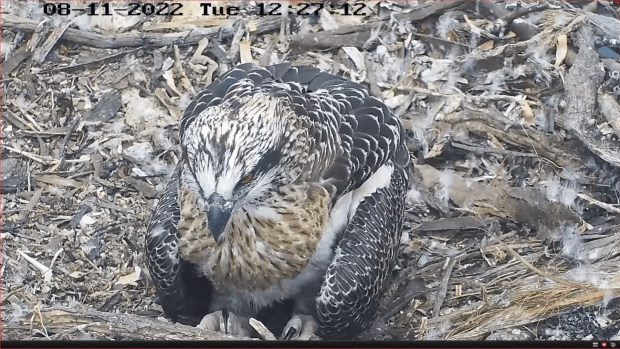
Day 5 Welcome to Winter…Girri is a BIG girl!

6 December 2025

Good Morning Everyone,

I am so happy that Toby and Hugo Yugo’s little kissing/licking fest touched your hearts. It is really easy to see why they bring such joy to our lives! SP wrote, “Mary Ann, you are my Santa!  The Toby-HY love fest… I’ve only watched it three times… so far. xoxo”

Brock reminded me today that it is ‘essential’ to find a way to have water for the outdoor animals that we feed. This is easy if you live in an area where it never gets below freezing. Here, it can be problematic. You MUST be careful so as not to cause the little birds to freeze their feet and feathers. Because of these issues, I am reluctant to use a heater in the bird baths if there is any chance their little feet will stick and be pulled off! Luckily for Brock, there are two dishes in his heated feeding station – one for wet food and the other for water. He had several long drinks today!

The small sparrows and Starlings were busy eating snow. They don’t get as much as they would if there were a bird bath for them, but they do get some hydration, which is really important if you are feeding them.

Two articles with some different points of view.

I hope you did not worry about Gabby being away from her nest and leaving Beau to incubate for approximately 24 hours. This is ‘Gabby’s Way’. Every year, she takes a break before the eggs hatch. The first time I saw this panic set in, I thought she had died, leaving Samson to care for their family, but no. Gabby was having a ‘spa time’ – I liked to call it. Gabby is now home, and Beau was so happy to get off those eggs, he flew off the nest when he caught her flying in!

Beautiful Gabby back in the nest.

I decided to take a sheet out of Gabby’s playbook today while Anne was caring for Don, Toby, and The Girls.

You probably know someone who was or is a caregiver to another individual – their partner, a parent, another family member, or a friend. It is stressful. There is no ifs, ands, or buts about it. Caregivers are often ‘tired beyond belief’ and rarely take time for themselves. You might know someone who cared for another person and actually died before them. It happens more often than you might think. As Don’s illness progresses, I am trying hard to make sure that my life is a bit more balanced. So, going back to Gabby…I gave myself a ‘treat’ today. I spent the afternoon at the Dior counter today getting a ‘refresh’ from a wonderful woman who has worked for this French cosmetics company for 35 years. It was fun – and a reminder that each of us needs to create time to relax and laugh!

Moving back to our birds. As you know, Heidi and I have been monitoring osprey nests for mortality numbers and causes. Heidi sent this to me today and I thought that you might be interested, too.

“This was the presentation held yesterday on Virginia Eastern Shore by Dr. Watts and Ben Wurst.  The presentation itself is only about 67 minutes long, and is very informative.https://youtu.be/bR8byYABd8s?s

A lot of takeaways.  VV’s nests all had abandoned eggs.  But, Watts’ data indicated the majority of nest failures were from brood reduction due to a lack of menhaden.  Most of the eggs hatched, but most chicks didn’t survive.  Interesting.”

Overfishing has led to the death of 60,000 penguins! The Guardian gives us the details. “More sustainable fisheries management could improve the penguins’ chances of survival. Conservationists are taking action on the ground, by building artificial nests to shelter chicks, managing predators and hand-rearing adults and chicks who need rescuing. Commercial purse-seine fishing, which involves encircling a school of fish with a large net and then trapping them by closing the bottom, has been banned around the six largest penguin-breeding colonies in South Africa.

It is hoped this will “increase access to prey for penguins at critical parts of their life cycle”, said the study co-author Dr Azwianewi Makhado, from the Department of Forestry, Fisheries and the Environment in South Africa.”

60,000 African penguins starved to death after sardine numbers collapsed – studyhttps://www.theguardian.com/environment/2025/dec/05/african-penguins-starve-to-death-south-africa-sardine-population-aoe?CMP=share_btn_url

African Penguins” by BasL is licensed under CC BY-SA 2.0.

I don’t know about you, but my calendar is counting down to the arrival of the ospreys in the UK! Of course, there is a big gold star at the beginning of April to remind me to be on the lookout for Iris’s return to Missoula, Montana.

Lots of couples are incubating. Eagles and Albatross.

You can watch the Royal Albatross Royal Cam Pair, BOK and WYL, in New Zealand. If you are not aware, the letters relate to the coloured identification bands on their legs. BOK (female) is Blue-Orange-Black with ‘K’ being for Black. WYL (male) is White-Yellow-Lime.

Today, the couple were reunited as they switched incubation duties. The note under the video reads: “WYL returns to the Plateau nest site to give his mate BOK a well-earned break from incubation. Watch him enter from the left of the frame to greet her, and after a brief reunion, BOK lifts off and hands over nest duties. Following a few vocal exchanges with the neighbors, she heads back out to sea. Join us live as we follow their journey through the 2025–26 breeding season! RoyalCam was set up in January 2016 by the Department of Conservation and the Cornell Lab has been collaborating with DOC since 2019 to bring the cam to life. To learn more while watching, view the cam at https://www.doc.govt.nz/royalcam

At Port Lincoln, Dad was on the barge during the early morning hours having a nap. The camera panned to the old barge but no ospreys were visible.

Girri is such a character. She has even been incubating the remaining egg in the scrape on and off!

Just look at those juvenile feathers coming in!

Girri is a BIG girl.

There has been no news of any peregrine falcons from the CBD of Melbourne coming into care. This is great news!

Liberty and Guardian have been at the Redding Eagles nest.

More eagle news on Monday!

Signing off with Hawk Mountain’s migratory count for the week of 3 December. Osprey count way down. Bald Eagles up. Sharp-shinned Hawks down along with many others. My goodness…but a growth in Broad-winged haws.

It isn’t just at Hawk Mountain that some species numbers are beginning to plummet. In the UK, recognizing this horrific act, people are opting to name streets after our amazing birds in order that they not be forgotten.

Streets named after birds in Britain on rise as species’ populations plummethttps://www.theguardian.com/environment/2025/dec/05/street-names-birds-britain-rise-populations-plummet?CMP=share_btn_url

I don’t need to tell you that Toby and The Girls make my life worth living.

After a day of frolicking in the snow, there is nothing nicer than napping on a toy duck.

Thank you so much for being with us today. We hope to have you with us again tomorrow!

Thank you to Heidi for sending us the link to that presentation on the Ospreys with Dr Watts and to SP for allowing me to quote them. I am also grateful to the owners of the streaming cams – Charles Sturt University, Port Lincoln Osprey, American Eagle Foundation, and NZ Dept of Conservation/Cornell Bird Lab – where I took my screen captures today and to the authors of the articles on providing water for wildlife in winter, The Guardian for covering the death of the African Penguins or OpenVerse for the image of the African Penguins.

Let’s Talk, Darling Starling

8 November 2022

Good Morning Everyone,

I was a little ahead of myself. The banding at Port Lincoln does not take place until the 12-14th (Australian time).

I have been trying to lure the European Starlings back into the garden. Last January there were 58 eating snow and hard seed cylinders along with butter bark and meal works. Nothing seems to bring them to the garden currently and this is troubling me.

The pictures below were taken in my garden on the 26th of January 2022.

This evening I was thumbing through and reading different entries in the two books – collaborations between writers and artists – that form the fundraiser on the Red Series by the British Trust for Ornithology. How disgusted was I when I found the Starling. So my plan is to introduce you to a different bird every day between now and the end of the year that is vulnerable. Today we are talking Starlings.

“Nowadays you can count them, when at one time they were literally countless.” Scientists think the causes of the decline involve farming practices that have poisoned insect prey with pesticides and chopped down grassland habitat. Other farmland bird populations too are reeling from the impacts.”

This report on the decline of Old World House Sparrows and European Starlings is excellent. It is long and it is thorough, some 244 plus pages divided into sections dealing with each species. It is not for bedtime reading but, even skimming through some sections and pausing to read bits and bobs will underscore the challenges that these two species face. These are two birds that I often hear people complain about at their feeders – there are so many of them. And yet, there aren’t. It is a delusion. If we cannot protect the Sparrows and the Starlings, what birds can we help?

Diamond doesn’t like them but they must be easy prey for the Peregrine Falcons in the rural areas of NSW Australia. Indigo is frightened by them and Rubus just gets down to business and eats them.

Some of you might have seen the recent YouTube video of the Starling that has learned to talk and sing but, did you know that this was common knowledge during the time of Shakespeare? In his entry for the Starling in Into the Red, M.G. Leonard begins with Henry IV and the entry where Hotspur declares that he will teach a Starling to repeat the name ‘Moritimer’ over and over again to drive the King mad since he declared his brother-in-law a traitor. Leonard is fascinated that a Starling would be a proper gift for a King, and that over 400 years ago it was well known how intelligent they were and how they could be taught to speak.

Leonard continues with Mozart who purchased a pet Starling in 1784 and taught it to sing. Mozart trained his pet Starling to sing his concertos. It was well-known that he loved his Starling more than anything in the world. The bird is said to have died a week before Mozart’s father. Mozart did not attend his father’s funeral. Instead he staged an elaborate memorial for his beloved bird.

In order to create a European landscape full of birds and plants, a German brought and released 60 Starlings- along with every other species mentioned by Shakespeare- in New York City in March 1890.

We think of murmurations and we think of Starlings.

Leonard ends blasting humans — “What monsters must we be, that we have reduced it to sit on the Red List.”

I agree. My heart is broken.


Australian Nests:

I have been thinking about the Melbourne Four. Risking getting egg on my face, I am going to come out and say that I think that the ‘Four’ will fledge within close proximity of one another on the same day. They have been very busy today watching the flying demonstrations that Mum and Dad have been doing. And one of them is ‘loafing’ like Alden. ‘A’ says Alden’s stance has gotten all the way to Australia!

Loafing.

Loafing and flapping. There are hardly any dandelions left on these beauties. They have the great DNA of old Dad and the new Mum and the love and care of new Dad. How fortunate.

That must be some aerial display – like 2 Stealth Bombers at an Air Show but for the private viewing of their kids…it is hard to imagine these four a month ago!

‘A’ has alerted me to a storm hitting the Melbourne area causing thunder and steady rain. It is not a good day for the eyases to fledge – and also. Look at the one on the ledge. The size of that crop dictates that bird will probably want to stay put and go into a food coma any moment!

At the nest of Cornell University’s Red-tail Hawk Big Red, she will always fill the eyases up to the brim if she doesn’t want them to fledge.

My goodness, I don’t know how that one eyas can stand she is so full. Gracious. It looks like she swallowed a small beach ball instead of a pigeon. Now, I wonder. Did she eat all of the pigeon leaving only scraps for her siblings??? Sure looks like it!

‘H’ reports that 5 prey items were brought to the Melbourne Four by both Mum and Dad. One of those was eaten almost entirely by Mum who took away the scraps. Thanks, ‘H’.

A super nice fish was delivered to Mum and Big by Dad around 1034. The winds will be gusting up to 30 mph and well, Dad is a great fisher but, he, too, can have difficulties. This is a lot of fish and should keep Big til later in the day. In the real world, a fish this size might be the only prey of the day.

‘A’ sent the observation board from Port Lincoln also. To recap, Big is 52 days old today. Mum and Dad brought in fish – Dad brought in 2 and Mum brought in 1. Those times were: 10:34, 13:15, 19:23. Thanks ‘A’.

I wonder how many more mornings we will wake up to Indigo looking off the ledge to the world beyond? She can fly. Rubus can’t.

Indigo is doing the same exercises that Diamond did in the morning – great stretches.

What a beautiful falcon Indigo is. She is watching carefully as the adults fly around the tower. They will begin to lure her with prey. Many on the chat do not realise that Xavier and Diamond will provide prey for about 4-6 weeks while they teach Indigo to hunt and be independent. Cilla Kinross says she does not monitor them after they fledge but she sees them in the trees about 400 m from the tower.

Rubus is not nearly ready to fledge.

‘A’ sent the days feeding recap for us at Orange: RECAP: 06 56 59 prey, left for chicks; 7:25:02 prey, Rubus takes; 9:17:05 X w/juv starl, leaves with chicks; 9:22:42 D w/GST, feeds; 13:25:17 X w/juv star, leaves with chicks; 16:48:25 pigeon, D feeds. In other notes, one of the prey had a blue leg band and Diamond ate it! Oh, goodness.

Other Nest News:

A major storm, one of the worst to hit the Big Bear Valley, is arriving today. Jackie and Shadow are getting prepared. Please send your positive and warm wishes to them.

Everyone has their favourite species of bird and within that species, most of us have one or two favourite bird families on the streaming cams. I have my own favourites and then I have the nests that I recommend to others to follow. Those nests are steady as you go and reliable and they include Harriet and M15 at SWFlorida, Samson and Gabby at NEFlorida, and Liberty and Guardian at Redding. The Channel Islands Bald Eagle nests have their challenges. The parents are incredibly amazing but, eaglets found themselves clinging to the sides of cliffs last year. It can literally put a hole in your heart while you wait to see if Dr Peter Sharpe will arrive in time to save the baby. So that is why West End and Two Harbour are not in those top 3. Fraser Point is a great nest, only about 2 metres off the ground, and is the home of Mama Cruz and Andor. I do not and will not recommend Dale Hollow which is on the border between Kentucky and Tennessee. The male is currently injured and last year there was siblicide at this nest. There is also a strict no intervention policy by the people that run the cams and that includes if fishing line is on the nest. The Captiva Bald Eagle nest has had its issues and it remains unclear if Connie and Clive will have a successful clutch this year. The last two eaglets to hatch on the nest, Peace and Hope, died from rodenticide poisoning. Glacier Gardens is a great nest but the visibility of the nest is not good. So, if you are starting to make a list and have limited time and want colourful characters and steady as you go then Harriet and M15 along with Samson and Gabby and Liberty and Guardian are your nests. I personally love Shadow and Jackie at Big Bear – talk about characters – and so do about 6000 other people. They did successfully raise one chick last year -Spirit – and that eaglet was amazing. I will be watching them again. Another good nest is the KNF nest 1 of Anna and Louis at the Kisatchie National Forest in Louisiana. Louis is an incredible fisher. One year he had 20 fish on the nest – 20 – for a recently hatched eaglet. They have fledged 1 eaglet for each year of the past two years. There are many, many others but if you want safe and secure for beginning eagle watching head to those three mentioned above.

That storm has hit Big Bear Valley. The winds are horrific and you can hear the rain and/or ice pellets alongside the howling wind. I will continue to check on this nest for today and the next couple of days. The eagles at Big Bear are used to harsh winter weather and, as we saw in Florida, they survived a hurricane. Looking forward to seeing Jackie and Shadow back on the nest when this is over.

Samson and Gabby are making their nest very comfy. Look at the reeds and moss that are coming in for lining. Fantastic. For those of you who do not know this nest, Samson hatched on this very nest. It belonged to his parents Romeo and Juliet. Samson and Gabby have fledged Jules and Romey, Legacy, and last year, Jasper and Rocket – success for the three years they ahve been together. Let’s see what year 4 brings.

Of course, after mentioning Harriet and M15, it would not have been fair to not have included some images. This couple, whose nest was entirely destroyed by Hurricane Ian, have rebuilt and has many of you note and ‘A’ reminds me, Harriet is now giving M15 ‘the foot’ to remind him it is time to fertilise some eggs.

Thank you so much for being with me today. Please take care wherever you are. Looking forward to seeing you soon!

Thank you to the following for their posts, their videos, and their streaming cams and for their notes: ‘A’, ‘H’, BTO, SWFlorida, D Pritchett and Lady Hawk, Port Lincoln Ospreys, 367 Collins Street by Mirvac, Charles Sturt Falcon Cam and Cilla Kinross, NEFL-AEF, and FOBBV.