
31 October 2022
Good Morning Everyone,
I hope that each of you had a joyful weekend and your start to the week is showing promise.
Most Canadians are obsessed with the weather. We are also slightly superstitious. OK. Many of us are highly skeptical if it is too nice late into the fall. We fear that we will pay for it by having 5 months of -35 C with lots of deep snow. So everyone that was out today – again – in their shirt sleeves and runners with no socks hopes that there won’t be ‘a winter retaliation.’ It is seriously hard to believe. Families were having picnics! Some brought their lawn chairs to sit by the edge of the pond and take in the sun’s rays. One of the biggest delights was the fact that almost everyone said ‘hello’ to one another. Being outside really does make us happier!
The number of waterfowl is dwindling at all the city parks, however. Less than the people! Duck and geese counts today at our St Vital Park were 350+ Canada Geese, 7 Mallards, 5 Wood Ducks and 3 Ring-billed Gulls.
My photos are not the greatest. The light was ‘odd’ but, I did notice how clear the water is today compared to earlier in the year. I also noticed that the parks personnel (or a fairy) has cleared the island, the water, and the shore of human litter. It is nice!
The male Wood Duck blends in so nicely with the colour of the pond and the leaves.

So many were flapping their wings today in the water. It is impossible to see the face but I love the light going through the primaries of the wing.

Oh, these sweet little female Wood Ducks. They are so tiny and so adorable.

Notice how the plumage of the female Mallard is such good camouflage in the fall when all of those hunters are trying to lure them to the marshes and wetlands to shoot them. Oh, goodness. I have an immediate knee jerk reaction just thinking about it.

Every year Canada Geese replace all of their worn out feathers at once – this means that when they are molting they cannot fly at all. It also accounts for all of the feathers around the park in the summer. It is quite odd seeing them without any tail feathers. Canada Geese are not the only ones to do a complete moult. Townsend Warblers, after the breeding season is over but before the southern migration also replace all of their feathers.
Audubon has a short and to the point article on the basics of feather replacement if you are curious:


The water is low. The torrential spring rains flooded the island ruining all of the nests and the eggs. Many had second clutches but a large number of the ducks and geese moved northward away from the pond. You can see on the bottom of the totem pole how high those waters rose.

There were some late hatched Mallards. I could see 2 small ones today and I do not know what happened to the others. I did find my images from a few weeks ago of the two female Mallards with ‘Angel Wing’. They can swim and feed but they will never be free to fly. It was simply pure sadness that could have been avoided. The two were taken to the wildlife rehabilitation centre. They had to be euthanized. The cause is nutrient deficiency from feeding ducks bread.
Please feel free to use my picture of this beautiful creature whose life was cut short because she preferred eating bread instead of the pond plants. Ducks do not know bread is not healthy. It is junk food and it tastes good to them just like candy and chips taste good to humans.
Most people want to be good to the ducks and geese. They have no intention of harming them – they are feeding them to be kind. ‘Killing with Kindness’ – should be the next campaign slogan at the park ponds.

There were so many people walking yesterday at the pond. It was fantastic to see – young and old. There are many trails of varying lengths, some through the forest and others around the pond or the cricket pitch.
The Guardian had an interesting article on walking. Please read it. So many people I know think that unless they walk that magical 10,000 steps a day there is no benefit to them. This article points out that the use of that number was not medically driven but was part of a marketing campaign. Recent research has shown that 10 minutes of brisk walking a day is very beneficial. So forget all the fancy gadgets that you think you might need and just get moving! And if you can walk in an area where there are trees – and even better animals and birds – any stress that is sitting on your shoulders dissipates. The author of the article agrees:
“But as the contemporary American philosopher, Arnold Berleant, argues, it is when we’re actually moving through a landscape, rather than treating it simply as scenery, that we most fully connect with a place and ignite all our senses. Berleant uses the term “aesthetic engagement”, but it needn’t be quite so lofty: A walk along the river might count, or perhaps time spent practising shinrin-yoku (forest bathing), really attending to the details of the trees, the leaves, the smells and the sounds.’
Nature does cure our ills. It can be a profound sea change to our lives. Sit in the sand and listen to the ocean and the gulls. Close your eyes in a soccer field and absorb the honks of the geese flying overhead. It is very healing. And I want all of you (and myself) to live long and well with our feathered friends. If everyone understood how powerful walking in a forest and listening to birds can be in terms of changing our lives for the good, would we be so quick to cut down the trees with nests of the Bald Eagles, bulldoze another 64 acres of good agricultural or forest for houses that are big enough for 10 families but hold only a single couple?
https://www.theguardian.com/lifeandstyle/2022/oct/30/walk-nature-good-for-mind-body-soul
Well, I know that I am on my soapbox and ‘preaching to the choir’ because anyone reading my blog loves all of the birds – from the tiniest hummingbird to the largest raptor and all in between. We know they make us happy and heal our souls. We just need to spread the word!
__________________________________________________________________
In the Mailbox:
Responses to the Alphabet Fun Game – make a list of the Alphabet and put the name of a bird from a streaming cam by as many letters as you can – are starting to come in. Thank you! I hope it was great fun! Remember to get yours in by midnight 2 November Central Time. Email is: maryasteggles@outlook.com
Making News:
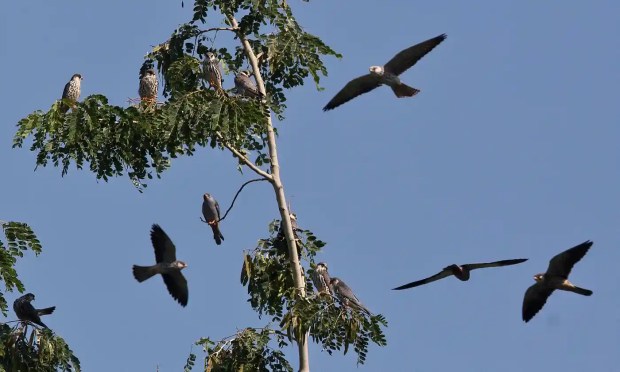
Amur Falcons are being protected in three Indian States! Nets, catapults, guns, and air guns used to harm the beautiful raptors are being banned and confiscated. This is much welcome news.

The fast decline of many species is alarming. Sharon Dunne posted this in the Albatross group and I know that many of you will find this article both interesting and disturbing. The number of birds disappearing is frightening.

Eurasian Jays are showing how intelligent they are! Birds do not go for instant gratification showing higher intelligence. Many of us can attest to the intelligence levels of birds making decisions every day as we watch them meet the challenges that humans have given them. That said, this is a good read. As I write this my own Blue Jays are on the roof of the conservatory telling me the peanuts are all gone! They do not get peanuts at the weekend so Mondays are always a flurry.
Do not forget to check nests during the off season. The Osprey nest at Mispillion Harbour in Delaware continues to amaze ‘H’ with its visitors. Bald Eagles have eaten fish on it, an immature Hen Harrier came to visit, a soaked Peregrine Falcon found the nest in a story, and today, a Turkey Vulture visited and cleaned up all the scraps. How grand. I love Turkey Vultures, and Condors, and Adjutant Storks. They are the vacuum cleaners of the natural world.
Australian Nests:
As I write this, there have been three feedings at the Port Lincoln Osprey nest. They occurred at 0634, 0717, and 0815. Big got the vast majority of the fish but, Middle did eat. Mum has had little and she flew off the nest around 0834. It is now past noon and she has not returned. Dad delivered a large flat fish to the nest at 11;44:45. Dad flew off and then returned at 120438. I thought he was going to fly off with the fish but the osplets were prey calling so loud that he stopped and tried to feed them. He could not. He has left the fish on the nest with Big and Middle to their own devices. It is quite clear that these two cannot self-feed. Yes, they can hork down a fish tail but they are not capable of feeding themselves. They have nibbled at the open edge that Dad created.
I have to admit that I have a bit of a lump in my throat. I hope that Mum is catching a fish for herself and is eating it. She has had little to eat for a couple of days. At the same time my mind goes back to the two osplets on the Finnish nest whose Mum died of Trichomoniasis (a parasite that causes lesions and impacts the bird’s ability to eat, swallow, etc. The 4th hatch at Melbourne scrape died of this last year). I am not saying this Mum has that deadly disease (if not treated) – far from it. I am just saying that it reminds me of that nest with the two osplets. One could self feed but Boris could not and had a difficult time. They both survived to fledge – their dad dropping off fish at the nest and both of them – to various degrees – successfully. But…these two cannot feed themselves, yet. So what has happened to Mum?
Dad has dropped off the fish but there is no one to feed Big or Middle. They both sniff around the fish.

Dad returns and watches his two chicks struggle. Middle is at his feet calling to be fed.

Dad decided to try and feed the two. He is not successful and leaves. — Many Osprey males feed their chicks. Some will also feed in tandem with the females when there is fear that a smaller chick will not get enough. Many of you will remember how Louis and Aila at the Loch Arkaig nests shared feeding duties in 2020 when there were three chicks with little Captain, JJ7, getting a private feeding. When this happens, everyone wins. The third hatch usually gets strong enough and time passes and it survives.


Dad returned and took the fish off the nest. This is interesting. The weather has turned really nasty. Did he take the fish off so that predators would not be attracted to the nest? or does he think they are not hungry? will he break the fish into pieces and return them? or is he as hungry as Mum and will eat the fish?
The weather has turned bad. Both Big and Middle are trying to find comfort together in the nest.


Oh, my gosh. Just about the time my heart has dropped to my little toe, Mum returns. She has the tail piece of the fish and it is 125445. Dad is there. I bet he is so happy to see her arrive! The kids are ravenous and, in particular, Middle. Let us hope he gets a good portion of this fish.

Middle got bites by doing his famous snatch and grab. This makes Big very upset if Big perceives that Middle is getting more fish than her.

Middle got a couple of bites at the beginning but he is clearly afraid of Big. It isn’t a huge piece of fish but, I am sure hoping that Middle gets some.
The key is – when Mum is feeding Big if she feeds slow he will get full sooner and there will be plenty left for Middle. You may have witnessed this happening at other nests. When she feeds Middle she has to feed him fast so he can get as much fish as possible within a short time.
Middle went to snatch and grab a bite and Big furiously attacked him. This is not good. Middle needs some food.

Middle waited – not long – til Big got situated and moved up. Mum made sure that he got some bites of fish. Not a huge amount like Big got but, Middle did get some fish. Regardless, he needs more, much more compared to Big.


Mum flew into the nest with the tail end of a fish. It should be presumed that she ate the front portion or part of it before returning to the nest. She, too, as noted many times, needs to eat. Hopefully when this bad weather system passes, more big fish will arrive. That is what this nest needs.
Big with her big crop and Middle flapping. I bet he will want off this nest as fast as his wings will carry him. Oh, I wish we could hire Ervie to teach his little brother to fish!!!!!!!!!!!! Ervie and Middle could trade stories about Big and Bazza. Maybe they could even invite Dad and sit down at the shed together leaving Mum and Big upstairs. Just imagine.

I continue to be very curious about the amount of fish that the tuna fishing fleets take out of these waters that are not tuna. What impact has this local commercial fishing had on the Ospreys?
I woke up very concerned as to whether or not Middle had any more fish at Port Lincoln. He really has not had enough to keep a sparrow alive and it is concerned. There is no way to check how he did. Perhaps some of you in Australia will know for the later time in the day as the live stream at Port Lincoln is down. It is to rain again and the winds are blowing at 31 kph.
Both of the Peregrine Falcon scraps have had at least one or more meals by the time I am writing this (1900 on the Canadian Prairies).
Indigo and Rubus are eating well. According to ‘A’ and the moderator, this is a recap so far of today’s feedings: RECAP: 4:20:36 D w/prey, eats, feeds 4:57:42; 6:42:14 X w/noisy miner, leaves with chicks; 8:36:12 D w/stubble quail/ feeds; 8:51:25 D takes NM; 9:41:51 X w/rosella, he feeds.
It is often some of the expressions that occur during these feedings that are so hilarious. Rubus just stretches and jumps to get his bites. Please note, I continue to say he/his because I really believe Rubus is a male. There are times when Indigo, who is so large and already declared a female, gets the Diamond look of seriousness in her eyes. Rubus never has that. He has long thin legs like he is trying out for a basketball team or long distance running. They are quite the characters.
Indigo, however, also gets frightened! We saw it with the Starling Head and again today when Rubus was trying to eat ‘Eggie’. My goodness. Here are some of the images from today at the scrape in Orange, enjoy.
Indigo stands and looks out the window of the scrape at the world beyond, just like Diamond.

Indigo protests loudly when Diamond shows up without breakfast!

Prey is left to see what Indigo and Rubus would do with it. It is a Noisy Miner.


That beautiful plumage is coming. You can see the peach on the feathers from various angles.


Indigo was really trying to get some more bits and bites out of Mum. But…look at that tail!


Look at Rubus’s eye. ‘What is up with you, sis?’

The stormy weather has reached Orange. There was lots of lightning and Diamond spent the night inside the scrape with Indigo and Rubus.

The Melbourne Four are eating fine. They are also losing most of that white soft down off their feathers. While we may not see the parents, one of them would normally be close by keeping an eye – perhaps up on another higher ledge. The amount of ‘ps’ and feathers tells it all!
Freshly plucked whole pigeon and consumed in a few minutes.


That is not an adult. That is one of the older eyases – I think the eldest. There is hardly any down left.


The Melbourne Four are fine.
Migration News:
In migration news, there is no word from Karl II or Kaia. They had both reached Africa. There is scant service where they winter and it is hoped that they are both enjoying themselves, feeding and replenishing their weight lost in migration. Bonus was last on the Island of Levbos. He appeared to be flying in the wrong direction but has righted himself and is back in Greece heading South. Little Waba is doing well and is in Egypt – ahead of Bonus.
Send your best wishes to all our nests including the Port Lincoln Osprey barge. Hang in there Middle. The weather will be better after Tuesday. Hoping for big fish to fall from the sky!
Thank you for being with me. Please take care everyone. See you soon!
Thank you to the following for their posts, videos, and streaming cams where I took my screen captures: The Guardian, BBC Four and Sharon Dunne, HM, Port Lincoln Ospreys, Charles Sturt Falcon Cam, and 367 Collins Street by Mirvac.


