It warmed up! Mike finished the railings and will begin the small deck extension shortly. Toby and I planted beans, tomatoes, red peppers, chives, various lettuces, and rosemary. We even managed to almost finish painting a wicker plant stand for one of the lovely chartreuse ferns. It was 17 C. Ann and Don went to the zoo, where to their delight, the peacocks were really putting on quite the show. It was what I call a ‘cracker’ of a day.
‘PB’ just sent a note about Achieva. Jill went out and caught a small fish for Big to eat alone. Then she went out again and came in with a big catfish for both her and Little. She is a brilliant dedicated Mum!
I love the fact that these two osprey are so bonded that they remain together despite having no eggs but protecting their territory and nest for next year! It’s called ‘hope’ and we all could use a good dose of it right now!
Sadly, Flora’s Harry has not been seen at the Alyth Substation osprey platform since Saturday. Flora had to go and find food, and when she left their eggs, the Corvids came and ate them. It is a blessing. There are no chicks to starve, and Flora can have a summer building up her strength. Harry was very special and is a huge loss.
Blue KL5 has not returned to the Loch Garten nest for many days. He is also presumed to be lost like Harry. It has been a rough year in the UK osprey world, much different than in previous years when couples were secure and chicks hatched and fledged in a normal calm manner.
Heidi reports on the saddness coming out of Mispillion Harbour osprey platform.
There is cuteness at the nest of Dylan and Seren – and what a bright spot these little osplets are that are hatching!
So cute – turn around you silly!!!!!!!! Manton Bay with Blue 33 and Maya.
Iris had a little visitor from one of the nests inside her nest!
Have you been wonderfing about the female at the Glen-Hayes nest?
We have a fledge/fludge at Johnson City ETSU.
Have you noticed that Monty and Hartley raise the most energetic chicks?!!!!!!!! Always getting into mischief. SK Hideaways gives us some of their latest antics in this video: https://youtu.be/GhKpFR5-4Ao?
Lady and Dad have been regularly coming to the nest tree in the Sydney Olympic Park.
Hatch watch for Richmond and Wendy.
Gracie Shepherd shows us the latest on the fires on Santa Rosa Island where there are eagle nests with babies!
What a cutie that hatched for Dylan and Seren yesterday with another nice pip in the second egg!
Prey becomes comfy pillows at Big Red and Arthur’s nest in New York.
Aerating the eggs at Pitkin County in Colorado.
Ann loves peacocks and this article just popped up in The Guardian!
It’s raining. The sky is grey and it is cooling off. Hoping for warm weather tomorrow! Take care everyone. We will see you again soon.
Thank you to everyone for their contributions – videos, informative posts and messages with images, authors of FB posts and the owners of the streaming cams that allow us these screen captures and a view into the life of these families.
As promised, I am including a review of the latest children’s book on ospreys by Connie Dennis from Nova Scotia, Canada. Calico and I have read it several times since its arrival last week and Calico gives the book her Golden Paw Award! The cover below gives you a good idea of the quality of the images and the other page shows the great layout.
I am going on a little holiday to Toronto from Wednesday evening through Saturday. I will take you to some of the City’s parks where I will be ‘birding’. The blog will be much shorter on Thursday than usual – I arrive in Toronto late, late Wednesday night. However, we will have Heidi’s reports, Geemeff’s, and a few nests Thursday morning! Things will be back to usual Sunday. In the meantime, I hope you enjoy my little excursion.
BOOK REVIEW:
Connie Dennis and her husband, Don, are more than just residents of Nova Scotia. They are privileged observers of the lives of the Osprey couple, Ethel and Oscar. Their home provides a front-row seat to the incredible fish-eating raptors, and they have used this unique perspective to create Pickles the Osprey. An Osprey’s Journey in Nova Scotia. This children’s book is beautifully illustrated with Don’s photographs, offers a rare glimpse into the life of these majestic birds, a perspective that only Connie and Don could provide.
Pickles the Osprey is a delightful book. It has Calico’s seal of approval, which is very hard to earn! Pickles gives us a first-hand view of his life as an osplet in a nest in Nova Scotia. He introduces us to his parents, who work hard to provide their chicks with a nice nest and fish. We learn what kind of fish ospreys consume in Nova Scotia, which differs from fish hawks in other parts of the world. Connie provides useful scientific facts in a manner that is not dull to young people. She also peppers the story with ‘Fun Facts’ alongside the humour of Pickles. Children will learn about the unique talons of the osprey that allow them to grasp fish and carry them back to the nest. They will learn about fledging and migration. In addition, Dennis brings up one of the main challenges of our raptors – hydro poles. The couple worked tirelessly to ensure the ospreys in Nova Scotia were safe. They have provided images of the help that Nova Scotia Power has given to the raptors such as Oscar and Ethel.
The book has stunning close-up images of Pickle’s nest and great graphics. Included are photos of Canadian currency with ospreys and some fun photoshopping with Pickles sharing a meal of fish tacos with his parents after migration. I had no idea that ospreys appeared on our paper currency! And I did not know that Ospreys are the provincial bird of Nova Scotia. This proves that there is always something for us to learn. Grandparents, parents, and teachers will find this an excellent resource to help young people understand the life cycle and the challenges that ospreys face in a contemporary world—highly recommended!
All profits from the sale of Pickles the Osprey: An Osprey’s Journey in Nova Scotia go to Hope for Wildlife. Connie will also sign and mail copies anywhere. This way, ALL profits go to Hope for Wildlife. The address for ordering is below. Copies can also be obtained from Amazon and Indigo.
For slightly older youngsters, I highly recommend Belle’s Journey. An Osprey Takes Flight by Rob Bierregaard and Kate Garchinsky. This book gives you an excellent glimpse at osprey migration using a GPS satellite-tagged bird and twenty years of research into bird migration. Belle takes her first flight from the nest and travels down the coast of the United States all the way to South America. Through her trials and tribulations, we learn about the great challenges and why so many do not last the journey. It is another Calico favourite, and Heidi tells me it suits adults, too.
It remains hot with no break in sight for some of our Pacific Northwest nests. Let’s check and see how a few of them are doing:
At Charlo Montana, Lola’s posture says it all.
It is much nicer for the ospreys in the early morning and evening. Iris is hot like Lola and keeping her babies cool. These poor females.
Iris doesn’t know but Finn has a big fish coming in if he doesn’t lose it!
Finn ate on the fish for nearly an hour and delivered a huge headless piece to Iris. She is delighted as are the chicks.
‘PB’ sent me the Owl cam view of this feeding!
Dunrovin. It is hot there for Swoop and Winnie.
At McEuen Park, Mm continues to try to keep her only surviving baby safe and fed as best she can. She often alerts that intruders are near. Did they harm her mate? Will they try a nest takeover?
Cowlitz PUD: The one remaining osplet, not taken by the eagle, is getting to be a fair size. Maybe the eagle will give up. That would be wonderful for Electra. It started out promising until the heat hit the nest and the eagle. Take a breath.
Steelscape:
The Only Bob at Minnesota Landscape Arboretum continues to appear to be thriving.
Expecting fledges at Field Farm any time!
Hoping Beaumont and Hope keep up the good work with their two osplets. Knocking on wood!
For those birds in the area where Menhaden is their main source of food – and it is being scooped up by the millions of pounds, let’s stop this.
Bailey isn’t the only raptor donating blood. Connick did and saved a Red-tailed Hawk. Thanks, ‘J’!
A great Osprey rescue.
Geemeff’s Daily Summary for Loch Arkaig and The Woodland Trust:
Daily summary Tuesday 16th July 2024
A slow day today, no fish arrived on the nest but Louis did bring a very impressive ten foot pole, and spent some time positioning it on the nest and doing some nest-scraping. Despite Dorcha calling loud and long for fish, he decided to attempt mounting her but a wayward breeze put paid to that by blowing him away. LizB says: The mating attempts, along with coy mantling, skydancing, nest scraping and bringing in nesting materials are all normal bonding behaviours to reinforce their bond after what they see as a nest failure following the loss of their chicks. No Ospreys visited Nest One, just a Thrush visited and perched for a few moments. The light rain and light winds of tonight’s forecast were already in evidence when night cam switched over much earlier than usual, and thundery showers are expected tomorrow.
Night cam switches on (day cam): Nest One 23.24.45 (03.27.14); Nest Two 23.10.47 (03.40.54)
7/16 Osoyoos osprey nest: The live stream was offline until 0930, so we may have missed a couple of Olsen’s early fish deliveries. It was another very hot day, with a temperature of 102F/39C at 1600. We did not see a fish delivery until 1759, and it was a very large whole fish brought by Soo. After such a long time without a meal, I was concerned that there might be some aggression, but there wasn’t. It was a peaceful, 41 minute feeding, and Soo and her two remaining chicks had a nice meal. At 2113, Olsen dropped off a small partial fish, and there was some slight intimidation from Big toward Middle. This feeding lasted for 7-minutes, and Middle was able to eat during the last 2 minutes. Weather for 7/17: Partly cloudy, high 99F/37C, light winds.
7/16 Audubon Boathouse osprey nest: As you know, Dory and Skiff’s two young chicks were killed by a Great Horned Owl in the early morning hours. There was some light rain in the evening. Dory dropped down from the perch and tried to cover her chicks’ bodies to protect them from the rain. In 2022 Dory and Skiff fledged three chicks. They have had 6 chicks over three seasons, and half of them were predated by a GHO.
7/16 Mispillion Harbor osprey nest: Della and Warren have done a wonderful job raising their two 49 and 50-day-old chicks. The chicks have both been doing some major wingercising. They have not achieved any significant lift as yet, but it won’t be long!
7/16 Chesapeake Bay Foundation osprey nest (Annapolis): This is a cam without rewind. Three eggs were laid, and three hatched. The two youngest nestlings died within days of hatching. The oldest chick seems to be doing very well, and is estimated to be 37 days old.
7/16 Patuxent River Park osprey nest: It is still difficult for Little to acquire food because of his aggressive fledgling sibs. Mom doesn’t even get enough to eat. It has been extremely hot at the nest area (101F on Tuesday), and the fish count to the nest has dropped. Little’s only meal of the day was at 0515 from a large leftover fish, but it was a good, long feeding from Mom. For the first time, Little was performing some high hovers that were completely out of our sight. I think the kid may be ready to fly…but he needs a good meal first.
7/16 Colonial Beach osprey nest: This area reached at least 97 degrees today. Once again, there were only three fish brought to the nest. The chicks are 21 and 22 days old. Chick #1, Big, has just started to become aggressive during meals over the past couple of days. At 0720 David dropped off a large flatfish, and Big prevented Little from eating during the meal. David delivered another large fish at 0900, and Little was finally able to eat for about 5-minutes at the end of the meal. More than 8 hours passed, and finally Betty arrived with a medium sized fish. Due to aggression by Big, Little was only able to eat two bites of fish and the fish tail. I am worried for Little.
Sweet Baby Blue at the HWF-BBC Central Nest in British Columbia. I am so glad that you have been enjoying seeing the fish pieces fly to the nest! They all deserve our help.
Kristel had a Raven and, consequently, a huge crop on the 15th. Kristel was 10 weeks old. She is waiting for more prey deliveries this morning.
Cute little Dorsett Hobby Mum is learning!
Mr Crow would like you to learn more about Crows so that you will consider feeding them! Just as the creator of the video states – the Crows know our car! And there is nothing shy about them when it comes to telling us their food trays are empty. Just like all the other birds living in an urban environment, their habitat is being destroyed as I wrote and there are little food choices for them. Please help if you can. You will be rewarded much more than you give.
Thank you for being with us. Take care everyone. See you soon.
Thank you to the following for their streaming cams, videos, images, screen captures, posts, comments, and letters: ‘Geemeff, H, J, PB’, Connie Dennis, Don Dennis, Morning Dove Press, Charlo Montana, Montana Osprey Project, McEuen Park, Dunrovin Ranch, Cowlitz PUD, Pam Breci, MN LA, Field Farm, Newfoundland Power, Lesley the Bird Nerd, SK Hideaways, Hancock Wildlife Foundation, Eagle Club of Estonia, Looduskalender, Osoyoos, Audubon Boathouse, Mispillion Harbour, Chesapeake Bay Foundation, Patuxent River Park, by Rob Bierregaard and Kate Garchinskyand Colonial Beach.
I hope that each of you had a joyful weekend and your start to the week is showing promise.
Most Canadians are obsessed with the weather. We are also slightly superstitious. OK. Many of us are highly skeptical if it is too nice late into the fall. We fear that we will pay for it by having 5 months of -35 C with lots of deep snow. So everyone that was out today – again – in their shirt sleeves and runners with no socks hopes that there won’t be ‘a winter retaliation.’ It is seriously hard to believe. Families were having picnics! Some brought their lawn chairs to sit by the edge of the pond and take in the sun’s rays. One of the biggest delights was the fact that almost everyone said ‘hello’ to one another. Being outside really does make us happier!
The number of waterfowl is dwindling at all the city parks, however. Less than the people! Duck and geese counts today at our St Vital Park were 350+ Canada Geese, 7 Mallards, 5 Wood Ducks and 3 Ring-billed Gulls.
My photos are not the greatest. The light was ‘odd’ but, I did notice how clear the water is today compared to earlier in the year. I also noticed that the parks personnel (or a fairy) has cleared the island, the water, and the shore of human litter. It is nice!
The male Wood Duck blends in so nicely with the colour of the pond and the leaves.
So many were flapping their wings today in the water. It is impossible to see the face but I love the light going through the primaries of the wing.
Oh, these sweet little female Wood Ducks. They are so tiny and so adorable.
Notice how the plumage of the female Mallard is such good camouflage in the fall when all of those hunters are trying to lure them to the marshes and wetlands to shoot them. Oh, goodness. I have an immediate knee jerk reaction just thinking about it.
Every year Canada Geese replace all of their worn out feathers at once – this means that when they are molting they cannot fly at all. It also accounts for all of the feathers around the park in the summer. It is quite odd seeing them without any tail feathers. Canada Geese are not the only ones to do a complete moult. Townsend Warblers, after the breeding season is over but before the southern migration also replace all of their feathers.
Audubon has a short and to the point article on the basics of feather replacement if you are curious:
The water is low. The torrential spring rains flooded the island ruining all of the nests and the eggs. Many had second clutches but a large number of the ducks and geese moved northward away from the pond. You can see on the bottom of the totem pole how high those waters rose.
There were some late hatched Mallards. I could see 2 small ones today and I do not know what happened to the others. I did find my images from a few weeks ago of the two female Mallards with ‘Angel Wing’. They can swim and feed but they will never be free to fly. It was simply pure sadness that could have been avoided. The two were taken to the wildlife rehabilitation centre. They had to be euthanized. The cause is nutrient deficiency from feeding ducks bread.
Please feel free to use my picture of this beautiful creature whose life was cut short because she preferred eating bread instead of the pond plants. Ducks do not know bread is not healthy. It is junk food and it tastes good to them just like candy and chips taste good to humans.
Most people want to be good to the ducks and geese. They have no intention of harming them – they are feeding them to be kind. ‘Killing with Kindness’ – should be the next campaign slogan at the park ponds.
There were so many people walking yesterday at the pond. It was fantastic to see – young and old. There are many trails of varying lengths, some through the forest and others around the pond or the cricket pitch.
The Guardian had an interesting article on walking. Please read it. So many people I know think that unless they walk that magical 10,000 steps a day there is no benefit to them. This article points out that the use of that number was not medically driven but was part of a marketing campaign. Recent research has shown that 10 minutes of brisk walking a day is very beneficial. So forget all the fancy gadgets that you think you might need and just get moving! And if you can walk in an area where there are trees – and even better animals and birds – any stress that is sitting on your shoulders dissipates. The author of the article agrees:
“But as the contemporary American philosopher, Arnold Berleant, argues, it is when we’re actually moving through a landscape, rather than treating it simply as scenery, that we most fully connect with a place and ignite all our senses. Berleant uses the term “aesthetic engagement”, but it needn’t be quite so lofty: A walk along the river might count, or perhaps time spent practising shinrin-yoku (forest bathing), really attending to the details of the trees, the leaves, the smells and the sounds.’
Nature does cure our ills. It can be a profound sea change to our lives. Sit in the sand and listen to the ocean and the gulls. Close your eyes in a soccer field and absorb the honks of the geese flying overhead. It is very healing. And I want all of you (and myself) to live long and well with our feathered friends. If everyone understood how powerful walking in a forest and listening to birds can be in terms of changing our lives for the good, would we be so quick to cut down the trees with nests of the Bald Eagles, bulldoze another 64 acres of good agricultural or forest for houses that are big enough for 10 families but hold only a single couple?
Well, I know that I am on my soapbox and ‘preaching to the choir’ because anyone reading my blog loves all of the birds – from the tiniest hummingbird to the largest raptor and all in between. We know they make us happy and heal our souls. We just need to spread the word!
Responses to the Alphabet Fun Game – make a list of the Alphabet and put the name of a bird from a streaming cam by as many letters as you can – are starting to come in. Thank you! I hope it was great fun! Remember to get yours in by midnight 2 November Central Time. Email is: maryasteggles@outlook.com
Making News:
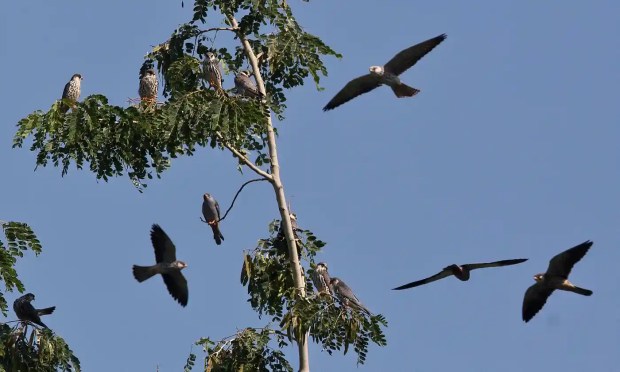
Amur Falcons are being protected in three Indian States! Nets, catapults, guns, and air guns used to harm the beautiful raptors are being banned and confiscated. This is much welcome news.
The fast decline of many species is alarming. Sharon Dunne posted this in the Albatross group and I know that many of you will find this article both interesting and disturbing. The number of birds disappearing is frightening.
Eurasian Jays are showing how intelligent they are! Birds do not go for instant gratification showing higher intelligence. Many of us can attest to the intelligence levels of birds making decisions every day as we watch them meet the challenges that humans have given them. That said, this is a good read. As I write this my own Blue Jays are on the roof of the conservatory telling me the peanuts are all gone! They do not get peanuts at the weekend so Mondays are always a flurry.
Do not forget to check nests during the off season. The Osprey nest at Mispillion Harbour in Delaware continues to amaze ‘H’ with its visitors. Bald Eagles have eaten fish on it, an immature Hen Harrier came to visit, a soaked Peregrine Falcon found the nest in a story, and today, a Turkey Vulture visited and cleaned up all the scraps. How grand. I love Turkey Vultures, and Condors, and Adjutant Storks. They are the vacuum cleaners of the natural world.
As I write this, there have been three feedings at the Port Lincoln Osprey nest. They occurred at 0634, 0717, and 0815. Big got the vast majority of the fish but, Middle did eat. Mum has had little and she flew off the nest around 0834. It is now past noon and she has not returned. Dad delivered a large flat fish to the nest at 11;44:45. Dad flew off and then returned at 120438. I thought he was going to fly off with the fish but the osplets were prey calling so loud that he stopped and tried to feed them. He could not. He has left the fish on the nest with Big and Middle to their own devices. It is quite clear that these two cannot self-feed. Yes, they can hork down a fish tail but they are not capable of feeding themselves. They have nibbled at the open edge that Dad created.
I have to admit that I have a bit of a lump in my throat. I hope that Mum is catching a fish for herself and is eating it. She has had little to eat for a couple of days. At the same time my mind goes back to the two osplets on the Finnish nest whose Mum died of Trichomoniasis (a parasite that causes lesions and impacts the bird’s ability to eat, swallow, etc. The 4th hatch at Melbourne scrape died of this last year). I am not saying this Mum has that deadly disease (if not treated) – far from it. I am just saying that it reminds me of that nest with the two osplets. One could self feed but Boris could not and had a difficult time. They both survived to fledge – their dad dropping off fish at the nest and both of them – to various degrees – successfully. But…these two cannot feed themselves, yet. So what has happened to Mum?
Dad has dropped off the fish but there is no one to feed Big or Middle. They both sniff around the fish.
Dad returns and watches his two chicks struggle. Middle is at his feet calling to be fed.
Dad decided to try and feed the two. He is not successful and leaves. — Many Osprey males feed their chicks. Some will also feed in tandem with the females when there is fear that a smaller chick will not get enough. Many of you will remember how Louis and Aila at the Loch Arkaig nests shared feeding duties in 2020 when there were three chicks with little Captain, JJ7, getting a private feeding. When this happens, everyone wins. The third hatch usually gets strong enough and time passes and it survives.
Dad returned and took the fish off the nest. This is interesting. The weather has turned really nasty. Did he take the fish off so that predators would not be attracted to the nest? or does he think they are not hungry? will he break the fish into pieces and return them? or is he as hungry as Mum and will eat the fish?
The weather has turned bad. Both Big and Middle are trying to find comfort together in the nest.
Oh, my gosh. Just about the time my heart has dropped to my little toe, Mum returns. She has the tail piece of the fish and it is 125445. Dad is there. I bet he is so happy to see her arrive! The kids are ravenous and, in particular, Middle. Let us hope he gets a good portion of this fish.
Middle got bites by doing his famous snatch and grab. This makes Big very upset if Big perceives that Middle is getting more fish than her.
Middle got a couple of bites at the beginning but he is clearly afraid of Big. It isn’t a huge piece of fish but, I am sure hoping that Middle gets some.
The key is – when Mum is feeding Big if she feeds slow he will get full sooner and there will be plenty left for Middle. You may have witnessed this happening at other nests. When she feeds Middle she has to feed him fast so he can get as much fish as possible within a short time.
Middle went to snatch and grab a bite and Big furiously attacked him. This is not good. Middle needs some food.
Middle waited – not long – til Big got situated and moved up. Mum made sure that he got some bites of fish. Not a huge amount like Big got but, Middle did get some fish. Regardless, he needs more, much more compared to Big.
Mum flew into the nest with the tail end of a fish. It should be presumed that she ate the front portion or part of it before returning to the nest. She, too, as noted many times, needs to eat. Hopefully when this bad weather system passes, more big fish will arrive. That is what this nest needs.
Big with her big crop and Middle flapping. I bet he will want off this nest as fast as his wings will carry him. Oh, I wish we could hire Ervie to teach his little brother to fish!!!!!!!!!!!! Ervie and Middle could trade stories about Big and Bazza. Maybe they could even invite Dad and sit down at the shed together leaving Mum and Big upstairs. Just imagine.
I continue to be very curious about the amount of fish that the tuna fishing fleets take out of these waters that are not tuna. What impact has this local commercial fishing had on the Ospreys?
I woke up very concerned as to whether or not Middle had any more fish at Port Lincoln. He really has not had enough to keep a sparrow alive and it is concerned. There is no way to check how he did. Perhaps some of you in Australia will know for the later time in the day as the live stream at Port Lincoln is down. It is to rain again and the winds are blowing at 31 kph.
Both of the Peregrine Falcon scraps have had at least one or more meals by the time I am writing this (1900 on the Canadian Prairies).
Indigo and Rubus are eating well. According to ‘A’ and the moderator, this is a recap so far of today’s feedings: RECAP: 4:20:36 D w/prey, eats, feeds 4:57:42; 6:42:14 X w/noisy miner, leaves with chicks; 8:36:12 D w/stubble quail/ feeds; 8:51:25 D takes NM; 9:41:51 X w/rosella, he feeds.
It is often some of the expressions that occur during these feedings that are so hilarious. Rubus just stretches and jumps to get his bites. Please note, I continue to say he/his because I really believe Rubus is a male. There are times when Indigo, who is so large and already declared a female, gets the Diamond look of seriousness in her eyes. Rubus never has that. He has long thin legs like he is trying out for a basketball team or long distance running. They are quite the characters.
Indigo, however, also gets frightened! We saw it with the Starling Head and again today when Rubus was trying to eat ‘Eggie’. My goodness. Here are some of the images from today at the scrape in Orange, enjoy.
Indigo stands and looks out the window of the scrape at the world beyond, just like Diamond.
Indigo protests loudly when Diamond shows up without breakfast!
Prey is left to see what Indigo and Rubus would do with it. It is a Noisy Miner.
That beautiful plumage is coming. You can see the peach on the feathers from various angles.
Indigo was really trying to get some more bits and bites out of Mum. But…look at that tail!
Look at Rubus’s eye. ‘What is up with you, sis?’
The stormy weather has reached Orange. There was lots of lightning and Diamond spent the night inside the scrape with Indigo and Rubus.
The Melbourne Four are eating fine. They are also losing most of that white soft down off their feathers. While we may not see the parents, one of them would normally be close by keeping an eye – perhaps up on another higher ledge. The amount of ‘ps’ and feathers tells it all!
Freshly plucked whole pigeon and consumed in a few minutes.
That is not an adult. That is one of the older eyases – I think the eldest. There is hardly any down left.
The Melbourne Four are fine.
Migration News:
In migration news, there is no word from Karl II or Kaia. They had both reached Africa. There is scant service where they winter and it is hoped that they are both enjoying themselves, feeding and replenishing their weight lost in migration. Bonus was last on the Island of Levbos. He appeared to be flying in the wrong direction but has righted himself and is back in Greece heading South. Little Waba is doing well and is in Egypt – ahead of Bonus.
Send your best wishes to all our nests including the Port Lincoln Osprey barge. Hang in there Middle. The weather will be better after Tuesday. Hoping for big fish to fall from the sky!
Thank you for being with me. Please take care everyone. See you soon!
Thank you to the following for their posts, videos, and streaming cams where I took my screen captures: The Guardian, BBC Four and Sharon Dunne, HM, Port Lincoln Ospreys, Charles Sturt Falcon Cam, and 367 Collins Street by Mirvac.
It is 16 degrees C. The sky on the Canadian Prairies is mostly cloudy. While the Blue Jays and Crows remain and the squirrels continue their feverish collection of nuts for their winter cache, it appears that most of the Dark-Eyed Juncos have departed. Oh, I will miss them flitting about with that touch of white on their tails as they move. There are still some Canada Geese in the City feeding on the grass and, tomorrow, I hope to get out to count geese and ducks. It didn’t work for today but, tomorrow should prove to be another light-jacket day. How grand!
In the Mailbox:
‘H’ asks: Do falcons hunt at night?
The answer is yes! This may be particularly true for urban falcons. Most observers of falcon streaming cams were first introduced to the night hunting with Alden, the new mate of Annie at the U-California Berkeley Campanile scrape box. It was thought that Alden used the light of the city to help him hunt for prey. It was also noted that the smaller birds that the falcons feed on are active in the dark and it would make it easier for Alden with the challenge of one of his legs. Sean Peterson also believes that it is safer for Alden to hunt at night, away from the eyes of other large predators (save for owls). This breeding season we have seen M22 bring prey in before dawn at the 367 Collins Street scrape.
From the Bookshelf:
I took Helen Armitage’s Lady of the Loch with me to several appointments this morning to read while I was waiting. I am going to go back and put a highly recommended star by this small packed volume. If you want to learn about nesting behaviour, this is an excellent read. If you want to learn about some of the myths about Ospreys that were debunked by Lady, it is a good read. At the time, scientists believed that Osprey females could only lay a total of 20 eggs! Lady laid more than 58!!!!!!!!!!!!!
Making Waves:
The floofs from the 367 Collins Street scrape have moved!!!!!!!!!!!!!! With the smallest one capable of stomping (‘A’s word and a sound she loves to hear) up and down the gutter, the Melbourne Four have packed up their bags and headed to the scrape at the other end of the ledge. This scrape is protected from rain and from the sun. They will no longer wonder if they are being roasted. Of course, we will have to rely on sounds and it would seem from yesterday that feedings also took place at that end of the building’s ledge. In the past there was great reluctance to move the camera during the breeding season. This is why, I believe, that Mirvac will be installing a second camera so that we can enjoy the eyases wherever they are until they fledge.
Of course, that does not help us observe them now but the policy has been very clear. The falcons will not be disturbed in order to change the camera for public viewing. That would go against all of the State wildlife laws.
So, at present, let us hope that those little fluff balls run back and forth to get their legs strong!
At 0606 you could hear kew-kew-kew coming from the ledge. The eyases were obviously enjoying their breakfast.
Nest News:
Deb Steyck made a video of Harriet and M15 working on their nest yesterday. Enjoy!
‘H’ caught the pair of Bald Eagles on the Mispillion Harbour Osprey nest again! This time they are removing a nice big stick. Replenishing their own nest for breeding season? I had no idea until ‘H’ told me that some of the Bald Eagles stay in Delaware, on the coast, for the winter. I know that we have one couple in our City and a single male downtown that stay year round. It has to do with food availability not necessarily weather.
Thanks ‘H’.
It was good to see that Middle had some of the late fish. I was extremely impressed when Big moved away from eating and Mum waited, watched, and then physically moved the fish over to Middle and fed him. This meant that Middle did not have to walk up to the fish and have Big turn around and beak him again. Middle had already been subjected to many attacks yesterday. I wonder what today will hold for our osprey nest on a barge in the marina at Port Lincoln?
Yesterday, it was very interesting watching Rubus and Indigo at the scrape in the water tower at Orange. I don’t know if it is just me or if it is the timing of the Starling deliveries, but these two eyases seem to much prefer Crimson Rosella’s, Rainbow Lorikeets, and ducklings compared to Starlings — like their mother, Diamond.
Diamond was up and out of the scrape at 060657. The day is waking up at Orange. Rise and Shine Rubus! Serenade us with your very loud voice.
Rubus and Indiigo had a leftover breakfast at 070557. Then…
Xavier arrives with a King Parrot at 074247. Rubus and Indigo are delighted!
Look at Rubus. Isn’t Dad going to feed us this morning? Xavier is a wonderful feeder. Maybe later, little Rubus.
Big is known to usually wake up in a good mood at Port Lincoln. That mood seems to change later. I am hoping that the whooper of a fish that came in at 064931 will just keep Big happy. Maybe Dad will find another one. he ate the head – Dad has to be as hungry as Mum at times. Keep them coming!
It is almost impossible to see who is eating until around 0717 when you can see Middle gets bites. I cannot tell you who got the most of that fish with confidence. I hope that Mum was able to feed them rather equally with some for herself.
Mum is beautiful and so are the two osplets. Just look. Little angels. Oh, I hope it stays that way from now on. Middle is closest to us. The black line on the top of its head is smaller. What a beautiful beard, Middle.
Middle looks like it has a crop forming. You can certainly see Big’s crop! Oh, I hope this nest has a good day today.
Oh, wish for fish for Port Lincoln!
Thanks for joining me today. Take care everyone. See you soon!
Thank you to the following for their videos, their posts and their streaming cams where I took my screen captures: Deb Steyck and SWFlorida Eagles, ‘H’ and Mispillion Harbour Osprey Cam, 367 Collins Street by Mirvac, Port Lincoln Ospreys, and Charles Sturt Falcon Cam and Cilla Kinross.