Eagle Season is coming!

It is almost Bald Eagle breeding season in some parts of the United States. as more and more people and governmental agencies focus on the environment, there are studies from around the world trying to make wind farms more safe for our beautiful raptors.

The University of Minnesota has been doing just that. They discovered some interesting things when trying to use sound —– Bald Eagles just have normal hearing, nothing special. So as many begin talking about floating platforms in the ocean to generate renewable power, what can help the birds?

https://www.startribune.com/university-of-minnesota-researchers-protect-eagles-wind-farms-airspace/600100175/?fbclid=IwAR1ctzmnP07P3o5wb8IKkL0j35KkO33jluna8B38ge4CnZm2J-DTiqvhpeI

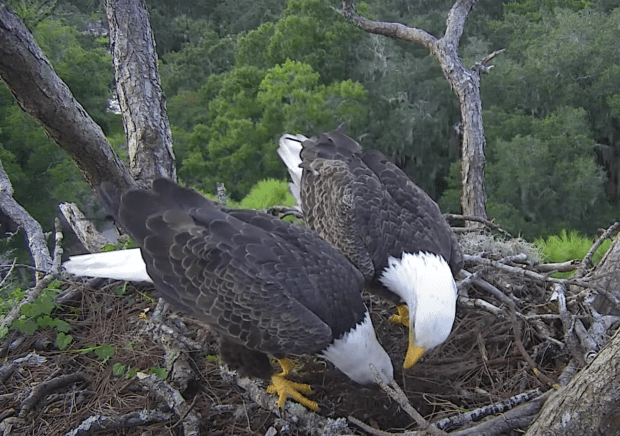
The sun is just rising over the Northeast Florida Bald Eagle nest near Jacksonville, Florida. It is the home of Samson and Gabrielle (Gabby). This is their third season together. They have hatched Romy and Jules (2020) and Legacy (2021).

If you have forgotten, this is the nest that Samson hatched at. It belonged to his parents, Romeo and Juliet. Tragedy struck the pair in 2019. The story and video of it is here:

This is the beginning of the 2021-22 season. It is a new day with wonderful prospects for the fall and spring! I so look forward to their little ones. Legacy pulled at all my heart strings as she did thousands of others. What a grand juvenile she grew into. So, lots to look forward to.

Samson and Gabby had spent the night on the branches of the natal tree. It is just turning 07:00 and Samson is fishing. Gabby is down working on the walls of the nest getting it ready.

She looks all over trying to decide what to move and where the new branches should go. Typically, the male brings in the branches and the female positions them.

It will not be long til Gabby has this nest worked into her liking. It is high up on a pine tree and everything has to be perfect to protect the eggs and the eaglets.

She waits for Samson to arrive. You will notice that he has brought a big stick onto the nest. Now he has left again.

Now he is back! They are having a conversation about what to do during the day.

I have to admit that I really enjoy this Bald Eagle nest near Jacksonville. Legacy was just a joy last year as she navigated life with ‘Eggie’ and ‘Pinecone’ as an only child. Here is the link to their streaming cam 1 (they have 3):

There are two other streaming cams to watch and both couples have arrived. One of the most famous is the nest of Harriet and M15 on the land of the Pritchett Family in Fort Myers. Both eagles have returned to the nest and have been seen working on it.

The third is the Captiva Eagle Nest on Santibel Island. It is the home of Connie and her new mate, Martin. Both have arrived at the nest this afternoon. One was seen earlier in the day.

Last year, the two eaglets named Peace and Hope died of rodenticide poisoning. The male Joe – well, I would argue that he reacted the same way that Romeo did when he could not care for the eaglets in 2018-19 – and well, Joe is gone.

Let us hope that Connie and her new mate have a fabulous year and that the folks using these designer poisons have stopped and cleaned up the area for these beautiful birds.

There are so many Bald Eagle nests it is hard to keep up with them. At the same time, there are the beautiful White-tailed and Golden Eagles in Europe. The Latvian Fund for Nature runs a host of eagle cams and I will be bringing you information as it becomes relevant. I am hoping that Matilde will have a new mate and that this will be successful! Spring is going to be busy!

The female at the Port Lincoln Osprey Nest is yelling to Dad to get a fish on the deck for the osplets!

Last year he seemed to ignore her but this year Dad has been, for the most part, on the ball. Sometimes he has to come to the nest to get his earful orders but then he goes fishing. Let us keep our fingers crossed for a very large fish like the one delivered yesterday. These kids are growing and they need more bigger fish. Less feedings but a lot of fish.

It is now 08:30 at the White-Bellied Sea Eagle Nest in Sydney’s Olympic Forest and WBSE 27 and 28 are waiting for a breakfast delivery, too.

This pair have done well this year. WBSE 27 has the darker head at the back with 28 here at the front. Both are healthy and there are no obvious physical difficulties like 26 had last year.

The problem that they do have are feathers and the two are constantly preening.

Both can stand and walk well.

Here they are watching for the parents to make a delivery! Waiting must be very hard when you are hungry. How dependent these birds are on the good health of their parents, too.

Food deliveries will be coming. The nestlings wait at both Port Lincoln and Sydney.

Thanks for joining me. I will bring you an update on the PLO nest first thing tomorrow. Take care everyone.

Thank you to the following for their streaming cams where I took my screen shots: The NE Florida Cam and the AEF, Captiva and the AEF, Port Lincoln Osprey Project, Sea Eagles @ Birdlife Australia Discovery Centre.

Godwits…and more

I have heard the name but have never seen the bird – or, at least, I do not think I have. With my lousy shorebird IDs, I might have even confused this beautiful long-legged shorebird with a Greater Yellowlegs. Of course, everyone would have laughed.

Godwits are ‘very’ long legged shorebirds but their legs are not yellow! Their beak is ‘very, very’ long and is bi-coloured – light rose and espresso -and ever so slightly upturned at the end. They are called waders because they live in the mudflats and the estuaries. See how their legs go deep into the mud, too. They feed by sticking that very long beak into the mud, rooting around for worms and small shellfish.

“Bar-tailed Godwit” by naturalengland is licensed under CC BY-NC-ND 2.0

The breeding adults have a chest that ranges from a deep terracotta for the males to a brighter orange for the females. The wing and back feathers are more brown and white overall with a touch of the breast colour, sometimes. They have gorgeous dark eyes.

“Bar-tailed Godwit” by 0ystercatcher is licensed under CC BY-NC-SA 2.0

The juveniles have a cream coloured breast with overall brown and white feathering.

“Bar-tailed Godwit” by 0ystercatcher is licensed under CC BY-NC-SA 2.0

What is so miraculous about these shorebirds is their migration. They breed in Alaska and fly in September to New Zealand! They make only one stop, normally. And they do the trip in record time. It is an 11,265 kilometre journey or 7000 miles. They accomplish this in eight days! Yes, you read that correctly, eight days.

“Bar-tailed Godwits” by naturalengland is licensed under CC BY-NC-ND 2.0

Neils Warnock, the Executive Director of Alaska Audubon in 2017, remarked,These godwits are epic migrants. We had a bird, E-7, that we had tagged, and she left New Zealand in the spring. She flies non-stop seven days, ten thousand kilometres, to the Yellow Sea. All of the Bar-tailed Godwits of Alaska, they stop at the Yellow Sea.”

The Yellow Sea is located between mainland People’s Republic of China and the Korean Peninsula.

Historically the mudflats of the Yellow-Sea have been rich with food for the Bar-tail Godwits so they can fatten up and make the rest of the journey to their winter homes in New Zealand without having to stop. Today, the mudflats of the Yellow Sea are under threat – they are disappearing with coastal development. This could prove to be a major challenge for these beautiful shorebirds. There have been many studies and the researchers have seen a drop in the number of shorebirds by 30% in the last few years because the mudflat areas have been reduced by 65%.

https://www.science.org/news/2017/04/migrating-shorebirds-danger-due-disappearing-mudflats

The reports of the shrinkage of the mudflats has been coming in since 2013 with alarms sounding.

Today the Pukorokoro Miranda Shorebird Centre in New Zealand reported that Bar-tailed Godwit 4BYWW made his flight in 8 days and 12 hours arriving home at 03:00 on 26 September. He flew 12,200 km. His average speed was 59kph. 4BYWW may have set a new distance record for the Bar-tail Godwits. We will know when the others return home. Isn’t that amazing?

What I found most interesting was her route. She does not appear to have gone via the Yellow Sea. Is this because of the decline of the mud flats? Have the birds adapted their migratory route? I definitely want to look at this more closely.

This was the satellite tracking image posted by the Pukorokoro Miranda Shorebird Centre FB page:

The Centre was tracking another four adults and 3 juveniles on their journeys home. One of those, 4BWWB, has been reported as flying non-stop for 163 hours and over 10,000 km. Seriously, my head can’t comprehend what that must be like. I am also truly amazed at what these sat-paks can tell us about the birds and their amazing resilience. Just incredible.

Tiaki officially fledged on the 25th of September. The Royal Albatross cam chick of 2021 is foraging off the coast of New Zealand at the present time. She will eventually make her way to the waters off of South America near Chile. We wait for her return in four to six years to Taiaroa Head where we will hear that beautiful Sky call, again.

While millions and millions of birds are moving from their summer breeding grounds to their winter homes, others are waiting for eggs to hatch. Holly Parsons posted a table of Diamond’s incubation history.

Xavier and Diamond’s first egg was laid in the scrape box on top of the water tower at Charles Sturt University in Orange, Australia on 31 August this year. Cilla Kinross, the main researcher, is expecting a hatch from 6-9 October with the most promising day being the 7th. Can’t wait!

Diamond was catching some sleep this morning. If all of the eggs hatch, her and Xavier are going to be very busy!

If the hatch is expected around the 7th of October at Orange, then what about those Melbourne Peregrine Falcons? The first egg was laid on the 21st of August – yes, that is right. Ten days before the Orange falcons. So, I am going to be looking for a hatch at Melbourne starting in two days!!!!!! This means that all of the Melbourne eggs, if viable, will hatch before those in Orange. It will be nice to get to enjoy them without trying to watch both at the same time!

For those of you wondering about those beautiful White-bellied Sea Eagles, 27 and 28, here they are. Talk about gorgeous.

Things will really be starting to ramp up shortly. Bald Eagle breeding season in the United States begins in a few days. Looking forward to checking on some nests to see if the birds have returned – such as Anna and Louis who had the first hatch on a nest in the Kisatchie Forest last year since 2013. His name was Kistachie – very appropriate.

Then there is always the trio at Port Lincoln. They had two feedings this morning and a third at 11:31:27 when Dad brought in a very small fish. All of the chicks were well behaved – quite civil to one another. And, of course, Little Bob is right there in front! Look carefully you can see him.

Life is good. Everything seems to be going really well for all the nests.

Thank you so much for joining me today. I hope you enjoyed learning about the Godwits as much as I did. Incredible birds. Take care everyone!

Thank you to the following for their streaming cams where I took my screen shots or for postings on their FB pages that I have shared with you: Port Lincoln Osprey Project, 367 Collins Street Falcons by Mirvac, Falcon Cam Project at Charles Sturt University and Cilla Kinross, Pukorokoro Miranda Shorebird Centre, Sea Eagle Cam @Birdlife Australia Discovery Centre, and Cornell Bird Lab and NZ DOC.

Feature image credit: “Bar-tailed Godwit” by 0ystercatcher is licensed under CC BY-NC-SA 2.0

Oh, Little Bob!

Oh, another glorious fall day on the Canadian Prairies. The sun is shining bright and the sky is blue. The leaves of the vines looking like stained glass ranging in colour from rust to orange, light yellow, and chartreuse. Just stunningly beautiful.

I always worry about the third hatches. I have worried about the third at the Port Lincoln nest the minute the egg was laid. Last evening one of the chatters called #3 “Tuffet.” That is a great nickname for Little Bob.

And Little Bob looks like such an angel. If you are having trouble telling who he is, he still has his egg tooth today. That is him wide awake smiling at the camera.

My goodness. I have begun to feel sorry for Mum. She has only to wiggle or get up to stretch and he has his mouth wide open!

Big and Middle are not bothered at all. Little Bob still has a crop but he is sure curious as to whether or not Mom will give him some bites!

“What cha’ doin’ Mom?”

Little Bob is decidedly not hungry. When I last left the family Dad had brought what was left of the ‘whale’ that he had brought in at 12:35:44.

There was another feeding around 13:08.

If you are wondering, yes, that is Little Bob being fed!

By 13:24 Mum has them all tucked and Dad is over on the ropes.

Around 16:00 the chicks are fed again.

With the whale finished, Dad is going to need to go out and fishing. At 16:49 Dad comes to have a consultation with Mom. She puts in an order for a fish as the kids are growing restless.

The delivery comes in half an hour. Well done, Dad. I wonder if he has a stash of these nice large fish?

Notice that all of the chicks have some fish still in their crop from the earlier feeding.

Oh, dear. That fish was flapping. Hope that little one is OK. It sure isn’t stopping Little Bob with his crop from wanting a meal. There he is near that flapping tail.

Oh, these three are really going to be a handful when they are older. Dad is going to have to bring further reinforcements for the walls. Mom finishes feeding them and then…

She moves the fish and starts again! They all line up again.

Look carefully at the back of Little Bob on the end. Can you see the two dark stripes starting to emerge? and just look at how adorable those little wings are. Gosh these kids are cute.

Dad will remove the fish and return it at 18:20:01.

There’s Little Bob flaunting his crop – wondering if his is the biggest or not.

Mom probably thought she could have a few bites in peace and quiet. What do you think? Yes, that is Little Bob with his mouth open! Poor Mom.

Now another wants some fish. You can still see their crops from the 18:22 feeding. But there is also something else we can see. Look, pin feathers are coming. Soon they will look like reptiles. Their light coat of down will be replaced by a darker woolier coat at 10-12 days. That is followed by the reptile phase.

We are entering the second week. Already these chicks have more than likely tripled their body weight. It should, in fact double again in the next three to four days. The fastest period of growth will come at 15-30 days. This is when we need fish on this nest.

It is possible that when Mom got up to eat some fish she fed some of the Osplets around 21:13.

It was hard to tell because Mum swung herself around so we couldn’t see.

Little Bob wiggles his way out from under Mom in the middle of the night and is calling for fish!

And we are back where we started. Around 1:13, Mom wants to stretch her legs and Little Bob thinks it is time to eat again – crop or not.

It is now 2:51 in the morning, 22 September in Australia. Mom and chicks are fast asleep. No doubt Little Bob will be right up front at the table the minute that fish lands on the nest.

This third hatch is anything but shy or afraid. This nest has really turned itself around thanks to the good deliveries of fish by Dad and the continuous feedings by Mom. No one on this nest has been hungry.

The crucial period is not here yet. We need to make it through weeks 3 and 4.*

Looking for hatch watch with the Peregrine falcons in Melbourne in 6 days. That will liven things up a bit. Over at the WBSE in the Sydney Olympic Park, the parents are dropping prey now that the eaglets are self-feeding. Most of the time 27 gets the food. Yesterday, Mom did the feeding. 28 had a nice crop. The first seen in awhile. The pair continue to work their wings.

Thank you so much for joining me today — and thank you for your interest in the Eastern Ospreys at Port Lincoln, Australia. So far, so good. Continue to send warm wishes to all the nests.

Thank you to the Port Lincoln Osprey Project and the Sea Eagles @ Birdlife Australia Discovery Centre for their streaming cams where I took my screen shots.

* Last year, the feedings were not as good at the PLO. Around Day 15 there was a perceived drop in food delivery. Siblicide occurred and sadly, little Tapps died when he was 18 days old.

Thursday in Bird World

Everyone that I know either loves to see an Osprey fish or they wish they had the opportunity to do so. This is one of the best two minute videos I have ever seen showing the physical stamina that the male needs to land his fish and get it out of the water for the family. Look at it closely.

John Williams kept a list of the fish that Dylan brought to the nest for Only Bob, Blue 496. That was the Lyn Clywedog Nest. There were 354 fish seen at the nest including Rainbow Trout, Brown Trout, and 10 Grey Mullet. This is for one chick and his mate. I wonder how this number of fish increases for nests of more than one chick? Does anyone know?

Last night, at 18:15, the Dad at the PLO Barge brought in a nice fish. He had eaten the head off. Mum proceeded to provide three feedings to the Osplets between then and 22:15. After the last feeding, she ‘hid’ the fish. Lots of times the fish are hidden to keep insects off. In some countries, the fish buried in the strawy nests stay fresher. I am thinking of the White Tailed Eagles in Latvia. Or maybe she did want to hide it from Dad!

One thing that we always need to remember is that video from the beginning. The male’s role is often forgotten in terms of its importance.

The Osprey nests ONLY succeed when the male is in tip top condition. Tiger Mozone made that point last night on the PLO chat. The nest will fail if the male is not a good fisher or is in poor physical condition. The male must eat. How could he keep up his strength otherwise? Dad eats first and brings the remainder to the nest. Eating the head – which might be the best part (I doubt it) – might also stop that fish from flapping (it doesn’t always). So do not begrudge the male a meal – cheer him on. We need the male healthy so he can exert the type of energy it takes to catch the fish. Many say it is 8 to 15 tries to get a fish. That is a lot of diving. Of course, we also hope that there are lots of fish around the surface for the male to catch.

This image has been circulating. I have no idea who took it, where it originated but it was in my inbox awhile ago sent from a friend. Thanks ‘M’.

The next time you look at the legs of the males – think strength. They do not need a gym membership!

Dad on the ropes eating the head of one of the fish he brought in.
The 3 Bobs stand at attention if they are hungry. This is an image after that fish was delivered.

The little ones at the PLO nest need bites of fish often now. Like I said, Mom fed them at 18:15 and then twice again before bedtime. In 2 weeks time they will need more fish. It is important that the 2-3 week period be stable with deliveries. This will be a big growth period.

This was at 18:15:54. It is less than a minute after the fish delivery. I am including this image so you will then notice how those three get to attention when it is feeding time.

In 30 seconds, they have all turned around and gotten in line. Well done, little ones.

The last feeding of the day. They look like they are singing!

It has been some days since I checked on the Black Stork family of Karl II and Kaia whose nest is in the Karula National Forest in Estonia. The current tracking is for Karl II, Pikne, and Udu.

Udu is now in Hungary. The comment on the forum is that Udu seems to have an affinity for finding good fishing spots.

I like this map the best as it shows Karl’s family plus Jan and Janika’s Julge. Julge is the purple. You might recall that he got on a ship and went the wrong direction but righted himself and is now taking the Western route to either southern Spain and Portugal or on to Africa. I wonder if he will stop in Spain?? Karl II is near to where he was when I last checked on him. Near the Black Sea in the Ukraine. A great stopping off spot it seems.

While a few days might not change Karl II’s trajectory that much, it sure has changed the plumage of the White Bellied Sea Eaglets 27 and 28. Wow. They are gorgeous. And, yes, Toni Castelli-Rosen, they are as pretty as the Red Tail Hawks! Indeed, I have had to admit to Toni that they are double gorgeous. I love the plumage on these juveniles.

The last time Aran was seen was Tuesday morning so he might have left on his migration. The Glaslyn Valley will be waiting for him next year. Isn’t it gorgeous? I understand they are leaving the camera on all winter. Wow. What a treat.

It is not clear if Iris has left Missoula, Montana yet. There were photographs of an Osprey on Iris’s favourite branch eating a fish on 12 September. That was four days ago. Did she leave without saying goodbye to her nest? Maybe. Tiaki, the Royal Cam chick, had a feeding today (LGL) and Tiaki is still on Taiaroa Head. Samson has been bringing in sticks and him and Gabby are working on the NE Florida Bald Eagle nest.

Take care everyone. Thanks for joining me today. I had hoped to do a quick check on all the nests but the long drive in the rain was exhausting. I will do that this weekend. Stay safe everyone. Check out the trio at the PLO Barge. They are darlings.

Thank you to the Bywyd Gwyllt Glaslyn, Port Lincoln Osprey Project, Sea Eagles @Birdlife Australia Discovery Centre, the Eagle Club of Estonia and BirdMap for their streaming cam and FB pages.

Gabby is home!

Gabrielle or Gabby flew into the NE Florida Bald Eagle nest near Jacksonville today, 12 September. She might well have been on the branches or around earlier but I have her at 19:33:12. What a wonderful sight – to have this fabulous couple back safe and sound on their nest. Samson doesn’t migrate and he was seen several times during the summer and, in particular, when the camera maintenance was taking place. Both eagles got busy inspecting the nest. They were digging around and I wondered if they were looking for ‘Eggie’ that Samson had buried last year after Legacy spent so much time taking care of it, incubating and rolling. Oh, Legacy, what an amazing character you turned out to be!

They seem to have a discussion. Samson is on the left in his Levi Black Stretch ‘Slim Fit’ jeans and Gabby is on the right.

I wonder why they are so preoccupied with this one spot. Is this really where ‘Eggie’ could be buried?

More discussions!

All is right in The Hamlet. How comforting seeing them both roosting on their branches of the nest tree. In 2020, Gabby returned on 12 September, too.

This is their third season. In 2019 they fledged Jules and Romey named after Samson’s parents, Romeo and Juliette. This was their nest – indeed, it is the nest where Samson hatched. Last year, they fledged Legacy. What a sweetheart. She sure stole a few hearts!

After all the excitement in NE Florida, I decided just to check on the other nests. No hatch, yet, at the Port Lincoln Osprey Nest. For those of you watching the Royal Cam chick, it has been confirmed that her neighbour chick, SSTrig, fledged late afternoon 12 August nest time. SSTrig is the first chick to hatch and fledge of adults, Green Lime Green and Red Lime Black. Tiaki and SSTrig did not always get along very well. You might remember their little altercations.

At the White Bellied Sea Eagle nest in Sydney, Australia, a bird arrived around 13:35 13 August. WBSE 28 was more or less in a submissive pose during the entire feeding. WBSE 27 ate 98% of the gull. I wondered what had happened earlier but the camera feed would not let me rewind that far back – which seemed odd since you can always go back at least 8-12 hours. But, not today.

The adults at the 367 Collins Street Osprey Nest in Melbourne continue to make their well rehearsed handover of incubation duties. These two are really quite incredible.

I know that some of you have been wondering why dad isn’t bringing mom food at the nest. Prey will not be brought until the eyases hatch. There is a place up above the nest where the male leaves prey for the female so she can eat.

Here is cute little dad.

And beautiful mom. A couple more weeks. These two better rest as much now as they can! Four eyases. Oh, my goodness. I cannot wait.

Xavier has come in to see if he can have a turn to incubate their eggs. Diamond doesn’t get off and hand over the duties as easily as the mom at Collins Street. Poor Xavier. Xavier will often bring prey to the ledge and Diamond will take it and fly out of the scrape to eat it.

Why do the two falcon couples do this? keep prey out of the scrape when there are eggs? For cleanliness and not to bring in any parasites or insects. That is also the reason that falcons do not use twig nests.

It is now the wee hours of the morning on the Canadian Prairies. I didn’t intend to write another blog but, oh how I wanted to let you know about Gabby. This is wonderful news. Harriet and M15 are back at the SW Florida Bald Eagle nest. And that reminds me that I need to check and see what is happening at Captiva.

Thank you for joining me for this quick alert. Have a great Monday everyone.

Thank you to the following for their streaming cams where I took my screen shots: The Falcon Cam at Charles Sturt University in Orange and Cilla Kinross, The 367 Collins Street Falcons by Mirvac, NE Florida Eagle Cam and the AEF, and Sea Eagles Cam@ Birdlife Australia Discovery Centre.

As the Nest Turns 11 Sept

The female on the Port Lincoln Osprey barge woke up to some rain and by mid-day there was rough weather. The moderator of the PLO chat said they hoped that the chick would choose to stay in the egg!

It is currently 12 degrees C with a wind speed of 42 km/h or 26.09 miles per hour. Blustery. Not good for fishing. Best wrapped up in a cosy blanket with a cup of tea and a good book. Hang in there mum.

Aran is still in the Glaslyn Valley. Doesn’t he look grand on one of his favourite perches looking over ‘his’ territory. As much as others might have their eyes on their natal nest, Aran doesn’t intend to hand it over to either Tegid or Aeron, Monty’s boys, Z1 and Z2, respectively.

Some are worried. My notebook just said that ‘Aran migrates after the middle of September.’ That was accurate but not precise enough.

As it happened, Tiger Mozone on the PLO chat and so I was able to ask him. Immediately – literally – there was a link to ‘Tiger and Chloe B’s Osprey Data’.

https://www.imagicat.com/Glaslynstats2021.html?fbclid=IwAR1uxYgOaHJ85Yo7zbbEpttPlKvHn_N4zWrrL-TLutWheHwn_AQQRZPLr8c

These are the dates that Aran was last seen at the Glaslyn nest from 2015-2020:

  • 2015. 25 September
  • 2016. 16 September
  • 2017. 12 September
  • 2018. 22 September
  • 2019. 16 September
  • 2020. 15 September

The average is September 17th. That is six days from now. There is no need for anyone to be alarmed that Aran is still in the Valley, worrying that he is unable to migrate due to his earlier injury. Aran is ‘being Aran.’

Everyone that watches the Royal Cam Chick at Taiaroa Head, Tiaki, you should be giving a shout out to Ranger Sharyn. She located Tiaki 150 metres from her natal nest and the streaming cam. She carried her back to the general area of the nest – and just in time. LGL flew in and fed her daughter shortly after.

Here is Tiaki seeing her mom and coming quickly for that delicious squid shake. These chicks can really move when food is involved — or running away from ‘the dreaded basket’ when the rangers come round to weigh the chicks.

Victor Hurley, the Peregrine Falcon specialist who uses the streaming cam in Melbourne to study the falcons, is looking for some help. He was on the 367 Collins Street Falcons FB page today asking for individuals to accurately provide the time stamp for the incubation hand over duties. Later, he will be looking for time stamps for prey delivery. If you would like to help, please go to the 367 Collins Falcon Watchers and PM Hurley.

Here is a great example of what he is looking for. Mum is getting off the eggs and Cutie Pie ‘Dad’ is falcon walking on the ledge. They are such a good team.

It is windy in Sydney, too. WBSE 27 and 28 had a tiny bird – looks like another gull chick – around 6:29. 28 held back until almost all of the bird had been eaten by 27. That is a bit unusual for the first feeding in the morning. Normally 28 is right up front ready to go.

Notice that 27 stood for its breakfast! Oh, these two are really developing. Both have been standing more and trying to walk.

Another food item comes to the nest around 10:00. This time Lady splits the meal between both of the chicks.

28 is on the left and 27 on the right. You will notice that while the wing and back feathers are growing in nicely on both, 27’s tail is longer and 27 is noticeably larger.

In his book, Soaring with Fidel, David Gessner reminds readers that at the time of migration the juvenile Ospreys are transformed in appearance from when they were first fledglings. Gone is the white scallop on the feathers, gone is most of the down, the eyes are yellow, the dark feathers are darker, and the birds have ‘slimmed down’ somewhat.

So today an Osprey appeared on the Achieva Nest in St Petersburg. Help me out here. Could we be looking at a slightly older Tiny Tot?

The top two images are of the visitor today. The top one looks more like the face of Tiny Tot with the trademark ‘heart’ on the top of the head.

These are the first images that I grabbed of Tiny Tot out of the hundreds that I have. I wish that I could get both of the birds in the exact position.

Of course, it could be my mind playing tricks. I would dearly love for this to be Tiny Tot.

When I was scrolling for images of Tiny Tot, I cam across this one of Tiny Little. The Two Tinys are the stars of survival for 2021. The most amazing, clever, determined to live little birds who beat the odds. What I wouldn’t give for Tiny Tot to have a Darvic ring! Then we would not be guessing who is on that nest.

I will leave all of you with this mystery and a reminder of how inspiring these two little ospreys are to all of us.

Thank you so very much for joining me today. Take care everyone. Stay safe.

Thank you to the following for their streaming cams where I took my screen shots: PLO Osprey Project, Cumbrian Wildlife Trust and the Foulshaw Moss Osprey Nest, Sea Eagles @ Birdlife Australia Discovery Centre, Achieva Credit Union St Petersburg, 367 Collins Street Falcons, and Bywyd Gwyllt Glaslyn.

The Birds ‘Down Under’

As people in North America wait for the Bald Eagles to begin preparing their nest and breeding, much of the ‘bird’ action is in Australia. I pulled up a map so that we can locate the nests that are on streaming cams in Australia – fondly known as ‘Down Under’ here in Canada.

I made the map a little larger just so it is easier to see. Or is it just me that is having trouble reading all that small print?!

The White-Bellied Sea Eagle Nest is in Sydney. On the map it is in bold letters on the lower right hand side. The Peregrine Falcon Nest of Xavier and Diamond is in Orange. Orange is just outside of Sydney. Trace your finger to 10 o’clock from Sydney and you should see Orange in grey letters. The 367 Collins Street Falcons are in Melbourne. It is at the very bottom in black letters. The Port Lincoln Osprey Barge is in Port Lincoln. This is a small place. Locate Adelaide which is up the coast from Melbourne on the left. Take your finger and move it over in a straight line to the left from Adelaide to the bottom of the second peninsula. There is Port Lincoln. I am also going to include Solly’s Location so you can see where she is relative to where she hatched and fledged at Port Lincoln. Solly is currently staying the majority of the time at Eba Anchorage. Solly is 311 km from the place she fledged. Prior to Solly, the general understanding was that Eastern Ospreys stayed much closer to their natal nest. The evidence from the satellite tracking is changing the understanding of how far these fledglings might travel upon fledging.

Time flies. It was only a blink and Pippa Atawhai, the 2020 Royal Cam chick, had fledged — BUT, that was a year ago. Now we are waiting for Tiaki to fledge soon. It seemed like the month of August just melted. It was on the 3rd, the 6th, and the 9th that Mum at the Port Lincoln Osprey Barge laid her eggs for the 2021 season. At this very moment, the PLO FB Page is taking guesses on when the eggs will hatch. Yes, we will be moving into hatch watch within a week. Baby Ospreys are coming. Oh, those lovely little reptiles!

Dad continues to bring in materials for the nest. They are all over the place – big strips of bark and moss – even some more rope. He is a bit of a pack rat. Thank goodness he hasn’t been bringing in toys like Richmond and Jack in the US. It would be awfully crowded if that were to happen.

Watching this nest is not for the faint of heart. Siblicide is a regular occurrence.

The dominant hatch of 2021 was Solly. She is 352 days old on 7 August, Australian time. Solly was considered, out of the two surviving chicks, to be the one that would succeed. We have no news of DEW and unlike Solly, DEW was not equipped with a satellite transmitter. Solly has, however, demonstrated that she can survive and today she flew rom her normal home tree in Eba Anchorage to Perlubie to check out the fish. This is the graph from the satellite transmission.

The Port Lincoln Osprey Project is taking guesses as to the date of the first hatch on their FB page. You don’t need to be a member to pick a day – go and have some fun!

The White Bellied Sea Eaglets are doing fine. They are well fed and protected and they are growing so fast. Those beautiful juvenile feathers are coming in changing their appearance almost daily. They had a good fish feast the morning of the 6th and the wee ones slept and then woke up and began picking up sticks and leaves on the nest moving them about with their beak. They are not yet steady on their feet but they are standing more and 27 was attempting to walk today.

Both still had big crops after the fish breakfast. 28 got the majority.

Just look at those beautiful colours coming in. 27 is on the left and 28 is on the right.

Here 27 is standing watching 28 play with some sticks with its beak and talons. The sea eaglets are developing at a normal pace. It is all good.

The golden glow of morning fills the scrape box of the Peregrine Falcons, Xavier and Diamond, in Orange.

Each parent takes turns incubating the eggs so that the other can have a break. Diamond will do the overnight incubation and Xavier will be the security guard.

Here is a short video of the hand over of incubating duties from Diamond to Xavier:

Remember that the males are about 30% smaller than the females. Xavier works with his feet and wings to get those three large eggs under him so they can all be warm.

It is even harder for the tiny male at the 367 Collins Street nest who has four eggs to warm!

Mom arrives for her turn.

She is working her wings too to get those four eggs under her.

Looked at how poofed out all those feathers are. Wow.

Here is Dad. His feathers are all poofed, too. He is so tiny compared to mom. My goodness – he really does have to work to get all four under him properly.

After wiggling about he gets everything settled. We will be looking for hatch towards the end of September.

Thank you so much for joining me. All of the birds in Australia seem to be doing just fine. We will watch the sea eagles change colour before our eyes and anticipate the arrival of the Ospreys. It’s a few weeks before falcons start hatching. Take care everyone.

Thank you to the following for their streaming cams where I took my screen shots and video clips: The 367 Collins Street Falcons, The Falcon Cam at Charles Sturt University and Cilla Kinross, Sea Eagle Cam @ Birdlife Australia Discovery Centre, and the Port Lincoln Osprey Project and FB Page.

PLEASE NOTE: I am taking my computer in for servicing. I hope to have it returned to me sometimes on Thursday so I will be back with another newsletter Thursday or Friday.

White Bellied Sea Eaglet 28 dominates feeding

The golden glow of the morning sun kissed the branches of the old Ironbark Tree in Sydney’s Olympic Forest. WBSE 27 and 28 were sound asleep in the nest bowl while an adult was on the parent branch keeping watch.

This morning breakfast arrived at 9:20:11. It was a nice chunk of fish.

28 was up at the breakfast table right away and dominated the feeding. There was no pecking and 28 was on the left side! Well, well.

It is easy to see that 28 really loves the fish! One of the things people have noticed is that the birds actually do have preferences. Some prefer fish, others prefer birds. Some don’t like specific species of birds. WBSE tend to really love their fish!

Here is a short video clip of the feeding.

WBSE 28 is still being fed after ten minutes. Indeed, Lady will still be feeding 28, almost exclusively, for another twenty minutes.

At 9:30:11 either a Pied Currawong or an Australian Magpie swooped down on the nest. Lady alerted and both of the sea eaglets pancaked on the nest.

Anyone watching the feeding would have immediately known that Lady’s alert call meant ‘danger’ and the sea eaglets stopped everything and became very still. This is what all raptors do, as far as I know. It is certainly what Osprey chicks do when their parent is alerting.

Oh, these eaglets love this fresh fish! 28 has gotten very good at the quick snatch method as well. He is very cute.

Lady finished feeding the pair at 10:01:27. They both settled down, each with a crop – 28’s was the biggest! He is in front sort of sitting up.

Right now it is easy to tell the difference – 27 has more juvenile feathers on its shoulders and wings.

No doubt, WBSE 27 might well dominate the next feeding. But it is significant to note that 28 stepped up first and was fed – and went to sleep with a very large crop. There was absolutely not a hint of sibling rivalry other than the typical ‘snatch and turn’ of 28 at times. The ‘snatch and turn’ is often a side effect reaction – grab the food quickly and turn – protecting one’s head from being pecked earlier in the chick’s life.

These two are doing very well. I hope that the Magpie or the Currawong – as well as BooBook Owl, and others do not inflict any injuries on any of the sea eagles. In fact, some of you might remember that it was a Magpie that helped WBSE 26 last year against the Pied Currawong.

The top two images are of a Pied Currawong and the bottom one is an Australian Magpie. Sometimes you only see a blur. Those familiar with the sounds of the forest might be able to tell who caused the ruckus.

“Pied Currawong ( Strepera graculina)” by Tatters ✾ is licensed under CC BY 2.0
“Pied Currawong” by Tatters ✾ is licensed under CC BY-SA 2.0

There are decided differences between the two but a split second sweep of black and white makes it difficult. The Pied Currawong has been a constant in the Sydney Olympic Forest. Perhaps it has a nest near to the sea eagles and wants the big birds – the top of the food chain – to get out of town!

“Australian Magpie” by Lisa.Hunt is licensed under CC BY 2.0

Sadly, the Currawong did chase 26 out of the forest and she wound up the next day, after a storm that evening, on the 22nd floor of a condo building about 1.5 kilometres away from the nest. The Currawong are a big problem in the forest. They also chased 25 out when it fledged and I suspect they have done this in years past. 25 never returned to the nest. No one knows what became of her. Ideally, these two beauties fledge and return to the nest for rest and food just like the Bald Eagles or the sea eagle fledglings are fed down by the Parramatta River by the parents til they can survive on their own.

It has to be mentioned that Sydney’s Parramatta River is full of dioxins. Commercial fishing is banned after elevated levels of the toxins were found in seafood from the Sydney Harbour and the Parramatta River.

“Parramatta River, NSW, Australia” by Terrazzo is licensed under CC BY-SA 2.0

The toxins leaked into the river from a shipping container company as reported in The Sydney Morning Herald on 16 May 2009. The article said, “The Patrick’s site on the Camellia peninsula, near Rosehill Racecourse, has been found to be leaking the chemical Chromium VI, posing a risk to people and marine life.”

In 2017, 2ser 107.3 reported that the Parramatta River was a “toxic time bomb.” They said, “Fifty years of toxic chemical residue is sitting on the bottom of Sydney Harbour and the Parramatta River. It’s a toxic time-bomb and disturbing this sediment could worsen already dire pollution levels. And now sweeping developments along the shore of the River could be bringing more pollution to the already sullied waters.” While many might have hoped to swim in the river before they were too elderly to do so, contaminated storm water was pumped into the river in December 2020 causing more problems.

https://www.news.com.au/technology/environment/contaminated-storm-water-pumped-from-camellia-site-into-parramatta-river/news-story/83b1a3c9e5e5c226d687ad47f0ee982e

That lovely fish that the two sea eaglets ate this morning came from this river. It is a tragedy.

Thank you so much for joining me. These are just the cutest little sea eagles. 28 is quite the character. Spend some time watching them. Everything is good.

Thank you to the Sydney Sea Eagle Cam @ Birdlife Australia’s Discovery Centre for their streaming cam where I took my screen shots and video clip.

A look at 3 feedings at the WBSE Nest

All of the other nests are relatively quiet. While I do love to see the adults sharing incubation duties, watching a bird incubate eggs can sometimes feel like watching paint dry. So I decided to go and see what was happening with the little sea eaglets. They were just finishing a meal when I started watching them. I turned away for a second and a second gull was brought to the nest by Dad at 12:47. Good gracious. Had Dad won the Silver Gull Lottery?

This is an image from the feeding when I first started watching the sea eaglets. Thank goodness for rewind. This was the first prey delivery of the day and it arrived at 12:19:01.

Both eaglets are sharing the prey and behaving themselves in this feeding. WBSE 27 is on the left and 28 is on the right. The picture shows Lady giving 28 a morsel of meat. She alternates between them. There is absolutely not a hint of rivalry.

Here they are standing up. It is a wonder they aren’t falling over from being top heavy.

They hear Dad approaching the nest.

Dad arrives at the nest with another gull. Both of them sit on their little bottoms in shock. Look at their faces seeing that prey. Also notice that 28, in the front, has a large crop, too.

The time for the second delivery is 12:47:20 as shown on the time stamp.

Remember, both have literally just eaten. Both chicks have crops. Neither one of them is ‘starving’. Indeed, there is no shortage of food on the nest. The behaviour in this second feeding demonstrates that rivalry is not always because there is less food being delivered. It is strictly about dominance on the nest.

In the image below, 27 is up by Lady getting ready to be fed. 28 is moving up from the back to go to the left of 28. I wonder why 28 did not go to the right. That is its usual spot – and it is a good place to catch the eye of Lady.

27 first gives 28 ‘the look’. Was it because 28 had to balance itself by extending its wing out and it touched 27’s back?

Whatever it was, 27 pecks 28 making sure that 28 realizes who is boss.

28 immediately goes into submission and stays that way for approximately 12 minutes while 27 eats the gull. These are the hardest things to watch on these large raptor nests between the chicks. We always want them to be nice to one another.

By the time that 28 straightens himself and gets up to the feeding place, the gull is almost gone. 27 got 98% of that gull while 28 got a few bites.

The behaviour of 27 shows that despite there being plenty of food, she will insist on dominance. She will eat first. Anyone watching large raptor nests will know that there is always a dominant bird. Often the one dominated gets very clever. They listen, watch, and learn to read ‘the clues’ so as not to be attacked. 28 has a little more learning to do. It would be interesting to see if 28 is only pecked when it is on the left.

So the time is 13:07:18 – and guess what?! A third gull arrives on the nest at 13:15:13. Yes, I am serious. Dad must have found a nest of gulls. If I remember correctly there is an old barge and the Silver Gulls make their nests there. It is not far away. Someone told me once that the pigeons are for falcons and gulls are for eagles. It certainly seems true at some of the Australian nests!

Here is the next prey item arriving on the nest.

Both chicks get up to the feeding area. 27 is on the left and 28 has its usual spot on the right. It is important to note that the eagles do not see straight in front of them; they must tilt their head a bit.

Just look at how full these two are! I do hope that Lady gets a chance to eat.

This time 28 got lots of food. Lady alternated between them. In the end, 27 was too full to eat anymore and 28 finished off that gull.

Both are in food comas.

There is no moral to this story. There is a lot of prey coming on the WBSE nest. This is the first time I have seen three prey items delivered and eaten in this short of time. WBSE 27 still feels that it needs to, sometimes, throw about her position on the nest. At this last feeding there was no rivalry. Both ate and they had big enough crops to last them til evening!

As they grow, each will need more and more food. The gull chicks are not that big. The food that is delivered is also meant for Lady. Let us hope that she gets a good meal today. The female’s lose vital nutrients making the eggs they lay and it is said that they lose approximately 30% of their body weight during the nesting phase. Hopefully Dad will bring on a nice big fish or eel for later.

The Silver Gull that Dad brings to the nest are the most common gull in Australia.

“Silver Gull” by 0ystercatcher is licensed under CC BY-NC-SA 2.0

They are found everywhere. While the adults are 40-45 cm or 15.7 to 18 inches and have a wing span of 94 cm or 3 ft, the chicks would be much smaller. Last year Dad was always raiding the nests of the gulls in addition to fish, eels, and at least one turtle. I recall that one eagle expert said that the ‘red meat’ of some prey tends to make the eaglets more aggressive than the fish. That could be what happened today or maybe 27 was just annoyed at 28 for touching her.

Both sea eaglets are eating as you can see. It is a bit unnerving to see the eldest whip the little one into shape especially since they had been doing so well. Still, this is a worthwhile nest to watch because the behaviour is so fascinating. I am going to have to watch this nest more closely. I am curious as to whether the pecking only occurs when WBSE 28 is on the left of 27. Perhaps it doesn’t matter.

The link to the WBSE camera is here:

One of the things I find most fascinating are learning the birds connected with their vocalizations in the Sydney Olympic Forest.

Thanks so much for joining me today. Stay well, stay safe. See you soon.

Thank you to the Sea Eagle Cam @ Birdlife Australia Discovery Centre where I took my screen shots.

Good News in Bird World, 31 August

The sky is blue, the sun is shining bright and it is 21 degrees C on the Canadian Prairies. Just a grand day for everyone. And it is a good day for our birds. Let’s dig into those good news stories.

Jan and Janika’s Black Stork fledgling, Juleg, is not in Russia! He managed to turn around. It would appear he flew because the speed is faster than a tanker but, does it matter? Juleg is back on course having spent the night at Jaroslawiek in Poland. Fantastic news!

The question now is whether ‘the brave one’ will continue going southwest or try to correct his heading heading through Greece and Turkey? We wait. He is alive and well. That is what matters most.

Hurricane Ida temporarily took out the connection to the streaming cam at the Kistachie National Forest in Louisiana. Everyone was worried. However, the winds and rain did not damage the system that the USFWS has put in place to watch the Bald Eagles, Louis and Anna. This is great news!

If you have been watching the Boulder Osprey Cam and were frustrated that it quit working, it is back on line today. The female is still delivering food to the fledgling. Everything is good.

Remember Only Bob? The only hatch of Dylan and Seren at the Llyn Clywedog Nest? the largest male Osprey ever to be born? Today the researchers issued the list of fish that were delivered to Blue 496. There were 354 of them! Rainbow trout were almost exclusively the fish at the beginning and end of the season with Brown trout making up the middle time slot. There were also 10 Grey Mullet that Dylan took from the Dyfi Estuary 15 miles away! —— Ah, you remember! Dylan is the one that flew 25 minutes one way, got a trout, and flew back 25 minutes with it. What a guy.

Here is Dylan delivering one of those whopper trout to Blue 496, Only Bob.

The arrival of fish at the Llyn Clywedog Nest in the Hafren Forest has puzzled some of the observers. It is now thought that when Dylan chased intruders away he sent them packing and instead of returning empty handed, he would stop and fish. Hence the reason from the Brown trout from Nanty Moch which is 7 km from the nest and the mullet from the Dyfi Estuary which is 12.7 km away. Dylan and Seren, Blue 5F, did a great job with their only hatch. Seren left and will be seen where she always spends her winters – in the Tanji Marsh in The Gambia.

Aran is still at the Glaslyn nest. Mrs G has not been seen since 30 August. Can you see him?

The tiny little birds all over the Glaslyn Nest yesterday have been identified as Mistle Thrushes.

Mistle Thrushes are common and are found all over the United Kingdom. They eat berries, earthworms, and insects. They would have had a grand time foraging in the Osprey nest!

Here is a short video showing the Mistle Thrust eating berries in the winter. Listen for their song.

All you have to do is look at the photograph of WBSE 27 and 28 – yes, that is 28 with that massive crop – to see that things are going quite well on the White Bellied Sea Eagle nest in Sydney. What a relief.

It feels like a good day. It would only be better if someone had a sighting of Tiny Little, Blue 463. White YW was seen on the nest today so he is still around.

Take care everyone. Enjoy the rest of the day wherever you are. I am off to check on the local Ospreys.

Thank you to the following for their streaming cam where I took my screen shots: Sea Eagles, Birdlife Australia, and The Discovery Centre, City of Boulder Osprey Cam, Bywyd Gwyllt Glaslyn, Carnyx Wild and Llyn Clywedog Osprey Cam, KNF Bald Eagle Cam, and BirdMap.