Late Saturday and early Sunday in Bird World

Everyone at the Sydney Sea Eagle Cam, Birdlife Australia, and The Discovery Centre are working hard to provide videos and updates on the White-Bellied Sea Eagle Cam in the Sydney Olympic Forest. A number of days ago I simply had to quit watching the live camera feed. The level of prey had dropped coming into the nest and WBSE 27 was overly aggressive to WBSE 28. It appears that the current delivery of prey items is quite good and, 28 has figured out how to wait and watch and then get fed. These are all good things and helped our Ospreys, Tiny Tot Tumbles and Tiny Little survive.

In the image below, both WBSE 27 and 28 are full to the brim. This is excellent. Soon WBSE 28 will be too big and any worries of siblicide should evaporate. Fingers crossed for this little one.

Gorgeous light on these two. 27 is quite large compared to 27. But both are full and clown feet are coming!

Diamond, the female at the Peregrine Falcon nest in Orange, Australia continues to think about laying that first egg. It is Sunday morning in Canada and I just checked on Diamond. Still waiting for that egg.

If you missed it, the female at 367 Collins Street laid her fourth egg.

My goodness what a beautiful morning in Wales. I wonder what impact the streaming cams will have on tourism when the world can travel again?

I love seeing the cows going in from the fields. It is all so serene.

These little birds seem to be all around the nest. Do you know what they are?

Aran came to visit the nest before the mist was gone.

He looked around every direction and then left. Yesterday he was on the perch with Mrs G. This morning, Sunday, Aran was at the nest around 6am. He will probably leave when Mrs G does. They may be staying longer to make sure Aran is fit for migration – every day of healing helps – or they may still be protecting that nest against Monty’s kids. Maybe they will wait for them to leave!

Yesterday, both of the boys, Idris and Dysynni, were on the nest at Dyfi. Dysynni was 100 days old. This morning all is quiet. Are they still around? Telyn migrated on 21 August with Ystwyth following on the 24th. There are sure lots of people including Emyr Evans watching the Dyfi nest this morning to see if either Idris or Dysynni or both show up.

Idris has arrived with a nice fish for his son. He is looking around. Doing his duty. Idris flies off the perch with the fish looking for Dysynni. Will he find him? has he left? It is about 6am.

Idris arrived back in Wales on 29th of March. He is reputed to always be one of the last Ospreys to leave Wales. What a fabulous dad he has been. With all the sadness this year, Idris raised one-quarter of all Wales’ hatches to fledge. You are a great dad, Idris. I remember those whoppers you brought in this year. Incredible. You deserve your break now.

It is equally quiet up at The Loch of the Lowes. The Scottish Wildlife Trust has issued their official statement that Laddie, LM12, Blue NC0, LR1 and LR2 have departed for their migration. Stay safe all.

Rutland Manton Bay’s Osprey nest seems very lonely as well.

Are you interested in Goshawks? Here is a lovely six minute video I found of a compressed breeding season. It is quite nice. I love when the three are learning to self-feed. So cute.

We have Northern Goshawks that live in Manitoba year round. They only come down to the southern areas of our province if prey is limited in the north.

My heart skipped a beat. There is an Osprey on the Foulshaw Moss nest! Is it Tiny Little? No. It is White YW also doing his duty, like Idris, to make sure that his chick has breakfast. White YW has been looking about and calling. There is no Tiny Little rushing to the nest to tear at his toe or grab the fish. While he waits, White YW decides to do some nestorations. Gosh, it must be hard trying to figure out if they are just over at the river or have left.

White YW flies away from the nest. Will this be his last visit to check on Tiny Little? Blue 463 – our fantastic Tiny Little – could be in Brittany by now.

My garden is filled with birds this morning. It is a roar to go out to the feeders. Today we may have to fill them up four times. The delight, however, came in the form of a male Ruby-throated Hummingbird at the Vermillionaires. Did you know they are capable of speeds up to 100 km per hour. Their wings beat up to 1200 times a minute – which is precisely why it is hard to get decent photographs of them.

We are just so delighted to see them.

If this is a normal year – and so far it has been anything but, the hummers will be gone by 3 September.

We did not put our the sugar water for them this year because of the wasps. Our City has been consumed with them and they take over the feeders. The wasps do not, however, bother with the Vermillionaires.

Soon all of the Ospreys in the UK and Europe will be making their way to Africa. We wish them good winds, great feeding places enroute, and a safe arrival. Thank you so much for joining me today. I hope you have a fabulous Sunday or start to the week depending on where you are. Take care everyone.

Thank you to the following for their streaming cams where I take my screen shots and video clips: Bywyd Gwyllt Glaslyn, Dfyi Osprey Project, Cumbrian Wildlife Trust and Foulshaw Moss, 367 Collins Street by Mirvac, Charles Sturt University Falcon Cam and Cilla Kinross, Sydney Sea Eagle Cam, Birdlife Australia, and The Discovery Centre FB Page, LRWT Manton Bay Ospreys, and the Scottish Wildlife Trust and Friends of Loch of the Lowes.

Sadly, no word about Malin

I want to thank everyone that took the time to write to me and tell me how much Malin meant to them. My inbox was overflowing with letters expressing love and concern for Malin. Everyone wanted to know if there had been any word. Mom and Dad have both been on the nest with fish and today Marsha (mum) was there around 13:00. She did not have any fish that visit. During her morning visit she called out for Malin. So far there has been no sighting of Malin.

After going through the FB postings of the Nature Center, we were able to determine that Malin was the middle hatch. The youngest just disappeared from the nest and the eldest died in the middle of June leaving Malin, the chick that hatched on 18 June, alive. Malin was then the middle hatch of 18 June. Malin then was 63 days old at fledge. The average age for ospreys to fledge in Wisconsin appears to be 55 days. That would make Malin’s timing within range. Most ospreys spend at least 2 weeks flying and letting their parents feed them. Many stay much longer. Two examples that I give are Tiny Tot and Tiny Little because they were both hatches that suffered from lack of food. Tiny Tot stayed on the nest for a total of four months or 120 days. That is more than twice as long as Malin. Tiny Little remains on the nest in Cumbria. She will probably fledge before Tiny Tot’s 120 days – but she could be on the nest for 90 days.

There is disagreement over whether Malin simply flew or whether or not Malin was frightened off the nest by an intruder. Experts on both sides see that exit differently. It is unfortunate. The result is the same – Malin has not returned to the nest. The reactions to looking for Malin are different depending on which you believe. If Malin just flew because he wanted to then no one would go and really look for him. If one believed that Malin was frightened off the nest, they might worry that he was injured and look harder. Something that has to be kept in mind is that Osprey feed their fledglings on the nest – it is preferable. They do sometimes feed on a branch but I haven’t found an Osprey expert that has ever seen an Osprey parent feed their fledgling on the ground. In fact, if a fish falls off a nest they will not go and retrieve it. Have you ever seen an Osprey eat or feed its chick on the ground?

The research continues to stress that the more food and the longer fledglings stay on the nest the higher the success rate. That is the reality. This nest is really empty. Malin defied the odds – he survived and thrived. We hope that the name we gave him carries him on into his life and that he is somewhere safe eating a fish.

Collins is looking down like he might be seeing Malin.

One of the last times the entire family was together on the nest. It was a real privilege to watch little Malin survive and then – thrive. Let us all continue to send this family positive energy.

19 August 2021. Malin, Marsha, and Collins.

It is about 7am in Latvia and Estonia as I write this. The Black Storklings are waking up and like all birds are a little more energetic than they are at mid-day.

The two images below are from Grafs and Grafiene’s nest near Sigulda, Latvia. At least one of the storklets has fledged. Perhaps today they will all fledge and find the feeder area with the beautiful Grafiene decoy.

It is now just after 9am in Latvia and there is only one storkling on Graf’s nest near Sigulda. This means two have fledged just like my source had indicated. The second fledge is the oldest at 7:43 am. He is 70 days old today. The youngest fledged at day 66 after hatch.

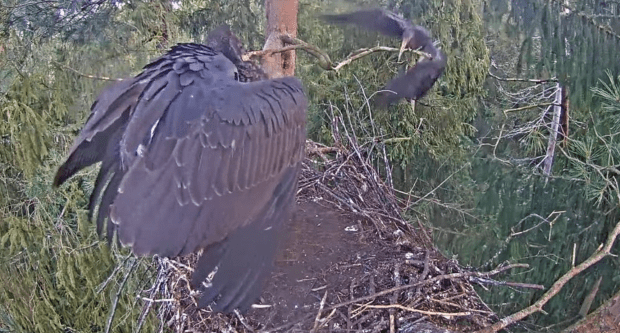
This was not the smooth flight of the youngest. The oldest hit the branch on the other side of the tree. There is concern about the condition of that wing. I will update you as soon as there is any information. Send your strong and positive wishes. I hope it looks worse than it was. How terrifying for this young bird to have that happen.

Even so, I hope that both of the storklings are at the feeder filling themselves with fish – just like we hope Malin is doing the same.

There is now only the middle hatch. Perhaps it will go today. They are 68 days old.

When I checked on Jan and Janika’s storklings in Estonia’s Jogeva County, no more fish have been delivered to the nest. It looks to me like every scrap of the old fish has been eaten – I thought that yesterday. Perhaps one really packed down in the nest is there, the one the storkling on the left is pecking at. All of the birds need food.

Hopefully all of them will fledge and find the feeder set up for them, too.

They are so beautiful with the sunlight filtering through the trees. The storks are 67 and 68 days old today. The average for fledging is 68-72 days. I wonder if Urmas will deliver some more fish?????

Do you watch the peregrine falcons, Xavier and Diamond? If you do, then you will know that part of the pair bonding ritual is Xavier presenting a prey item to Diamond. Diamond is not that particular but, she does not like Starlings. She cannot stand them. She has turned Xavier away when he had a Starling for her. They must taste terrible!

Well, today, Xavier hit the jackpot. Diamond was completely excited about her lunch – although some of you might not be. Xavier had a Superb Parrot for his beautiful Diamond. Make sure your sound is turned up.

Superb Parrots are also known as Green Leek Parrots or the Barraband’s Parakeet. These little beauties are native to southeast Australia living in the dry woodlands of New South Wales and Victoria. They were once considered vulnerable in terms of conservation and have been listed as Least Concern since 2012. Loss of habitation due to timber logging might well see this bird back as being vulnerable.

They are medium sized, growing up to a little over 15 cm or 16 inches in length. The bird in the image below is a juvenile. How do I know that? It has brown eyes while the adults have yellow-orange eyes. The adult male has a bright yellow face and throat while the female looks like the plumage that the juvenile has below. They eat fruits, berries, insects, as well as grains and nuts.

Awww. What a sweet face.

WBSE 27 and 28 continue to charm the socks off of everyone. That beautiful fluffy white down is in transition. They look a little like old terry cloth towels sleeping in their nest this morning in Sydney.

Look closely along the edge of the wing of WBSE 28 on the left. You will see the little pin feathers coming.

The pantaloons are growing too.

Just look at that sweet baby, WBSE 28, looking up at its parent. How adorable.

They are so young and yet, both of them know to pancake when there is an intruder near the nest. They hear their parents alarming and down they go. Look at the concern shown in the eye of WBSE 27 on the left. You can also see the black pin feathers coming in on both in this image better than the other one. But look – their cute little tails are growing!

You cam almost see them growing right before your very eyes.

Tiny Little still makes my heart skip a beat. Oh, what a wonderful bird you have turned out to be. You were so very tiny with that big older siblings but just look at you waiting for your breakfast to arrive.

Oh, you have that ferocious look like Mrs G. I have said that a couple of times but you do, Tiny Little. I hope you live as long as Mrs G and have lots of successful hatches. You really are quite amazing, Tiny Little.

Tomorrow is Saturday but there is no Ferris Akel tour this week. I was hoping to catch up with what is happening with Big Red and her family. It was raining yesterday but the Hornings were able to spot all four of them so we know that K1 and K3 are still with us – how grand, the 21st of August.

I am researching ‘Climate Driven Evolutionary Change’. If you know of bird arrivals or departures that are earlier than normal or later than what has been the norm, please let me know. It is much appreciated.

It is so nice to have you here with me. The rain is still falling – and that is a good thing. Please continue to send your positive wishes to Malin and all the bird families. Take care of yourselves. See you soon.

Thank you to the following for their streaming cams where I took my screen shots and video clip: The Falconcam Project at Charles Sturt University and Cilla Kinross. Collins Marsh Osprey Nest, Cumbrian Wildlife Trust and the Foulshaw Moss Osprey Cam, The Eagle Club of Estonia, The Latvian Fund for Nature, and the Sea Eagles Cam, Birdlife Australia, and The Discovery Centre.

Monday in Bird World

There is some sad news coming in from the Kakapo Recovery. During routine checks, Tutu was found dead. He hatched in 2019 and the team says he was quite ‘the character’. This brings the total population of Kakapo in the entire world to 201.

Photo of Tutu @ Petrus Hedman Kakapo Recovery FB

The news coming in is not all bad but, it could be a lot better. I reported that Grafs had provided two feedings for the Black Storklings on the nest near Sigulda. As it turns out, after I posted my newsletter, Grafs returned two ore times making a total of four feedings on 15 August. The team are hoping that Grafs will find the feeding table. If Grafs does and accepts the food, this nest could turn around quickly! At the present time the storklings are in a critical condition.

This is the news from Janis Kuze:

“I can report that fish were let into the feeder last night, the place is a few hundred meters from the nest and is easy to see from the air, but the bird still has to find it.
Thanks to everyone who provided support!”
Jānis Ķuze

Grafs arrived with some larger fish for the storklings at 14:47. He has yet to find the feeding table. Some are thinking that it might not be in his territory. There is a discussion about putting a decoy black stork to attract Grafs.

A feeding table has also been set up for the Estonian Black storklings of Jan and Janika. I understand a decoy – a White Stork decoy painted black – is at that table to try and lure the male to the fish for the storklings.

Yesterday I said that the storklings had eaten all of the fish. That was incorrect. They have been stomped into a pile but the Estonian storklings are still eating from them today and they have had a feeding from Jan. You can see the remaining fish today on the back left of the nest. Thankfully the nestlings are eating from them. If you look at their bills they are still a dull colour which is good. They are also not getting stress lines in their feathers like the storklings of Grafs. Stress lines are translucent feathers caused by all manner of stresses not just lack of food. Regular growth in feathers is not translucent.

Here is the link to the streaming cam of the Black Storklings in Latvia:

Here is the link to the streaming cam of the Black Storks in Estonia:

If you want to keep up to the minute with what is happening at either or both of these nests, please look under the information of each streaming cam. You will find the link to the English forums.

Please be mindful that these are extremely difficult times for the moderators and helpers on the chats and the forums. These two nests showed great promise – the best – and as I have said many times — the fate of our birds hangs on a fragile piece of thin thread. It can change any moment. The biologists and vets are doing everything possible. We need for the male storks to find the fish tables. Send your warm thoughts to all. The little ones need a miracle.

UPDATE: It appears that Jan has found the fish table. He has flown in and brought 2 very large fish to the nest in Estonia. There are also fish left there from the bander! Great news. Let us hope this continues and now we just need Grafs to find the fish.

And now on to some rather silly news. Blue 462 at the Foulshaw Moss Osprey Nest in Cumbria, got the breakfast fish. And, of course….Tiny Little was right there making sure her big sibling could not eat in peace. Tiny Little is giving them back what they gave to her as a youngster in the nest!

Tiny Little loves moving around the sticks. It is really disturbing to the one who is trying to eat.

One of the cameras got knocked but what it did was give us a nice close up of all those sticks Tiny Littles moves and returns, moves and returns.

There were others wanting some of that fish – those pesky crows who seem to be around, too.

Tiny Little kept running at the crows to get them to go away but finally, it was 462 that flew away leaving Tiny Little that great big fish all to herself. Do you think Tiny has enlisted the crows to help her? with the promise she will leave some food? Normally, Tiny Little is like a vacuum cleaner removing every piece of fish!!

In the image below, 462 has just flown off the nest. Tiny Little is moving towards that big fish she is going to have for breakfast.

Tiny Little spends some time making sure the siblings and the crows are not going to bother her. At one time or another the crows were climbing and flying around that part of the nest. But never mind. Tiny Little started 16 August off with a nice big crop. Well done Tiny Little.

It’s now 17:30ish on the Foulshaw Moss nest and Tiny Little is there calling White YW for food along with another sibling. It looks like 464 to me but I cannot catch the band number. Tiny Little is the fledgling at the back.

Tiny Little is such a character. She is one of the good news stories of the year for sure! I really hope that when she returns to raise her family it is on one of the nests with a streaming cam.

Do you recognize this view?

That is the scrape box for the Collins Street Falcons in Melbourne! and the YouTube channel is up and running. This is fantastic news to all of us that have waited to see this couple and their eyases again. Dad is just the cutest.

Both parents are working on the scrape box. That is mom in the image below.

Here is the link so you can be in on the action from the very beginning:

It doesn’t get any cuter nor any happier than the little sea eaglets in the nest on the old Ironbark Tree in Sydney’s Olympic Park.

Both of them are thriving! That is 27 facing us with its big crop and 28 is still eating.

Yesterday, Malin went to sleep with his head on a fish and another whole Bullhead on the left side of the nest. He woke up this morning and finished off the “pillow fish” and Marsha flew in and fed him and ate a lot of the Bullhead herself.

Malin has a nice big crop! Mom is getting some fish and that catch did not go to waste. And that is a good thing.

Thank you so much for joining me today. This newsletter comes about six hours earlier than I expected. It is nearly 100 degrees F on the Canadian Prairies and the birds are in hiding. No photography until later. I will continue to monitor the two Black Stork nests and bring updates. Send your prayers and your warm wishes to those two Black Stork nests. They need a miracle to get the males to accept the fish! Bukacek did so we need Grafs and Jan to do the same!

Thank you to the following for their streaming cams or their FB pages where I took my screen shots: The Kakapo Recovery FB, Collins Marsh Nature Centre Osprey Cam, Sydney Sea Eagles, Birdlife Australia, and The Discovery Centre, Cumbrian Wildlife Trust and the Foulshaw Moss Osprey Nest, 367 Collins Falcons, The Eagle Club of Estonia and The Latvian Fund for Nature.

What’s happening in Bird World?

I don’t know a person watching a nest on a streaming cam that doesn’t get anxious if food is not brought to the nestlings and fledglings on a regular basis. Most of us start doing a bit of nail biting. Today, for example, Malin had 4 feedings. It isn’t as good as five but it is better than nothing! And last Sunday Malin had nothing. We are all hopeful for tomorrow. The weather is cooling off – Malin we are wishing for six fish tomorrow!

Malin 13 August 2021
Malin 13 August 2021 after a feeding

Jake Koebernik of the Wisconsin DNR did a great job answering a lot of questions that some of us have had about Malin’s nest. One was ‘why are the fish that are delivered are so small?’ and the other was ‘why do fish deliveries drop at the weekend?’ This is his answer, “As for the nest at the Collins Marsh NC, the streams and marshes around that territory probably only offer smaller species such as bullhead, bluegills, small bass and northern pike. There aren’t large lakes or real productive rivers in that part of the state, so they are going after what is abundant and available.” Jake’s answers cleared up a lot of the mysteries. —— And tomorrow, when Malin wakes up, Malin will have its official name! Fingers and toes crossed for it to be Malin!!!!!!!

My friend ‘S’ sent a screen shot of a delivery that Telyn made to the Dyfi nest this afternoon. We both agreed that Malin’s eyes would pop out if he saw a fish this big land on the nest at Collins Marsh. That fish is bigger than Blue 491! Wow.

And if you did not hear, Idris had been missing since Wednesday and he was on the nest today, albeit with a completely sunken crop. He brought a nice fish to one of the chicks. Hoping he gets his own fill of fish. Where in the world could he have been? It is worrisome.

Telyn delivered a whopper for 491, Ystwyth who is 82 days old on 14 August

Oh, if only places that have ponds could stock them for the birds. The Pritchett Family in Fort Myers has a stocked pond for Bald Eagles Harriet and M15 and their kids and the water also allows them to cool off and clean their feathers.

We are told by the IPCC that we can expect the droughts and extreme heat to be with us. Since these changes to our climate are known to be directly caused by human activity, maybe it is time to figure out ways to help the wildlife. Providing water and food is a start.

These two little sea eaglets are just adorable and a little spunky, too. They are growing like the sunflowers in my garden that the birds planted.

Both had nice crops after this feeding.

Judy Harrington, the researcher observing the WBSE Nest in the Sydney Olympic Park forest, just released her report on what these two have been eating during the last fortnight (14 days). In fact, it is the first two weeks of their life. Harrington also records the amount of time spent feeding by both the male and the female has been recorded. Lady took on 109 feedings for a total of 21 hours and 20 minutes. Dad did 8 feedings for a total of 42 minutes. Dad has been providing most of the food – he brought in 25 items and Lady brought in 5. These consisted of the following in total: 16 Bream, 4 catfish, 2 fish, 1 Mullet, 2 Whiting, 1 Yellowtail, 1 Ibis chick, 1 nestling, 1 pigeon, and 1 bird. They have now morphed into sea eagles, the second largest bird in Australia.

Sadly, it appears that Lady was hit during the night by Boo, the BooBook Owl that lives nearby in the forest. Despite its very small size the BooBook Owl has caused injuries to the large sea eagles in the past.

It is thought that Boo, as the little owl is so fondly called, has a nest near to the Sea Eagles. To my knowledge, the WBSE have never bothered their nest but, – hey. Every parent is afraid of a larger predator and wants them to leave the area.

“Boobook owl” by jeans_Photos is licensed under CC BY 2.0

Legacy on the Fortis Red Deer Nest has fledged. She has been on and off the nest a few times today. One was to get some fish! Here she is with Mum. After all the nestling deaths during the heat wave, this is just one of the happiest moments from that nest. Look how big Legacy is next to mom. Congratulations.

It is almost impossible to see what is happening on the Fortis Alberta Exshaw nest up at Canmore. Both chicks appear to be on the nest and calling for food. It is unclear to me if one or both have fledged.

The love story of the two Canada Geese has gone viral. It warms our hearts to see these two devoted birds – Amelia finding and waiting for Arnold during his surgery and recovery and now their reuniting. My friend, ‘R’ found two more stories on them and I want to share with you what she sent to me. You could read about these two all day – and you will always walk away with a smile.


https://boston.cbslocal.com/2021/07/15/goose-surgery-visit-mate-new-england-wildlife-center-cape-cod-branch/
Female reporter admits to being teary eyed! 

https://whdh.com/news/goose-who-underwent-emergency-surgery-released-back-into-the-wild-to-be-with-his-devoted-mate-on-cape-cod/Shirts for sale: “Honk If you Love Arnold!”

The story of Arnold and Amelia has taught us all something. If you find an injured Canada Goose and are taking it into care, please take the time to find its mate! The outcome might be much more positive. If you live in an area where there are Canada Geese – let your local wildlife rehabber know about the story of Arnold and Amelia. They will understand why it is important to keep bonded mates together (and their goslings if necessary).

And news about Kona. It is nearing 100 F or 38 C on the nest in Montana. The foster mother, Scout, has been shading Kona. Everything is going well with this foster. How grand.

@ Montana Osprey Porject

Leaving you with a gorgeous image of Loch of the Lowes. It just looks so still and peaceful in the early morning hours of 14 August.

And a last peaceful image of Diamond on the ledge of her scrape box on the water tower at Charles Sturt University in Orange, Australia. We will be looking for eggs before the end of the month. Izzi was last in the scrape box of Xavier and Diamond 6 August. He was photographed on 10 August and someone thought they heard him this morning.

Thanks for joining me today. I am off to try and find some hawks tomorrow so this is coming out early. I will bring you some late Saturday news in the evening. Take care. Stay safe! If you hear of interesting bird stories – and in particular, raptors – let me know.

Thank you to the following for their streaming cams where I took my screen shots: Collins Marsh Nature Centre, Sea Eagle Cam, Birdlife Australia and the Sydney Discovery Centre, Dyfi Osprey Project, Scottish Wildlife Trust and Friends of Loch of the Lowes, Falcon Cam Project at C Sturt University, Fortis Alberta Exshaw and Fortis Alberta Red Deer. Thank you to ‘R’ for sending me the links on the coverage of Arnold and Amelia and to ‘S’ for the information on Telyn and her whopper of a fish delivery. It is much appreciated! Thank you to the Montana Osprey Project FB page for the image of Scout and Kona.

The Hornbill

There are over 50 different varieties of Hornbill. The one that I want to focus on today is the Rhinoceros Hornbill. It is the State Bird of Malaysia. I became acquainted with these amazing birds during a trip to the Sarawak in East Malaysia many years ago.

The arrow points to Sarawak. The Rhinoceros Hornbill is present also in Sabah as well as Borneo, in yellow.

You could not move through the area around the harbour of Kuching without seeing ‘something’ decorated with the motif of a hornbill – from table cloths, batik wall hangings, phone cases, and old and not-so-old wood carvings. To actually see these highly endangered birds you needed a guide to take you to the jungle areas where local tribes still live in their long houses. There the hornbill was also used as a design for the totems on the poles supporting their roof as well as on many of the art of tattoos.

“Iban? Long House near Kuching” by rosskevin756 is licensed under CC BY-NC-SA 2.0

The weavers of the area specialize in ikat. Ikat is a type of resist dying. The threads are resist dyed before they are woven. The pattern in the textile below is called the ‘Feather of the Hornbill’.

Old carving of Hornbill, Ironwood. Sarawak Museum, Kuching.

The Rhinoceros Hornbill is depicted in numerous designs in wood carving. The wooden figure above is a Kenyalang. Historically, these carvings were associated with many of the tribes in Sarawak, Sabah, and Borneo. For the Iban, the figure is an essential part of a celebration called the Gawai Kenyalang. Its role was as a messenger. It called upon the spirit world to give courage to the warriors who went out headhunting. The carvings are still made today and they are still important for the various tribal communities. Head hunting ended in the 20th century and most of the carvings are considered cultural icons.

The Rhinoceros Hornbill is a large bird, 80 to 90 cm (31–35 in) long. The males are larger than the females. The birds are covered with black feathers except for the white tail that has a single black band. Their legs are white. The Hornbill is most notable for its colourful bill which is huge. In fact, that orange and red bill is what gave the bird its name. The Hornbill uses this lightweight beak to gather its food, build its nests, seal the nest, and feed the chicks. The structure on top of the bill is called a casque. It is hollow and its function is to amplify the call of the birds. The eyes of the male are red with black rims while those of the female are white with a red rim like the one below.

“Rhinoceros Hornbill” by shankar s. is licensed under CC BY 2.0

In comparison, this is an image of the male so that you can see the difference in their eye colour. It is the easiest way to recognize each of the genders.

“Rhinoceros Hornbill” by Steve Wilson – over 10 million views Thanks !! is licensed under CC BY 2.0

The Hornbills are very unique in their nesting habits. They are cavity nesters but with a twist. When the female is ready to lay her 1-3 eggs, she will locate a cavity in a tree trunk (or sometimes a rock formation) to make her nest. Once made she helps her bonded-for-life mate seal her into the cavity with mud. The only opening is a small oval hole where the male feeds the female during her confinement that lasts 50 days. He also feeds the nestlings. This arrangement is very practical. It helps protect the nest from any type of predator including lizards and snakes. Ninety days after the chicks hatch, the female will break open the mud covering to the nest.

The Rhinoceros Hornbill is listed as vulnerable. One of the biggest threats to its existence is the loss of the rainforest where it lives and builds its nest. It is also hunted for food as well as for items that are believed to give men virility including the feathers and the skull. The large trees that occupied the forested areas of Borneo are being cut down at an alarming rate. When I was there the wood was being shipped to China on those huge boats. It was overwhelming to see the forest being obliterated.

“Rhinoceros Hornbill (Buceros rhinoceros)” by Mark Louis Benedict is licensed under CC BY-NC-ND 2.0

In other news, Tiny Little Bob or Blue 463 nabbed the first fish of the morning on the Foulshaw Moss Osprey Nest in Cumbria. Tiny Little was busy eating it while sibling 462 waited on the nest. Tiny Little is off to a great start to the day! Go Tiny Little!

Karl II arrived at 8:10 to feed the three fledglings on the Black Stork nest in Estonia. The fledglings were incredible.

The glare of the sun on the camera creates a strong glow so you can’t see clearly what is going on. Karl arrives on the right and feeds the hungry storklings quickly. The nest is in the Karula National Park in Estonia.

One of the Storklings on the Siguldas Black Stork nest in Latvia has decided to get up close and personal with the camera and its supports while it waits for Grafs or Grafiene to bring them their breakfast.

The good news at the Peregrine Falcon Nest in the scrape box on the grounds of Charles Sturt University in Orange, Australia is that Izzi – cute little Izzi – has not been in the scrape box for six days. He has been heard but he has not gone in after several altercations with Xavier. Diamond, Izzi’s mother, is expected to lay her eggs by the end of August. Here is Diamond looking out over her territory.

Also in Australia, the two little sea eaglets, 27 and 28, are just cute. They are really growing. Dad brought in a life fish and was going to feed them today. Lady flew in and stepped on the fish before it could flop all over the chicks. Then she took over the feeding. Both ate well but 27 had an enormous crop.

It continues to be as good a day as it can be in Bird World. The juvenile Ospreys are eating and eating preparing to being their migration. For some of the UK nests the average number of days is around 90 hatch days old for fledging. We will be keeping our eyes open to see who is leaving.

Thank you so much for joining me. Have a wonderful Friday everyone. See you soon.

Thank you to the following for their streaming cams where I took my screen shots: WBSE Sea Eagle Cam, Birdlife Australia and the Discovery Centre, Cumbrian Wildlife Trust and the Foulshaw Moss Osprey Nest, Falconcam Osprey Project, C Sturt University and Cilla Kinross, the Eagle Club of Estonia, and the Latvian Fund for Nature.

Birding Action has started in Australia

Wow. At 00:52:40, Mom goes into labour. She is the female Osprey on the Port Lincoln Osprey Barge in Australia. Dad is sitting right at nest side in support. It was magical. The minute the egg was, Dad was off. My time said 00:57:58. And with that single significant event, the Port Lincoln Osprey season for 2021 is underway!

Mom looks very content in the early morning Australian sun.

I was very glad to see Dad there. Last year Dad just about ended my love of Ospreys. The death of Tapps, the third hatch in 2020, practically cemented that. The Achieva Osprey nest brought back the pain but the triumph of Tiny Tot gave me faith. It also has made me question the entire notion of ‘survival of the fittest’. So this year I am wishing for consistent fish drops when the eggs hatch – Dad, that means enough fish for everyone every day with no breaks.

The Northern Hemisphere fledglings are preparing to migrate (if they hatched in an area where the birds travel to warmer climates during the winter) so for all Osprey lovers this is a chance to start at the very beginning again — in Australia.

The adults spent a lot of time bringing in new twigs and lining the nest cup with bark. It is quite beautiful. This nest looks like someone cares!

Of the chicks that have fledged from this nest, Calypso (2019) fishes and is seen regularly in the Port Lincoln area. Solly (2020) was fitted with a satellite tracker as well as a leg band. It is reassuring to know that she is well. There have been no reported sightings of her brother, DEW, that I am aware of.

Solly is 317 days old and she is at her favourite place, Eba Anchorage.

The two eggs have hatched at the White-Bellied Sea Eagle cam in the forest of the Sydney Olympic Park. They are WBSE 27 and 28. Both are doing fantastic. Dad has been bringing in Bream, Pigeon, several other types of birds, and Eel-tailed Catfish. The chicks are not wanting for food or variety!

The link to the Sea Eagle Cam is here:

Are you a Peregrine Falcon lover? There are two excellent nests in Australia on streaming cam. One is on all year round and has covered the antics of Xavier, his mate Diamond, and their son, Izzi. The scrape box is on the water tower on the grounds of Charles Sturt University in Orange, NSW. This family is part of a research project of Professor Cilla Kinross.

I should tell you that this nest is hilarious. Xavier is such a sweetie and he is courting Diamond now even though they have been a bonded pair for a number of years. He brings her gifts of prey to the scrape box and they do a courtship dance. Sometimes Xavier forgets and brings Diamond a Starling. Diamond hates Starlings and refuses to accept the gift from Xavier! And then there is Izzi. Izzi is like the cutest almost one year old falcon. He should not be at the nest but he is. You see, Izzi fledged three times. The first was accidental so he was taken back up the 170 stairs to the scrape box on the water tower. The second was a good fledge but he ran into a window. He was in care for several days and returned to the scrape box. The third time was the charm. The problem? Well, Izzi should have left his parent’s territory before the beginning of 2021. Yes, it is now August. That is the problem.

I mean seriously – could you tell this cutie pie to leave home?

Both Diamond and Xavier have been ‘scraping’ in the scrape box. The indentation they are creating is where Diamond will lay the 2021 season eggs. The couple have already been mating on the top of the water tower.

This is Xavier. The yellow around the eyes, the cere (part above the beak), and the legs and feet are a deep yellow when falcons are adults. Look at the beautiful plumage patterning.

This is Xavier scraping in the scrape box.

This is Diamond scraping in the scrape box. Notice the colour of the stones. In his book, The Peregrine, J.A. Baker states that “Peregrines bathe every day…The bed of the stream must be stony and firm…They favour those places where the colour of the stream-bed resembles the colour of their own plumage.” Absolutely. Camouflage. But why do they take so many baths? Baker believed that it was so they would not transfer any lice or other parasites from their prey onto them that could cause illness or disease. The same is true of the scrape box. Peregrine falcons lay their eggs in gravel and not on a twig nest to avoid illness or disease.

Here is a very short but loud pair bonding in the scrape box. Have a look at the dance that Xavier and Diamond do together. Xavier is the smaller of the couple. Falcons, like other raptors, have reverse sex size diamorphism – meaning the female is larger.

Here is the link to the box camera. There are in fact two cameras: one looks at the inside of the box as above and the other is positioned to look forward from the back taking in the ledge and a bit of the outside world. That is cute little Izzi looking out to that big world beyond.

The chat feature has moderators, often Professor Kinross, as well as a FB Page where you can get great information.

The second is the Collins Street Falcons better known as the CBD Falcons in Melbourne. The camera is not operational yet. There are many videos from last year if you search for Collins Street Falcons on YouTube. In 2020, the couple had triplet girls. Triplets? Three eggs hatch within a period of 24 hours. These girls grew like crazy. They grew bigger than their dad.

I am including one video of the male delivering a pigeon to feed them. I just love this tiny little male. He melts my heart every time I look at him.

The diet of the two falcon families is different. The Melbourne falcons are urban. Their diet is almost exclusively pigeon. In contrast, the falcons in Orange are rather rural with a more varied diet including Starlings (remember Diamond dislikes those), Galah, sometimes a Supreme Parrot, other parrots, and birds. One thing that eyases love are cicadas. They hold them in their foot and eat them like a popsicle. It is crazy. In one day last year, Izzi ate 17 cicadas in a row. There had to be a swarm of them! It was incredible.

As night comes to the Canadian prairies the sun is rising on a new day in Europe for all of the birds. The rain falling in the Latvian forest where the three Black storklings nest sounds wonderful.

It was reported today that my city had only 1/10 the average amount of rain in July. It has been 150 years since this small amount of rain was last recorded. We long for a day just to listen to the sound of rain falling like it is here on the Black Storklings in Latvia:

Thank you so much for joining me today. It is wonderful to have you with me. Take care everyone!

Thank you to the following for their streaming cams where I took my screen shots: The Latvian Fund for Nature, Sea Eagle Cam, Birdlife Australia and the Discovery Centre, Charles Sturt University and the Falcon Cam Project, Port Lincoln Osprey Project and PLO FB Page for Solly’s transmitter data.

Note: The next newsletter will appear late Tuesday.

Happenings in Bird World 2 August 2021

It is a gorgeous day on the Canadian Prairies. The extreme heat of the past has dissipated and the sun is shining. There is no wind, every leaf is still. The only thing moving in the garden are the little songbirds waiting for the feeders to be filled. No wind means there is no smoke from the wildfires farther north. It is a nice change. We are all hoping for big downpours and, if the weather report is correct, that will come at the weekend.

A serious lump came in my throat this morning when I went to check on Tiny Little at the Foulshaw Moss Osprey Nest. No one was there this morning (nest time) and now the crows are picking at the nest. Normally, at this time of day, Tiny Little would be on the nest waiting for a fish drop. There appear to be no birds in the parent tree in the background. The Crows are a reminder that the days of seeing our Ospreys are precious ones.

I returned to the Foulshaw Moss nest several times. The last visit revealed Blue 464 – the first of White YW and Blue 35’s chicks to fledge – on the nest food calling. You could see the shadow of another bird on the camera at times.

There are some ‘late’ nests and some just starting in case you are having empty nest syndrome.

One of those nests is at the Collins Marsh Nature Centre in Wisconsin. So as not to confuse everyone, the constant watchers got together. Each felt the chick needed a name, even if it was just for us. ‘S’ from Hawaii suggested Malin which means ‘strong little warrior.’ It fit perfectly for this small chick. Voted for unanimously amongst our small but caring group! So from now on I will refer to him or her as Malin, just so you know.

The female was not on the Collins Marsh nest when I checked. She is absent for long periods of time. I want to think she is fishing and will be back to feed Malin or she is just resting. The male has made a fish delivery. This time it is headless. Malin is confused because Dad will not ever do any feeding. Malin is standing and walking much better than last week but he still wants to be fed by the adult.

Malin continues to try and get the male to feed him the fish but it is not happening!

Once Malin realized that he was being left to fiend for himself, he started self-feeding on the fish. Because this one is headless, Malin is making much better progress. This little one is trying very hard.

There is a concern about the feather growth of Malin. Unfortunately, the camera is not clear. Yesterday, ‘S’ took some screen shots that indicated some wing feathers near the tips could be missing. If you look carefully at the image below, you can see the green grass through both wings clearly. This could be a serious concern for this young bird.

Thinking about Malin’s development, a search through the FB pages of the nature centre indicates that three chicks hatched on this nest on 16, 18, and 20 of June. Historically, the smallest – the third – has died on this nest with the exception of one year. This year Malin is the only one to survive leaving us to believe that he was either the first or second hatch. That would mean that he is either 46 or 44 days old. From Osprey development charts, it appears that Malin is about two weeks behind the average in growth. This is most likely due to the low food deliveries.

Maris Strazds, from the Institute of Biology at the University of Latvia states that the availability of food determines the dates of fledging and also that the survival rate of chicks is better if they spend more time on the nest after fledging. Strazds is speaking specifically about storks but this is also known to be true in hawks and falcons and I would like to think that it also extends to Ospreys and Bald Eagles.

While the feather growth is being monitored by the Wisconsin DNR Biologist and a concerned Wildlife Rehabber of the area, access to the nest is a problem. The nest is situated on top of a wildlife tower that was moved to this site so that people could climb the stairs and view the countryside. Here is a close up view. It appears that a metal roof with a peak was fabricated to fit on top of the flat roofed water tower.

In this image the nest looks quite deep. This image was taken several years ago and it seems that the nest has been reduced in size – perhaps by strong winds. Photographic comparison of the nest cup now with the chick and a couple of years ago also indicates a loss of nesting material, perhaps substantial amounts, missing.

It is difficult to determine if there is a wooden support under the twigs. If you look at the images of the nest with Malik (above) it appears that there is something ‘square’ underneath a couple of layers of twigs.

My concern is that if the feather development on Malin is problematic, there is no emergency access to the nest from the observation box. In other newsletters I have indicated that there should be a means to access the nest without compromising the safety of the individuals trying to help the birds.

There is only one operational White-Bellied Sea Eagle cam in the world. It is at the WBSE nest in the Sydney Olympic Park and the excitement there is just beginning. These two little ones, 27 and 28, appear to be getting along without food competition. Of course that can change but there has been plenty of Catfish Eels (or is it Eel Catfish?) on the nest.

Right now the sea eagles are sleeping. One little babe can be seen sleeping on Lady’s leg.

You can access this streaming cam here:

Tomorrow I will give you some information on other nests in Australia including two Peregrine Falcon streaming cams.

If it is Bald Eagles you love then the Glacier Gardens Bald Eagle Nest in Juneau, Alaska is not to be missed. Kindness is such a little sweetheart. Liberty and Freedom are helping her by trying to get her self-feeding skills honed. The eagles fledge later in Alaska because they are bigger in size than the ones hatching in the Southern US who are already off the nest. At Glacier Gardens, the average fledge is 89 days after hatch while the rest of Alaska is 80 days on average.

‘L’ also sent me the link to an Osprey nest that she has just discovered. The chick hatched on 23 June. It is a real little sweetheart ——- and the camera definition is excellent!

It is the Minnesota Landscape Arboretum Osprey Nest. There is only one surviving chick. The other perished on 26 June; the cause is not clear. This chick looks extremely healthy. The nest is on top of a platform at the University of Minnesota. Enjoy!

Because so many of you love storks, I want to mention two that my friend, ‘S’ in Latvia says are very special. One nest is in Latvia and the other is in Estonia.

The Black Stork nest in Latvia is very special. The birds are listed as critically endangered and it is rare to see them in Latvia even though the White Stork population is healthy. The male is Grafs. ‘S’ explains to me that the nest is late because Grafs was a bachelor and waited a very long time for his mate, Grafiene, to arrive. The three storklings hatched on 12, 14, and 15 of June. There are many challenges for this couple and their trio. The first is the late hatching date and the worry about whether or not the parents will remain with the storklings until they are developed and strong enough for migration. The storklings will be ready for fledging in 20 or more days. That puts it at the third week of August. As we know, storks are already gathering for their migration so watchers can only wait and hope and take the beauty of this nest a day at a time – as we always do with other nests. The second concern has been the dangerous heat that has hit nests all around the world causing a drop in prey delivery. The third is the nest itself. It appears to be unsafe despite the fact that other stork couples have fledged chicks in previous years.

I want to add that the chicks are very healthy – they are doing so well so I want all of us to be optimistic. This year I have seen miracles happen on nests – I only have to look at Tiny Tot on the Achieva Osprey Nest and Tiny Little on Foulshaw Moss to know that positive things can happen if we all send warm wishes. Even the turning of the deadly storm cells away from the nest at Collins Marsh was another of those miracles or the safe return of the male at the Barnegat Light Osprey Nest in NJ after being missing for a day due to that same weather system. So, we wait, watch, and hope.

You can watch this beautiful nest here:

It is raining today on the nest. Oh, how I wish the beautiful storklings could send some of that moisture to Canada!

There is also a forum in English for this nest where you can go back and see the long history and discuss the nest. You can access it at

The second Black Stork nest is actually in Estonia. As in Latvia, Black Storks are loved in Estonia and are rare.

It is also raining at this nest today, too.

The parents are Jan and Janika. The nest is very stable so there are no worries with the structure. But because of the horrific heat that has impacted all nests, food deliveries have sometimes been problematic. Janika, like the mother on the Collins Marsh Osprey nest also disappears for long periods. These storklings will also have a challenge to be flight ready for when the migration begins. Again, we can watch with wonder at these extraordinary birds but we must be aware of some of the challenges that birds encounter. Life is not easy.

There is also a forum for this nest. It is here:

I really want to thank ‘S’ for bringing these two Black Stork nests to my attention plus sending me all of the information about them. They are such beautiful and rare birds and it is a real privilege to see them hatch, grow and learn, and then begin their journeys. In addition, I want to thank ‘L’ for sending the information on the Minnesota Landscape Arboretum Ospreys and ‘S’ for finding all the images of the tower at Collins Marsh and the Nest and the great name for the Collins Marsh chick – Malin.

And I want to thank you for joining me today. It is always a pleasure to have you here with all the other bird lovers around the world. Stay safe everyone. See you soon.

Thank you to the following for their streaming cams where I took my screen shots: Eagle Club of Estonia, Latvian Fund for Nature, Collins Marsh Nature Center, Cumbrian Wildlife Trust and the Foulshaw Moss Osprey Nest, Sea Eagle Cam, Birdlife Australia, and the Discovery Centre, Glacier Gardens Bald Eagle Nest, and the Minnesota Landscape Arboretum Osprey Cam.

Early Monday in Bird World, 2 August 2021

Many who read my newsletter have a love for all birds and a particular fondness for one or two species and a number of nests. My personal journey began with an encounter in my own garden – literally, getting up close and personal with a female Sharp-shinned hawk in the dead of winter who, I believed at the time, was eating the garden rabbit, Hedwig. She wasn’t. Our eyes locked to one another’s, ‘something’ happened. I cannot describe it but those minutes changed my life. I know that many of you have had a similar experience as well as others who have gone on to write books about their journeys.

Philip Brown’s, The Scottish Ospreys from extinction to survival, written in 1979, is just such a book. My used copy arrived in the post a couple of days ago from the UK. The only time that I have had to read has been late at night. The book is so well written that I was often hesitant to stop reading. His enthusiasm and love for these fish-eating birds animates the drive in Scotland to reintroduce the Osprey after years of extinction. Brown gives a good solid history but it is his personal stories of spending time with others at the eyries of Loch Garten guarding the nests that draws the reader into sympathy with the birds. Brown worries about the trees that are partially dead but have nests, about the poachers that are killing the birds, and how to halt the illegal practice of egg collecting. Those are woven in with the growing understanding of osprey behaviour and the efforts to grow public interest in the birds. If Ospreys tug at your heart then this is a book that you should read. When I was looking for a copy I discovered that the book could be ordered from the UK with standard post for a very reasonable price. It is a hardback book and used copies are available for less than 5 GBP.

I want to re-mention another book, available only in paperback. Lady of the Loch. The Incredible Story of Britain’s Oldest Osprey is by Helen Armitage. There are a couple of ways it is different than the Brown volume. It is newer, written in 2011. The book covers the reintroduction of the Osprey to Scotland also but does it by focusing on a single bird, Lady, at the Loch of the Lowes. Lady raised 48 chicks migrating to Africa and back 20 times. That is simply astounding. Armitage’s book is different in another way. The lens is female, a welcome change when the majority of books on Osprey are written by men. She includes details not found in other volumes including one that I found particularly interesting. In trying to protect the Osprey, “In September 1899, Queen Victoria confirmed that certain regiments would stop wearing osprey plumes…” She also notes that it was women who continued the fight to stop the use of bird plumes including the Duchess of Portland who became the head of the Society for the Protection of Birds. It is time to think of fall reading and these are two really excellent books to curl up with.

In nest news, it appears that Bukacek or Father Stork is the only member of his family sleeping on the nest at Mlade Buky.

It is possible that both Pankrac, the female, and Servac, the male are with other fledglings preparing for their migration?

The normal practice with raptors is the female leaves for migration first. The male remains feeding the fledglings and bulking up himself. Once the fledglings depart, the male begin his long journey. Is this also the same ritual for storks?

I had a beautiful letter from a reader, ‘S’. She confirms the special status of storks in her country, Latvia. The people of Latvia have a special name for the White Storks, svētelis. She says the term speaks to the “embodiment of something holy and brings peace and protection from bad things.” This belief explains so much about the great love the people of Latvia have for their storks and that same understanding of storks being special must extend to surrounding countries where people go to great lengths to care for these amazing birds.

In regards to the migration of the storks, ‘S’ says that every year the storks gather on the trees, the roofs of all the houses and buildings, as well as on the electricity poles close to where she lives. When they are all ready to leave they begin clacking their bill together similar to what they do when the storklings are wanting food. Close your eyes and try to imagine how wonderful it would be to see this enormous gather of storks, each being called by the winds to begin their journey. The only equivalent we have in Manitoba are the Canada Geese. Every year they gather on the large ponds near to our nature centre, Fort Whyte. They arrive as the sun is setting calling one another. It is extremely moving. I can only imagine if it were storks!

There are several videos on YouTube about Klepetan and Malena, the famous Croatian white storks and the man, Sljepan Vokic, who has cared for Malena for more than 22 years. Sometimes, it is nice to see one of those videos just to remind ourselves that the world is full of kind caring people.

Skipping down to Australia, the two little sea eaglets, 27 and 28, are doing really well. It is mystifying watching Lady feed them the tiniest morsels of fish from her large beak.

Just look at the size of fish flake Lady is feeding to 28. She is so gentle.

There is plenty of fish in the nest and, so far, I have not seen any signs of food competition. Both of the little ones have nice tiny crops after their feedings. So far, so good. Fingers crossed it keeps up. Indeed, the only cheekiness I have seen is 28 trying to take a bite of 27’s head!

I love the look in Lady’s face as she stares at those two precious little fluffy bobbles. In many ways Lady reminds me of NC0 on the Loch of the Lowes nest in that she has grown into being an excellent – and loving – mother.

There is a gentleness about her movements with the two chicks this year that is striking. These moments of both of them tenderly tucked under mom will pass so quickly – they grow so fast!

A quick early Monday morning check on the UK Osprey nests reveals that Aran and Mrs G have been on the nest together since approximately 4 am.

Amidst the bleating of the sheep and the cows mooing, Aran brought in a fish for Mrs G and did a survey of their nest.

It is reported that Aran’s wing is much improved. He is flying more and fishing for himself as well as delivering fish to Mrs G. This is all good news since it was unknown at the time of his wing injury in late May whether or not he would be healed in time for migration.

One of Laddie and NC0’s chicks is on the Loch of the Lowes nest hoping for a food drop. Of course, that band is in hiding so it is anyone’s guess which chick is calling for fish!

The scene at the Dyfi Nest of Idris and Telyn and their two fledglings is simply pastoral. That said, no one is home!

The nest of Tiny Little is equally beautiful. I love the gentle yellows of the sun kissing the Dyfi Nest as it moves above the horizon and the gentle golden pink colouring the landscape of the Foulshaw Moss nest below.

A little later the Foulshaw Moss is magical. No Tiny Little though.

I cannot think of a better way to start a Monday morning than collapsing into the serenity of one of these landscapes. You can feel the stillness while, at the same time, soaking in the freshness of the smell of dew on grass.

Thank you for joining me. I will get the synopsis of what is happening with the Gough Island Recovery project this week. Once I started reading Brown’s book on Ospreys many other things went to the wayside. I hope that you have a great start to the week. Take care all.

Thank you to the following for their streaming cams where I took my screen shots: The Scottish Wildlife Trust and Friends of the Loch of the Lowes, Dyfi Osprey Project, Sea Eagle Cam, Birdlife Australia and the Discovery Centre, Mlade Buky White Stork Cam, Bywyd Gwyllt Glaslyn, and The Cumbrian Wildlife Trust and the Foulshaw Moss Osprey Nest.

Sunday news in Bird World

The sun is bright but not too hot, the Hibiscus continues to bloom, and Tiny Little is on the Foulshaw Moss nest eating a large fish. That is a great beginning to the day.

This is actually ‘the tea time’ fish for our favourite little fledgling on the Foulshaw Moss nest. It is about 16:00 in Cumbria.

Tiny Little is so smart. She doesn’t waste her time and energy fighting with the mouth and eyes of the fish, she rips a part of the belly open and begins to eat the side and the bottom of the fish. She is ever mindful that there are also two hungry siblings lurking about.

Tiny Little ate off that fish for more than an hour. She got a lot of really nice fish Great work, Tiny Little!

After what appears to be an hour and a half, big sibling 464 arrives. I missed the hand off. Was Tiny Little finished or did 464 come in and take the fish? We will never know. 464 has been fighting with the front of that fish for over an hour now. Sibling 462 is waiting their turn! Tiny Little has flown off.

In the White-Bellied Sea Eagle Nest in the Sydney Olympic Park, Lady has been busy feeding 27 and 28. Oh, they are so cute! I love this stage. Lady is so gentle feeding them with her big beak. They look like two little snow people with arms.

The Only Bob or Bobette in the Collins Marsh Osprey Nest in Wisconsin has had a couple of feedings this morning and perhaps more by now; it is now 13:33 on that nest. The fish that are being brought to the nest by both parents are quite small. I wonder if all the fish are that small? or are the bigger fish lurking around in deeper water?

The chick is being watched for feather development. It is hoped that the ‘blood’ feathers will grow fully and, at the time of fledging, the chick will have a full set of juvenile plumage.

In the image below, you might want to look at what some people call the quills on the left wing. As the feathers grow, those quills break open and eventually fall off. This is what we are watching.

Yesterday I reported that Bonifac, one of the male storklings cared for by the people of Mlade Buky had been electrocuted just like its mother. The other male, Servac had not been to the nest but was seen flying with other storks. Pantrac has been to the nest to be fed. There were no storks on the nest so far today. This is not unusual! The storks are beginning to gather for their migration to Africa. Yesterday might well have been the last day for them in Mlade Buky.

Before the age of Immarsat M and GPS, the only way to study the migration of the storks was if they were ringed. In 1933, a short entry in Nature Magazine (30 September, p 509) says that ‘Storks nesting east of the River Elbe have been found to use the Asia Minor route when migrating, and those nesting west of the Elbe are stated to take the route through Spain.’ Today those similar routes are simply called the Easter and the Western. The western is through Spain and the Straits of Gibraltar while the eastern has the birds flying through Egypt following the Nile. With Satellite tracking, the birds are now known to winter in Ethiopia, the Central African Republic, Senegal, Nigeria and the Niger River Basin.

The observations of the success of the migration and the concerns in 1933 are similar to those in 2021. It is a two month journey for the Danish storks – anything can happen between the time the storks leave and arrive. Even with laws protecting migrating birds, these lovely creatures have been known to have been shot down in France, Malta, and in parts of Egypt. There are many other things that impact this hazardous journey – changing climates, lack of food and water can all contribute to the loss of the birds.

Because we are talking about European laws, it is essential that the countries that make up the European Union – and many who do not- work together to ensure that the killing of migrating birds in European states is halted. There also need to be uniform protections in the territories where the birds migrate. As the world changes, following the SARS Covid-19 pandemic, countries in African that have been devastated by wars, famine, droughts, and epidemics need to understand that ‘birding’ can be an economic success story. People will begin to travel. Bird Tourism can bring vital monies into these struggling economies.

There is, however, another very troubling trend. As the climates change some of the storks are not migrating. Traditionally, they travelled to Africa where food supplies were plentiful during the winter when they were not in Europe. One troubling occurrence is that many of the European storks who take the western route are now stopping and living in garbage dumps in Spain and Portugal during the winter. There are groups that are not happy with the storks being there year round. One of them is called ‘Stop Storks’. A discussion of the issues is in an article, “European Storks become Couch Potatoes and Junk Food Junkies” in Environment.

https://www.dw.com/en/european-storks-become-couch-potatoes-and-junk-food-junkies/a-19172154

Speaking of storks, one of the nests that I have, embarrassingly not mentioned for some time, is that of the Black Storks in the Karula National Park in Estonia. The camera was broken during a severe storm on 25 June and was not operational again until 15 July. Oh, those wee babies sure have grown. Their parents are Karl II and Kaia.

The trio was ringed on 9 July. You can see the bands. Those bands contain Kotkaklibi transmitters. To my knowledge this is the first instance this type of satellite tracker has been used on the Black Storks. The band numbers are as follows 716U for the oldest chick, 716P for the middle, and 716T for the youngest. Names are pending.

In the image below you can see both the banding ring and the transmitters on the legs a little better. Hopefully reports will come back on a regular basis so that we can follow these three as they undertake their first migration.

Here is the link to the streaming cam of the Black Storks in the Karula National Park in Estonia:

Thank you so much for joining me today. Please go and see those lovely Black Storks. We are now at 1 August and they will not be with us for much longer. I hope everyone is well. Take care. Enjoy.

Thank you to the following for their streaming cams where I took my screen shots: Cumbrian Wildlife Trust and the Foulshaw Moss Osprey Cam, the Sea Eagle Cam, Birdlife Australia, and the Discovery Centre, the Collins Marsh Nature Centre and Osprey Cam, the Mlade Buky White Stork Cam, and the the Eagle Club of Estonia.

Please Note. I have very strong opinions and will always advocate hard for ways in which to protect birds. My son sent me an article with some videos on a troubling conspiracy theory in the United States. It is the ‘Birds are Not Real’ group. They believe that birds are equipped with transmitters and are actually drones that are for surveillance. Those beliefs would cause the killing of innocents. If you know of someone who believes this, please have a gentle conversation with them. If you want to check out their beliefs and what is happening, please Google: Birds are Not Real.

For the love of storks

Do people who love storks like to send me private notes? Most often, no one will mention in a comment that their favourite bird is actually ‘the stork’. It is curious. My interest in storks is their behaviour, and sometimes their actions can be alarming. This is especially true when the adults decide there is not enough food available for seven storks, only three or four. Of course, the question lingers: why do some storks lay so many eggs that hatch when there is not nearly enough food for even half? The only answer that I have is that they are ‘insurance eggs’ like the second egg in an eagle nest.

For those people who love storks, here is something special. This video clip is of the White Stork nest in Mlade Burky, Czech Republic, this afternoon when two are on the nest in the hope of getting a meal from Father Stork. You might think that this is a ‘contemporary’ stork dance! They are incredibly graceful.

Pantrac with Father Stork. 31 July 2021

This video clip shows Pantrac, the female, on the nest. She has just flown in. She sees Father Stork arriving in the distance and is food begging.

This is the link to the streaming cam for the White Storks in Mlade Buky:

The storks were given lovely names. Pankrac (CE887) is the female seen in the video clip above with the dad, Bukacek. Servac (CE886) and Bonifac (CE885) were the two males. Sadly, I received a message today that Bonifac has been electrocuted in the same manner as his mother. He was killed on 29 July at approximately 14:08. It was not the same pole.

Is there a silver lining? My reader ‘S’ believes so. There are two healthy storks alive thanks to Sandor Havran and Jin Zeman, who organized feeding the little ones and then feeding Bukacek separately to not frighten the growing storks. Bukacek often fed his little ones ten times a day. That is incredible. The issue of electrocutions is not limited to Czechoslovakia. It has happened in my province also.

My reader, ‘S’, informs me that a law was passed to place protections for the birds on the electric transmission lines in 2009. That law was 458/2009 Coll. According to ‘S’, “it imposes a duty to secure all high voltage lines against bird injury by 2024.” The work is scheduled to begin in August of this year. I am not surprised that the company is waiting until the very last minute to put these protections for the birds. Ironically, it might have been much more cost-effective if they had begun the project in 2009 instead of eleven years later. It is only through the public’s caring that our Manitoba Hydro follows the laws in my province. Just a few months ago, they were caught clear-cutting around hydro poles in an area with active nests. Phone calls to the company, our provincial premier, and the newspapers and television stations paused until the birds left the area. Sadly, in the Czech Republic, it is too late for Bonifac and his mother, Barunka and hundreds of other birds of all species who die annually.

I see only Pantrac sleeping on the nest tonight. The father, Bukacek, came to the nest to feed the two fledglings before night. He called Servac, but he did not come, so Servac is not close to the nest. Only Pankrac got to eat. Here is she sleeping so beautifully on one leg! Servac was seen flying with other storks during the afternoon.

I found another little video on YouTube. It is only about a minute long and was shot by someone ‘shocked’ by all the stork nests! The community in a village in Poland love their storks. In fact, more storks live in the village than people who share their rooftops with these amazing birds.

In other bird news, the cuteness factor certainly exists on the White Bellied Sea Eagle nest in the Sydney Olympic Park Forest. Here is Lady feeding the two little ones, 27 and 28, a couple of hours ago.

The Collins Marsh chick has had a few feedings today. This one was about 4pm nest time.

If you have been wondering about the Black-Browned Albatross that is at Bempton Cliffs in the UK and not in the Southern Ocean, here is an excellent article:

I found only an empty nest every time I checked on Tiny Little today. So, let us assume that with wonderful parents like she has, she had some fish sometime today!

I would like to introduce you to some of the ‘wildlife’ that live in my urban garden that has ‘gone to the birds’.

This is ‘Little Woodpecker’. He shares the large suet cylinder with insects with the Blue Jays, three grey squirrels, and Little Red. It was not so long ago that Little Woodpecker brought the fledgling to find the feeder.

This is Little Red. He has decided to come and have a drink while the bowls were lined up to be cleaned. Little Red – and all the Little Reds after – have a lifetime lease on our large shed. The City believes it is a garage, and they have no sense of humour when I tell them my car won’t fit in there, and it is a squirrel that lives there! He takes all the seeds from the Maple Trees and builds very warm baskets throughout the space.

This is Hedwig. Hedwig’s mother brought him and left him under the bird feeders when he was about a month old. Here he is at one year with his short little ears. To this day, Hedwig sits under the bird feeders and loves it when they are full of birds tossing seeds everywhere!

Thank you so much for joining me today. I am so sorry to bring you the sad news about Bonifac. Send warm wishes out to all our bird friends for plenty of food and a safe environment. We owe it to them! Take care, everyone. See you soon.

Thank you to ‘S’ for writing to inform me about Bonifac and the laws regarding protections. It is much appreciated. Thank you to the following for their streaming cams where I took my screenshots and video clip: Mlade Buky White Stork Cam, Collins Marsh Nature Centre and Osprey Cam, and the Sea Eagles, Birdlife Australia, and the Discovery Centre.